
For charging products entering the Indian market, whether sold on e-commerce platforms such as Amazon India, Flipkart, or through offline channels, BIS certification is the core safety access threshold. Newcomers often delay product launch and increase costs due to unclear compliance judgment, wrong path selection, or failed tests. Combined with the scenario of charging products, this article breaks down the process from compliance judgment, path selection, full-process application to post-certification maintenance one by one. Beginners can directly refer to it, and experienced sellers can also avoid high-frequency risks.
I. Must-Know Basics: The Relationship Between BIS Certification and Charging Products
What is BIS Certification
Simply put, BIS certification is India’s official product safety access certification, with a status similar to China’s 3C certification, and is uniformly managed by the Bureau of Indian Standards (abbreviated as BIS). Any product on the mandatory list issued by the Indian government must obtain the corresponding BIS certification before it can be legally imported, sold, or listed on major Indian e-commerce platforms.
For charging products, the core functions of BIS certification are very practical: first, it enables smooth customs clearance, avoiding cargo detention and high fines; second, it meets the listing requirements of mainstream e-commerce platforms; finally, products comply with local Indian safety regulations, which can reduce the risk of safety accidents such as electric shock and fire, and reduce subsequent after-sales and compliance troubles.
Plain-Language Explanation of Key Terms
People who are new to BIS are often confused by various English abbreviations, which are easy to understand after being explained in plain language:
- IS Standard: India’s national standard, similar to China’s GB standard, is the core basis for BIS product testing. For example, the safety requirements of chargers and the size specifications of plugs are all written in the corresponding IS standards.
- QCO (Quality Control Order): A mandatory compliance document issued by the Government of India, equivalent to the “official mandatory list”. Which products must be certified, according to what standards, and what process to follow are all subject to this document, which is the core basis for judging whether BIS certification is required.
- CRS (Compulsory Registration Scheme, BIS Scheme II): A simplified certification path specially set up for electronic and information technology products. No factory inspection is required for the first application. As long as the product passes the test and the data review is approved, the registration number can be obtained. This is the path taken by the vast majority of consumer charging products.
- ISI Mark Certification (BIS Scheme I): A “heavyweight” path for high-risk products. It not only requires product testing, but also factory production system inspection. After obtaining the certificate, annual supervision and inspection are required. The process is more complicated and the cycle is longer.
- R Number: The unique number of CRS registration, in the format of “R-xxxxxxxx”, which must be marked on the product or packaging as required, equivalent to the product’s compliance ID card.
- AIR (Authorized Indian Representative): A necessary role for overseas sellers to apply for BIS. It must be a local Indian compliant registered entity, responsible for liaising with BIS to submit applications, handling supplementary materials, and also bearing local Indian compliance responsibilities. Overseas manufacturers cannot directly submit applications to BIS and must appoint an AIR.
- BIS Standard Mark: The official logo of BIS, which can only be marked on certified products and cannot be printed arbitrarily.
Clarification of Common Misconceptions
Common cognitive misunderstandings are mainly concentrated in four categories, and clarifying them in advance can avoid detours:
First, not all charging products require BIS certification. Whether it is required must be judged in combination with the latest QCO and mandatory list. You cannot blindly apply just because others say “all charging products need certification”.
Second, certifications from other countries such as CE, FCC, and UL cannot replace BIS. BIS only recognizes test reports issued by its authorized laboratories in accordance with Indian IS standards.
Third, BIS certification is not valid for life. Whether it is CRS registration or ISI certification, there is a fixed validity period. It must be renewed before expiration, and continuing to sell after expiration is a violation.
Fourth, not only complete machines require certification. Accessories such as charging cables, plugs, and adapters sold separately also need separate BIS certification as long as they are on the mandatory list.
II. First Judge: Whether Your Charging Product Requires BIS Certification
Many sellers will directly ask whether a certain product requires BIS certification when they first contact it. In fact, a preliminary judgment can be made by following a four-step method:
Step 1: Look at the sales scenario. All products officially imported into India for sale or e-commerce listing need to be checked for compliance requirements. Whether personal use items, samples, repair parts, and exhibition items are exempt needs to be verified in combination with the scope of application of the QCO, import purpose, quantity, customs requirements, and platform sales scenarios. Certification exemption cannot be assumed by default.
Step 2: Check the mandatory rules. All judgments must be based on official documents, that is, QCOs, notifications from the Ministry of Electronics and Information Technology (MeitY) of India, and public announcements on the BIS official website. You cannot rely on casual statements from freight forwarders or agents.
Step 3: Classify by function. Judgment cannot be made based on self-defined product names. It must correspond to the categories in the list according to the actual function of the product. For example, a product called “super fast charger” is essentially a power adapter and must follow the rules for IT electronic equipment.
Step 4: Verify applicable standards. Confirm that the parameters and structure of the product match the requirements of the corresponding IS standard.
All category judgments in this chapter are subject to the latest QCOs, MeitY notifications, BIS official website lists, and applicable IS standards. Product names are for reference only and cannot be directly used as a basis for classification.
Charging Products with High Probability of Mandatory Compliance
Among charging products, categories with a high probability of triggering mandatory compliance include the following, and specific verification needs to be combined with their respective characteristics:
- Power adapters, mobile phone chargers, GaN fast chargers, multi-port chargers: most belong to the electronic IT category and follow the CRS path;
- Laptop adapters, car chargers, wireless chargers: need to be judged according to power, specific functions, corresponding lists and standards;
- Wall USB charging ports, power strips with charging function: the compliance path needs to be judged in combination with structure and power;
- USB-C cables, adapters with chips: need to be checked against the latest QCOs, MeitY notifications, and BIS lists to see if they are included in the mandatory scope; if included in the CRS list for electronic information products, they are usually processed through the CRS path;
- Plugs and sockets: most need to check the IS 1293 standard and ISI certification path;
- Ordinary wires and cables: need to match specific IS standards and compliance paths according to cable type, rated voltage, purpose and corresponding QCO, and cannot directly apply IS 1293;
- Power banks: mandatory requirements need to be confirmed according to the latest issued QCO.
Confusing Boundary Cases
These cases are most prone to misjudgment, and separate verification is recommended:
- Complimentary charging cables: it depends on whether the BIS certification of the complete machine covers this accessory. If the complete machine certification does not include the complimentary cable, separate certification may still be required when imported separately;
- Low-power customized test charging accessories: may not be within the mandatory scope, but need to be verified according to HS code and actual purpose. You cannot self-identify as “samples” to be exempted;
- Repair parts, exhibition samples, test samples: compliance requirements should not be exempted by default. They need to be verified one by one in combination with QCO exemption clauses, import purpose, quantity, whether they are for sale, and customs declaration requirements; if the exemption conditions are not met, you may be required to supplement compliance documents, have goods detained, returned, or even punished.
Reference of Common Applicable IS Standards
Common applicable standards can be initially checked in the following directions:
- Chargers, power adapters: need to be distinguished according to product use and mandatory list items (such as for IT equipment, audio-visual equipment, power banks, etc.), different categories correspond to different IS standards; among them, power adapters for IT equipment commonly correspond to IS 13252, and audio-visual products and power banks need to separately check the corresponding standards;
- Plugs and sockets: most correspond to IS 1293 (Indian safety standard for plugs and sockets);
- USB Type-C cables, connectors, adapters: need to check the corresponding standards according to the latest mandatory list.
The final applicable standard is subject to the latest official announcement.
Official Regulatory Inquiry Channels
To check the most accurate rules, go directly to these official channels:
- MeitY (Ministry of Electronics and Information Technology of India) official website: check CRS mandatory registration notices for electronic IT products;
- BIS official website: check the mandatory certification list, list of recognized laboratories, and public certificate database;
- QCO documents for each category: check the mandatory requirements, applicable standards, and compliance paths for specific products.
Rules are dynamically adjusted, please refer to the latest official announcement for the most up-to-date information.
III. Choose the Right Path: CRS or ISI for Charging Products
Choosing the right certification path is the most critical step, which directly affects the efficiency and cost of application. The core differences between the two commonly used paths for charging products can be seen in this table:
| Comparison Dimension | CRS (Scheme II Compulsory Registration Scheme) | ISI (Scheme I Mark Certification Scheme) |
|---|---|---|
| Applicable Products | Electronic information products (such as consumer-grade chargers, USB-C cables) | High-risk products (such as plugs and sockets, high-power industrial power supplies) |
| Factory Audit | No factory inspection required for first application | Factory review/inspection is required after application acceptance, and annual supervision audit is required after certification |
| Core Certificate | R Number (format R-xxxxxxxx) | ISI Mark Certification Certificate |
| Process Complexity | Relatively low, mainly testing and document review | Relatively high, including factory inspection and regular spot checks |
| Cycle and Cost | Relatively short and low | Relatively long and high |
Path Selection Method for Charging Products
The vast majority of consumer-grade chargers, adapters, and USB charging cables/adapters with electronic functions follow the CRS path; high-power industrial-grade power supplies, plugs and sockets mostly need to follow the ISI path according to corresponding standards; ordinary wires and cables need to be separately judged for compliance paths in combination with categories and applicable standards.
For products sold in combination, such as a “charger + charging cable + plug” set, the applicable path for each component must be judged separately, and all cannot default to CRS. For example, if the plug in the set belongs to a category with mandatory ISI certification, it must be separately ISI certified.
Consequences of Choosing the Wrong Path
Choosing the wrong path brings multiple risks:
- The application is directly rejected by BIS, delaying the launch schedule;
- The test report does not meet the path requirements, requiring full re-testing;
- The certificate does not match after arrival at the port, making customs clearance impossible or even leading to return shipment.
IV. Pre-Application Preparation: Prepare Materials, Samples, and Rules
Adequate preparation can reduce the probability of subsequent supplementary materials and re-testing by 80%.
List of Application Materials for Charging Products
The materials required for application can be divided into four categories:
- Entity Qualification Category: Business license of the manufacturer, qualification documents of the AIR, trademark certificate or trademark authorization letter (if the brand owner and the manufacturer are not the same entity);
- Product Technology Category: Model list, input and output parameters, USB/USB-C protocol description, circuit block diagram, list of key safety components (such as capacitors, optocouplers, fuses and other components that affect safety);
- Label and Packaging Category: Product nameplate draft, packaging design draft, and manual. The positions for the BIS standard mark, R number/certificate number, and IS standard number must be reserved in advance;
- Supplementary Materials for Series Application: If multiple models are applied for together, a model difference description and the basis for selecting the main test model need to be provided. The main test model is generally the one with the highest power and the most complex structure.
Pre-Submission Product Self-Inspection (Key Points for Charging Products)
Self-inspection before sample submission can greatly reduce the probability of re-testing. Focus on the following items:
- Adapters with built-in Indian pins: the size, spacing, safety distance, and rated value of the plug/pins must comply with relevant Indian plug requirements and the provisions of the IS standard applicable to the complete machine. Pre-inspection in advance can greatly reduce the probability of failure; if non-Indian standard pins such as Chinese standard or US standard are directly sent for testing, there is a high probability that the test will not pass. Note: If plugs, conversion plugs or sockets are sold as independent products, it is necessary to separately check whether they fall within the scope of IS 1293 standard and ISI certification;
- Output parameter (voltage/current/power) markings must be clear and completely consistent with the actual circuit output parameters. It is not allowed to mark 65W but actually only have 50W;
- Safety protection and performance must meet requirements: corresponding protection should be configured according to applicable IS standards and product design, and key items such as overvoltage, overcurrent, short circuit, over-temperature, withstand voltage, insulation, fire protection, and abnormal operation should be checked. For example, the product must not catch fire or leak electricity during short circuit testing;
- USB-C/PD products: the fast charging levels claimed in the protocol must be completely consistent with the rated output on the nameplate. For example, if the nameplate lists 5V3A, 9V3A, 20V3.25A, there cannot be an extra 12V level or a missing level in the protocol;
- Label information must be complete: it must include mandatory content such as rated parameters, manufacturer information, and place of origin.
Series Model Consolidation Rules (Key to Cost Reduction)
Many sellers think that each model needs to be tested separately. In fact, eligible models can be combined into one series for application, which can save a lot of money.
Prerequisites for consolidation: Same manufacturer, same production factory, same brand (or formal trademark authorization), consistent basic design platform, consistent key safety components, and consistent safety structure.
Cases where consolidation is not allowed: Excessive difference in power levels, different number/types of interfaces, different shell fire-resistant materials, different production factories or brands.
For series applications, the model with the highest power and the most complex structure must be designated as the main test model, and the other models only need to undergo difference testing or be reported for the record.
How to Choose the Application Channel
There are two main channels for BIS application, suitable for different sellers:
- Self-application: Suitable for sellers with local Indian teams who are familiar with BIS processes and rules. It can save agency service fees, but if you are not familiar with the process, it is easy to encounter pitfalls;
- Entrust an agent to handle: Suitable for overseas newcomers and sellers without local Indian resources. It can save a lot of communication and trial-and-error costs.
To judge whether an agent is reliable, you can look at three points: whether there are successful cases of charging products (able to provide R numbers that can be queried on the BIS official website), whether there are local Indian contacts, and whether they will inform the risk boundaries in advance (instead of simply promising “guaranteed pass”).
Core Role of the Authorized Indian Representative (AIR)
The AIR is a necessary compliance entity for overseas sellers to apply for BIS. Overseas manufacturers cannot directly apply for BIS and must appoint a compliant Indian registered entity as the AIR. The AIR is not only responsible for liaising with BIS to submit applications and handle supplementary materials, but also bears local Indian compliance responsibilities, such as cooperating with market supervision investigations and handling compliance disputes. Therefore, you cannot casually find an informal entity as the AIR. You must find an institution with compliant qualifications and stable liaison capabilities.
V. Full Core Application Process (Mainly CRS)
Taking the CRS path, which is most commonly used for charging products, as an example, we will explain what to do at each step and what precautions there are. The differences in the ISI path will be explained separately.
Step 1: Product Classification and Applicable Standard Confirmation
First, check the function and parameters of the product, match the categories in the QCO and BIS mandatory lists, and confirm whether to take the CRS or ISI path and which IS standard corresponds. At the same time, sort out which models can be combined into a series application and which need to be applied for separately.
Key Checkpoint: The classification result must be consistent with the judgment of the BIS-recognized laboratory. You cannot determine the path by yourself, otherwise the test result may not be recognized by BIS.
Step 2: Clarify the Boundaries of Application Entities
Confirm the corresponding relationship between the applicant (usually the manufacturer), AIR, brand owner, production factory, and importer, and verify the validity of brand authorization documents, factory qualifications, and AIR qualifications.
Key Checkpoint: Products with multiple brands and multiple factories must be applied for separately, and qualifications cannot be mixed. For example, the same charger produced by the same factory with two different brands requires two independent R numbers.
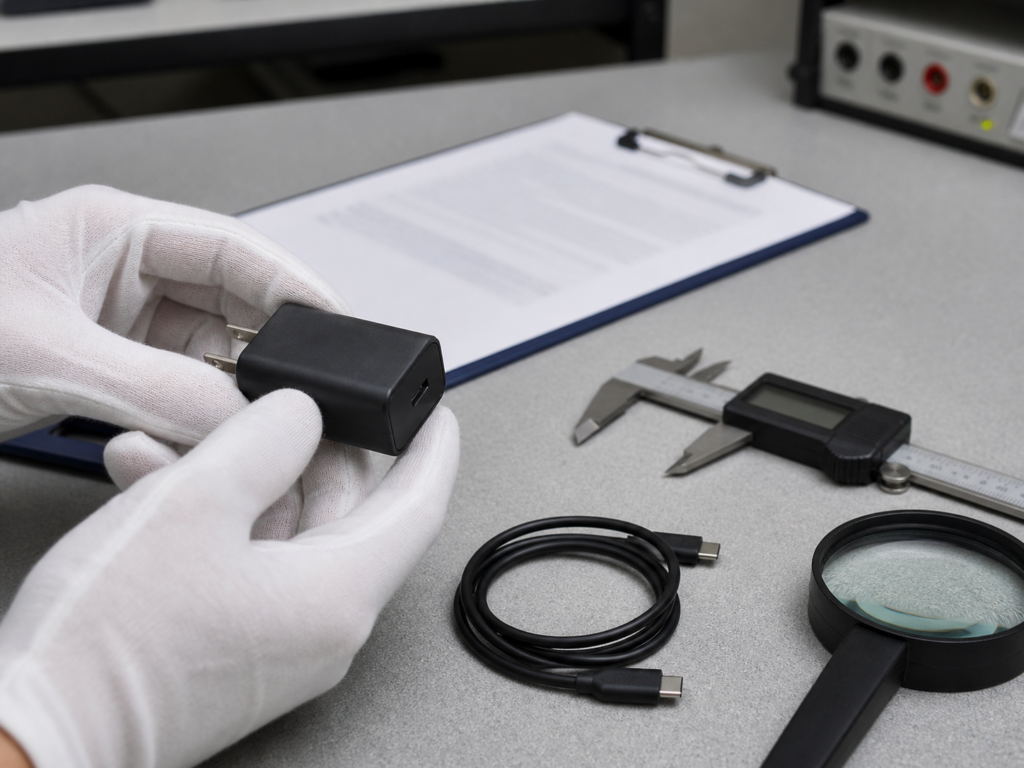
Step 3: Send Samples to BIS-Recognized Laboratories for Testing
The testing institution must be a recognized laboratory announced on the BIS official website. BIS will not recognize reports from non-recognized laboratories at all.
Common test items for charging products are divided into two categories: chargers/adapters mainly test insulation safety, output stability, temperature rise, withstand voltage, abnormal operation, etc.; charging cables/adapters mainly test conductor resistance, plug-in life, temperature resistance, bending test, marking durability, etc. The specific requirements are subject to the corresponding IS standards.
Test cycle reference: If the product has no problems, the report can usually be issued in 2-4 weeks, which will be extended for complex products or when the laboratory schedule is tight. If the test fails, the product needs to be rectified and samples re-submitted, and the cycle will be increased accordingly.
Key Checkpoint: The samples sent for testing must be completely consistent with the final mass-produced version. You cannot use engineering prototypes for testing and then change the structure during mass production; you must also confirm the valid submission window of the test report in advance – that is, how long after the report is issued it must be submitted to BIS. Late submission will result in the report being invalid and requiring re-testing.
Step 4: Submit BIS Online Registration Application Within the Validity Period of the Report
The application must be submitted through the BIS official online declaration system. The submission content includes product information, factory information, AIR information, a full set of application materials, and valid test reports.
If the preliminary review is passed, it will enter the official review stage. If it is not passed, you need to supplement materials as required and resubmit. Common reasons for supplementary materials for charging products include: unclear model difference description, missing necessary information on labels, and incomplete qualification documents (such as expired trademark authorization).
Key Checkpoint: The application must be submitted within the valid submission window of the test report.
Step 5: BIS Official Document Review and Correction
BIS will review the validity of the test report, the consistency of application information, and the compliance of authorization documents. Common review issues include: expired test report, inconsistent manufacturer address and qualification documents, and non-compliant model coverage.
If the review is passed, it will enter the certification issuance stage. If it is not passed, corrections must be made within the specified time limit and then resubmitted.
Key Checkpoint: Supplementary materials must be submitted on time. Overdue submission may result in the application being directly rejected, requiring the process to be restarted.
Step 6: Issuance of CRS Registration Number (R Number)
As long as the test is passed and all application materials meet the requirements, BIS will issue the CRS registration number, that is, the R number. The registration document will include information such as product model, brand, production factory, validity period, R number, and corresponding IS standard.
The first thing after getting the certificate is to check whether all the information on the document is consistent with your application, such as whether the model is written correctly and whether the brand name is correct. Don’t wait until customs clearance or listing to find the error, which will be more troublesome to correct.
Step 7: Labeling and Market Launch in Accordance with Specifications
After obtaining the R number, labeling must be done as required before legal sale. The CRS label must include three core elements: BIS standard mark, R number, and corresponding IS standard number. The marking must comply with the BIS CRS marking rules and the specific requirements of the corresponding product standards. Usually, it must be clearly marked on the product body and/or the minimum sales packaging, manuals and other specified carriers; if it is impossible to mark on the body due to product size and structure limitations, it should be marked on the packaging or accompanying documents in a manner permitted by BIS, and relevant basis should be retained. The label must not be obscured, the font must be legible, and the parameter information must be completely consistent with the certificate.
Extra attention should be paid to the labeling of charging products: parameter markings must not falsely mark power, interface type or protocol, and must completely match the registered information on the certificate; the BIS mark can only be used for products of the models, brands, and factories listed on the certificate, and cannot be used beyond the scope.
Under the premise that the certificate is within the validity period, the product model/brand/factory/applicable standard are completely consistent with the registration information, the label matches the import/platform information, and there are no undeclared changes, the product can be used for formal import, sale, and e-commerce listing.
Core Differences of the ISI (Scheme I) Path
If your product needs to follow the ISI path, the process will have several more links than CRS: after the application is submitted and accepted, it must first pass the factory inspection by BIS or a recognized institution to confirm that the production system and quality inspection process meet the requirements; after obtaining the certificate, there is also an annual supervision audit, requiring regular factory inspections and market spot checks. The overall cycle is longer and the cost is higher, so it is only suitable for high-risk categories.
VI. Cycle and Cost: Estimation Methods and Influencing Factors
BIS certification does not have a fixed cycle and cost, which needs to be estimated in combination with product conditions and service content. Here we provide reference ranges and influencing factors.
Reference Range of Overall Cycle
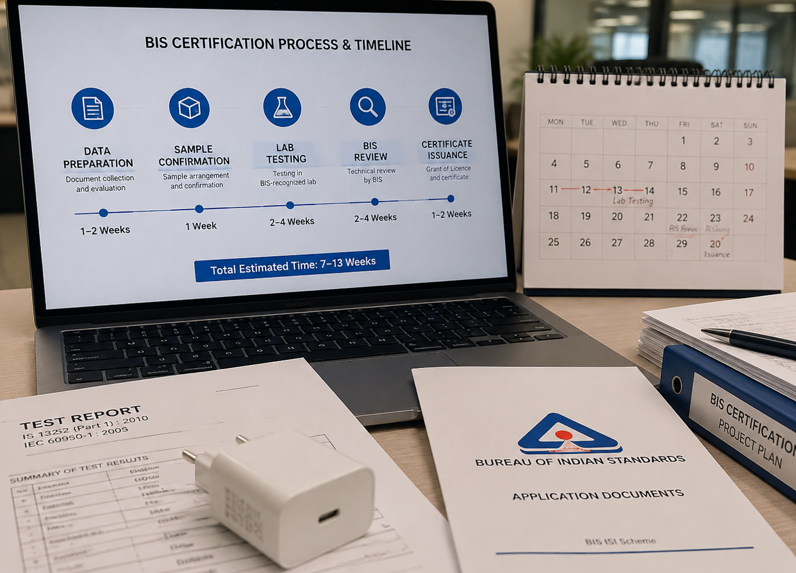
The conventional cycle without rectification and schedule congestion can refer to the following ranges:
- Data preparation + sample confirmation: 1-4 weeks, depending on the completeness of data and the efficiency of model sorting;
- Laboratory testing: 2-6 weeks, depending on product complexity and laboratory schedule;
- BIS review and certification issuance: 2-8 weeks, depending on the number of applications and the number of corrections.
The overall conventional cycle is 2-4 months. If there is rectification, supplementary materials, or it coincides with Indian holidays (such as Diwali, Holi, when government departments have long holidays) or application peak periods, the cycle will be longer. Be sure to reserve buffer time in advance, and don’t start the process just before the launch date.
Note: There is no absolutely fixed cycle, and buffer time needs to be reserved according to the actual situation.
Main Components of Cost
The cost of BIS certification mainly consists of the following parts:
- BIS official application/registration fee: fixed charge, calculated according to the applicant entity and the number of models;
- Laboratory testing fee: calculated according to product type, test items, and number of models. There are great differences between different products. For example, the testing fee of a single-port 20W charger and a 65W multi-port GaN fast charger is quite different;
- AIR service fee: charged per project or per year, after all, the AIR has to bear local compliance responsibilities;
- Agency/consulting service fee: if a third party is entrusted to handle it, it is calculated according to the service content, such as basic application only, or including rectification support and renewal services;
- Additional costs: such as re-testing fees, sample shipping fees, translation fees, factory audit fees for the ISI path, etc.
Charging Product-Specific Factors Affecting Cycle and Cost
For charging products, these factors have the greatest impact on the cycle and cost:
- Product type: Multi-port chargers, GaN fast chargers, and products with PD protocol have more test items, higher costs, and longer cycles;
- Number of models: Models with the same platform and structure can be combined for series application, which can greatly reduce the cost per model;
- Compliance path: The ISI path requires factory inspection, and the cost and cycle are much higher than CRS;
- Number of rectifications: The more times the test fails and data corrections are made, the higher the cost and the longer the cycle;
- Other variables: such as the submission window of test reports, fluctuations in BIS review, Indian holidays, laboratory schedules, etc.
Reasons for Large Differences in Quotations from Different Institutions
The quotations from different institutions may differ by several times, mainly for three reasons:
- Different service scopes: Some low-price quotations do not include AIR service fees, renewal services, rectification support, and re-testing guidance. They seem cheap, but will continue to add money later;
- Different model coverage: Some quotations are only for a single model, and some are for the entire series of models. Don’t think you got a bargain, only to find out that only one model can be processed;
- Different laboratory qualifications: Extremely low quotations may use informal unrecognized laboratories, whose reports are not recognized by BIS at all, and in the end you spend money but cannot get the certificate.
Note: There is no unified fixed quotation, which needs to be calculated in combination with product and service content. Do not easily believe overly low fixed-price offers.
VII. Pitfall Avoidance Guide: High-Frequency Failure Reasons and Avoidance Methods for Charging Products
High-frequency problems in BIS application for charging products are mainly concentrated in three stages: application, testing, and market use. Avoiding them in advance can greatly reduce compliance costs.
Common Pitfalls in the Application Stage (Avoid Direct Rejection)
- Wrong product classification: For example, declaring a fast charger as an ordinary accessory, choosing the wrong standard, and finally being directly rejected. Avoidance method: Check the classification with a BIS-recognized laboratory or formal AIR in advance, do not judge by yourself;
- Unreasonable model consolidation: Forcibly grouping products with large power differences and different interface types into one series, which is rejected by BIS. Avoidance method: Sort out models strictly in accordance with the series consolidation rules, do not force consolidation just to save money;
- Non-compliant AIR qualification: Using a non-Indian registered entity as the authorized representative, the application is directly rejected. Avoidance method: Choose an AIR that can provide formal Indian registration qualifications, and verify the qualifications in advance;
- Inconsistent data information: The entity name and address on the application information, test report, and qualification documents are different. For example, one is “XX Technology Co., Ltd.” and the other is “XX Technology”, which will be required to supplement materials or even be rejected. Avoidance method: Cross-check all materials before submission to ensure that the entity information is completely consistent.
High-Frequency Failure Reasons in the Testing Stage (Exclusive to Charging Products)
- Adapters with built-in Indian pins: the pin size, spacing, safety distance, etc. do not meet the relevant Indian plug requirements and the provisions of the complete machine standard. Avoidance method: Pre-inspect the pin part according to corresponding requirements before sample submission; if it is a plug/socket product sold independently, it needs to be separately checked according to the IS 1293 standard;
- Output voltage/current exceeds the range allowed by the IS standard, for example, marked 5V2A but actually measured 5.5V. Avoidance method: Debug the circuit in advance before sample submission to ensure that the parameters meet the standard requirements;
- Overvoltage/overcurrent/short circuit protection fails, or withstand voltage, insulation, and temperature rise do not meet the standards. Avoidance method: Do internal pre-inspection according to safety requirements before sample submission, or find a third party to do pre-testing;
- The protocol level of USB-C/PD products is inconsistent with the nameplate output. For example, the 12V level is not written on the nameplate but is in the protocol. Avoidance method: Use a PD tester to check the protocol firmware and nameplate parameters in advance to ensure complete consistency;
- Insufficient label marking durability, easy to fall off after friction or wiping. Avoidance method: Choose wear-resistant label materials (such as silk screen printing, laser engraving), and do pre-inspection of marking durability in advance according to applicable IS standards or requirements of recognized laboratories to confirm that it is still legible after friction and wiping.
Common Pitfalls in Labeling and Market Use
- The font of the R number/IS standard number is too small and the position is too hidden to be seen clearly. Avoidance method: Design according to BIS label requirements, and check the font size and position in advance;
- Missing printed mandatory content such as IS standard number, manufacturer information, and place of origin. Avoidance method: Make a list of mandatory items and check them one by one after designing the label;
- Using the BIS mark on products of uncertified models, brands, or factories is a serious violation. Avoidance method: Establish a mark use review mechanism, and only products listed on the certificate can use the BIS mark;
- The parameters on the packaging and e-commerce detail page are inconsistent with the certificate information. For example, the certificate says 65W but the detail page falsely marks 100W. Avoidance method: The parameters of the detail page and packaging must be cross-checked with the certificate to ensure complete consistency.
VIII. Post-Certification Maintenance: Renewal, Change and Compliance
Obtaining the certificate is not the end. Subsequent maintenance is also very important, otherwise the certificate may be revoked and the product will be fined.
Certificate Validity Period and Renewal Requirements
The CRS registration for consumer charging products is usually valid for 2 years, and the specific validity period is subject to the marking on the certificate. A renewal application must be submitted in advance before expiration. Continuing to sell after expiration is a violation. When renewing, the latest test report (if required by the official) and compliance certificate need to be submitted.
Post-Certification Change Scenarios and Handling Paths
If there are changes to the product, not all cases require re-application. Different scenarios have different handling methods:
- Adding models of the same platform: follow the model inclusion process, and just supplement difference testing (if necessary);
- Adding/replacing brands: submit trademark authorization/change certificate, and follow the change application process;
- Replacing the production factory: need to re-apply, or go through the factory change audit. The ISI path requires re-factory inspection;
- Replacing key safety components, changing power, changing interfaces, changing shell materials: need to re-test and submit a change application;
- Only changing appearance color and packaging text (not involving safety parameters and label information): no need to declare, but proof of consistent safety structure must be retained for spot checks.
Market Supervision and Compliance Risks
BIS conducts irregular market spot checks, directly buying products from the market for testing. Therefore, mass-produced products must be completely consistent with the certified samples, and shoddy work is not allowed. The BIS mark cannot be used beyond the scope of the certificate (model, brand, factory).
The consequences of violation are very serious: the certificate will be suspended or even revoked, the product will be detained and fined, and the e-commerce platform will also remove the relevant links.
BIS Certificate Authenticity Verification Method
Whether it is your own certificate or a supplier’s certificate, you can verify the authenticity through the following methods:
- Query by entering the R number or certificate number through the public database on the BIS official website;
- Check whether the manufacturer, product model, and applicable standard on the certificate match the actual situation;
- Check whether the format of the product label complies with BIS specifications, and whether it is marked with the R number, IS standard number and BIS mark.
IX. Quick Self-Check List for Beginners
For your convenience, we have sorted out self-check lists for three stages, which can be checked item by item during the application process:
Pre-Application Self-Check
- □ Whether the product is within the scope of the latest BIS mandatory list/corresponding QCO
- □ Whether the applicable compliance path (CRS/ISI) and IS standard have been confirmed
- □ Whether there is a compliant Authorized Indian Representative (AIR)
- □ Whether products with built-in pins comply with relevant Indian plug requirements and corresponding standards
- □ Whether models are sorted out according to consolidation rules, and whether application materials are complete and information is consistent
In-Application Self-Check
- □ Whether the testing laboratory is a recognized institution announced on the BIS official website
- □ Whether the submitted samples are completely consistent with the final mass-produced version
- □ Whether the registration application is submitted within the valid submission window of the test report
- □ Whether the reason for test failure is clear and whether rectification has been completed
- □ Whether BIS supplementary material requirements are submitted within the specified time limit
Post-Certification Self-Check
- □ Whether the product/packaging is printed with the BIS mark, R number/certificate number, and IS standard number as required
- □ Whether the certificate is approaching its validity period and whether it needs to be renewed in advance
- □ Whether the product has a model change/factory change/brand change, and whether a change needs to be processed
- □ Whether the e-commerce detail page and packaging parameters are completely consistent with the certificate information
Study Summary
After reading this content, you should have mastered the core competencies of BIS certification:
- Can quickly judge whether products such as chargers, power adapters, and USB-C charging cables require Indian BIS certification
- Can distinguish the applicable scenarios of CRS and ISI paths, and choose the right application direction
- Can sort out the complete process of BIS certification and the inspection requirements of each node
- Can avoid high-frequency pitfalls in BIS application for charging products, and reduce the risk of rejection and re-testing
- Can initially estimate the cycle and cost of BIS certification, and plan the launch time of the Indian market in advance
- Can complete the full-process self-check against the self-check list to ensure product compliance