
Many practitioners in the charging product industry often stumble on access rules when entering the Indian market for the first time: either they think overseas certifications such as CE and FCC are sufficient for direct market entry, or they cannot distinguish the differences between BIS, CRS, and ISI, only realizing they need to supplement certification after their goods are detained at customs, resulting in heavy losses. In fact, BIS CRS is India’s core mandatory access system for electronic products, and is highly relevant to products such as chargers, power adapters, and charging cables. Understanding its rules can help avoid the vast majority of compliance pitfalls in the Indian market.
Basic Cognition: First Understand Core Concepts and Boundaries
Core Concepts and Competent Authorities
First, two core definitions must be clarified: BIS stands for Bureau of Indian Standards, which is the official Indian regulatory agency responsible for product safety and market access; CRS stands for Compulsory Registration Scheme, which is a mandatory market entry registration system launched by BIS specifically for electronic products. Its core logic is simple: charging products must first pass safety tests that comply with Indian standards and complete official registration before they can be legally imported, sold offline, or listed on e-commerce platforms. All official CRS-related information can be queried on the Manakonline portal of the BIS official website, which is the most authoritative entry point.
Differences from Other BIS Certifications
Many people confuse CRS with other certifications under BIS, but in fact the three have completely different positioning:
- Difference from ISI Mark Certification: CRS is mainly based on product testing + document review, and does not require initial factory inspection before certification issuance, mainly covering consumer electronic products; while ISI is a more traditional mandatory certification that requires factory audits, and mostly covers electrical and building material products.
- Difference from Voluntary BIS Certification: CRS is a mandatory requirement, and products without it cannot enter the Indian market at all; voluntary BIS certification is only a quality endorsement actively applied for by enterprises, with no mandatory binding force.
- The certification path for charging products is also clear: chargers, power adapters, and charging cables on the list follow CRS; independently sold plugs and wires follow ISI certification, so do not apply the wrong category.
Key Term Explanations
During the process of engaging with CRS, you will encounter several high-frequency terms. Understanding them in advance can avoid understanding deviations:
- R-number: Also known as the CRS registration number, it must be printed on the product together with the BIS standard mark; neither is dispensable.
- India Authorized Representative (AIR): Simply put, it is the local Indian compliance responsible person that overseas manufacturers must designate. All official communication and responsibility docking with BIS must be completed through AIR, and overseas enterprises cannot directly apply for CRS.
- IS Standard: India’s national safety standard. All CRS tests are carried out in accordance with the corresponding IS standards, equivalent to China’s GB national standards.
- BIS Standard Mark: An official compliance mark that can only be used by products that have obtained CRS certification, and cannot be printed without authorization.
Correction of Common Misconceptions
Here we first clarify several core institutional cognitive misunderstandings to avoid subsequent understanding deviations:
First, BIS certification is not equal to CRS — CRS is only one of many certification systems under BIS, specifically for mandatory registration of electronic products, and the two cannot be equated;
Second, overseas certifications such as CE, FCC, and CCC cannot replace CRS at all. The Indian government does not recognize these overseas certifications, and CRS testing and registration must be completed separately;
Third, CRS is managed under a list system. Only categories within the official mandatory list need to be applied for, and there is no need to blindly apply for certification and waste costs.
Regulatory Basis and List Update Rules
CRS was not created out of thin air by BIS. It is subordinate to the mandatory registration system of the Indian Ministry of Electronics and Information Technology (MeitY), and is implemented by BIS. Its core goal is to control safety risks such as electric shock and fire of electronic and electrical products, and has nothing to do with performance and compatibility.
How the Mandatory List is Updated
The categories for mandatory registration are not static. The government will issue category adjustments through Quality Control Orders (QCO) and official notices. In recent years, with the implementation of the USB-C unified interface policy and the popularization of fast charging technology, the mandatory list for charging products has been gradually expanding. The applicable scope of power banks and some charging accessories needs to be checked against the latest QCO and official notices; for boundary products such as USB-C fast charging cables, do not judge directly based solely on interface type or current size, and must be subject to the official list entries.
Authoritative Query Channels
The only authoritative channel for judging whether a product is on the list is the mandatory registration list section of the Manakonline portal on the BIS official website, where information is updated in real time. If you are unsure about boundary categories, you can obtain written confirmation through the official consultation window or by entrusting AIR, and do not judge by experience on your own.
Impact of List Updates
If the government adds new mandatory categories, it will set aside a transition period for enterprises. Certification must be completed within the transition period, and products that have not obtained certification after the transition period ends cannot enter the market. If the IS standard corresponding to a certified product is updated, it is also necessary to meet the requirements of the new version of the standard within the transition period specified by the government, otherwise the registration will become invalid.
Applicability Judgment: Does Your Charging Product Need CRS?
The only basis for judging whether a product needs CRS is the latest mandatory registration list issued by BIS. First, let’s clarify the common consequences of non-compliance, and then talk about the specific judgment methods.
Consequences of Non-Compliance for Charging Products
For charging products, the compliance risks of not completing CRS are clear:
- Customs clearance link: Products may be detained by customs, and face handling such as supplementary certification, return, or destruction, subject to the specific law enforcement requirements of customs;
- Sales link: E-commerce platforms will prohibit new uncertified products from being listed, and already listed products may be removed. Some platforms may also take measures such as deducting security deposits and restricting store permissions in accordance with platform rules;
- Serious cases may also face fines, or even be included in the market access ban list.
Typical Charging Products That Require Key Attention
The following categories are products in the charging field that are usually included in CRS control or require key checking against the list. Among them, the mandatory requirements for wall-mounted chargers and conventional power adapters are relatively clear, while cables, power banks, etc. need to be confirmed in combination with the latest list:
- Wall-mounted mobile phone chargers, USB-C power adapters, charging plugs with USB ports;
- AC-DC power adapters for devices such as laptops, tablets, and routers (that is, power supplies that convert household alternating current into direct current);
- USB-C fast charging cables, power banks: If they have been included in the corresponding category in the latest mandatory list, CRS must be completed as required, subject to the product definition and applicable standards in the list.
Judgment Logic for Boundary Products
For many uncertain boundary products, you cannot only look at the interface type, but must judge from three core dimensions: the core function of the product, sales method, and input power type. For example, for the same USB-C cable, a separately sold high-current fast charging cable may be on the list, while an ordinary low-current data cable may not be; for the same charger, a wall-mounted one needs to be certified, while one powered by a car cigarette lighter may not.
For your convenience, we have compiled the judgment conclusions for common charging products:
| Product Type | Whether CRS is Required and Notes |
|---|---|
| Mobile phone wall-mounted charger | Required, both independent and bundled sales are within the mandatory scope |
| Laptop power adapter | Required, all conventional power AC-DC adapters are included in the list |
| Power adapter included with the host device | Required, bundled sales still need to meet mandatory requirements |
| Separately sold USB-C fast charging cable | To be confirmed, need to check the latest mandatory list |
| Ordinary USB-A low-current data cable | Usually not required, subject to the latest list |
| Car cigarette lighter powered charger | Usually not required, additional evaluation needed if with household plug converter |
| Wireless charging base | To be confirmed, need to check the latest mandatory list |
| Built-in power module of equipment (not sold separately) | Usually not required, not a separately sold consumer product |
Special Scenarios That Can Be Exempted
There are three special scenarios that can be exempted from CRS, but they must meet clear conditions and cannot be abused:
- Personal use, reasonable quantity of portable charging products. For example, bringing 1-2 chargers when traveling to India is fine, but bringing a whole box is not a reasonable quantity;
- Samples for R&D and testing need to apply for exemption from the government in advance, and there are strict quantity limits;
- Compliant spare parts for maintenance cannot be sold as new products in the name of spare parts.
Three-Step Judgment Method for Beginners
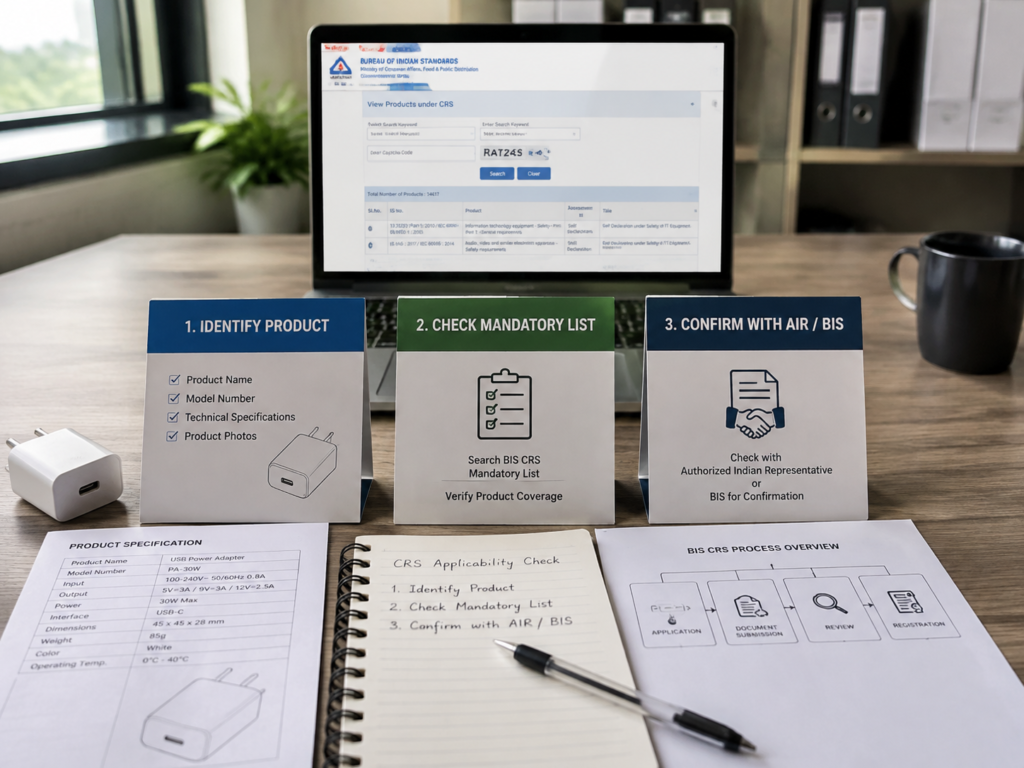
For beginners to judge whether a product needs CRS, following these three steps will basically not go wrong:
Step 1: First clarify the core type and sales method of the product, for example, whether it is a wall charger or a car charger, whether it is sold separately or bundled with the host;
Step 2: Go to Manakonline on the BIS official website to check the latest mandatory list and corresponding IS standards;
Step 3: If you are unsure about boundary products, directly consult AIR or the official window to obtain written confirmation, do not guess on your own.
Common Misconceptions in Applicability Judgment
In actual judgment, you also need to avoid several common scenario misunderstandings:
First, the fact that samples can clear customs does not mean that formal sales are compliant. The exemption for R&D samples is only for testing purposes, and cannot be applied to bulk sales;
Second, adapters sold in bundles also need CRS. Don’t think that if they are sold together with mobile phones and laptops, they don’t need separate certification;
Third, low-voltage charging accessories do not necessarily not need certification. For example, some low-voltage fast charging cables may also be included in the list, and everything is subject to the latest list.
Core Rules: Basic Requirements You Must Know for CRS
After confirming that the product needs CRS, understanding the core rules first can avoid a lot of unnecessary cost and time waste.
Applicant Subject and Responsibility Division
The primary responsible subject of CRS is the product manufacturer, which bears primary responsibility for the compliance of the product. Overseas manufacturers must designate a local Indian AIR and submit formal authorization documents, and cannot apply directly as an overseas entity. Importers or brand owners can be co-applicants, but they must never lend or fraudulently use others’ registration numbers, and will be heavily fined once discovered.
In addition, CRS registration is bound to the manufacturer, production factory, brand, model, and applicable standard. If the production factory is changed, you must apply for change or re-register, and cannot continue to use the original certificate.
IS Standards Corresponding to Charging Products
Different charging products apply different IS standards. The common corresponding relationships are:
- Wall-mounted chargers and power adapters usually apply IS 13252 Part 1, and special-purpose adapters may apply IS 616;
- The applicable standard for power banks is subject to the provisions of the latest list;
- For USB/USB-C charging cables and interface products, you need to check the standards corresponding to the latest list.
When checking, the English product name, IS standard number, standard version, and applicable scope in the CRS list of the Manakonline portal shall prevail. You cannot directly apply the standards based only on the Chinese common names of “charger” or “cable”. If the standard is updated, certified products need to meet the new version of the standard within the official transition period, and supplementary testing is required if necessary.
Model/Product Family Division Rules
Many enterprises will ask: Can multiple models share one registration number to save costs? There are clear rules for this:
- The premise for sharing a registration number is: the core circuit, key safety components, input and output parameters, and production factory are completely consistent;
- Cases that can be merged: different colors, shell textures, cable lengths, plug versions under the same specification (only minor appearance changes that do not affect safety);
- Cases that must be registered separately: differences in power, different number of output ports, use of different PCB solutions, changes in key safety components, different production factories.
Whether they can finally be merged into one product family is subject to BIS’s official audit conclusion, do not judge on your own.
Labeling Requirements for Charging Products
For charging products, BIS has clear mandatory labeling requirements:
- The content that must be marked includes: BIS standard mark, R-number, IS standard number, product model, input and output parameters, none of which can be missing;
- Marking position: Chargers should be marked on the nameplate or near the pins where it is not easy to wear, and charging cables should be marked at the connector or on a durable label;
- General requirements: The label must be durable, clear, and not easy to erase. The information on the nameplate must be consistent with that on the packaging. For specific requirements, please refer to the official labeling guide.
Registration Validity Period Rules
The CRS certificate has a fixed validity period, and the duration is subject to BIS’s latest rules. You need to apply for renewal in advance before expiration. If you fail to renew after the deadline, the registration will directly become invalid and can no longer be used.
Special Compliance Differences for Charging Categories
For different types of charging products, the CRS control focus and certification boundaries are also different. The following is a step-by-step explanation for common categories to help you quickly identify the key compliance points.
Mobile Phone/Tablet Wall-Mounted Chargers
The core control points of this type of product are output stability, overheat protection, and electric shock prevention, all of which are the links most likely to cause safety accidents. Special attention should be paid that products with fast charging protocols must be declared according to the maximum power, not according to the ordinary 5V power, otherwise it may cause inconsistency between the nameplate, test report and actual maximum output, leading to supplementary documents, retesting or insufficient certification scope.
Laptop Power Adapters
This type of product has higher power, and the core control points are temperature rise, insulation performance, and overload protection. There are two points to note: First, if it is a version with replaceable plugs, the plugs sold to India must meet Indian safety requirements, and you cannot casually match plugs of other specifications; second, adapters with multiple output interfaces must be declared according to the maximum combined output power, such as the total power of dual-port simultaneous output, not just the maximum power of a single port.
USB/USB-C Charging Cables
For this type of product, specific test items need to be confirmed according to the corresponding IS standards. Usually, focus is on insulation performance, temperature resistance, and heating risk under high current; items such as plug-in life and interface compatibility are included in the evaluation scope only if they are required by the corresponding IS standards or are additional needs of the enterprise. If the insulation of high-current fast charging cables is poor, it is easy to overheat and melt. It is recommended that relevant enterprises evaluate compliance in advance. After all, the charging product list has been expanding in recent years, and preparation in advance can avoid subsequent passivity.
Certification Boundaries of Plugs and Charging Ports
Many people cannot figure out the certification ownership of plugs and interfaces. Let’s clarify here:
- Independently sold plugs and wires are subject to ISI Mark Certification and are not within the scope of CRS;
- Indian plugs integrated on chargers only need to undergo CRS testing together with the whole machine, and do not need separate ISI registration;
- The USB-IF certification for USB-A/USB-C interfaces and BIS safety certification cannot replace each other — USB-IF is in charge of compatibility, and BIS is in charge of safety, the two are completely different things.
Other Related Charging Products
- Power banks: Compliance requirements are subject to the latest list, and may be adjusted in recent years;
- Car chargers: Models powered by cigarette lighters are usually not mandatory, but if they come with a household plug converter, additional evaluation is required;
- Wireless chargers: Whether they are mandatory needs to be checked against the latest official list, which is currently under dynamic adjustment.
Full Process: Complete Steps from Preparation to Certification
The CRS processing process can be divided into five stages. We will explain the key points and precautions of each stage clearly.
Preparatory Stage
Before the formal application, three things must be done first:
First, complete the applicability judgment of the product, and preliminarily evaluate whether the product parameters meet the corresponding IS standards to avoid major problems during testing;
Second, select a qualified AIR and sign a formal authorization agreement. The reliability of AIR directly affects the subsequent communication efficiency;
Third, prepare a full set of materials, including product specifications, circuit diagrams, list of key components, actual product photos, and nameplate design drafts. Organizing them in advance can avoid subsequent supplementary documents.
Sample Testing Stage
Testing is the core link of the entire process, and attention must be paid to:
- Samples must be sent to BIS officially recognized laboratories for testing, and reports issued by non-recognized laboratories are completely invalid;
- The core test items of charging products usually include electric shock insulation, overheating temperature rise, short circuit/overload protection, and interface safety performance, subject to the items listed in the corresponding IS standards, which are also the links most prone to failure;
- The validity period of the test report is usually 90 days, and the specific duration is subject to BIS’s current CRS application rules, product categories, and system submission requirements. After receiving the report, submit the registration application as soon as possible to avoid retesting due to expired report;
- If the test fails, you need to rectify and resend samples. The rectification time is not included in the basic processing cycle, so try to do pre-testing in advance to pass the first time.
Registration Application and Review Stage
After passing the test, you can submit an application through BIS’s official registration system, and upload a full set of materials such as test reports and AIR authorization letters. CRS review is a document consistency review, and no factory inspection is required before certification issuance, which is why it is faster than ISI.
If the government requires supplementary documents, they must be submitted within the specified window, otherwise the application may be rejected. Common reasons for supplementary documents include: nameplate does not meet requirements, inconsistent model naming, component list does not match the report, and problems with AIR authorization materials. These can be avoided by checking in advance.
Certification Obtainment and Initial Compliance Inspection
After the review is passed, the government will issue an R-number. This registration number can be publicly queried on the BIS official website, and its authenticity can be verified. After receiving the certificate, check immediately: whether the registration number, model, manufacturer, and standard number are consistent with the application, to avoid information errors.
Special attention should be paid: Only products produced after the certificate is issued can be marked with the BIS mark and registration number. Inventory products produced before cannot be marked without authorization, otherwise it will be considered a violation.
Cycle and Cost Estimation
Many people care about how long it takes to get the certificate and how much it costs. Here is a reference for you:
- The basic cycle (when the materials are complete and the test passes once) is 6-8 weeks;
- Common reasons for cycle extension include: unqualified testing requiring rectification, missing materials requiring correction, tight laboratory scheduling, and backlog of BIS reviews;
- The core cost consists of three parts: testing fee, AIR service fee, and official registration fee;
- Factors affecting cost include: product type (the higher the power, the higher the testing fee), number of applied models, and whether rectification is required.
If you want to speed up, you can do pre-testing in advance to reduce the failure rate, organize materials according to requirements to avoid supplementary documents, and choose a service provider with experience in charging product CRS. Familiarity with the process can avoid detours.
Post-Certification Maintenance: Getting the Certificate is Not the End
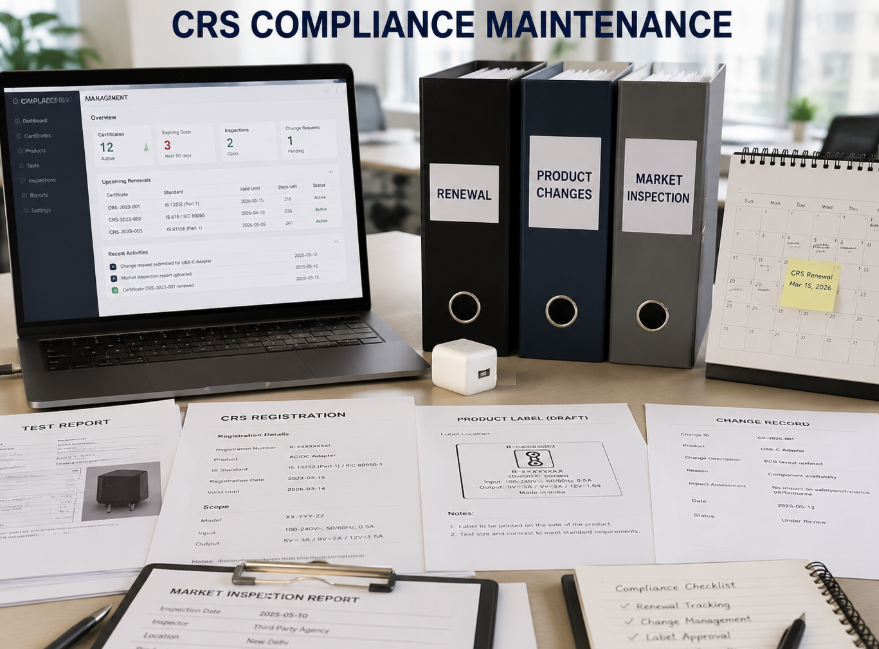
Many enterprises think that getting the CRS certificate means everything is fine, but in fact, subsequent maintenance is equally important, otherwise it will easily lead to certificate invalidation and affect normal sales.
Renewal Rules
A renewal application needs to be submitted before the CRS certificate expires. The advance time is subject to BIS’s latest requirements. Don’t wait until it expires to remember. When renewing, you need to confirm that the product still meets the currently valid IS standards. If the standard is updated, supplementary testing may be required.
Post-Certification Change Rules
If the product changes after certification, not all cases require re-registration. Different changes correspond to different handling methods. We have compiled them into a table for easy comparison:
| Change Type | Handling Method |
|---|---|
| Minor appearance changes in the same product family, addition of models with the same parameters, brand name change (subject remains unchanged) | Can be directly filed/expanded |
| Key components of the same specification changing suppliers, output interface layout adjustment (quantity unchanged) | Need to change after supplementary testing |
| Core circuit solution change, significant adjustment of power/input and output parameters, production factory change, product category change | Need to re-register |
| Factory address change, replacement of core safety components not reported, product functions exceeding the original certification scope | High risk, certificate may be cancelled if not reported |
The above is only a prediction of conventional plans. Whether it can actually be filed, expanded, supplemented with testing, or requires re-registration shall be subject to BIS’s official audit conclusion on the registration scope, model family division, and change materials.
Market Spot Check and Compliance Response
After certification, you may also encounter spot checks. Common spot check scenarios include customs clearance spot checks, e-commerce platform verification, and random spot checks in market circulation. The most common non-compliance items for charging products include: no registration number, inconsistent model, missing or inconsistent labels, and failed safety tests.
If you encounter a spot check, provide a valid CRS certificate and test report immediately, cooperate with the official sample re-inspection. If it is indeed unqualified, rectify it in time and do not delay.
Document Retention Requirements
Usually, you should pay attention to keeping the registration certificate, test report, label version, shipment records, and AIR authorization documents. These materials are not only needed to deal with spot checks, but also used during renewal, so do not discard them at will.
Practical Tools and Checklists
To help beginners get started quickly, we have compiled several practical tools and checklists that can be directly used for comparison in daily operations.
Must-Check Checklist for Beginner Operations
- Before application: Have checked the latest mandatory list to confirm that the product requires certification, AIR has compliance qualifications, and the testing laboratory is officially recognized by BIS;
- During application: Model division complies with product family rules, all material information is consistent, and nameplate labels meet official requirements;
- After certification: Only products within the certification scope use the mark, product changes are applied for in time, renewal is done in advance before expiration, and registration numbers are not lent/fraudulently used.
Quick Verification Method for Test Reports
After receiving the test report, you can quickly judge whether the report is valid from four aspects:
- Check product information: whether the name, model, brand, and factory address are consistent with the application;
- Check test standards: whether the cited IS standard matches the CRS list and whether the version is valid;
- Check conclusion: the test conclusion should be “compliant/passed”, and there are no out-of-scope restrictions in the remarks;
- Check issuing agency: whether it is a BIS-recognized laboratory.
Practical Tool List
You can make several simple tools by yourself to improve daily work efficiency:
- Applicability judgment form: list the product type, sales method, input power type, and output parameters, and you can preliminarily draw a compliance conclusion;
- CRS processing flow chart: organized in the order of “product judgment → sample testing → document submission → review and certification → label use → renewal maintenance”, clear at a glance;
- Document preparation Checklist: divided into four categories: manufacturer information, product materials, authorization documents, and test reports. Check off when preparing materials to avoid missing items;
- Certificate consistency check form: check 6 items: model, brand, factory, standard, label, registration number, check immediately after getting the certificate;
- Registration number authenticity query path: BIS official website Manakonline → enter registration number/manufacturer/model to verify, to avoid getting fake certificates.
Learning Summary
Entry Level (Usable Immediately After Reading)
- Can quickly distinguish the three types of certification: BIS, CRS, and ISI, and clarify the conventional certification path for charging products;
- Can preliminarily judge whether their own charging products need CRS through the three-step judgment method + common product cases;
- Can sort out the complete processing flow, basic cycle and core cost composition of CRS;
- Can independently query the authenticity of the CRS registration number and check whether the product label is compliant.
Semi-Proficient Level (Advanced Judgment Ability)
- Can preliminarily plan certification schemes and model division according to product type, parameters, sales methods, and factory address, and reasonably control costs;
- Can identify common compliance risks such as invalid test reports, out-of-scope models, and insufficient AIR qualifications;
- Can respond to basic market spot checks, as well as conventional needs such as certificate changes and renewals;
- Can quickly estimate the certification cycle and cost of different types of charging products, and plan the launch rhythm of the Indian market in advance.
Overall, the core logic of BIS CRS certification always revolves around safety compliance and list-based access: taking the latest official mandatory list as the judgment basis, completing testing and registration as required, and doing a good job in daily maintenance such as changes and renewals after certification, you can steadily meet the access requirements for charging products in the Indian market.