
If you plan to sell charging products to the Indian market, or buy accessories such as mobile phone chargers and power banks in India, you have most likely heard the term “BIS certification”. But many people have a very confused understanding of it: is it voluntary or mandatory? Do overseas brands need to apply for it? Why are the certification marks of chargers and plugs different?
First, Understand: What Exactly is BIS Mandatory Certification
The full name of BIS is the Bureau of Indian Standards, an official Indian statutory body responsible for formulating product standards, issuing certifications, and conducting market spot checks, not a non-governmental industry association. The so-called “BIS mandatory certification”, simply put, means that as long as a product is included in the official mandatory list, it must obtain a certificate issued by BIS before it can be legally imported, sold in physical stores, and listed on e-commerce platforms.
Many people think BIS certification is just a certificate, but in fact it is a complete compliance system — from formulating safety rules, to reviewing and issuing certificates, to random spot checks after products are launched, the entire process is under supervision. A common confusion needs to be specially clarified here: the testing basis for BIS certification is India’s local IS series of standards, but passing the IS test does not mean obtaining BIS certification. The IS standard is equivalent to the “scoring rules” of an exam; passing the test is only the first step in applying for certification. Only after official review and approval by BIS and issuance of a certificate can a product be considered truly compliant.
For charging products, the role of BIS mandatory certification is very practical: first, it ensures safety, prevents electric leakage, overheating and fire caused by low-quality chargers and power banks, and reduces personal safety risks for ordinary users; second, it unifies the safety bottom line of the market, avoiding vicious competition from low-priced goods that cut corners; finally, the rules are fair, Indian local brands and overseas imported brands are treated equally, without any special exemptions.
People who are new to BIS most often have three typical misunderstandings, which are clarified all at once here:
First, they think BIS is a voluntary certification that only adds bonus points. In fact, as long as the product is on the mandatory list, selling or importing it without a certificate is an illegal act, not an optional item.
Second, they think only Indian local brands need to do it, and overseas products do not. This is also wrong: imported brands and imported products also need to hold certificates to enter the Indian market.
Third, they think all charging accessories need BIS. In fact, only finished products listed in the list are required; small accessories and scattered parts are not within the mandatory scope.
Which Charging Products Require BIS? How to Draw the Boundary?
After understanding the basic concepts, you must be most concerned: does the charging product I have need BIS at all? We will first list the common categories that are clearly in the mandatory list, then talk about those that do not need it, and finally talk about the boundary situations that are most easily confused.
Charging Products That Clearly Require Mandatory Certification
Currently, in the BIS mandatory list, common charging-related products include: power adapters for mobile phones, laptops, IT equipment, and audio-visual equipment; power banks, car chargers; power strips and wall sockets with USB charging ports; USB/USB-C charging cables with charging function that are clearly listed in the official list; separately sold Indian standard plugs and power cords (following the ISI certification path, which will be discussed later); and matching power adapters for wireless chargers.
Charging Accessories That Do Not Require Mandatory Certification
There are several types of charging-related products that are not within the scope of mandatory certification: one type is decorative accessories without electrical functions, such as charging cable protective covers and magnetic rings; the second type is unassembled components, such as separately sold USB female sockets and charging port parts; the third type is charging equipment that is only used in special industrial scenarios and not for ordinary consumers; in addition, for products not included in the mandatory list, if there are applicable IS standards and BIS opens the corresponding voluntary certification/licensing path, they can be applied for on a voluntary basis, but they are not statutory mandatory requirements.
Boundary Products That Are Most Easily Confused (Key Point)
In actual operation, the boundaries of several types of products are particularly vague, and many people have fallen into pitfalls, so be sure to remember clearly:
First, USB/USB-C charging cables. Ordinary data cables sold separately are not on the mandatory list; if they are sold as accessories with complete machines such as mobile phones and chargers, they only need to follow the certification requirements of the complete machine and do not need separate certification. Only independently sold charging cables with charging function that are clearly listed in the official list require mandatory certification.
Second, Indian standard plugs. If they are integrated with the charger, they are already covered by the complete machine certification of the charger, and do not need separate ISI certification; but if they are plugs sold separately, they must undergo separate ISI certification.
Third, travel adapter plugs. This type of product must be judged separately against the BIS mandatory list, and the certification rules for chargers cannot be directly applied.
Fourth, set products, such as a combination pack of “charger + charging cable + detachable plug”, each component must be confirmed for certification requirements separately. It cannot be said that as long as the charger has a certificate, the entire set is compliant.
Quick Judgment Method and Special Situations
You can make a quick judgment following a simple logic: first, check whether the product is a finished charging device sold to ordinary consumers; if it is for industrial use or just a part, there is basically no need to consider it; then go to the BIS official website to check the latest mandatory list of electronic and electrical products to see if there is a corresponding category; finally, confirm it in combination with the actual function, use and sales form of the product — here is a special reminder: the core of judgment is what the product itself is, not its customs code or the marketing name given by the merchant. For example, if you package a charger as a “smart power supply terminal”, as long as its actual function is to charge mobile phones and laptops, it must follow the rules for chargers, and you cannot escape by changing the name.
There is also a special situation to note: if it is a small amount of charging products purchased overseas for personal use, BIS certification is not required; but if it is for sale, even if it is a gift in a commercial activity, it must have certification.
Can’t Tell CRS and ISI Apart? Just Remember This Mnemonic
Charging products mainly involve two BIS official mandatory certification paths: CRS and ISI. Both are statutory mandatory certifications, with differences only in applicable objects, review processes, and mark styles. The specific comparison is as follows:
| Comparison Item | CRS Mandatory Registration | ISI Mark Certification |
|---|---|---|
| Applicable Products | Electronic/IT charging finished products such as chargers, power adapters, and power banks | Electrical accessories such as separately sold Indian standard plugs, sockets, and power cords |
| Core Requirements | Focus on safety testing, generally no on-site factory audit required | Requires factory quality system audit + continuous market supervision, with stricter requirements |
| Mark Style | BIS official mark + unique registration number starting with R- | ISI mark + license number starting with CM/L- |
| Common Validity Period | Usually 2 years, subject to the certificate annotation | Usually 1-2 years, subject to the certificate annotation |
To distinguish the two, you can refer to the mnemonic: For electronic charging finished products, look for CRS; for plug and wire accessories, look for ISI. It should be noted that ISI is mainly for basic electrical accessories such as plugs and wires, and is not a mandatory certification path for charging electronic products. The applicable scopes of the two are completely different.
How Does BIS Certification Work? The Full Process Explained in Plain Language
Many people think the certification process is very complicated, but in fact it is very simple when broken down. We will first talk about the two most core rules, then the complete process.
First, only the official Indian BIS has the right to issue certificates. Third-party laboratories on the market can only be responsible for sample testing and are not qualified to issue certificates. Do not be deceived by institutions that claim to “directly issue certificates”. Second, if it is an overseas manufacturer, it cannot directly apply for certification with BIS. It must appoint a local Indian authorized representative (equivalent to the compliance contact person for overseas brands in India), who will liaise with BIS and bear the corresponding compliance responsibilities.
The conventional certification process, in plain language, is five steps:
Step 1: First confirm that the product is on the mandatory list, find the corresponding IS test standard, and don’t waste time using the wrong standard.
Step 2: Send the sample to a BIS-recognized laboratory to complete all required safety tests. Only after passing the test can you proceed to the next step.
Step 3: Prepare application materials such as test reports, product information, and manufacturer information, and submit them to BIS for review.
Step 4: After BIS review and approval, a formal certification certificate is issued. At this time, the corresponding certification mark can be printed on the product or packaging.
Step 5: Don’t think that getting the certificate means everything is fine. After the product is launched, BIS will randomly spot-check products on the market. If the spot check fails, the certificate will be directly revoked, and there will be corresponding penalties.
For charging products, the specific test items are subject to the product category and corresponding IS standards. The following are the core assessment concerns for common products such as chargers, adapters, power banks, plugs/cables:
First is the most basic electrical safety, that is, no electric leakage, no overheating and fire during use, and protection can be triggered in case of short circuit, so no danger will occur.
Second is electromagnetic compatibility — in plain language, when charging, it will not interfere with other electronic devices nearby, for example, it will not cause noise in the connected speaker, nor will it affect the nearby TV signal.
Third is interface matching: if the product involves a USB-C/fast charging interface, the interface specifications, rated output and mark consistency shall be checked in accordance with applicable standards; Indian standard plugs must meet the local socket size adaptation requirements and can be inserted and used normally.
Fourth, the marking must be standardized. For example, the parameters such as power, voltage and current marked on the charger must be consistent with the actual ones, and false marking is not allowed. For example, it is not allowed to mark a 20W product as 65W to deceive people.
Finally, we need to talk about the rules for certification change and maintenance. Getting a certificate is not a once-and-for-all thing: if the product is redesigned, such as changing the charging port, adjusting the circuit, or changing the rated power, you need to re-apply for certification and cannot continue to use the original certificate; if the manufacturer, foundry or brand is changed, you also need to re-confirm the coverage of the certification and cannot directly apply it; if the corresponding IS standard is updated, you need to supplement the test or re-apply according to the official requirements of BIS; you can apply for renewal/update in accordance with BIS regulations 3 months before the certificate expires. Whether supplementary testing, sampling or resubmission of materials is required shall be subject to BIS’s current notice, the corresponding certification path and the certificate status.
How to Identify Genuine and Fake BIS Certification? A Step-by-Step Guide to Checking
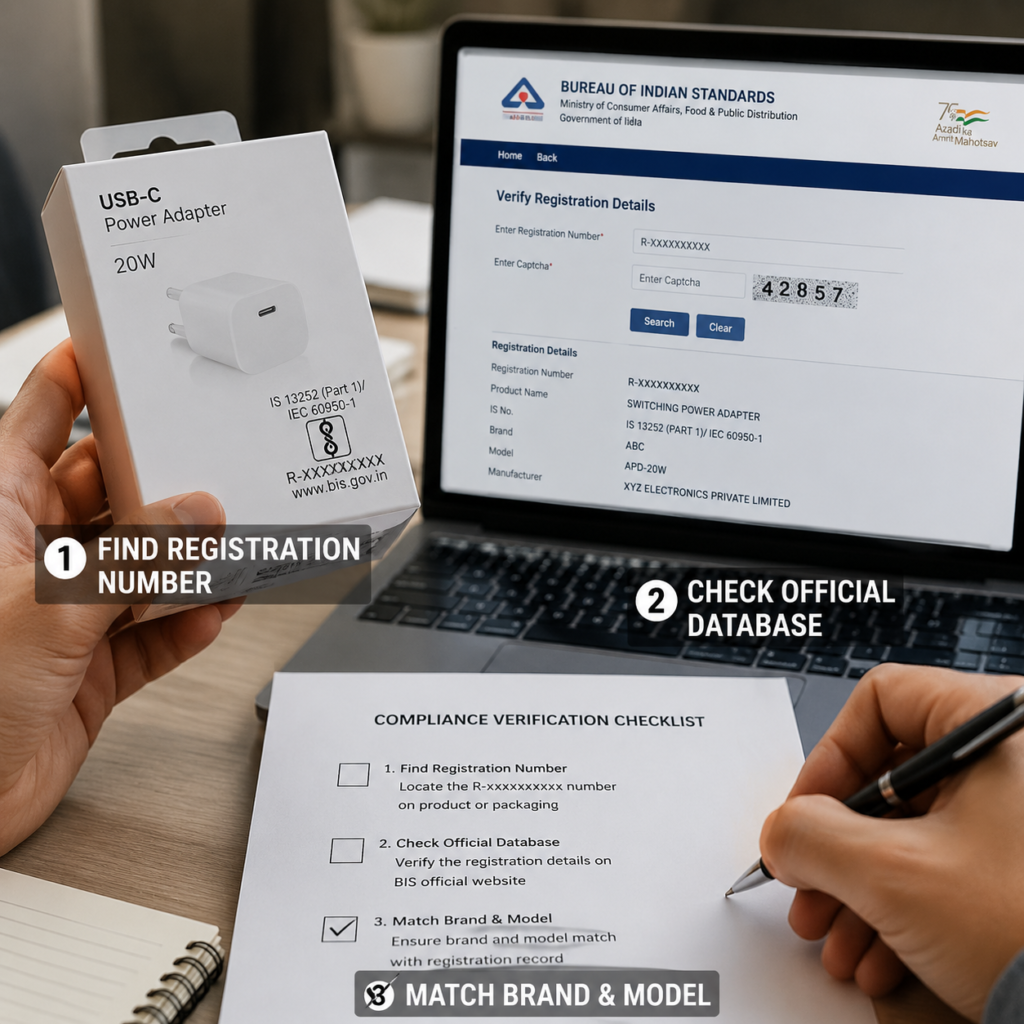
Whether it is consumers buying accessories or sellers choosing suppliers, it is very important to learn to identify genuine and fake BIS certification. We will first talk about the requirements for formal marks, then how to check the authenticity.
First of all, different types of products have different marking requirements: CRS products, such as chargers, adapters, and power banks, must be printed with the official BIS mark plus a unique registration number starting with R-; ISI products, such as plugs and power cords, must be printed with the ISI mark plus a license number starting with CM/L-. The mark is generally located on the product body or the smallest sales package. For charging cables, it is usually printed on the plug end, and the mark must be clear and legible, not easy to wipe off. The kind that comes off with a scratch is definitely non-compliant.
The method to check authenticity is very simple, it can be done in three steps:
Step 1: First find the BIS registration number on the product or packaging, which is the string of numbers starting with R- or CM/L-.
Step 2: Open the public query entry on the BIS official website and enter this registration number.
Step 3: Check whether the brand, model, and manufacturer in the query result are consistent with the actual product you have. Only if they match is it genuine.
Identifying fake certification is actually not difficult, just remember a few typical characteristics: if the product only has the BIS or ISI mark and the corresponding registration number cannot be found, there is a high probability of a problem, because formal BIS certification has a unique number that corresponds one-to-one with the product; if the number is found but cannot be found on the BIS official website, or the brand and model in the query result do not match the actual product, it must be fake; there is another situation where a large certification mark is placed on the e-commerce product detail page, but the product or the smallest package you receive does not have it printed at all. You should also be extra careful about this, because the formal requirement is that the mark must be on the product body or packaging, and only placing it on the detail page does not count; finally, if someone claims to hold a “universal certification” that covers all models of the entire series, you need to verify carefully: BIS certification is bound to specific models, parameters, production factories and brand coverage, and there is no valid certificate that is universal for the entire series.
The Most Common BIS Misconceptions, Both Buyers and Sellers Should Pay Attention
There are many more misconceptions about BIS certification. We will talk about them in two categories: ordinary consumers and overseas sellers, and then talk about the real risks of no certification.
Common Cognitive Biases of Ordinary Consumers
Many consumers have deviations in their understanding of BIS, and the four most typical ones are:
First, they regard BIS certification as a “high-end certification” and think that products with this mark are the best. Actually, that’s not the case. BIS mandatory certification is the statutory safety bottom line in the Indian market, which means that the product meets the minimum requirements of the corresponding safety standards and can reduce the risks of electric leakage, overheating, fire, etc., but it does not mean higher performance, nor does it mean that failures or accidents will never occur. It does not represent performance indicators such as charging speed and durability. Don’t confuse safety certification with performance certification.
Second, they think that having overseas certifications such as CE, FCC, and UKCA is equivalent to having BIS. These are all certifications from other countries or regions, with different rules and requirements. They cannot replace BIS at all, and must be done separately to enter the Indian market.
Third, they think that USB-IF’s PD certification is equivalent to BIS. USB-IF’s PD certification is for interface compatibility, such as whether fast charging can be triggered, which is completely different from BIS’s safety certification. The two have nothing to do with each other and cannot replace each other.
Fourth, they think that either all charging cables need certification or none do. In fact, whether certification is required depends on the product definition and sales form of the charging cable. For example, ordinary data cables sold separately do not need it, only independently sold cables with charging function listed in the list need it, and those sold with the complete machine only need to follow the complete machine’s requirements.
Key Pitfall Avoidance Points for Overseas Sellers and Brand Owners
For overseas sellers doing business in the Indian market, there are several pitfalls that must be avoided:
First, do not believe the false promise of “one certificate covering the entire series”. Certification is only valid for the specific model, circuit parameters, production factory and authorized brand submitted at the time of application. Adding new models, adjusting parameters or replacing foundries all require re-application or confirmation of the certification coverage.
Second, when looking for an agent, be sure to confirm that the other party is formally authorized. Don’t look for small unauthorized institutions, otherwise it is easy to get fake or invalid certificates. When customs clearance is blocked and products are detained, the loss will be huge.
Also, don’t think that getting a laboratory test report means everything is fine. The test report is only one of the materials for applying for certification. Only the formal certificate issued by the official BIS is the proof of compliance.
Finally, if you do OEM products, be sure to check the holder of the certification, the covered brands and models in advance. Don’t have a situation where the certificate is for Brand A but you are selling Brand B. This kind of “certificate not matching the product” is also considered a violation.
Real Risks of No Certification
If charging products do not have BIS mandatory certification, the risks are real: for ordinary consumers, uncertified products often cut corners and have falsely marked parameters, with high risks of electric shock and fire. Don’t joke about your own safety; for sellers and brands, uncertified products cannot be cleared through customs normally. Once found, they will be fined, goods detained, and removed from e-commerce platforms. In severe cases, they will be blacklisted and cannot enter the Indian market in the future. One more point to add here: if it is a charging product with wireless function, in addition to BIS certification, it must also comply with the relevant regulations of the Indian WPC (Wireless Planning and Coordination Wing), don’t miss that.
Final Summary
After learning, you can master the following core abilities: quickly judge whether charging products require BIS mandatory certification; distinguish the applicable scenarios and mark differences between CRS and ISI certifications; identify formal BIS certification marks and independently check authenticity through the official website; avoid common misconceptions and not be misled by fake certifications; understand the core risks of uncertified charging products in the Indian market.