
If you are engaged in exporting products such as chargers and charging cables to South Korea, or purchasing charging accessories in the South Korean market, you will most likely come across the term “K-RoHS”. Many people confuse it with KC safety certification, and some think it requires products to be completely free of any harmful chemical substances — these are all very common misconceptions. Next, we will focus on charging products to clarify the core rules, restricted substances, scope of application, and key points to avoid pitfalls of K-RoHS, which will be useful from basic understanding to practical judgment.
K-RoHS is a toxic and harmful substance control regulation formulated by South Korea for electrical and electronic products. Its core basis is South Korea’s Act on Resource Circulation of Electrical/Electronic Products and Automobiles. It is a purely environmental requirement and has no relation to the charging speed or electrical performance of products. Its core logic is not to completely ban harmful substances, but to limit the content of these substances within a safe range. The ultimate goal is to reduce pollution to soil and water sources after e-waste is discarded, as well as potential harm to human health.
For electrical and electronic products placed on the South Korean market, domestic manufacturers and importers in South Korea are the primary responsible entities for harmful substance compliance, and need to prepare compliance certification materials and perform information disclosure or declaration obligations in accordance with regulatory requirements. The South Korean Ministry of Environment has a supporting electronic information system called EcoAS, which is mainly used for the declaration and management of resource circulation-related information. The declaration obligations and product labeling requirements of this platform are separate compliance links from K-RoHS restricted substance testing and self-declaration. Completing EcoAS-related declarations does not mean that the K-RoHS material compliance certification has been completed. In terms of regulatory enforcement, it is mainly based on enterprise self-declaration + material testing certificates. South Korean regulatory authorities and importers will conduct random spot checks. If a product is found to be non-compliant in a spot check, it may face regulatory measures such as customs clearance obstruction, product recall, or fines.
For charging product practitioners, K-RoHS is an environmental compliance requirement that needs to be focused on when products enter the South Korean market; for ordinary consumers, charging products that comply with K-RoHS have lower harmful substance content, are more reassuring to use, and are more environmentally friendly. People who are new to this are most likely to fall into four cognitive pitfalls, which are clarified here first: First, it is not a safety certification, and does not cover electrical safety issues such as electric leakage and overheating, which fall under the control of safety certifications such as KC; second, it is not equivalent to KC certification, as the two have different control directions, scopes of application, and regulatory requirements, and compliance needs to be verified separately; third, it does not require products to be completely free of harmful substances, and compliance is achieved as long as the content is within the specified limits; fourth, having relevant labels does not mean compliance, the core is that the product material itself meets the limit requirements, and labels are only part of information disclosure.
Core Restrictions: 10 Categories of Substances and Homogeneous Material Calculation Rules
After understanding the basic concepts, let’s look at the core control content: what substances exactly does K-RoHS restrict? What is the maximum allowed content? Which parts of charging products generally need key inspection for these substances?
K-RoHS currently controls 10 categories of harmful substances, of which 6 are conventional items included earlier, and the other 4 types of phthalates are endocrine disruptors that have been included in the current list of restricted substances. The following “common inspection directions” are empirical summaries from the charging product supply chain, and do not mean that all products contain the corresponding substances. Specific control requirements shall be subject to the current list of restricted substances issued by the South Korean Ministry of Environment when the product is placed on the market. Early test reports that only cover 6 categories of conventional substances cannot be directly used as complete K-RoHS compliance certificates, and the compliance of the 4 types of phthalates needs to be additionally verified.
| Substance Category | Common Inspection Directions for Charging Products | General Limit |
|---|---|---|
| Lead (Pb) | Metal welding or plating parts such as solder, USB interface plating, PCB pads | 0.1% (1000ppm) |
| Cadmium (Cd) | Metal surface treatment layers such as metal contacts and switch spring plating | 0.01% (100ppm, the strictest limit among all conventional substances) |
| Mercury (Hg) | Old-style fuses and fluorescent indicator components, rarely used in new charging products | 0.1% |
| Hexavalent chromium (Cr⁶⁺) | Surface treatment parts such as anti-rust plating of power plugs and passivation layers of metal parts | 0.1% |
| Polybrominated biphenyls (PBBs) | Historically may be present in some plastic housings and PCB boards with brominated flame retardant formulas; note that brominated flame retardants do not necessarily contain PBB/PBDE | 0.1% |
| Polybrominated diphenyl ethers (PBDEs) | Historically may be present in some wire sheaths and insulating parts with brominated flame retardant formulas; note that brominated flame retardants do not necessarily contain PBB/PBDE | 0.1% |
| Phthalates (4 types in total: DEHP, BBP, DBP, DIBP) | Soft plastic or adhesive materials such as PVC wire sheaths, USB soft plastic parts, and adhesives | 0.1% for each individual type |
Just knowing the limits is not enough; there is another most common calculation pitfall: these limits are not calculated based on the average content of the entire product, but based on homogeneous materials.
What is a homogeneous material? You can understand it as the smallest single material unit that cannot be further disassembled by ordinary mechanical methods (such as breaking, scraping, disassembling, cutting). For example, for an ordinary USB charging cable, the outer PVC sheath, the inner copper core, the solder joints at both ends of the interface, and the plastic housing of the interface are all different homogeneous materials; for another example, for a PCB board, the base material, copper foil plating, surface solder, and screen printing ink also belong to different homogeneous materials, and the entire PCB or the entire interface cannot be tested as a single material.
The core rule is: each homogeneous material must individually meet the limit requirements, and the average content of the entire product cannot be used to make up the number. For example, if the phthalate content in the sheath exceeds the limit, even if the copper core is completely fine, the entire product is considered non-compliant. Many small manufacturers use “whole machine average compliance” as an excuse, which is completely inconsistent with the rules.
How to Judge the Scope: Does Your Charging Product Need to Comply with K-RoHS?
Many people will ask: does the charging accessory I sell need to comply with K-RoHS? Here we first give a general judgment sequence, which shall ultimately be subject to the legal classification of current South Korean regulations:
Step 1: Determine whether it is an “electrical and electronic product” as defined by South Korean regulations, that is, whether it relies on electric current or electromagnetic fields to work and falls within the statutory product category scope;
Step 2: Determine whether it is placed on the South Korean market as a product (including all circulation scenarios such as sales, gifting, and maintenance replacement);
Step 3: Check whether there are statutory exemptions or exceptions.
Common Candidate Control Scope (Must Be Confirmed by Mapping to Statutory Categories)
The following are common candidate controlled products in the charging field. Whether they finally fall within the control scope needs to be checked against the current statutory list of electrical and electronic product categories in South Korea:
- Full-function electrical and electronic products: Most civilian products with independent electrical functions, such as mobile phone chargers, laptop power adapters, fast chargers, wireless chargers, power banks, and power strips with USB charging ports, fall within the statutory control scope.
- Parts and accessories:
- Independently sold USB charging cables (including data cables with E-Marker chips), USB male/female connectors, charging port components, etc., need to be individually checked whether they are on the list of statutory independently controlled products. If yes, they must comply with the requirements for independent products;
- If they are built-in components of controlled products such as chargers and docking stations (such as the interface socket inside the charger head and the built-in power pins), they will be included in the homogeneous material compliance assessment along with the main product, and there is no need to declare separately as an independent product.
Products Usually Not Within the Control Scope
- Pure mechanical accessories: storage buckles, plug holders, and cable ties (only used for organization, not involved in conduction, signal transmission or charging functions) without any electrical functions are usually not within the control scope because they do not belong to the category of electrical and electronic products;
- Non-product body: auxiliary materials such as packaging, instruction manuals, and qualification certificates are not part of the product body, and do not need to be included in the harmful substance control of the product body;
- Special parts for industrial equipment: If a charging module is customized for specific industrial equipment, only serves as a component of the equipment, and is not separately placed on the market for consumers, it needs to be further confirmed in combination with the product definition, use, and list of subordinate regulations, and cannot be directly determined as not controlled.
Judgment Reference for Boundary Products
When encountering uncertain boundary products, you can first make a preliminary judgment based on “whether it is an electrical and electronic component that relies on electric current/electromagnetic fields to work”, and the final result shall still be subject to regulations and official interpretations:
- Car chargers: Those sold separately as civilian electrical and electronic accessories usually fall within the candidate control scope, and the statutory category needs to be checked;
- Decorative charging cable protective sleeves: They only serve a decorative purpose, have no electrical functions, and are not part of the product body, so they are not within the control scope.
Impact of Sales Methods on Compliance Responsibilities
For electrical and electronic products that fall under South Korea’s statutory control categories, no matter in what way they are placed on the South Korean market, they must perform corresponding compliance obligations. The specific form of responsibility needs to be judged in combination with the product category, import method, and circulation scenario:
- Independently sold charging accessories: If they fall under the statutory control category, they are controlled as independent products and must have complete compliance materials;
- Charging accessories sold as a set/given as a gift: If the accessory itself falls under the statutory independent control category, it must have separate compliance documents; if it is a standard factory component of the main product (such as the standard charger and charging cable of a mobile phone), it will be covered together with the compliance assessment of the main product, and the responsibility shall be borne by the manufacturer/importer of the main product;
- Charging accessories for maintenance and replacement: Replacement parts imported and sold separately, if they fall under the statutory control category, need to be separately compliant, and compliance certification materials must be provided as required when importing; accessories provided with equipment maintenance services and not sold separately to consumers shall be checked against the compliance requirements of the original equipment.
There is a common misconception here: some people think that gifts and accessories do not need to be compliant, since they are not for sale anyway. In fact, compliance obligations cannot be automatically excluded just because they are non-sale items; it is still necessary to check their product category and import/placement method — if they fall under the statutory control category and enter the South Korean market for circulation, they still need to meet the requirements.
Exemption Clauses: Not a Free Pass, Must Be Used in Accordance with Rules
Seeing this, some people may ask: are there any exceptions? There are indeed, which are the exemption clauses of K-RoHS.
Simply put, for some specific components or application scenarios where mature and usable alternative materials or processes are not yet available, South Korea allows the content of harmful substances in these scenarios to exceed the limits under specified conditions. However, exemptions cannot be used arbitrarily for all products, and they have strict boundaries: First, they only target specific components and uses, with clear technical qualification conditions, and the scope cannot be expanded arbitrarily; second, they have a fixed validity period, and will be re-evaluated upon expiration, and the exemption will be cancelled if a feasible alternative is available; third, it is necessary to clearly mark which exemption is used and which component it corresponds to in the compliance technical documents, to facilitate spot check verification.
Common exemption scenarios that may be involved in charging products (specifically, the current valid exemption list and corresponding numbers in South Korea must be checked, and they cannot be applied directly based solely on material names):
- Lead in high-temperature solder: Only applicable to high-temperature welding scenarios that meet specific temperature thresholds and component types, and not automatically applicable to the welding parts of all high-power components;
- Lead in glass/ceramic components: Only applicable to glass or ceramic components with specific functions, such as fuse glass housings and ceramic substrates, and cannot be extended to all glass and ceramic components.
When using exemptions, be sure to confirm in accordance with the standardized process to avoid pitfalls:
Step 1: Check the current valid exemption list in South Korea to confirm that the use and technical parameters of the component fully meet the qualification conditions of the corresponding exemption clause, and the scope of application shall not be expanded arbitrarily;
Step 2: Confirm that the exemption clause is still within the validity period when the product is placed on the market; expired exemptions are invalid;
Step 3: In compliance technical documents (such as test reports and self-declarations), clearly mark the number of the exemption item used and the corresponding component, in preparation for regulatory spot checks.
Special note: Exemptions cannot be applied directly based on the general label of “industrial grade/civilian grade”; the equipment type, component, use, technical parameters, and validity period specified in the specific clauses must be checked item by item; only when the exemption clause clearly stipulates that it is only applicable to industrial uses can it not be extended to civilian charging products.
Key Inspection: High-Risk Materials in Charging Products
Knowing the rules, when actually making products, which parts are most prone to problems? We have sorted out a high-risk inspection table according to the common material categories of charging products, and marked the priority inspection level for your key verification:
| Material Category | Main Risk Substances | Common Corresponding Components | Inspection Notes | Priority Inspection Level |
|---|---|---|---|---|
| PCB and Soldering Materials | Lead (solder), PBB/PBDE (historically may be present in some brominated flame-retardant PCBs) | Internal PCB boards and solder joints of chargers | Even small-sized PCBs in small chargers must be individually judged after being split into homogeneous materials; products using leaded solder and low-cost recycled PCB boards require key inspection | High |
| Cable Sheaths and Soft Rubber Materials | Phthalate plasticizers, PBB/PBDE (historically may be present in some brominated flame-retardant wires) | Charging cable sheaths, heat shrink tubes, interface soft rubber sheaths | Charging cables made of soft PVC are high-risk categories for phthalate exceeding the limit, while cables made of TPE and silicone have relatively lower risks | High |
| Metal Parts and Surface Treatment | Lead, cadmium, hexavalent chromium (plating/passivation treatment layer) | Power pins, USB interface metal terminals, internal metal shielding shells | After the supplier changes the electroplating process or electroplating factory, compliance needs to be re-evaluated; it is not allowed to directly presume exceeding the limit based solely on the type of electroplating process, and the test result shall prevail | Medium-High |
| Plastic Housings and Insulating Parts | PBB/PBDE (historically may be present in some brominated flame-retardant plastics), phthalates (soft plastic plasticizers) | Charger head housings, USB interface plastic skeletons, internal insulating spacers | Misconception reminder: In addition to heavy metals, plastics also need to be inspected for controlled substances such as brominated flame retardants and phthalate plasticizers; black plastics, recycled materials, and low-cost plastics have relatively higher risks | Medium-High |
| Easily Overlooked Small Auxiliary Materials | Phthalates, heavy metals (in ink/adhesives) | Label ink, housing adhesives, cable printing layers | Small auxiliary materials are also homogeneous materials and cannot be ignored due to their small size; many compliance issues arise from these easily overlooked details | Medium |
Pitfall Avoidance: It Is Not the Same as EU RoHS or KC Certification
Many people who have worked in the European market will ask: I have an EU RoHS report, can I use it directly as K-RoHS? Some people cannot distinguish the relationship between K-RoHS and KC certification. We will clarify the differences here to help you avoid the pitfalls of general reports.
Similarities and Differences with EU RoHS
The core control logic of the two is similar, and there are many overlaps in the basic rules: both target harmful chemical substances in electrical and electronic products; the basic restricted substances (6 conventional items + 4 types of phthalates) and common limits have large overlaps; both use homogeneous materials as the basic unit for limit calculation. However, due to differences in regulatory systems, scopes of application, and version updates, they must never be equated directly. There are three core differences:
First, the scope of applicable products is different: South Korea defines the controlled categories according to its own resource circulation-related regulations, which is not completely consistent with the product scope of the EU RoHS Directive;
Second, the exemption clauses are different: the exemption scenarios, applicable conditions, and validity periods of the two are different, and EU exemptions cannot be directly applied to the South Korean market;
Third, the regulatory requirements are different: South Korea has independent information declaration, labeling, and spot check rules, which are independent of the EU’s regulatory system.
EU RoHS test reports can be used as technical reference materials, and cannot be directly equated with K-RoHS compliance certificates. If you want to use them for reference, you need to check at least the following content:
- Product consistency: The tested product model, material composition, and supply chain are completely consistent with the products actually placed on the South Korean market;
- Substance scope: The tested substance scope covers all current controlled substances of K-RoHS;
- Splitting rules: The splitting principle of homogeneous materials meets the relevant requirements of K-RoHS;
- Exemption matching: The exemption clauses involved in the report comply with the provisions of the current South Korean exemption list;
- Document requirements: Meet the specific document requirements of South Korean importers, platforms, or regulatory authorities.
Relationship with KC Certification
K-RoHS and KC certification are two parallel types of South Korean market access compliance requirements, with different control directions and cannot replace each other: KC certification focuses on use safety-related requirements such as electrical safety, electromagnetic compatibility, and wireless performance of applicable products, while K-RoHS focuses on environmental requirements for the content of harmful substances in materials. K-RoHS is not a unified statutory precondition for KC certification for all charging products. Whether KC certification is required and how the two types of compliance requirements are connected need to be checked according to the specific product category, the corresponding mandatory certification or safety confirmation system, and the import process.
How to Judge Compliance: Methods from Beginner to Advanced
After talking about so many rules, is there a way to preliminarily judge whether a charging product complies with K-RoHS? We have sorted out the methods for you at two levels: beginner reference and advanced verification. Note that the final compliance shall be subject to regulatory requirements and actual material data.
Beginner Level: Auxiliary Reference Clues
This method is suitable for ordinary consumers or newcomers who have just entered the industry, and can only be used as a preliminary reference, not directly as a compliance conclusion:
Some electrical and electronic products in South Korea that are subject to labeling obligations need to mark harmful substance-related information on the product or manual as required. If the corresponding mark can be found, it can be used as a preliminary reference; however, not all controlled products are required to mark the content table on the packaging, and the absence of relevant labels does not mean that they must be non-compliant.
Advanced Level: Verify Compliance Technical Documents
This method is suitable for friends in procurement and foreign trade. It confirms compliance by verifying the technical documents provided by suppliers, focusing on the following points:
- Document support: Prioritize verification of technical materials such as third-party test reports and complete supply chain material declarations. Self-written declarations by manufacturers without test support have low credibility;
- Coverage completeness: Whether the report or declaration covers all homogeneous materials of the product, rather than only testing the entire product or a few main components;
- Exemption compliance: If there are substances exceeding the limit in the report, check whether they correspond to the current valid K-RoHS exemption clauses in South Korea, and the applicable scenarios and technical conditions are completely matched;
- Product consistency: Whether the product model, material supplier, and production process corresponding to the document are consistent with the actually purchased/sold products. If there are changes in materials, processes, or suppliers, compliance needs to be re-evaluated;
- Report validity: The credibility value needs to be comprehensively judged in combination with multiple dimensions: first check whether the model, material, supplier, batch, and regulation version covered by the report match; then refer to the report issuance time and the specific requirements of South Korean importers and platforms — usually, reports issued more than 1 year ago and unable to provide proof that materials/processes have not changed cannot be directly accepted, and need to be supplemented with a material unchanged statement, sampling recheck, or re-testing.
If you are engaged in mass production, you should also pay attention to daily compliance maintenance: after replacing suppliers of key materials such as wires, plastics, and plating, compliance needs to be re-evaluated; when the plastic grade of the housing, flame retardant grade, electroplating process, etc. change, suppliers should be required to update material declarations or supplement testing; keep complete material traceability documents in preparation for spot checks by South Korean importers, platforms, or regulatory authorities.
Summary
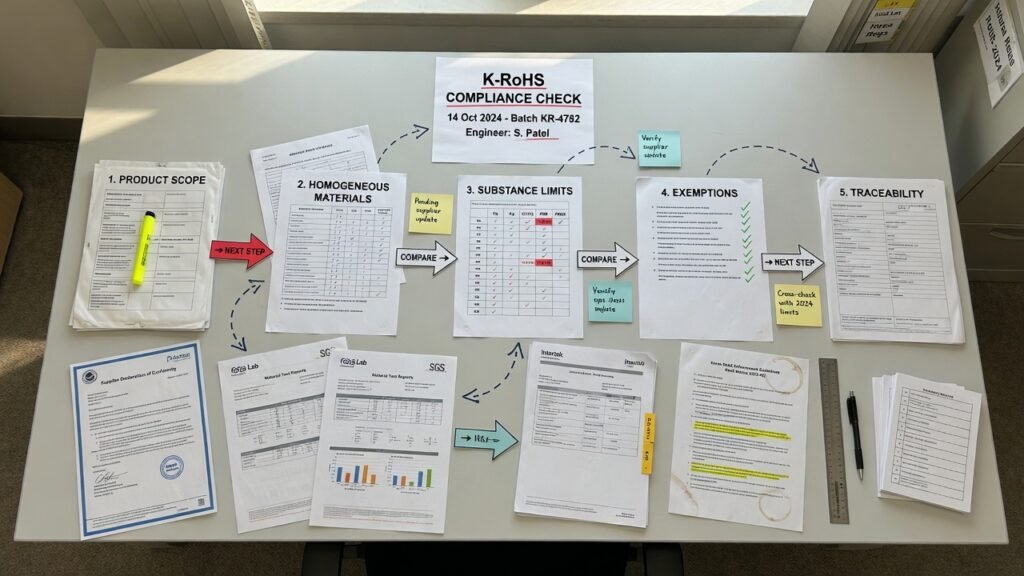
In general, to judge the K-RoHS compliance of charging products, you can follow the core steps: first check the product category and placement scenario to confirm whether it falls within the statutory control scope; then compare with the current list of 10 categories of controlled substances and verify the limits according to the homogeneous material rules; when using exemption clauses, check the applicable conditions and validity period item by item; EU RoHS reports are only for technical reference and need to be reused after matching South Korean requirements; do a good job in material traceability and change review during the mass production stage, and keep complete compliance documents for spot checks. Whether you are exporting charging products to South Korea or purchasing charging accessories in South Korea, mastering these key points will help you avoid most common K-RoHS pitfalls.