
If you are engaged in cross-border trade of charging products in Canada, or purchase charging accessories with wireless functions locally, you have most likely heard of ISED certification. However, there are all kinds of claims about its validity period in the market: some say it needs to be renewed every 5 years, some say it is valid for 10 years, and others think it requires annual renewal fees. Most of these claims are inaccurate, and the premise for judging the validity period of ISED certification is to first confirm whether the product belongs to the category with regulated wireless transmission. Starting from basic concepts, this article will systematically sort out the core rules, invalidation scenarios, query methods and pitfall avoidance points of ISED certification validity period, covering common scenarios for seller compliance and consumer purchase.
First Clarify 3 Basic Concepts
Before talking about the validity period, we must first clarify several easily confused concepts, otherwise it is easy to be misled by wrong information.
First is the ISED radio certification itself: it is Canada’s market access credential for electronic products with regulated wireless transmission functions. It was formerly called IC certification, and is now uniformly managed by Innovation, Science and Economic Development Canada (ISED). After the product passes certification, it will receive a unique ISED ID (also often called IC number), and everyone can check the corresponding certification information in ISED’s official database, which is the core compliance credential.
Many people mix up three things: “certification status”, “certification certificate” and “test report”, and even take the validity period of the latter two as the validity period of the certification itself, which is one of the biggest misunderstandings. Simply put: Certification status is the officially recognized compliance identity, and also the real subject of our discussion of “validity period”; the certification certificate is only a paper/electronic proof issued after passing certification, even if a certain validity period is printed on the certificate, it does not mean that the certification status will automatically expire on that date; the test report is a technical support material issued by the laboratory, and its validity has no direct relationship with the official certification status.
For charging products, the importance of ISED certification is reflected in all aspects: for sellers’ goods to clear customs and be listed on mainstream e-commerce platforms, ISED is a core inspection item. If non-compliant, the light consequence is delisting and fines, and the serious consequence is recall; when ordinary consumers buy overseas version wireless chargers and smart power banks, they can also use the presence of formal ISED certification as a basis for compliance judgment, to avoid inferior products with excessive radio frequency emissions.
Does Your Charging Product Need to Consider ISED Validity Period?
Not all charging accessories involve ISED radio certification — only products with regulated wireless transmission functions need it. Pure wired products have nothing to do with it at all, so naturally there is no “validity period” issue. We can use a table to quickly distinguish:
| Charging products requiring ISED radio certification | Charging products not requiring ISED radio certification |
| Wireless chargers (including magnetic and car-mounted models) | Pure wired charging adapters (only AC to DC function) |
| Charging adapters, power banks, and charging sockets with Bluetooth/WiFi/NFC | Ordinary charging cables / plug adapters (only for power/data transmission) |
| Special USB accessories with power line communication / wireless modules | Charging accessories that only supply power and do not emit regulated signals |
If you are not sure which category your product belongs to, there are two quick judgment tips: first, check whether there are words related to wireless transmission such as “wireless charging”, “Bluetooth”, “WiFi”, “NFC” in the product parameters and promotional pages; if yes, it most likely requires certification; second, if there is no clear statement, directly ask the seller for the ISED ID or formal compliance statement, and be more vigilant if the other party cannot provide it.
Core Rules of ISED Certification Validity Period
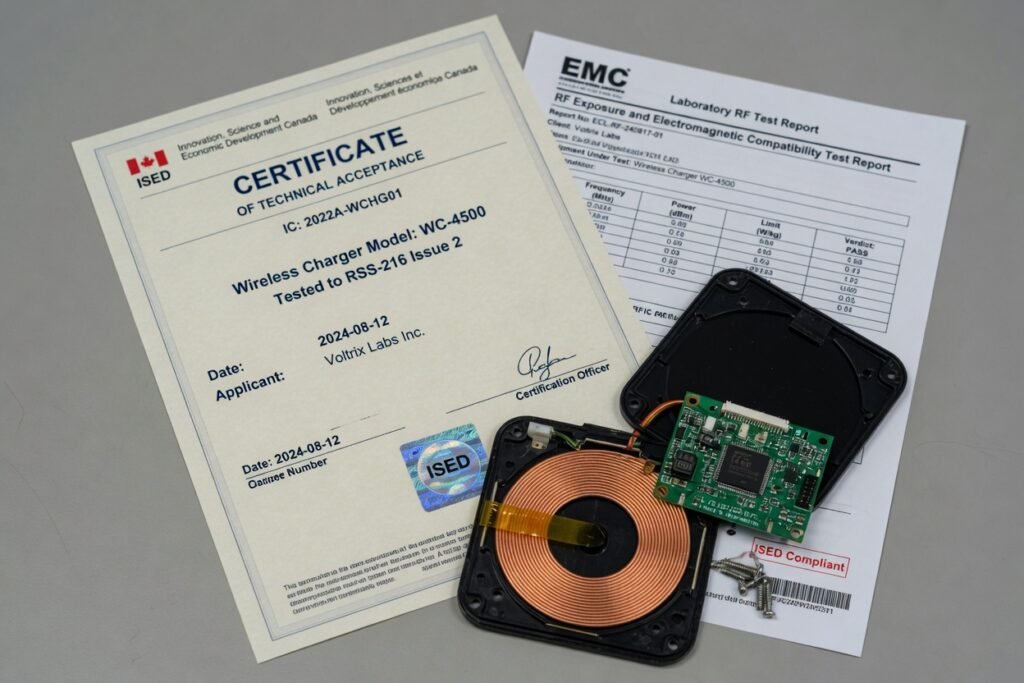
The question that many people care most about is: how long does ISED certification last? The answer may be different from what you think — The official does not set a mandatory fixed expiration date, nor is there a unified validity period, and it will not automatically expire on a yearly basis.
In other words, as long as three prerequisites are met, the certification can be valid for a long time: first, there is no substantial change to the radio frequency part of the product; second, the official rules applicable to the certification have not been updated; third, the certification has not been revoked by the official or actively cancelled by the certificate holder. For example, for an ordinary wireless charger, if the coil and control chip have not been changed since its launch, and ISED has not adjusted the relevant rules for wireless charging, it is normal for the certification to be valid for a long time.
As for the “5-year validity period” and “10-year validity period” circulating in the market, they are actually misinformation, mainly from two sources: one is conceptual confusion, taking the validity period of certifications from other countries or the validity period of laboratory test reports as the validity period of ISED certification itself; the other is market rumors. In fact, ISED has never stipulated a unified fixed validity period, and how long the certification can last depends entirely on whether the product itself has changed and whether the rules have been updated.
A special reminder here: A valid certification status does not mean that the product can be directly sold legally in Canada. In addition to ISED radio certification, the product also needs to meet other requirements such as label compliance, having a local Canadian responsible party, complying with electrical safety and EMC (electromagnetic compatibility) requirements. Only with a complete set of compliance documents can it be normally marketed and sold; don’t think that having a valid ISED ID means everything is fine.
What Situations Will Cause ISED Certification to Become Invalid?
Although there is no fixed expiration time, ISED certification is not “one certification for life”. When encountering the following four types of situations, the certification may become invalid:
The first and most common type is substantial changes to the radio frequency of the product. The “substantial change” here refers to changes that affect radio frequency performance, such as changing the coil or control chip of a wireless charger, changing the Bluetooth module or adjusting the antenna of a Bluetooth-enabled power bank, or increasing the wireless transmission power; even firmware-level changes, such as upgrading radio frequency control firmware, or adding wireless functions to an originally pure wired product, count as substantial changes. But if only the shell color, packaging design, or label layout is changed, as long as the radio frequency part is completely unchanged, it will not affect the validity of the certification.
The second type is the update of applicable official rules or referenced standards. ISED will irregularly update the RSS (Radio Standards Specification) technical rules for radio frequency requirements of radio equipment, or adjust the industry standards referenced by RSS; while ICES (Canadian Interference-Causing Equipment Standards) mainly corresponds to electromagnetic compatibility/interference requirements, which are not the basis for judging the invalidation of radio certification itself, and relevant requirements can be included in other compliance items for unified management.
Whether a rule update affects the validity of the original certification shall be subject to the update announcement of the corresponding ISED RSS or its referenced standards. The announcement will clearly specify the transition period, applicable objects, and whether supplementary testing, re-evaluation or certification update is required. Usually, rule updates will set a transition period of 6-12 months. During the transition period, inventory products that have legally entered the Canadian market can generally continue to be sold; after the transition period, newly produced and newly imported products usually need to complete compliance assessment in accordance with the new rules, and whether the original certification can be used depends on the requirements of the announcement and whether the product still complies with the new rules.
The third type is abnormalities in the certification subject or status. For example, the certificate holder has false declarations, is out of contact, actively cancels the certification, or has invalid qualifications; or official random inspection finds that the product is unqualified, or there are verified consumer complaints, the certification will be suspended or even revoked; there are also scenarios of private labeling and certification resale. If there is no formal authorization from the original certificate holder, or the certification information is not updated in time after a change in company name or entity, it may also cause problems with the certification status.
The fourth type is that the product’s model, hardware version, and bill of materials (BOM) exceed the coverage of the original certification. Many people think that “one ISED ID can cover all products of the same series”, but that is not the case at all — certification only covers the specific model, hardware configuration and radio frequency parameters submitted at the time of declaration. Common out-of-scope situations include: models of the same series with different powers, hardware versions with replaced radio frequency components, sub-models with added wireless functions. These cannot use the original certification. But if it is the same model and same configuration with only changed packaging, or non-radio frequency minor changes of the same model, it is not out of scope. Here is a pitfall that many sellers have stepped on: even if the wireless module used in the product itself has passed ISED certification, the whole device (such as a Bluetooth-enabled power bank) still requires separate whole-device certification and cannot directly use the module’s certification as a substitute.
Focuses of Validity Judgment for Different Charging Products
For charging products with different types of wireless functions, the risk points and judgment focuses of certification are also different. When judging, we should grasp the core:
First, we need to distinguish a confusing difference in compliance paths: do not confuse the Supplier’s Declaration of Conformity (SDoC) with formal ISED radio certification. Some low-risk devices or interference compliance requirements may adopt the supplier self-declaration path, where the supplier conducts testing and keeps records on its own, no official certificate is issued, and there is no unified ISED ID. However, the scope of application of this path has strict category restrictions, which must be confirmed against specific ISED rules and equipment categories, and it is not the mainstream compliance method for most charging products with regulated wireless transmission.
The mainstream compliance path is formal certification with an ISED ID, issued by an ISED-recognized organization, and information can be queried through the official database. It should be noted that the certification path cannot be divided only by power level, but shall be based on whether the product is in the regulated catalog. The quick distinction method is: products with an officially queryable ISED ID belong to formal certification; products without an ID need further verification of whether their compliance path meets Canadian regulatory requirements.
Specific to different charging products:
The first type is wireless chargers. The core check items for judging validity are the coil, control chip, transmission power and radio frequency firmware. If there is an update of RSS wireless charging related rules, or changes to the product’s radio frequency hardware/firmware, the validity of the certification needs to be re-evaluated; if it is only a shell modification, packaging change, or adjustment of ordinary charging circuits (such as increasing wired input power), as long as the radio frequency part remains unchanged, it will not be affected. Under the premise of no radio frequency changes and no applicable rule updates, the certification can remain valid for a long time; many enterprises will proactively review the product’s radio frequency configuration and rule changes every few years, which is an internal compliance management action, not an officially stipulated certification validity period.
The second type is smart charging adapters and power banks with Bluetooth, WiFi, NFC. The core check items for this type of product are the wireless module model, antenna layout and radio frequency firmware version. Due to the rapid iteration of Bluetooth and WiFi related technical standards, the probability of corresponding RSS rule adjustments is relatively higher. If there is a corresponding rule update or the wireless module is replaced, a review is required. If only the battery capacity is adjusted, the shell is changed, or the ordinary charging circuit is modified, it will not affect the validity of the certification. Many enterprises will proactively review the corresponding rules and wireless module configuration every few years, and this cycle is only for internal compliance reference and has nothing to do with the official certification validity period.
The third type is pure wired charging adapters and ordinary charging cables. This type of product has no regulated wireless transmission function and does not involve ISED radio certification at all, so naturally there is no validity period issue, and there is no need to waste energy on this.
The use of certification in private labeling and foundry (OEM) scenarios requires extra caution: if you directly use the existing certification of the factory, you must first check whether the model, hardware version, and brand information marked on the label covered by the certification match, and obtain written authorization from the original certificate holder; if you need to add a brand, change the certificate holder entity or transfer the certification, it shall be evaluated by the original certificate holder or an ISED-recognized certification body to confirm whether it is necessary to update the REL (Radio Equipment List) database filing information, add listing or re-apply for certification. If it involves certification transfer or second-hand certification purchase, it is also necessary to check whether the original certificate holder has cancelled the certification, and whether the certification coverage includes the currently sold products, to avoid purchasing invalid certification.
Three Steps to Check Whether ISED Certification is Valid
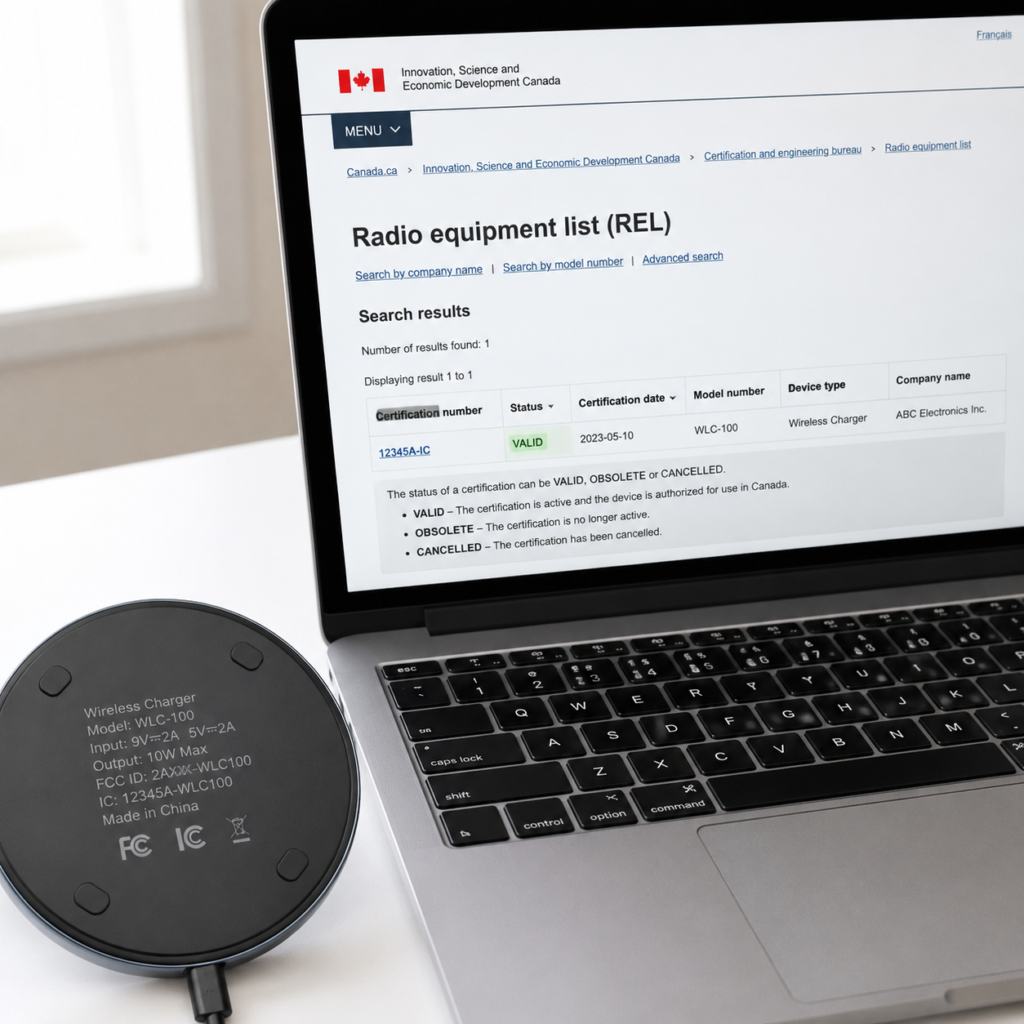
Just listening to the seller say “there is certification” does not count; it is reliable to check it yourself. In fact, the operation is very simple, divided into three steps:
Step 1: First find the product’s ISED ID (IC number). It is usually printed on the label at the bottom of the product, the packaging box, or the compliance section of the manual. The detail page of e-commerce platforms will generally also mark it in the compliance section. If you can’t find it, just consult the seller or brand to ask for it. It should be noted that products adopting the self-declaration path do not have an official unified ISED ID, and their compliance needs to be verified separately.
Step 2: Query through ISED’s official Radio Equipment List (REL) database. The most accurate way is to enter the complete ISED ID for search, or you can enter the product model and brand name for fuzzy search. The query result will show the current status of the certification. You should focus on whether it is in an available and valid state, and pay attention to abnormal states such as suspension, revocation, cancellation, and termination. The specific status name shall be subject to the display on the official REL page.
Step 3: For charging products, be sure to check 5 key pieces of information. You cannot rest assured just by seeing that the status is valid:
First, check the model: models of the same series with different powers and different functions may correspond to different certifications. You cannot just look at the series name and assume it is universal. For example, a brand’s 15W wireless charger and 25W wireless charger are likely to be two independent certifications.
Second, check the brand and certificate holder: to prevent fraudulent use of certification. For example, if Brand B uses Brand A’s certification without formal authorization, even if the certification status is valid, it is invalid for your product.
Third, check the coverage: the power and wireless function type marked in the certification must be completely consistent with the sold product. For example, if the certification covers an ordinary wireless charger, but what you sell is a smart charging socket with WiFi function, it is obviously not within the coverage.
Fourth, check the certification status: it must be the available and valid status displayed by the official. Certifications with abnormalities such as suspension and revocation cannot be used.
Fifth, check the hardware version: it must be consistent with the bill of materials and radio frequency configuration at the time of certification declaration. Some products have not changed the model, but have replaced the wireless chip, which is also out of scope.
If you can’t find the record, don’t jump to conclusions. You can troubleshoot in this order: first confirm whether the ISED ID or model you entered is wrong, such as mixing up numbers and letters, or missing characters; if the input is correct, ask the seller to provide formal certification documents to judge whether its compliance path meets the requirements; if the seller cannot provide valid proof, it is most likely a case of fraudulent certification use or forgery, and you should be cautious whether you are purchasing for resale or for your own use; another possibility is that the certification has been cancelled or revoked, or this model is simply not within the coverage of the original certification.
Pitfall Avoidance Guide: Common Misconceptions and Decision-Making Methods
5 Common Cognitive Misconceptions About Charging Products
Misconception 1: One ISED ID covers all products of the whole series → Correction: Certification only covers the specific model, hardware configuration and radio frequency parameters at the time of declaration. If different models of the same series have differences in radio frequency configuration, they cannot share the same ID.
Misconception 2: Valid FCC certification = valid ISED certification → Correction: The radio certification systems of the United States and Canada are independent of each other and cannot replace each other. The same product needs to obtain ISED certification separately before it can be sold in Canada.
Misconception 3: A valid certificate means legal sales → Correction: Valid certification only means that the radio compliance identity is valid, and it also needs to meet other requirements such as model matching, label compliance, and local responsible party. For details, please refer to the core rules explanation above.
Misconception 4: All charging products need to check ISED validity period → Correction: Only products with regulated wireless transmission functions need it. Pure wired charging adapters and ordinary charging cables do not involve ISED radio certification.
Misconception 5: ISED certification requires annual renewal/annual review → Correction: ISED radio certification has no annual renewal requirement, no annual fee is required, and it can be valid for a long time as long as no invalidation scenario is triggered.
Judgment Logic for Whether Re-certification is Required After Product Changes
If your product has been changed and you don’t know whether you need to re-do the certification, you can judge according to this logic: first check whether the change involves the radio frequency part, then check whether it changes the radio frequency performance. If it is a change such as replacing the wireless chip/coil/module, adjusting transmission power, adding wireless functions, modifying the antenna, or updating radio frequency firmware, you must re-do the certification; if it is just changing the shell, changing the packaging, or minor non-radio frequency adjustments, as long as the radio frequency performance remains unchanged, you don’t need to re-do it, but you should keep the change records by yourself for future inspection. If you are not sure, it is best to find an ISED-recognized organization to do a difference assessment; don’t judge by yourself, as the loss will be greater if it turns out to be non-compliant.
Handling Priority and Long-Term Maintenance After Invalidation
If you really encounter the situation of certification invalidation, handle it according to priority: first, if the certification is revoked/suspended, the model configuration is out of scope, or the certification is fraudulently used or forged, stop selling immediately, and don’t take chances; if the invalidation is caused by the update of official rules, then conduct supplementary testing according to the requirements of the announcement, and complete the re-certification within the transition period; if the radio frequency part of the product has changed, then follow the complete certification process for new products, and absolutely cannot use the old certificate.
In the long run, it is not difficult to maintain the validity of the certification: usually do not arbitrarily modify the radio frequency part of the product, pay more attention to ISED’s rule update notices, and if filing information such as company name and address changes, update the certification information in time.
Overall, ISED radio certification does not have a unified fixed validity period, and its validity always revolves around three core dimensions: whether the product’s radio frequency configuration has changed, whether the applicable rules have been updated, and whether the certification status is normal. For practitioners and consumers of charging products, mastering the category judgment method, learning to verify certification information through the official database, and clarifying invalidation trigger scenarios can effectively avoid radio compliance risks in the Canadian market.