
For overseas sellers of charging products targeting the Chinese market, the two core entry-level questions are: Does my product need to apply for CCC certification? What are the approximate cost and time frame for certification? CCC is the statutory safety access threshold for the Chinese market, involving multiple links such as sales, customs clearance, and e-commerce listing. Clarifying the rules in advance can avoid unnecessary cost waste and launch delays. This article will systematically break down the cost composition, timeline calculation logic, and influencing variables of CCC certification, helping first-time applicants establish a clear understanding and independently estimate the approximate cost and time range.
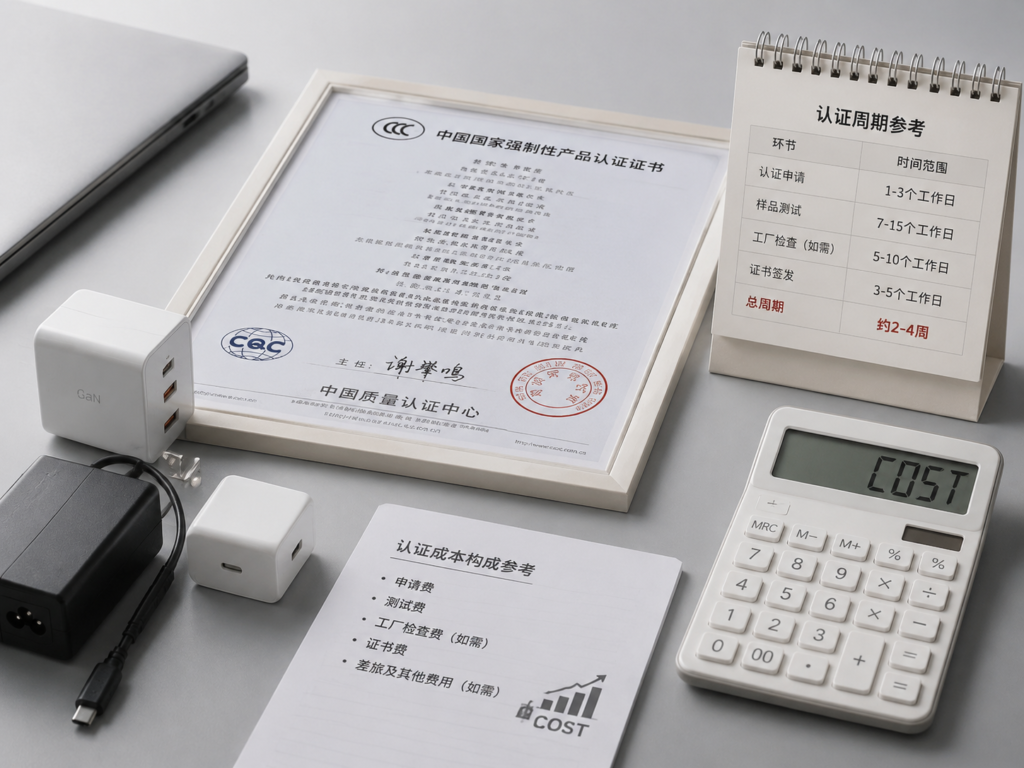
Step 1: First Figure Out If Your Product Requires CCC
First of all, it should be clear that CCC is not a “quality product medal”, but a mandatory safety certification stipulated by the Chinese government. Products within the mandatory catalog that are sold in China, imported for customs clearance, or listed on e-commerce platforms usually must obtain a CCC certificate; whether samples not for sales purposes, R&D test prototypes, exhibits, repair parts, etc. are eligible for exemption or special treatment needs to be confirmed separately in accordance with the requirements of customs, market supervision departments, and certification bodies. The entire certification process is not only about testing samples, but also includes on-site audits of production factories and annual supervision inspections after obtaining the certificate, so it is not a one-and-done matter. Those who launch products for sale without obtaining the corresponding certificate may face risks such as platform removal, customs detention, and penalties from market supervision departments, and cannot conduct business legally.
Many people think that only Chinese local sellers need to do CCC, but in fact, as long as the product is sold in China, no matter which country the company is registered in, it must comply with this rule.
For charging products, the following categories are clearly within the scope of mandatory certification: wall-plug and desktop chargers for mobile phones and tablets, power adapters for laptops and digital products, power cords and charging cable sets with AC mains plugs (that is, the complete set of cables with one end plugged into the wall and the other end connected to the device).
Of course, there are also many easily confusing gray boundaries: for example, ordinary USB-A or USB-C data cables that are only used for power transmission and data transmission, without active chips or power conversion functions, are mostly not in the mandatory catalog and do not need to apply for CCC; but if the cable has an active voltage regulation chip inside and has power conversion functions, it is necessary to specifically check the catalog requirements. Another example is charging accessories bundled with complete machines, such as chargers included with laptops, whether they need to obtain CCC separately cannot be generalized: chargers and power adapters sold separately that fall within the mandatory catalog must apply for CCC separately; if they are accessories imported or sold as bundled with the complete machine, it needs to be comprehensively judged based on the CCC certification rules of the complete machine, whether the accessory itself is included in the mandatory catalog, the model coverage of the complete machine certificate, the import declaration method, and the specific requirements of the certification body, and the complete machine certificate and accessory certificate cannot be used as substitutes for each other.
A special reminder here: do not assume that all products with USB interfaces require CCC; only products listed in the mandatory catalog need certification. If you are unsure, you can ask a certification body to do a “catalog applicability confirmation” to clarify the scope first at a small cost, avoiding wasted effort.
There are also several cognitive pitfalls that overseas sellers are most likely to fall into, which need to be clarified in advance:
First, European and American certifications such as CE, FCC, and UL cannot replace CCC. Even if the product has passed US UL and EU CE certifications, it still needs to do CCC as required when entering the Chinese market. These overseas certifications can only be used as a reference for laboratory testing and cannot exempt the statutory certification process.
Second, do not think that if the accessories have CCC, the complete machine does not need certification. For example, a charger has CCC, but if the tablet computer sold with the charger is in the mandatory catalog, it still needs to apply for the complete machine CCC separately, and the accessory certificate cannot be used as a substitute.
Third, not all products with USB require CCC. The core judgment basis is still whether the product is in the mandatory catalog. There is no need to worry excessively, nor should you take chances.
Where Does the Money for CCC Certification Go?
After confirming that CCC is required, the cost composition is the most concerning issue. There is no unified fixed price for CCC certification, but it consists of multiple parts. We will explain them one by one from mandatory fees to hidden costs:
The first part is official fixed fees, which need to be paid to the certification body, are mandatory items, and the basic fees of different formal certification bodies have very little difference, so there is no need to deliberately compress costs by choosing institutions. This fee is mainly the application and registration fee, charged by “product unit” — simply put, it is a group of products recognized by the certification body that can be certified together. The same unit only charges one application fee, including document review and certificate issuance fees. In addition, it should be noted that the often-mentioned annual supervision fee is already included in the annual factory inspection fee and does not need to be paid separately. If an institution charges an annual supervision fee separately, you should be vigilant.
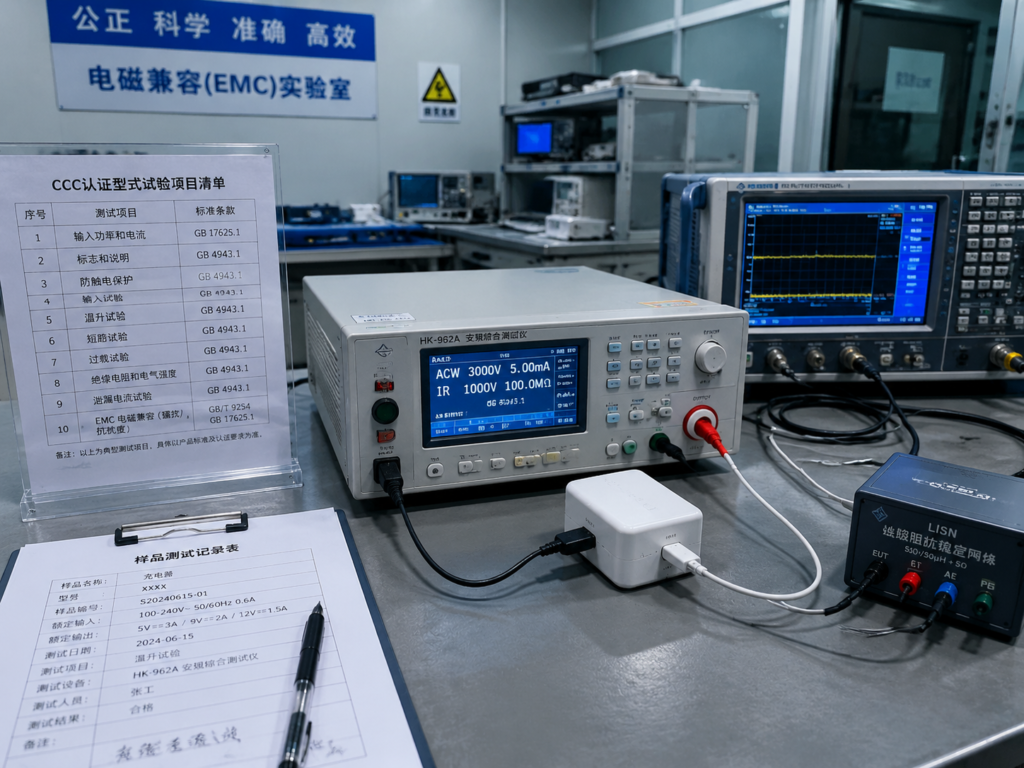
The second part is the type test fee, that is, the sample test fee, paid to the testing laboratory, which is the largest expenditure item in the entire certification. The so-called type test is to send samples to a designated laboratory to conduct a full set of safety tests (such as electric leakage prevention, fire prevention, high temperature resistance, etc.) and electromagnetic compatibility tests (that is, it will not interfere with other electrical appliances, nor is it easily interfered by other electrical appliances, professionally referred to as EMC). The level of this part of the fee mainly depends on the complexity of the product: the higher the power, the more interfaces, and products with functions such as PD fast charging, the more test items, the higher the fee. If the test fails and needs to be retested, it will be charged separately for each failed item, not as a package. There are three most common test failure items for charging products: first, the nameplate parameters do not match (for example, it is marked 65W but actually only 45W, or there is a lack of Chinese labels); second, the fast charging protocol is unclear (for example, only “fast charging” is written, without specifying specific versions such as PD3.0, QC5); third, the key components are inconsistent with the application materials, or lack applicable CCC/CQC certificates, test reports, specifications and other qualified certification documents; when the model, supplier, or specification of key components changes, it is necessary to confirm in advance whether it affects the test results or the validity of the certificate.
The third part is the factory inspection fee, that is, the fee for the certification body to send inspectors to the production factory for on-site audit, mainly to check whether the production process and quality control can ensure that the mass-produced products are consistent with the test samples. The first factory inspection fee is calculated by “person-day”, that is, one inspector working for one day counts as one person-day, and charging products generally require 2-3 person-days. The travel, accommodation and food expenses of the inspectors are reimbursed as actual expenses. The more remote the factory, the higher this part of the fee. After obtaining the certificate, an annual supervision inspection is required once a year, and the cost is about 30%-50% of the first factory inspection, which is lower than the cost of the first audit.
If you are an overseas seller, there are also some exclusive hidden costs that are easily overlooked: for example, all application materials must be in Chinese, English materials need to be translated and notarized, and there are also authorization document processing fees; samples need to be sent from overseas to Chinese laboratories, resulting in international logistics fees, tariffs, and the cost of specially making test prototypes; if the Chinese labels, manuals, and packaging of the product do not meet the requirements, rectification will also incur fees; in addition, there are optional service fees, including agency service fees, expedited fees, etc., as well as rectification fees for failed product tests and non-conforming factory systems, which are all possible additional expenses.
How Long Does CCC Certification Take? Timeline Breakdown
After talking about costs, let’s explain the time frame. Many people have misunderstandings about the CCC timeline. First, the calculation rules need to be clarified to avoid discrepancies in timeline calculation standards: first, the timeline is calculated based on Chinese working days, weekends and statutory holidays (such as Spring Festival, National Day) are not included, so when estimated by natural days, the duration will be longer than the number of working days; second, the commonly referred to timeline is the time from the formal acceptance of the application by the certification body to the receipt of the certificate. The time for the applicant to prepare materials, make samples, and send samples in the early stage is not included — this part of the pre-preparation time is the most underestimated hidden time consumption, and the pre-preparation duration of some projects can account for one-third of the total time consumption.
If it is a domestic factory, the product passes the test at one time, no rectification is required, and the schedule is normal, the duration of each stage is roughly as follows: document review and acceptance takes 1-3 working days, mainly depending on the completeness of the materials, and can be accepted on the same day if fully prepared; type test takes 15-30 working days, ordinary slow-charging chargers (such as 5V2A) take about 15-20 days, fast-charging and multi-port output products require 20-30 days due to more test items; factory inspection and report submission takes 5-10 working days, including scheduling, on-site audit, and sorting out audit reports; certificate approval and issuance takes 5-10 working days, that is, the certification body finally reviews all materials and issues the certificate if there are no errors.
But in actual operation, there are very few completely smooth cases. Common reasons for timeline extension include: the most common is that the test fails and requires rectification and retesting, which generally increases by 7-30 days. The specific duration depends on the difficulty of rectification. The aforementioned nameplate mismatch, unclear fast charging protocol, and missing key component materials are the most common reasons for delays; if the factory inspection fails and requires rectification, it will increase by 10-20 days; every year from Q3 to Q4 is the peak season for cross-border stock preparation, and a large number of applicants submit certification applications at the same time, so laboratories and inspectors have tight schedules, which will increase by 10-20 days; if the factory is overseas, inspectors need to apply for visas and coordinate cross-border scheduling, which generally increases by 2-4 weeks; in addition, too many errors and omissions in materials and repeated supplementary submissions will also increase the acceptance time by 3-10 days.
Many applicants who are eager to get the certificate will ask about the expedited channel. Formal expedited services do exist: some certification bodies can provide priority testing and priority review channels, which require an additional 20%-50% fee. Under the premise that the materials are complete, the sample passes the test at one time, and the factory can cooperate with the schedule, the overall timeline can be shortened by about one-third compared with the normal schedule (note that the shortened duration is about one-third of the normal timeline, not shortened to one-third of the original timeline), and it will not reduce test items, lower factory audit standards, or simplify the final certificate issuance review requirements. Expedited service is not a panacea: if the test fails and requires rectification, the application materials are incomplete, or the factory audit schedule is full, the expedited service will not take effect. In addition, there is no expedited channel of “buying a certificate with money”. All formal expedited services must go through a complete and compliant process. Those who claim “get the certificate in 10 days, no sample testing required” are all scams. The obtained certificate is either forged, or does not match the actual product and production entity, and will face serious compliance risks once verified.
Why Are the Price and Time So Different? Core Influencing Variables
Seeing this, you may wonder: for the same charger, some can be done for more than 10,000 yuan, while others cost 50,000 to 60,000 yuan? Some get the certificate in 4 weeks, while others have to wait two or three months? The core difference comes from three variables: the product itself, the factory situation, and the application preparation.
First is the situation of the product itself: first is the power level. The higher the power, the more test items, the higher the cost and the longer the timeline. For example, a 5W ordinary mobile phone charger and a 200W laptop power adapter have obvious differences in test items, so the price and time are naturally quite different; second is the functional complexity. Products with PD fast charging, multi-port output, GaN (gallium nitride) technology, and data transmission functions will have more test items, so the cost is higher and the timeline is longer; third is the merging rule of product units. Multiple models produced by the same factory with the same core components (such as PCB boards, transformers, capacitors) can be merged into one product unit, only charging one fee and doing one test, which can save a lot of cost and time. But never forcefully merge models that do not meet the rules. For example, forcibly classifying 20W and 65W chargers into one unit, if found, will not only require supplementary testing, but also need to go through the process again, which will instead increase costs and lengthen the timeline.
Then is the situation of the factory: if the factory already has an ISO9001 quality system, or has done CCC certification for similar products before, the factory audit pass rate will be much higher and the timeline will be shorter; the location of the factory also has a significant impact: the overall cost of overseas factories is 30%-100% higher than that of domestic factories, and the timeline is also 2-4 weeks longer. After all, inspectors need to go abroad, the travel cost is high, and scheduling is also more difficult; even for domestic factories, if they are located in remote areas, the travel expenses will be higher and the schedule will be longer, because it is inconvenient for inspectors to travel back and forth; if the same product is produced by multiple factories, each factory needs to accept the factory audit, and the cost and timeline will increase accordingly.
Finally is the situation of application preparation: if the key components of the product (such as transformers, optocouplers, capacitors) already have CCC certification, the test pass rate will be higher, and there will be no retesting due to the qualification of key components; doing pre-testing in advance, that is, testing by yourself according to CCC requirements first, or finding an agent to do pre-testing, can greatly reduce the probability of failure in the formal test; the application method also has an impact: applying by yourself can save the agency service fee, but you need to connect the whole process by yourself and be familiar with the rules, which is easy to repeatedly supplement materials due to unfamiliarity with the requirements; entrusting a professional agent requires paying the corresponding service fee, but they are familiar with the process, can reduce the probability of supplementary materials and rectification, and the timeline is more stable, which is suitable for overseas applicants who are not familiar with domestic certification rules; in addition, the quality of material preparation is also very important. Fewer errors and omissions mean faster acceptance, while more errors and omissions will lengthen the timeline due to repeated supplementary submissions.
Calculate It Yourself: Quick Estimation Method for Cost and Timeline
In fact, you don’t need to consult a certification body, you can roughly estimate the cost and timeline by yourself. The following is a simple four-step estimation method:

First calculate the cost: Step 1, first confirm how many product units you have according to the product unit merging rules. This is the most basic calculation basis. The more units, the higher the cost; Step 2, match the basic test fee range according to the product type, power, and function. For example, ordinary slow charging has lower cost, while fast charging, multi-port, and GaN products have higher cost; Step 3, add the official application fee and factory inspection fee. Overseas sellers also need to add hidden costs such as translation, logistics, and rectification; Step 4, be sure to reserve 10%-20% of contingency funds to cover all possible additional expenses for the first certificate issuance plus the first year of supervision, such as minor rectification and supplementary material fees, to avoid exceeding the budget.
Then calculate the timeline: Step 1, first determine the basic timeline according to product complexity: 4-6 weeks for ordinary slow-charging chargers, 6-8 weeks for fast-charging adapters, 3-5 weeks for charging cable sets with AC plugs; Step 2, adjust according to the factory situation: if the factory has done CCC before, it can be reduced by 1 week; if there is no quality system, add 1-2 weeks; if it is an overseas factory, add 2-4 weeks; Step 3, adjust according to the application time: if applying in the peak season of Q3-Q4, add 1-2 weeks of scheduling buffer; Step 4, finally reserve a 1-2 week buffer period to deal with sudden supplementary materials or minor rectifications, don’t cut the time too close.
The following are common reference ranges for domestic factories in recent years, without rectification, and normal scheduling, only for market reference. The actual cost and timeline shall be subject to the formal quotation of the certification body and laboratory and the result of product unit division:
- Ordinary 5V2A single-port charger: total cost 15,000-25,000 yuan, timeline 4-6 weeks
- 65W PD multi-port fast charging adapter: total cost 25,000-40,000 yuan, timeline 6-8 weeks
- USB-C fast charging cable set with AC plug: total cost 10,000-20,000 yuan, timeline 3-5 weeks
- 100W+ GaN multi-port adapter: total cost 40,000-60,000 yuan, timeline 8-10 weeks
If it is an overseas factory project, the cost needs to increase by 30%-100%, and the timeline increases by 2-4 weeks. The above is only a rough range, and the specific value needs to be determined according to the actual situation of the product, but the overall range will not be too different.
Exclusive for Overseas Users: Pitfall Avoidance and Optimization Tips
For overseas sellers, due to unfamiliarity with Chinese certification rules, it is easy to step into pitfalls. The following are the most common risk points, as well as optimization methods to save money and time:
Cost-related Pitfall Avoidance
First, beware of the “all-in-one price” trap. Many institutions attract customers with low all-in-one prices, and after payment, they charge additional retest fees, factory audit travel expenses, rectification fees, and annual supervision fees under various names, and the final total cost is higher than the normal quotation. Therefore, when inquiring about the price, be sure to ask clearly: what items are included in the quotation, what are not included, and whether there are hidden consumption.
Second, do not believe the scam of “purchased certificates can be used”. The CCC certificate corresponds one-to-one with the applicant entity, production factory, and product model. The purchased certificate is either forged or affiliated, and does not match the actual product. Once verified, it will face serious compliance risks, which is not worth the loss.
Third, do not forcefully merge non-compliant product units, otherwise it will incur additional supplementary testing fees, which will instead increase costs and lengthen the timeline.
Timeline-related Pitfall Avoidance
First, do not believe the excessive promise of “get the certificate in 10 days”. Even if everything goes smoothly for normal charging products, it takes at least about 4 weeks. It is impossible to complete the entire process of testing and factory audit in 10 days, which is definitely a scam.
Second, do not apply only when the sales or promotion deadline is approaching. Start the certification at least 2-3 months in advance to leave enough buffer time. Otherwise, once rectification is required, you will miss the promotion node.
Third, for applications in the peak season, be sure to reserve an additional 1-2 weeks of scheduling buffer, do not estimate according to the normal timeline.
Fourth, do not ignore the pre-preparation duration: include the preparation time of materials and samples into the overall project planning according to the aforementioned rules, and do not count it into the formal certification timeline, so as to avoid misjudging the launch time.
Optimization Methods to Save Money and Time
Prioritize agents with overseas service experience: they can solve language, time difference, and cross-border communication barriers, assist in completing document translation and notarization, sample customs clearance, pre-review and pre-scheduling, etc., greatly reducing communication costs and the probability of errors. Try to use supply chain components or finished products that have passed CCC certification in China, so that the testing difficulty is lower, the pass rate is higher, and the timeline is shorter. Do pre-testing and material pre-review in advance to solve problems before the formal application, reducing the probability of retesting and supplementary materials. Reasonably merge product units, and try to group eligible models into one group to reduce duplicate costs. If it is an overseas factory, be sure to confirm the factory audit schedule 2 months in advance to avoid delays due to visa and scheduling issues.
Cost Avoidance Tips After Obtaining the Certificate
When planning the overall budget for CCC certification, do not only calculate the cost of the first certificate issuance. You need to reserve long-term compliance budgets such as annual supervision, certificate change, and renewal after obtaining the certificate in advance to avoid unplanned expenditures in the future. The validity period of the CCC certificate is 5 years. You need to apply for renewal 3-6 months before the expiration. Don’t wait until it expires to re-apply, otherwise the certificate will become invalid and you need to go through the complete certification process again. Every year, you need to cooperate with the annual supervision inspection, otherwise the certificate will be suspended or even cancelled. If the product model, production factory, or key components change, be sure to apply for a certificate change in advance, do not change without authorization, otherwise the certificate will become invalid. If there is a CCC standard version change, you need to complete the difference confirmation according to the transition period requirements announced by the certification body, and if necessary, supplement the test and go through the certificate change/version update procedures.
CCC certification is the statutory safety threshold for charging products to enter the Chinese market, and its cost and timeline have clear rules to follow. After mastering the content of this article, applicants can independently complete the following matters: judge whether their own charging products need to apply for CCC certification; understand the composition of CCC quotations and identify hidden fee traps; estimate the approximate cost range and reasonable timeline of their own products; optimize costs and timeline by adjusting product units, supply chain selection, and application methods; plan the certification rhythm in advance to avoid delaying the launch and listing progress in the Chinese market.