
Practitioners in the charging product industry targeting the Canadian market often encounter two typical problems: products that have passed safety certification are detained at Canadian customs due to lack of ISED-related documents; or ordinary wired chargers are misjudged as requiring ISED certification, which unnecessarily increases compliance costs. The core of the problem mostly lies in unclear judgment of the applicable scope of ISED certification. This article will thoroughly explain ISED’s applicable rules from the perspective of charging products, covering the entire process from preliminary screening to advanced judgment, from entry-level quick self-check to boundary situation determination.
First, Understand the Basic Logic of ISED Certification
First, clarify the most core definition: ISED, whose full name is Innovation, Science and Economic Development Canada, formulates market access requirements for specific electrical and electronic equipment, and does not regulate all electronic products. It controls two types of risks at its core: one is whether devices that actively emit radio signals will illegally occupy public spectrum resources, such as interfering with broadcasting, mobile phone signals, and aviation communications; the other is whether digital devices that meet specific conditions will generate electromagnetic clutter that affects the normal use of other devices during operation.
For charging products, there is a very important basic conclusion: not all chargers require ISED assessment. Only those that include wireless transmission, wireless power transfer functions, or fall within the applicable scope of corresponding electromagnetic compatibility standards require corresponding assessment.
Why must we first clarify the applicable scope? The reason is straightforward: if a product enters the Canadian market without compliance, the light consequence is cargo detention and e-commerce platform delisting, and the serious consequence is a fine; conversely, if the product does not need to meet ISED-related requirements, blindly conducting testing and certification will only increase unnecessary compliance costs.
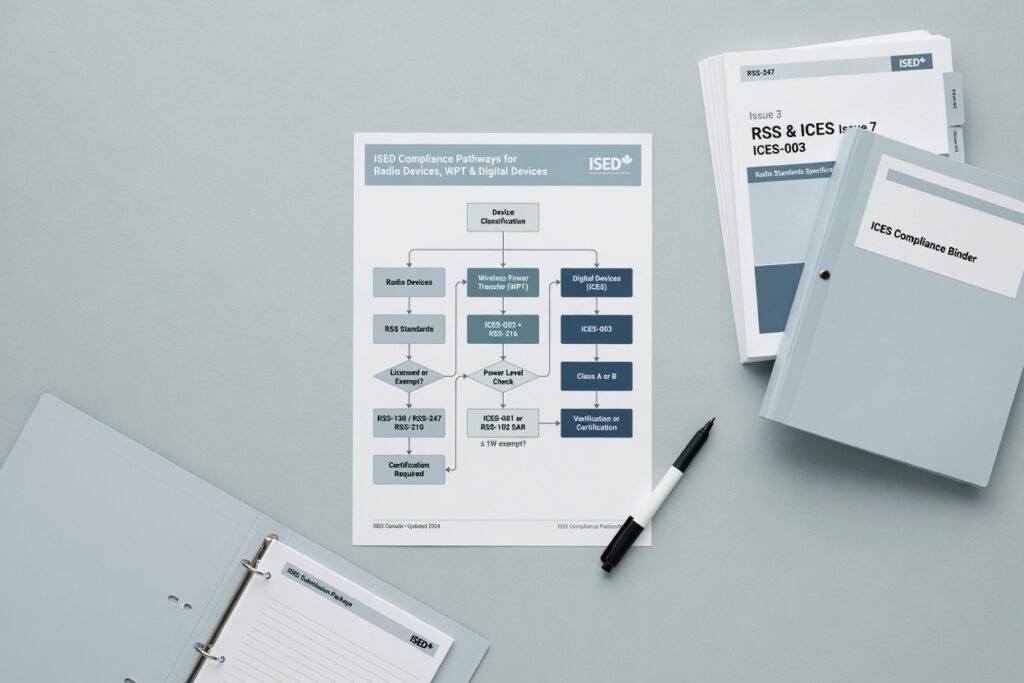
Three ISED Compliance Paths for Charging Products
This is the basis for all subsequent judgments. We divide them into three categories according to regulatory types:
The first category is radio transmitting devices, that is, products with active wireless communication signal transmission (usually with receiving function at the same time) such as Bluetooth, Wi-Fi, FM transmission, and cellular network. Such products need to enter ISED radio compliance assessment and meet the requirements of the corresponding radio equipment technical specifications (RSS series for short). The specific authorization path (formal certification/filing, etc.) needs to be confirmed in combination with frequency band, power, and device type. Products that require formal certification will have a unique ISED certification number after passing.
The second category is wireless power transfer (WPT) devices, such as wireless chargers, which transfer energy through electromagnetic fields rather than communication. Such products are assessed according to special specifications for wireless power transfer (such as RSS-216). Whether formal certification is required depends on the product’s operating frequency, transmission method, power/field strength and device classification, and cannot be generalized.
The third category is digital/unintentional radiation devices, such as fast chargers with digital control circuits and docking stations with data functions. Such devices do not actively emit radio signals, but internal digital circuits may generate electromagnetic clutter. It is necessary to first confirm whether the product belongs to the category of digital devices defined in the Canadian Electromagnetic Compatibility Technical Specifications (ICES series for short, the most commonly used is ICES-003), and then determine whether electromagnetic compatibility compliance assessment is required; eligible ones can take the Supplier’s Declaration of Conformity (SDoC for short) path — that is, the enterprise tests and keeps documents as required, without submitting them to ISED for an official number.
A quick check order for charging practitioners: if the product has Bluetooth, Wi-Fi or is a wireless charger, first check the radio-related requirements; if it is just an ordinary wired charging product, start with the electromagnetic compatibility applicable scope.
Certifications Easily Confused with ISED, Clarified Once and for All
Many people confuse ISED with other common certifications. Here is a clear distinction:
• CSA/ULc are safety certifications, which regulate whether the product will cause electric shock or fire. Even pure wired chargers may need them, and this part is not under the jurisdiction of ISED.
• ISED regulates radio frequency spectrum and electromagnetic compatibility, which are two completely independent sets of requirements from safety certification.
• FCC is the access requirement of the United States. The regulations of the United States and Canada are independent of each other. Although much test data can be reused, FCC certification cannot be directly used as ISED certification, and must be re-assessed according to Canadian rules.
Special attention should be paid: charging products with wireless functions must meet both safety certification and ISED requirements, and cannot only do one of them.
Beginner’s 4-Step Quick Self-Check Method: 15-Second Preliminary Judgment
After understanding the basic logic, you don’t have to go to a laboratory for paid testing at the beginning. You can use these 4 steps for preliminary screening to quickly determine whether further assessment is needed.
Step 1: First Check If It Is a Commercial Placement Scenario in Canada
As long as the product is placed on the Canadian market, whether it is shipped from a local warehouse, cross-border direct mail, listed on e-commerce platforms, sold in offline stores, supplied to distributors, even publicly displayed at exhibitions or used for commercial demonstrations, it falls within the scope requiring assessment.
If it is a sample carried into the country for personal use or for internal R&D testing not for sale, it is necessary to check the specific regulatory conditions of the corresponding scenario, and cannot directly default to exemption from commercial compliance requirements. The final compliance obligation is determined by the actual sales, import, transmission behavior and applicable regulatory provisions.
Step 2: Check for Active Wireless Transmission Communication Functions
Directly check whether there are these keywords on the product parameter page: Bluetooth, Wi-Fi, cellular, FM transmission, active NFC communication. These functions involve active wireless communication signal transmission. As long as any one of them is present, ISED radio compliance assessment is usually required. The specific authorization path needs to be confirmed against the applicable RSS specifications in combination with the operating frequency band, transmission power, modulation method, antenna configuration and device purpose.
There is an exception here: infrared remote control is optical communication, which does not trigger radio certification, but it is still necessary to check electromagnetic compatibility and safety requirements. Note on NFC: it cannot be judged only by the dichotomy of “active/passive tags”. It is necessary to check whether there is active radio frequency communication, its operating frequency and communication method, and then determine whether it is included in regulation.
Step 3: Check for Wireless Power Transfer Function
Look for keywords such as “wireless charging”, “WPT”, and “inductive charging” in the parameters. As long as this function exists, it is necessary to enter compliance screening according to wireless power transfer specifications such as RSS-216. It should be noted that the certification type cannot be determined only by the words “wireless charging”. The specific compliance path also needs to be determined in combination with the operating frequency, transmission method, power/field strength and device classification.
Step 4: Check for Digital Circuit Risk Clues
If none of the first three steps are hit, then check for these preliminary screening clues: PD fast charging protocol control chip, power display, multi-port intelligent distribution, data conversion function, built-in control chip. If there is any clue, it is necessary to further verify whether the product belongs to the category of digital devices defined in the ICES specifications, and then determine whether electromagnetic compatibility assessment is required.
It should be noted here that these are only clues for preliminary screening, and do not mean that the ICES standard is necessarily applicable. Ordinary switching power supplies themselves are not automatically equivalent to digital devices regulated by ICES-003, and the final judgment needs to be based on circuit structure, operating mode and applicable standards.
You can condense these four steps into four easy-to-remember sentences: first check whether it is placed on the Canadian market, then check whether it has active wireless functions, third check whether it has wireless charging power transfer, and fourth check whether it has intelligent digital circuits.
Which Charging Products Require Key Assessment of ISED Requirements?
After completing the preliminary self-check, we will refine to specific products to help you correspond to the accurate compliance direction.
Products That Usually Require Radio Compliance Screening
Such products correspond to the first two regulatory categories mentioned above, and the core is that they involve active radio frequency transmission or wireless power transfer:
The first category is wireless charging products. Whether it is a desktop wireless charger, a car wireless charger, or an adapter, power bank, or power strip with wireless charging function, they are all within the screening scope. The reason for triggering is simple: wireless charging transmits energy through radio frequency electromagnetic fields, which falls under the category of ISED’s wireless power transfer regulation, and the assessment is based on special specifications such as RSS-216. The specific compliance path to take needs to be confirmed by the product’s operating frequency, transmission power/field strength, and device type. Special reminder here: whether assessment is required has no direct relationship with the power level. Even a 5W low-power wireless charger needs to complete the applicable scope check first, and cannot be directly exempted.
The second category is chargers or accessories with active wireless communication functions, such as fast chargers that can adjust power via Bluetooth APP, and power strips that support Wi-Fi remote control. Such products have built-in radio frequency modules and will actively transmit/receive wireless communication signals, so they need to conduct compliance assessment according to the RSS specifications of the corresponding wireless technology. For NFC, it is necessary to check whether there is active radio frequency communication, operating frequency and device classification. Passive NFC tags usually do not trigger radio assessment, but need to be confirmed with specific parameters.
The third category is car charging products with radio frequency transmission, such as car chargers with FM transmission function, and car charging mounts with Bluetooth hands-free function. FM transmission and Bluetooth both fall within the scope of radio frequency regulation and need to be assessed according to the corresponding RSS specifications.
There is a unified judgment logic here: as long as the charging product includes wireless transmission or wireless power transfer function, in principle, it should enter the radio compliance screening process; for wireless power transfer devices, parameters must be checked according to RSS-216 and related rules before determining the specific compliance path, and cannot be directly equated with formal radio certification.
Products That Usually Require ICES EMC Applicability Verification
Such products do not actively emit radio signals, but may generate electromagnetic clutter due to internal digital circuits. It is necessary to first confirm whether they belong to the category of digital devices defined in the ICES specifications, and then determine the corresponding assessment requirements:
The first category is wired charging products with digital control, such as USB-C PD fast chargers and multi-port intelligent distribution chargers. Common screening clues include PD protocol control chips, intelligent power distribution circuits, etc. It is necessary to first check whether they belong to the scope of applicable devices of standards such as ICES-003, and then determine the testing, declaration and labeling requirements. Note: High-frequency switching power supplies themselves are not automatically equivalent to digital devices regulated by ICES-003, and need to be comprehensively judged in combination with parameters such as circuit structure, clock frequency and interface type.
The second category is charging products with display or touch control, such as chargers with power display and power banks with touch switches. Since display and touch control circuits belong to the category of digital circuits, it is necessary to first verify whether they fall within the applicable scope of the corresponding ICES standards.
The third category is USB-C charging accessories with data functions, such as docking stations, hubs, and active charging cables with signal conversion functions. The data transmission and signal conversion circuits of such products will generate electromagnetic noise, which needs to be assessed according to applicable ICES standards.
If such products meet the requirements, they can take the Supplier’s Declaration of Conformity (SDoC) path, no official number is required, and the enterprise only needs to keep the test report and declaration documents on file.
Judge by Product Structure, Don’t Be Misled by Product Names
There is a very important judgment logic here: look at the internal structure, not the product name. The same charging product may include multiple subsystems, such as AC/DC power supply, USB interface, wireless charging module, Bluetooth module, display circuit, etc. As long as one of the subsystems falls within the ISED regulatory scope, the whole machine needs to be assessed according to the corresponding requirements.
For example: a wireless charging base with a Bluetooth speaker needs to assess not only the radio requirements of wireless charging and Bluetooth, but also the electromagnetic compatibility applicability of digital circuits. You can’t just look at the charging function just because it is called a “charging base”.
Which Charging Products Usually Do Not Fall Within the Scope of Radio Transmitting Certification?
Note that the premise here is “do not fall within the scope of radio transmitting certification”, which does not mean that ISED’s electromagnetic compatibility requirements need not be considered at all, and further verification is required in combination with product functions.
Pure Passive Charging Accessories Without Electronic Components
Such products have no active electronic components at all and do not generate radio frequency transmission, and are usually not included in the scope of radio transmitting device regulation:
• Ordinary passive charging cables, such as USB-A to C and C to C cables without chips or wireless functions, only transmit electrical signals and do not actively generate radio frequency transmission. However, they still need to comply with other regulations such as safety, but are not related to ISED’s radio regulation.
• Pure passive charging parts, such as separate USB-C male/female connectors, power plug parts, charging shells without electronic components, and cable organizers.
• Pure mechanical charging accessories, such as charging mounts without electronic circuits and plug conversion shells.
The core reason why these products are exempt from radio certification is that they have no active radio frequency transmission and no wireless power transfer function.
Basic Charging Products Without Wireless Functions
For example, basic 5V2A wired charging heads, simple-structured car chargers, and basic power banks without display or smart protocols usually do not involve radio transmitting certification requirements. However, whether the ICES electromagnetic compatibility specifications are applicable cannot be judged only by the product name or whether there is a smart protocol, and needs to be checked one by one according to the internal circuit structure, digital functions, operating mode and applicable standards. Safety certification (such as CSA) is not under the jurisdiction of ISED and needs to be assessed separately.
Limited Exemptions for Specific Scenarios (Only for Radio Certification)
The following scenarios are only common situations where exceptions may apply, and do not constitute a general exemption conclusion. The specific restrictive conditions of the corresponding regulatory provisions need to be checked:
• A small number of samples only used for internal R&D testing and not for sale: need to comply with the relevant regulations for R&D equipment, shall not publicly transmit or use beyond the R&D scope, and are not applicable if involving public display or demonstration.
• Non-sold charging products carried by individuals into the country and only for personal use: need to comply with the import quantity and use scope restrictions for personal use items, and are not applicable if involving resale or commercial use.
Special reminder: as long as the product is used for commercial sales, distribution, public display or commercial demonstration, compliance obligations cannot be excluded on the grounds of “sample”, “personal use” or “not for sale”.
Advanced Judgment Rules for Products with Vague Boundaries
If you encounter combined or customized products, or want to understand more detailed judgment logic, you can read this part to help you avoid hidden pitfalls.
How to Judge Multi-Function Combined Charging Products?
The core principle is very clear: as long as one subsystem falls within the ISED regulatory scope, the whole machine needs to comply with the corresponding requirements. For example, a wireless charging base with a Bluetooth speaker and a Wi-Fi fast charger with a small night light cannot ignore the included wireless function just because “the main function is charging” — as long as there is a radio frequency function, it needs to enter the radio compliance screening, which is a pitfall many people easily step into.
Can Products of the Same Series with Different Configurations Share One Certification?
The core principle is: the same ISED certification cannot be directly shared without verification. ISED certification can cover multiple models listed in the application documents, or configuration adjustments that comply with the change rules. Whether it can be covered needs to check the model scope, hardware configuration (radio frequency module, antenna, power supply part), radio frequency parameters, software version and allowed change range in the certification certificate and application records.
Take a common example: the pure wired basic version and the Bluetooth smart version of the same charger usually cannot share the same radio certification due to essential differences in radio frequency modules and antennas, but the final result still depends on the certification records and change rules. Mixing certifications without verification may lead to customs clearance detention and product delisting.
If a Certified Wireless Module Is Used, Does the Whole Machine Still Need Assessment?
The core principle is: a certified wireless module does not mean that the whole machine is automatically compliant. Module certification is only for the radio frequency performance of the module itself, and is attached with clear installation restriction conditions, including antenna model/gain, power supply method, installation position, co-location requirements, radio frequency exposure limits, etc.
The compliance work that the whole machine needs to complete includes: checking whether the module installation fully complies with the certification restrictions, assessing the impact of the housing on radio frequency signals, verifying the unintentional radiation level of the host, confirming the compliance of product labels, checking whether the user manual marks module information and warnings, etc. If the module installation restrictions are fully met, some radio frequency tests can use the module’s certification data without repeating all tests, but the applicable compliance verification and document retention at the whole machine level still need to be completed; if the installation restrictions are not met, corresponding tests and certification need to be carried out according to the requirements of the whole machine.
How to Distinguish Active vs Passive Charging Accessories?
The key to judgment is not the product form, but whether there are built-in active electronic components, such as control chips, signal conversion circuits, wireless modules, etc.
Take two common examples: ordinary chip-free charging cables are passive accessories and are usually not included in the scope of radio transmitting devices; USB-C fast charging cables with only E-marker chips are usually not treated as radio transmitting devices when there is only E-marker and no other signal conversion, display, wireless or complex digital functions. However, whether a separate ICES compliance document is required should be confirmed according to the overall cable structure, functions and applicable standards, and cannot be directly judged by the single component of E-marker.
The misconception here is that you should not directly judge exemption just because it is a “cable”. You must look at the internal components and actual functions.
Legal Boundaries of Different Usage Scenarios
ISED compliance requirements need to be comprehensively judged in combination with product functions and usage scenarios. Boundary prompts for common scenarios (all are preliminary references, and the specific shall be subject to applicable regulatory provisions):
• Market placement (sales, distribution, public display, commercial demonstration): corresponding ISED compliance requirements must be completed, and no exemption is allowed.
• Import: commercially imported products need to comply with all applicable compliance requirements; products imported in small quantities for personal use need to comply with the relevant restrictions on personal use items, and the specific needs to be checked with the relevant regulations of customs and ISED.
• R&D testing: samples only for internal R&D and not for sale may temporarily not meet commercial certification requirements on the premise of complying with the regulations for R&D equipment, not exceeding the R&D scope, and not publicly transmitting; if involving public display, demonstration or external provision, they need to meet the compliance requirements of the corresponding scenarios.
There is also a reminder here: ISED requirements mainly depend on the product’s functions and transmission parameters, and have no direct relationship with whether the product is consumer-grade or commercial-grade.
Common Misconceptions to Avoid
We have sorted out the 6 most easily stepped pitfalls to help you take fewer detours:
1. Misconception: If there is no wireless function, you don’t need to care about ISED at all
Correct answer: If the product falls within the category of digital devices defined in the ICES specifications, electromagnetic compatibility assessment is still required, but radio certification is not involved.
2. Misconception: Wireless chargers only charge, no need for ISED assessment
Correct answer: Wireless charging transmits energy through radio frequency electromagnetic fields, which falls under the category of ISED’s wireless power transfer regulation. Compliance screening must be completed first, and then the specific path is determined.
3. Misconception: If you have CSA safety certification, you don’t need to do ISED
Correct answer: CSA regulates safety (electric shock, fire), and ISED regulates radio frequency and electromagnetic compatibility. The two are completely independent. Charging products with wireless functions need to meet both.
4. Misconception: With FCC/CE certification, you can sell directly in Canada
Correct answer: US-Canada and China-Europe regulations are independent of each other. Test data can be reused, but must be re-assessed according to ISED rules and complete the corresponding compliance process, and cannot be directly replaced.
5. Misconception: If the wireless module is certified, the whole machine doesn’t need further assessment
Correct answer: Module certification has installation condition restrictions. The whole machine needs to check installation requirements, unintentional radiation, labels, manuals, etc., and cannot be directly used.
6. Misconception: Charging products with small power and small size don’t need assessment
Correct answer: ISED judges the regulatory scope by function, frequency band and transmission method, which has no direct relationship with power and volume. Low-power devices also need to check the applicable scope first.
Compliance Result Classification and Required Documents
After explaining the judgment methods, we divide the ISED compliance judgment results of charging products into four categories to facilitate corresponding follow-up work:
Category 1: Need to complete ISED radio formal certification: products with active wireless communication functions, or wireless power transfer devices that meet the formal certification requirements after verification, need to obtain the official ISED certification number.
Category 2: Need to conduct ICES electromagnetic compatibility compliance assessment: products that are verified to belong to the category of digital devices defined in the ICES specifications, and eligible ones can take the Supplier’s Declaration of Conformity (SDoC) path.
Category 3: Usually not within the scope of ISED radio regulation: pure passive accessories, basic charging products without wireless functions and not falling within the applicable scope of ICES, only need to complete other regulatory compliance (such as safety) as required.
Category 4: Insufficient data need further confirmation: products with unclear functions and parameters need to provide complete technical data for special assessment.
The required documents for different compliance paths are different:
• Radio formal certification category: ISED certification number, product label complying with RSS and labeling rules (including number and necessary warnings), user manual compliance statement, complete test report, certification certificate, etc.
• Electromagnetic compatibility self-declaration category: compliance declaration document, test report of corresponding ICES standards, product identification meeting requirements.
• Module certification reuse category: module certification certificate, proof documents that the whole machine installation complies with the module restriction requirements, module-related information marked in the user manual, whole machine supplementary test report (if any).
If you want to verify the validity of the certification, you can check it through the ISED official database, certification records, and product technical data.
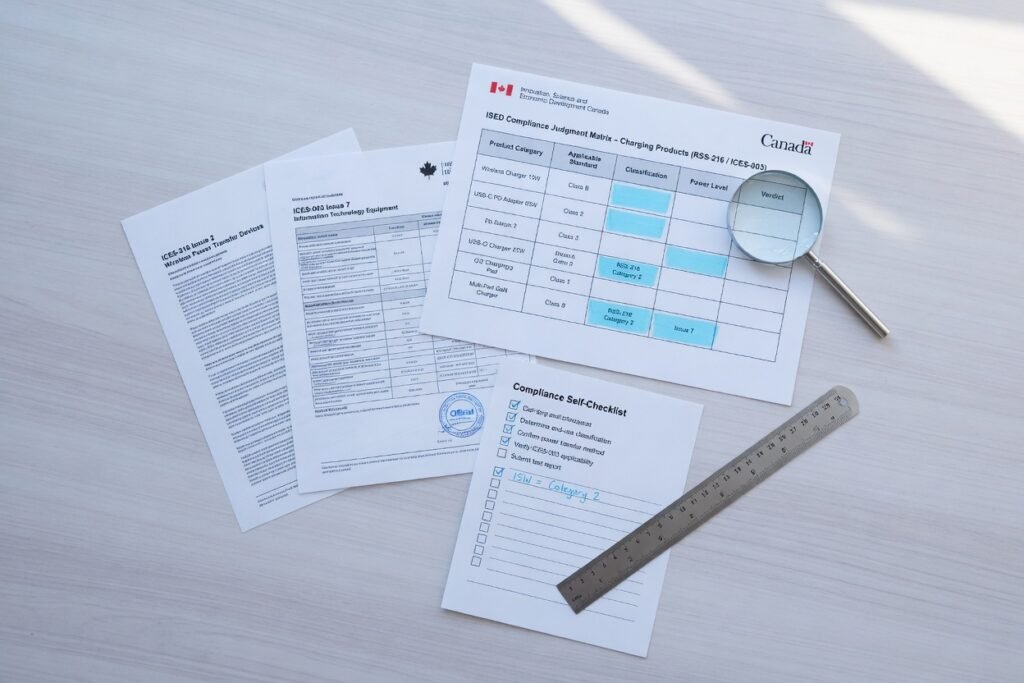
Judgment Case Matrix of Common Charging Products
To make it more intuitive for you to compare, we have sorted out the preliminary judgment conclusions of 8 most common charging products for your quick reference:
| Product Type | Preliminary Judgment Conclusion | Conditions for Further Verification |
| 65W Wired PD Fast Charger | Usually does not involve radio transmitting certification, need to further verify whether ICES EMC requirements are applicable | Internal circuit structure, digital circuit clock frequency, interface type, whether it falls within the applicable scope of standards such as ICES-003 |
| Multi-Port USB-C Charger with Power Display | Usually does not involve radio transmitting certification, high probability of entering ICES EMC applicability verification | Display circuit parameters, operating mode of intelligent distribution chip, whether it falls within the applicable scope of corresponding ICES standards |
| 5W Desktop Wireless Charging Base | Need to enter WPT category radio compliance screening | Operating frequency, transmission method, power/field strength, device classification, determine specific compliance path |
| 65W Fast Charger with Bluetooth APP Control | Need to conduct radio compliance assessment, and also verify whether ICES EMC requirements are applicable | Bluetooth module parameters, whole machine RF performance, applicable standards for digital circuits |
| Ordinary Chip-Free USB-C to C Charging Cable | Usually does not fall within ISED radio regulatory scope | Confirm no built-in active electronic components, no wireless function, check other applicable regulations (such as safety) requirements |
| USB-C Fast Charging Cable with Only E-Marker Chip | Usually not treated as radio transmitting device, whether ICES compliance document is needed needs further verification | Confirm only contains E-marker, no other active functions such as signal conversion/display/wireless, check applicable ICES scope |
| 20000mAh Power Bank with Wireless Charging | Need to enter WPT category radio compliance screening, and also verify whether ICES requirements are applicable | Wireless charging operating frequency, transmission parameters, digital circuit situation and applicable standards |
| Car Charger with FM Transmission Function | Need to conduct radio compliance assessment | FM transmission frequency band, power, Bluetooth (if any) parameters and corresponding RSS specifications |
Summary
For charging products targeting the Canadian market, the core of the applicable scope of ISED depends on the product’s functions and parameters: those with active wireless communication or wireless power transfer functions need to first enter radio compliance screening, and then determine the specific path according to the corresponding RSS specifications; wired products with digital circuits need to first verify whether they fall within the applicable scope of ICES electromagnetic compatibility standards, and then determine the assessment requirements.
If you encounter boundary situations that are uncertain, you can first conduct a pre-assessment with a third-party laboratory with ISED qualifications or a formal agent. The final compliance conclusion shall be subject to the verification results of ISED official rules, database records and product technical data, to avoid losses such as customs detention, fines or platform delisting caused by misjudgment.