
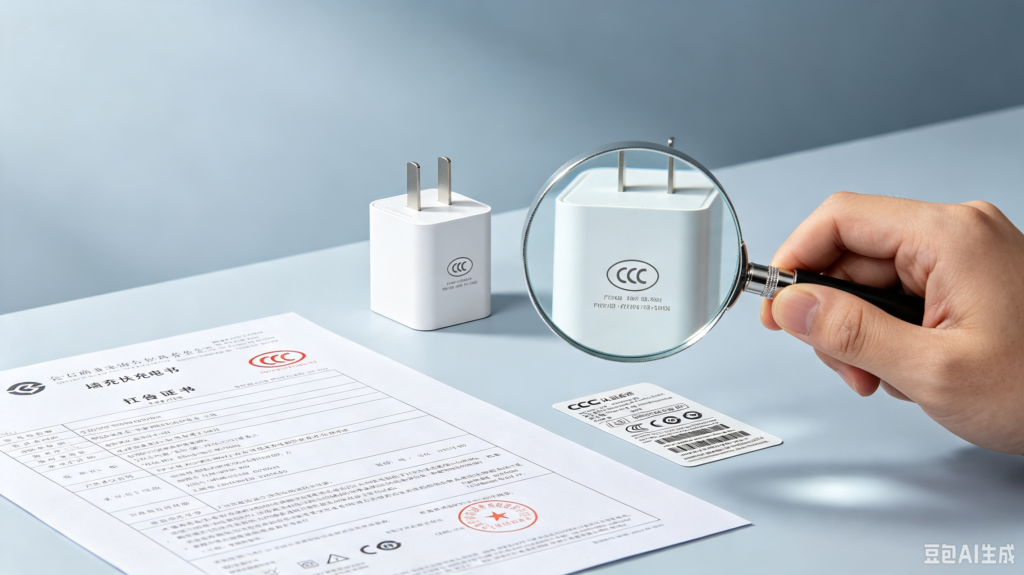
If you often buy Chinese-made fast chargers via cross-border online shopping, or plan to sell charging products to the Chinese market, you must have seen the oval mark composed of three Cs printed on the side of chargers — that is the CCC mark. Many people have only a partial understanding of it: some think it is a “golden seal of quality”, some believe all charging cables must have it, and others confuse it with CE or UL marks.
Basic Knowledge: First Understand What the CCC Mark Is
Let’s start with the most straightforward explanation: the CCC mark is the “safety ID card” issued by China for charging products — only products that have passed official mandatory safety testing are eligible to have this mark printed on them. Its official full name is the “Official Mark of China Compulsory Certification (CCC)”, and its core attribute is a safety access threshold. It only means that the product’s safety items such as electric shock protection, insulation, heat resistance, and abnormal operation meet the requirements of China’s mandatory standards. It reduces safety risks, but does not equal a promise that the product will not malfunction or that accidents will absolutely never happen, nor does it mean that its charging speed, durability, or performance are better than products without the mark. This point must be clarified first.
Many people confuse the CCC mark with the CCC certificate. In fact, the two have a “surface and essence” relationship: the mark is a symbol printed on the product body that can be seen at a glance; the certificate is an official document issued by the authority, which clearly states information such as the product models covered by the certification, manufacturing factory, applicant, and certification scope. It is not legal just because a CCC mark is affixed. The use of the mark is legal only when the certificate is genuine and valid, and the product is fully within the scope covered by the certificate. For example, for two chargers made by the same factory using a common mold, the 20W model has passed CCC certification, but the 65W model has not. If the same CCC mark is also affixed to the 65W model, it is a violation.
For overseas users with different identities, the value of the CCC mark is completely different: when individual buyers purchase Chinese-made charging products via cross-border online shopping, a clear CCC mark on the product body is an intuitive basis for judging basic safety compliance, which can greatly reduce the risk of buying unqualified products that have not undergone safety testing; for cross-border e-commerce merchants who want to sell charging products to the Chinese market, the CCC mark is a necessary condition for legal sales, and without it, products cannot enter formal channels; for enterprises that import products in bulk into China, the CCC mark is a core item of customs inspection, and non-compliance will directly lead to goods being detained or even fined.
Many overseas users confuse CCC with certification marks they are familiar with. Here is a clear distinction: First, CE, FCC, UL, PSE and other marks common in markets or certification systems such as the European Union, the United States, North America, and Japan cannot replace CCC at all. Even with 10 overseas certifications, CCC is still required to enter the Chinese market; second, the CCC mark is not an energy efficiency mark, an environmental protection mark, let alone a brand logo, it is only responsible for safety access; finally, the certification number/factory code below the CCC mark is completely different from the product’s model number, batch number, and serial number. Many people use the product model to check CCC certification, and think it is fake if they can’t find it, but in fact they are looking for the wrong number.
Here we first clarify the two most common beginner misconceptions:
First, “having a CCC mark = the product will not break” — wrong. CCC is only the minimum safety threshold, and does not guarantee performance and durability. For example, a charger that has passed CCC certification may fail to charge after half a year of use, and it meets the requirements as long as it has no safety hazards;
Second, “all charging products need a CCC mark” — wrong. For common charging products, those involving mains AC-DC conversion usually require mandatory certification, while pure low-voltage charging accessories do not. We will explain this in detail next.
Mandatory Scope Judgment: Which Products Must Be Affixed with the CCC Mark
Let’s teach you a quick judgment method that can be used in 10 seconds: the core is to see whether this product can be directly plugged into China’s 220V national standard wall socket (flat-pin two-hole/three-hole household socket). If it can be plugged directly, it is highly likely to be within the CCC mandatory scope; the auxiliary judgment standard is whether it has the function of converting 220V alternating current into low-voltage direct current (also known as AC-DC conversion). If both conditions are met, the probability of being within the mandatory scope is higher. This is only a quick preliminary screening method, and the final result is still subject to the current CCC catalog, product category, rated input, and certificate coverage scope.

Typical Charging Categories That Must Be Affixed with the Mark
Specifically for charging products, the following categories must be affixed with the CCC mark:
- Wall-plug chargers: various fast chargers and travel chargers with national standard pins;
- Power adapters: laptop power supplies and desktop power supplies with AC input;
- Integrated charging cables: charging cables where the AC plug and cable are connected together, with a built-in power conversion module inside the plug;
- Charging devices with AC input: wall-plug desktop multi-port charging docks and plug-in wireless chargers.
Typical Charging Categories That Do Not Need to Be Affixed with the Mark
Conversely, the following types of charging products do not need to be affixed with the CCC mark:
- Pure USB/USB-C data cables: without any AC conversion function, only transmit low-voltage electricity and data;
- Car chargers: only draw 12V/24V low-voltage electricity from the car’s cigarette lighter port, and do not involve 220V conversion;
- Portable charging docks/expansion docks with only USB-C input: no AC plug, rely on the C port to input low-voltage electricity;
- Pure adapters: only change the shape of the interface, without voltage transformation or rectification functions.
Easy-to-Mistake Boundaries in Scope Judgment
In actual judgment, there are several boundaries that are easy to fall into pitfalls, which need attention:
First, same appearance does not equal same certification scope. Many chargers use common mold shells and look exactly the same, but their power, input voltage, and internal circuit solutions are different. Maybe only one of them has passed CCC certification, so you cannot default that all products with the same appearance have certification;
Second, products sold in sets or separately must be judged individually. For example, for a “charger + data cable” set, the charger requires CCC, but the pure data cable does not. You cannot say that because the entire set is certified, the data cable should also be affixed with the CCC mark, or use the charger’s certification to endorse the data cable;
Finally, cables or adapters with power supplies need to be re-judged, not all cables and adapters are exempt from certification — for example, integrated charging cables with AC plugs and built-in conversion modules, or wall-plug USB adapters, are within the mandatory scope and must be affixed with the mark because they have AC-DC conversion.
Standard Appearance and Beginner Counterfeit Identification: 3 Steps to Eliminate Most Fake Marks
Now that we know which products must have the mark, the most practical thing next is how to tell the authenticity of the CCC mark at a glance. Let’s start with the standard appearance:
A formal CCC mark has several core features: the overall shape is oval, and the three “C” letters are evenly arranged inside the oval; a unique factory code or certification number is usually printed below the mark; there is no mandatory requirement for the color of the mark, as long as it forms a clear contrast with the product shell and can be clearly identified — for example, a white mark on a black charger, or a gray or black mark on a white charger, are both legal. It is not that only black CCC marks are real.
There are many manufacturing processes for CCC marks, all of which are compliant. Don’t think that only one type is real: the most common is the adhesive type, which is mostly used for small-sized fast chargers, because the shell area is small, so a small label is enough; followed by silk screen printing or molding, which are mostly used for high-power power adapters and large-sized chargers, directly printed on the shell, more wear-resistant; there is also laser engraving, which is generally used on high-end charging products with metal shells, with good texture and will not fall off.
Individual buyers do not need to check the system, and can eliminate most fake marks with 3 steps by naked eye:
The first step is to look at the shape. The real mark is a standard oval, with three Cs arranged evenly and in coordinated proportions. Fake marks are often made into a circle, or the Cs are skewed, of different sizes, or out of proportion;
The second step is to look at the number. There is a clear unique number below the real mark. Fake marks either have no number, or are printed blurrily, or even print a random string of numbers to make up the number, with the wrong number of digits;
The third step is to look at the process. The printing or engraving of the real mark is very clear and will not lose paint. The adhesive mark is also affixed flat, without edge curling or blistering. If it falls off with a light scratch by hand, it is most likely fake.
It should be noted that naked eye counterfeit identification can only eliminate obvious fake marks, and cannot prove that the certificate is genuine and valid; if you need to confirm that the product is fully compliant, you also need to verify the certification information through official channels.
Legal Usage Requirements: Having a Mark Does Not Necessarily Mean Compliance
Some people may ask: as long as the mark is real and the product has passed certification, is it necessarily compliant? Not necessarily. There are clear legal requirements for the use of the CCC mark. Even if the product has passed certification, incorrect use of the mark is still a violation.
First is the position requirement: the CCC mark must be affixed or printed on a conspicuous position of the product body, such as the side of the charger or the bottom of the power adapter, and cannot be blocked by pins, anti-slip pads, or factory protective film for a long time. For example, for a charger with foldable pins, if the CCC mark is printed on the side that is blocked after the pins are folded, it cannot be seen normally, which is a violation. Here is a special reminder: if the CCC mark is only on the outer packaging box or instruction manual, but not on the product body, it is a violation; the CCC mark on e-commerce product detail pages and promotional pictures also cannot replace the physical mark on the product body.
Second are the size and clarity requirements: the CCC mark only needs to be scaled proportionally according to the official style, and there is no unified minimum size — small-sized chargers can use small-sized marks, but must ensure that they can be clearly identified by the naked eye. In addition, the mark must be firm enough. If it is worn to the point of being unrecognizable under normal use, it is also non-compliant.
The most important point is that the certification information corresponding to the mark must completely match the product, specifically meeting three consistencies:
First is model consistency: the model on the certification certificate must be exactly the same as the model actually marked on the product, and cannot be misattributed;
Second is subject consistency: the manufacturing factory and certification applicant on the certificate must match the actual manufacturer and brand owner of the product. ODM and OEM products must also be consistent with the information on the certification documents, and certificates of different brands cannot be mixed;
Third is status consistency: the certification certificate must be within the validity period. If the certificate has been suspended, revoked, or cancelled, even if the product has passed certification before, the CCC mark can no longer be used.
Common illegal usage situations include: privately affixing the mark without obtaining CCC certification, forging or altering the CCC mark, fraudulently using the certification mark of other manufacturers, and using it beyond the certification scope (for example, using the 20W certification to affix the mark to a 65W product). These illegal acts may lead to multiple consequences: in the import link, they may face customs detention, ordered rectification, return or confiscation; in online sales, they may be removed from the platform by the platform, and may also be subject to administrative penalties by regulatory authorities. If a safety accident is caused, they also need to bear the responsibility for consumer claims.
Mark Usage Differences of Common Categories
Different types of charging products have different CCC mark usage habits due to different volumes and structures. Several of the most common products are as follows:
- Small wall-plug fast chargers: Due to their small size, most use the smallest size adhesive marks or laser-engraved marks, usually located on the side or bottom; for models with foldable pins, the mark must never be printed on the surface that is blocked after the pins are folded.
- Laptop/high-power power adapters: This type of product has a large shell area, generally uses silk screen printing or molding processes, with very clear mark definition. Many also print the factory code for easy verification of certification information.
- Charging cable products: For integrated charging cables with AC plugs, the mark must be printed on the AC plug body, not on the cable body; pure USB/USB-C data cables do not need to be affixed with the CCC mark; for charging cables with adapters, only the adapter with AC conversion function needs to be affixed with the mark, and the cable itself does not.
- Desktop charging docks/plug-in wireless chargers: Desktop models with AC input must be affixed with the mark on the base body; portable models with only USB-C input do not need the CCC mark because there is no AC conversion.
Compliance Verification and Pitfall Avoidance Methods
If you are purchasing in bulk or doing cross-border sales, you need a complete set of compliance verification methods; individual buyers can also use it to verify high-risk products.

4-Step Logic of Compliance Verification
Compliance verification must be carried out in order, otherwise it is easy to do useless work. There are 4 steps in total:
The first step is to first judge whether the product is within the CCC mandatory scope — if it is a product that does not require certification such as a pure data cable or car charger, there is no need to check further;
The second step is to check whether the appearance, position, and clarity of the mark meet the requirements mentioned above;
The third step is to verify whether the product’s model, parameters, and production subject are consistent with the information on the certification document;
The fourth step is to go to the official platform to check whether the current status of the certification certificate is valid.
Official Public Query Method
The official channel for querying CCC certification is the public query platform of the Certification and Accreditation Administration of China, which is completely free and open to everyone. When querying, you can enter the certification number, product model, or name of the manufacturing enterprise. There are three core points to verify: whether the certificate is within the validity period, whether the model of this product is within the certification coverage scope, and whether the information of the manufacturing factory matches. Even if you don’t understand Chinese, you can directly query with the pure digital certification number, and it is easy to understand the core status with the help of translation tools.
Pitfall Avoidance Tips for Overseas Individual Buyers
For overseas individual buyers, you don’t need to check the system every time, just remember three pitfall avoidance tips:
First, prioritize looking at real photos of the mark on the product body, and don’t only refer to the mark in the promotional pictures on the detail page (display on electronic channels cannot replace the physical mark on the product body);
Second, look at the price. If the price of a 65W gallium nitride fast charger is far lower than the market price and the mark is blurry, it is most likely a fake mark;
Third, be wary of misleading publicity. For example, if a pure data cable claims to be “CCC certified”, there must be a problem, because pure data cables do not need CCC at all. Products with randomly affixed marks are even more suspicious, and low-price white-label chargers also have a high risk of fake marks.
Inspection Checklist for Overseas Merchants/Bulk Purchasers
If you are an overseas merchant or purchasing in bulk, you need to conduct inspections according to the whole process:
- Before procurement: first confirm whether the product is within the mandatory scope, require the supplier to provide the CCC certificate of the corresponding model, and first verify whether the information matches;
- Before mass production: confirm that the position, size, process, and parameters of the mark are consistent with the certification documents to avoid printing errors;
- Before import/listing: check the validity of the certificate again, spot-check whether the mark on the physical product is clear and whether it is blocked. Absolutely do not conduct out-of-scope publicity, for example, you cannot call pure data cables “CCC certified high-quality cables”;
- Problem handling: if a suspected violation is found, first suspend sales or temporarily detain the goods, verify the certification documents, and contact the certification body for confirmation if necessary. Do not take chances.
Usage Rules for Special Scenarios
In addition to conventional products, there are several rules for special scenarios that many people easily confuse. Here is a unified clarification:
- Charging products imported into China: Many overseas brands think that because they are foreign, they do not need CCC to enter China. In fact, this is not the case — all charging products that are in the CCC mandatory catalog and sold within China, whether domestic or imported, must use the CCC mark in accordance with certificate and mark rules; products not in the catalog such as pure low-voltage cables and car chargers are not subject to this requirement. The requirements for the use of CCC marks on imported products are exactly the same as those on domestic products, and overseas certifications such as CE and UL cannot replace CCC.
- Charging products for export only: If the product is only sold overseas and does not enter the Chinese market at all, there is no need to affix the CCC mark; but if the same product is sold both domestically and overseas, the version sold in the Chinese market must meet the CCC mark requirements.
- Repaired/refurbished products: Formal repairs should maintain the consistency of the original certification structure, nameplate, and mark information, and must not damage or remove the original CCC mark; when shell replacement, nameplate reproduction, or internal circuit changes are involved, the certification holder shall confirm whether it is still within the certification scope, and the original mark cannot be used privately without authorization. Refurbished machines with privately replaced shells or modified internal circuits (for example, changing the internal of a 20W model to 65W) will have their original CCC certification invalid and cannot be sold legally.
- Shared nameplates for multi-country versions: Many brands make global products, and it is allowed to print certification marks of multiple countries on the same nameplate — CCC can be placed side by side with CE, FCC and other marks, but each mark must be independent and clear, cannot block each other, and cannot share patterns (for example, mixing the C of CCC with the C of CE). In addition, the model and input/output parameters of the version sold in the Chinese market must completely correspond to the information on the CCC certificate, and the model sold domestically cannot be different from that on the certificate.
Core Capability Summary
Finally, we condense the compliance judgment logic of the full text into 3 progressive core criteria, which can be quickly applied whether it is individual buyers verifying products or merchants conducting compliance inspections:
- Determine the scope first: The prerequisite for judging the compliance of the CCC mark is to confirm that the product is within the mandatory certification category. Products not in the catalog do not need to check the mark, to avoid doing useless work;
- Then verify the match: For products within the mandatory scope, not only must the product body have a clear and compliant CCC mark, but also ensure that the certification model and production subject corresponding to the mark are completely consistent with the actual information of the product;
- Dynamic verification: The legality of the CCC mark changes dynamically with the status of the certificate. Once the certificate is suspended, revoked, or cancelled, the use of the original mark is no longer compliant. It is necessary to confirm that the certificate is currently valid before sales or procurement.