
If you sell charging products and want to enter the South Korean market or list on local platforms such as Coupang and Gmarket, KC certification is the first unavoidable access threshold. Many new sellers only know KC as “a Korean certification mark”, and easily fall into pitfalls when actually applying: either they find the wrong institution and get an invalid certificate, or they choose the wrong path and incur extra costs, or they only find out that the product lacks radio wave compliance when the goods arrive at the port and are detained by customs. Starting from the actual scenarios of charging products, this article sorts out the essence of KC certification, scope judgment, full process steps, segmented product requirements, cost and cycle, and post-certification compliance key points, to help you from beginner to independently judging the compliance direction.
Must-Know for Beginners: KC Basics and Scope Judgment
First of all, we must clarify the most core understanding: the KC mark is a mandatory compliance mark for charging products marketed in South Korea, not a quality award. That is to say, passing KC certification only means that the product meets South Korea’s minimum safety and radio wave requirements, and does not represent how good the quality is, but without it, the product cannot be legally marketed at all.
Many people think KC is a single certificate, but that is not the case. KC is South Korea’s unified compliance mark, but it is backed by two completely independent regulatory systems:
- KATS (Korea Agency for Technology and Standards) under the Ministry of Trade, Industry and Energy, is responsible for electrical safety regulation, such as requirements related to electrical safety like electric shock protection, overheating, and short circuit;
- the National Radio Research Agency (RRA), which is responsible for EMC (Electromagnetic Compatibility, simply put, the product does not interfere with other devices during operation nor is it interfered with) and RF (Radio Frequency, that is, compliance related to wireless signals, such as signals from wireless charging) regulation.
That is to say, the KC mark you see is actually a unified mark that can only be used after both “safety compliance + radio wave compliance” are passed. A single certificate cannot cover everything; the application, testing, and certification issuance of the two lines are carried out separately.
If you sell products to South Korea without KC certification, the consequences are more serious than you think: first, customs will directly detain the goods, and they cannot clear customs at all; mainstream e-commerce platforms require filling in the KC certification number when listing, and without it, you cannot even create a listing; if found by market supervision, there will be administrative fines, and in serious cases, all sold products may even be recalled.
There is another common misunderstanding: many sellers use CE, FCC or UL reports to apply for KC, thinking that all safety tests are interchangeable. In fact, KC and the certification systems of other countries are not mutually applicable and cannot replace each other; testing and application must be re-conducted in accordance with South Korean standards.
Mandatory Scope Judgment for Charging Products
Does your charging product need KC certification? It is divided into three categories according to requirements:
- Mandatory products: Plug-in chargers, PD fast chargers, AC/DC power adapters, desktop charging stations, wireless charging pads. All mass-produced products sold to South Korea must undergo KC compliance.
- Products requiring separate assessment: Charging cables with E-Marker chips (with active circuits, higher risk than ordinary cables), car chargers (DC input, not directly plugged into mains power, lower risk), and replaceable plug adapters (involving plug safety, requiring separate structural review).
- Exemption cases: Small quantities of samples for personal use, non-sale test prototypes, but they must meet the relevant requirements of customs, and bulk sales under the guise of samples are not allowed.
Three Certification Paths for KATS Safety Category
After confirming that KC certification is required, first of all, you need to figure out the three certification paths for KATS safety category, which are divided according to product risk from high to low, and the strictness of supervision is also different:
| Certification Path | Risk Level | Core Requirements | Examples of Charging Products That May Be Involved (final subject to official product catalog and certification institution judgment) |
|---|---|---|---|
| Mandatory Safety Certification | High | Third-party laboratory testing + factory audit + certificate issued by certification institution designated by the KATS system | High-risk AC input products such as high-power AC fast chargers and high-power desktop charging stations |
| Self-Regulatory Safety Confirmation | Medium | Third-party laboratory testing + document review + certificate issued by certification institution designated by the KATS system, no factory audit required | Medium-risk AC input products such as ordinary mobile phone AC chargers and medium-power adapters |
| Supplier’s Declaration of Conformity (SDoC) | Low | Enterprises retain test reports and conformity declarations on their own, no official certificate issuance required | Ordinary passive charging cables, low-risk accessory products |
There are three main reference factors for judging the path: whether it is directly plugged into AC mains power, power level, and whether it has active circuits or fast charging functions — the higher the risk, the stricter the supervision. However, these are only references for preliminary judgment. The specific certification path for charging products shall ultimately be subject to KATS’s official product catalog or the judgment of a formal certification institution, and cannot be classified solely based on power or input type.
For example, for adapters with the same AC input, different power and different structures may belong to different paths; in addition to KATS safety, wireless chargers also need to apply for RRA RF certification; car chargers have lower risk because of DC input, so they need to be assessed separately; active charging cables with E-Marker have higher risk than passive cables, and their paths also need to be assessed separately.
Pre-Application Preparation: Core Premises to Avoid Pitfalls
After figuring out the basic rules and the general direction of the product, don’t rush to send samples. Pre-application preparation is the core of reducing subsequent detours.
Required: Local South Korean Agent
The first mandatory requirement, which is also the most easily overlooked by overseas sellers: overseas enterprises cannot directly apply for KC certification, and must entrust a legally registered local entity in South Korea as their agent.
The role of this agent is not just to help you submit materials, but also to be responsible for liaising with South Korean official authorities, handling communication during testing and review, following up on subsequent changes and supervision, and more importantly, bearing local compliance legal responsibilities in South Korea — equivalent to your compliance responsible person in South Korea.
A special reminder here: you must prioritize selecting formal qualified entities with experience in charging product services, and do not look for unqualified individuals or small intermediaries. Otherwise, at best, communication efficiency is low, and at worst, the certificate obtained is invalid, wasting money and delaying progress.
Roles and Responsibility Boundaries in the Whole Process
Many people cannot distinguish the roles of all parties in the application process and often contact the wrong person. Here we clarify the responsibility boundaries:
- Manufacturer/Overseas Seller: Need to provide real product materials and samples, cooperate with rectification requirements during testing. The most important thing is to ensure that mass-produced products are completely consistent with the submitted test samples, otherwise you will be responsible for problems in subsequent spot checks.
- South Korean Agent/Importer: This is the liaison entity recognized by South Korean official authorities, which must bear local compliance legal responsibilities, and all official communication is conducted through them.
- Certificate Holder: The holder on the certificate can be the manufacturer or the South Korean importer, but must meet the corresponding qualification requirements.
- Testing Laboratory: Must have corresponding testing qualifications from KATS or RRA to issue officially recognized test reports; not any laboratory can do this.
- Certification Institution: Responsible for reviewing materials and test reports, issuing certificates, and carrying out subsequent factory inspections and market supervision — note that laboratories conduct testing, and certification institutions issue certificates; do not confuse them.
- Customs/E-commerce Platforms: Responsible for verifying the validity of certification. Without compliance certificates, goods cannot clear customs nor be listed for sale.
Confirmation of Official Product Items and Certification Combinations
Next, you need to confirm the official product items corresponding to the product and the required certification combination. If this step is wrong, all subsequent work will be in vain.
When confirming, several core dimensions need to be checked: Korean product name, HS code, input/output type (AC or DC), power level, whether it has wireless or fast charging functions, and whether it is a product sold as a set.
There are two confirmation methods: one is to query the official catalogs of KATS and RRA by yourself, but they are all in Korean, which is not very friendly to overseas sellers; the other more reliable method is to entrust a South Korean agent or a qualified certification institution to conduct a pre-assessment. They are more familiar with the classification of charging products and can reduce the probability of errors.
For charging products, common certification combinations are as follows:
- Ordinary AC chargers/adapters: KATS safety certification + RRA EMC registration
- Wireless charging products: KATS safety certification + RRA EMC registration + RRA RF type certification
- Passive USB charging cables: Assess for SDoC, or conduct supporting certification together with the main product
In addition, note that some charging products also need to meet South Korea’s standby power consumption or energy efficiency requirements, which should also be confirmed in advance and not missed.
Selection of Certification Institutions/Laboratories
When selecting certification institutions and laboratories, the core is to look at qualification matching: prioritize selecting service providers that can cover KATS safety and RRA EMC/RF testing qualifications, or can coordinate corresponding accredited laboratories and certification issuing institutions, and their qualification scope must cover relevant testing items for charging products; if different institutions are selected to be responsible for safety, EMC, and RF links respectively, ensure that all parties have corresponding official accredited qualifications to avoid connection problems.
Prioritize institutions with experience in similar charging product projects, such as those that often handle fast chargers and wireless chargers. They are more familiar with the standards, can help you find problems in advance, and reduce the number of supplementary submissions and rectifications.
There are two pitfalls that must be avoided here: First, do not choose institutions that can only do testing but cannot liaise with official certificate issuance. Otherwise, after getting the report, you have to find an institution to go through the certification process by yourself, which wastes time. Second, never believe the claims of “guaranteed pass” or “certificate without testing”. KC is a mandatory certification controlled by South Korean official authorities, and all tests must be conducted in accordance with standards. Those who claim guaranteed pass either provide fake certificates or charge extra fees later in disguise.
Preparation Checklist for Charging Product Materials
Material preparation is also a place where many people get stuck. Preparing everything in advance can save a lot of time. The materials required for charging products mainly fall into the following categories:
- Basic Product Information: Model, rated input and output parameters, interface type, plug form, supported fast charging protocols. These must be accurate and cannot be falsely labeled.
- Technical Materials: Circuit schematic diagram, list of key components (such as transformers, MOSFETs, optocouplers, etc.), product appearance and internal photos, 2-4 formal mass-produced samples — note that they must be mass-produced versions, not engineering prototypes.
- Compliance Documents: Korean label draft, Korean instruction manual, applicant’s qualification documents, power of attorney from the South Korean agent. If it is an OEM/ODM product, a brand authorization letter is also required.
If multiple models are applied for together, as long as the core circuit, power, interface, and plug are the same, they can be assessed jointly, and each model does not need to be tested separately, but a description of the differences between different models must be provided.
Finally, a consistency requirement must be emphasized: the materials you submit, the test samples you send, and the products you mass-produce later must have exactly the same model, parameters, and structure. Otherwise, even if you get the certificate, it will be invalidated if inconsistency is found later.
Full Process Practice of KC Certification (Exclusive for Charging Products)
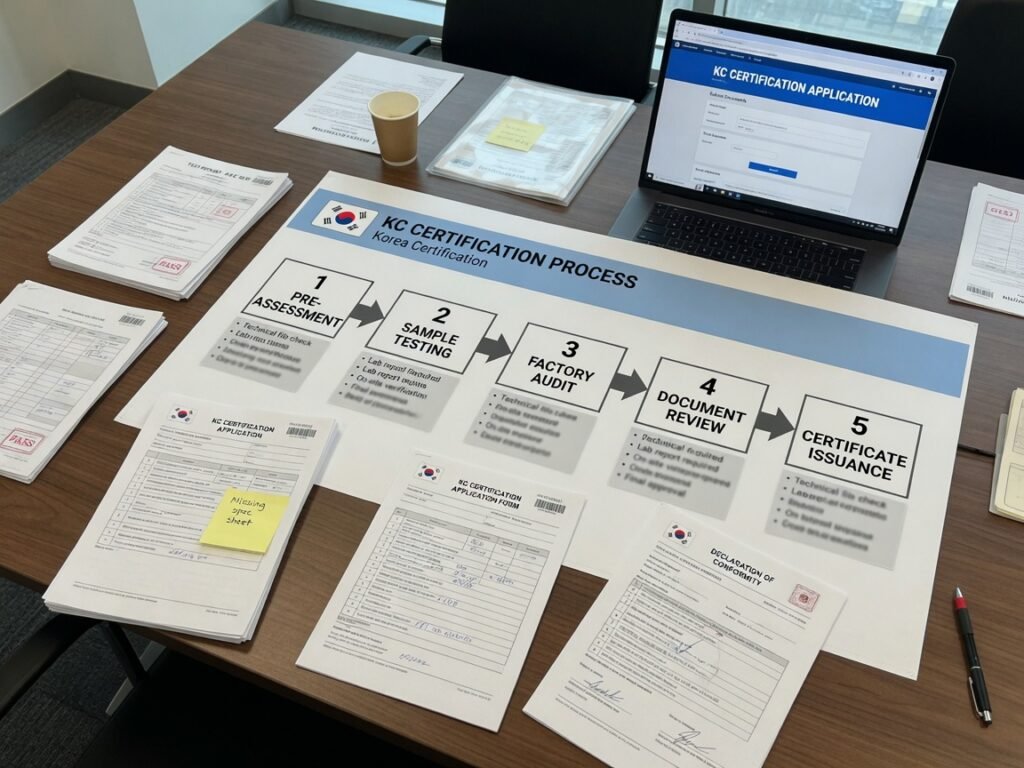
After all preparations are done, you can enter the formal application process. There is a core rule for KC certification of charging products: the KATS safety line and the RRA EMC/RF line can submit samples simultaneously and proceed in parallel, without waiting for one line to be completed before starting the other. This can save a lot of time. Only after both lines are fully compliant can the product be legally marketed.
Phase 1: Pre-Assessment and Application Submission
The core action is to submit the prepared product materials to the certification institution, so that they can pre-assess the corresponding safety certification path of the product, whether EMC/RF is required, and what the specific testing scope is.
There are several exclusive checkpoints for charging products that must be clearly confirmed: whether the input type is AC or DC, what the power is, and whether it has wireless charging or fast charging functions. These directly determine the certification path and cost. Once chosen incorrectly, if the application is rejected by the official authority later, you have to go through the process again, wasting time and money.
The focus of the preliminary review for the two lines is also different:
- KATS Safety Line: Mainly confirm whether you belong to the mandatory, self-regulatory or SDoC path, and which safety standard is applicable.
- RRA Line: Mainly confirm whether EMC registration is required, whether RF certification is required, and which radio wave standard is applicable.
If the preliminary review fails, it is usually due to incomplete materials or classification problems. Just supplement the materials or adjust the classification as required and resubmit.
Phase 2: Sample Testing and Rectification
After passing the preliminary review, you enter the sample testing and rectification phase.
First of all, note that the submitted test samples must be completely consistent with the officially sold version for the South Korean market. The focus of verification varies by category: plug-in AC chargers must adopt a round-pin plug structure that meets South Korean standards; products with external power cords and car input must ensure that the input end specifications, labels, rated parameters, and instruction manuals are consistent with the Korean version; for products such as wireless charging pads and charging cables, the focus is on checking labels, interfaces, rated parameters, and accompanying accessories. Inconsistent versions for other regions must not be used for testing, otherwise the testing will be in vain and will not be recognized by the official authority.
The core testing items of charging products are divided into three categories:
- Safety Category (KATS System): Mainly tests electric shock insulation, overheating protection, short circuit protection, shell flame retardancy, interface safety, etc., all of which are directly related to electrical safety.
- EMC Category (RRA System): Tests electromagnetic compatibility, that is, the interference and anti-interference ability of the product during operation. A reminder here: fast charging products, especially those with GaN solutions, have a much higher probability of failing EMC than ordinary chargers due to high switching frequency, so you should be prepared in advance.
- RF Category (RRA System): Only products with wireless functions such as wireless charging, Bluetooth, and WiFi need to be tested, such as wireless charging pads. It mainly verifies that wireless signals meet South Korea’s radio wave requirements and will not interfere with other devices.
During testing, not all items are tested one by one repeatedly. For example, multi-port charging products are assessed according to the most unfavorable working conditions, various output combinations, and maximum load. It is not necessary to conduct a full set of tests for each interface separately, which can save testing cost and time. The mechanical reliability of USB interfaces (such as plug and unplug times) is assessed according to applicable standards. Some platforms or buyers may have stricter requirements, which should be confirmed with the customer or platform in advance.
There are several common reasons for non-conformity of charging products: excessive temperature during charging, false power labeling, EMC exceeding standards, and substandard safety structure (such as insufficient creepage distance). If the test fails, there is no need to retest all items; only the unqualified items need to be retested. However, if the rectification is caused by the change of key components, the testing scope must be re-assessed, and other items may need to be added for testing.
Phase 3: Factory Audit (Only Required for KATS Mandatory Safety Category)
After passing the test, do you just wait for the certificate? Not necessarily. Only products that follow the KATS mandatory safety certification path need to go through the factory audit link.
Factory audits are only for high-risk AC input charging products, such as high-power fast charging adapters and high-power desktop charging stations. Medium-risk self-regulatory safety confirmation and low-risk SDoC do not require factory audits.
The core of the audit is not to see how big the factory is or how advanced the equipment is, but to check whether the production process can ensure that mass-produced products are consistent with the test samples, that is, consistency control.
The audit method can be on-site audit or remote audit, depending on the requirements of the certification institution. If the audit fails, rectification must be carried out as required, and a re-inspection will be conducted after the rectification is completed. Only after passing can you enter the next phase.
Note here that RRA’s EMC and RF certifications do not have mandatory factory audits, and mainly rely on sample testing and document review. So don’t think that all KC certifications require factory audits.
Phase 4: Document Review and Certificate Issuance
After all tests and factory audits (if required) are passed, you enter the document review and certificate issuance phase.
The focus of review for the two lines is different:
- KATS Safety Line: Mainly check whether the test report is qualified, whether the product materials and labels are consistent, and whether all applied models are covered.
- RRA Line: Mainly check whether the EMC/RF test reports and technical parameters meet the requirements of radio wave regulations.
After passing the review, the vouchers you get are also different. Many people think they are all a KC certificate, but that is not the case:
- For mandatory or self-regulatory safety certification, you will get a safety certification certificate issued by a designated certification institution under the KATS system, with a unique number, and the certificate information can be queried on the KATS official system.
- For SDoC, there is no officially issued certificate; you only need to keep the test report and conformity declaration by yourself.
- For EMC/RF compliance, you will get a conformity registration certificate or type certification certificate issued by the corresponding institution under the RRA system, which also has a separate number, and the information can be queried on the RRA official system.
The authenticity of the certificate can be queried by entering the number on the official websites of KATS and RRA respectively. Since they are two systems, they need to be queried separately.
Finally, note that only after both the safety and radio wave lines are compliant can you mark the KC mark and corresponding number on the product in accordance with the specifications. You cannot mark KC only after passing safety, which is non-compliant.
Exclusive Compliance Key Points for Segmented Charging Products
The above is the general process, but charging products have many forms, and different products have different compliance key points. We will pick a few common segmented categories to explain.
Chargers/Power Adapters
- For plug-in chargers, the plug must meet South Korea’s round-pin specifications. Even if it has a replaceable plug design, the equipped Korean adapter must also meet South Korea’s plug safety requirements.
- For multi-port or high-power chargers, the safety risk level is determined according to the highest power and the most unfavorable output combination. For example, a 100W four-port charger is assigned a path based on the maximum power of 100W, not the power of each port.
- For GaN or PD fast charging products, the EMC failure rate is higher than that of ordinary chargers. It is recommended to conduct pre-testing before formal testing to avoid delays caused by subsequent rectification.
- Products with multiple interfaces and multi-power output such as desktop charging stations also have their certification paths determined according to the highest risk level.
Charging Cables/USB Interface Accessories
- Ordinary passive charging cables, that is, those without chips, are usually not within the scope of mandatory safety certification. They can be assessed together with the main product as supporting products, or SDoC can be done separately.
- Active charging cables with E-Marker chips or fast charging identification functions have higher risk than passive cables due to active circuits, and their certification path needs to be assessed separately; they cannot be directly classified as ordinary cables.
- The safety standards for USB interfaces include electrical requirements, and mechanical reliability (such as plug and unplug life) is determined according to official standards and the rules of the buyer or platform. Some platforms may have higher requirements.
Special Form Charging Products
- Wireless chargers must additionally apply for RRA RF certification because they involve wireless signals, to meet the requirements of South Korea’s Radio Wave Act, otherwise they cannot be marketed.
- Car chargers have lower risk than AC input products because they use DC input (plugged into the cigarette lighter) and are not directly plugged into mains power. Whether mandatory certification is required needs to be assessed separately; not all car chargers require it.
- Replaceable plug adapters need to meet South Korea’s plug safety requirements because they are directly exposed to mains power, and their certification path also needs to be assessed separately; they cannot be equipped casually.
Application Cycle and Cost Estimation (Decision Reference)
After talking about the process and product requirements, what everyone is most concerned about must be: How long does it take to get KC certification? How much does it cost? The following are conventional references under the premise of no rectification and complete materials. The actual situation will vary due to product complexity and different institutions.
Conventional Application Cycle
- Low-risk SDoC category, such as ordinary passive charging cables, usually takes 2-4 weeks to complete.
- Medium-risk self-regulatory safety + EMC, such as ordinary mobile phone chargers, usually takes 4-8 weeks.
- High-risk mandatory safety + EMC, such as high-power fast charging adapters, takes longer due to factory audit, usually 8-12 weeks.
- Products with RF functions, such as wireless chargers, need an additional 2-4 weeks on the corresponding basic cycle.
There are many factors affecting the cycle: the number of sample rectifications, whether the materials are complete, the progress of factory inspection, and the number of applied models. For example, one rectification may take an extra 2-3 weeks, and repeated supplementary materials will also delay time. So preparing well in advance can save a lot of time.
Cost Composition and Approximate Range
First, let’s clarify that the following are reference prices for a single model under the premise of no rectification, in RMB, excluding additional fees. They can only be used as a rough reference, and the actual quotation of the institution shall prevail.
The core cost consists of three parts: testing fees (safety + EMC/RF), certificate issuance fees, and service fees of the South Korean agent.
In addition, there may be some additional fees, such as factory audit fees for mandatory categories, fees incurred from rectification, sample shipping fees, translation fees, travel expenses for factory inspections, etc. These are all calculated separately.
Approximate reference range for a single model:
- SDoC category: several thousand RMB.
- Self-regulatory safety + EMC category: 10,000-20,000 RMB.
- Mandatory safety + EMC category: 20,000-30,000 RMB.
- Products with RF functions: add several thousand to 10,000 RMB on the corresponding basis.
Why is there such a big price difference? Because different certification institutions, product complexity, and applicable standard versions will lead to different prices. For example, the testing fee for a 65W GaN fast charger is definitely more expensive than that of a 10W ordinary charger. So don’t just look at the low price; first confirm the qualification and service scope of the institution.
Cost Reduction Tips for Multi-Model Products
If you have multiple models of products, there are also some reasonable cost reduction tips:
First, series products that meet the merging conditions can share one certificate, and each model does not need to be applied for separately, which can reduce a lot of testing costs — the merging conditions are as mentioned earlier: core circuit, power, interface, and plug are the same, only the appearance or model name is different.
Second, for products with the same core components and circuit structure, many testing items can be shared without repeated testing, which can also reduce additional testing fees.
Third, confirm the product classification and certification combination in advance, and do not choose the wrong path. For example, if you treat a mandatory category as a self-regulatory category and get rejected later to redo it, you will have to spend twice the money.
Post-Certification Compliance Operation and Pitfall Avoidance Guide
Obtaining a KC certificate does not mean everything is done once and for all. Post-certification compliance operation is the key to maintaining the validity of the certificate. Neglecting subsequent requirements may lead to certificate invalidation or even fines and recalls.
Compliance Requirements for Korean Labels and Instruction Manuals
This is the most prone to problems. Many sellers have their goods detained by customs due to unqualified labels.
Product labels must include the following content: KC mark, model, input and output parameters, information of the manufacturer or importer, and Korean safety warning text.
The label must be affixed to a conspicuous position of the product and not easy to wear. The size and proportion of the KC mark must also meet the specifications, and the size or shape cannot be changed arbitrarily.
Common mistakes include: using English labels, parameters inconsistent with the certification, and missing Korean safety warnings. These will all lead to customs clearance failure, so be sure to check them in advance.
Certificate Validity Period and Maintenance Requirements
Different types of certification have different validity periods and maintenance requirements:
- KATS mandatory safety certification: The validity period is usually 5 years, but factory inspections must be conducted every year to maintain validity. If regulations are updated, it is also necessary to re-assess whether the product meets the new requirements.
- KATS self-regulatory safety confirmation: The validity period is subject to the marking on the certificate, and renewal must be done before expiration.
- SDoC: There is no fixed validity period. As long as the product is not changed and you keep the complete test report and conformity declaration, it remains valid.
- RRA EMC/RF registration/certification: Focus on the validity of registration status, model consistency, and change declaration requirements; whether there is a fixed validity period or update requirements shall be subject to the certificate category corresponding to the specific product and the requirements of radio wave regulations.
In addition, note that products of all categories may be spot-checked by official authorities or platforms. If the spot check fails, rectification is required, and in serious cases, recall is required. So don’t think that you can modify the product casually after getting the certificate.
Compliance Handling of Product Changes (Core Pitfall Avoidance)
This is the core pitfall avoidance point. Many people have fallen into this pit: after getting the certificate, they privately replace core components or adjust parameters to reduce costs, and as a result, the certificate is directly invalidated when found, and they have to pay fines.
Product changes are divided into three situations, with different handling methods:
- Changes requiring only filing: For example, changes of non-core components and brand name changes. These do not affect the structure and performance of the product, and only need to be filed with the certification institution, no re-testing required.
- Changes requiring supplementary testing: For example, charging power adjustment, interface replacement, core component changes, circuit adjustment. These will affect the safety or EMC performance of the product, so corresponding items need to be tested supplementary, and changes can only be made after passing.
- Changes requiring re-application: For example, major adjustment of product structure, change of input type (such as AC to DC), change of production address for mandatory category products. These are equivalent to a different product, and the full certification process needs to be followed again.
Never take chances and make private changes without filing. Once spot-checked by market supervision, the consequences will be very serious.
Essential Requirements for Customs Clearance and Listing
When clearing customs, the following documents are generally required: certification certificate or registration certificate, test report, Korean label sample, invoice and packing list. The specific requirements are subject to customs requirements.
For e-commerce platforms, mainstream South Korean e-commerce platforms such as Coupang and Gmarket require valid KC compliance vouchers when listing, and without them, you cannot list at all.
Some platforms also have special rules, such as requiring the certificate holder to be the brand owner or an authorized supplier. If you use the factory’s certificate, it is best to prepare the brand authorization or the certificate holder’s authorization letter in advance, otherwise the platform may not recognize it.
Common Misconceptions About Certification Validity
Finally, let’s sort out several common misconceptions about the validity of KC certification, which many people have fallen for:
- Treating SDoC as official certification: High-risk products must follow the mandatory safety certification path and cannot be replaced by SDoC; medium-risk products also cannot simplify self-regulatory safety confirmation into an enterprise-retained declaration. Both categories must meet the corresponding regulatory requirements.
- Thinking KC is a single certificate: Only doing KATS safety certification without doing RRA EMC/RF, resulting in goods being detained by customs when shipped. KC is a mark that can only be used after both safety and radio wave compliance are met, neither can be missing.
- Using others’/old certificates: Using certificates of different models from the same factory, or using certificates that have expired, will be exposed as soon as checked.
- Thinking it’s a one-and-done after getting the certificate: Failing to conduct annual supervision inspections or file for product changes, leading to certificate invalidation. For example, mandatory category certificates require factory inspections every year; if not done, the certificate will be suspended or even revoked.
Quick Self-Check and Frequently Asked Questions
Quick Self-Check Checklist for KC Certification Application
You can quickly self-check against these three points:
- Product classification self-check: Is your product directly plugged into AC mains power? What is the approximate power? Does it have wireless or fast charging functions? Is it a complete machine or an accessory?
- Application condition self-check: Have you found a qualified South Korean agent? Do you have mass-produced Korean version samples? Are the product parameter materials, Korean labels and instruction manuals all ready?
- Path judgment self-check: For high-risk AC products, follow mandatory or self-regulatory safety + EMC; for low-risk accessories, assess SDoC; if with wireless functions, add RF certification additionally.
Frequently Asked Questions
Q: How long does it take to apply for KC certification?
A: Ordinary chargers without rectification usually take 4-8 weeks, mandatory category products with high power and factory inspection usually take 8-12 weeks, and those with RF functions take an additional 2-4 weeks.
Q: How much does KC certification for chargers cost?
A: Ordinary models without rectification cost about 10,000-20,000 RMB, high-power mandatory models cost about 20,000-30,000 RMB, both excluding additional fees such as rectification and factory audit travel expenses.
Q: Do USB charging cables need KC certification?
A: Ordinary passive charging cables usually follow SDoC or are assessed together with the main product as supporting products. Active charging cables with E-Marker require separate assessment of the certification path.
Q: What is the difference between KC and RRA certification?
A: KC is South Korea’s unified mandatory compliance mark, covering two parts: electrical safety and radio wave compliance; RRA is the official regulatory agency responsible for radio wave (EMC/RF) compliance. RRA’s EMC/RF certification is part of KC compliance, not another certification independent of KC.
Q: Can CE/FCC replace KC?
A: No. KC is South Korea’s mandatory access requirement, and it is not mutually applicable with the certification systems of other countries, so they cannot replace each other.
Q: How long is the validity period of KC certification?
A: Mandatory safety certification is usually valid for 5 years and requires annual factory supervision; the validity period of self-regulatory safety confirmation is subject to the marking on the certificate; SDoC has no fixed validity period and remains valid as long as the product is not changed; for RRA EMC/RF certification, attention should be paid to registration status and change requirements, and the specific period is subject to the corresponding certificate category and regulations.
After completing the above self-check and rule sorting, you can basically independently judge the KC certification combination, process nodes, cycle and cost range, and change handling requirements for charging products, and prepare for compliance access to the South Korean market.