
If you have bought chargers or laptop power adapters in the U.S., you may have seen various energy efficiency-related markings: some printed with “DOE Level VI”, some with the blue ENERGY STAR logo, and some without a dedicated energy efficiency label. You may wonder: what do these markings mean respectively? Is a product without a yellow-background energy efficiency label non-compliant? Does a higher energy efficiency charger charge faster? The energy efficiency rules for consumer electronics may seem complicated, but when it comes to daily-use charging products, there are three core sets of rule systems. Once you sort them out, you can avoid merchant promotional traps and choose more energy-saving and more reliable products.
First, Understand the Three Core Sets of Energy Efficiency Rules
There are three core sets of U.S. energy efficiency rules related to charging products, with completely different governing agencies and functions, so please do not confuse them.
The first set is FTC EnergyGuide (yellow-background energy efficiency label), governed by the U.S. Federal Trade Commission, essentially an “energy consumption comparison card” — it is mandatory for some products to be affixed in a prominent position, so that consumers can directly compare the energy consumption levels of similar products. But note that this label is mainly for large home appliances/whole machines such as TVs, monitors, and refrigerators, and most independent chargers are not in the mandatory labeling catalog.
The second set is DOE Minimum Energy Efficiency Standard, formulated by the U.S. Department of Energy, targeting regulated charging products with wall-plug AC-DC (alternating current to direct current) conversion function, is the mandatory access threshold for the U.S. market — only products that meet the standard can be sold through formal commercial channels in the U.S. Charging products without AC-DC conversion function, such as in-vehicle DC chargers and power banks, are not within the mandatory jurisdiction of this set of standards. It has no unified mandatory labeling requirement, and the relevant energy efficiency grades are generally only marked on product parameters or nameplates.
The third set is ENERGY STAR, a voluntary high-efficiency labeling system led by the U.S. Environmental Protection Agency (EPA). If there is an applicable ENERGY STAR specification for a specific product category and the product has completed official certification listing, it usually means that its energy efficiency performance is higher than the DOE minimum access requirement, and it is allowed to use the unified blue star logo. Whether categories such as independent chargers and external power supplies can use this logo shall be subject to the product coverage catalog currently published by the EPA and the listing information of specific models.
Many people wonder why FTC yellow labels are almost never seen on independent chargers. There are three main reasons: First, the product catalog for which FTC mandates the posting of EnergyGuide yellow labels is dominated by whole machines such as TVs and monitors, and independent chargers are not in this catalog; second, the energy efficiency of regulated charging products is mainly supervised by the DOE, and as long as they meet the minimum energy efficiency standards, they are compliant, and there is no need to mandatorily post yellow labels; third, if charging components are sold together with whole machines that require mandatory EnergyGuide labeling, their energy consumption will be included in the energy efficiency calculation of the whole machine, and no separate yellow label will be posted — whole machines such as mobile phones and laptops themselves are not in the FTC EnergyGuide mandatory labeling catalog, so they cannot be used as examples of yellow label application.
The practical value of paying attention to the energy efficiency of charging products for ordinary users includes:
- For products of the same power, you can directly compare the energy-saving ability, without relying on the merchant’s empty “super energy-saving” rhetoric, you can get the answer by looking at the parameters;
- Most products with non-compliant energy efficiency use poor materials, such as omitting filter circuits and using inferior chips, which are often accompanied by problems of large heat generation and false power marking, and the potential risks are far higher than the difference in electricity bills;
- For chargers that are plugged into the wall for a long time, the standby power consumption seems to be only a few tenths of a watt, but when accumulated throughout the year and multiplied by multiple devices in the home, the difference in electricity bills will be obvious;
- When shopping overseas or cross-border, checking whether it meets the DOE requirements can quickly determine whether it is a regulated product formally admitted to the U.S. market, and avoid buying parallel imports.
Quick Judgment: Does Your Charging Product Need to Meet Energy Efficiency Requirements?
Not all products with “charging” in their names need to meet energy efficiency rules. The core judgment standard is: whether it has the conversion function of “wall-plug alternating current to low-voltage direct current” — the core of energy efficiency supervision is the electric energy loss in this conversion process.
For easy comparison, the following is a classification of common charging products:
| Category | Common Products | Energy Efficiency Requirements |
|---|---|---|
| Need to meet energy efficiency requirements (only for consumer-grade products with built-in AC-DC power conversion modules) | Wall-plug laptop/monitor power adapters, single/multi-port USB chargers (including USB-C PD fast chargers), charging docks with built-in power conversion modules, wall power strips with USB power ports | Need to meet the DOE minimum energy efficiency standard, no mandatory FTC yellow label posting required |
| No need to meet energy efficiency requirements | Passive charging cables/data cables, pure plugs/ordinary adapters, in-vehicle DC chargers, ordinary USB/DC input power banks | No AC-DC power conversion function, usually not managed according to AC-DC external power supply energy efficiency rules; if products such as power banks have AC input, built-in AC-DC modules, or are sold as composite power supply equipment, the regulatory scope shall be re-determined according to the actual structure |
| Partial exemption scenarios | Matching chargers with extremely low power below 5W, industrial/custom non-consumer-grade charging equipment, second-hand charging products for personal use from overseas shopping or private transfer | May be eligible for exemption or special rules, which need to be confirmed item by item in combination with output power, supporting equipment use, sales scenarios and specific DOE exemption clauses, and cannot be judged solely by the single condition of power |
For composite function products such as power strips with USB ports and charging docks, the energy efficiency requirements only apply to their built-in wall-plug AC to low-voltage DC power conversion modules. It is necessary to confirm whether the module falls within the DOE’s regulatory scope for external power supplies/charging equipment, and cannot be directly judged only by the product name; the safety and electrical performance of the power strip itself belong to other regulatory categories.
For partial exemption scenarios, the specific determination needs to meet the corresponding conditions: matching chargers with extremely low power below 5W may be eligible for exemption rules, but cannot be directly determined solely by the output power being lower than 5W, and it is still necessary to check the DOE’s definition of external power adapters, the use restrictions of supporting equipment and the specific requirements of exemption clauses; industrial/custom charging equipment must be non-retail for ordinary consumers, only used in industrial or specific custom scenarios, and still need to meet the relevant requirements of the corresponding field; second-hand products for personal use from overseas shopping and private transfer are only applicable to personal use scenarios of non-commercial sales, and if used for resale, they still need to meet the mandatory energy efficiency requirements.
If you encounter a product you are not sure about, you can use three methods to judge:
First, look at the core function: as long as it converts the 120V alternating current from the wall into low-voltage direct current that can be used by mobile phones and laptops, no matter what the name is, charger, adapter or dock, its power conversion part must meet the energy efficiency requirements; if it is DC to DC (such as in-vehicle chargers, power banks), or has no conversion function at all (such as charging cables, adapters), it does not need to.
Second, look at the sales scenario: only brand-new consumer-grade products sold through formal commercial channels in the U.S. need to meet the standards compulsorily. Second-hand products that individuals buy back from overseas for their own use, given by friends, or resold privately are not within the scope of mandatory supervision — but if they are purchased in bulk for sale, they must meet the requirements.
Third, look at the actual structure: do not default that it needs to meet the energy efficiency labeling requirements just because the name contains “charger”. For example, “in-vehicle charger” has “charger” in its name, but it uses the direct current from the car’s cigarette lighter and has no AC input, so it does not need to meet the energy efficiency rules for AC-DC power supplies.
How to Read the Energy Efficiency Labels and Parameters of Charging Products
Now that you understand the scope of application, let’s talk about how to check the energy efficiency information specifically, and which parameters are really useful.
Where to Find Energy Efficiency Information
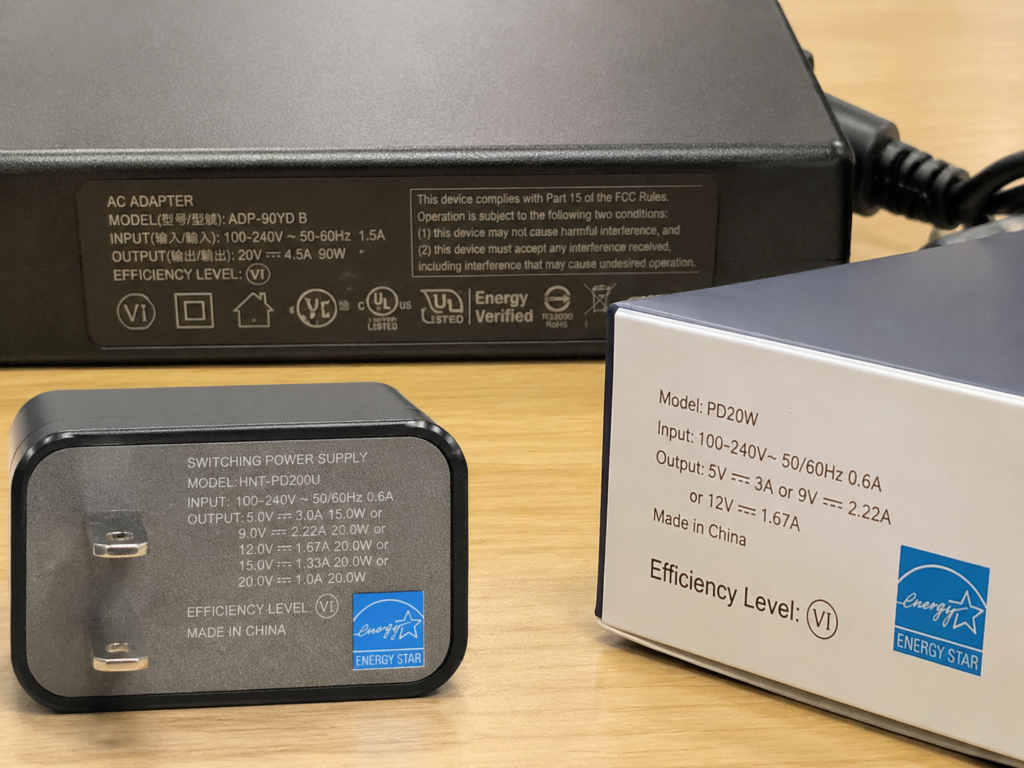
For physical products, larger adapters (such as the standard large-size power supplies for laptops) usually have energy efficiency information affixed to the side; due to limited space, small fast chargers mostly print the energy efficiency markings on the metal nameplate next to the prongs, or on the outer packaging box.
For e-commerce pages, only whole machines that require mandatory FTC yellow labels (such as TVs and monitors) must display the yellow label in a prominent position on the detail page; the energy efficiency information of charging products is usually located in the lower area of the parameter specification page, and you need to scroll down to find it.
2 Core Energy Efficiency Indicators You Must Check
Don’t be fooled by the fancy writing on the parameter page, there are only two indicators that can truly represent the energy efficiency level:
The first is average conversion efficiency, which is the ratio of alternating current converted to direct current. For example, a charger with 90% efficiency takes 100W of electricity from the wall, 90W of which is delivered to the charging device, and the remaining 10W is dissipated as heat — the higher the ratio, the more energy-efficient. It is important to note here: some merchants only mark “maximum efficiency 92%”, but this is only a single-point efficiency under a specific load (such as 100% full load), and cannot represent the overall energy efficiency. It is only useful to look at the average efficiency under multiple loads of 25%, 50%, 75%, and 100%.
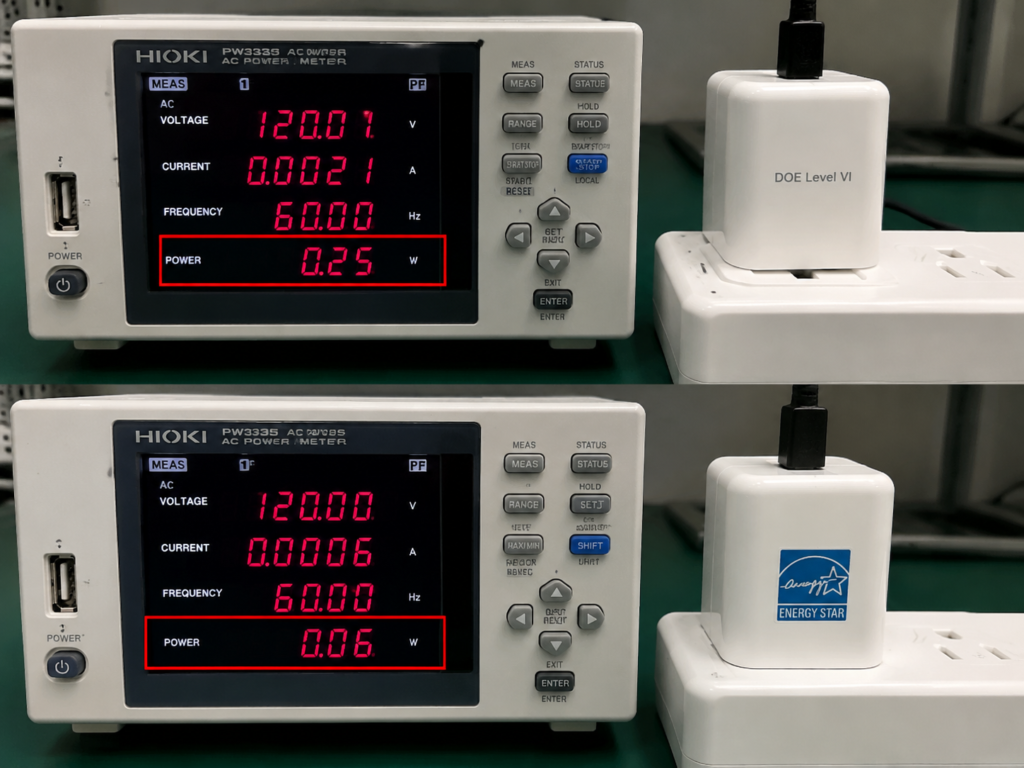
The second is standby (no-load) power consumption, which is the power consumption when the charger is plugged into the wall but not connected to any device. The lower the value, the better. Many people are used to keeping the charger plugged into the socket all the time, and standby power consumption is wasted electricity for nothing.
Identification of Three Common Energy Efficiency Labels
There are three common energy efficiency labels on charging products, corresponding to the three sets of rules mentioned earlier:
- DOE Level VI: For external power supplies and wall-plug charger products covered by DOE energy efficiency rules, Level VI is the current common minimum access threshold, that is, the passing line. It should be noted that the DOE minimum energy efficiency standard is a mandatory access requirement, but there is no unified mandatory labeling format. Relevant information is usually printed directly on the product nameplate or parameter page. Consumers can use it as a reference clue for compliance, but cannot directly determine that the product is non-compliant just because there is no eye-catching label. When information is missing, you should check the compliance materials of the official model.
- ENERGY STAR blue label: It is a voluntary high-efficiency label, only applicable to products that have been included in the scope of ENERGY STAR specifications and have passed official certification and listing. If a charging product has this label, it means that its energy efficiency performance is higher than the DOE minimum access requirement, and usually the specific efficiency value will also be marked. Consumers can check whether a specific model is within the listing scope through official EPA channels.
- FTC EnergyGuide yellow label: You will only see it on whole machines such as TVs and monitors that require mandatory labeling. If it is a charging component attached to a whole machine, the energy consumption has been included in the yellow label data of the whole machine, and it will not be pasted separately.
Advanced Usage: Energy Efficiency Comparison and Authenticity Identification
After you understand the basics, let’s talk about some practical tips: how to correctly compare the level of energy efficiency, and how to identify falsely marked or illegally used labels.
Correct Comparison Logic for Energy Efficiency Levels
Many people are prone to pitfalls when comparing energy efficiency. Remember three principles and you won’t go wrong:
First, comparison is only valid for products of the same power, and products with different powers have no reference value. For example, a 20W mobile phone fast charger and a 65W laptop adapter, no matter how high the efficiency of the former is, you can’t say that it is more energy-efficient than the latter, because the power base is completely different.
Second, refer to the reasonable range of average efficiency: the multi-load average conversion efficiency of ordinary consumer-grade charging products is usually in the range of 80%-92%. If it is claimed to exceed 95%, you should focus on checking whether its test method meets the multi-load average rules mentioned above, whether it meets the DOE or ENERGY STAR test specifications, and whether there are corresponding certification documents. There is a high probability of false marking. For products of the same power and type, when the nominal average efficiency difference exceeds 5 percentage points, you should be alert to whether peak efficiency is mixed, model parameters are incorrectly marked, or there is false marking. It should be noted that the above are reference thresholds for rapid screening, not a basis for directly determining illegality. The final compliance needs to be confirmed in combination with official tests or certification documents.
Third, be wary of marketing rhetoric that only promotes “maximum efficiency”: only the average efficiency under multiple loads can represent the real energy-saving level. The reference value of mentioning peak efficiency alone is limited. For the specific judgment logic, please refer to the description of the core indicators section above.
How Big is the Actual Impact of Standby Power Consumption
For regulated charging products that meet the DOE Level VI standard, the standby power consumption is generally ≤0.5W, and high-efficiency models with ENERGY STAR certification can be as low as below 0.1W. Based on standby power consumption of 0.1W-0.5W, plugged into the wall 365 days a year, and residential electricity prices in different regions of the U.S. (about 0.1-0.3 USD per kilowatt-hour), the annual standby electricity cost of a single charging product plugged into the wall for a long time is usually in the range of 0.5-3 USD. Calculated based on the average U.S. residential electricity price, the annual standby electricity cost of a 0.5W standby charger is about 0.7 USD, and that of a 0.1W product is about 0.14 USD, which is a common low-limit scenario within the range.
The difference in standby electricity cost of a single device may seem small, but if there are multiple charging devices plugged into the wall for a long time at home, or if you live in a state with high electricity prices (such as California), the total cost difference will increase significantly. Therefore, for chargers that are plugged into the wall for a long time, prioritize models with low standby power consumption.
Key Points to Check for Different Charging Products
Different types of charging products have different usage scenarios, so the key points for checking energy efficiency are also different:
- Mobile phone USB-C fast chargers: usually used at medium and low loads, and many people don’t unplug them after use, so focus on average conversion efficiency and standby power consumption;
- Multi-port charging devices (such as multi-port charging docks, power strips with USB ports): often charge multiple devices at the same time, so focus on the total efficiency when multiple ports output simultaneously, rather than the maximum efficiency of a single port;
- Laptop power adapters: usually used at high loads (such as charging while using), so focus on the efficiency under 75%-100% high load.
Methods to Identify False Energy Efficiency Markings/Fake Labels
Now many merchants have false energy efficiency markings or illegal use of labels. You can quickly identify them through three methods:
First, look at the format: formal DOE Level VI markings and ENERGY STAR labels have unified official styles, not non-official color stickers printed by merchants themselves. For example, the ENERGY STAR blue label has a fixed pattern and font, which cannot be modified arbitrarily.
Second, check the match: the model and power parameters on the label must be completely consistent with the description on the product body, packaging box, and e-commerce page. If the model does not match, it is likely that the merchant pasted the label randomly.
Third, verify the rationality of parameters: for products of the same power and same positioning, the average efficiency usually does not have an obvious gap of more than 5 percentage points. If a certain product’s nominal efficiency far exceeds other products of the same type, or claims to exceed 95%, you can check its test conditions according to the multi-load average efficiency rules mentioned above, and ask for official certification documents at the same time. Don’t trust single promotional rhetoric easily.
6 Most Common Energy Efficiency Cognitive Misconceptions
There are many widespread wrong statements about the energy efficiency of charging products, which are clarified at one time as follows:
- Misconception 1: With ENERGY STAR, you don’t need to meet DOE requirements
Wrong. For charging products regulated by DOE energy efficiency, the DOE minimum energy efficiency standard is a mandatory market access threshold, while ENERGY STAR is a voluntary high-efficiency certification based on meeting the standard — it is equivalent to passing the exam with 60 points first before you can be evaluated for excellence with 90 points. There is no such thing as getting a high-efficiency certification and not needing to meet the basic access requirements. - Misconception 2: The higher the energy efficiency, the faster the charging speed
Wrong. Energy efficiency measures “whether it saves electricity” and has nothing to do with charging speed. Charging speed depends on output power and fast charging protocol: a 20W high-energy-efficiency charger, no matter how energy-efficient it is, charges slower than a 65W ordinary energy-efficiency charger — high energy efficiency just means it takes less electricity from the grid and wastes less, but the output power to the mobile phone is still 20W. - Misconception 3: Charging cables must also have energy efficiency labels to be compliant
Wrong. Ordinary passive charging cables and data cables are only media for transmitting electricity, without any power conversion function, and are not within the scope of energy efficiency supervision at all. Don’t be influenced by misleading rhetoric such as “energy efficiency certified cables” promoted by merchants, this is just a marketing gimmick. - Misconception 4: Charging products without FTC yellow labels are non-compliant
Wrong. The FTC yellow label is only mandatory for a small number of whole machine products such as TVs and monitors. Independent chargers are not in the mandatory labeling catalog at all. As long as regulated charging products meet the DOE minimum energy efficiency standards, they are compliant, and whether there is a yellow label is not important at all. - Misconception 5: Energy efficiency labels equal safety certifications
Wrong. Energy efficiency only manages “how much electricity is consumed” and does not involve safety issues at all — for example, whether it will leak electricity, catch fire, or have overcharge protection, these belong to the jurisdiction of safety compliance certifications such as UL and ETL; and the FCC certification that people often hear about mainly manages electromagnetic compatibility (such as whether the product will interfere with the normal operation of other electronic devices), which is not the same as safety or energy efficiency. Don’t think that a product must be safe just because it has an energy efficiency label, the two are completely different regulatory dimensions. - Misconception 6: Charging products purchased by individuals from overseas must have U.S. energy efficiency labels
Wrong. The mandatory energy efficiency requirements only apply to brand-new consumer-grade products sold through formal commercial channels in the U.S. If you buy them back from overseas for your own use, or they are given by friends, you don’t need to meet U.S. energy efficiency requirements; but if you buy them in bulk for sale, they must meet the requirements.
Practical Guide: Full Steps for Purchase, Receipt, and Rights Protection
After talking about so much theory, finally I will give you a set of practical steps that can be used directly, just follow them when buying charging products.
Three-Step Quick Check for E-Commerce Purchases
Step 1: First determine the product category. Only wall-plug chargers, power adapters, docks/USB power strips with AC-DC conversion need to check energy efficiency. Charging cables, in-vehicle chargers, and power banks do not need to take energy efficiency labels as the key point of verification.
Step 2: Check whether the product’s model and rated power are consistent with the page description, to avoid the situation where the page parameters do not match the actual model, and prevent merchants from mixing parameters of models with different powers.
Step 3: Check whether the product nameplate, packaging or parameter page lists energy efficiency-related information such as DOE Level VI, average efficiency, and no-load power consumption; if there is an ENERGY STAR label, it means it is a high-efficiency model of the corresponding category; there is no need to directly determine non-compliance due to the absence of an FTC yellow label; when the energy efficiency information is unclear, you can ask the merchant for a compliance certificate or check the public information of the official model.
Check Method After Receiving the Goods
After getting the product, first check three things:
First, whether the model and rated power on the product body’s nameplate, packaging box, and e-commerce page are completely consistent. Even a difference of one letter may be a different model.
Second, check whether the energy efficiency label is complete and clear, and whether there are traces of alteration or wrong pasting, such as tearing off the label of another product and pasting it on this one.
Third, if you find inconsistent information, first ask the merchant to check whether it is a different model version. Everything shall be subject to the nameplate on the product body; if the difference is large (for example, the page marks 65W but the actual is 20W, or the regulated product has no energy efficiency marking at all), you can apply for return or exchange according to law.
Handling Methods for Purchasing Non-Compliant Products
If you purchased the product from a regular U.S. merchant or platform, first directly contact the merchant to apply for return or exchange, and most regular merchants will cooperate.
If the merchant refuses to handle it, you can choose the corresponding channel according to the type of problem: for marketing fraud issues such as false energy efficiency labels and exaggerated publicity, you can file a complaint with the FTC (Federal Trade Commission); if it involves the problem that regulated charging products do not meet the DOE minimum energy efficiency access standard, you can refer to the DOE’s public list of compliant products, or feedback and verify through relevant DOE channels.
After mastering the above content, you can independently complete 5 judgments and operations related to the energy efficiency of charging products: distinguish the roles and applicable scenarios of the FTC yellow label, DOE minimum energy efficiency, and ENERGY STAR, quickly judge whether the charging product in your hand needs to meet energy efficiency requirements, compare the energy-saving level of products of the same power and estimate the long-term electricity cost difference, identify false energy efficiency markings, fake labels and common marketing misconceptions, and know how to protect your rights when you buy non-compliant products.