
If you deal with chargers, charging cables, and power-equipped charging accessories for the Korean market, you have most likely heard of KC certification, and may have encountered similar problems: products printed with the KC mark are detained at customs, either because the certification category does not match, or the filing information cannot be found. Many people’s impression of KC safety certification is limited to “Korea’s mandatory certification”, but when it comes to product selection, certification application, and mark verification, they will encounter a bunch of questions: Do charging cables need mandatory certification? Can CB reports be transferred? Why can’t I clear customs even after getting KC safety certification?
This article is targeted at cross-border sellers and compliance beginners, and thoroughly explains KC safety certification for charging products from basic concepts, classification judgment, technical requirements to verification and pit avoidance, balancing introductory understanding and practical judgment.
First, Understand: What Exactly is KC Safety Certification?
Many people think KC certification is Korea’s “quality excellence award”, but that is not the case at all. It is an electrical product market entry safety threshold established by South Korea under the Electrical Appliances and Household Products Safety Management Act, with only one core function: preventing risks that directly threaten personal and property safety such as electric shock, fire, and overheating. It has nothing to do with how well the product works or how fast it charges.
Charging products are a key category under KC supervision because they directly contact mains power and are often used with personal devices such as mobile phones and computers. If they are not compliant as required, the lightest consequences are customs detention, removal from shelves, and sales bans; the heaviest consequences include fines, and even legal liability for the responsible entity within South Korea.
Three Management Paths for KC Safety
Many people say “apply for KC certification”, but in fact there are three types of management paths related to KC safety, which are divided into categories by the Korean Agency for Technology and Standards (KATS, the competent authority of the KC system) according to product risk levels. Enterprises cannot choose on their own, and the implementation requirements of different paths differ significantly:
- Mandatory Safety Certification: For categories with the highest risk, a KATS-accredited institution must complete full tests and initial factory inspection. After passing, the corresponding certification certificate is obtained, and regular supervision is required thereafter.
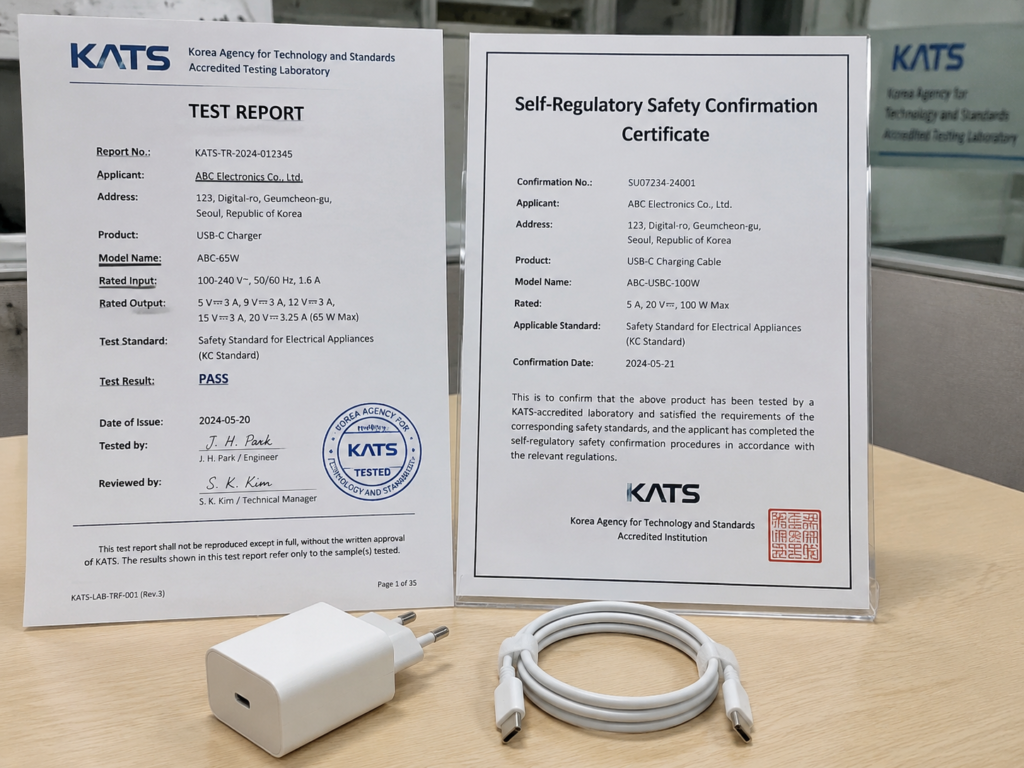
- Self-Regulatory Safety Confirmation: For categories with medium risk, test reports issued by KATS-accredited laboratories must be submitted in accordance with the requirements of the corresponding category to complete the safety confirmation procedures.
- SDoC (Supplier’s Declaration of Conformity): For categories with extremely low risk, the responsible entity completes the conformity assessment on its own, signs the self-declaration, and retains the full set of technical documents. There is no need to submit an application for official certification in advance, and it is subject to post-event spot checks.
Here are two core reminders to remember first:
First, a KC mark printed on a product does not mean it has passed mandatory safety certification. Products under all three management methods can be marked with the KC mark as required. Which category a product belongs to and whether it is compliant must be verified in combination with the number and filing information of the corresponding category; you cannot judge solely by the mark.
Second, overseas certifications cannot directly replace KC safety certification. CE, UL, 3C and other national safety regulations are independent of each other and cannot be directly used universally; if a product has a qualified CB report (a mutual recognition report issued under the IEC CB system), it can be submitted to a Korean certification institution for evaluation. If it meets the requirements, some test items can be waived, but Korean local difference tests must be supplemented. The final scope of waiver is subject to the audit result of the certification institution.
In addition, the often-mentioned “KC EMC” (electromagnetic compatibility compliance) is completely independent of KC safety certification: safety governs “whether it will cause electric shock, fire, or overheating”, while EMC governs “whether it will interfere with other electrical appliances or be interfered with”. If a product falls under both types of supervision, compliance must be completed separately, and they cannot replace each other.
How to Determine Which Type of KC Safety Management Applies to Charging Products?
After understanding the basic concepts, the next core question is: which category does my charging product belong to? After all, the cost, cycle, and requirements of the three management methods are very different. A wrong judgment will either lead to unnecessary extra costs, or problems due to insufficient compliance.
Core Judgment Dimensions of Classification
KC safety classification is not as simple as “just looking at power”. Its legal basis is the Electrical Appliances and Household Products Safety Management Act, and specific categories are determined by the three types of management category catalogs issued by KATS. When making a judgment, multiple dimensions must be considered comprehensively:
- Input method: is it plugged into mains power (AC) or USB/DC?
- Does it have a power conversion circuit (such as voltage transformation, current transformation, rectification)?
- What are the rated voltage, power and other parameters?
- What is the product used for? Is it specifically for charging or has other functions?
- Is it sold independently? Or is it a complimentary accessory?
- What is the product structure? Does it have components such as batteries or hubs?
Reference for Retrieval Starting Points of Common Charging Products
We have sorted out the retrieval directions for common charging products, which are only for quick positioning and do not constitute a legal classification conclusion. The final confirmation must be combined with category definitions, rated parameter ranges, structural requirements, and sales forms:
| Product Type | Reference Retrieval Starting Point | Core Judgment Tips |
|---|---|---|
| Wall chargers, desktop power adapters, multi-port/wireless charging docks with AC input | Prioritize searching for power adapter-related items in the mandatory safety certification category | Categories connected to mains power, containing power conversion circuits, and sold independently need to be checked against category definitions, rated parameter ranges, and structural requirements |
| Ordinary USB/USB-C charging cables, low-power charging accessories without mains input | Prioritize searching for cable-related items in the self-regulatory safety confirmation category | First confirm whether it falls under the regulated cable category, then check parameters, structure, and sales form |
| Extremely low-risk non-electrical core accessories (such as pure interface adapters) | Prioritize searching for accessory-related items in the SDoC category | Low-risk accessories that do not involve core electrical safety functions need to be checked against corresponding category rules |
There are several types of special products that cannot directly apply the above table, and must be verified one by one in order:
- Charging cables: For classification, first confirm whether it belongs to the regulated wire/cable category, then check the rated voltage/current, cable and terminal structure, whether it contains active conversion or power management circuits, and whether it is sold independently in turn. E-Marker is used to report cable capacity and related parameters to chargers and devices, and is not equivalent to a power conversion circuit itself; it is still necessary to verify whether it contains active conversion, power management or other functional circuits to determine whether the classification changes.
- Pure plug adapters: It cannot be determined that they are not regulated solely by the fact that they “have no voltage or current conversion function”. First, check whether they belong to the plug/socket/electrical connector category.
- Built-in power modules that are not sold independently: For example, a power board built into a speaker, if not sold separately, must be evaluated for compliance according to the complete machine category. At the same time, check whether the power module belongs to an independent regulated category; the certification rules for independent charging products are not directly applicable.
Applicable Rules for Set Products
If a product is sold as a set, it shall be judged according to the following principles:
- If the products in the set themselves belong to independently sold regulated categories, each product must meet the safety requirements of its corresponding category;
- Complimentary accessories in the set that are not sold separately must meet corresponding safety standards, and the certification responsibility and evaluation method shall be confirmed in combination with the complete machine category rules;
- Complete machine sets (such as a docking station set with power supply) are uniformly evaluated according to the category requirements of the complete machine.
3-Step Preliminary Judgment Method
You don’t have to memorize categories by rote. You can make a preliminary judgment yourself in these three steps:
Step 1: First figure out the basic attributes of the product: is the input method AC or DC? Does it have a power conversion circuit? Is it sold independently? What are the rated parameters?
Step 2: Check the latest three types of management category catalogs released by KATS, and initially match the management direction against the product attributes.
Step 3: If you are unsure, directly submit it to a KATS-accredited certification institution for category pre-confirmation — spending a small amount of money to confirm in advance is better than remedying the situation after applying for the wrong certification or having goods detained.
There are two experience references for classification matching, but they are by no means judgment standards: first, the higher the product power and the more structures that contact mains power, the greater the probability of falling into a high-requirement management category, but this is not the only basis; second, products with batteries and fast charging functions may have different classifications from ordinary products, which requires additional verification.
Core Differences of the Three KC Safety Management Systems
After preliminarily judging the category, let’s take a closer look at the core differences between the three management methods, so that you can evaluate the cost and cycle in advance.
| Comparison Item | Mandatory Safety Certification | Self-Regulatory Safety Confirmation | SDoC (Supplier’s Declaration of Conformity) |
|---|---|---|---|
| Applicant and Responsible Entity | A domestic Korean manufacturer or importer acts as the responsible entity and applies to a KATS-accredited certification institution | A domestic Korean manufacturer or importer acts as the responsible entity and submits a confirmation declaration to the specified institution according to category requirements | The domestic Korean responsible entity completes the conformity declaration on its own, no need to apply for official certification in advance |
| Test Requirements | Full tests must be completed by a KATS-accredited third-party laboratory | Full tests must be completed by a KATS-accredited third-party laboratory | Tests can be conducted by the entity itself or by a qualified institution, specifically implemented in accordance with corresponding category rules |
| Factory Inspection | Initial factory inspection + regular supervision inspection are required | No factory inspection required | No factory inspection required |
| Certificate Form | Certification documents are issued in accordance with category rules, corresponding to a unique filing number | Complete confirmation procedures in accordance with category rules, and obtain the corresponding certificate and filing number | Retain technical documents such as test reports and self-declarations on your own, no unified official number |
| Marking Requirements | KC mark, filing number, product rated parameters, and information of the domestic Korean responsible entity must be marked in accordance with category rules | KC mark, filing number, product rated parameters, and information of the domestic Korean responsible entity must be marked in accordance with category rules | Marking requirements are implemented in accordance with corresponding category rules, no unified number requirement |
| General Requirements | All must retain complete technical documents and compliance records for official spot checks | Same as left | Same as left |
*Note: The application institutions, test requirements, certificate names, and number formats of different categories are subject to the current category management rules and official system fields released by KATS. Do not apply a unified template.
Core KC Safety Technical Requirements for Charging Products
After knowing which category your product belongs to, you need to understand which specific safety requirements it must meet — you don’t have to memorize the standards, but at least you need to know what the key assessment points are, to avoid pitfalls when sending samples for testing. All technical requirements must be implemented in accordance with the Korean safety standards of the category to which the product belongs, and there is no general threshold.
Mains-Connected Chargers/Power Adapters
Products that are connected to mains power and contain power conversion circuits usually involve stricter safety assessments, and the assessment is mainly divided into three aspects:
- Electrical Safety: Verify the insulation system and isolation requirements of the primary side (mains side) and secondary side (low-voltage output side) according to product structure and applicable standards, and at the same time test dielectric strength, insulation resistance, and leakage current of accessible metal parts; overcurrent, overheating, and short-circuit protection functions must meet standards; verify the rated output of each port, total output capacity, port combination working conditions, and safety performance under overload, short-circuit, and abnormal working conditions.
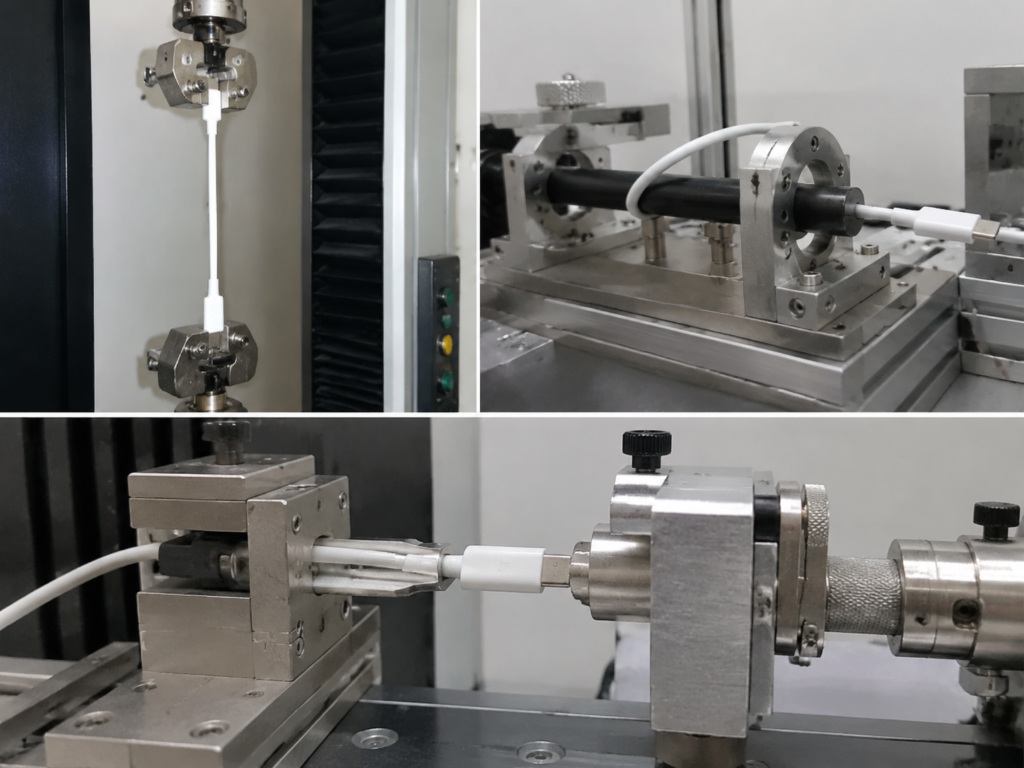
- Structural and Mechanical Safety: The plug must be compatible with Korean standard sockets, and the shell and interface must have sufficient strength and not break when dropped; the power cord must have tensile and bending resistance, and the core must not break after a few pulls.
- Materials and Components: The shell and insulating parts must have sufficient flame retardant performance to prevent the spread of fire; key components (such as transformers, capacitors, optocouplers) must be consistent with those declared and cannot be replaced at will.
Charging Cable Category
For cables, first confirm the category and applicable standards, then check the following core directions accordingly. The requirements for passive cables are relatively simple, and active cables with circuits require additional circuit safety tests:
- Basic Performance: Conductor resistance must not exceed the standard (otherwise it is easy to heat up), the thickness and strength of the insulation layer must meet standards, and it must also pass the withstand voltage test.
- Mechanical Performance: It must have sufficient tensile strength, the bending life meets requirements, and the insertion and extraction strength of the terminal must not be too low — it cannot become loose after a few insertions.
- Heating Requirements: When working at rated current, the temperature rise of the cable and interface must not exceed the standard limit, otherwise it is easy to age or even catch fire.
If it is a cable with a circuit (such as an active cable with video conversion, a cable with power management), it must additionally meet the safety requirements of the corresponding circuit, and the classification may also change.
Electronic Products with Power Supply
For example, products such as docking stations with AC input and desktop hubs with charging functions, the compliance boundaries must be clearly distinguished:
- The external power supply part is assessed according to the safety requirements of chargers/power adapters;
- The complete machine part must meet the insulation, temperature rise, and structural safety requirements of the complete machine — you cannot consider the product compliant just because the power supply part is compliant.
General Requirements for Markings and Instructions
No matter which type of management method is applicable, product markings and instructions must meet the basic requirements of the corresponding category:
- Mandatory safety certification and self-regulatory safety confirmation products: The product body must have a clear and durable Korean parameter label, marking key information such as rated input, power, and output specifications, and at the same time mark the KC mark, corresponding filing number, and information of the domestic Korean responsible entity; a Korean safety warning instruction manual must be attached.
- SDoC products: Marking and instruction requirements are implemented in accordance with corresponding category rules, and it is necessary to ensure that product model, rated parameters, safety warnings, and responsible entity information are clearly accessible; if the corresponding category requires marking the KC mark, it must be marked in accordance with the rules.
The durability of the marking must meet the safety standards of the corresponding category, and must not be blurred or easy to peel off.
How to Verify the Authenticity of KC Marks and Compliance Certificates?
Whether you are a seller verifying goods when purchasing, or checking authenticity during procurement, learning to read KC marks and check filings is an essential skill — after all, there are too many fake KC marks.
Key Verification Points for Formal KC Safety Marks
The KC mark itself cannot prove the management category and compliance of a product, and must be verified together with the filing number of the corresponding category, product information, and official filing.
A formal KC mark is usually marked on the product parameter label or shell (such as laser engraving), and must meet the clarity and durability requirements of the corresponding category. The marks of mandatory and self-regulatory products must include the KC mark, filing number, product rated parameters, and information of the domestic Korean responsible entity; the mark content of SDoC products is implemented in accordance with the requirements of the corresponding category, there is no unified official number, and when verifying, it is necessary to check the consistency of the self-declaration, test report, and product information at the same time.
Common Invalid/Violation Marks
When encountering the following situations, it can basically be determined that the mark has compliance risks:
- Only the KC mark, no valid number of the corresponding category, or the number format and category do not match the product;
- The model, power, and output specifications marked on the mark are inconsistent with the official filing/declaration information;
- The mark is blurred, easy to peel off, and does not meet the durability requirements of the corresponding category;
- Using a mark for a lower management category to impersonate a higher category requirement, such as using a self-regulatory confirmation number to impersonate a mandatory certification number.
Official Verification Steps
To check whether the KC filing of a product is real, follow these three steps:
Step 1: First collect the product model, the filing number of the corresponding category, and the accurate name of the manufacturer/importer;
Step 2: Query the filing information through official channels such as the KATS official website and the Korea Product Safety Information Center;
Step 3: Check whether the query result is completely consistent with the model, parameters, and responsible entity on the product mark.
To ensure the traceability of verification results, it is necessary to record the query date, official query page number or screenshot archive number, the category of the corresponding product, and the applicable safety standard version, and retain the query results together with the product model, rated input and output parameters, responsible entity information, and corresponding sales batch materials.
Application, Maintenance and Change of KC Safety Certification
If you are a seller and need to apply for KC safety certification for your products, you should focus on the following content — many people spend unnecessary money on certification, or the certification becomes invalid after product modification because they did not report the change, all because they did not understand the rules.
Preparation Before Application
Don’t just find an institution to send samples right away. Do these things first:
- Preliminarily confirm the applicable management direction according to the 3-step judgment method, and do a category pre-confirmation if you are unsure;
- Prepare test samples, product specification parameter table, key component list, and drafts of Korean labels and instructions;
- Choose a KATS-accredited third-party certification institution, or a reliable and legal agent — don’t be greedy for cheap and find unlicensed intermediaries, the loss of getting a fake certificate is even greater.
Core Application Steps
The processes for different categories and management types vary, and can be promoted according to the following general steps. Specific requirements are subject to corresponding category rules:
- Category and Standard Confirmation: First clarify which category the product belongs to and which version of the Korean safety standard is applicable. This is the basis for all subsequent work. If you are unsure of the judgment, you can first do a category pre-confirmation.
- Compliance Path Evaluation: Evaluate whether the existing CB report meets the requirements for waiving some tests, and whether products of the same series can apply for series certification to reduce costs.
- Test and Data Preparation: Complete all tests (including Korean local difference items) in accordance with the requirements of the corresponding category, and sort out materials required for application such as product specifications, component lists, and Korean labels and instructions.
- Audit and Confirmation Link: For mandatory safety certification, materials and test reports must be submitted, and initial factory inspection is accepted. After passing, the certification certificate is obtained; for self-regulatory safety confirmation, materials and test reports are submitted to complete the declaration, and the confirmation certificate is obtained after passing; for SDoC, the responsible entity completes the conformity assessment on its own and signs the self-declaration.
- Mass Production Consistency Control: Mass-produced products must be consistent with the safety structure and key components of the test samples, and cannot be changed at will.
Maintenance of Compliance Certificates
Getting the compliance certificate is not the end. The maintenance requirements for different management categories vary: mandatory categories need to accept regular factory supervision inspections by the certification institution as required; self-regulatory categories need to continuously maintain the consistency of mass-produced products and test samples, and submit materials in time when changes that require updating the declaration occur; SDoC needs to continuously ensure that products meet corresponding safety standards, and re-evaluate conformity when products change. All categories must properly retain the full set of compliance materials such as test reports, certification certificates, component lists, and change records for official spot checks.
Hierarchical Judgment of Product Changes
When products are modified, many people easily cause compliance invalidity due to failure to report changes. Common changes can be preliminarily distinguished according to the degree of impact. The specific treatment method needs to be verified with the certification institution or competent authority in advance, and cannot be applied on your own:
- Changes that do not require declaration: appearance color adjustment that does not affect safety performance, packaging text optimization (not involving product marking parameters), it is recommended to retain change records.
- Changes that require filing update: change of manufacturer name/address, change of product name (not involving safety structure and performance), generally no additional tests are required.
- Changes that require supplementary tests: replacement of key safety components, adjustment of the number of output interfaces (without changing the power level and core safety structure), need to evaluate the impact on safety performance, and may require supplementary tests for corresponding items before updating the filing.
- Changes that require re-application: changing the input voltage/rated power, replacing the plug specification, modifying the core safety structure, adding a fast charging protocol. Such changes may lead to significant changes in the product’s safety attributes, which need to be evaluated in combination with specific modifications. If the overall compliance is affected, a new application is required.
Special reminder: Adding a fast charging protocol does not necessarily trigger re-certification. It needs to be comprehensively judged in combination with output capacity, protection circuit design, and applicable standards. Be sure to confirm with the certification institution in advance.
Ways to Reasonably Accelerate the Application
If you want to save time and cost, there are two legal ways:
- Submit a qualified CB report to the certification institution for evaluation, and after passing, some test items can be waived;
- For products of the same series, if the core safety structure, key components, and power levels are the same, you can apply for series certification, instead of testing each model separately.
But note that products with different powers, different plugs, and different core safety structures cannot share series certification. Don’t force them together to save money, which will cause problems instead.
Responsibility Division and Parallel Obligations Beyond Safety
There are two easily overlooked issues when applying for certification: who bears the responsibility? In addition to KC safety certification, are there other requirements? Many people fail to clear customs because they miss parallel compliance requirements.
Responsibility Division of Import and Sales Chain
The declaration and market responsibility related to KC safety are usually borne by domestic Korean manufacturers or importers according to the corresponding management path; overseas manufacturers need to go through relevant procedures through domestic Korean responsible entities or agents that comply with current rules. Specific application qualifications, scope of responsibility, and agency methods are subject to corresponding category management rules. The responsibilities of each link are divided according to roles:
- Domestic Korean Manufacturer: Bears the primary safety responsibility of the product, is responsible for the application/declaration of the corresponding management path, mass production consistency control, and compliance reporting of product changes;
- Domestic Korean Importer: Responsible for verifying product compliance before entry, implementing Korean marking and instruction requirements, and cooperating with official spot checks and problem handling;
- Agents/Sellers: Need to verify the compliance certificates of the products they sell, shall not sell products known to be non-compliant, and retain relevant compliance materials as required by regulations;
- Overseas Manufacturer: Can entrust a domestic Korean agent to handle compliance-related procedures, and the safety responsibility must ultimately be implemented to the legal responsible entity within South Korea.
Don’t Miss These Parallel Compliance Obligations
KC safety certification is only part of the compliance of electrical products in the Korean market. There are also multiple independent compliance requirements, which need to be checked for applicability according to product attributes:
- KC EMC (Electromagnetic Compatibility): Completely independent of safety certification. Whether it is applicable and which type of management path applies need to be checked according to product functions, electromagnetic compatibility category catalog, and current rules; if the product falls under both types of supervision, compliance must be completed separately.
- Korea Energy Efficiency (MEPS): Whether it is an energy efficiency management object needs to be checked according to the Korea energy efficiency management object catalog and product definition, and cannot be judged solely by power level.
- Hazardous Substances and Resource Circulation: South Korea has special regulations on hazardous substance restriction and resource recycling, which are not within the scope of KC safety certification, but need to be compliant as required.
- Radio Communication Compliance: If the product has wireless communication functions such as Bluetooth, Wi-Fi, or cellular communication, the certification requirements need to be checked according to the relevant rules of Korean radio equipment; for pure wireless charging functions, first check applicable requirements such as electromagnetic compatibility and energy efficiency, and whether it belongs to the scope of radio equipment supervision needs to be judged in combination with transmission parameters, function definitions, and current catalogs.
Common Misconceptions and Practical Pitfall Avoidance
After talking about so many rules, let’s sort out the cognitive misconceptions that everyone is most likely to fall into, and then use three practical cases to help you string together the previous knowledge.
Common Cognitive Misconceptions
- Having a KC mark = passing mandatory safety certification: Products under all three management methods can be marked with the KC mark as required, and the specific category and compliance need to be verified in combination with the corresponding number and filing information.
- All charging cables/fast charging cables with E-Marker need KC mandatory certification: The classification of charging cables needs to be judged in combination with multiple dimensions such as whether it is a regulated category, rated parameters, structure, and sales form. E-Marker itself is not equivalent to a power conversion circuit and does not directly determine the classification.
- 3C/CE/UL certification can be directly converted to KC: National safety regulations are independent, and overseas certifications cannot directly replace KC safety certification; only qualified CB reports can apply for evaluation to waive some tests, and Korean local difference items still need to be supplemented.
- Products connected to 220V mains must be subject to mandatory safety certification: Mains input is only one of the dimensions of classification judgment, and the final category needs to be comprehensively confirmed in combination with KATS current category catalog, product structure, purpose, rated parameters, and independent sales form.
High-Frequency Pitfalls in Application and Sales
These pitfalls are all learned by many sellers at great cost, so be sure to avoid them:
- Product modifications are not verified and reported in advance according to the rules, resulting in invalid compliance certificates and fines during spot checks;
- Finding an unqualified agent, getting a forged certification certificate or filing, and only finding out it is fake when clearing customs;
- Only applying for KC safety certification, not checking parallel obligations such as electromagnetic compatibility, resulting in customs clearance failure;
- Secretly changing the structure and replacing components during mass production, which is inconsistent with the test samples, and failing market spot checks;
- Using the old version of the category catalog to judge new products, resulting in wrong classification and wrong certification.
3 Practical Classification Reference Cases
The following are classification retrieval references for three types of common charging products to help you quickly master the judgment logic. All conclusions are subject to the official catalog and certification institution confirmation:
Case 1: 65W USB-C Wall Charger
- Core judgment dimension: connected to mains power, contains power conversion circuit, sold independently, prioritize searching for power adapter items in the mandatory safety certification category.
- Key items to verify: whether the definition and rated parameter range of power adapters in KATS current category catalog cover this product, and whether the structure meets the category requirements.
- Parallel obligations: need to check the electromagnetic compatibility category catalog, and simultaneously confirm whether MEPS energy efficiency requirements are applicable.
Case 2: 100W USB-C Charging Cable Only with E-Marker
- Core judgment dimension: E-Marker is only used to report cable capacity parameters, no power conversion circuit, prioritize searching for cable items in the self-regulatory safety confirmation category.
- Key items to verify: whether it falls under the Korean regulated wire/cable category, whether the rated voltage and current are within the corresponding range, whether the terminal structure meets the category definition, and whether it is sold independently.
- Parallel obligations: Pure passive cables usually do not need to handle electromagnetic compatibility compliance; if they have other functions, they need to be evaluated separately.
Case 3: 100W USB-C Docking Station with AC Input (with PD Output)
- Core judgment dimension: connected to mains power, contains power conversion circuit, sold independently, but because it has an expansion function, it cannot be directly classified into the charger category, and needs to be retrieved and evaluated according to the complete machine category.
- Key items to verify: whether it belongs to power adapters or electronic products with power supply in KATS current category catalog, and whether it covers requirements related to expansion functions.
- Parallel obligations: need to check electromagnetic compatibility and energy efficiency requirements; if it has a wireless communication function, it is also necessary to check radio communication compliance requirements.
Summary
For the preliminary KC safety compliance inspection of charging products, it can be promoted according to the following core actions:
- Sort out the basic attributes of the product such as input method, structure, rated parameters, and sales form;
- Query the current valid category catalog of KATS, and initially match the applicable KC safety management path;
- Check core safety risks such as insulation, structure, and materials in advance against the technical requirements of the corresponding category;
- Verify the KC mark and filing information through official channels, keep query records, and check self-declarations and technical documents for SDoC products;
- Simultaneously check parallel compliance obligations such as electromagnetic compatibility, energy efficiency, and radio communication to avoid missing items.
All classification, test and compliance conclusions are subject to the current valid official rules of KATS and the formal confirmation of accredited certification institutions.