
Sellers of charging products targeting the U.S. market have most likely heard the term “TSCA”: freight forwarders ask if you have a TSCA declaration, platforms require TSCA compliance certificates, and some service providers even promote “full TSCA certification”. Many people get more confused the more they hear — is it a safety certification or an environmental requirement? Do my chargers and charging cables have to be tested?
Let’s clarify the core understanding once and for all: there is no universal “TSCA certification”. It is not a performance or safety certification for charging products, but an environmental protection regulation of the U.S. EPA (Environmental Protection Agency) that governs the entire life cycle of chemical substances. Only charging products containing specific regulated chemical substances will be affected; not all charging products entering the U.S. need to proactively undergo TSCA testing. Specific obligations need to be comprehensively judged based on product type, substance composition, one’s own role, and applicable rules. This article only covers common TSCA rules for consumer-grade charging products, and does not involve professional chemical scenarios such as new chemical substance declarations; new rules subsequently issued by the EPA may still trigger obligations due to differences in product materials, uses, and import identities, and shall be subject to the latest official requirements.
How to Determine If Your Product Is Regulated? Follow These 4 Steps
Don’t rush to arrange testing as soon as you hear TSCA. Follow the four steps below to quickly determine if you have triggered any obligations; this is the most core practical tool for charging product practitioners.
Step 1: First Clarify What You Are Selling/Importing
TSCA requirements differ significantly between finished products and chemical materials:
- Finished products: Assembled consumer products such as complete chargers and full charging cables usually trigger fewer obligations than pure raw materials.
- Materials/chemical substances: Raw materials imported separately, such as plastic pellets, coatings, and solder, trigger more declaration and reporting obligations.
For example, if you import 1,000 USB-C charging cables, they fall under the finished product category; if you import 1 ton of PVC plastic pellets for cable jackets, they fall under the material category, and the applicable rules are completely different.
Step 2: Identify If Chemicals Subject to Special TSCA Rules Are Involved
TSCA regulates tens of thousands of chemical substances, but those related to ordinary consumer-grade charging products are concentrated in substances corresponding to two types of rules, so there is no need to check them one by one:
- High-relevance substances corresponding to Section 6(h) restriction rules: Decabromodiphenyl ether (DecaBDE, a brominated flame retardant), isopropylated triphenyl phosphate (PIP(3:1), a plasticizer/flame retardant).
- Substances corresponding to Section 8(a)(7) information reporting rules: PFAS (commonly known as “forever chemicals”, commonly found in waterproof and oil-resistant coatings).
- Low-relevance substances: Commonly heard harmful substances such as lead, cadmium, and phthalates have no general TSCA restrictions, and usually fall under the regulation of RoHS, CPSIA, or U.S. state laws. Don’t confuse them, but you still need to verify the corresponding regulations according to the product’s target market.
For example: if DecaBDE is explicitly added as a flame retardant to the plastic housing of a charger, it may trigger the corresponding restriction rule; if the waterproof coating of a charging cable contains PFAS, you need to first check the applicable conditions of the corresponding rule, and cannot directly determine it as non-compliant.
Step 3: Locate the Specifically Applicable TSCA Provisions and Clarify the Nature of the Rules
Not all regulated substances are prohibited. TSCA rules are mainly divided into two categories with completely different natures, and their determination logic, responsible parties, and compliance requirements are all different; standards cannot be mixed:
- Restriction rules: For example, the PBT (persistent, bioaccumulative, and toxic substances) restriction under Section 6(h) has clear prohibited/restricted uses, concentration requirements, and applicable scenarios. Products that do not meet the rule requirements cannot be imported or sold.
- Reporting/recordkeeping rules: For example, the PFAS reporting rule under Section 8(a)(7) only requires specific parties to submit historical data. It is essentially information collection, not a ban, and the obligated party is not necessarily a finished product seller.
Step 4: Determine Obligations Corresponding to Your Role
For the same product, parties with different identities bear completely different obligations. The core judgment criteria are “whether you are a responsible party defined by the rules” and “whether you are the party that introduces the goods into the U.S. territory”:
- U.S. domestic finished product importers: They are the core responsible parties in the import process and must bear the TSCA compliance obligations for the corresponding goods.
- Cross-border e-commerce sellers/overseas manufacturers: If they clear customs as the U.S. importer in their own name, they must bear the same obligations as domestic importers; if the U.S. buyer/platform is responsible for import, they should confirm the division of responsibilities in advance, and also have the obligation to cooperate in providing product ingredient information.
- Chemical substance/material importers/manufacturers: They bear more obligations such as declaration, reporting, and testing, with stricter requirements.
- Personal use/small test samples: Obligations are usually lower than mass-produced finished products imported commercially, but they may still be subject to customs random inspection. If they actually violate the restriction rules, they will still face consequences such as cargo detention, subject to the on-site determination of customs and the EPA.
Quick Judgment Mnemonic
It’s okay if you can’t remember the four steps; first screen according to this mnemonic:
- Selling consumer-grade finished products: First check the rules corresponding to the substances, ask suppliers for declarations corresponding to the relevant provisions, and avoid blind testing.
- Selling chemical materials: Separately verify TSCA declaration, reporting, and testing requirements, and do not apply the logic for finished products.
- Personal use: No need for proactive testing, but products containing prohibited substances may still be detained.
Boundaries Between TSCA and Other Common Compliance Requirements
Many people confuse TSCA with other U.S. market compliance requirements, but their regulatory dimensions are completely different: Compliance documents such as UL, FCC, RoHS, and CPSIA cannot automatically replace TSCA’s legal obligations, nor can they directly prove that TSCA requirements are met; however, the material composition data and laboratory test data in them can be used as auxiliary evidence across projects, but they still need to be verified separately according to the regulatory objects, substance lists, and determination rules of each regulation, and cannot be directly applied universally.
- UL safety certification: Focuses on the electrical safety of charging products (such as electric shock protection, fire protection, mechanical strength), belongs to safety certification, and has nothing to do with chemical substance regulation. UL reports cannot directly prove TSCA compliance.
- FCC certification: Focuses on electromagnetic interference and radio frequency compatibility of electronic products, belongs to mandatory electromagnetic compatibility requirements, has a different regulatory dimension from chemical control, and cannot be mutually recognized.
- EU RoHS Directive: Targets restrictions on specific hazardous substances in electrical and electronic products. Its applicable region, regulatory list, and responsible party logic are all different from TSCA. RoHS reports cannot replace TSCA compliance certificates.
- CPSIA/U.S. state laws: CPSIA mainly targets substances such as lead and phthalates and safety requirements for children’s products. State laws such as Proposition 65 in California target warning obligations for specific hazardous substances. Their applicable objects and rule logic are different from TSCA. These substances are usually not general TSCA verification items, but still need to be verified according to product categories and target market requirements.
Detailed Explanation of Core TSCA Rules Related to Charging Products
TSCA Section 6(h): PBT (Persistent, Bioaccumulative, Toxic) Substance Restrictions
PBTs are a class of toxic chemical substances that are persistent and accumulate in the environment and organisms for a long time. The EPA has included such substances in restriction rules to regulate their manufacture, import, and commercial distribution. There are two main ones related to charging products:
Decabromodiphenyl Ether (DecaBDE)
- Charging product components that may be involved: Charger plastic housings, inner and outer insulation layers of charging cables, plug plastic bases, transformer insulation layers (commonly used as brominated flame retardants, subject to the supplier’s formula).
- Core rule requirements: According to the final rule for PBT substances under TSCA Section 6(h) issued by the EPA, the regulation of DecaBDE requires simultaneous verification of activities, product scope, concentration, and exemption conditions:
- Prohibited/restricted activities: It is prohibited to manufacture, import, process, commercially distribute (including sell), or use consumer electronic and electrical products (including charging products) with intentionally added DecaBDE in the U.S. territory. Intentional addition does not meet the rule requirements regardless of content.
- Impurity residue limit: If DecaBDE is an unintentionally produced impurity during the production process, its concentration shall not exceed 0.1% (1000 ppm). This limit only applies to impurity residue scenarios and cannot be used to exempt intentional addition behavior.
- Exemptions and exceptions: The rule has a clear exemption list, including specific industrial uses, qualified recycled materials, existing inventory before the rule takes effect, etc. The specific content shall be subject to the official text of the final rule issued by the EPA, and cannot be directly judged solely based on “consumer-grade products”.
Isopropylated Triphenyl Phosphate (PIP(3:1))
- Charging product components that may be involved: PVC cable jackets, plug plastics, adhesives, sealants (can be used as plasticizers or flame retardants, subject to the supplier’s formula).
- Core rule requirements: Although PIP(3:1) is also a PBT substance under Section 6(h), its regulatory logic is completely different from that of DecaBDE — there is no unified concentration safety line that can be directly applied to consumer-grade charging products. Instead, differentiated restrictions are set for different scenarios and different end uses of manufacture, processing, and commercial distribution, and there are several clear exclusion clauses (such as specific industrial end uses, specific processing scenarios, etc.).
- Example of charging product judgment: If PIP(3:1) is detected in the PVC jacket of the same USB-C cable, it cannot be directly determined as non-compliant. It is necessary to confirm in sequence: whether it is intentionally added or a production impurity, whether this type of consumer-grade cable is within the scope of the rule’s exclusions, and whether your role is a responsible party defined by the rule (such as a material processor vs. a finished product importer), then draw a conclusion in combination with specific provisions.
- Important reminder: Never apply DecaBDE’s logic of “intentional addition equals non-compliance” or fixed concentration limits to judge PIP(3:1); the applicable scope and judgment standards of the two are completely different.
Other PBT substances are rarely involved in ordinary consumer-grade charging products, so there is no need for key verification.
TSCA Section 8(a)(7): PFAS Substance Information Reporting Rule
PFAS, commonly known as “forever chemicals”, are a class of synthetic organic compounds commonly found in waterproof and oil-resistant coatings.
- Charging product components that may be involved: Charging cable waterproof coatings, adapter PCB protective coatings, label backing adhesives (not all coatings contain PFAS, subject to chemical structure and formula).
- Nature of the rule: This is an information collection rule, not a prohibition rule issued by the EPA in 2023. It requires parties that manufactured (including imported) PFAS substances meeting the rule’s definition, or mixtures/articles containing PFAS, in the U.S. territory from January 1, 2011 to December 31, 2022, to submit historical manufacture/import data, uses, exposure information, etc. to the EPA.
- The determination of obligated parties is divided into three levels:
- Goods attribute matching: First confirm whether the manufactured/imported goods are PFAS substances, PFAS-containing mixtures or articles defined by the rule, and the time is within the 2011-2022 range.
- Information availability judgment: Obligated parties must perform reporting obligations based on “known or reasonably ascertainable information”, that is, if it can be reasonably confirmed through supply chain materials, test data, etc. that the product contains PFAS meeting the definition, they must declare as required, and there is no need to proactively conduct additional testing to verify.
- Role and responsibility division:
- U.S. domestic finished product importers, or overseas sellers/manufacturers that complete U.S. customs clearance in their own name: If the imported charging products meet the above goods attributes, they usually directly fall under the reporting obligated parties and must complete the declaration independently; upstream material suppliers are only responsible for assisting in providing ingredient data and cannot replace the importer’s legal responsibilities.
- Upstream material/chemical substance manufacturers: If they directly export PFAS or PFAS-containing materials to the U.S., they must bear the reporting obligations for their own goods.
- E-commerce sellers that are only responsible for platform sales and do not bear import responsibilities: Usually they are not direct obligated parties under this rule, but they have the obligation to cooperate with importers or regulators to provide product-related information.
- Common point of confusion: RoHS does not regulate PFAS, and TSCA currently has no general consumer-grade PFAS prohibition rule. RoHS reports cannot replace PFAS-related compliance certificates; consumer-grade charging products containing PFAS will not be prohibited from import solely because of this rule, but obligated parties that fail to submit data will face EPA penalties.
Substances Commonly Misclassified as TSCA-Regulated
Lead, cadmium, and phthalates are usually regulated by RoHS, CPSIA, or U.S. state laws, and have no general TSCA restrictions; they only need to be verified when such substances are included in specific TSCA rules, subject to the latest EPA announcement.
TSCA Testing Sampling and Component Identification (For Reference Only When Testing Is Required)
TSCA testing is only required when required by customs/platforms, when supplier declarations are insufficient, or for internal quality control needs. Sampling is a core link that affects the validity of the report. If operated improperly, it is very likely that you will invest costs but get an invalid report.
First clarify the boundaries of low-relevance components: Components that do not contain organic polymers or organic coatings, such as pure metal pins, uncoated pure copper contacts, and uncoated ceramics/glass, are usually not high-risk components for TSCA’s key regulated organic substances, and do not require priority testing; but if the component surface has organic coatings such as plating, ink, adhesives, or sealants, the coating needs to be checked as a separate material for risk, and cannot be directly excluded.
First Locate High-Risk Components to Avoid Untargeted Testing
Different regulated substances correspond to different components. There is no need to disassemble the entire product for full testing; first look at the high-relevance parts:
| Regulated Substance Category | High-Relevance Components in Charging Products |
|---|---|
| Brominated flame retardants such as DecaBDE | Charger plastic housings, inner and outer insulation layers of charging cables, plug plastic bases, transformer insulation layers |
| PIP(3:1) | PVC cable jackets, plug plastics, adhesives, sealants |
| PFAS | Charging cable waterproof coatings, PCB protective coatings, label backing adhesives |
Medium-Low Risk and Easily Overlooked Components for Testing
- Medium-low risk: Uncoated pure metal conductors, uncoated pure ceramic and glass components basically do not involve key TSCA rules, so there is no need for priority testing.
- Easily overlooked: Small components with coatings or adhesives such as screw plating, heat sink coatings, label inks, and inner packaging films included with goods may instead contain regulated substances; do not miss them.
Core Sampling Rules: Disassemble According to Rule Requirements, Illegal Mixed Testing Is Prohibited
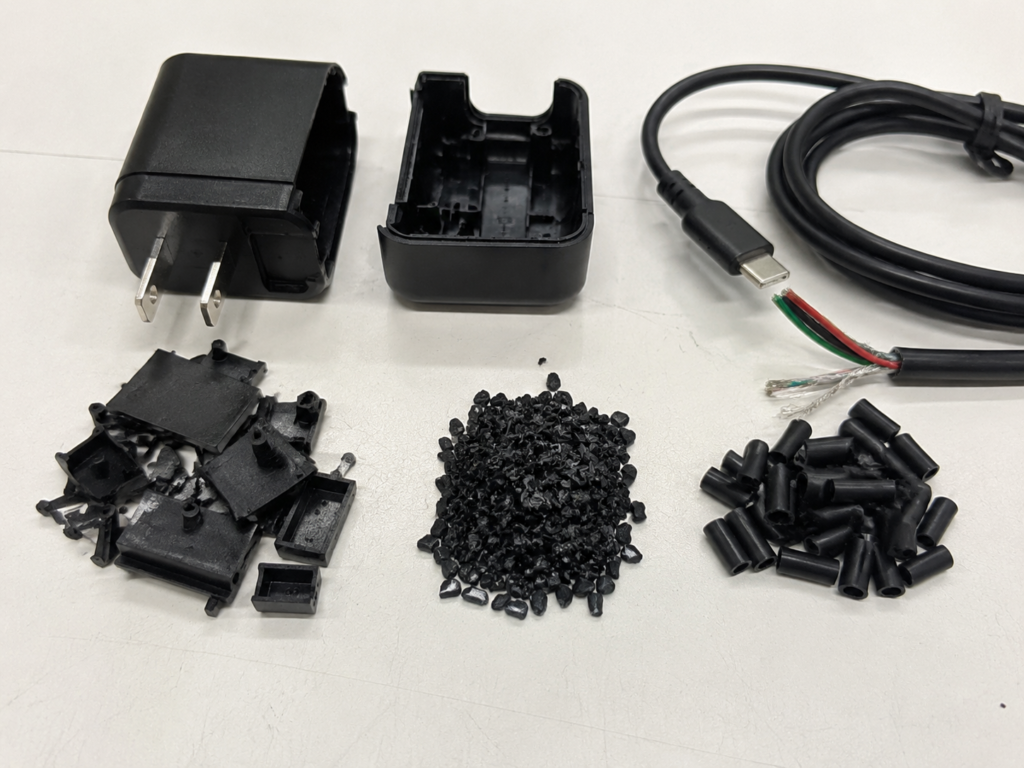
- First clarify the determination unit: TSCA has no unified testing standard. Whether it is necessary to disassemble by homogeneous material depends on the determination requirements of the target rule. For restriction rules with clear concentration limits, it is usually required to determine by homogeneous material (a single material that cannot be further divided into smaller components by mechanical disassembly, such as a piece of plastic, a section of cable jacket); some rules may be determined by component or the entire product, subject to the corresponding rule.
- Risks of mixed testing: If the rule requires determination by homogeneous material, but components of different materials are mixed for testing, it will dilute locally excessive substances (for example, if DecaBDE in the USB connector plastic exceeds the limit, mixed testing with the large housing may show compliance), and such reports are not recognized.
- Prerequisites for combined testing: Components of the same material and same color cannot be combined solely based on appearance. There must be supplier proof that the formula, raw material supplier, production batch, and processing technology of different components are completely consistent before combined testing can be considered; otherwise, the results may be inaccurate due to formula differences.
- Situations where separate testing is required: Components of different materials and different functions (such as the charging cable outer jacket and the USB head plastic) must be sampled separately.
TSCA Compliance Verification and Risk Prevention and Control Practice
TSCA compliance is not only about “doing testing”. Proceeding according to the following priorities can both control costs and cover most risks.
Validity Boundaries of Three Types of Compliance Certificates
Common TSCA compliance-related certificates are divided into legal obligation category and supporting evidence category. The two have different natures and cannot replace each other:
- TSCA import certification/declaration (legal obligation category, if applicable): According to TSCA Section 13, the applicable objects of import certification are chemical substances and mixtures regulated by TSCA, as well as articles covered by specific TSCA rules; not all consumer electronic products such as chargers and charging cables need to submit import certification. Whether to submit, and whether to submit a declaration of “compliant with all applicable TSCA rules” or “meeting exemption conditions”, depends on whether the goods fall within the scope of TSCA regulation, whether they involve specific rule requirements, and the specific provisions of customs declaration. It is usually completed through customs declaration fields, and no separate paper document submission is required.
- Supply chain compliance declaration (supporting evidence category): Written confirmation issued by upstream suppliers is the most commonly used basic compliance evidence, but it cannot be used alone as sufficient compliance proof. A qualified declaration needs to clearly list: corresponding specific TSCA provisions, regulated substances, material model, whether the substance is intentionally added in the formula, production batch, supplier signing entity and basis of knowledge; when involving concentration limits, homogeneous material determination, or exemption conditions, it also needs to be supported by material composition tables, targeted test reports, or rule applicability analysis. A vague declaration that only says “compliant with TSCA” has no effective probative force.
- Third-party test report (supporting evidence category): Only used when supplier declarations are insufficient, when explicitly required by customs/platforms, or for internal quality control needs; it is not mandatory in all scenarios.
Core Actions for Compliance Implementation
Sorted by cost from low to high and efficiency from high to low, prioritize the previous methods:
- Request detailed supply chain declarations: Require suppliers to provide compliance declarations corresponding to specific TSCA rules, substances, and material batches, and implement compliance requirements from the supply chain end. This is the lowest-cost basic action.
- Verify full material composition: Ask suppliers to provide a complete list of material compositions and compare it with the TSCA regulated list, which is suitable for verification of high-risk materials.
- Targeted third-party testing: Only test for high-risk or involved substances. TSCA has no unified “charging product testing package”, so there is no need to blindly do a full set.
- Establish a material change mechanism: Require suppliers to notify in advance when changing formulas or raw materials, and re-evaluate compliance to avoid non-compliance caused by material changes.
All compliance certification materials must be retained as required by the rules, and material formulas, suppliers, and batch changes must be recorded simultaneously; when materials are changed, suppliers are changed, or TSCA rules are updated, the validity of existing certificates needs to be re-evaluated.
Core Precautions for Laboratory Testing
When you really need to do testing, pay attention to these points to avoid pitfalls:
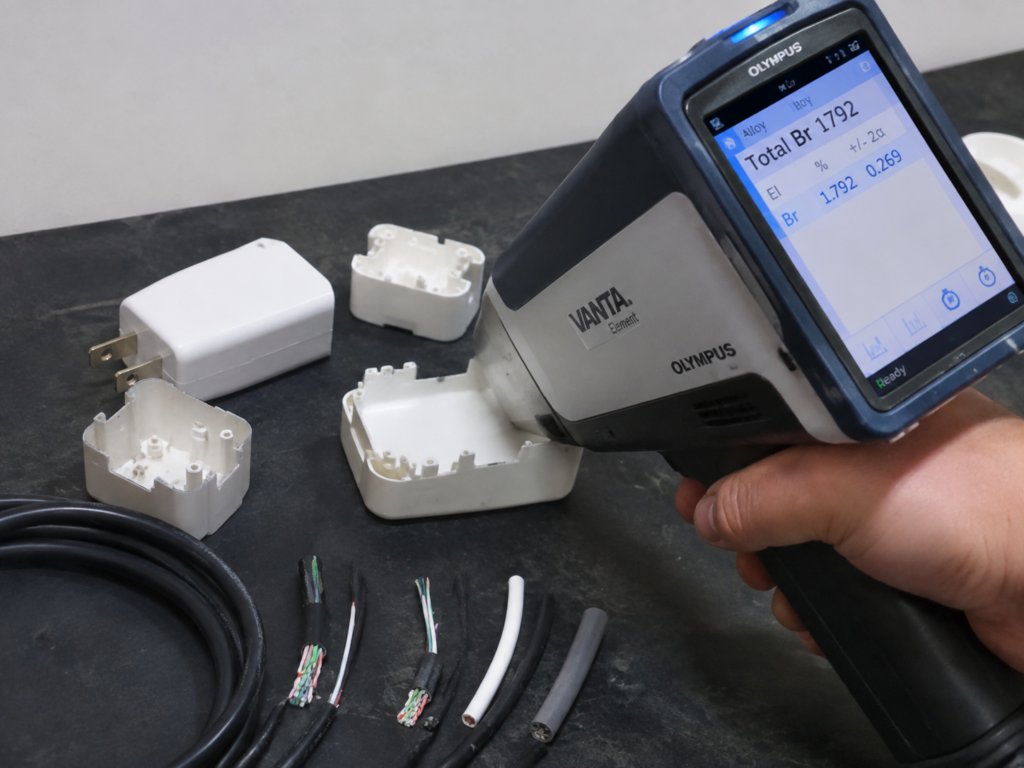
- Testing process: First do preliminary screening, then confirmatory testing. Preliminary screening uses XRF (X-ray Fluorescence Spectrometer) to quickly screen elemental indicators such as total lead, cadmium, and bromine content, which is only for risk prediction (for example, high total bromine content may contain DecaBDE, which can be further tested); the confirmatory link needs to select verified chromatography-mass spectrometry or other applicable standard methods according to the target substance and substrate type, and at the same time verify the method’s pretreatment process, target substance list, limit of detection, limit of quantitation, and quality control requirements — testing methods for different substances are completely different, and there is no universal “full set of TSCA testing” method.
- Important reminder: XRF cannot distinguish specific organic substances, nor can it detect PFAS. It must never be used alone as a basis for TSCA compliance.
- Sample preparation requirements: Disassemble the corresponding materials according to the determination unit of the target rule, and sample components of different materials, formulas, and colors separately; for a single material, usually about 10 to 20 grams can be prepared as a reference for laboratory communication. This is not a unified statutory sample quantity, and the final amount shall be subject to the target substance properties, substrate type, testing method, laboratory minimum dosage, and sample retention requirements. Samples used for formal compliance certification must come from mass-produced finished products and can represent the formula, supplier, and batch of the corresponding materials. R&D samples can only be used for internal preliminary screening and cannot be used as evidence of mass production compliance.
- Core elements of a valid report: Check these points first when you get the report; missing any may make it invalid: ① Clear sample information (corresponding product model, sampled component, batch); ② Core parameters (tested substance, measured content, limit of detection, limit of quantitation, corresponding rule limit); ③ Laboratory qualification (priority is given to laboratories with ISO/IEC 17025 corresponding capability scope, subject to the regulations of the requesting party); ④ Basic testing information (testing method, issuance date, quality control records).
Test Report Interpretation and Compliance Determination
Don’t just look at “pass/fail” when you get the report; judge according to three steps:
- Check sampling information: Confirm whether it corresponds to the target product and whether the sampling method meets the requirements of the target rule — if the sampling does not meet the rule requirements (such as illegal mixed testing), the result is directly invalid.
- Check core parameters: Verify the tested substance, limit of detection, limit of quantitation, measured value, and corresponding rule limit. Note: Not detected (ND) is not necessarily compliant; it is only valid when the limit of detection is lower than the rule limit; if it is below the limit and there is no evidence of intentional addition, it can usually be determined as meeting the requirements on the premise that the applicable scenarios and exemption conditions of the rule are met; if it exceeds the limit or intentional addition is confirmed, it is most likely non-compliant, unless there is a clear exemption clause.
- Check scope of application: Products of the same material, same formula, and same series can share the report; it is necessary to confirm whether it covers all sales models and corresponding TSCA rules.
The above determination logic only applies to situations where the corresponding rule does adopt concentration limits and allows determination through testing data. Actual judgment needs to first confirm whether you are a responsible party, whether the rule applies to the product/material, then verify the determination unit, applicable use, effective date, and exemption clauses, and finally compare the concentration. You cannot draw conclusions solely based on values.
Common Scenarios of Report Invalidation
Even if you get a passing report, it will be useless in the following situations:
- Insufficient sample representativeness: The test sample is different from the mass-produced goods in material and formula.
- Sampling does not meet rule requirements: Sampling is not carried out according to the determination unit of the target rule, covering up the problem of local excess.
- Method mismatch: Wrong testing method is used, for example, using XRF to determine DecaBDE content, which is simply inaccurate.
- After materials, suppliers, or regulations are updated, the old report is not re-evaluated.
Principles for Judging Boundary Cases
When encountering uncertain situations, remember one principle: TSCA has no general exemptions. There is no such thing as “all recycled plastics are exempt”, “all industrial equipment is exempt”, or “all repair parts are exempt”. The correct judgment method is to check the exemption clauses, applicable scenarios, and effective dates of specific TSCA rules. Some PBT rules do have exceptions for recycled materials and specific industrial uses, but everything shall be subject to the official interpretation of the EPA.
Actual Consequences of Non-Compliance and Common Causes
The consequences of non-compliance vary greatly in different scenarios:
- Commercial import scenario: If the goods trigger the obligations of TSCA restriction rules but are not compliant, U.S. Customs may detain or return the goods, and in serious cases, they may also face EPA fines.
- E-commerce platform scenario: If the platform requires compliance certificates corresponding to TSCA rules but you cannot submit them, it may lead to the removal of product listings.
- Information reporting rules: Obligated parties that fail to submit data as required will face EPA penalties, but it will not directly lead to the prohibition of product import — violation of reporting obligations and violation of product restrictions are two different things and cannot be confused.
U.S. Customs usually conducts random inspections or case-by-case verification of TSCA compliance, not every batch is inspected; obligations for personal use and small test samples are lower than mass-produced commercial goods, but if they actually violate the restriction rules, they may still be intercepted.
There are five main common causes of TSCA non-compliance in charging products:
- The plastic housing uses an old formula brominated flame retardant containing DecaBDE, violating the Section 6(h) restriction rule;
- Parties with PFAS reporting obligations (such as U.S. importers) fail to submit data as required by Section 8(a)(7), facing EPA penalties;
- Finished product importers cannot obtain sufficient PFAS ingredient information from the supply chain, and cannot determine their own obligations or respond to verifications;
- PIP(3:1) in components such as USB connector plastic bases and plug plastics does not meet the use and distribution requirements of the corresponding rules;
- Supplier declarations are too vague to correspond to specific TSCA rules and substances, and cannot be used as valid proof.
Common Cognitive Misconceptions
- Misconception 1: Charging products must undergo TSCA testing to enter the U.S. — Wrong. Whether testing is required is screened according to the four-step judgment method. Most consumer-grade finished products do not require proactive testing, and only need it when specific obligations are triggered or random inspections are conducted.
- Misconception 2: With RoHS/UL/FCC certification, you don’t need to worry about TSCA — Wrong. The regulatory dimensions are different, and they cannot automatically replace or prove compliance with another regulation; separate verification is required.
- Misconception 3: A single mixed test of the entire charger meets TSCA requirements — Wrong. If the rule requires determination by homogeneous material, testing must be done after disassembly, and mixed test results are not recognized (see sampling rules for details).
- Misconception 4: TSCA has banned PFAS in all consumer products — Wrong. The current Section 8(a)(7) is only an information reporting rule, and there is no general consumer-grade PFAS prohibition requirement.
- Misconception 5: TSCA test reports are permanently valid — Wrong. After materials, suppliers, or regulations are updated, old reports need to be re-evaluated.
Key Points for Responding to Customs/Platform Random Inspections
When a random inspection occurs, you can proceed according to the following steps:
- First verify the involved substances and the corresponding TSCA rules. Submitting a general declaration that does not match the involved rules may delay verification.
- If you already have a qualified report or declaration, first confirm whether it covers the involved products, substances, and rules to avoid mismatch.
- If there is no compliance evidence, prioritize targeted testing for the involved substances, balancing cost and verification efficiency.
The TSCA rule system seems complex, but for practitioners of consumer-grade charging products, the core logic is very clear: first determine the applicable rules, then clarify your identity as a responsible party, and finally select the corresponding compliance evidence. There is no need to blindly do a full set of tests, nor can you take it lightly. Since the EPA updates rules or issues new regulatory requirements from time to time, when encountering specific problems, it is recommended to prioritize checking the latest official provisions issued by the EPA, or consult a qualified compliance service provider.