
If you are a novice manufacturer, importer, or cross-border platform seller planning to sell chargers, charging cables, and USB interface products to the United States, you have most likely heard of the abbreviation TSCA, but are often confused by various claims: some say it is a mandatory certification like FCC, some say it only applies to chemical plants, and others say that with UL certification, you don’t need to worry about TSCA. Starting from the actual scenarios of charging products, this article clarifies the core points of TSCA regulations, from entry-level judgment to practical due diligence, to help you build a basic compliance awareness.
1. What exactly is TSCA? What does it have to do with charging products?
TSCA stands for the Toxic Substances Control Act, a federal-level chemical substance management regulation in the United States, enforced by the U.S. Environmental Protection Agency (EPA). Its core control focuses on the safety of chemical substances, but it does not mean that “all chemical substances in products are governed by the same set of rules” — TSCA divides controlled objects into three categories: bulk chemical substances, mixtures, and articles. The applicable rules and exemption situations vary greatly among different categories. It is completely different from the control scope of FCC (the U.S. federal agency responsible for electromagnetic compatibility and radio frequency equipment compliance) and UL (a third-party safety certification system, not a federal regulation) that we often contact, and they cannot replace each other.
For charging products entering the U.S. market, TSCA-related requirements are federal rules that need to be complied with. The specific responsibilities and risks depend on product attributes, applicable TSCA provisions, and import declaration methods. If they fail to meet the applicable requirements, they may face risks such as customs detention of goods, fines, or being required by platforms such as Amazon and Walmart to provide compliance certificates or even take down product links.
Novices who are new to TSCA can easily fall into three basic misunderstandings, which we will clarify in advance:
First misunderstanding: There is an official unified “TSCA finished product certification”. In fact, there is no official finished product certification under TSCA that covers all charging products. Its core is chemical substance compliance — as long as the controlled chemical substances in the product meet the requirements of the corresponding provisions, the relevant rules are satisfied. There is no “general finished product certification certificate” stamped with the official seal of the EPA.
Second misunderstanding: TSCA only applies to chemical plants and has nothing to do with sellers of charging products. The subject of obligations under TSCA is not limited to chemical enterprises. As long as you import or sell charging products containing chemical substances controlled by TSCA in the United States, you need to perform corresponding obligations in accordance with the corresponding provisions. The specific responsibilities depend on the role (manufacturer, importer, distributor) and applicable rules.
Third misunderstanding: Having FCC or UL certification is equivalent to TSCA compliance. The three control completely different dimensions: FCC controls electromagnetic compatibility and radio frequency equipment compliance, UL is a third-party electrical safety certification system, and TSCA controls the environmental and health risks of chemical substances. The three are different requirements for U.S. market access and cannot replace each other.
2. Is your charging product within the control scope of TSCA?
The vast majority of finished charging products and components belong to the “article” category as defined by TSCA, which is the basic premise for judging applicable rules.
There are three core judgment criteria for “articles” in TSCA: they have a fixed shape and design form, have specific use functions, and do not release chemical substances as the main purpose during normal use. For example, an ordinary charger is a typical article — it has a fixed shape, its function is voltage transformation and charging, and it does not actively release chemical substances during normal use, so it belongs to the article category.
It should be particularly noted that belonging to the “article” category does not mean complete exemption from TSCA requirements. The article category only exempts part of TSCA obligations (such as the general chemical data report for bulk chemical substances), but the prohibition and restriction rules for substances under Section 6, reporting obligations for specific substances, import certification requirements, etc. may still apply. All compliance responsibilities cannot be exempted solely based on the “article” attribute.
Specific to charging-related products, the common coverage is divided into two categories:
Finished products: including chargers, power adapters, charging cables, USB plugs, various interface adapters, etc., which basically fall within the control scope of the article category.
Components: core material components inside the product, such as the plastic shell of the charger, PCB circuit board, insulating parts, surface coating, solder, the outer sheath of the charging cable, soft rubber of the connector, etc., also belong to the article category and need to comply with the corresponding applicable rules.
There are also fully exempt scenarios, but they need to meet strict regulatory conditions and cannot be applied arbitrarily: one is imported products that meet the reasonable quantity for personal use and are not for commercial sale as stipulated by U.S. Customs and Border Protection (CBP), such as a small number of charging accessories purchased by individuals through overseas shopping for personal use; the other is components made entirely of natural substances, which are extremely rare in consumer-grade charging products, and if involved, the EPA’s exemption rules need to be checked separately.
3. Core TSCA Control Rules: Clarify the Boundary with Four Logics
You don’t need to memorize complex legal provisions by rote. Grasp the four core rules to understand the control logic of TSCA, and then check with the rules of specific substances.
First, the basic listing rule: the EPA has an official TSCA Chemical Substance Inventory (TSCA Inventory) to confirm whether a certain chemical substance has been included in the listed scope. But this is not equivalent to a “finished product compliance whitelist” — the fact that all chemical substances in the materials of a product are in the inventory does not mean that the product must meet all TSCA requirements. The specific compliance needs to be comprehensively judged in combination with the prohibition and restriction rules under Section 6, article exemption conditions, specific use exceptions, etc. In supply chain due diligence, raw material suppliers usually confirm the listing status of chemical substances contained in the materials they provide, but downstream importers and sellers still need to check whether the supplier’s declaration corresponds to the product’s components, materials, and models, and cannot directly assume exemption from liability.
Second, the core restriction rule: that is, the prohibition and restriction rules for hazardous chemical substances stipulated in Section 6 of TSCA. The EPA will issue separate final rules for specific high-hazard chemical substances, clarifying the controlled behaviors (manufacturing, processing, distribution, use, etc.), applicable product scope, limit requirements, transition periods, and exemption situations. There is no unified general threshold — even whether unintentionally added impurities are compliant must be judged against the final rule of the specific substance, and cannot be generalized with a fixed ratio. As long as finished charging products or components contain substances controlled under Section 6 and do not meet the corresponding exemption or transition period requirements, they need to comply with relevant regulations.
Third, the import certification rule: that is, the import certification requirements under Section 13 of TSCA. Some controlled imported goods need to submit TSCA import certification to CBP, but whether it is necessary to submit and which type to submit cannot be mechanically divided simply by “whether it contains restricted substances”, but should be determined according to the legal attributes of the imported goods (chemical substances/mixtures/articles), the corresponding applicable TSCA rules, HTS codes, and the current announcement requirements of CBP and EPA. There are two types of import certification: one is positive certification, which declares that the product complies with all applicable TSCA rules; the other is negative certification, which declares that the product is within the scope of TSCA exemption or is not subject to TSCA import certification requirements. For charging products, it is recommended that a customs broker or professional compliance service provider confirm the certification requirements in combination with the specific materials, uses, and current rules of the product before actual declaration, and do not apply a unified standard on your own.
Fourth, specific reporting obligations: TSCA’s reporting obligations are only triggered in specific scenarios, and not all charging products need to perform them. Among them, the one that may be related to charging articles is TSCA Section 8(a)(7) PFAS Special Report — this requirement applies to entities that manufacture (including import) chemical substances, mixtures, or articles containing PFAS substances, but the specific applicable conditions (including the definition scope of PFAS, reporting period, exemption situations, and data fields to be submitted) shall be subject to the official announcement issued by the EPA in the current period, and cannot be simply understood as “as long as it contains PFAS, it must be reported”. It should be clarified that the reporting obligation for PFAS and the prohibition and restriction obligation under Section 6 are two sets of independent rules. The need to report does not mean that the substance is banned, and vice versa. Another type of general chemical data report (CDR) is only for entities that manufacture or import bulk chemical substances, and sellers and importers of finished charging products usually do not need to perform this obligation.
4. High-Risk Controlled Substances and Screening Clues for Charging Products
There are many types of chemical substances controlled by TSCA, but for charging products, there is no need for a comprehensive investigation. As long as you grasp several types of high-risk substances and check them in combination with product material scenarios, you can cover the main compliance risks. The material scenarios mentioned below are only screening clues. Whether they contain controlled substances and whether they meet the requirements need to be confirmed through the bill of materials (BOM), safety data sheet (SDS), supplier material declaration, or targeted testing.
First, PBT substances, which are a category of high-hazard substances under the key control of TSCA Section 6 — simply put, PBTs are chemical substances that are “persistent, bioaccumulative, and toxic”, and have a great long-term impact on the environment and health.
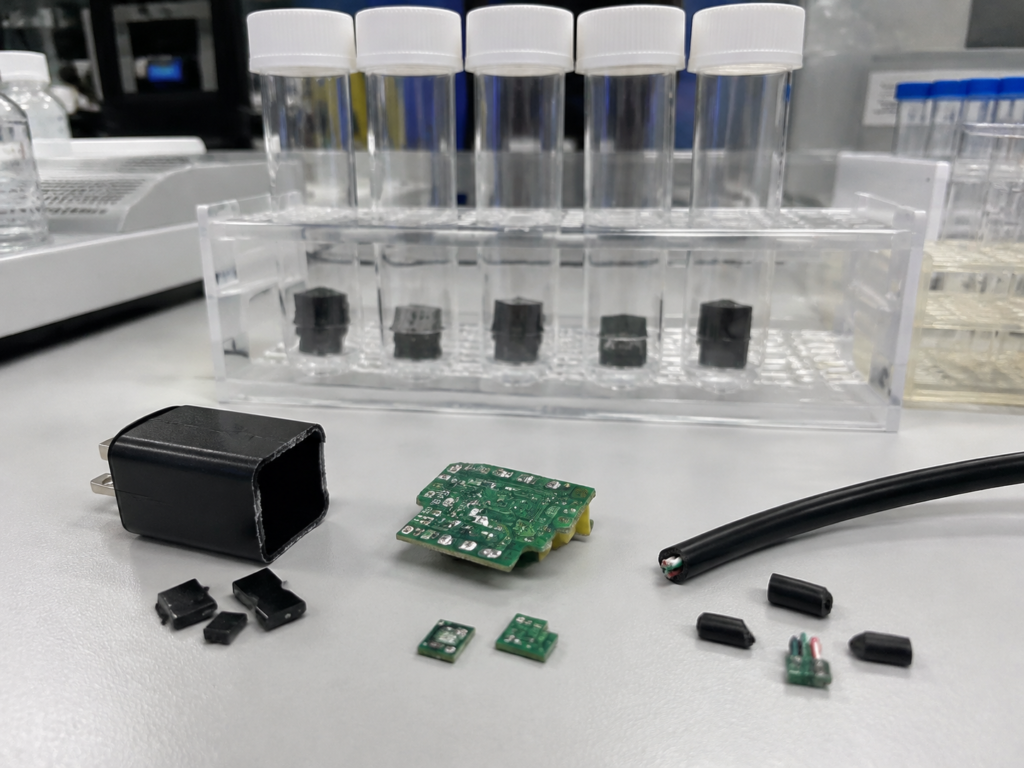
- DecaBDE (Decabromodiphenyl Ether): a commonly used brominated flame retardant. The EPA’s final rule for DecaBDE controls its manufacture, processing, distribution, and specific uses. There are corresponding control requirements and transition period arrangements for its application in consumer electronic and electrical products, and there are also special restrictions on the use of recycled materials for reprocessing. The specific applicable products and exception clauses in the EPA’s final rule for DecaBDE need to be checked. Common screening scenarios: materials that require flame retardants, such as charger plastic shells, PCB boards, and charging cable insulation layers.
- PIP(3:1) (Isopropylated Triphenyl Phosphate): functions as both a plasticizer (to soften plastics) and a flame retardant. The EPA’s final rule for PIP(3:1) has control requirements for its manufacture, processing, and distribution. Different product categories and uses have corresponding exemption or transition period arrangements. Applications such as electronic and electrical cables and soft rubber components need to be checked against specific rules. Common screening scenarios: materials that require plasticization or flame retardancy, such as PVC charging cable outer sheaths, connector soft rubber, and insulating sheaths.
In addition to the above two, there are also low-risk PBT substances such as 2,4,6-TTBP, HCBD, and PCTP, which are rarely actively added to the materials of charging products. Usually, compliance of upstream raw materials is sufficient, and they do not need to be used as key investigation items. If material changes are involved, targeted checks can be made.
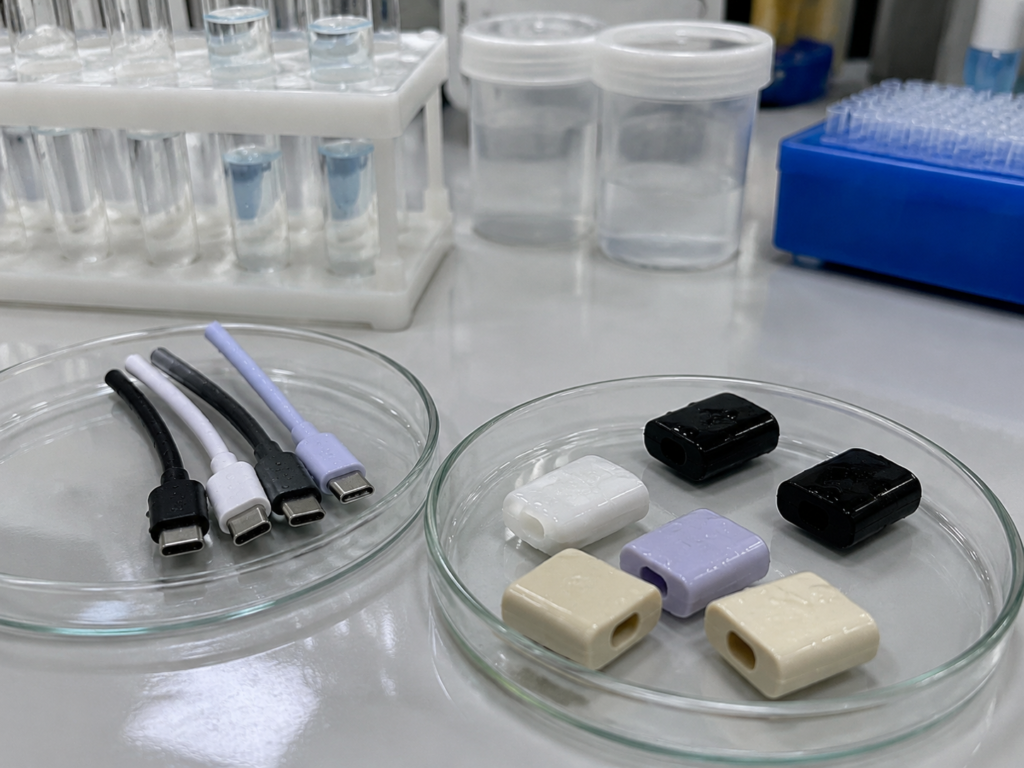
Second is PFAS (Per- and Polyfluoroalkyl Substances), commonly known as “forever chemicals”, named for their extremely difficult degradation in the natural environment. PFAS is a general term for a class of substances. TSCA has different control requirements for different PFAS substances. Some categories have prohibition and restriction rules, and at the same time, there is the special reporting requirement under Section 8(a)(7) mentioned above (the specific rules are subject to the current EPA announcement). Common screening scenarios: scenarios where fluorine-containing materials may be used, such as waterproof/stain-resistant coatings on charging cables, dirt-resistant coatings on plastic shells, and lubricating films inside some fast chargers.
Finally, there are two types of controlled substances that need to be clearly distinguished from other regulations:
- Heavy metals such as lead and cadmium: TSCA does not set unified general limits for lead and cadmium in all charging products, and their control needs to be judged in combination with specific TSCA provisions. TSCA compliance cannot be directly derived solely from the compliance conclusions of RoHS or California Proposition 65. The control scope, limits, and applicable logic of the three are all different. Common screening scenarios: metal-containing components such as plug metal plating and solder.
- Polychlorinated biphenyls (PCBs): TSCA has strict controls on the manufacture, processing, distribution, and commercial use of PCBs. Modern charging products basically do not actively add PCBs, and only old decommissioned equipment may have residues. Newly produced consumer-grade charging products usually do not need key investigation.
5. Entry-Level Compliance Practice: Complete Basic Due Diligence in Five Steps
If you are a novice who has just been exposed to TSCA, you don’t need to do a full test at the beginning. Follow the five steps below to complete basic compliance due diligence, balancing cost and risk control.
Step 1: Establish the product’s bill of materials (BOM). You don’t need to disassemble the product to every screw. Just sort out the core material components, especially the components that may involve high-risk substances mentioned above: for example, the outer plastic, surface coating, and soft rubber connector of the charging cable; the plastic shell, PCB board flame retardant material, solder, and insulating parts of the charger; the plastic shell, metal plating, and sealant of the USB plug/interface, etc. The corresponding material types and suppliers should be clearly listed.
Step 2: Screen the TSCA controlled substances to be checked according to product materials. Combined with the material characteristics and functional promotion of the product, corresponding to the previous high-risk substance list, determine the substances that need to be checked with priority: for example, for charging cables with waterproof and stain-resistant coatings, focus on checking PFAS-related rules; for charger shells with flame retardant requirements, focus on checking the rules of brominated flame retardants such as DecaBDE; for PVC cables, focus on checking the relevant rules of PIP(3:1). You don’t need to check all substances, first focus on high-priority items.
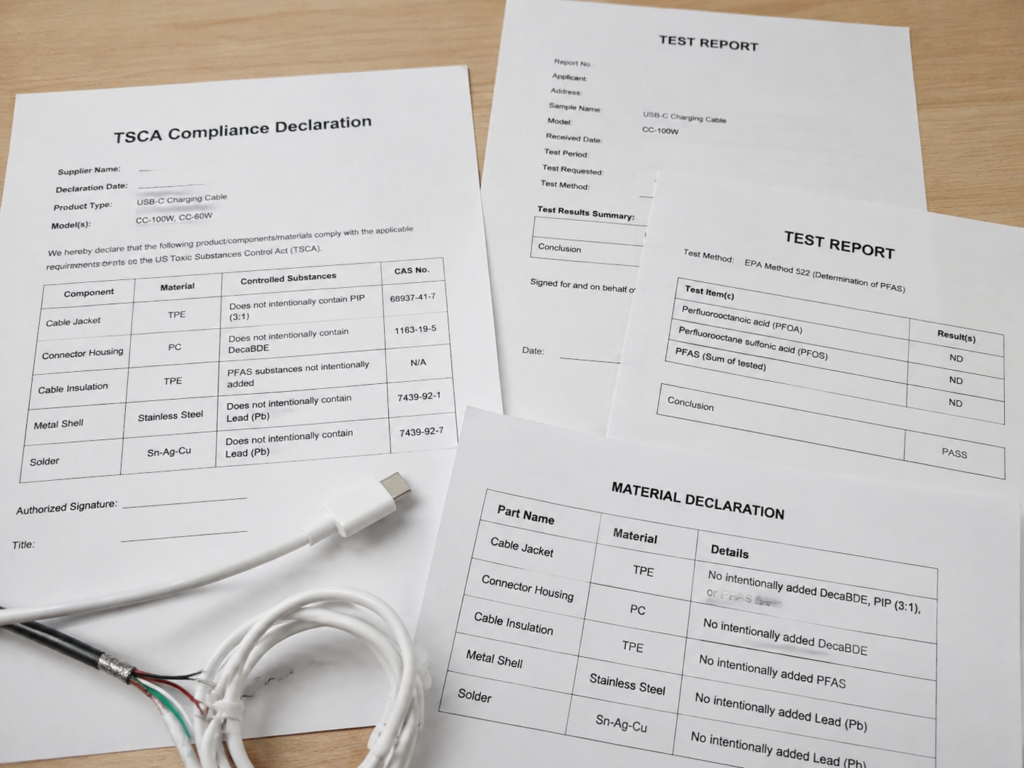
Step 3: Request compliance certification documents from the supply chain. You don’t need to do the testing yourself first. First, ask the upstream supplier for the compliance materials of the corresponding components. The core includes: the TSCA compliance declaration issued by the supplier (it needs to clearly cover the specific product model, components, materials, and corresponding controlled substances, and cannot be a vague “this product complies with TSCA”), and test reports or material declarations for the corresponding controlled substances (if any). After getting the documents, check two core points: first, whether the components, materials, and models covered by the documents are consistent with your products, to avoid using documents from other products to make up the number; second, if there is a third-party test report, it is necessary to confirm that the test method meets the requirements of the corresponding TSCA rules, and the specific qualification requirements shall be checked according to the corresponding rules or the regulations of the importer and the platform. It should be noted here that a general declaration only marked “the whole product complies with TSCA” without specific component, material, and model information cannot independently prove the compliance of a specific product and cannot be used as the sole basis for due diligence.
Step 4: Confirm the TSCA requirements for import declaration. The specific requirements for import certification cannot be judged by yourself. You need to entrust a qualified customs broker or compliance service provider to confirm whether it is necessary to submit TSCA import certification and whether positive or negative certification should be submitted, in combination with the product’s HTS code, material attributes, and applicable TSCA rules, to ensure that the declaration meets the current requirements of CBP and EPA.
Step 5: Organize and retain compliance files. All supply chain declarations, test reports, material traceability records, and import declaration-related documents shall be archived by product model. If suppliers are changed or material formulas are adjusted, the files shall be updated in time. The retention period of compliance files shall be determined according to the specific TSCA provisions triggered, import declaration requirements, and the enterprise’s own compliance policy. It is recommended to cover the entire sales cycle of the product and the subsequent possible random inspection cycle.
6. Advanced Pitfall Avoidance: Clarify Misunderstandings and Quickly Judge Compliance
If you have completed basic due diligence and want to further identify potential risks and avoid pitfalls, you can learn the following advanced content.
Common Advanced Misunderstandings
First misunderstanding: RoHS/REACH compliance is equivalent to TSCA compliance. That’s wrong. EU RoHS currently restricts 10 substances (lead, mercury, cadmium, hexavalent chromium, polybrominated biphenyls, polybrominated diphenyl ethers, and 4 phthalates). The control list, limits, and scope of application of REACH also differ from TSCA. The regulatory logic and control objects of the three are completely different. Even if the product meets EU compliance requirements, it still needs to be checked against TSCA rules separately when sold to the United States, and cannot be directly applied.
Second misunderstanding: If the finished product belongs to the “article” category, you don’t need to worry about TSCA. This is a common misunderstanding of the concept of “article” — the article category only exempts part of TSCA obligations. The prohibition and restriction rules for substances under Section 6, specific PFAS reporting obligations, import certification requirements, etc. may still apply. They need to be judged in combination with specific provisions, and you cannot rest easy solely based on the “article” attribute.
Third misunderstanding: Small-batch shipments or platform drop-shipping don’t need to worry about TSCA. That’s wrong. As long as the products enter the U.S. market for commercial sale, importers and sellers need to bear corresponding compliance responsibilities in accordance with applicable TSCA provisions. Customs will not directly exempt them due to small quantity, and platforms may also require compliance certificates according to rules. The specific responsibilities need to be determined in combination with the import declaration subject and sales model.
Quick Distinction of Similar Regulations
Many people easily confuse TSCA with other common U.S. and EU compliance requirements. The table below can help you quickly sort out the differences:
| Similar Regulation/System | Core Control | Applicable Level/Region | Relationship with TSCA |
|---|---|---|---|
| FCC | Electromagnetic compatibility and radio frequency equipment compliance | U.S. federal | The control scope is completely different. They are different dimensions of U.S. market access, need to be complied with simultaneously, and cannot replace each other |
| California Proposition 65 | Hazardous substance warning label requirements | California state level, U.S. | TSCA is a federal access rule, and California Proposition 65 is a state-level warning system with different requirements. Products sold to California need to additionally meet the requirements of California Proposition 65 |
| EU RoHS | 10 hazardous substances in electronic and electrical products | EU region | The control list, limits, and regulatory logic are all different. RoHS compliance is not equivalent to TSCA compliance |
Quick Compliance Judgment Method
To quickly judge whether the TSCA compliance of a product is reliable, you can start from three dimensions:
First, confirm the TSCA attribute of the product and the scope of applicable rules, clarify whether it is an article, mixture, or bulk chemical substance, and initially delineate the provisions that need to be complied with.
Second, check the matching of supply chain documents: an effective compliance certificate must correspond one-to-one with the specific product model, components, and materials, and can cover the applicable controlled substances. Vague general declarations or reports that do not match the product cannot be used as the basis for compliance.
Third, identify high-risk signals: if you encounter situations such as suppliers being unable to provide material declarations for specific components, products with special functions (such as waterproof and stain-resistant, high flame retardant) being unable to provide compliance evidence for corresponding substances, or raw material costs being significantly lower than the normal industry level, you must be more vigilant and further verify, and cannot directly accept oral compliance promises.
Entry-Level Self-Check List
Check the following list one by one to quickly confirm whether basic compliance due diligence has been completed:
□ The core high-risk components of the product have been sorted out, and a clear bill of materials has been formed
□ A TSCA compliance declaration issued by the supplier covering the corresponding components and controlled substances has been obtained
□ Compliance certificates for the corresponding TSCA controlled substances have been checked for the high-risk materials involved in the product
□ The TSCA certification requirements for import declaration have been confirmed by a customs broker or compliance service provider
□ Traceable compliance files have been established, and update and retention rules have been clarified
Generally speaking, TSCA is a basic federal rule for chemical substance safety in the United States, not a special access threshold for charging products. For practitioners in the charging product industry, as long as you clarify the TSCA attribute of the product, grasp high-risk materials and core controlled substances, and do a good job in supply chain due diligence and file retention, you can effectively control most compliance risks. It should be noted that the specific rules of TSCA (especially the requirements for emerging controlled substances such as PFAS) may be dynamically adjusted. When encountering new materials, uncertain prohibition and restriction rules, or import declaration issues, it is recommended to check the current official requirements of the EPA and CBP, or consult a professional compliance service provider to avoid pitfalls due to rule updates.