
If you run a consumer goods business in the United States—whether operating an offline physical store, selling on platforms, doing direct shipping from an independent website, or using FBA fulfillment—you have most likely heard of the CPSC. Some regard it as a “terrifying scourge”, believing that being selected for inspection will lead to bankruptcy-level fines; others think they are small sellers with low sales volume and low product value, so they will never be inspected.
In fact, these views are somewhat one-sided. CPSC enforcement follows clear rules and discretionary logic; it does not conduct random inspections or impose arbitrary fines, nor does it completely skip small businesses just because of their size. Understanding its enforcement logic will not only help you avoid most compliance pitfalls, but also let you know how to respond when problems actually arise, so you do not worsen penalties due to panicking and acting recklessly.
Basics: Definition, Jurisdiction, and Liable Parties
Before learning about enforcement rules, you must first clarify what the CPSC regulates and who is responsible, which is the starting point for all compliance judgments.
What is the CPSC, and what are its enforcement bases?
The CPSC is the U.S. federal agency responsible for regulating the safety of civilian consumer products. The core foundational law for its enforcement is the Consumer Product Safety Act (CPSA). The Consumer Product Safety Improvement Act (CPSIA), enacted in 2008, is a major amendment to the original regulatory system. Together with category-specific safety rules, these form the CPSC’s enforcement bases. Its core regulatory goal is to reduce personal injuries and deaths caused by consumer products.
Which products fall under CPSC jurisdiction?
The CPSC has jurisdiction over civilian consumer products intended for ordinary consumers, for personal or household use, covering all sales channels including offline stores, online platforms, direct shipping from independent websites, and FBA fulfillment.
The following categories are generally not under CPSC jurisdiction and are regulated by other federal agencies: food, drugs, cosmetics, tobacco, motor vehicles, aircraft, military supplies, and products for purely industrial use.
There is also an easily overlooked boundary: used or antique products may have limited exemptions from certain specific CPSIA requirements (such as some phthalate limits), but they still cannot have general safety hazards—if a product presents an unreasonable safety risk, it will still be regulated by the CPSC.
Who is liable for violations?
Any party involved in the distribution chain of consumer products may be held liable, including: U.S. domestic manufacturers, importers, distributors, retailers, private label owners, and online sellers.
There are two key liability rules to remember:
First, the U.S. importer of imported products is the statutory primary liable party—even if you are an overseas seller or manufacturer, you may still be directly held liable by the CPSC;
Second, if a parent company or actual controller is deeply involved in the violation, they will also bear joint and several liability.
Why should new sellers also pay attention?
The CPSC allocates enforcement resources based on product risk, not business size—small businesses and small-batch high-risk products are equally likely to be selected for inspection. Moreover, there are various forms of penalties, and severe cases may directly lead to business shutdown. The cost of non-compliance is far higher than the cost of proactive compliance, so even entry-level sellers cannot take it lightly.
How Enforcement Reaches You: Sources of Leads and Case Filing Criteria
Many people wonder: the CPSC has limited staff, so how could it happen to inspect me? In fact, most of the CPSC’s enforcement leads come from fixed channels, not random inspections.
The Core Trigger: Section 15(b) Mandatory Reporting Obligation
This is an obligation that many businesses most easily overlook and most easily stumble on: according to Section 15(b) of the Consumer Product Safety Act, once a business discovers that a product meets any of the following statutory circumstances, it must immediately report to the CPSC—late reporting or concealment is itself a serious violation, even if the product has not yet caused actual harm:
- The product has a defect that may create a substantial product hazard;
- The product violates applicable mandatory safety rules or bans;
- The product presents an unreasonable risk of serious injury or death.
Many people ask: Can I investigate thoroughly first before reporting? After obtaining relevant information, a business may indeed conduct a reasonable and prompt preliminary investigation, but it cannot use “investigation in progress” as an excuse to delay reporting. The CPSC generally sets the baseline requirement for “immediate reporting” as within 24 hours of learning of the risk. This is a general operational guideline, not an absolute hard deadline for all cases, but unexcused delays will be directly deemed late reporting.
There is another common misconception: I have low sales and no one was injured, so I don’t need to report. This is completely wrong—the core criterion for Section 15(b) reporting is whether the statutory risk trigger conditions are met, which has no necessary connection to sales volume or whether actual injury occurred. For example, if the children’s toys you sell have small parts that easily fall off, even if there is only one consumer complaint and no child has actually ingested a part, as long as the risk is sufficient to constitute a substantial hazard, you must report it on time.
5 Common Types of External Leads
In addition to voluntary reporting by businesses, the CPSC’s enforcement leads also come from these 5 channels:
- Consumer complaints and injury reports: The U.S. has a public database called SaferProducts.gov, where any consumer can report injuries or safety hazards caused by products. If multiple similar complaints are received for the same product, it is very likely to trigger a focused CPSC investigation.
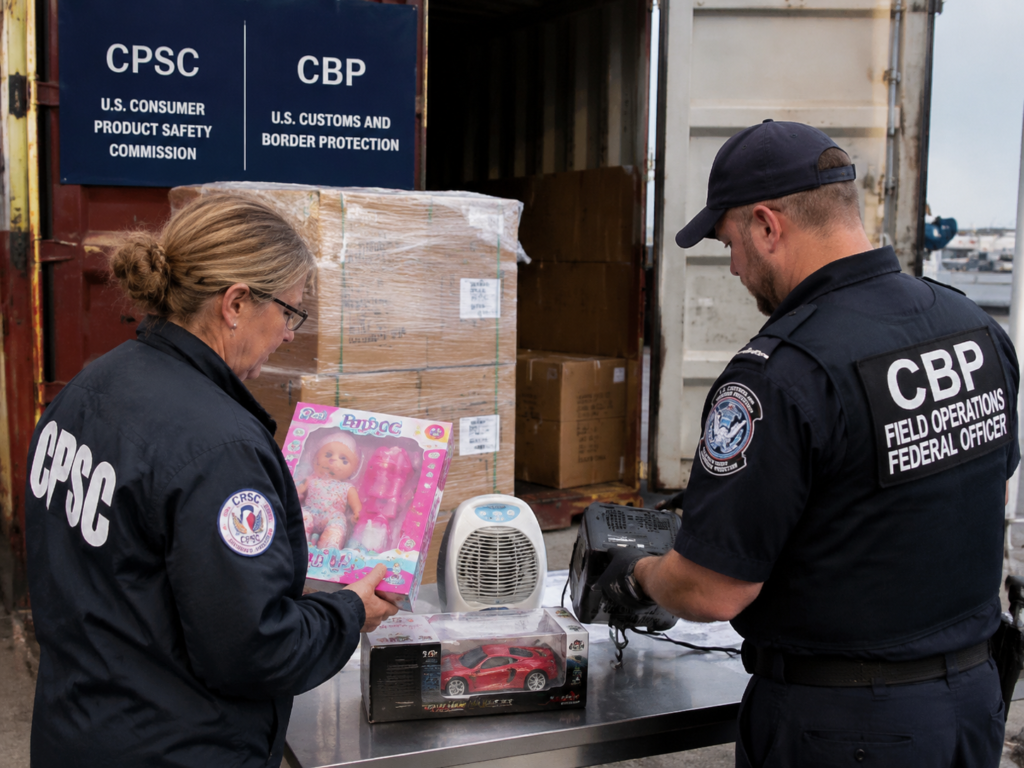
- Joint random inspections at import ports: U.S. Customs and Border Protection (CBP) and the CPSC jointly conduct random inspections of imported goods at ports. Selected goods will be directly detained and sent for testing, and non-compliant goods may be denied entry into the U.S.
- CPSC proactive market sampling: The CPSC proactively purchases samples online and offline for testing, focusing on high-risk categories. It is not only complained-about products that are inspected.
- Third-party reports: Competitors, media, and ordinary consumers can all report non-compliant products to the CPSC, and this situation is not uncommon in practice.
- Cross-agency information sharing: State-level regulatory agencies, other federal departments, and even international regulatory organizations will transfer product safety leads to the CPSC when discovered.
When will a case be upgraded to a formal investigation?
Not all leads will trigger a formal investigation. The CPSC will first assess the risk and sufficiency of evidence. Generally, a case will be upgraded to a formal investigation if any of the following conditions are met:
- The product indeed presents a continuing risk, but the business has not promptly stopped sales or carried out rectification;
- The business does not respond in a timely manner, provides incomplete information, or makes contradictory statements, leading the CPSC to believe there may be concealment;
- The case involves high-risk situations such as injury incidents or children’s products;
- There is evidence that the business may have intentionally concealed problems or committed fraud.
Common Enforcement Tools and Possible Pathways
Many people think CPSC enforcement is a fixed process that “escalates step by step from minor to severe”, but that is not the case. The CPSC will adopt multiple measures in parallel, or directly initiate corresponding procedures, based on the risk level of each case, the evidence situation, and the business’s cooperation level. There is no requirement to progress level by level. Businesses that receive relevant leads should also not wait for “level-by-level progression” before taking actions such as stopping sales, preserving materials, or assessing their Section 15(b) reporting obligation.
Informal Communication (Mildest, No Penalty Record)
This is the most common initial contact method, and the first CPSC email many people receive falls into this category. Common forms include information request letters, phone or email inquiries, and verbal rectification suggestions. The core is to require the business to provide compliance documentation and explain relevant situations.
At this stage, no formal case has been filed, and there will be no penalty record. There is only one key point for response: respond promptly and provide complete compliance evidence. For example, if the CPSC asks whether the water cups you sell have compliant test reports, if you send the corresponding reports within the required time and explain that the product is compliant, there is a high probability that the case will be closed directly without escalation.
Formal Investigation
If the leads initially confirm the risk of a violation, or the business does not cooperate with informal communication, the case will enter the formal investigation stage.
The CPSC’s evidence collection methods include retrieving relevant documents, verifying samples, interviewing relevant personnel, and cross-verifying information such as product batches, sales volume, and complaint records. At this stage, you may receive a Civil Investigative Demand (CID), which is a formal legal document with legal effect. After receiving it, you must first verify the legal basis, scope of investigation, and response deadline of the document, and immediately preserve all relevant materials. You cannot refuse without reason or fail to respond after the deadline.
If trade secrets or confidential business information are involved, you can, with the assistance of professionals, communicate with the CPSC to adjust the scope of investigation, apply for an extension, or request confidential treatment. However, you cannot directly refuse to submit materials on the grounds of “trade secrets”—confidentiality rules affect the way information is disclosed and protected, and do not automatically exempt you from the obligation to submit.
Voluntary Corrective Actions
Before or after a formal investigation, if a product is confirmed to have compliance risks, the CPSC will usually first negotiate voluntary corrective actions with the business, which is a very common problem-solving method in practice.
Common voluntary corrective actions include: voluntary recall (which can be repair, replacement, full refund, etc.), removal from shelves and sales suspension, supplementary testing, label modification, etc. The CPSC has a Fast Track processing channel. If eligible businesses promptly commit to implementing corrective actions recognized by the CPSC, they can usually shorten the CPSC’s processing time for preliminary assessment of defect risks and speed up case progression.
A common misconception needs to be corrected here: voluntary recall is a measure of proactive cooperation by the business, and does not mean that a fine will necessarily be imposed. Many businesses panic as soon as they hear about a recall, thinking they will definitely be fined a large sum of money. In fact, proactive cooperation with a recall will instead become a favorable discretionary factor, and may even result in exemption from fines.
Mandatory Enforcement Measures
If a business does not cooperate with voluntary corrective actions, or the product hazard is particularly serious, the case will enter the mandatory enforcement stage. Common mandatory measures include:
- Mandatory recall: The CPSC will first determine in accordance with statutory procedures that a product may constitute a substantial product hazard, issue a notice to the business and give it an opportunity for a hearing, before it may issue a mandatory recall order; if the business is dissatisfied with the result, it may raise a defense and apply for review in accordance with procedures.
- Sales ban: For businesses that refuse to rectify and continue selling dangerous products, the CPSC may apply to a federal court for a temporary or permanent injunction prohibiting the continued sale of relevant products.
- Import-specific measures: For imported products, the CPSC will work with CBP to take measures such as detaining goods, denying entry, requiring rectification before release, confiscation or destruction in accordance with the law. Related costs are usually borne by the importer; if there are repeated violations, the business may be added to a key supervision list, and the random inspection rate for subsequent imported goods will be greatly increased.
Criminal Referral (Extremely Rare)
This is the most severe enforcement method and occurs extremely rarely. Only when a business intentionally violates the law, forges compliance documents, conceals defects, and causes serious consequences (such as major casualties) will it be referred to the U.S. Department of Justice (DOJ) for prosecution. Not only will the company be fined, but executives and relevant responsible persons may also face imprisonment.
For the vast majority of small and medium-sized businesses, as long as they do not intentionally commit fraud or concealment, they will basically not reach this stage, so there is no need for excessive panic.
How Penalties Are Calculated: Amount Rules and Severity Logic
Many people are most concerned about how much the fine will be. In fact, CPSC penalties are not decided arbitrarily; they have clear calculation rules and discretionary standards.
Civil Penalties vs. Criminal Penalties
First, it is necessary to distinguish between civil penalties and criminal penalties; the two are completely different:
| Comparison Item | Civil Penalties | Criminal Penalties |
|---|---|---|
| Proportion | Over 90% | Extremely rare |
| Applicable scenarios | Negligent/unintentional violations | Intentional fraud/concealment resulting in serious casualties |
| Main form of penalty | Mainly fines | Company fines + personal imprisonment of executives |
| Probability for small and medium sellers | High | Extremely low |
The violations of the vast majority of small and medium-sized businesses fall under the civil category, so you don’t have to think of jail time as soon as you hear about penalties.
Calculation Rules and Caps for Civil Fines
The basic calculation logic for civil fines is: they are accumulated per individual violation, but there is a cumulative cap for violations of the same related series. The specific cap amount is adjusted annually for inflation, and violations under different regulations may be subject to different cap standards. Businesses can check the current statutory values in the civil penalty inflation adjustment section on the CPSC’s official website.
The determination of the unit of violation and whether violations belong to the same related series need to be judged in combination with specific legal provisions and case facts, and there is no unified fixed standard.
In practice, the actual penalty amount in most cases will be lower than the statutory cap. Proactive cooperation and timely rectification are usually important factors for lenient discretion.
Common Considerations Affecting the Severity of Fines
The following are common factors that affect the amount of fines, summarized based on enforcement practice, to help operators estimate risks. This is not an exhaustive statutory list. When making a penalty decision, the CPSC will also comprehensively consider statutory factors such as the nature, circumstances, scope, and severity of the violation, the number of involved products, and proportionality to the size of the business:
- Risk level: The higher the product risk, the heavier the penalty. For example, penalties for products that have caused actual harm are heavier than those for products with only potential risks; penalties for products targeting vulnerable groups such as children and the elderly are heavier than those for ordinary adult products.
- Scale of violation: The larger the sales volume of the involved product, the more consumers involved, and the longer the violation lasts, the heavier the fine. The penalty for selling 100 units is definitely not on the same level as that for selling 100,000 units.
- Subjective fault: Is it an unaware negligence, or a knowing violation and intentional concealment? The penalty for the latter will be much heavier.
- Degree of cooperation: Did you proactively report, actively rectify, and cooperate with the investigation? Proactive cooperation will be considered for leniency, while refusal to cooperate will be considered for severity.
- History record: Is it a first violation or a repeat offense? Are there any prior similar compliance records? Penalties for repeat offenses will be significantly increased.
Don’t Overlook Non-Fine Associated Costs
Many people only focus on the fine amount, but in fact, non-fine associated costs are often much higher than the fine:
- Direct recall costs: Costs of returns, refunds, repairs, destruction, and sending notifications to consumers. For example, if you sold 10,000 power banks, just refunds could cost hundreds of thousands of dollars.
- Business losses: Inventory removal from shelves, channel cooperation termination, platform account suspension, and damage to brand reputation—these losses may directly lead to business shutdown.
- Other costs: Legal fees, compliance consultant fees, storage fees and destruction fees for detained imported goods—added up, these are also a considerable expense.
High-Risk Scenarios That Most Easily Lead to Pitfalls and New Seller Misconceptions
Now that we understand the rules, let’s talk about which situations carry higher risks and the common cognitive mistakes new sellers make, to help you avoid pitfalls in advance.
4 Common Types of Violations with Severe Consequences
In practice, the following types of violations very easily trigger enforcement and have relatively severe consequences:
- Missing compliance documentation: No test reports corresponding to mandatory requirements, or documents such as Children’s Product Certificates (CPC) and General Certificates of Conformity (GCC) do not meet requirements—many new sellers don’t even know they need to prepare these documents, so they are caught every time they are inspected.
- Label violations: Missing or incorrect safety warning labels (such as warnings for choking risk, flammability risk, electric shock risk), or children’s products do not have tracking labels as required. These problems are very common.
- Non-compliant products: Excessive harmful substances (such as lead, phthalates), structural safety hazards, non-compliant flammability performance, etc. This is the core type of violation.
- Violation of reporting obligations: Late reporting or concealment of product defects or injury incidents. Even if the product itself has minor problems, the act of concealment itself will lead to severe penalties.
4 Types of High-Risk Categories That Require Key Attention
The CPSC’s enforcement resources are tilted toward high-risk products. The following 4 categories are those that require key attention in practice. Specific compliance requirements are subject to the mandatory standards, testing, and labeling rules of the corresponding category:
- Children’s products: Toys, strollers, children’s clothing, children’s furniture, etc., are categories under key control of the CPSIA.
- Household flammable products: Mattresses, pajamas, curtains, carpets, etc., which easily cause serious injury once a fire breaks out, have relatively strict control requirements.
- Products with electricity/batteries: Electronic products, power banks, small home appliances, etc., which easily cause electric shock and fire accidents.
- Household/sports high-risk products: Helmets, bicycles, heaters, fitness equipment, etc., which easily cause personal injury.
If you operate in the above categories, you must pay extra attention to compliance.
5 Common Cognitive Misconceptions Among New Sellers
Many new sellers stumble not because they intentionally violate rules, but because of cognitive errors:
- Jurisdiction misconception: “I’m a small seller doing direct shipping, so I won’t be inspected”—Wrong. The CPSC allocates enforcement resources based on product risk, not business size. Direct shipping and FBA are both within its jurisdiction. Even if you only sell a dozen units a month, as long as it’s a high-risk product, you may still be selected for inspection.
- Liability misconception: “I have test reports from my supplier, so I’m fine”—Wrong. The importer is the statutory primary liable party. Whether a test report is valid depends on the regulatory requirements corresponding to the product: for products subject to children’s product rules where the law explicitly requires third-party testing, the test must be issued by a CPSC-accepted third-party laboratory to be valid; for non-children’s general-use products subject to General Certificate of Conformity (GCC) requirements, a certificate can be issued based on a reasonable testing program, but the product must still be ensured to comply with the corresponding mandatory standards. If the report does not meet the corresponding requirements, even if the supplier provides it, the ultimate liability will still be borne by the importer.
- Risk misconception: “No harm was caused, so I won’t be fined”—Wrong. As long as the product has risks or violates mandatory standards, you may be fined; it is not necessary for someone to actually be injured.
- Rectification misconception: “I’ve rectified it, so I won’t be fined”—Wrong. Previous violations will not be automatically exempted from liability just because you rectified them later. Rectification is only a factor for lenient consideration, not a guarantee of no penalty.
- Documentation misconception: “It doesn’t matter if labels, reports, and batches don’t match, as long as I can explain it”—Wrong. Inconsistent documentation will greatly amplify risks, and verbal explanations are far less effective than written records. For example, if you tested Batch A but are selling Batch B, the test report cannot prove the compliance of the products being sold.
There is another easily overlooked boundary rule: voluntary standards that are not included in the CPSC’s mandatory requirements will not directly lead to penalties. For example, if you fail to meet a recommended standard issued by an industry association, you will not be fined directly for that. But if the product has safety hazards as a result, you will still be held liable for the unsafe product.
Practical Operations for New Sellers: Quick Self-Inspection and Correct Response to Receiving Notifications
After talking about so many rules, finally, here are a few directly usable practical methods that even new sellers can start using right away.
3-Step Quick Risk Self-Inspection
You don’t need to understand complex regulations. Follow these 3 steps to eliminate most basic risks:
- Step 1: Confirm jurisdiction: First determine whether the product falls under CPSC jurisdiction. If it is an excluded category such as food, drugs, or motor vehicles, you do not need to comply with CPSC compliance requirements.
- Step 2: Verify corresponding requirements: Check the mandatory safety standards, testing requirements, labeling and certificate requirements for the product’s category—for example, children’s toys require testing for lead and phthalates, a Children’s Product Certificate (CPC), and a tracking label; ordinary household small appliances must comply with corresponding electrical safety standards and issue a General Certificate of Conformity (GCC) as required.
- Step 3: Check document consistency: Check whether test reports, certification documents, batch records, and sales records are correspondingly compliant. For example, whether the product model and batch on the test report match those being sold, and whether the issuing agency meets the requirements of the corresponding regulations.
Correct Processing Steps for Receiving a CPSC Notification
If you do receive a CPSC notification, don’t panic. Follow these 4 steps to avoid worsening penalties:
- Step 1: Verify authenticity, don’t act recklessly: First confirm whether the notification is real (there are now scammers impersonating the CPSC). Don’t casually admit to violations, and absolutely do not delete or destroy relevant records—deleting records will be deemed intentional concealment and obstruction of investigation, directly worsening penalties.
- Step 2: Freeze sales and seal up materials: Immediately suspend the sale, shipment, and restocking of the involved product. Seal up all relevant materials (test reports, purchase records, sales records, complaint records, etc.) and samples, and do not modify them arbitrarily.
- Step 3: Internal synchronization and material organization: Notify relevant personnel such as supply chain, compliance, and customer service staff, and organize all materials related to the involved product without omission.
- Step 4: Assess risks and seek professional help if necessary: Based on the product’s risk level and the scale of the violation, assess whether and how to rectify. If the situation is relatively serious, don’t tough it out on your own; seek help from a professional compliance consultant or lawyer.
Considerations That May Lead to Leniency or Exemption from Penalties
The following 3 types of situations are usually favorable considerations for leniency or exemption from penalties, but they do not guarantee exemption:
- First violation, no actual harm caused, and extremely low product risk—for example, only the text on the label is printed in the wrong position, and the product itself has no safety hazards.
- Before the CPSC discovers the problem, the business proactively reports the risk, fully rectifies, and initiates a recall. This situation will be a very important factor for lenient discretion.
- The business has fulfilled its reasonable review obligation, and the violation is entirely caused by the supplier’s fraud—for example, you commissioned a compliant laboratory for testing as required, and the supplier’s submitted sample passed but the bulk goods had materials changed without authorization. In this case, you can claim a reduction in penalties, but it is difficult to be completely exempt. After all, the importer is still the statutory primary liable party and is responsible for the compliance of imported products.
4 Types of Behaviors That May Significantly Increase Penalty Risk
The following behaviors may be deemed as non-cooperation with investigation, intentional violation of the law, or obstruction of investigation, which will significantly increase the severity of civil penalties and may even lead to criminal risks. They must be avoided:
- Ignoring notifications and failing to reply after the deadline—what might have been a minor problem will, if you refuse to respond, lead the CPSC to directly make an adverse finding based on existing evidence, and the penalty will be significantly increased.
- Providing false information, concealing violation facts, or forging compliance documents—this constitutes intentional violation of the law, and severe cases will be referred for criminal investigation.
- Transferring or destroying non-compliant products, deleting relevant records—this will be deemed as resisting investigation and concealing evidence, and will be directly handled with severity.
- Continuing to sell non-compliant products after a recall is announced—this constitutes a knowing violation, and penalties will be greatly increased.
When Do You Need Professional Support?
Not all situations require a lawyer or compliance consultant, after all, the fees are not low. If any of the following situations apply, it is recommended to seek assistance from a professional:
- Involving children’s products, detained imported goods, or public recall;
- Involving death, serious injury, or multiple injury complaints;
- Receiving a Civil Investigative Demand (CID) or formal investigation order, or involving late reporting or false materials;
- Large-scale violation, which may face high fines or business shutdown.
Overall, the core of CPSC enforcement is to prevent and control consumer product safety risks, not simply to impose penalties. For ordinary sellers and small and medium-sized businesses, you neither need to see it as a terrifying scourge nor take chances. The core logic of compliance is actually very simple: first determine whether your products and business are subject to CPSC jurisdiction, then do a good job of daily compliance against the mandatory rules of the corresponding category; once risks are discovered, promptly assess your Section 15(b) reporting obligation, stop sales and preserve relevant materials immediately, and proactively cooperate with the investigation to minimize the losses caused by non-compliance. Spending a little effort in advance on daily compliance is far more cost-effective than trying to fix things after a problem occurs.