
Enterprises engaged in the electrical and electronic equipment business in the UK market have mostly seen the “crossed-out wheeled bin” mark on products, and may also be required by e-commerce platforms to provide a WEEE registration number. Many operators’ understanding of UK WEEE stays at the level of labeling, and they even confuse it with the RoHS regulation, only realizing that it is an independent compliance requirement when they encounter product removal from platforms or customs detention of goods.
This article explains the key points that enterprises should pay attention to when judging UK WEEE compliance responsibilities from the aspects of definition, scope of application, responsible entities, core obligations, and common risks, covering the core content of entry-level judgment and practical pitfall avoidance.
Basic Understanding: First Figure Out What It Regulates and Why It Exists
Many people first encounter UK WEEE because products need to be labeled with the “crossed-out wheeled bin” mark, but this is only its most superficial requirement. In plain terms, UK WEEE is the UK’s Extended Producer Responsibility (EPR) regulation for electronic waste — its core is to regulate the collection, treatment, and recycling responsibilities of electrical and electronic equipment after scrapping, not to restrict the product’s market entry itself.
Its official full name is the , abbreviated as UK WEEE. The “Extended Producer Responsibility” here, simply put, means that specific recycling, treatment, financing, and information disclosure responsibilities in the entire product life cycle are clearly borne by the market entities that place products on the market, rather than being part of the general waste management responsibilities of the public sector; the government is still responsible for overall supervision and the coordination of the public collection system, and does not completely shirk waste management responsibilities. After all, toxic substances such as lead, mercury, and cadmium in electronic waste will pollute soil and water sources. In the past, most of these treatment costs came from public finance. Now, having merchants who place products on the market bear the costs according to the rules is fairer and can also force enterprises to reduce waste.
The main purposes of the introduction of UK WEEE are threefold: first, to reduce electronic waste from being directly landfilled or incinerated, and to reduce the harm of toxic components to the environment and human health; second, to promote the recycling and reuse of materials such as metals, plastics, and glass in electronic waste, and reduce resource waste; third, to standardize the environmental protection responsibilities of the market, and prevent enterprises from passing recycling costs on to the general public.
Many people confuse UK WEEE with EU WEEE, so the applicable boundary must be clarified first: before Brexit, this set of rules did originate from the EU WEEE Directive, but after the end of the Brexit transition period in 2021, UK WEEE became an independent UK domestic regulation, only applicable to England, Scotland, and Wales (collectively called Great Britain, abbreviated as GB); due to the special arrangements of the Brexit agreement, Northern Ireland continues to apply the EU WEEE framework, and Crown Dependencies such as Jersey, Guernsey, and the Isle of Man also have independent rules. The registration, rules, and recycling targets of the two types of regulations are not mutually applicable, and enterprises need to confirm compliance requirements separately according to the sales location and their own role. The regulatory body of UK WEEE is not a single agency, but is separately handled by the respective environmental regulatory authorities of England, Scotland, and Wales.
Do You Need to Comply? 3-Step Quick Judgment of Applicable Scope
After understanding the basic definition, the question everyone is most concerned about must be: do my products and business need to comply with UK WEEE? We can judge one by one from the three dimensions of product, territory, and identity, and then use the 3-step self-check method to quickly confirm.
First Look at the Product: What is “Electrical and Electronic Equipment (EEE)”
UK WEEE regulates “Electrical and Electronic Equipment”, abbreviated as EEE, which in common terms refers to products that operate on electricity, batteries, or electromagnetic fields. The core rule for determination is: the normal operation of the product requires reliance on electric current, electromagnetic fields, or batteries, but “whether it is completely attached to other equipment” is not the only criterion for determination. It is also necessary to comprehensively judge based on three conditions: whether it has independent electrical functions, whether it is specially designed as a component of another device, and whether it is placed on the market as an independent product. Usually, the rated voltage of such products does not exceed 1000V AC or 1500V DC, and the specific details shall be subject to the latest official interpretation.
For example: a computer mouse sold separately is an independent EEE and needs to comply with the regulations; while the built-in motherboard of a computer does not need to comply with EEE regulations separately because it is specially designed as a component of the computer and does not have independent use functions. Most common electrically powered products in daily life are within the coverage, such as large household appliances (refrigerators, washing machines), small household appliances (hair dryers, rice cookers), IT and communication equipment (mobile phones, computers), consumer electronics (headphones, cameras), lighting products (lamps, LED lights), electric tools, monitoring equipment, electric toys, vending machines, etc.
Scenarios explicitly excluded from the regulation by law must meet statutory conditions at the same time, and cannot be judged solely by the product name. Common exclusion scenarios include:
• Equipment specially used for military or national security purposes;
• Specific implantable medical devices or medical devices with infectious risk (this exclusion does not apply to general medical diagnosis and monitoring equipment);
• Large fixed industrial tools or installations that meet specific installation methods, uses, and scale requirements (not all industrial components are exempt).
As for the frequently asked questions about private second-hand resale, automotive electronic components, etc., they also need to be judged in combination with the scenario: private non-commercial resale of second-hand goods usually does not need to bear producer responsibility, but commercial second-hand electrical appliance sales still need to be evaluated according to the rules; automotive electronic components that are specially used as part of automobiles, placed on the market with the whole vehicle, and whose responsibility is borne by the whole vehicle producer do not need to comply separately, but independent EEE such as separately sold car chargers and car navigators still need to meet the requirements. If you encounter a gray area and are unsure, you can directly consult the UK Environment Agency, or find an officially recognized compliance service provider to confirm.
Then Look at the Territory: Not the Entire UK is Covered
The regular coverage of UK WEEE is only England, Scotland, and Wales (GB). Many people think that “UK (United Kingdom)” refers to the entire country, but that is not the case: Northern Ireland applies EU WEEE rules due to Brexit agreement arrangements, and Crown Dependencies such as Jersey, Guernsey, and the Isle of Man have their own independent electronic waste regulations, which are not within the coverage of UK WEEE. If your products are sold to both GB and Northern Ireland, you need to check the compliance requirements of both sides separately.
Finally Look at Identity: Who is the Responsible Entity
The “producer” in UK WEEE does not only refer to factories, but is determined by the actual role in the transaction chain. The core responsible party is the entity that first places EEE on the GB market, which can be judged according to the following priority:
1. Own brand party: the entity that manufactures or commissions the manufacture of EEE under its own brand and places it on the GB market;
2. Importer: the entity that imports EEE from outside the UK into the GB market;
3. Distance seller: an overseas entity that has no physical establishment in the UK and directly sells EEE to end users in the GB region.
If the product has been legally placed on the GB market by other producers, subsequent reselling distributors and retailers usually do not bear the core responsibilities of producers such as registration and payment, but if the distributor changes the brand, re-imports, or changes the product form and places it on the market again, it will assume the identity of a producer.
The secondary obligations of distributors and retailers are also not uniform, and need to be determined in combination with the sales scenario:
• All merchants selling EEE need to inform consumers that products cannot be discarded at will and provide information on recycling channels;
• Retailers that meet the statutory business area requirements need to provide in-store free recycling points for small EEE;
• Retailers selling large household EEE need to provide one-to-one recycling services for old appliances when delivering new products.
Two key points should be paid special attention here: first, responsibility determination is based on legal definitions and the actual transaction chain. Even if you sign a contract with a supplier or partner stating that the other party is responsible for compliance, it cannot exempt you from your statutory responsibilities — contracts cannot override statutory obligations. Second, overseas producers that have no business premises in the GB region and directly conduct distance sales to GB end users must appoint a qualified UK authorized representative to be responsible for docking with regulatory authorities and performing statutory liaison and compliance coordination obligations; the representative must have clear written authorization and cannot be an ordinary logistics provider or platform. If the Northern Ireland market is involved, it is also necessary to separately check the requirements for authorized representatives under EU WEEE.
3-Step Quick Self-Check Method (Use Directly for Entry Level)
If you are still unsure, you can use the following simple method to quickly judge whether you need to bear the core obligations of the producer:
1. Check the product: Is your product an EEE that relies on electricity/batteries/electromagnetic fields to operate, and is not within the statutory exclusion scope?
2. Check the territory: Is your product sold to England, Scotland, and Wales (GB) region?
3. Check the identity: Do you fall into the three producer categories: own brand party, importer, or overseas distance seller?
If the answer to all three questions is “yes”, you must fulfill all producer obligations of UK WEEE; if you are only a distributor or retailer, you only need to perform secondary obligations as required.
Core Compliance Obligations: 4 Things You Must Do
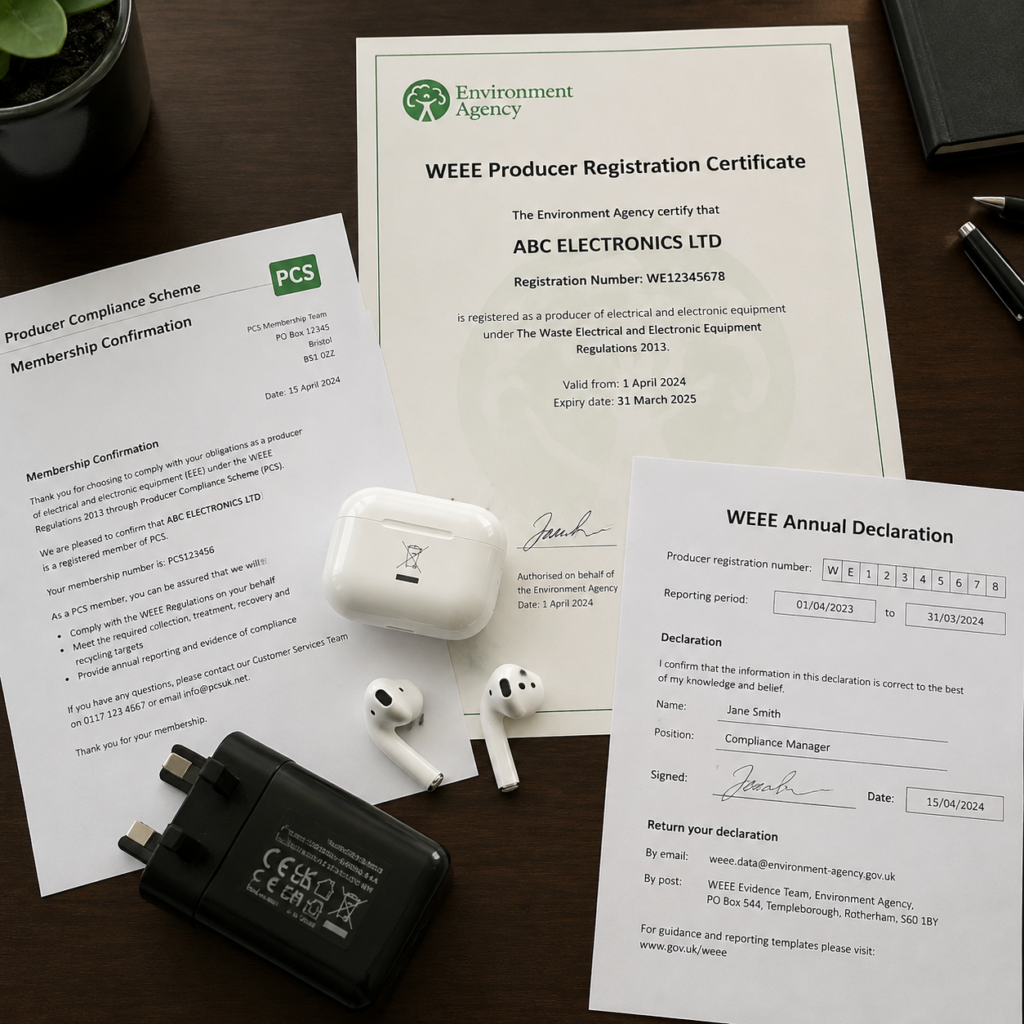
If it is confirmed that you need to bear producer responsibility, there are four core obligations that must be fulfilled, none of which can be missing.
1. Complete Producer Registration
First, you need to complete producer registration. The registration path should be determined based on your place of establishment, main business location, and applicable regulatory area to identify the corresponding environmental regulatory authority; you do not need to register repeatedly in each sales area.
Producers of household EEE that exceed the small producer threshold usually need to join an officially recognized Producer Compliance Scheme (PCS) — simply put, it is an officially authorized third-party organization that will help you coordinate the recycling network, calculate recycling fees, handle annual declarations and other specific affairs, so ordinary merchants do not need to build recycling points across the UK by themselves. Small producers usually do not need to join a PCS compulsorily, and can directly register with the environmental regulatory authority according to the requirements of the applicable region; enterprises that only sell non-household EEE may also have different paths of direct registration or joining a PCS, which need to be confirmed according to product attributes and regulatory authority requirements.
Here, pay attention to the difference between three concepts: registration is a statutory requirement, PCS is a common channel for fulfilling obligations, and an authorized representative is the statutory liaison for overseas entities. The three cannot be confused. Overseas distance producers must go through a UK authorized representative to handle registration-related procedures.
2. Label the WEEE Mark as Required
This is the familiar “crossed-out wheeled bin” mark, which means to tell consumers: this product cannot be discarded as ordinary domestic waste and must be recycled separately.
The position of the mark can be adjusted according to the size of the product: large products can be printed directly on the product body, and small products (such as headphones) can be printed on the outer packaging or in the manual. The requirement is that it is clear, permanent, and not easy to wear, and stickers that come off as soon as you scratch them cannot be used.
It must be noted here that affixing the WEEE mark is only part of compliance, not equal to completing all compliance. Full compliance also includes multiple links such as registration, recycling financing, and declaration. For details, please refer to other content in this section.
3. Bear Recycling and Treatment Costs
Producers need to bear the relevant costs of recycling, treatment, and reuse after scrapping for the products they place on the market, but the recycling arrangements and cost bearing methods are different in different scenarios:
• Household (B2C) EEE: Recycling is usually funded and coordinated by PCS, which works with local government collection systems and retailer recycling points to jointly provide free recycling channels. Consumers generally do not need to pay when discarding old household appliances. The specific method depends on the product type: small appliances can be taken to supermarkets or community recycling points, large household appliances are usually collected by merchants when delivering new products, and local authorities also provide public collection services.
• Non-household (B2B) EEE: Producers need to ensure that there are legal collection and treatment arrangements. The specific recycling operations and cost bearing can be agreed through contracts with commercial users, but the contract can only allocate actual execution and costs, and cannot exempt the producer from statutory responsibilities — if commercial users do not handle it in accordance with regulations, the producer still needs to bear the corresponding compliance obligations.
For example: the same hair dryer, sold to individual households for use, belongs to the B2C category, and recycling is financed uniformly by PCS; sold to barber shops for commercial use, it belongs to the B2B category, and the producer can agree with the barber shop who is responsible for the recycling operation, but the final compliance responsibility still lies with the producer.
4. Do a Good Job in Data Recording and Annual Declaration
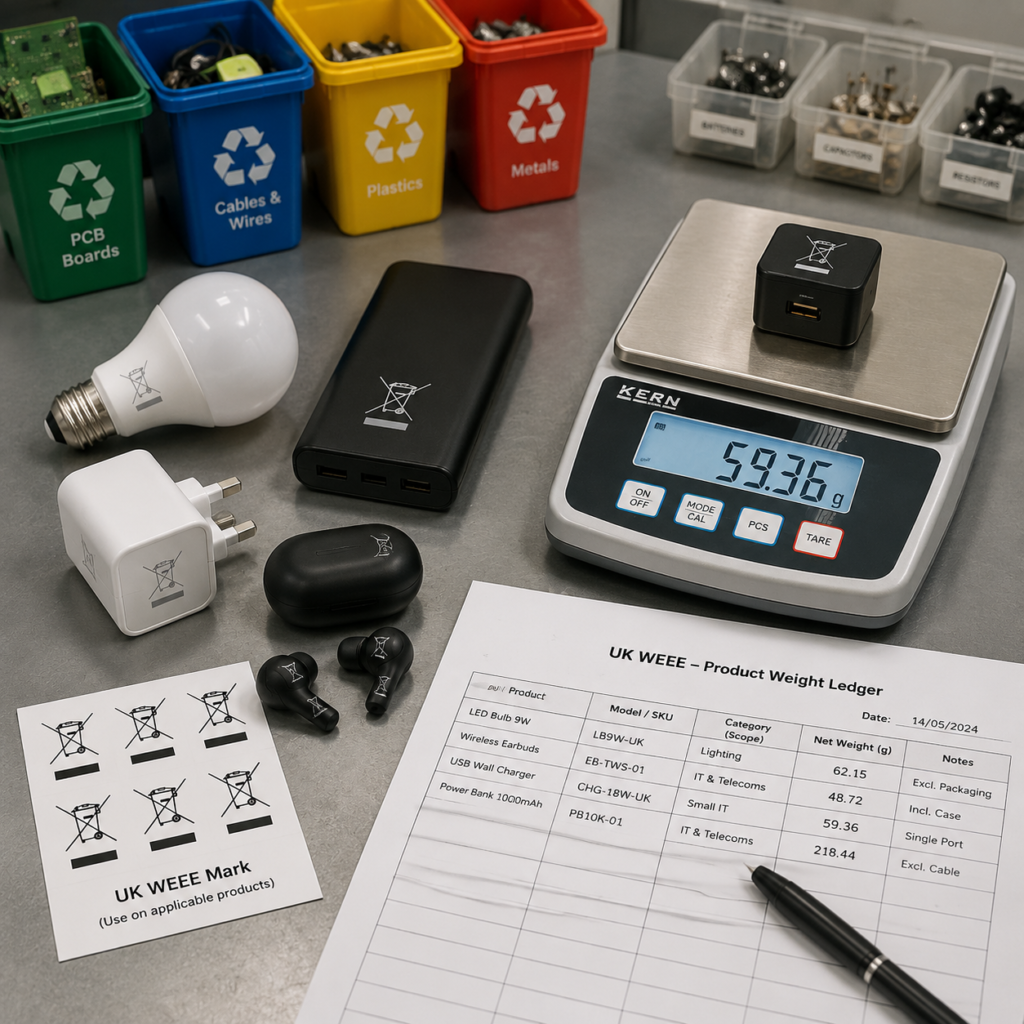
Producers need to record the weight, quantity, and household/non-household attributes of EEE placed on the GB market each year according to the product categories specified by the authority. All data must be traceable and supported by corresponding sales, import, and inventory vouchers.
The core caliber of weight statistics is the net weight of the EEE body, and there are several clear boundaries: product sales packaging falls under the scope of packaging EPR regulations, and independent batteries fall under the scope of battery regulations, both of which are not included in the EEE weight for WEEE; non-detachable accessories and built-in components sold integrally with the product are included in the body weight; if a detachable independent accessory itself is EEE and priced separately, it must be counted separately. The statistics of set products need to be judged according to the rules: if it is sold as a single integrated EEE (such as a complete desk lamp with a base), it is counted by the overall weight; if it is a combination of multiple independent EEEs (such as a mobile phone set bundled with headphones), the weight of each independent EEE must be counted separately, and the specific details shall be subject to the declaration rules of the current year.
When making the annual declaration, producers need to submit data such as placement volume and category distribution; if they join a PCS, the PCS will coordinate and undertake the institutional collection and recycling targets. Annual recycling targets are usually set by category, which may fall in the range of about 45%-85%. The specific proportion, calculation caliber, and whether it is coordinated and completed by the PCS shall be subject to the official target of the current year and the PCS arrangement. The declaration rules for newly placed products and historical legacy WEEE are different, so you need to check the latest requirements before declaration.
Advanced Judgment: Boundary Rules Necessary for Semi-Proficiency
If you already understand the basic requirements and want to further clarify the responsibility differences in different scenarios to avoid pitfalls in gray areas, you can master the following advanced rules.
Judgment of Small Producers and Differences in Rules
Many small sellers are concerned about “can I simplify the process if my sales volume is small”, the answer is yes, but you must first meet the standards for small producers. Taking the common caliber in England as an example, if the total weight of EEE placed on the GB market per year is less than 5 tons, it can usually be treated as a small producer; the rules for Scotland, Wales, and the specific registration path need to be confirmed according to the current requirements of the corresponding environmental regulatory authorities. Eligible small producers can apply the simplified registration process, do not need to join a PCS compulsorily, and can directly register with the environmental regulatory authority of the corresponding region.
But it should be noted that what is simplified is only the registration channel, not the exemption of responsibility. Small producers still need to fulfill the obligations of product labeling, bearing recycling responsibilities, and submitting annual placement data as required, and cannot do nothing just because of small scale. If the annual placement volume is close to the threshold, it must be calculated according to the actual weight sold to GB, and cannot be estimated only by purchase volume or total sales volume, and there must be real sales records as vouchers.
Rules for Distinguishing B2C and B2B
For the same product, the compliance requirements are different when sold to ordinary consumers and to enterprises. The core basis for distinction is the product’s designed use, end user, and use scenario. The sales channel is only a reference, and cannot be judged solely by “sold to enterprises or individuals”.
B2C (household) products refer to products designed and used for families and ordinary consumers, such as household projectors sold to individuals on Amazon. The recycling of such products is financed uniformly by PCS, with stricter responsibility requirements, and must pay recycling fees and cooperate to complete recycling targets as required.
B2B (non-household) products refer to products sold and used for commercial, industrial, and professional scenarios, such as the same projector sold to enterprises for conference rooms. The recycling operation of such products can be agreed through the contract between the buyer and the seller, but the producer still needs to ensure overall compliance.
It should also be noted that the same product may be classified into B2C and B2B categories respectively due to different sales objects. In this case, the weight and declaration must be counted separately and cannot be mixed.
Responsibility Division of Different Sales Models
For responsibility determination under different sales models, the core is “look at the actual role, not the model name”. Especially for several common models of cross-border sellers, you can judge according to the following logic:
• B2B sales for downstream assembly: If the sold parts or semi-finished products do not have independent electrical functions, are only used as built-in components of the final finished product and placed on the market with the main product, and the final finished product already has a producer bearing WEEE responsibility, then the component supplier does not need to register as a producer separately; if the component itself is an independent EEE (such as a separately sold computer power supply), and you are the party that first places it on the GB market, you need to fulfill the producer obligations.
• Cross-border direct mail/distance sales: Overseas sellers who directly ship goods from overseas to end users in the GB region are distance producers and bear all producer responsibilities.
• Platform sales: For sales on platforms such as Amazon and eBay, first check whether the seller itself falls into the producer category — if it is an own brand, importer, or distance seller, the seller bears the main responsibility; platforms usually require sellers to provide compliance certificates according to their own rules. If the seller violates the rules, the platform may take measures such as product removal or account suspension. Whether the platform itself bears statutory obligations needs to be judged according to its role in the transaction chain and cannot be generalized.
• Cross-border warehouse (FBA/overseas warehouse) model: Responsibility determination does not depend on who the warehouse operator is, but on the ownership of the goods, the import declaration entity, the sales contract entity, the brand party, and who is the entity that first places the product on the GB market. For example, if you use FBA to ship goods, and you are the import declaration entity and sell under your own brand, then you are the producer and bear all responsibilities; if a local UK brand party is responsible for import and registration, and you are only the operation agent, then the responsibility lies with the brand party.
• Distributor resale of compliant products: Only when the product has been legally placed on the GB market by other producers, and the distributor has not changed the brand, re-imported, or changed the product form, does it not need to bear the producer registration obligation, but still needs to fulfill secondary obligations such as informing consumers of recycling information and providing recycling acceptance services as required.
Management of Product Weight Statistical Caliber
Weight is the core basis for calculating recycling fees and declarations, and many people make mistakes here. From the perspective of enterprise internal data control, it is recommended to organize weight vouchers in the following ways: first refer to the net weight data in the product BOM (Bill of Materials), cross-verify with actual weighing results, and then compare with the specification data provided by the supply chain to ensure that the deviation between the three is within a reasonable range; all data must retain version and source vouchers and cannot be estimated at will.
Comparison of Easily Confused Regulations: Don’t Mix Them Up
UK WEEE is often confused with other environmental regulations. We compare the most common ones together to help you clarify the boundaries.
| Comparison Dimension | UK WEEE | EU WEEE | UK RoHS |
| Core Regulatory Direction | Recycling, treatment and financing responsibilities of electrical and electronic equipment after scrapping | Recycling, treatment and financing responsibilities of electrical and electronic equipment after scrapping | Restriction on the use of specific hazardous substances in electrical and electronic equipment |
| Applicable Region | England, Scotland, Wales (GB) | 27 EU member states; Northern Ireland applies the EU WEEE framework due to special arrangements of the Brexit agreement | England, Scotland, Wales (GB) |
| Core Compliance Actions | Producer registration, product labeling, recycling financing, annual declaration (varies by entity type, product category, and scale) | Complete registration, labeling, payment, and declaration in the corresponding member state | Conformity assessment, preparation of technical documents, signing of declaration of conformity |
| Rule Universality | Not mutually applicable with EU WEEE, separate procedures are required for entering the GB market | Not mutually applicable with UK WEEE, separate procedures are required for entering the EU or Northern Ireland market | Completely independent from WEEE-type regulations, not a substitute for each other |
The above are general rules. Specific obligations need to be judged separately in combination with sales region, enterprise identity, product category and scale, and cannot be directly applied solely by product type.
UK WEEE and EU WEEE are regulations of the same type but belonging to different jurisdictions, and their registrations are not mutually applicable. Enterprises that sell to both GB and the EU/Northern Ireland need to comply separately.
UK WEEE and UK RoHS target the same type of products but have different regulatory stages. The former regulates the recycling responsibility after scrapping, and the latter regulates the restriction of hazardous substances before market entry. The compliance requirements are completely independent and not a substitute for each other.
UKCA marking, battery regulations, packaging EPR, etc. are all independent compliance obligations, which cannot be covered by WEEE, and need to be handled separately according to product attributes.
Common Misconceptions and Violation Risks: Don’t Step on These Pitfalls
High-Frequency Cognitive Misconceptions
Many people’s misunderstandings about UK WEEE stem from only understanding fragmented information. Here are the most common misconceptions listed to help you avoid pitfalls:
1. Affixing WEEE mark = compliance: Wrong. The mark is only a consumer reminder, and full compliance also includes links such as registration, recycling financing, and declaration.
2. Having RoHS report = no need to do WEEE: Wrong. The two have completely independent regulatory stages and content, and are not substitutes for each other. Even with a RoHS report, you still need to complete WEEE compliance separately.
3. Low annual sales volume = no need to care at all: Wrong. Small producers only have simplified registration processes, and the basic obligations of labeling, recycling, and declaration still need to be fulfilled.
4. Only doing B2B = no need to comply: Wrong. Only when the product is a component without independent functions, only used for downstream finished product assembly and the responsibility is borne by the final finished product producer, may it not need to be registered separately; independent EEE directly sold to enterprises for use still needs to fulfill compliance obligations according to the rules.
5. Overseas enterprises not in the UK = no responsibility: Wrong. As long as you directly sell EEE to end users in the GB region, you are a distance producer and must comply with UK WEEE, and you cannot evade responsibility on the grounds that the company is overseas.
6. The platform will bear all responsibilities: Wrong. If the seller itself falls into the producer category, it is the first responsible entity; the platform usually requires the seller to provide a compliance certificate, and whether it bears responsibility itself needs to be judged according to its legal identity.
Common Violation Behaviors
In actual supervision, the most common violation behaviors are the following categories: selling corresponding EEE without completing producer registration; the product has no WEEE mark or the position, clarity, and durability of the mark do not meet the requirements; failing to implement recycling responsibilities and pay relevant fees as required; overdue declaration, false declared category/weight/data; failing to provide recycling information or recycling services to consumers as required.
Actual Risks of Violations
If you violate the UK WEEE regulations, the regulatory authority can take measures such as investigation, ordering rectification, restricting product sales, and requiring supplementary registration and declaration according to the circumstances. In serious cases, you may face administrative fines and even criminal liability. The specific penalty intensity depends on factors such as the violated clause, duration, scale of involved products, and environmental impact caused, and is determined by the judicial or regulatory authority in accordance with legal procedures. In scenarios such as import, platform review, or regulatory spot checks, there may also be situations such as cargo inspection delays, platform removal of products or store suspensions. Failure to pass the compliance audit of B2B customers is also a common commercial impact.
Compliance Implementation Self-Check Steps: Check Basic Risks Step by Step
If you are already doing business in the UK market, or plan to enter, you can conduct a comprehensive compliance self-check according to the following steps to identify risks in advance. All self-check materials are recommended to be kept for future reference.
Step 1: Basic Qualification Self-Check
First confirm whether you need to bear producer responsibility and to what extent, and keep the following evidence accordingly:
• Product evidence: specification description, function description, electrical parameters of each SKU, to confirm whether it belongs to EEE and whether it meets the statutory exclusion conditions;
• Territory evidence: sales orders, logistics records, to confirm whether the product is sold to the GB region, and whether it involves Northern Ireland or Crown Dependencies;
• Identity evidence: transaction chain sorting records, to confirm whether you are an own brand party, importer, or overseas distance seller, and whether the product has been legally placed on the GB market by upstream producers;
• Scale evidence: statistics of the total weight of EEE placed on the GB market per year, to confirm whether it reaches the small producer threshold.
Step 2: Compliance Obligation Self-Check
If it is confirmed that you need to bear producer responsibility, then check one by one whether there are any missing obligations, and keep the following vouchers accordingly:
• Registration category: Producer registration certificate, PCS contract (if any), UK authorized representative agreement (applicable to overseas sellers), to confirm that the registration scope is consistent with the actually sold products and regions;
• Product category: WEEE mark design draft, printing sample draft, to confirm that the mark position, clarity, and durability meet the requirements;
• Operation category: SKU ledger (recording the category, net weight, household/non-household attribute, sales region of each SKU); cooperation agreement or explanation document of recycling channels, to confirm that consumers can obtain free recycling information;
• Declaration category: submission vouchers of annual declaration, data supporting materials (sales records, import vouchers, weight calculation basis), to confirm that the declared data is consistent with the actual placement.
Step 3: Basic Actions for Risk Reduction
Whether you are fully compliant now or not, you can start with these basic actions first to reduce subsequent risks:
• Complete EEE classification and responsibility determination before the product is listed, and keep the classification judgment records;
• Establish and continuously update the SKU ledger, which at least includes SKU, WEEE category, EEE body net weight, sales region, B2C/B2B attribute, data source and update time;
• Use written agreements to clarify the respective responsibility divisions with suppliers, compliance service providers, logistics providers and other partners to avoid subsequent disputes;
• Regularly review the rule updates of the UK Environment Agency every year, and adjust compliance arrangements in a timely manner;
• All compliance documents shall be kept for at least the number of years required by law to facilitate regulatory verification.
Final Summary
The core logic of UK WEEE is Extended Producer Responsibility: whoever first places electrical and electronic equipment on the UK GB market bears the core responsibility for scrapping and recycling. In practice, you can first judge the applicable scope in the order of “product-territory-identity”, and then implement the four obligations of registration, labeling, recycling, and declaration accordingly. Since regulatory thresholds, annual targets, declaration calibers, and supervision procedures may be adjusted over time, actual operations shall be subject to the current official requirements of the regulatory authorities in the applicable region.