
For cross-border sellers, small manufacturers or importers operating in the UK market, one of the most frequently asked questions when first getting to know UKCA is: How long is the validity period of this certification?
Some say 3 years, some say 5 years, and others think it can be used for life once obtained. In fact, none of these statements are accurate — UKCA is not a certificate with a unified validity period, but a conformity assessment mark affixed to products. Its usability depends on the continuous compliance status of the product, and is directly related to the product type, application route, and subsequent product changes.
This article will sort out the core rules of UKCA validity, invalidation scenarios, self-inspection methods, handling upon expiration, and CE transition requirements, to help you independently judge the compliance status.
Before formally explaining the rules, let’s clarify the most basic concepts first to avoid subsequent confusion:
The full name of UKCA is UK Conformity Assessed, which is the UK conformity assessment mark and one of the compliance credentials for products entering the Great Britain (GB) market of the UK. The “UKCA validity period” we often refer to essentially refers to the duration of the compliance qualification for a product to legally use the UKCA mark — the core logic is: if the product continuously meets the requirements of the corresponding UK regulations, the compliance qualification is valid; if the compliance status is broken, the qualification may be invalidated in advance. It does not refer to the printed date on paper documents, nor is there a fixed validity period applicable to all products.
UKCA compliance involves many different types of time-effect concepts, which many people confuse. There are 7 common types, each with completely different meanings, which need to be distinguished:
1. Validity of UKCA mark use: No fixed expiry date, fully bound to the continuous compliance status of the product;
2. Validity of UK Declaration of Conformity (UK DoC) document: A compliance commitment letter signed by the manufacturer itself, valid along with the product’s compliance status, with no fixed validity period;
3. Validity period of third-party AB certification certificate: Only applicable to products or modules that require the participation of a UK Approved Body (AB) in the assessment, with clear start and end dates, and renewal required upon expiration;
4. Probative force of test reports: There is no statutory unified validity period per se, and they may lose their probative function due to standard updates, product changes, etc.;
5. Retention period of technical documents: For most products covered by ordinary UKCA, technical documents are required to be retained for 10 years from the date when the product is last placed on the GB market. Special categories such as medical devices and construction products shall follow special rules — this is a requirement for data retention, which is a separate matter from whether the certification itself is valid;
6. Continuous compliance and supervision obligations: Vary depending on the assessment route. For self-declaration categories, the responsible party shall maintain the compliance status on its own; for third-party audit categories, regular supervision shall be accepted as required;
7. Validity period of CE mark recognition in GB: Determined by the corresponding regulations of the product category, with no unified deadline.
First Determine Whether You Need to Pay Attention to UKCA Validity Period
Before understanding the specific rules, you can quickly confirm the scope of application first:
• Market boundary: UKCA only applies to the market of Great Britain (GB: England, Wales, Scotland) of the UK. The CE/UKNI mark applies to Northern Ireland, and the EU does not recognize UKCA.
• Covered categories: Typical categories that need to pay attention to UKCA validity period include low-voltage electrical equipment, EMC equipment, toys, ordinary machinery, personal protective equipment (PPE), pressure equipment, etc. (i.e., categories required to bear the UKCA mark under corresponding regulations); food contact materials, cosmetics, pharmaceuticals, food, complete motor vehicles, etc. belong to other UK regulatory systems, do not require the UKCA mark, and there is no need to pay attention to their validity period.
• Responsible roles: Manufacturers, UK importers, cross-border e-commerce sellers, and UK authorized representatives all need to bear relevant responsibilities for UKCA compliance and pay attention to the validity period requirements.
Validity Period Rules for Different Certification Routes
There are two main application routes for UKCA: self-declaration and third-party institution participation. The time-effect rules of the two are quite different, and some special categories have separate regulatory requirements.
Self-Declaration Route: No Fixed Validity Period
The first is the self-declaration route, which does not require third-party institution audit and is suitable for low-risk categories. For example, common USB small fans, LED desk lamps, and low-risk plush toys all fall into this category.
Under this route, UKCA has no fixed validity period. As long as the following continuous compliance judgment framework is met, the UKCA mark can continue to be used:
1. The product continuously meets the basic safety and compliance requirements of applicable UK regulations;
2. No substantive changes affecting compliance have occurred in product design, structure, core materials, production process, etc.;
3. The content of technical documents and UK DoC is accurate, and the cited compliance certification route (such as UK designated standards or other equivalent certification methods) is still recognized by regulations.
The operation is also relatively simple: the manufacturer signs the UK Declaration of Conformity (UK DoC) on its own and retains the technical documents as required, without needing to find a third-party institution to issue a certificate.
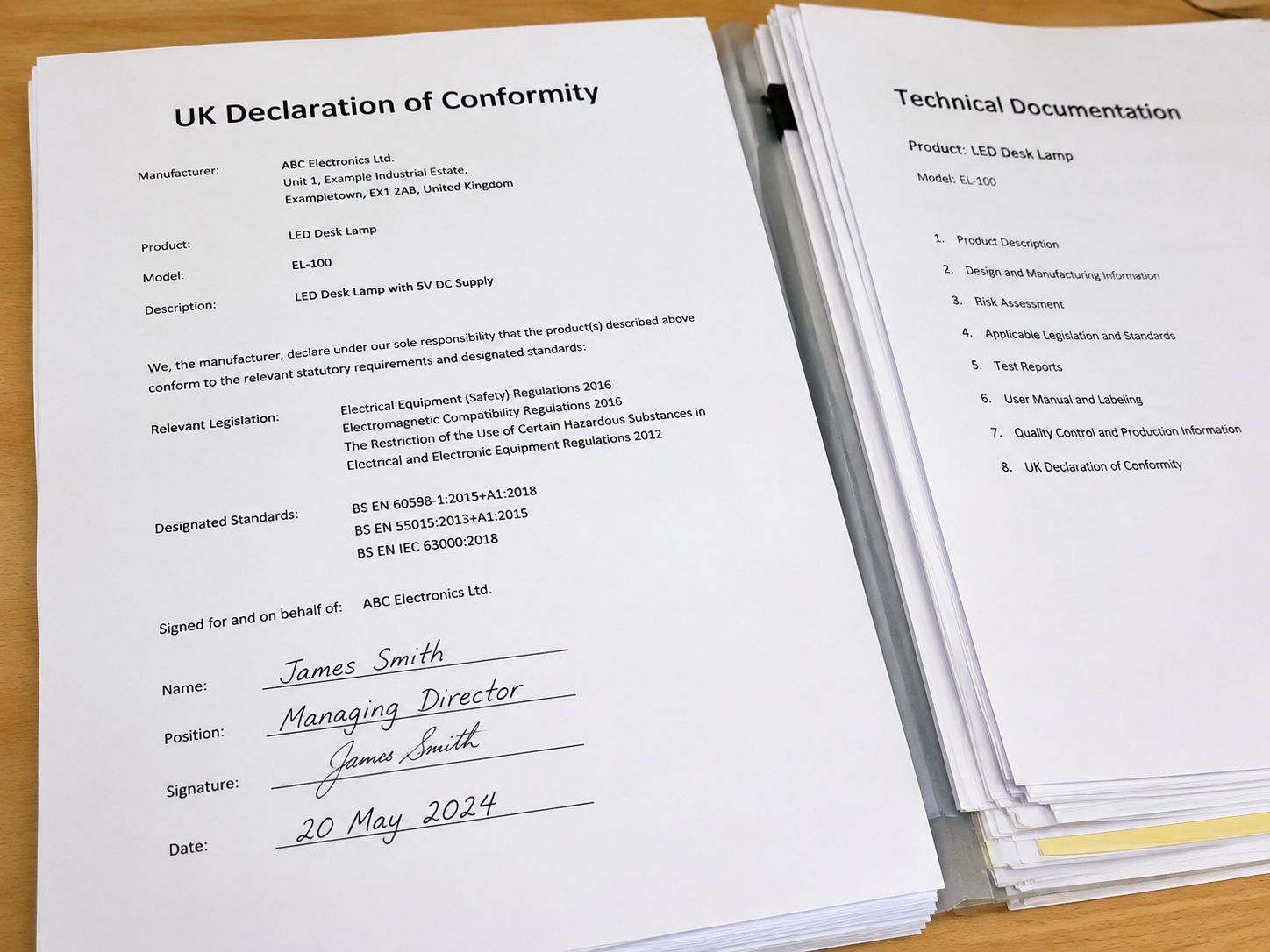
It should be noted that UK designated standards are a common route to prove compliance with the basic requirements of regulations, but not the only route. Standard revision does not necessarily lead to the immediate invalidation of the original compliance qualification. It is necessary to check the revision content, the official designated status of the standard, whether there is a transition arrangement, and whether the product still meets the basic requirements of the regulations; if it is still compliant after assessment, the original compliance documents can continue to be used without immediate re-processing.
Third-Party AB Participation Route: Clear Certificate Validity Period
The second is the route that requires the participation of a UK Approved Body (AB for short), which is usually applicable to high-risk categories or high-risk assessment modules, such as Category III personal protective equipment (such as high-altitude work safety belts, chemical-resistant gloves and other high-risk protective equipment), high-risk machinery, gas appliances, lifts, etc.
A UK Approved Body is an institution authorized by the UK official that can undertake conformity assessment tasks under specific regulations. To judge whether an institution is qualified to assess your products, you cannot only look at whether it has UKAS accreditation. You need to log in to the UK Market Conformity Assessment Bodies database to check whether the institution is approved to cover the regulations, product categories and assessment modules corresponding to your products — the same AB may only have assessment qualifications for some categories or modules.
Under this type of route, the conformity assessment certificate issued by the AB will be marked with a clear “Expiry Date”, but there is no unified standard for the certificate period across all categories, which completely depends on the corresponding product regulations, type of assessment module, additional conditions of the certificate, and the rules of the issuing AB. Some certificates also come with requirements for annual supervision or regular re-assessment. If supervision is not passed, the certificate will be invalidated in advance even before the stated date.
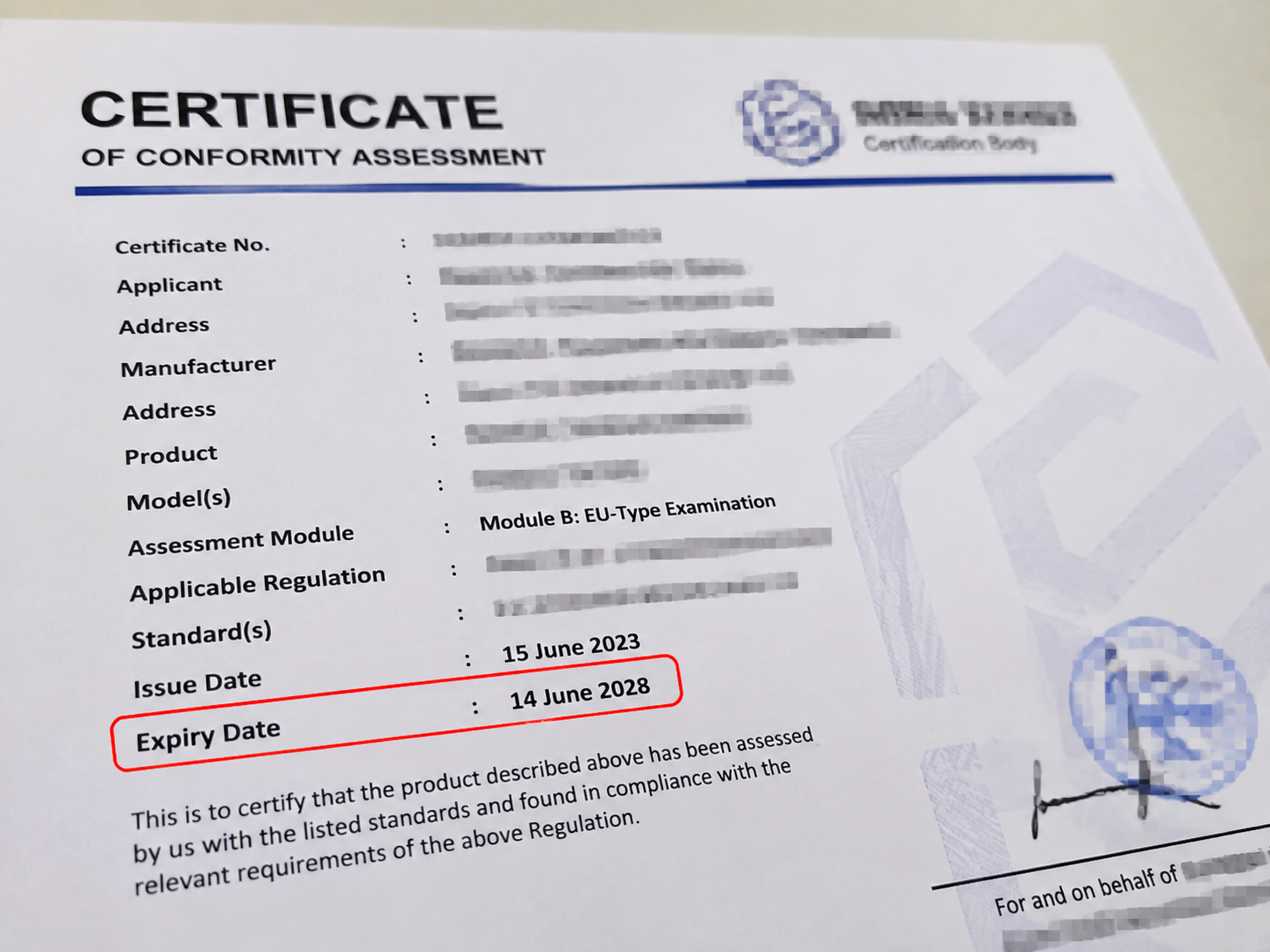
Common examples of assessment modules include (only common types, not statutory unified classification):
• Type examination category: Conformity assessment for sample design, the specific validity period shall be subject to the statement on the certificate
• Production/product quality assurance category: Assessment bound to the factory quality system, usually accompanied by annual supervision requirements; failure to pass supervision will lead to early invalidation of the certificate
• Factory production control category: Assessment for production process management and control, the validity period shall be implemented in accordance with regulations and certificate conditions
Regardless of the type, the final validity period shall be subject to the date marked on the certificate, and requirements such as supervision and change declaration attached to the certificate must be met, otherwise it may be invalidated in advance. If the product regulations do not mandate the participation of an AB, even if you find a third-party institution to conduct tests and issue certificates, it still belongs to the self-declaration compliance route and is not affected by changes in the qualifications of third-party institutions.
Special Regulated Categories: Implemented in Accordance with Special Regulations
In addition to ordinary industrial products, there are some special regulated categories, such as medical devices, construction products, explosives, marine equipment, etc. There is no general rule for the UKCA validity period of these categories, which shall be subject to the special regulatory requirements of the corresponding category. For example, medical devices must follow the rules of the UK MHRA (Medicines and Healthcare products Regulatory Agency), and the validity logic of ordinary industrial products cannot be directly applied to avoid misusing the rules.
CE and UKCA Transition Recognition Rules
Many people think that CE has a unified transition period deadline in the UK, but this is not the case. There is no unified rule applicable to all categories for the recognition of the CE mark and related EU compliance documents in the UK’s Great Britain (GB) market. Whether it is accepted, the scope of application, and transition arrangements must be confirmed in accordance with the specific UK regulations to which the product belongs and the government’s current recognition policy.
At present, CE compliance documents for most ordinary industrial categories (such as low-voltage electrical appliances, toys) can still be used as the basis for compliance in the GB market, and there is no mandatory conversion to UKCA. However, before sales, you must check the latest official UK announcement to confirm the recognition status of your category, so as to avoid risks brought by rule adjustments. The CE recognition rules for special categories such as medical devices, construction products, and marine equipment must be separately verified in accordance with the corresponding special regulatory requirements, and the rules for ordinary categories cannot be applied.
In addition, if you voluntarily convert CE compliance documents into UKCA compliance documents, the new UKCA compliance qualification takes effect independently, and its validity period is not bound to the original CE documents. The remaining validity period of CE documents cannot be directly used.
4 Key Situations That Lead to Early Invalidation of UKCA
No matter which compliance route is adopted, the use of the UKCA mark is not once and for all. When the following 4 types of situations occur, the original compliance assessment may no longer be applicable, and an impact assessment must be carried out immediately; if it is confirmed that it does not meet the regulatory requirements and exceeds the scope of the original technical documents or third-party certificates, the original compliance documents and UKCA mark shall not continue to be used.
1. Substantive Changes to the Product
Changes to the product’s design, structure, core materials, safety functions, rated parameters, or changes to model, specification, brand that affect compliance, or changes to product use and classification (such as changing consumer-grade electrical appliances to industrial-grade use) all constitute substantive changes that may affect compliance.
When making a judgment, you can refer to three core questions: Does the change affect the basic safety/compliance requirements of applicable regulations? Does it exceed the scope of the original test report or third-party certificate? Is it necessary to update the UK DoC/technical documents or re-conduct conformity assessment?
If it is only an appearance adjustment that does not affect safety and compliance (such as ordinary color changes, outer packaging style adjustments), it will not directly lead to the invalidation of compliance qualifications. However, it should be noted that if the change involves product labels, warnings, traceability marks or product identification information, the corresponding technical documents still need to be updated to ensure accurate information.
2. Updates to UK Regulations or Designated Standards
When applicable UK regulations are revised, or UK designated standards (i.e., compliance certification standards recognized by regulations) are updated or abolished, it may affect the validity of the original compliance qualification.
The judgment can be carried out in the following order:
Step 1: Distinguish whether the update is to the regulation itself or to the designated standard;
Step 2: Confirm whether the new version of the requirements has been officially incorporated into the compliance route of the corresponding regulations by the UK authorities;
Step 3: Check whether the updated content involves the core compliance requirements applicable to the product, and whether the authorities have issued transition arrangements;
Step 4: Based on the assessment results, choose to conduct supplementary verification, update technical documents/UK DoC, or re-conduct conformity assessment.
It should be noted that designated standards are only a common route to prove compliance with the basic requirements of regulations, not the only route. After the standard is updated, if the product can still meet the basic safety requirements of the regulations, the original compliance qualification can be retained through assessment, and it should not be directly deemed invalid just because of the standard update.
3. Changes Related to Third-Party Certification (Only Applicable to AB-Issued Certificates)
This type of situation only affects products that require AB-issued certificates, and the self-declaration route is not affected by changes in third-party institutions. Common changes include: the issuing AB has its assessment qualification for the corresponding regulations/modules revoked, the certificate is suspended/revoked due to failure to complete annual supervision as required or illegal use, the product model/scope covered by the certificate is reduced, etc.
When such changes occur, the compliance qualification corresponding to the original certificate will no longer be valid, and remedial measures must be taken in a timely manner.
4. Production Consistency Cannot Be Guaranteed
The basis of UKCA compliance is that mass-produced products are consistent with the samples/requirements of the original compliance assessment. If the production site is relocated, core suppliers are replaced, or major changes occur in production processes or quality control methods, resulting in inconsistency between mass-produced products and the original test samples and certificate requirements, or if the product is confirmed to be non-compliant after re-assessment triggered by market spot checks or safety accidents, the basis of the original compliance assessment will no longer be valid.
At this time, a production consistency check must be re-conducted, and the UKCA mark can continue to be used only after confirming that the product still meets the regulatory requirements; if the check fails, the product must be adjusted or compliance documents updated in a timely manner.
Practical Steps for Self-Inspection of UKCA Validity Period
You can self-inspect the validity of UKCA compliance according to the following steps. Note that official inspection channels may vary for different categories, and you need to select the corresponding entry in combination with the regulations to which the product belongs.
Step 1: Confirm Two Basic Premises
If the following two premises are not met, there is no need to carry out UKCA validity inspection:
1. Target market confirmation: Only products sold to the UK’s Great Britain (GB) market need to have their UKCA validity checked. The CE/UKNI mark applies to Northern Ireland, and the EU market does not recognize UKCA.
2. Compliance route confirmation: First determine whether the product belongs to the self-declaration route or the third-party AB certification route. The judgment order is:
• Step 1: Check the UK regulations corresponding to the product to confirm whether the category mandates the participation of an AB in conformity assessment;
• Step 2: If the regulations require AB participation, then check whether the issuing institution is in the UK Market Conformity Assessment Bodies database and has authorization for the corresponding regulations, product categories and assessment modules;
• Step 3: Check whether the product model and applicable regulations covered by the certificate are consistent with the actually sold products.
If the regulations themselves do not require AB participation, even if there are test reports or certificates issued by third-party institutions, it still belongs to the self-declaration compliance route.
3-Step Self-Inspection for Self-Declaration Categories
If it is the self-declaration route, conduct the inspection in the following three steps:
1. Check product consistency: The actually sold product is consistent with the model, core parameters, safety functions, and production control requirements recorded in the UK DoC and technical documents, and no substantive changes affecting compliance have occurred.
2. Check the validity of compliance basis: Confirm that the compliance basis cited in the UK DoC (such as designated standards, regulation versions) is still recognized by the UK authorities, and the product continuously meets the basic requirements of applicable regulations.
3. Retain supporting materials: There is no unified official query entry for self-declaration UKCA. All supporting materials (technical documents, UK DoC, test reports, etc.) need to be retained by the responsible party (manufacturer, importer, etc.) on their own, and can be provided during market spot checks.
The validity of regulations can be queried through the UK legislation official website, and UK designated standards can be queried through the UK designated standards database, both of which are public channels.
3-Step Self-Inspection for Third-Party Certified Categories
If it is the third-party AB certification route, conduct the inspection in the following three steps:
1. Check certificate validity period: First check the “Expiry Date” marked on the certificate to confirm whether it is within the stated period.
2. Check certificate and institution status: Two levels of inspection are required:
• Institution qualification: Through the UK Market Conformity Assessment Bodies database, confirm that the issuing AB still has the authorization qualification for the corresponding regulations, product categories and assessment modules;
• Certificate status: Through the certificate query entry on the official website of the issuing AB, verification email, or written contact with the AB, confirm that the specific certificate is in valid status, with no records of suspension, revocation or scope reduction.
3. Check coverage scope: Confirm that the product model, specification, and applicable regulations covered by the certificate are completely consistent with the actually sold product, and use beyond the scope is prohibited.
For special categories such as medical devices, construction products, and marine equipment, it is also necessary to check in the corresponding special regulatory database (such as the MHRA database for medical devices), and judgment cannot be made solely based on the logic of ordinary UKCA certificates.
Note: CE and UKCA are independent compliance systems, and the validity period of CE compliance documents cannot be used to replace the validity inspection of UKCA.
10-Second Quick Preliminary Judgment Checklist
If you only need a quick preliminary judgment, you can check against the following 5 items. If all are met, it is highly likely to be compliant and valid, and then you can conduct a detailed inspection later:
1. The target market is GB, and the product falls within the UKCA coverage scope;
2. The actually sold product is consistent with the model and core parameters recorded in the compliance documents;
3. The cited UK regulations and designated standards are still the current valid versions;
4. If it is an AB-issued certificate, the certificate is within the validity period and the institution and certificate status are normal;
5. No substantive changes affecting compliance have occurred to the product, and production consistency can be guaranteed.
Handling upon Expiration/Invalidation and Daily Maintenance
Time Recommendations for Advance Maintenance
To avoid compliance gaps, it is recommended to do a good job of daily maintenance in advance:
• AB-issued certificates: It is recommended to apply for renewal from the original issuing AB 3-6 months in advance to leave buffer time for audit and rectification;
• Self-declaration categories: There is no need to update compliance documents every year, but it is recommended to carry out at least 1 validity inspection per year, confirm the status against continuous compliance requirements, and adjust in time if there are changes;
• Special categories: Prepare in advance according to the supervision and renewal requirements of the corresponding regulations, and the time nodes of ordinary categories cannot be applied.
Handling Methods for Different Invalidation Situations
For different invalidation or risk scenarios, the handling methods are different:
• AB-issued certificate expires, and the product has no changes, and standards and regulations have no updates: You can apply for renewal from the original issuing AB, and the process is usually simpler than new application;
• Substantive changes occur to the product, or after the update of regulations/standards, it is assessed that the original compliance requirements are not met: Regardless of whether the validity period stated on the certificate has been reached, the compliance must be re-assessed, and if necessary, re-conduct conformity assessment and update compliance documents;
• Self-declaration categories encounter regulation/standard updates: First assess whether the product still meets the compliance conditions against the new requirements; if it still meets, you only need to update the technical documents and UK DoC and retain the assessment records; if not, you need to conduct targeted supplementary tests or adjust the product before updating the compliance documents;
• The corresponding qualification of the issuing AB becomes invalid: You can no longer apply for renewal from the original institution, and you need to transfer to an AB with the corresponding regulation and module authorization qualifications to re-conduct the assessment.
Transition Rules for Products Already Placed on the Market
Many sellers are concerned about whether products already sold to the UK will become non-compliant due to subsequent rule updates. This involves the key rule of “placing on the market”:
“Placed on the market” refers to the first time a single product is put into circulation or completes the first supply in the GB market. For a single product that meets the requirements of the then-effective regulations when placed on the market, whether subsequent updates to regulations or standards affect its continued circulation, use or resale shall be implemented with reference to the transition clauses of specific regulations and market supervision rules.
If the product has safety hazards, is included in the recall scope, requires corrective measures, or the regulations have clear retrospective requirements, it is still necessary to cooperate with the handling as required. Manufacturers and importers need to retain supporting materials such as contracts, invoices, transportation or delivery records to claim the transition treatment for the placement time of the corresponding products; if they cannot provide proof of placement time, they may not be able to apply this transition rule.
Consequences and Remedies after Invalidation
After UKCA compliance becomes invalid, the UKCA mark shall not be affixed to newly produced products that have not been placed on the GB market. Using expired or invalid compliance documents during customs clearance may result in goods being detained and even fines.
The core of remediation is to restore compliance status as soon as possible: complete renewal, re-assessment or document update according to the reason for invalidation, and then carry out sales or customs clearance operations after obtaining valid compliance certificates.
Core Maintenance Points
To continuously maintain the validity of UKCA compliance, you can remember three core action principles:
1. First make scope judgment: Only products sold to the GB market and belonging to UKCA-covered categories need to pay attention to UKCA validity; first confirm the compliance route, then conduct corresponding inspections.
2. Plan renewal in advance: Apply for renewal of AB-issued certificates 3-6 months in advance to leave buffer time to avoid gaps.
3. Conduct regular inspections: Conduct at least 1 compliance validity check per year, and immediately carry out impact assessment when product changes occur or regulations/standards are updated.
Common Misconceptions and Frequently Asked Questions
Common Cognitive Misconceptions
• Misconception 1: The validity period of the test report is equal to the UKCA validity period
Correction: The test report is a testing certificate, and UKCA is the qualification to use the compliance mark. There is no binding relationship between the two; the probative force of the test report needs to be judged in combination with multiple factors and cannot be directly equated with the validity of UKCA.
• Misconception 2: Products of the same series can share one UKCA compliance document
Correction: Only models and specifications clearly covered by the compliance document can be shared. New models need to first confirm whether they are within the coverage scope and cannot be directly applied.
• Misconception 3: The “report within 1 year” required by the platform is a statutory requirement of UKCA
Correction: The time-effect requirements of platforms or retailers belong to commercial access rules, not the statutory requirements of UKCA; at the statutory level, it is necessary to ensure that test reports can effectively prove that products meet the requirements of current regulations.
• Misconception 4: The CE validity period is equal to the UKCA validity period
Correction: CE and UKCA are independent compliance systems, and their rules cannot be confused; whether CE can be used in the GB market needs to be confirmed according to the regulations of the corresponding category, and there is no binding relationship with UKCA validity.
Frequently Asked Questions
• Does UKCA have a unified validity period?
UKCA is the UK conformity assessment mark, not a unified certificate, and there is no fixed validity period applicable to all categories. Under the self-declaration route, as long as the product continuously meets the applicable regulatory requirements and the technical documents are accurate and valid, the UKCA mark can continue to be used; for products that require a UK Approved Body (AB) to issue a certificate, the specific validity period of the certificate shall be subject to the “Expiry Date” stated on the certificate, and the duration varies according to regulations, assessment modules and the rules of the issuing institution.
• How many years is the UKCA test report valid?
The test report itself has no statutory unified validity period. Whether it can be used as the basis for compliance certification needs to be comprehensively judged in combination with various factors such as the standard version applicable at the time of testing, regulatory requirements, the consistency between test samples and mass-produced products, the applicability of test methods, and laboratory capabilities. The time of testing cannot be used as the sole judgment criterion.
• Does the UK DoC need to be updated every year?
No. As long as the product continuously meets the compliance requirements and the content of technical documents and UK DoC is accurate, the UK DoC remains valid; it is recommended to regularly check the compliance status once a year and update the documents when there are changes.
• Can the CE mark and related EU compliance documents still be used in the UK’s GB market?
There is no unified rule for the recognition of CE in the UK’s GB market, which needs to be confirmed according to the specific UK regulations to which the product belongs and the current official policy. At present, CE compliance documents for most ordinary industrial categories can still be used as the basis for compliance in the GB market, but special categories such as medical devices, construction products, and marine equipment need to be inspected in accordance with special regulatory requirements. CE and UKCA are independent compliance systems, and the validity period of CE documents is not bound to the UKCA compliance status.
• Will changing suppliers lead to UKCA invalidation?
Changing suppliers itself does not directly affect the validity of UKCA. It is necessary to assess whether major changes have occurred in core materials, production processes, and quality control methods, and whether these changes affect the product’s compliance with applicable regulatory requirements; if no substantive changes affecting compliance have occurred and production consistency can be guaranteed, there is no need to adjust compliance documents.