
For electronic product sellers operating in the U.S. market, most have likely heard the term “California Prop 65” — either the platform suddenly requires uploading compliance documents, or you receive relevant notices, or even have your sales restricted in California. Many people’s first reaction is “Is my product quality unqualified? Will it be banned from sale?” In fact, there is no need to panic excessively. California Prop 65 is essentially a consumer right-to-know regulation, not a quality ban. As long as you understand the logic and follow the steps, you can implement compliance in an orderly manner. This guide, from the perspective of electronic product sellers, covers basic concepts, initial risk screening, judgment logic, practical operation steps, key points to avoid pitfalls, and emergency handling, to help you sort out the compliance ideas for California Prop 65.
I. Beginner’s Basics: What is California Prop 65, and Its Relationship with Electronic Product Sellers
1. Core Logic of California Prop 65
California Proposition 65 (officially often abbreviated as Prop 65) is essentially a California consumer right-to-know warning regulation — it is neither a sales ban nor a product quality standard. For analogy, it is like a restaurant menu marking “This product contains peanut allergens” — it does not mean the dish is not allowed to be sold, but to inform people with peanut allergies so they can choose whether to buy it themselves.
Its core requirement is only one: if your product is sold in California, contains chemical substances on California’s official list, and consumers will be exposed to these substances during normal use (i.e., there is “exposure risk”), you must clearly inform consumers in advance.
Contrary to what many people think, the enforcement of California Prop 65 does not rely entirely on government spot checks; instead, most are initiated by private plaintiffs. California law allows individuals or law firms to enforce the law on behalf of the public. Private plaintiffs generally must first serve a 60-day violation notice, and only after meeting the statutory procedures can they file a lawsuit, and they can receive a portion of the fine after winning the case. Therefore, many professional institutions scan listings on e-commerce platforms in batches to find non-compliant sellers and issue notices or lawsuits, which is why sellers of all sizes may encounter compliance issues.
2. Applicable Sellers and Exemption Rules
Many sellers will ask: “My company is in China, and goods are shipped directly from China, so do I not need to worry about it?” The answer is no. The determination of obligations under California Prop 65 depends on whether the product ultimately reaches California consumers and the seller’s role in the sales chain, and has no absolute relationship with the seller’s registered location or warehouse location: whether you are a cross-border e-commerce seller, use a U.S. overseas warehouse, run a self-built website, or resell to California through distributors, as long as California consumers can buy your product and there are statutory exposure scenarios, you need to assess your own warning obligations.
The only statutory exemption applies to enterprises with fewer than 10 employees in total (calculated based on the overall scale of the enterprise, not the number of personnel in a single store or single sales channel). The specific determination rules are subject to the official announcement of the California Office of Environmental Health Hazard Assessment (OEHHA). Do not automatically assume that “small size meets exemption conditions”; you must verify against official requirements.
3. Reasons Why Electronic Products Are Prone to Triggering Risks
The reason why electronic products are prone to involving California Prop 65 issues is mainly that some commonly used materials or components may contain controlled chemical substances on the list (depending on the formula, process, and supplier’s material data), and consumers may indeed be exposed to them during daily use:
- High-incidence carriers: Soft PVC components such as soft rubber charging cables and earphone silicone sleeves may contain phthalates; solder, metal plating, and electrodes of some types of batteries may contain lead; old nickel-cadmium batteries and some switch contacts may contain cadmium; packaging inks, foams, and plastic shells may involve substances such as flame retardants and bisphenol A;
- Common exposure scenarios: Holding the product shell, repeatedly touching cables, children chewing small accessories, etc., all belong to “exposure under normal and reasonably foreseeable use”;
- Risk triggering channels: In addition to platform listing reviews, there are various possibilities such as distributors requiring compliance documents, consumer feedback, and batch screening by private law enforcement agencies.
4. Real Consequences of Non-Compliance for Electronic Products
The consequences of violating California Prop 65 are not “directly fined until bankruptcy”, but will affect sellers from two levels:
- Channel level: Platforms, distributors, or retailers may take measures such as removing listings, restricting sales in California, requiring submission of compliance documents, and terminating cooperation based on their own policies, contractual agreements, or risk control requirements, affecting product sales and business reputation — such measures are independent acts of the channels, not administrative penalties directly triggered by the California Prop 65 regulation;
- Legal level: If held accountable by private plaintiffs or government departments, you may need to pay settlement funds or fines. The statutory civil fine for California Prop 65 can be up to $2,500 per violation per day. The actual amount needs to be comprehensively determined based on the duration of the violation, sales volume, severity of the circumstances, evidence situation, procedural progress, etc., and may also involve costs such as attorney fees.
II. Quick Initial Screening: Does Your Electronic Product Have California Prop 65 Risks?
After clarifying the basic concepts, there is no need to rush to spend money on testing. First do a round of quick initial screening by yourself, and you will have a basic judgment on the risk priority of the product. The risk level is only used to divide the priority of compliance verification and the depth of required evidence, and is not directly equivalent to “must affix a warning” or “definitely compliant.”
1. High-Frequency Controlled Substances in Electronic Products and Their Possible Locations
The California Prop 65 control list is dynamically updated by OEHHA and contains hundreds of chemical substances. The list content and effective date will be dynamically adjusted with official assessments, and daily consumer electronics only involve a very small part of them. The following are the listed substances commonly involved in electronic products and their possible carriers, for initial screening reference only. The final shall be subject to the latest official OEHHA list and supplier material data:
- Lead: May exist in PCB solder, electrodes of some types of batteries, and plating of metal screws/shells. The specific content and exposure possibility need to be judged in combination with the process and product structure;
- Phthalates: May exist in soft plastic components such as soft PVC charging cable sheaths, earphone silicone sleeves, and key rubber skins, to increase the flexibility of plastics, depending on the material formula;
- Cadmium: May exist in old nickel-cadmium batteries, some switch contacts, and specific plating layers, and is currently less used in mainstream consumer electronics;
- Other substances that may be involved: bisphenol A (some polycarbonate plastic shells), flame retardants (circuit boards, foam buffer materials), specific heavy metals in packaging printing inks, phthalates in plastic bags, and controlled substances in accompanying small accessories (such as cable ties, storage bags).
Note: Not all the above materials necessarily contain listed chemical substances, and initial screening is only used to delineate the scope that needs further verification; some newly listed substances may not have established safe harbor thresholds, making self-certification of compliance more complex, and can be prioritized for verification during initial screening.
2. High-Risk Categories and Risk Level Classification
Combined with the structure, usage scenarios, and existing data of electronic products, they can be roughly divided into three risk levels:
- Low risk: The product has a fully enclosed structure, internal components are not exposed at all under normal and reasonably foreseeable use, consumers have no reasonable possibility of contact with controlled substances, and the compliance documents provided by the supplier can cover the corresponding SKU, batch, and exposure scenarios, such as power adapters with sealed structure, passive hubs with fully enclosed metal shells;
- Medium risk: Ordinary consumer electronics, with a small number of exposed soft rubber or metal components, no special high-exposure usage scenarios, existing supplier data can initially prove material composition, but lack targeted exposure assessment, such as ordinary wired mice, U disks with plastic shells;
- High risk: Products contain batteries, a large number of soft rubber/cables, exposed welding points, or are mainly designed for children aged 12 and under, used in long-term skin contact, and existing compliance data cannot cover the corresponding SKU, batch, or exposure scenarios, such as children’s smart watches, wireless earphones, sports bracelets.
If the following situations occur, the risk level will be increased accordingly, and priority verification is required: high sales volume in California, formal request from the platform or distributor to submit compliance documents, replacement of suppliers or core materials, and receipt of relevant compliance notices.
3. Preliminary Action Recommendations After Initial Screening
After the initial screening, there is no need to do a full set of tests immediately. You can do preliminary treatment according to the risk level first:
- Low-risk products: Organize and retain existing compliance data (such as supplier material declarations, structural descriptions), and no additional tests need to be arranged for the time being, but it is necessary to ensure that the data can support the low-risk judgment;
- Medium-risk products: First request compliance documents for the corresponding SKU and batch from the supplier (including material composition description, exposure assessment or test report). If the documents can cover the actual usage scenarios and are true and valid, no supplementary testing is needed for the time being; if the documents are missing or mismatched, then consider further exposure assessment or testing;
- High-risk products: Prioritize exposure confirmation; if you need to launch urgently and cannot complete the assessment for the time being, after verifying at least one relevant listed substance and the corresponding hazard category, you can affix a warning as a temporary transition according to official requirements, and then complete the assessment data as soon as possible — the warning content must be consistent with the actual possible exposure and hazard, and generalized warnings without specific basis cannot be used.
III. Core Judgment: The Logic of Whether to Affix a California Prop 65 Warning
Initial screening only roughly divides priorities. To truly decide whether to affix a warning, you need to understand two core concepts and judge according to the standard process. This part is also the key for sellers to go from “only following instructions” to “understanding logic and making judgments.”
1. Two Core Concepts (Explained in Plain Language)
Many people don’t understand the judgment logic of California Prop 65, essentially because they don’t distinguish the difference between “total content” and “exposure level”, as well as the applicable conditions of safe harbor thresholds:
- Exposure level: It is not the total amount of harmful substances in the product, but the amount that consumers actually come into contact with under normal and reasonably foreseeable usage scenarios — for example, during normal use, the mobile phone motherboard is sealed in a closed shell, and consumers will not directly contact it, so it can be initially judged that the lead exposure risk is low, but the final exposure level still needs to be comprehensively assessed in combination with product structure, usage methods, and even reasonable misuse scenarios (such as non-violent disassembly, contact after accidental product damage, etc.). Zero exposure cannot be directly determined solely by “internal components”. Material or structural characteristics can only be used for initial screening, and cannot replace formal exposure assessment or testing evidence.
- Safe harbor threshold: It is a safety reference line drawn by OEHHA for some listed substances that can be used for defense, divided into two categories: “No Significant Risk Level (NSRL)” for carcinogenic substances, and “Maximum Allowable Dose Level (MADL)” for reproductive toxic substances. The threshold values are different for different exposure routes (skin contact, oral ingestion, inhalation) and different applicable populations.
Note: Not all listed substances have corresponding official safe harbor thresholds. For substances that do not yet have safe harbor thresholds, enterprises can still prove through sufficient evidence that the exposure level does not constitute a statutory risk, but the burden of proof is more complex, and it is recommended to judge in combination with professional opinions. If the exposure level is lower than the safe harbor threshold of the corresponding scenario, it can be used as a legal defense basis for not needing to provide a warning.
2. 3-Step Judgment Process for Whether a Warning Is Required
To judge whether to affix a warning, just follow these three steps strictly, no need to guess blindly:
- Step 1: Confirm whether there is a California sales scenario and you need to bear the obligation: Whether you ship directly to California, the platform defaults to covering the entire United States, use a California overseas warehouse, or distributors resell the goods to California, as long as the product will flow into California and you need to bear the warning obligation, proceed to the next step of judgment;
- Step 2: Confirm whether the product contains chemical substances on the list and is accessible to consumers: It can be confirmed through material reports and test reports provided by the supplier, or refer to common controlled substances in the same category, and at the same time verify whether the substance exists in components accessible to consumers;
- Step 3: Confirm whether the exposure level exceeds the corresponding safe harbor threshold or compliance cannot be proven: This is the most core step. If the exposure level exceeds the threshold, or there is no sufficient evidence to prove that exposure does not constitute a statutory risk, a warning is required.
3. 4 Situations Where Warnings Are Legally Not Required
Only if any of the following situations is met, you can legally not affix a California Prop 65 warning. Do not take it for granted:
- The exposure level is lower than the safe harbor threshold of the corresponding scenario, or although there is no safe harbor threshold, there is sufficient evidence to prove that exposure does not constitute a statutory risk, and there is traceable data support;
- The enterprise meets the small business exemption standards clearly specified in California Prop 65, subject to the latest OEHHA announcement;
- The product is not sold to California at all, and it can be ensured through contracts and other means that the distribution chain will not resell the product to California;
- The chemical substances involved in the product are not on the current California Prop 65 control list issued by OEHHA at all.
4. Common Judgment Misconceptions
These three misconceptions are the most likely for sellers to step into, and must be avoided:
- Misconception 1: Warnings must be affixed if controlled substances are contained: Incorrect. If the substance is inside the product, not exposed at all under normal and foreseeable use, and consumers have no reasonable possibility of contact, it can be initially judged that no warning is needed, but this conclusion needs to be supported by corresponding structural assessment or testing evidence, and zero exposure cannot be directly determined solely by “internal components”;
- Misconception 2: Warnings must be affixed if the total content exceeds the standard: Incorrect. California Prop 65 regulates exposure level, not total content. Even if the total content is high, as long as the exposure level under normal and foreseeable use is lower than the safe harbor threshold (or can be proven not to constitute a statutory risk), no warning is needed — but this conclusion requires corresponding evidence and cannot be based solely on subjective judgment;
- Misconception 3: No warning is needed if RoHS compliant: Incorrect. RoHS is a regulation on the total content limit of harmful substances implemented in multiple jurisdictions such as the European Union and China. The applicable products and restriction requirements of different jurisdictions are different. Its control logic is completely different from the “exposure warning” of California Prop 65. RoHS compliance can only be used as a reference for material composition, and cannot directly replace the exposure assessment of California Prop 65.
5. Special Judgment Requirements for Children’s Electronic Products
If your product is a product mainly designed or intended for use by children aged 12 and under, the judgment criteria will be stricter:
- The exposure assessment needs to include children’s special usage methods into the scope of intended use and reasonably foreseeable misuse, such as chewing the product, long-term skin contact, accidental ingestion of small accessories, etc., and cannot be assessed only based on adults’ usage habits;
- Such products also need to meet the relevant requirements of the U.S. federal Consumer Product Safety Improvement Act (CPSIA), including test requirements for corresponding categories, Children’s Product Certificate (CPC), traceability labels and other obligations. The corresponding rules need to be applied according to the product type, and there is no unified “CPSIA certification”;
- Even if it meets CPSIA requirements, if the exposure level under California Prop 65 exceeds the corresponding threshold or compliance cannot be proven, warnings still need to be affixed as required. The two have different control logics and cannot replace each other.
IV. Practical Operation Steps: Full Process of California Prop 65 Compliance for Electronic Product Sellers
After understanding the judgment logic, you can implement compliance step by step. There is no need to pursue perfection in one step, just proceed according to priority.
Step 1: SKU Sorting and Data Collection (Mandatory for All Sellers)
Regardless of the size, this step is the foundation and must be done:
- First, according to the initial screening method above, mark all SKUs into three risk levels: high, medium, and low, and prioritize high-risk ones;
- Organize files by SKU, material, supplier, and batch, and multi-variant products should be split separately — for example, earphones of different colors, if the shell material and matching cables are different, cannot be treated as the same SKU;
- Request existing California Prop 65 related data from the supplier. Note that it must correspond to the specific SKU and batch, and cannot be a declaration that applies to all products;
- The compliance status of the same category can be used as an auxiliary reference, but do not copy it directly, because there may be differences in material formulas and product structures of different suppliers.
Step 2: Exposure Level Confirmation
All SKUs planned to be without warnings need to have traceable supporting data commensurate with the risk level; among them, SKUs screened as high-risk need to prioritize formal exposure level confirmation. There are two common confirmation methods:
- Method 1: Material data + scenario assessment (for beginner initial screening): Use the material composition data provided by the supplier, combined with the actual usage scenarios of the product (such as whether it is held in hand or in contact with skin, whether it will be chewed, contact duration, etc.) to conduct a preliminary assessment. For example, confirm that the cable is made of food-grade silicone material without phthalates, combined with the daily short-term hand-holding usage scenario, it can be initially judged that the phthalate exposure risk is low. However, this type of assessment can only be used as a basis for initial screening. In case of formal compliance notices or lawsuits, it needs to be supported by more sufficient evidence. Material properties cannot completely replace formal exposure testing or professional assessment.
- Method 2: Third-party laboratory exposure testing (more rigorous): Find a qualified third-party laboratory to conduct exposure testing targeted at California Prop 65 — note that it is exposure testing that simulates actual usage scenarios, not simple total content testing. Don’t do the wrong test and waste money.
After receiving the report, you need to focus on checking the following information: whether the test object corresponds to the specific SKU/batch, whether the tested chemical substance is a listed substance, whether the simulated exposure scenario is consistent with actual use, whether the calculation unit of exposure level matches the threshold, whether the applicable population and exposure route correspond, and whether the test method meets the specifications. If the exposure level is lower than the safe harbor threshold of the corresponding scenario, it can be used as a legal defense basis for not needing a warning.
Step 3: Compliance Plan Selection
According to the confirmation result of the exposure level, just select the corresponding compliance plan:
- Plan A: There is sufficient evidence to prove that the exposure level is lower than the safe harbor threshold (or although there is no safe harbor threshold, it can be proven that it does not constitute a statutory risk): Retain all supporting data, no need to affix a warning;
- Plan B: Confirm that the exposure level exceeds the corresponding threshold, and the involved listed substances and hazard categories have been clarified: Place a compliant California Prop 65 warning according to official requirements;
- Plan C: Sufficient assessment cannot be completed for the time being, but the product has clear high-risk clues and needs to be launched urgently: First verify at least one relevant listed substance and the corresponding hazard category, affix a warning as a temporary transition according to official requirements, and then complete the exposure assessment or material rectification as soon as possible. Generalized warnings without specific substances or hazard basis are not allowed;
- Plan D: The exposure risk comes from a single replaceable component, and the material replacement cost is controllable: Prioritize promoting the supply chain to replace low-risk materials, such as replacing PVC cables with silicone cables, to solve the problem from the root and reduce long-term compliance costs.
Step 4: Correct Setting of Warnings (Online + Offline)
If you decide to affix a warning, you must follow the official rules, otherwise it will still be considered a violation even if you affix it:
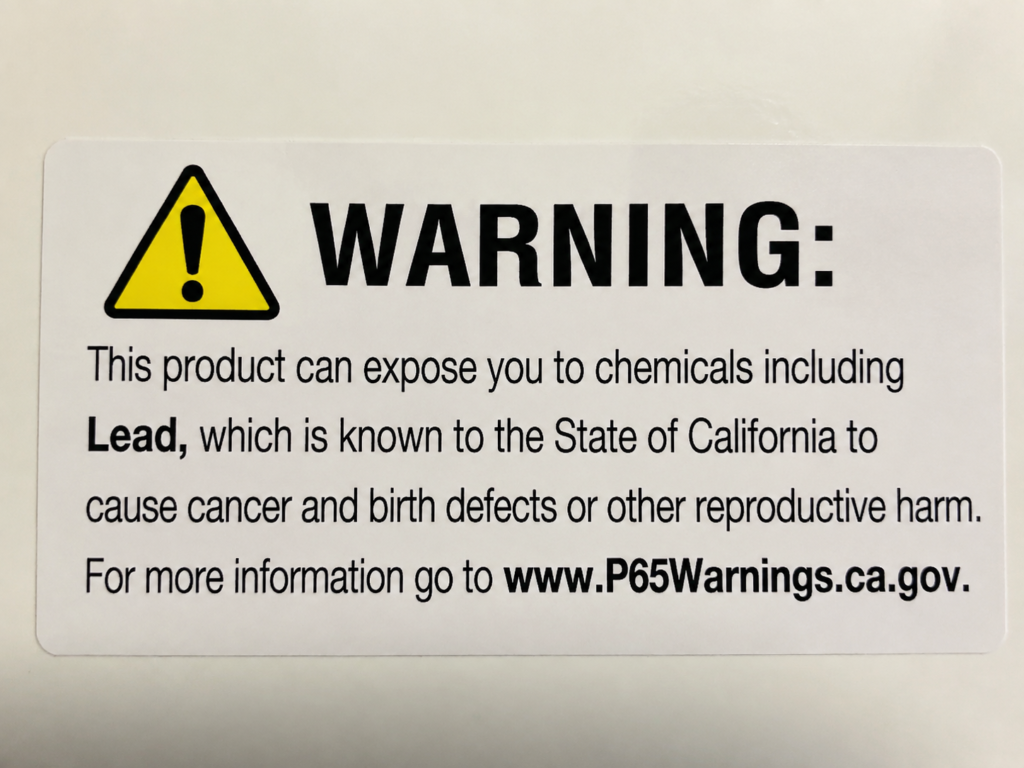
- Content requirements: California Prop 65 has clear format requirements for consumer product warnings. Using the official safe harbor model text can reduce compliance risks. The core elements include: yellow warning triangle logo, uppercase WARNING text, clear hazard type (carcinogenic/reproductive toxicity/both), at least one listed chemical substance related to product exposure, and the official California Prop 65 website (www.P65Warnings.ca.gov). The warning content must correspond to the substances, hazards, and exposure scenarios actually involved in the product. Vague expressions such as “This product complies with Prop 65” are not allowed, nor are “universal warnings” that do not correspond to the actual situation. If the product also provides information to non-English speaking consumers, warnings in the corresponding language must also be provided as required.
- Offline placement: For products sold offline in physical stores, the warning must be placed in a prominent position on the product body or outer packaging to ensure that consumers can clearly see it before purchase, and must not be hidden in the manual, inside the packaging, or other positions that are inaccessible before purchase.
- Online placement: For products sold on the Internet, the full warning must be displayed in a prominent position on the page before consumers purchase, or a clear clickable warning link must be set (must comply with OEHHA’s warning rules for Internet sales); if the platform backend has a dedicated California Prop 65 information field, the corresponding content must be filled in truthfully, and must not be concealed or misreported. Different sales channels may have more specific format requirements, which must comply with both official rules and channel policies.
Step 5: Compliance Evidence Retention (Mandatory, for Responding to Verifications/Notices)
Many sellers have done compliance, but did not retain evidence, so they cannot produce it when encountering verification, which means it was done in vain. Compliance evidence is the core support for responding to compliance verifications, notices, or lawsuits, and must be archived by SKU, variant, and batch to ensure traceability.
Materials to be retained include: material composition descriptions provided by suppliers, compliance declarations (must cover the corresponding SKU, batch, and materials), exposure assessment reports or third-party test reports, warning versions and launch/labeling records, sales records, distribution chain related documents, and change records of materials/suppliers/warnings. The specific retention period needs to be determined in combination with applicable regulations, platform agreements, distribution contracts, and professional legal opinions, to avoid inability to provide evidence due to missing data.
Step 6: Special Treatment for Multi-Variant/Set Products
Multi-variant and set products are the most likely to cause pitfalls, so they are explained separately:
- Multi-variant products (such as the same product with different colors, materials, accessories) need to complete exposure assessment one by one: if the actual exposure situation, involved listed substances, and hazard categories of different variants are completely consistent, a unified warning can be used; if there are differences, corresponding warnings must be formulated separately, and cannot be directly shared.
- For set products, the main unit, all accessories, packaging, and even gifts must all be included in the assessment scope, and no omission is allowed: it is necessary to judge whether each component will cause relevant exposure to consumers. If any component has exposure risk that requires a warning, the set’s warning must accurately cover all relevant substances and hazards, rather than directly applying a general warning just because a certain component has risk.
- If you do bundled sales later and add new accessories, for example, you originally sold mice, but now sell them bundled with mouse pads, you need to re-evaluate compliance, because the new accessories may bring new controlled substances.
V. Pitfall Avoidance Guide: 8 Common Pitfalls for Electronic Product Sellers
The following are common misconceptions encountered by electronic product sellers in California Prop 65 compliance. Understanding them in advance can effectively reduce compliance risks:
2 Pitfalls on the Supply Chain Side
- Verbal compliance without substantive data: Many suppliers will verbally claim “compliant with California Prop 65”, but can only provide self-issued general compliance declarations, and cannot provide material composition data or exposure test reports for the corresponding SKU and batch. Such declarations can be used as one of the auxiliary evidences, but used alone are not sufficient to support compliance defense. It is necessary to request supporting data matching the specific product and batch, and cross-verify the authenticity.
- Missing management of non-core components: Many sellers only assess the finished main unit, ignoring components such as components, packaging, and gifts — for example, the earphone itself is compliant, but the included soft rubber storage bag contains phthalates, and the packaging ink contains specific heavy metals, which may also trigger compliance risks. All components accessible to consumers must be included in the assessment scope, including gifts, packaging consumables, etc.
2 Pitfalls in Warning Setting
- Generalized warnings do not meet requirements: Using the same vague warning for all products, such as only writing “This product contains substances on the California Prop 65 list”, without clarifying the specific hazard type and related chemical substances. Such warnings do not meet official requirements, and even if affixed, may be judged as failing to fulfill the notification obligation.
- Placement position does not meet the requirement of being visible before purchase: Placing the warning at the bottom of the detail page, in the manual, inside the packaging, or other positions that consumers cannot see before purchase is equivalent to failing to fulfill the notification obligation, and may still trigger compliance issues. It is necessary to ensure that consumers can clearly obtain warning information before making a purchase decision.
2 Cognitive Pitfalls
- Small sellers will not be held accountable: Some small sellers believe that their sales volume is low and they will not become targets. In fact, private law enforcement parties usually screen products sold on the platform in batches, and regardless of sales volume, non-compliant products may be included in the verification scope.
- Affixing a warning means the product is unqualified: Many sellers worry that affixing a warning will affect sales. In fact, the California Prop 65 warning is a manifestation of consumers’ right to know, similar to allergen warnings on food. It does not mean the product is prohibited from sale, nor does it mean the product quality does not meet standards. Many well-known brands’ consumer electronic products are affixed with warnings as required.
2 Liability Pitfalls
- The platform will bear all compliance responsibilities: Some sellers believe that after paying platform commissions or compliance service fees, the platform will be responsible for all compliance issues. In fact, the platform is usually only responsible for the formal review of the listing process. The ultimate responsibility for compliance needs to be determined according to regulatory requirements, platform agreements, and the seller’s role in the sales chain. You cannot default that the platform will bear all responsibilities.
- Receiving a compliance notice means you must lose money: There is no need to panic excessively when receiving a compliance notice. You first need to verify the nature of the notice and your own compliance status. If you have sufficient evidence to prove that you have fulfilled your statutory obligations, you can submit materials for defense through formal procedures. Not all notices will ultimately lead to compensation.
VI. Emergency Handling: What to Do When Receiving California Prop 65 Related Notices/Verifications
If you receive a notice or verification request related to California Prop 65, you can respond in an orderly manner according to the following ideas to avoid expanding losses due to blind operations:
First Actions After Receiving the Notice
First do four things to stabilize the situation and control risks:
- Verify the nature and authenticity of the notice: First distinguish the type of notice. Common ones include platform in-site verification notices, 60-day violation notices issued by private plaintiffs, formal court complaints, and verification documents issued by government departments. At the same time, verify the identity of the sender to avoid fraud. Different types of notices have different reply deadlines, response procedures, and legal consequences, so you must first clarify the type before proceeding.
- Fix relevant evidence and samples: Immediately preserve the inventory samples of the accused product, all compliance data of the corresponding batch, sales records, warning placement records, etc., to avoid affecting the defense due to data loss or product changes.
- Check core information: Carefully check the product model, sales period, accused listed chemical substances, exposure scenarios and other information mentioned in the notice, confirm whether it is consistent with your actual situation, and whether there is a case of misidentified product or subject.
- Assess whether to take temporary measures: According to the type of notice, risk level, and your own compliance status, assess whether you need to temporarily adjust the sales status in California, supplement or correct the warning content to avoid further expansion of risks — not all notices require immediate suspension of sales, which needs to be judged in combination with the actual situation.
Response Path Selection Logic
Select the response method according to your actual situation:
- If you have sufficient compliance evidence (for example, a third-party test report proves that the exposure level is lower than the threshold, the warning has been placed in a standardized manner as required and the content is accurate): you can submit the corresponding evidence as required by the notice, explain the compliance basis, and apply for the revocation of relevant charges or restoration of sales;
- If it is confirmed that there are compliance defects: you need to combine the type of defect, notice stage, and your own business situation, formulate a rectification plan (such as supplementing warnings, replacing materials, improving evidence) under the guidance of professionals, and communicate solutions with relevant parties;
- If it involves formal litigation, high fines, or complex technical judgments: do not respond on your own. Entrust a lawyer or compliance service provider with experience in handling California Prop 65 cases as soon as possible to assist, to avoid aggravating liability due to improper operation.
Long-Term Preventive Measures
If you plan to deeply cultivate the California market for a long time, you can build a long-term compliance system from three aspects:
- Supply chain optimization: Prioritize the selection of low-risk materials, such as replacing soft PVC cables with silicone cables, using lead-free solder, to reduce exposure risks from the source and reduce subsequent compliance pressure;
- Internal spot check mechanism: Establish a spot check system for new batches and new suppliers, regularly conduct sample checks on high-risk SKUs to avoid batch compliance risks;
- Professional support docking: If the sales volume in California is high and the number of SKUs is large, you can dock with professional compliance service providers or lawyers, regularly follow up on list updates and rule changes to ensure the continuous effectiveness of the compliance system.
VII. Boundary Distinction: Differences Between California Prop 65 and Other Electronic Product Compliance Requirements
Many sellers confuse California Prop 65 with other compliance requirements. In fact, their control directions, applicable scopes, and legal bases are all different, and they cannot replace each other. The following table explains clearly:
| Compliance Requirement | Core Control Direction | Applicable Scope Description | Can It Replace California Prop 65? |
|---|---|---|---|
| RoHS | Total content limit of harmful substances | Multiple jurisdictions such as the European Union and China have relevant systems. The applicable products, restricted substances, and labeling requirements of different jurisdictions are different. It mainly controls the total content of harmful substances in electrical and electronic products | No, it can only be used as a reference basis for material composition, and the control logics of the two are completely different |
| FCC | Electromagnetic compatibility and radio frequency compliance | Electrical and electronic products in the U.S. market need to select the corresponding compliance path (such as certification, SDoC, etc.) according to the device type, which has nothing to do with chemical substance exposure | Completely irrelevant, cannot replace |
| NRTL Safety Certification (such as UL/ETL) | Electrical safety (fire prevention, electric shock prevention, etc.) | It is not a unified mandatory requirement at the U.S. federal level. Whether it is required depends on the product type, sales channel, insurance requirements, or local competent authority regulations. It mainly controls electrical safety risks | Completely irrelevant, cannot replace |
| CPSIA | Children’s product safety and harmful substance restrictions | At the U.S. federal level, for products mainly designed or used by children aged 12 and under, requirements vary by product type, which may include obligations such as testing, Children’s Product Certificate, and traceability labels | No, children’s products need to meet the different requirements of both at the same time |
| Platform compliance requirements | Listing review and platform rules | Review requirements formulated by each platform for products sold, usually focusing on formal reviews such as format and document submission | No, passing platform review does not mean fully meeting the statutory requirements of California Prop 65 |
VIII. Practical Tools and Compliance Priorities
Pre-Listing Quick Checklist (Can Be Directly Reused)
Before each new launch, check against these 5 items, which can cover most basic compliance risks:
- □ Whether there is a California sales scenario, and you need to bear the corresponding warning obligation (such as the platform defaulting to covering the entire United States, using a California overseas warehouse, selling directly to California, distributors reselling to California, etc.)
- □ Whether initial screening has been completed for all accessible components of the product (including accessories, packaging, gifts) to identify possible listed chemical substances
- □ Whether there is compliance supporting data for the corresponding SKU and batch (material composition description, supplier declaration, exposure assessment or test report)
- □ If a warning needs to be affixed, whether the content meets the official format requirements (including warning triangle, WARNING, hazard type, relevant listed substances, official website), and is visible before purchase both online and offline
- □ Whether all compliance data have been archived by SKU and batch, and can be retrieved at any time
Compliance Priorities for Sellers of Different Sizes
Sellers of different sizes can promote compliance according to priority based on their own business stage, and there is no need to pursue perfection in one step:
- Small sellers/new sellers: First complete the initial risk screening of all SKUs in the store, prioritize verifying the involved listed substances and exposure status of high-risk SKUs, implement warnings or supplement data as required, and retain basic compliance files;
- Medium sellers/stable sales volume: Conduct formal exposure testing for high-sales high-risk SKUs, improve the full-chain compliance evidence system, sort out and fill in compliance loopholes of multi-variant and set products;
- Large sellers/high sales volume in California: Promote the supply chain to carry out low-risk material replacement, establish a normalized batch spot check and list update follow-up mechanism, and reduce long-term compliance risks from the root.
The core of California Prop 65 compliance is “informed notification” and “evidence retention”. As long as you proceed step by step according to the risk level, first implement compliance in high-risk links, and then gradually improve the data system for medium and low risks, you can control compliance risks within a reasonable range.