
When it comes to products for the EU market, many people’s first reaction is that CE certification is required. But if your product does not have a corresponding CE directive, does that mean you don’t have to worry about safety requirements? Of course not. The EU has a set of fallback consumer product safety rules, namely the General Product Safety Directive (referred to as GPSD). All consumer products that are not fully covered by specialized safety regulations must comply with general product safety requirements.
Many small sellers, brand owners, and OEM factories often cannot figure out whether they need to comply with relevant rules, what tasks they need to complete, and who is liable when something goes wrong. Based on the liability framework of GPSD and combined with the transition requirements of the new General Product Safety Regulation (GPSR), this article breaks down all the liabilities of manufacturers under general product safety rules into actionable checklists, covering core compliance requirements from entry-level judgment to pitfall-avoidance practice.
1. Pre-requisite for Getting Started: First Determine Whether GPSD Applies to You
1.1 Plain-Language Definition and Core Role of GPSD
GPSD is the “fallback rule” for EU consumer product safety, with only one core requirement: products placed on the EU market must not endanger the health and safety of consumers under normal use and reasonably foreseeable misuse.
It should be noted that it is a safety baseline, not a quality standard. Compliance with GPSD does not mean that the product is of good quality or high grade; it only means that it has no unreasonable risks. For example, for an ordinary paper notebook, if the binding edge is so sharp that it cuts your hand when you turn the page, it does not meet GPSD requirements no matter how good the paper is or how nice the design is. Conversely, as long as there are no unreasonable safety risks, even a notebook with average paper quality can meet the requirements.
1.2 Scope of Application and Exclusion Boundaries
The judgment logic is very simple: first check whether there is a dedicated EU safety regulation governing your product, then see if GPSD needs to fill the gap.
- Priority application of special regulations: If a product is already covered by EU-wide safety regulations for its entire category, such as food, pharmaceuticals, medical devices, toys, and electronic and electrical products subject to CE requirements, the special regulations shall apply first, and it is not necessary to fully follow GPSD.
- Fallback application of GPSD: Consumer products that are not fully covered by special regulations, such as ordinary stationery, small household items, accessories, and fabric storage boxes, fall under the jurisdiction of GPSD.
- Partial gap-filling rule: If special regulations only cover part of the risks of a product, the remaining risks shall still be subject to GPSD. For example, if the special regulation for a certain type of product only governs chemical substance limits, uncovered aspects such as mechanical injury and fire risk must still comply with GPSD requirements.
When making a judgment, first check the special regulations corresponding to the product, then determine the scope of application of GPSD. Do not directly apply GPSD right away.
1.3 Transition Rules Between GPSD and GPSR
The GPSD we often refer to is the old version of the General Product Safety Directive, numbered 2001/95/EC. The new General Product Safety Regulation (referred to as GPSR, numbered EU 2023/988) officially applies from December 13, 2024, fully replacing GPSD as the current EU general product safety rule.
Which set of rules applies specifically depends on the time when the product is first placed on the EU market:
- Products newly placed on the market on or after December 13, 2024 shall uniformly comply with GPSR;
- Liability determinations related to old inventory and historical contracts placed on the market before December 13, 2024 shall be determined in combination with the placement date and the specific implementation rules of each member state.
The core liability logic of the two sets of rules is basically the same. The basic requirements in this article regarding product safety, risk assessment, technical documentation, and post-market monitoring also apply to GPSR. There are differences between the two regarding the requirements for responsible entities within the EU:
- Under GPSD, if an overseas manufacturer has not established a contactable responsible entity within the EU, the EU importer shall bear all manufacturer liabilities;
- Under GPSR, manufacturers outside the EU must mandatorily designate a legal entity within the EU as the EU responsible person, which is a statutory mandatory requirement.
1.4 Who is a “Manufacturer” as Defined by GPSD
Many people think that only factories that produce products are manufacturers, but this is completely wrong. GPSD has a clear core criterion for determining manufacturers: entities that place products on the EU market under their own brand or name.
According to this criterion, the following all belong to manufacturers under GPSD:
- Private brand owners (even if production is fully outsourced)
- Factories that produce and sell their own products
- OEM factories that affix their own brand
Pure OEM factories (only producing for others without affixing their own brand) and ordinary retailers are not manufacturers as defined by GPSD and do not need to bear the core liabilities of manufacturers.
For the requirements for responsible entities of overseas manufacturers, please refer to the transition rules above. If no EU-based contact party is specified, liability may be transferred to the importer.
1.5 Why GPSD Liabilities Must Be Taken Seriously
Whether it is GPSD or GPSR, compliance with general product safety rules is a pre-market requirement, not something that needs to be remedied only after an accident occurs. As long as products are sold to the EU market, they must first meet the requirements of the corresponding rules. Otherwise, market access qualifications will be directly affected: in mild cases, goods will be detained or removed from shelves; in severe cases, fines, recalls, or even EU-wide market access bans may be imposed.
2. Core Pre-Market Liability Checklist (Must-Do for Beginners, Core Focus)
As the primary responsible party under general product safety rules, manufacturers must complete the following core work before products are placed on the market, which is the basis of compliance.
2.1 Product Safety Compliance Liability (Core Obligation)
Product safety is the core of all liabilities. The judgment standard is not “as long as no accidents have occurred”, but to achieve a “reasonably foreseeable level of safety” under normal use and reasonably foreseeable misuse.
There is a very important risk control priority here, which many people get reversed:
- First priority: Eliminate risks directly at the design stage — for example, design the gap of drawers that pose a finger-pinching risk to a width that will not pinch fingers, solving the problem at the root;
- Second priority: Add protective devices — if risks cannot be completely eliminated through design, add protection, such as adding protective covers to sharp edges;
- Last resort: Affix warning labels — warnings are only supplementary measures and can never replace design improvements and protective devices.
Common risks that need to be covered include: mechanical risks such as cuts, pinches, and suffocation; excessive chemical substances; electrical risks such as electric leakage; scalding and fire risks; noise damage; and ergonomic problems caused by long-term use, all of which must be considered.
Regarding the application of standards, priority shall be given to unified safety standards officially recognized by the EU (also known as harmonized standards). Within the risk scope covered by harmonized standards, products are legally presumed to comply with the corresponding safety requirements. If there is no corresponding harmonized standard, member state standards, international standards, or industry standards may be referenced. However, it should be noted that compliance with standards does not mean absolute exemption from liability. If new safety risks are discovered later, they must be handled in a timely manner.
In addition, production consistency control must be done well: mass-produced products must be consistent with the samples you used for safety assessment. Materials, processes, and designs cannot be changed arbitrarily. If there are changes, safety risks must be re-evaluated.
2.2 Basic Requirements for Risk Assessment
Risk assessment is the core of technical documentation. It does not need to be written as a thick professional report, but four key questions must be clearly thought through and written down:
- What harm may the product cause? (e.g., cuts, suffocation, scalds)
- Which groups of users are most likely to be affected? (Vulnerable groups such as children, the elderly, and people with disabilities must be considered)
- In what scenarios will harm occur? (The entire product life cycle must be covered: transportation, installation, use, cleaning, maintenance, disposal — every link must be considered)
- What is the probability of harm occurring, and how severe is it?
Finally, a written risk assessment report shall be formed and stored together with other technical documentation.
2.3 Liability for Retention of Technical Documentation
Many people think that only products with CE marking need technical documentation. In fact, GPSD also explicitly requires manufacturers to retain complete technical documentation, which must be readily available during regulatory inspections.
Core technical documentation includes:
- Product description, design drawings
- Risk assessment report
- Relevant test reports
- List of applicable standards
- Quality control records
- Samples of labels and instructions for use
The storage requirement is that it must be accessible within the EU. It can be in electronic form, but must be authentic, complete, and quickly retrievable. The retention period is at least 10 years after the last batch of products is placed on the market. If a member state requires a longer period, local rules shall apply.
If there are changes to the product’s design, materials, or processes, or if new safety risks are discovered, or if applicable regulations or standards are updated, the technical documentation must be updated in a timely manner.

2.4 Liability for Product Labeling and Consumer Information
Products must carry all traceability and safety-related information, which cannot be omitted arbitrarily:
- Mandatory traceability information: brand/trademark, model, batch/serial number, name and contact address of the responsible party within the EU. These are the key to quickly finding the responsible party in case of an incident.
- Requirements for instructions and warnings: Instructions for use, warning labels, and other necessary safety information shall, in principle, be in the official language of the target member state of sale; if the product is sold in multiple member states at the same time, it must cover the official languages of all corresponding sales countries; if the target member state has more specific requirements for the form of information presentation, local rules shall be followed. The content shall include applicable groups, usage restrictions, residual risks (no matter how good the design is, there may be residual risks, which must be clearly told to consumers), and disposal methods. Vague warnings (such as only writing “use with caution”) are usually not compliant. Risk scenarios and applicable groups must be clearly stated. For example, “Keep out of reach of children under 3 years old; contains small parts that may cause suffocation” meets the requirements.
- Labeling validity requirements: Unless there are special exceptions, labels shall be clear and not easy to wear off, and shall not be printed only on easily removable temporary labels (specific requirements are subject to the rules of the target member state).
- Special requirements for online sales: When selling online, key safety information and responsible entity information shall be visible on the display page before purchase (such as the product detail page), to ensure that consumers can know the core safety tips before placing an order (specific requirements are adjusted according to the sales model and member state rules).
2.5 Exclusive for Overseas Manufacturers: Liability for Designating a Responsible Entity Within the EU
All manufacturers outside the EU and cross-border brand owners, as long as they place products on the EU market, need to specify a responsible contact entity within the EU. Specific requirements vary depending on the applicable rules:
- Historical products subject to GPSD: If an overseas manufacturer has not established a contactable responsible entity within the EU, the EU importer shall bear all manufacturer liabilities in accordance with the law; it is recommended to specify the domestic contact party in advance to avoid unannounced transfer of liability.
- Newly placed products subject to GPSR: A legal entity within the EU must be mandatorily designated as the EU responsible person, and the position must not be left vacant.
The core responsibilities of the domestic responsible entity include: liaising with regulatory authorities of various EU countries, providing or keeping technical documentation as required, and cooperating with product safety risk disposal work.
Labeling requirements: The name and contact address of the responsible entity shall be printed on the product or packaging to ensure that regulatory authorities can directly identify them during market inspections. They shall not only be placed in materials such as instructions for use that consumers can only see after purchase.
3. Post-Market Ongoing Liability Checklist (Must-Know for Advanced Level)
Many people think that everything is fine once the product is sold. In fact, the liabilities under general product safety rules run through the entire product life cycle, and there are three mandatory ongoing tasks after the product is placed on the market.
3.1 Proactive Product Safety Monitoring Liability
You cannot wait for regulators to contact you or for an accident to occur before discovering problems. You must proactively collect information related to product safety through channels including: consumer complaints, return/maintenance records, social media reviews, regulatory authority notifications, and accident information of similar products.
Collected information shall be handled at different levels: general quality problems (such as wrong color, minor appearance defects) can be handled according to the after-sales process; if it is a safety problem that may cause injury, it must be escalated immediately.
In cases of product revision, expanded use, introduction of new regulations/standards, or discovery of new risks, product safety must be re-evaluated. You cannot keep using old test reports from several years ago. For products sold for a long time, historical compliance documents must never replace ongoing monitoring.
3.2 Rapid Safety Risk Disposal Liability
Once a product safety risk is discovered, the first step is always to stop losses first: immediately suspend production, shipment, and sales, isolate affected inventory, and notify relevant parties in the supply chain, such as suppliers and distributors.
Next, corrective measures shall be selected according to the risk level, from low to high: supplementary warnings, free repair, replacement, refund, withdrawal (recovering channel inventory that has not yet reached consumers), recall (notifying consumers who have already purchased the product to return or dispose of it).
If it is a serious risk that may cause injury, regulatory notification usually needs to be completed within a few days, and the specific time limit is subject to the statutory requirements of the target member state. You can report directly to the regulatory authority of the target sales country, or conduct EU-level rapid notification and public warning through the EU’s Safety Gate (formerly RAPEX) system.
When implementing a recall, note that: the notification must clearly state how to identify the product, what specific risks there are, and what actions consumers should take; it must be published through channels that can effectively reach consumers; and the recall response rate must be continuously tracked — you cannot just send the notification and ignore it.
3.3 Regulatory Cooperation Liability
If EU regulatory authorities conduct inspections, technical documentation, product samples, and sales records shall be provided as required. Concealment, delay, or provision of false information is prohibited. If regulators put forward rectification requirements, they must be completed within the specified time limit, and follow-up measures such as removal from shelves, recall, and public notification must be cooperated with.
4. Advanced Judgment: GPSD Liability Boundaries of Different Entities (Avoid Taking Wrong Liabilities)
There are many roles in the supply chain, and not everyone has to bear the manufacturer’s liabilities. Clarifying the boundaries can not only avoid failing to bear the liabilities that should be borne, but also avoid taking on liabilities that should not be borne.
| Supply Chain Entity | Regular GPSD Liabilities | Exceptional Circumstances Where Full Manufacturer Liabilities Shall Be Borne |
|---|---|---|
| Brand owner/private brand seller | Bear all manufacturer liabilities | Liable only when placing the product on the market under its own brand/name; if it only sells other people’s brands without modification or rebranding, liability shall be determined according to distributor/retailer liabilities |
| Pure OEM factory | Only bear production liabilities agreed in the contract | When selling products under its own brand |
| EU importer | Verify product labeling and traceability information; confirm that the manufacturer has completed safety assessment and retained technical documentation; shall not place products on the market when product safety is not confirmed or risks are known; keep supply chain and product flow records; suspend sales and cooperate with rectification and recall when problems are found | When the overseas manufacturer has not established a contactable responsible entity within the EU |
| Distributor/retailer | Verify whether the product has basic compliance labels and traceability information; do not sell products with known or obvious safety hazards; keep product purchase and sales flow records; suspend sales and cooperate with rectification and recall when problems are found | When modifying product design/use or selling under its own brand |
| Modification/combination seller | Bear corresponding liabilities according to the original role | When changing the original design/use/safety characteristics of the product, or when new safety risks arise from combined sales |
There are two supplementary points to note:
First, EU importers cannot deem products compliant solely based on the oral statements of suppliers; actual supporting documents are required;
Second, special attention should be paid to modification and combined sales: if you modify the design, use, or safety characteristics of an ordinary product, for example, modifying an ordinary desk lamp into a model that can be clipped to a baby crib, the modifying party shall bear manufacturer liabilities, and the compliance documents of the original product cannot be used directly. If multiple products are combined into a set for sale, and new safety risks arise after the combination, for example, bundling an electric cooker and a non-high-temperature-resistant plastic bowl into a set, the combined seller shall also bear corresponding safety liabilities.
Note: If the product is subject to GPSR, overseas manufacturers must also meet the requirement of mandatorily designating an EU responsible person. For details, see the previous chapters on transition rules and pre-market liabilities.
5. Pitfall Avoidance Guide: Common Misconceptions About GPSD Liabilities
5.1 Misconceptions About Product Cognition
- Misconception 1: Small products/low-value products/free gifts do not need to comply. Correct logic: As long as they are ordinary consumer products placed on the EU market, regardless of their value or whether they are free gifts, they must meet general product safety requirements.
- Misconception 2: With the CE mark, you don’t need to worry about GPSD. Correct logic: CE is a compliance mark for the corresponding special regulations of the product, which only proves that the risks covered by the special regulations meet the requirements; residual risks not covered by special regulations, or ordinary consumer products without corresponding CE directives, still need to meet the fallback safety requirements of GPSD/GPSR.
- Misconception 3: No accidents mean the product is safe. Correct logic: General product safety compliance is a pre-market requirement. Risks must be proactively assessed and proofs retained. The absence of accidents cannot be used as a basis for compliance.
- Misconception 4: Complying with domestic safety standards is enough. Correct logic: Products placed on the EU market must meet the safety requirements of the EU and the target sales country. Domestic standards cannot directly replace EU rules.
5.2 Misconceptions About Operation Processes
- Misconception 1: Warning labels can replace design improvements. Correct logic: Risk control must prioritize eliminating risks at the design stage. Warnings are only supplementary measures and cannot replace design improvements and protective devices.
- Misconception 2: Hiring a third-party testing means you don’t have to bear liabilities. Correct logic: The manufacturer is the primary responsible party for product safety. Third-party test reports are only compliance supporting materials and cannot exempt the manufacturer from core safety liabilities.
- Misconception 3: Only English labeling is enough. Correct logic: In principle, safety information and labels in the local official language are required for the member state where the product is sold. English alone cannot meet the compliance requirements of most member states.
- Misconception 4: Technical documentation can be destroyed once the products are sold out. Correct logic: Technical documentation must be kept for at least 10 years after the last batch of products is placed on the market. If member states have stricter requirements, local rules shall be followed, and they shall not be destroyed in advance.
5.3 Misconceptions About Liability Division
- Misconception 1: Products are produced by factories, so all liabilities lie with the factory. Correct logic: The brand owner that places products on the market under its own brand is the statutory manufacturer under GPSD and bears the ultimate safety liability. Production outsourcing does not exempt from liability.
- Misconception 2: All liabilities can be shifted to importers/distributors. Correct logic: The core safety liability of manufacturers is statutory and cannot be fully transferred to other entities in the supply chain through contracts.
- Misconception 3: No special regulations mean no need to prepare technical documentation. Correct logic: GPSD/GPSR explicitly requires manufacturers to retain risk assessment reports and complete technical documentation as proof of compliance, regardless of whether there are special regulations.
6. Practical Tools: Quick Self-Check and Consequences of Violation
6.1 5-Step Quick Self-Check Checklist for GPSD Liabilities (Completed in 10 Minutes)
If you are unsure of your compliance progress, you can quickly check according to these 5 steps, and you can get a general idea in 10 minutes:
- Check applicable boundaries: First confirm whether the product is governed by special regulations or general product safety rules, then confirm whether GPSD or GPSR applies according to the placement time.
- Check product labeling: Check whether there is information of the responsible party within the EU and batch numbers, and whether products with risks have clear and easy-to-understand safety warnings.
- Check technical documentation: Check whether the risk assessment has been completed, whether the technical documentation is complete, and whether it is accessible within the EU.
- Check entity identity: Confirm the statutory liabilities corresponding to your role in the supply chain; if you are an overseas manufacturer, you need to confirm that the responsible entity within the EU has been specified in accordance with applicable rules (recommended for GPSD, mandatory for GPSR).
- Check after-sales mechanism: Check whether a post-market safety monitoring and risk disposal process has been established.
6.2 Common Consequences of Violation (By Severity)
The penalty intensity for violations of general product safety rules is linked to the severity of the risk. Common consequences are divided by severity:
- Mild: Rectification within a time limit, customs detention of goods, order to remove from shelves
- Moderate: Fines (the amount is linked to the value of goods and illegal gains, with different standards in each member state), public notification on Safety Gate (all EU regulatory authorities will pay attention)
- Severe: Mandatory recall, EU-wide market access ban, and may also involve criminal liability when serious personal injury is caused
The specific penalty standards are subject to the legal provisions of the target sales country, and the enforcement intensity varies among different member states.
6.3 Handling Methods When Unsure
If you encounter uncertain situations, you can handle them according to these steps:
- First check the corresponding EU special regulations, harmonized standards, or public guidelines of EU and member state regulatory authorities;
- Consult a qualified compliance service institution within the EU;
- You can refer to compliance cases of similar products, but pay attention to the differences between products and cannot directly copy them.
7. Summary
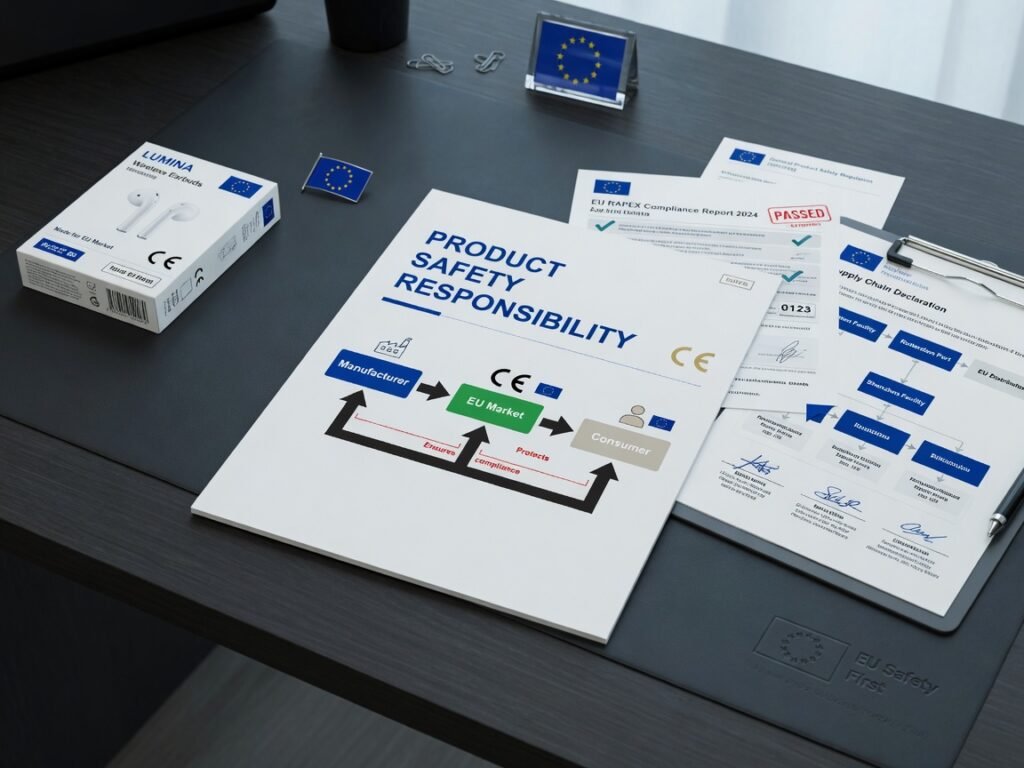
In general, as the old version of the EU’s general product safety fallback rule, GPSD only applies to products placed on the market before December 13, 2024. Current newly placed products need to comply with GPSR. The core liability logic of the two is highly consistent: whoever places a product on the EU market under their own brand name shall be fully responsible for the safety of the product throughout its life cycle. You can refer to the checklist in this article to determine the applicable rules, confirm the liabilities of the entity, check compliance actions before and after market launch, and handle risks in a timely manner when discovered to ensure product compliance.