
If you have shopped for mobile phone chargers in the United States, you have most likely seen the “DOE Level VI” (Level 6 energy efficiency) mark on the packaging; but in the promotion of home appliances and lighting products, the term “DOE Level VI energy efficiency” is also often seen. Although both are called “Level VI”, their natures are completely different — this involves the core applicable boundary of US energy efficiency rules, and is also the most common source of promotional misunderstanding. This article will systematically sort out the real requirements of DOE Level VI energy efficiency from the dimensions of applicable scope, core rules, verification methods, and common misconceptions.
Core Basic Boundary: Official Level VI Only Applies to External Power Supplies
The US Department of Energy (DOE) is the core federal-level agency formulating energy efficiency rules, responsible for setting mandatory energy efficiency baselines for consumer energy products and supervising market compliance. Its core function is to set market access thresholds, not to rank product energy efficiency. Its jurisdiction covers common consumer energy products such as home appliances, HVAC, lighting, and external power supplies, but the energy efficiency rules for different categories are completely independent, with different assessment indicators and rating frameworks, which cannot be compared across categories.
The official formal name of the commonly referred to “DOE Level VI” is Level VI. Only External Power Supplies (EPS for short) are subject to the DOE official Level I to Level VI rating system, and Level VI is the current highest federal mandatory energy efficiency level applicable to the external power supply category. Other categories such as home appliances, HVAC, and lighting do not apply to this rating framework, and the DOE has not adopted a unified 1 to 6 level rating setting for these categories.
The “DOE Level VI” statement for home appliances and lighting products on the market is a common analogy used by consumers and merchants — borrowing the认知 that Level VI for external power supplies represents high energy efficiency to refer to high-efficiency products that far exceed the mandatory threshold. It has no official standard basis, is easily confused with China’s energy efficiency grades, enterprise-defined tiers, and third-party institution ratings, and is a common source of misunderstanding.
Therefore, the primary prerequisite for discussing DOE energy efficiency is to clarify the product category: the test methods and assessment indicators of different categories are completely different, cross-category comparison is meaningless. When purchasing, importing, or selling products, you must first match the exclusive energy efficiency rules of the corresponding category to avoid being misled by the general “Level VI” promotion.
| Product Category | Is the DOE Official Level I-VI Rating System Applicable? | Core Mandatory Access Rules | Mandatory Information Disclosure Requirements | Voluntary High-Efficiency Certification |
|---|---|---|---|---|
| External Power Supply (EPS) | Yes (only this category has an official Level 1-6 framework) | Products within the applicable scope must meet Level VI | Products must be marked with the “VI” label as required | Check separately by specific category/current program, not used as a basis for Level VI compliance |
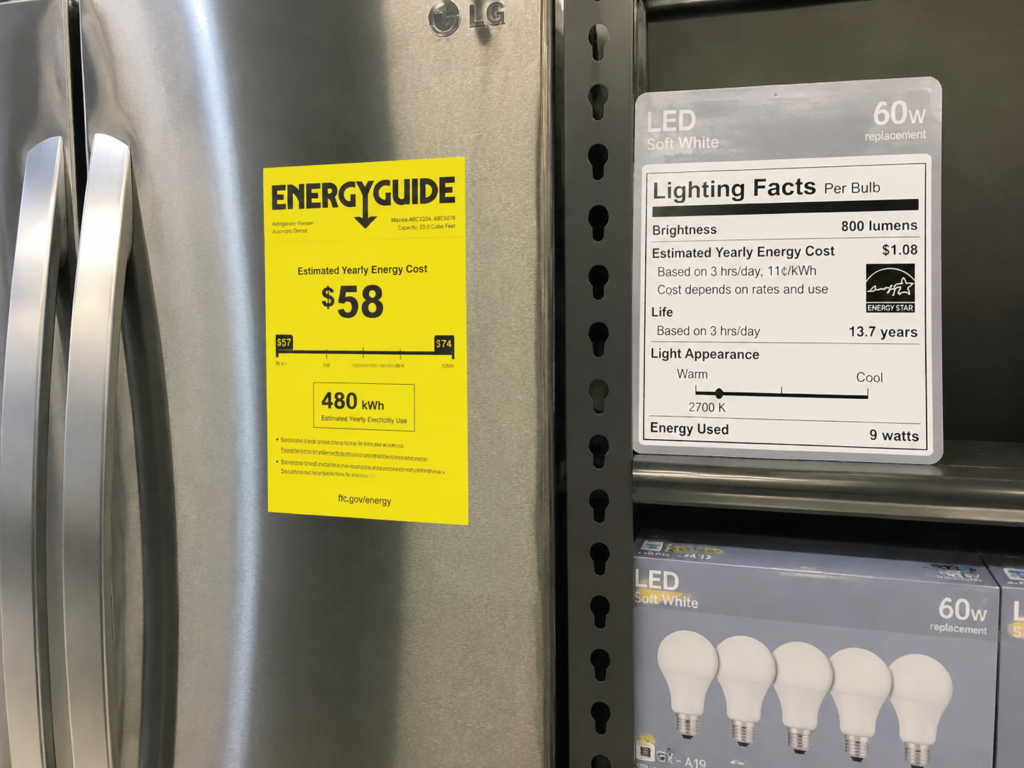
| Major home appliances such as refrigerators, freezers, and washing machines | No (the external power supply rating system does not apply) | Must meet the DOE MEPS standard for the corresponding category | Retail products must be affixed with the FTC EnergyGuide label | ENERGY STAR |
| HVAC equipment such as split air conditioners and heat pumps | No (the external power supply rating system does not apply) | Must meet the DOE MEPS standard for the corresponding category | Retail products must be affixed with the FTC EnergyGuide label | ENERGY STAR |
| Lighting products such as LED lighting | No (the external power supply rating system does not apply) | Must meet the DOE MEPS standard for the corresponding category | Some general retail products must be marked with Lighting Facts | ENERGY STAR |
Core Rules for External Power Supply Level VI
What is an External Power Supply (EPS)
An external power supply, commonly known as a “charger” or “power brick”, is an independent power supply device that powers devices such as mobile phones, laptops, routers, and monitors separately. Common forms include wall-mounted and desktop types, connected to powered devices via cables or plugs. By output type, they are divided into two categories: alternating current to direct current (AC-DC, the most common type for mobile phone and laptop chargers) and alternating current to alternating current (AC-AC, such as adapters for some old small home appliances).
The nameplate output power of consumer-grade external power supplies is mostly in the 0-250W range, but this is only a common market range and cannot be used as a legal basis for determining whether Level VI applies. Whether a specific product falls under the category of external power supplies requires comprehensive judgment based on DOE regulatory definitions, rated parameters, product structure, and test procedures.
Applicable Scope and Exemption Boundaries
Only exemption categories clearly listed in federal regulations are exempt from Level VI; judgment cannot be made solely based on product use or certification type. Product classification must be completed first, then matched with the corresponding rules:
- Typical regulated products: Mobile phone chargers, laptop adapters, router/monitor power supplies, external adapters for small home appliances, etc., all fall within the regulatory scope.
- Clearly exempt categories (must meet legal conditions):
- Built-in power supplies: Power supplies installed inside equipment that cannot be independently disassembled (such as built-in power boards for TVs, built-in power supplies for desktop computers) are subject to the energy efficiency rules of the corresponding equipment itself, and are not regulated under the external power supply category.
- Battery charging equipment: It is necessary to first confirm whether it falls under the “battery charger” category according to DOE definitions, and the exclusive energy efficiency rules for battery chargers apply; exemption from Level VI cannot be directly determined solely by product names such as “power bank” or “lithium battery charger”.
- Specific medical/industrial power supplies: Only dedicated power supplies clearly listed in regulations are exempt, and must meet the specific conditions of the corresponding exemption clauses; merely claiming medical/industrial use or holding medical/industrial certifications does not automatically constitute an exemption, and ordinary consumer-grade products may not use this to evade regulation.
Limit Requirements for Special Specification Products
Two types of external power supplies with special specifications do not apply to the limit rules for ordinary single-output products. They need to be matched with corresponding limits and DOE test procedures according to the specific product structure, and the limit formula for single-output EPS cannot be directly applied:
- Low-voltage output products: Products with an output voltage lower than 6V and an output current ≥ 550mA;
- Multi-output/multi-voltage products: Power supplies with multiple output ports or multiple output voltages.
Two Core Assessment Indicators
The core assessment of Level VI revolves around “efficiency during power supply” and “loss during no-load”, both of which must meet the standards. The specific limits vary with product category, rated power, output type, and regulation version:
- Active mode average efficiency: Refers to the proportion of electricity effectively delivered to the device to the total power consumption when the power supply powers the device. The higher the proportion, the less waste. For single-voltage external power supplies to which this test method applies, the average is usually taken after testing at four load points: 25%, 50%, 75%, and 100%, rather than only looking at full-load efficiency — after all, in daily use, power supplies are rarely in a full-load state for a long time, and looking only at full-load efficiency cannot reflect the power consumption in real usage scenarios. The load point settings and calculation methods of different types of EPS may vary, and the specifics shall be subject to the current official DOE test procedures.
- No-load input power consumption: Refers to the power consumption when the power supply is not connected to any load and only the input power is connected (no-load power consumption), which is not the same concept as the standby power consumption of powered devices. The no-load power consumption of a single power supply is very low, but when a large number of devices are plugged in for a long time, the cumulative energy consumption is still considerable, so it is one of the core assessment items of Level VI.
Note: The limits of Level VI are set by output power, output type, and single/multi-output tiers. There is no unified efficiency compliance line. To judge whether a product is compliant, it must be compared with the official limit table issued by the DOE.
Core Level VI Compliance Process
For an external power supply to achieve legal Level VI compliance, the following core steps must be completed, and all links must meet the requirements of current regulations:
- Product classification: Confirm whether the product falls under the category of external power supplies against DOE regulatory definitions, and exclude clearly exempt categories;
- Applicability judgment: Match the corresponding limit rules according to output type, rated power, and product structure (single/multi-output, low-voltage output, etc.);
- Standard testing: Complete energy efficiency testing in accordance with the unified test procedure officially issued by the DOE, and form technical documents such as test reports;
- Official declaration: The US importer, brand owner, or responsible manufacturer submits compliance information through the DOE Compliance Certification Management System (CCMS) to complete the mandatory access declaration. After the declaration is completed, traceable CCMS compliance records, submission credentials, or system-queryable information shall be retained for use in import, platform review, and DOE regulatory verification;
- Labeling and consistency: The product must be marked with the “VI” label as required by regulations, and the model and rated parameters in the test report, nameplate, and declaration information must be consistent;
- Change management: When key elements such as core components and circuit design are changed, compliance must be re-evaluated, and if necessary, retested and the declaration updated;
- Record retention: All compliance supporting documents must be retained for the legal period to cooperate with regulatory verification.
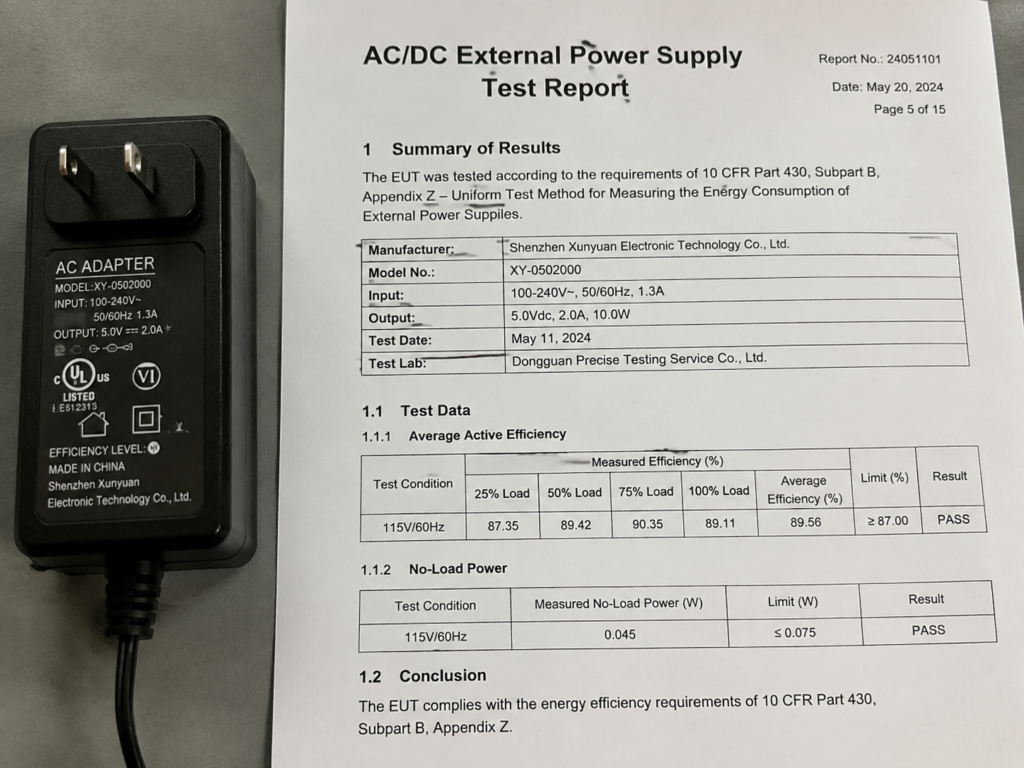
Note: The “VI” label is one of the compliance requirements, but compliance cannot be determined solely by the label. Final judgment must be made comprehensively in combination with official declaration records, test documents, and applicable regulations; the public scope of declaration information in the CCMS system varies by category, there is no unified “filing number” form, and the specifics shall be subject to the content queryable in the official system.
Core Differences from Previous Levels
For external power supplies, the higher the energy efficiency level number, the stricter the requirements. For external power supplies within the applicable scope that are newly manufactured or imported into the United States after February 2016, compliance with Level VI is mandatory at the federal level; the old Level IV and V levels are no longer federal mandatory access requirements, and products historically produced/imported shall be judged for compliance according to the regulations of their corresponding time.
Compared with Level V, the core upgrades of Level VI include two aspects: first, the no-load power consumption requirement is further reduced to reduce standby energy consumption; second, energy efficiency requirements are added for some low-power, low-voltage output, and multi-output products, expanding the regulatory scope. The specific newly covered categories shall be compared with the regulatory provisions of the corresponding version.
Official Energy Efficiency Rules for US Home Appliances/Lighting
Categories such as home appliances and lighting do not apply to the Level I-VI rating system for external power supplies. Their energy efficiency rules are composed of three types of requirements with different natures, corresponding to mandatory access, information disclosure, and voluntary high-efficiency certification respectively. The assessment priorities of different categories vary greatly, and the core rules of common categories are as follows:
| Product Category | Main Energy Efficiency Assessment Indicators | Mandatory Rules and Labeling Requirements | Optional Voluntary Certification |
|---|---|---|---|
| Refrigerators/Freezers | Annual power consumption under standard operating conditions (kWh/year), must be compared with products in the same volume segment | Must meet the DOE MEPS mandatory standard for the corresponding category, retail products must be affixed with the FTC EnergyGuide label to disclose annual power consumption and the energy consumption range of similar products | ENERGY STAR |
| Split Air Conditioners/Heat Pumps | Multi-dimensional seasonal performance indicators such as Seasonal Energy Efficiency Ratio (SEER2), rated operating condition Energy Efficiency Ratio (EER2), and Heating Seasonal Performance Factor (HSPF2) | Must meet the DOE MEPS mandatory standard for the corresponding category, retail products must be affixed with the FTC EnergyGuide label to disclose energy efficiency parameters and the range of similar products | ENERGY STAR |
| LED Lighting Products | Luminous efficiency (lumens per watt, i.e., the brightness value converted per watt of electrical energy) | Must meet the DOE MEPS mandatory standard for the corresponding category, some general retail lighting products must be marked with the FTC Lighting Facts label to disclose information such as brightness, power consumption, and luminous efficiency | ENERGY STAR |
| Washing Machines/Dishwashers | Power consumption and water consumption under standard operating cycles | Must meet the DOE MEPS mandatory standard for the corresponding category, retail products must be affixed with the FTC EnergyGuide label to disclose energy and water consumption and the range of similar products | ENERGY STAR |
The three types of rules have different natures and functions:
- DOE Mandatory Minimum Energy Performance Standard (MEPS): This is the energy efficiency access baseline for the US market. Products that do not meet the standard cannot be legally sold. This standard is formulated by the DOE by category, covering major energy-using products such as home appliances, lighting, and HVAC. Its core function is to eliminate high-energy-consuming products and improve the overall energy efficiency level of the market.
- FTC Energy Efficiency Label: Formulated and regulated by the US Federal Trade Commission (FTC), it is not a certification issued by the DOE. Its core function is to mandate products to disclose energy efficiency-related information, helping consumers compare and estimate annual energy consumption/operating costs and their ranges among similar products. Yellow EnergyGuide labels are used for categories such as major home appliances, and Lighting Facts labels are used for some general lighting products. The specific applicable scope shall be subject to the current FTC regulations.
- ENERGY STAR Certification: A voluntary high-efficiency certification jointly launched by the DOE and the US Environmental Protection Agency (EPA). Standards are set separately by product category, usually higher than the federal MEPS mandatory threshold. Specific requirements, applicable products, and test methods shall be subject to the current ENERGY STAR specifications for the corresponding category. Certified products can use the exclusive label, and consumers can check the validity of the certification in the official ENERGY STAR product directory.
Methods for Verifying the Authenticity of Energy Efficiency
The energy efficiency verification paths for different categories are different, and information can be verified through the following official public channels:
Verification of External Power Supply Level VI Compliance
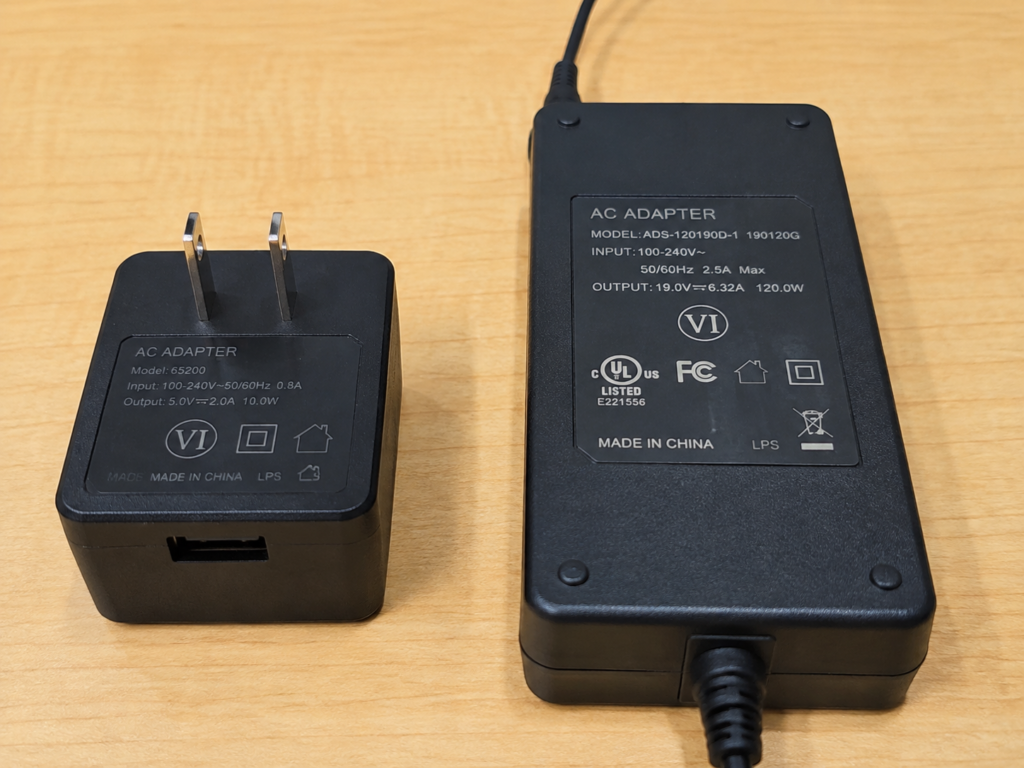
- Preliminary screening: Check whether there is a clear Roman numeral “VI” mark on the product body or nameplate. Compliant products must be marked with this mark as required;
- Official verification: Log in to the DOE CCMS compliance database, enter the accurate model number to query the declaration information, and check the following items one by one:
- The product model, rated input/output parameters, and product category are completely consistent with the physical nameplate;
- The “VI” mark on the product matches the filing information;
- If it is a derivative model with a different model suffix, a set-matching power supply, or a multi-output version, the filing records of other models cannot be directly used.
Note: The label is only a basis for preliminary screening. Final compliance must be comprehensively judged in combination with official declaration records, test documents, and applicable regulations.
Verification of Energy Efficiency Authenticity for Home Appliances/Lighting
- Mandatory access verification: Log in to the DOE CCMS database, match the corresponding product category, and confirm that the product has completed the mandatory access declaration. There are differences in declaration requirements and the scope of public information for different categories. CCMS records alone do not represent full compliance; other requirements such as labels and state-level rules must also be checked.
- Energy efficiency information comparison: Query EnergyGuide or Lighting Facts label information through official FTC channels to understand the energy consumption/efficiency range of the product among similar products.
- High-efficiency certification verification: If the product promotes ENERGY STAR certification, you can log in to the official ENERGY STAR product directory to query the validity of the certification by accurate model number.
Key Points for Verifying Merchant Promotions
- Confirm the nature of the “Level VI” statement: If it is for non-external power supply products, it is an unofficial statement, and the corresponding specific energy efficiency indicators or certifications must be clarified;
- Be wary of vague statements: Statements without clear test basis such as “comparable to Level VI” or “close to Level VI” require the merchant to provide corresponding official test data or certification proof;
- Reasonable verification boundaries: Some internal test reports or compliance documents of enterprises may not be disclosed to the public. Consumers can prioritize verifying information through official public databases, product labels, and model consistency. The inability to obtain complete technical documents does not mean that the product is necessarily non-compliant, but the promotional content must be consistent with official public records.
Common Misconceptions and Pitfall Avoidance Guide
Misconceptions of Concept Confusion
- Misconception: DOE Level VI = ENERGY STAR
The two have different natures and applicable scopes: Level VI for external power supplies is a federal mandatory access requirement, while ENERGY STAR is a voluntary high-efficiency certification set by category. The latter’s requirements are usually higher than the mandatory threshold, but specific judgment must be made based on the corresponding category specifications; most high-efficiency home appliance products use ENERGY STAR as a reference, and the two cannot be directly equated. - Misconception: High energy efficiency level = good product quality and many functions
Energy efficiency only assesses indicators related to power and water consumption, and has nothing to do with product quality, functions, noise, durability, etc. High-efficiency products may have basic functions, and low-efficiency products may also have more functions. The comprehensive quality of a product cannot be judged solely by energy efficiency. - Misconception: “DOE Level VI” is a universal official standard for all categories
This is a common confusion about the applicable scope of energy efficiency ratings. The “Level VI” statements for non-external power supplies have no official basis, and there is no need to pay extra for such gimmicks.
Misconceptions of Numerical Judgment
- Misconception: Energy efficiency can be judged by looking at a single parameter
For external power supplies, multiple requirements such as active mode average efficiency and no-load power consumption must be met at the same time, and looking only at full-load efficiency is completely meaningless. For example, a merchant promotes a charger with a 92% full-load efficiency, which seems very high, but if the no-load power consumption exceeds the limit, it still does not meet the Level VI standard.
The same is true for major home appliances and HVAC products: for refrigerators, the annual power consumption under standard operating conditions in the same volume segment must be compared; for split air conditioners and heat pumps, multi-dimensional indicators across all seasons such as SEER2, EER2, and HSPF2 must be combined, and a single peak parameter cannot be used as a selling point alone.
All energy efficiency values must be bound to officially specified test conditions to have reference value. “Self-reported values” that deviate from unified test conditions have no comparative significance and cannot be used as a basis for compliance judgment. - Misconception: The lower the power, the easier it is to meet the standard
The no-load limit of some low-power external power supplies is more sensitive relative to their rated power, and the difficulty of meeting the standard in design is not necessarily lower. Whether it is qualified needs to be calculated according to the limit and test procedure of the corresponding power tier, and cannot be judged solely by the power level. The absolute power consumption of major home appliances is directly related to volume and specifications, so relative efficiency must be compared under the same specifications, and it cannot be assumed that “low power consumption means high energy efficiency”. - Misconception: Having UL/FCC/CE certification equals compliance with DOE energy efficiency
UL is a common third-party safety listing system, FCC sets electromagnetic compatibility and other requirements for radio frequency equipment, and CE is a self-declaration mark for manufacturers to comply with applicable EU regulations; all three have nothing to do with DOE energy efficiency compliance and cannot replace each other. Products exported to the United States need to meet energy efficiency requirements separately. For example, a home appliance marked with “UL certification” only means that safety-related indicators meet the requirements, not that it meets DOE energy efficiency rules.
Misconceptions of Compliance and Purchase
- Misconception: DOE Level VI is all voluntary certification
Level VI for external power supplies is a US federal mandatory regulation. Products within the applicable scope that do not meet the standard cannot be legally sold; while high-efficiency certifications such as ENERGY STAR are voluntary, and enterprises can independently choose whether to participate. - Misconception: Energy efficiency requirements in all US states are exactly the same as federal ones
In addition to federal rules, some US states or local jurisdictions may set stricter energy efficiency requirements, registration requirements, or labeling requirements for specific products. For example, the California Energy Commission (CEC) has separate energy efficiency registration requirements for some home appliances and lighting products. Products entering the corresponding market must meet both federal and local rules, and it cannot be assumed that state requirements are unified with federal ones. - Misconception: High-efficiency products are always more cost-effective
High-efficiency products usually have a certain purchase price difference, the specific amount depends on the category, brand, specification, and market conditions, and not all usage scenarios are worth choosing. Cost-effectiveness must be comprehensively judged in combination with factors such as usage frequency, service life, and local electricity prices, and the highest energy efficiency cannot be blindly pursued.
Practical Decision Guide: How Different Groups Choose
Decision-Making Logic for Ordinary Consumers
- External power supplies: Applicable external power supplies legally sold in the United States must meet Level VI requirements, but there may still be non-compliant products with mislabeling or underreporting in the market. It is recommended to purchase through formal channels, no need to pay extra for the “Level VI” label. Focus on matching actual needs such as power, interface, and brand, and verify through official channels if necessary.
- Home appliances/lighting: Prioritize confirming that product functions meet usage needs. If you encounter non-external power supplies promoting “DOE Level VI”, directly refer to the actual data of ENERGY STAR or official energy efficiency labels, no need to pay extra for common gimmicks. Then combine the usage scenario to judge whether a higher-efficiency model is needed, and do not take energy efficiency as the only decision-making factor.
Decision-Making Logic for Cross-Border Sellers/Importers
- External power supplies: Products within the applicable scope must complete Level VI testing and CCMS declaration, otherwise they may face entry refusal, recall, sales restrictions, platform removal, or law enforcement penalties. The specific consequences depend on the type of violation and regulatory procedures. It is necessary to accurately determine whether the product falls under the exemption scope to avoid false declarations; after changes to core components or circuit design of the product, compliance must be evaluated in a timely manner, and retested and the declaration updated if necessary.
- Home appliances/lighting: First confirm the mandatory access requirements of the target market, including federal rules and corresponding state-level rules. High-efficiency promotions must correspond to ENERGY STAR certification or official test data, and unofficial statements such as “DOE Level VI” shall not be used to avoid violating advertising regulations.
Payback Calculation Framework for High-Efficiency Home Appliances
The payback period of high-efficiency products needs to be estimated in combination with specific situations. The following is a general calculation framework, and the results are only for individual reference:
- Calculate annual electricity cost savings: (Annual power consumption of ordinary model with the same specification – Annual power consumption of high-efficiency model) × Local electricity price (annual power consumption can refer to the EnergyGuide label or official test data);
- Calculate purchase price difference: Selling price of high-efficiency product – Selling price of ordinary model with the same functions;
- Calculate payback period: Purchase price difference ÷ Annual electricity cost savings.
When estimating, multiple variables such as actual usage frequency, installation conditions, climate environment, energy price fluctuations, and product life must be combined. It is recommended to cross-verify with different usage scenarios, and do not judge based solely on a single value. Usually, a payback period of within 3 years can be used as a reference line for high cost-effectiveness, but this is not a mandatory standard; considering the difference between actual use and laboratory operating conditions, it is recommended to reserve an error margin of about 10%-20%.
Scenarios Where There Is No Need to Pursue Higher Energy Efficiency
In the following scenarios, there is no need to pay extra for high energy efficiency:
- Products with extremely low usage frequency: Such as spare room air conditioners, small appliances used only a few times a year, idle spare chargers. The usage frequency is too low for the electricity savings to cover the price difference;
- Products for short-term use: If you plan to replace them within 1-2 years, the electricity savings usually cannot make up for the purchase price difference;
- “High-efficiency” promotions without official basis: For example, merchants use unofficial statements such as “DOE Level VI” to promote non-external power supply products and cannot provide corresponding official test or certification proof, which are marketing gimmicks and not worth paying extra for.
Regulatory Basis and Version Updates
DOE energy efficiency rules are regularly revised, and limit requirements, test methods, and covered categories may be adjusted. The rule update cycles for different categories are different, and compliance judgment shall be subject to the latest official announcement.
Verifiable official basis portals include:
- Code of Federal Regulations (CFR): The main query carrier for DOE’s current energy efficiency regulations. Specific compliance judgment shall be subject to the corresponding clauses, revision announcements, and effective dates;
- DOE official test procedures: Unified implementation standards for energy efficiency testing of all categories;
- DOE CCMS compliance database: Can query mandatory access declaration information for products such as external power supplies and home appliances;
- FTC energy efficiency label rules: Regulatory basis for labels such as EnergyGuide and Lighting Facts;
- ENERGY STAR official product directory: Can query product information of voluntary high-efficiency certification.
All compliance judgments shall be subject to the latest version of official rules and official declaration records. This article is an introductory guide and does not replace official compliance judgments. For special categories or questionable products, it is recommended to consult a professional compliance agency.
Summary After Learning
After reading this article, you can master three core judgment abilities:
First, clarify the applicable boundary of official Level VI: Only external power supplies are applicable to the DOE official Level 1-6 rating system. “Level VI” for other categories is a common market term. When encountering corresponding products, you can actively match the exclusive energy efficiency rules and will not be misled by general promotions;
Second, be able to independently verify the authenticity of energy efficiency: You can verify the compliance of external power supplies through product labels and the DOE CCMS database, and also judge the energy efficiency level of home appliances and lighting through FTC labels and the official ENERGY STAR directory;
Third, be able to make reasonable decisions: As a consumer, you can judge the cost-effectiveness of high-efficiency products in combination with usage scenarios and will not blindly follow the trend; as a seller or importer, you are clear about the compliance requirements for external power supplies and the promotion boundaries of home appliance products, and can avoid common compliance risks.