
Most merchants selling home appliances, lighting products, and power supply products in the U.S. market have heard of “DOE certification” — they know it is an energy efficiency compliance procedure that must be completed before products go on the market. But many people do not know that the U.S. Department of Energy (DOE) does not stop its work after collecting certification materials. It has a complete set of post-market enforcement mechanisms. From dozens of units in inventory of online sellers to millions of units shipped by brand owners, any violation may be investigated. In cases involving large shipment volumes, long duration, or false declarations, fines may reach tens of thousands of dollars or even higher; for minor cases with timely rectification, the handling results will be much lighter.
Basic Understanding: What is DOE Energy Efficiency Enforcement, Who and What It Regulates
Let’s first explain the essence of DOE energy efficiency enforcement in plain terms: it is a federal-level energy efficiency regulatory action led by the U.S. Department of Energy. Its core purpose is not to impose fines, but to force all high-energy-consuming products sold in the United States to meet mandatory minimum energy efficiency standards, reduce energy waste, and at the same time protect fair competition for law-abiding enterprises — if some people cut corners to make low-energy-efficiency products and sell them at low prices, law-abiding enterprises will lose competitiveness instead.
It should be clarified first that the “DOE certification” often mentioned in the industry refers to the compliance process of completing energy efficiency tests in accordance with DOE rules for the corresponding product category and submitting certification data to the DOE. It does not mean that the DOE will issue official certification certificates for each product model one by one. Certification and enforcement are connected in sequence: certification is a mandatory access requirement before going on the market, equivalent to buying a ticket according to the rules before entering the venue; enforcement is post-market spot check verification, checking whether you really bought the ticket as required, and whether the information corresponding to the ticket is consistent with the actual situation.
It should also be particularly clear that the DOE energy efficiency enforcement discussed in this article focuses only on energy efficiency compliance, test compliance, and declaration authenticity, and does not cover other regulatory requirements such as general electrical safety and product quality. Electrical safety may involve OSHA-recognized NRTLs, consumer product safety rules, etc. Safety certification reports issued by institutions such as UL and ETL cannot replace DOE energy efficiency compliance requirements.
Responsible Subjects Under Jurisdiction
The responsible subjects of DOE energy efficiency regulation can be divided into the following categories according to the type of responsibility and applicable conditions. Not all subjects participating in circulation will necessarily bear the same responsibility:
- Core responsible parties: U.S. domestic manufacturers, importers, and private labelers (also known as private branders, i.e., entities that entrust factories to manufacture products and affix their own brands). These three types of subjects directly participate in the manufacturing, import, or branded sales of products, bear primary obligations for product energy efficiency compliance, and are the objects that DOE enforcement most often directly holds accountable.
- Distribution and retail subjects: Distributors, retailers, and online cross-border sellers will generally not be held liable just for selling non-compliant products. They will only be held corresponding responsible if they continue to sell or distribute products knowing that they do not meet DOE requirements. When DOE carries out enforcement, it usually contacts the core responsible parties first.
- Overseas manufacturers: In practice, the DOE mostly implements regulatory requirements through U.S. domestic responsible parties and import links. However, if overseas manufacturers directly supply products to the U.S. market, participate in private label arrangements, or commit false declarations, they may bear actual consequences through importer recourse, contract liability, customs clearance restrictions, etc., and are not completely free of responsibility.
It should be noted that as long as products enter the U.S. commercial circulation field (including online dropshipping and small-batch imports), they fall within the scope of DOE energy efficiency regulation. There is no rule that “products below a certain number are automatically exempted”, but the determination of responsibility for different subjects needs to meet the corresponding statutory elements.
Scope of Regulated Products
The DOE collectively refers to high-energy-consuming products that need to be regulated as “regulated products/equipment”, covering a wide range of categories. Household products such as refrigerators, air conditioners, LED lighting, and external power supplies, as well as commercial/industrial products such as motors, HVAC systems, and commercial refrigeration equipment, may all be within the scope.
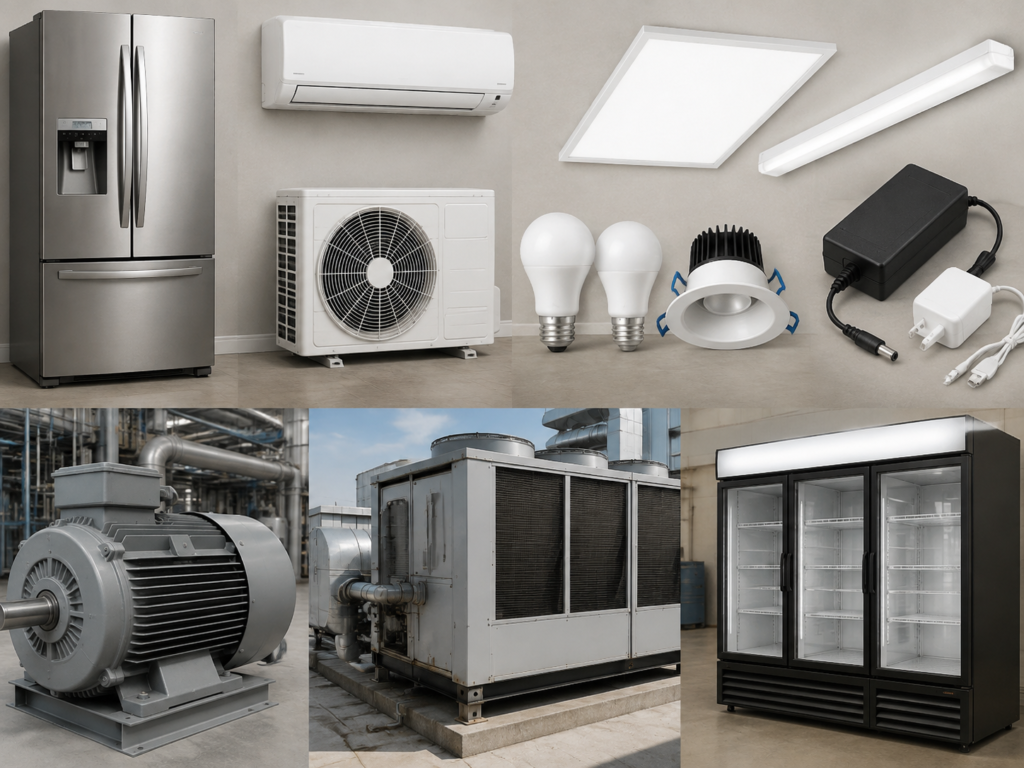
To judge whether a product is regulated, you cannot only look at its Chinese product name. You must correspond to the official DOE definition according to the product’s function and purpose — for example, for products also called “decorative lights”, if their main function is general lighting, they are regulated lighting products; if they are only for pure decorative purposes and do not undertake conventional lighting functions, you need to check the specific DOE rules to determine whether they are exempt, and you cannot make a determination solely based on the product name. You don’t need to memorize complex category numbers by rote; you can directly query by category in the regulated product list on the DOE official website.
Typical Exemption Situations
Only products that meet the exemption conditions clearly stipulated by regulations are not bound by DOE energy efficiency rules. Common exemption situations include:
- Products for personal use: This only applies to products that have not entered the commercial sales or distribution links, such as home appliances purchased by individuals from overseas for their own use. Products used for sale or business operations are not exempt even if the quantity is small.
- Military, special-purpose, and customized products: They need to meet the clear exemption conditions in the corresponding regulations and be officially recognized by the DOE. Self-declaring “customized” or “special purpose” does not qualify for exemption, and small batch size itself does not constitute a reason for exemption.
5 Common Cognitive Misconceptions for Beginners
When first getting in touch with DOE, many people are misled by wrong information. Let’s clarify them in advance:
- Only U.S. domestic manufacturers are responsible? Wrong. Importers and private labelers are all core responsible parties, and overseas manufacturers may also bear actual consequences through contract recourse, customs clearance restrictions, etc. Don’t think that finding a local U.S. importer can completely shift the responsibility.
- Small-batch/online sales will not be inspected? Wrong. Customs spot checks and online sample purchase spot checks may cover small-batch orders, and even if you only sell dozens of units, you may be selected for inspection.
- DOE only cares about energy efficiency values? Wrong. It also checks the status of certification submission, whether the tests comply with procedures, and whether the declaration materials are consistent with the actual products. It’s not that everything is fine as long as the values are sufficient.
- Having a third-party test report means compliance? Wrong. Compliance requirements are met only after tests are completed in a qualified laboratory in accordance with the DOE test procedures for the corresponding category, and certification data is submitted to the DOE as required. Reports issued by ordinary third-party laboratories on their own and not submitted to the DOE system as required cannot be used as a basis for compliance.
- Having UL/ETL safety certification meets DOE requirements? Wrong. The two are completely independent regulatory requirements. One covers safety and the other covers energy efficiency, and they cannot replace each other.
Pre-compliance Obligations: Failure to Complete These Will Trigger Penalties
To understand DOE’s compliance requirements, first of all, a core concept must be clarified: basic model. This is the smallest management unit for DOE certification and enforcement. You can understand it as: all products with completely consistent key energy efficiency characteristics are classified into the same basic model, which is equivalent to giving an “identity label” to each category of products with the same energy efficiency. The basis for dividing basic models is key parameters such as core components (such as compressors and motors), energy efficiency grades, control methods, and capacity — for example, for the same air conditioner model, 1-ton and 1.5-ton units use different compressors and have different energy efficiency, so they are two independent basic models and cannot be declared together.
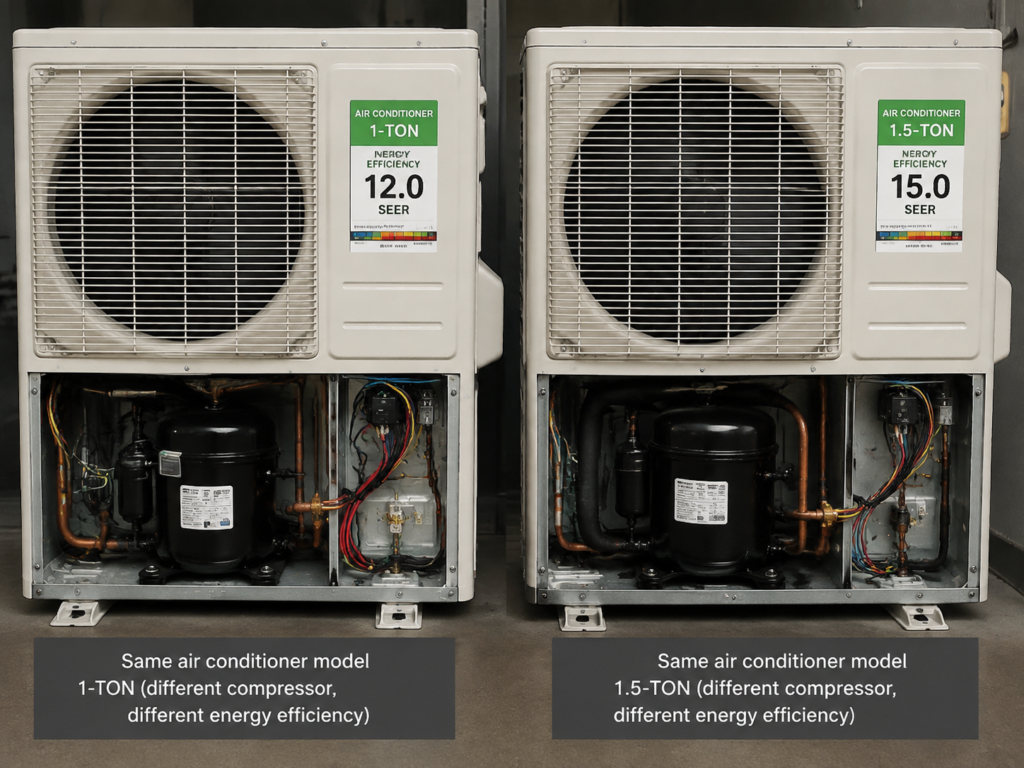
The most common risk is to classify products with different configurations into the same basic model in order to save test fees. As a result, when the DOE spot-checks untested configurations, it will directly determine that the declaration is false and handle it as a violation.
3 Core Actions That Must Be Completed Before Going on the Market
Missing any one may trigger a violation:
First, complete energy efficiency tests in a qualified laboratory in accordance with the official DOE test procedures for the corresponding product category. Different categories have different requirements for laboratory qualifications, which shall be subject to specific rules; self-tests or reports that do not comply with the rules cannot be used for certification declaration.
Second, submit certification data and related materials for each basic model as required through the DOE’s Certification and Compliance Management System (CCMS). CCMS is the official system used by the DOE to receive, manage, and disclose energy efficiency certification information. Submission does not mean that the DOE will issue approval certificates for each model one by one. The specific effective conditions and review requirements shall be subject to the regulations of the corresponding category.
Third, for imported products, applicable energy efficiency tests and certification submissions must be completed before entering U.S. commercial circulation, and the operation of “import first and then make up certification” is prohibited. U.S. Customs and Border Protection (CBP) may take measures such as detention, refusal of entry, return, or destruction of suspected non-compliant products during the import process based on declaration information, random inspections, or DOE cooperation requests. The specific measures depend on the product category, document status, and case circumstances. It is not that products without completed certification will definitely be detained, but once products with unclear compliance status enter the sales link after entry, they will directly trigger violation risks.
Product Changes and Ongoing Compliance Requirements
It’s not that everything is fine after the product goes on the market. If there are subsequent changes, they must also follow the rules: if it is a change in core parameters, such as replacing the compressor, changing the capacity, or changing the control method, the test must be re-conducted and the certification information in CCMS must be updated; if it is a change in non-core parameters, such as the color of the shell or the packaging style, the impact on energy efficiency must also be evaluated, and if it may affect the energy efficiency result, supplementary verification is required.
There are also ongoing compliance obligations during the sales process:
First, submit annual/periodic energy efficiency compliance reports as required by the DOE (requirements vary by category, subject to official requirements);
Second, all test reports, certification documents, and sales records must be kept for at least 5 years. The DOE may request them at any time, and loss or intentional destruction will be deemed a violation;
Third, the energy efficiency values on all public channels such as product packaging, labels, official websites, and e-commerce product detail pages must be completely consistent with the declared values submitted to the DOE, and false labeling to attract consumers is prohibited.
The legal basis for these requirements is the U.S. federal Energy Policy and Conservation Act (EPCA for short), which authorizes the DOE to formulate energy efficiency standards and carry out enforcement. Supporting it are specific energy efficiency standards, test procedures, and certification management requirements for each category. You don’t need to memorize complex standard numbers; you can just query by product category on the energy efficiency page of the DOE official website.
Enforcement Trigger Paths: How Violations Are Usually Discovered
Many people think that DOE enforcement is just “random spot checks”. In fact, there are many sources of clues that trigger enforcement. There are four common types, and whether to initiate enforcement and the pace of initiation depend on the specific circumstances of each case:
The first type is market spot check clues. The DOE may carry out market spot checks by directly purchasing samples from online platforms, offline stores, or distributor warehouses, or may obtain clues about suspected non-compliant products in the import link through cooperation with CBP. Spot checks usually prioritize categories and enterprises with high energy consumption, high sales volume, many complaints, or past violation records, but the specific scope and frequency of spot checks are not fixed.
The second type is abnormal certification data clues. The DOE will conduct regular or special screenings of the certification data in the CCMS system. If it finds missing data, obviously abnormal values, logical contradictions, or that the declared data is inconsistent with public publicity, product labels, and manuals, it may trigger a verification. In addition, those who fail to submit annual reports as required, fail to update certification after product parameter changes, or have chaotic basic model classification may also receive inquiry letters from the DOE.
The third type is third-party report clues. Consumer complaints, peer reports, media exposure, as well as violation clues discovered and transferred by testing institutions, retail platforms, and customs in their work, may all become the reasons for initiating enforcement.
The fourth type is clues transferred by other agencies. Energy efficiency violation clues discovered by state-level regulatory departments, the FTC, and other federal agencies during law enforcement may be transferred to the DOE for handling. Enterprises with past DOE violation records may be included in the key attention list, and the probability of being spot-checked in the future may increase accordingly.
Complete Enforcement Process: From Abnormality Discovery to Final Conclusion
Many people panic when they receive a DOE notice. In fact, the DOE’s enforcement procedures vary depending on the type of violation, case stage, and applicable regulations. There is no unified fixed process applicable to all cases, but it usually includes the following core links. The specific requirements shall be subject to the DOE’s official notice and corresponding regulations:
Preliminary Verification and Information Request
After the DOE discovers abnormal clues, it usually first sends an official letter to the relevant responsible party, requesting materials such as test reports, certification records, and sales data for preliminary verification of the situation.
The timeliness of the enterprise’s response and the completeness of the materials may affect the way subsequent enforcement is promoted; delayed replies, concealment of information, or inconsistent submitted materials may lead to further escalation of enforcement.
Sample Verification and Evidence Check
If it is necessary to verify the energy efficiency situation through testing, the DOE will send the samples to a qualified laboratory for testing in accordance with the official test procedures for the corresponding category. The test rules are consistent with the procedures applicable during market entry certification; test results submitted by the enterprise on its own that do not meet the requirements of DOE test procedures will usually not be accepted as a basis for rebuttal.
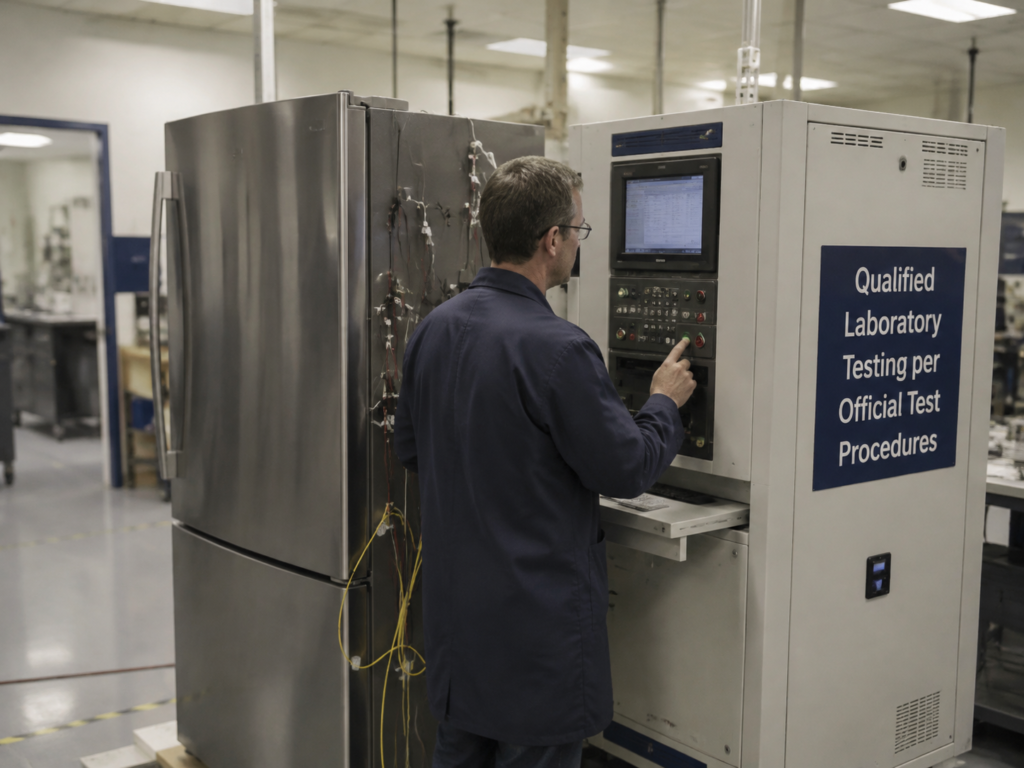
At the same time, the DOE may verify the authenticity of certification documents, production records, and sales records to confirm whether there is concealment, fraud, etc.
Non-compliance Notification and Right to Defend
If a violation is initially determined, the DOE will issue a written notice to the responsible party, clearly informing the specific content of the suspected violation, involved products, regulatory basis, and the right of defense enjoyed by the enterprise.
The notice will specify a clear response period (the period may vary for different cases, and shall be subject to the text of the notice). The enterprise may submit rebuttal evidence and explain the situation within the period, or may apply for a hearing in accordance with the requirements of applicable regulations.
Final Handling Results
The DOE will make a final handling decision based on the evidence submitted by both parties, the verification results, and applicable regulations. There are three common results:
- Termination of investigation: If the evidence submitted by the enterprise is sufficient to prove that the product is compliant, or the violation allegation is not established, the DOE may terminate the investigation and take no further enforcement measures.
- Settlement agreement: Most cases are resolved through settlement. The two parties reach an agreement through negotiation, and the enterprise promises to perform corresponding obligations (such as paying fines, completing rectification, and regularly submitting compliance reports). Settlement does not mean that the enterprise admits all the facts of the violation.
- Formal penalty decision: If the two parties fail to reach a settlement and the DOE determines that the violation facts are established, it will issue a formal penalty decision, clarifying the penalty content and performance requirements.
Core Penalty Rules: What Is Penalized and How It Is Calculated
What most people care about most is “how much will be fined for violations”. In fact, the consequences of DOE enforcement are more than just fines. The impacts involved are more complex than many people think, and it is necessary to distinguish between statutory enforcement measures, settlement obligations, measures of other agencies, and commercial collateral consequences.
6 Most Common Violation Situations
Almost all penalties are caused by these situations:
- The actual energy efficiency of the product does not meet the mandatory minimum standards of the DOE;
- Products are put on the market for sale without completing the DOE energy efficiency certification submission as required;
- Submitting false test reports, energy efficiency data, or certification materials;
- Failing to submit annual/periodic compliance reports as required, or failing to update certification after product changes;
- Incorrect basic model classification, and the declared information is inconsistent with the actual product;
- Failing to rectify within the time limit after receiving a rectification notice and continuing to sell non-compliant products.
Different Types of Enforcement and Compliance Consequences
For the convenience of distinction, we divide common consequences into four categories according to the issuing subject and applicable scenarios. Different types have different applicable conditions, and not all cases will involve all measures:
I. Enforcement Measures Directly Taken by the DOE in Accordance with Statutory Authority
- Civil fines: The most common type of penalty. The calculation method and statutory upper limit vary for different violations.
- Stop sales/distribution order: Requiring that products of the violating model shall not be manufactured, sold, or distributed in the United States.
- Order to rectify: Requiring the enterprise to complete compliance rectification within a specified period and submit a rectification report.
- Public enforcement information: The DOE will publish information on officially concluded violation cases on its official website, including the name of the enterprise, involved products, handling results, etc.
- Recall requirement: In some cases with serious violation circumstances and wide scope of involvement, the DOE may require the enterprise to recall the sold non-compliant products in accordance with relevant regulations, and the relevant costs shall be borne by the enterprise.
II. Compliance Obligations Attached to Settlement/Consent Decree
Most cases are closed through settlement. The settlement agreement or consent decree signed by both parties is not a formal administrative penalty decision (settlement does not mean that the enterprise admits all the facts of the violation), but the agreed obligations are legally binding. Common contents include:
- Agreed fine amount (usually lower than the statutory maximum)
- Proactive rectification or recall commitment
- Requirements for regularly submitting compliance reports and accepting subsequent supervision
- Restitution of illegal gains or public welfare compensation requirements agreed in some cases (whether applicable depends on the nature of the case and applicable laws, and not all cases will involve this)
III. Linkage Measures of Other Federal Agencies Such as CBP
These measures are not directly taken by the DOE, but may arise in linkage with DOE enforcement. Common ones include:
- Import link restrictions: U.S. Customs and Border Protection (CBP) may take measures such as detention, refusal of entry, return, or destruction of suspected non-compliant imported products in accordance with its own authority or at the cooperation request of the DOE, and may also increase the inspection ratio for enterprises with repeated violations.
- Simultaneous enforcement by other agencies: If the violation also involves other regulatory requirements such as FTC energy efficiency labels and state-level energy efficiency rules, relevant agencies may simultaneously initiate enforcement and impose corresponding penalties.
IV. Commercial and Supply Chain Collateral Consequences
These consequences are not official penalties, but often have a greater long-term impact than fines:
- Channel level: E-commerce platforms may remove non-compliant products according to platform rules, and retailers may suspend procurement or even terminate cooperation.
- Commercial disputes: May face indirect economic losses such as downstream customer claims, contract breaches, and inventory backlogs.
- Long-term compliance costs: Enterprises with violation records may face stricter reviews when submitting energy efficiency certifications in the future, the probability of customs clearance inspections may also increase, and brand reputation will be affected.
Calculation Logic of Civil Fines
For the civil fines that everyone is most concerned about, the calculation rules vary depending on the type of violation. Common penalty bases include:
- Accumulated based on the sales/import quantity of non-compliant products: applicable to violations involving specific products such as product energy efficiency not meeting standards and uncertified market entry.
- Calculated based on the number of days the violation continues: applicable to persistent violations such as failure to submit annual reports on time and failure to rectify within the time limit.
- Calculated based on the number of violations: applicable to behavioral violations such as false declarations and submission of false materials.
There is a statutory maximum limit for civil fines, which is regularly adjusted according to inflation. The specific amount shall be subject to the regulations applicable at the time of the illegal act and the latest adjustment rules announced by the DOE in the Federal Register. Values from previous years are only for historical reference.
It should be noted that the actual penalty amount is usually lower than the theoretical maximum. The DOE will exercise discretion based on the specific circumstances of the case, and does not impose the maximum penalty in all cases.
Advanced Practical Operation: Risk Judgment and Response
After understanding the basic rules, let’s talk about something more practical: how to judge the approximate severity of the penalty, how to respond when receiving a notice, and how to conduct self-inspection and prevent risks.
4 Types of Factors That May Affect Penalty Discretion
When determining the penalty amount or negotiating settlement conditions, the DOE usually comprehensively considers the following factors, but the specific results shall still be subject to applicable laws and case facts. There are no absolute rules for reduction or aggravation:
- Degree of subjective fault: If it is an unintentional violation (such as normal drift of production process, test error within a reasonable range), the penalty may be appropriately lighter in discretion; if it is intentional fraud or knowing violation (such as tampering with test data, selling a large number of products knowing they are non-compliant), a higher penalty range may apply.
- Scale and impact of the violation: The larger the number of involved products, the longer the sales time, the higher the product energy consumption, and the greater the impact on market order, the higher the total penalty amount usually is.
- Attitude towards cooperation and rectification: Those who proactively disclose problems, actively cooperate with investigations, quickly complete rectification, or proactively recall may obtain more favorable conditions in penalty discretion or settlement negotiations; those who refuse to cooperate, destroy evidence, or conceal sales data may face heavier penalties.
- History of violations: If the enterprise has previous DOE energy efficiency violation records and is a repeat offender, the penalty range may be increased accordingly.
Correct Response Steps When Receiving a DOE Non-compliance Notice
If you receive a relevant notice from the DOE, don’t panic too much, and never ignore it — failing to respond within the time limit may lead to the DOE directly making a penalty decision and missing the opportunity to defend. You can handle it in an orderly manner according to the following steps:
- Verify the notice information: First confirm the product model, test data, involved quantity and other information in the notice, and verify whether it is your own product, whether there is counterfeiting, information correspondence errors, etc.
- Control risk spread: Immediately suspend the shipment and sales of the involved models, lock relevant inventory and sales records, to avoid further expansion of the violation scale and increase in subsequent handling costs.
- Prepare defense materials: Within the response period specified in the notice, organize all relevant evidence (including certification documents, test reports, production records, sales data, etc.), and submit the defense materials on time, do not be overdue.
- Proactively communicate on rectification: If there is indeed a violation, you can proactively formulate a complete rectification plan (such as stopping sales, recalling, making up certification, optimizing internal processes, etc.), and communicate with the DOE to strive for more favorable handling conditions.
- Seek professional support: If the number of involved products is large and the circumstances are complex, you can entrust compliance service providers or lawyers familiar with DOE energy efficiency rules to assist in handling, to avoid greater losses due to unfamiliarity with procedures.
Four-Step Method for Compliance Risk Self-inspection
Enterprises can regularly conduct self-inspection of DOE energy efficiency compliance risks through the following four steps, to discover problems in advance and rectify them in time:
- Scope confirmation: Check against the official DOE regulated product list to confirm whether the products you sell are within the jurisdiction scope, do not judge solely based on product names or experience.
- Standard verification: Confirm the latest energy efficiency standards and test procedures applicable to the product, as well as the corresponding effective dates, do not use expired old test reports or old standards.
- Consistency check: Verify whether the test reports, certification data submitted to the DOE, parameters of actually sold products, and energy efficiency values on all public publicity channels (detail pages, packaging, labels, manuals, etc.) are completely consistent, and whether there is false labeling, errors or omissions.
- Risk assessment: If suspected non-compliance is found, assess the quantity of involved products, sales duration, energy efficiency gap, etc., determine the risk level, and prioritize handling high-risk issues.
4 Basic Actions to Reduce Risks in Daily Operations
Integrating compliance actions into daily operations can greatly reduce the risk of enforcement:
- Pre-market check: Complete product classification confirmation, compliance testing, and DOE certification submission first, then arrange sales or import. Do not “sell first and make up later” in order to rush for progress.
- In-sales control: All external energy efficiency publicity content shall be based on the certification data submitted to the DOE, and it is not allowed to falsely label energy efficiency values in order to increase sales.
- Regular maintenance and update: Submit annual/periodic compliance reports on time. When products are redesigned, core components are replaced, or parameters are adjusted, timely evaluate the impact on energy efficiency, and re-test and update certification information as required.
- Standardized record management: All test reports, certification documents, sales records, and change records shall be kept for at least 5 years as required, and properly stored for easy response to inspections.
Concept Clarification: Differences Between DOE and Other U.S. Energy Efficiency Regulations
Many people confuse DOE with other U.S. energy efficiency-related regulations. Let’s quickly sort them out with a table:
| Regulation Type | Nature | Core Jurisdictional Content | Violation Consequences |
|---|---|---|---|
| DOE Energy Efficiency Regulation | Federal mandatory requirement | Whether the energy efficiency of regulated products meets standards, whether tests comply with official procedures, and whether certification declarations are true | Civil fines, stop of sales/distribution, rectification requirements, public enforcement information, and some cases may involve recall |
| FTC Energy Efficiency Labeling Regulation | Federal mandatory requirement | Authenticity of information on the EnergyGuide yellow energy efficiency label, and whether energy efficiency publicity misleads consumers | Fines, label rectification requirements, etc. |
| ENERGY STAR | Voluntary high-energy-efficiency label led by the EPA | Whether the product meets high energy efficiency requirements higher than the DOE minimum standard | Unauthorized use of the label or false publicity may trigger FTC or other regulatory penalties; not using the label itself does not constitute a DOE violation |
| State-level Energy Efficiency Regulation (e.g., California CEC) | State-level mandatory requirement (only applicable to the corresponding state) | Energy efficiency, labeling, or registration requirements for regulated products sold within the state, which shall not violate federal preemption rules | State-level fines, sales bans, refusal of registration, etc. |
Note: According to U.S. federal law, for products already covered by DOE federal energy efficiency standards, state-level formulation of stricter similar standards usually requires federal authorization or compliance with specific exemption conditions; for product categories not covered by federal standards, states may formulate their own rules.
To judge whether a product needs to meet the energy efficiency requirements of a certain state, you can verify in the following order:
- First confirm whether the product is already covered by DOE federal standards;
- Then check whether the energy efficiency rules of the corresponding state apply to the product and whether there is federal preemption;
- Finally, confirm the specific content of state-level requirements (such as registration, labeling, test requirements, etc.).
When selling to states with relatively complete energy efficiency rules such as California, you need to separately check the official regulatory list of that state, and do not assume that the requirements of all states are consistent with federal requirements.
In general, the core logic of DOE energy efficiency enforcement is to ensure the implementation of mandatory energy efficiency standards through post-market supervision and maintain fair market competition. For enterprises, as long as they clarify the jurisdiction scope in advance, do a good job in full-process compliance management, and respond to problems in a timely manner, they can effectively avoid unnecessary risks.