
If you deal in electronic products for the U.S. market, whether selling mobile phone chargers, laptop power adapters, or importing equipment with external power supplies, you will encounter DOE energy efficiency requirements. This article starts with scope of application judgment, core assessment indicators, test validity rules, report interpretation, common pitfalls to avoid, and compliance processes, covering entry-level practical operations and basic risk assessment, to help you sort out the DOE energy efficiency testing requirements for external power adapters.
Basic Understanding: Why DOE Regulates External Power Supplies
Many people who encounter DOE for the first time think it is an unfamiliar requirement from a U.S. government agency, but the core logic is very simple: energy conservation.
What is DOE Energy Efficiency Regulation
DOE is the abbreviation for the U.S. Department of Energy. The external power supply energy efficiency requirements it issues are mandatory — as long as a product falls within the regulatory scope, it must meet the standards to enter the U.S. market. The core purpose is to reduce power waste of power adapters during standby and operation. After all, the total number of various chargers and power supplies that are plugged in all year round in U.S. households is extremely large, and the cumulative wasted electricity and carbon emissions are considerable.
The regulatory source of this set of requirements is Part 430 of Title 10 of the Code of Federal Regulations of the United States (10 CFR), which clarifies three core contents: first, the definition of external power supplies (Section 430.2); second, the specific energy efficiency limits (Section 430.32(w)); third, the unified test procedure (Appendix Z).
The compliance requirements are also very clear: products must pass required tests, and then be filed in the DOE’s Compliance Certification Management System (CCMS). Non-compliant products are not allowed to be imported or sold in the United States.
What Products Count as External Power Adapters
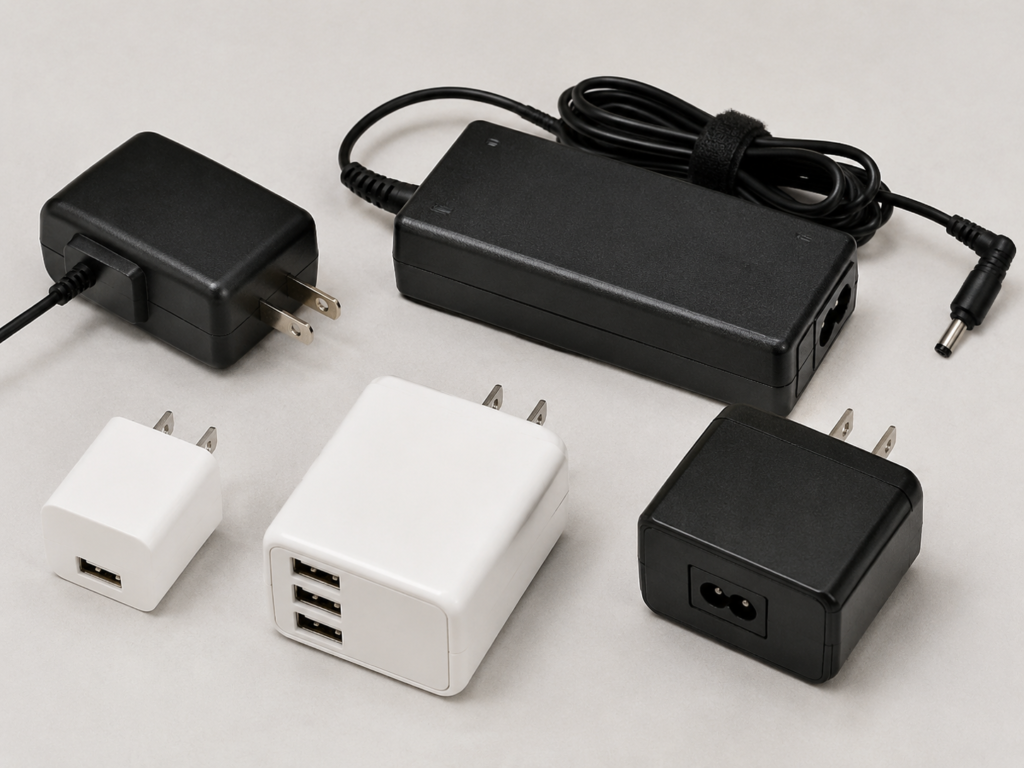
Let’s start with a plain-language definition: an independent power component that can be plugged directly into a wall socket and supplies power or charges other devices through a cable is an external power adapter, also known as EPS in the industry (short for External Power Supply).
It has two core characteristics: first, it is physically separated from the powered device and can be detached separately; second, it can be directly connected to the mains power supply. Common mobile phone chargers, laptop power adapters, and power bricks for routers, monitors, and set-top boxes all fall into this category.
By output type, they can be divided into AC-DC (alternating current to direct current, the most common type, including mobile phone chargers and laptop power adapters) and AC-AC (alternating current to alternating current, such as external power supplies for some audio equipment and old-fashioned lamps); by number of output channels, they can be divided into single-output (such as ordinary single-port chargers) and multi-output (such as multi-port USB chargers).
3 Common Cognitive Misconceptions for Beginners
People who are new to DOE are prone to misunderstandings. Let’s clarify them in advance to avoid detours:
The first misconception is “only mobile phone chargers need to be tested”. In fact, as long as they meet the definition of external power supplies, whether they are used for routers, monitors, or audio equipment, they need to meet DOE requirements.
The second misconception is “one test is valid for life”. If DOE updates the standard, or if your product is modified (such as replacing core components or adjusting power), re-evaluation and testing are required.
The third misconception is “only the brand owner is responsible”. In fact, importers, U.S. domestic sellers, and even online sales platforms all need to bear compliance responsibilities. For example, Amazon will directly remove non-compliant power products from its shelves.
Quick Applicability Judgment: Does Your Adapter Need DOE Testing
The first question many people care about most is: does my power supply need DOE testing? You can first use 3 basic conditions to make a quick judgment, and get a preliminary conclusion in 10 seconds.
10-Second Quick Judgment: 3 Basic Applicable Conditions
As long as all three conditions are met, it basically falls within the regulatory scope of DOE:
First, it is an independent power component that can be detached separately from the powered device, not built into the device;
Second, its input end can be directly connected to the U.S. 120V/60Hz AC mains. The “direct connection” here does not require the product to only support U.S. mains. Wide-voltage input adapters with a nameplate marking of “100-240V~ 50/60Hz” should also be included in the EPS applicability judgment scope as long as they can be directly connected to U.S. 120V/60Hz mains and are sold for the U.S. market;
Third, its output is used to supply power or charge other independent devices.
Common Regulated Product Types
Among products that meet the above three conditions, the most common types are:
First, low-voltage DC output AC-DC adapters, such as the commonly used 5V, 9V, 12V, 19V, 24V chargers and power supplies, accounting for the vast majority;
Second, AC output AC-AC adapters, such as external AC power supplies for some audio equipment and lamps;
Third, single-output or multi-output external power supplies, such as multi-port USB chargers. No matter how many ports they have, as long as they are independent external power supplies, they count.
Boundary Products: These Cases Do Not Need to Be Tested as EPS, or Require Separate Judgment
There are also many products on the boundary, either not within the scope of external power supply regulation, or need to be judged according to other rules:
- Built-in power supplies: For example, power boards in TVs and desktop computers, which are inseparable from the device, are not under EPS regulation, and follow the energy efficiency requirements of the corresponding device.
- Special-purpose power supplies for vehicles, aviation, and marine use: The input of such power supplies is usually not ordinary civilian mains, but they are not naturally exempt just because they belong to this type of use. Only products that are clearly excluded by regulations or fully meet the specific requirements of DOE exception clauses may be exempted. It is necessary to check item by item against the input method, actual use, and the text of exception clauses, and cannot directly judge that compliance is unnecessary based solely on the industry name.
- PoE powered devices, USB input power supplies: For example, PoE-powered cameras, or power banks with USB input, their input is not AC mains, so they are not within the scope of EPS regulation and require separate judgment.
- Pure battery chargers: If the product is only used to directly charge batteries and has no function of supplying power to external devices, it shall be regulated under DOE’s battery charger regulations, not according to external power supply rules.
- Medical devices and custom industrial special-purpose power supplies: They are not naturally exempt. Only products that fully meet the applicable conditions clearly listed in the DOE exception list can apply for exemption according to the rules. Compliance cannot be judged unnecessary solely based on the industry or use of the product. It is necessary to check the specific limitations on product type, use scenario, and performance requirements in the exception clauses.
- Multi-function products (such as power supply equipment with data transmission or Hub functions): Cannot be subjectively judged solely by “main function”. It is necessary to strictly compare the DOE’s definition of EPS and exception clauses, check item by item against the product’s physical structure, input method, and rated parameters. If necessary, confirm with DOE or a professional institution to avoid misjudgment.
Advanced Judgment: 4 Core Information Items to Check
If your product is relatively special, or you need 100% confirmation of compliance, you also need to check 4 core information items:
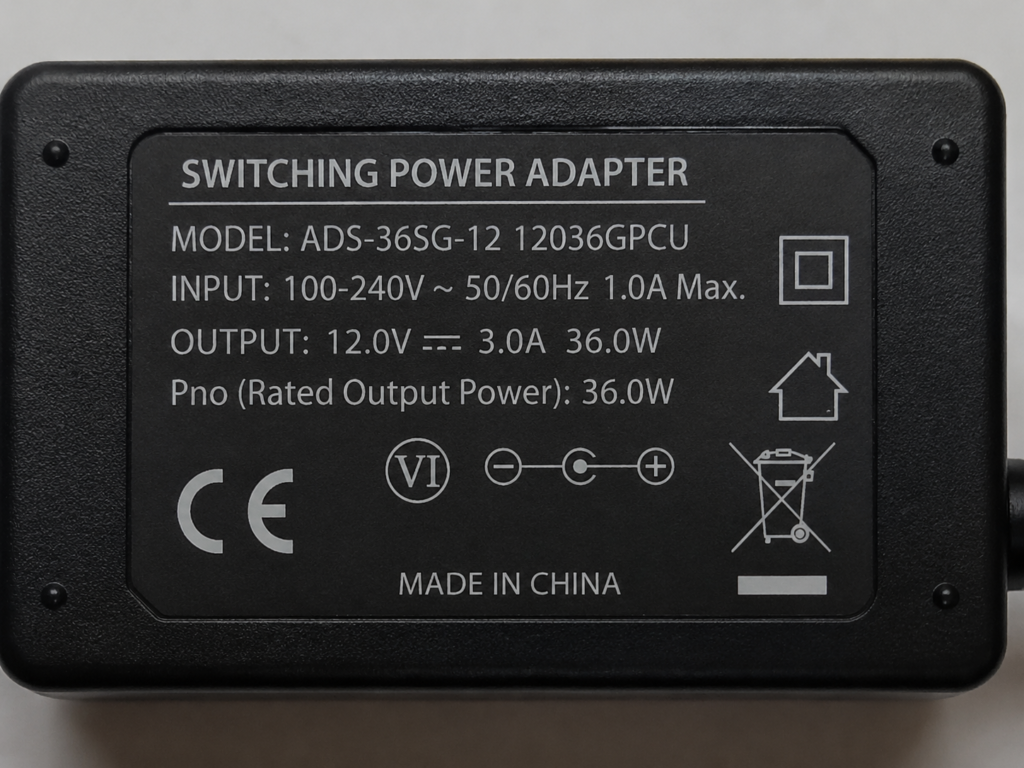
First, the product’s nameplate parameters, that is, the input and output voltage, rated current, and nameplate output power (commonly called Pno in the industry, short for rated output power) marked on the label;
Second, the product type, including whether the output type is AC-DC or AC-AC, how many output channels there are, and whether it is a multi-function product;
Third, the sales region. For example, products sold in California must also meet the local energy efficiency requirements of the California Energy Commission (CEC), and some indicators are stricter than the federal DOE;
Fourth, the use scenario, whether it is dedicated to a special industry or special scenario, and whether it may meet the exemption conditions.
Core Assessment Indicators: No-Load Power Consumption and Average Active Mode Efficiency
The core of DOE’s assessment of external power supplies has only two indicators: no-load power consumption and average active mode efficiency. It sounds professional, but it is easy to understand in plain language.
No-Load Power Consumption: The “Stolen Power” When Plugged In But Unused
No-load power consumption is the amount of power that an adapter secretly consumes when it is plugged into the wall but has no device connected to the other end and is completely unused.
Why is this indicator assessed? Because there may be a dozen or more adapters plugged into sockets all year round in U.S. households, each stealing only a few tenths of a watt of electricity each time, the cumulative wasted electricity across the country over a year is very alarming. The unit of this indicator is watt (W). The lower the value, the less standby waste.
Average Active Mode Efficiency: Power Utilization Rate When Working
Average active mode efficiency is the proportion of electricity taken from the grid that is actually delivered to the device when the adapter is working normally and supplying power to the device. The remaining electricity is wasted as heat. For example, if the efficiency is 85%, it means that for every 100 watts of grid power, 85 watts go to the device, and 15 watts are dissipated as heat.
You may ask, why use “average” efficiency? This is to prevent manufacturers from “focusing only on one aspect” — some manufacturers only maximize full-load efficiency to make their specifications look good, but in actual use, many times it is light load (such as the low-current state after a mobile phone is charged to 80%), and the efficiency at light load is particularly low, which instead wastes more power. Therefore, DOE requires testing the efficiency at four load levels: 25%, 50%, 75%, and 100%, and adopting corresponding calculation rules according to product type, which is closer to real usage scenarios. Among them, for the most common single-voltage single-output conventional EPS, the arithmetic average of the efficiency of the four gears is directly taken; for multi-voltage, multi-output, and special types of EPS, it is necessary to follow the load combination, output status, and calculation method specified in Appendix Z, and cannot simply average directly.
How to Match the Corresponding Energy Efficiency Limits
DOE’s energy efficiency limits are not uniform. They need to be matched according to the product’s type, voltage, and power. The current mainstream mandatory level is Level VI (commonly known as sixth-level energy efficiency). You can match it in four steps:
Step 1: Determine the main category. First confirm whether the output type is AC-DC or AC-AC, and whether the number of output channels is single-output or multi-output;
Step 2: Determine the voltage level. According to the output voltage, it is divided into low voltage (output voltage ≤6V) and basic voltage (output voltage >6V). It also depends on whether it is single-voltage or multi-voltage (for example, a PD charger with multiple output voltages counts as multi-voltage);
Step 3: Calculate the nameplate output power Pno. For single-output products, it is very simple, that is, rated voltage multiplied by rated current; for multi-output products, the power of each channel shall be accumulated according to the rules of Appendix Z;
Step 4: Look up the no-load power consumption and average active mode efficiency limits for Level VI.
To help you build an intuitive understanding, we have sorted out the reference no-load power consumption limits for single-output AC-DC basic voltage products (for introductory understanding only, actual compliance shall be subject to the corresponding provisions of the currently valid version of 10 CFR Appendix Z):
| Product Type (for reference only) | Nameplate Output Power (Pno) Range | Reference No-Load Power Consumption Limit |
|---|---|---|
| Single-output AC-DC basic voltage product | ≤49W | ≤0.1W |
| Single-output AC-DC basic voltage product | 49W~250W | ≤0.21W |
The above is only an introductory reference framework for single-output AC-DC basic voltage (output >6V) products. Other types of products such as low-voltage (output ≤6V), multi-voltage, multi-output, and AC-AC products shall not be directly applied. They shall be subject to the corresponding tables or formulas in the currently valid version of 10 CFR 430.32(w) and Appendix Z.
The limits for average active mode efficiency also correspond to different rules according to product classification, and are not a unified fixed percentage. From the general classification path: AC-DC and AC-AC external power supplies correspond to independent limit systems respectively; under the same output type, the calculation rules for single-output and multi-output products are also different — single-output products directly match the corresponding limits according to their own Pno, while multi-output products need to first calculate the total nameplate output power according to Appendix Z rules, and then apply the limit formulas or tables for multi-output categories. On this basis, the low-voltage/basic voltage gear is distinguished according to whether the output voltage is ≤6V, and the single-voltage/multi-voltage rules are distinguished according to whether there are multiple rated output voltages. Multi-voltage products usually need to be judged according to the strictest voltage gear requirements or special multi-voltage calculation rules.
We take the most common “12V 2A single-port router power supply” as an example to demonstrate the complete matching process of average active mode efficiency:
Step 1: Determine the main category: the output type is AC-DC, and the number of output channels is single-output, corresponding to the single-output AC-DC limit system;
Step 2: Determine the voltage level: the output voltage is 12V >6V, which belongs to the basic voltage gear, and there is only one rated output voltage of 12V, so it is a single-voltage product;
Step 3: Calculate the nameplate output power Pno: single-output Pno = rated voltage × rated current = 12V × 2A = 24W;
Step 4: Check the active mode efficiency limit: according to the efficiency rules for single-output AC-DC basic voltage products in 10 CFR 430.32(w), the limit for this power segment is usually calculated using a formula containing ln(Pno) (for example, in the common Level VI rules, the lower limit of average efficiency for basic voltage single-output AC-DC is 0.0626×ln(Pno) + 0.725, for introductory illustration only, actual shall be subject to current valid regulations). Substituting Pno=24W into the calculation, the corresponding limit is about 87%, and the measured average efficiency must be higher than this value to be considered compliant.
It should be reminded again that the above example is only for single-output AC-DC basic voltage single-voltage products. The limit formulas or tables for other types of products such as low-voltage, multi-voltage, multi-output, and AC-AC are different, and the calculation method of this example must not be directly applied. Overall, the limit for average active mode efficiency gradually increases with the increase of nameplate power, and the limit for low-voltage products is slightly lower than that for basic voltage products.
Relationship Between the Two Indicators and Easy-to-Confuse Points
It should be noted that no-load power consumption and average active mode efficiency are two independent assessment items. Both must meet the standards to be considered compliant. If one passes and the other fails, it is still non-compliant.
There are also two points that are easy to confuse:
First, no-load power consumption ≠ the whole machine standby power consumption of the powered device. For example, when a set-top box is on standby, the power consumption is the standby power consumption of the set-top box itself plus the adapter. What DOE assesses is only the power consumption of the adapter itself when it is no-load, which has nothing to do with the device.
Second, average efficiency ≠ peak efficiency. Peak efficiency is the highest efficiency that an adapter can achieve at a certain load point, while DOE requires the average efficiency of four common load points. High peak efficiency does not mean that the average will meet the standard.
Prerequisites for Valid Testing: What Kind of Test Results Count
Not just any test done by a random laboratory is a DOE test. Only test results that meet the requirements are valid. Otherwise, the test is a waste of time, and may even lead to penalties due to non-compliance.
Samples Must Meet Requirements
First of all, the test samples must be finished products in mass production status, not prototypes handmade in the laboratory — the performance of prototypes may be quite different from mass-produced versions, and they do not have market representativeness.
Secondly, representative mass-produced samples should be selected. Certification or type evaluation cannot rely solely on a single accidental sample. Usually at least 3 finished products are sampled. The number of samples and sampling method must comply with the certification sampling rules of 10 CFR Part 429 or the laboratory’s compliant sampling plan, to avoid individual deviation of a single sample affecting the results.
In addition, pre-aging treatment is usually carried out before testing, and testing is carried out after the performance of components is stable, to reduce the interference of initial performance fluctuations of new samples. This is a commonly used quality control measure in laboratories, not a mandatory step required by regulations.
Finally, the test shall use the original output cables and connectors consistent with the mass production status. The output cable loss is part of the overall performance of the product and must be included in the final test result. If the output cable needs to be replaced due to special circumstances, it must be proved that the length, wire diameter, material, connector specification, and overall line loss of the new cable are completely equivalent to the original cable. Otherwise, it is not allowed to arbitrarily replace with a better-specification low-loss cable to optimize test results.
Test Hardware and Environment Must Be Compliant
The input conditions of the test must meet the requirements. The benchmark of U.S. mains is 120V/60Hz, which shall be set according to the rated input range of the product, and the voltage cannot be adjusted arbitrarily.
Environmental conditions must also meet the requirements of Appendix Z. For example, temperature and ventilation must be in accordance with regulations. No additional fans can be added for heat dissipation, nor can anything be blocked to affect heat dissipation.
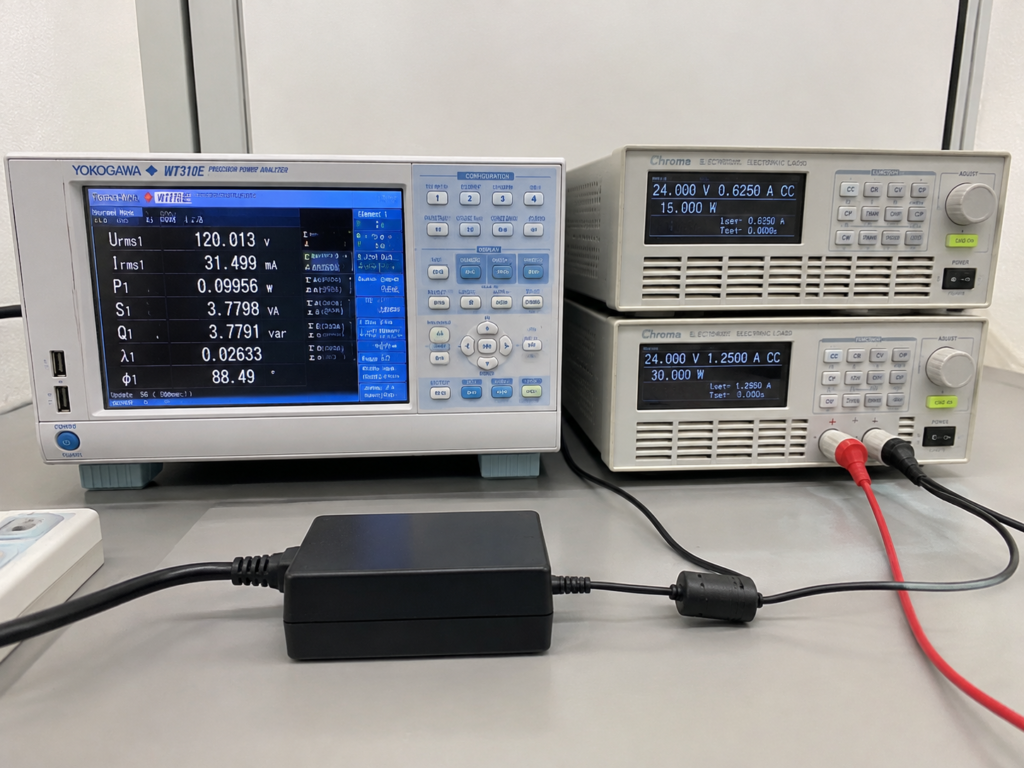
Test instruments must meet the requirements of Appendix Z for accuracy, resolution, calibration, and measurement uncertainty: no-load power consumption is in the milliwatt level, so it is necessary to focus on checking the low-power range resolution, accuracy, and measurement uncertainty of the power analyzer near common limits such as 0.1W and 0.21W, to avoid measurement deviation due to inappropriate range; for equipment commonly used in efficiency testing such as power analyzers and electronic loads, the common configuration in the industry is accuracy of class 0.5 and above, but ultimately it shall be subject to the traceable calibration and measurement uncertainty required by regulations. Test results that do not meet the requirements are invalid.
Another very important point: when measuring the output, it must be measured at the end connector of the original output cable, not directly at the output end of the circuit board — because the loss of the output cable is part of the product itself and must be included.
Test Operations Must Follow the Rules
During testing, the load points are set according to the percentage of nameplate output power, not the actually measured power. For example, if the product is rated at 10W, then 25% load is 2.5W. Even if the actual maximum output is only 9W, it must be set according to the rated value.
When sampling, the fluctuation period at startup should be avoided. Sampling should be carried out after the value stabilizes within the allowable range and lasts for the specified time, otherwise the result will be inaccurate.
The entire test process must strictly follow the requirements of the currently valid version of Appendix Z, and test steps cannot be modified without authorization.
Advanced: 4 Key Factors That Affect Test Results
If you want to judge whether a test report is reliable, or if you can’t find the reason for a product’s failed test, you can check from these four aspects:
First, environment and heat dissipation: if the test environment temperature is too high, the efficiency of components will decrease, which may lead to the average efficiency failing to meet the standard;
Second, accessories and wiring: if the output cable is too long or too thin, the line loss will increase, directly reducing the overall efficiency;
Third, sample status: if the product falsely marks the rated power, for example, the actual output is only 10W but marked as 20W, then the load point setting is wrong, and the compliance judgment is completely invalid;
Fourth, instrument accuracy: the no-load power consumption itself is only a few tenths of a watt or even lower. If the instrument accuracy is insufficient, it cannot be measured accurately at all, and the result is naturally invalid.
Core Process of DOE Energy Efficiency Testing: Understand the Logic, No Need to Memorize Details
Many people think the test process is very complicated. In fact, you don’t need to memorize every step of the details. As long as you understand the core logic and know the general situation, you can judge whether the report given by the supplier is reasonable.
Step 1: Sample Classification and Matching
Before testing, the first thing to do is to check the sample’s model, nameplate parameters, and product classification, and first match the corresponding energy efficiency limit table. More importantly, it is necessary to first confirm whether the product is within the exemption scope, otherwise you will spend money on testing for a long time, but it turns out that testing is not needed at all, which is a complete waste.
Step 2: No-Load Power Consumption Test
The logic of the no-load test is very simple: connect the adapter to a test power supply that meets the requirements, with nothing connected to the output end, completely no-load. After the value stabilizes, samples are taken at multiple time points, and finally the average value is taken, which is the result of no-load power consumption.
Step 3: Average Active Mode Efficiency Test
The active mode test needs to measure the efficiency of four load levels: 25%, 50%, 75%, and 100% respectively.
For ordinary single-voltage single-output external power supplies, simply take the arithmetic average of the efficiency of the four load points.
If it is a multi-voltage, multi-output, or special type of external power supply, the total average efficiency shall be calculated according to the load combination and output conditions specified in Appendix Z. For example, for a multi-port USB charger, the loads of all output ports must be combined to calculate the total efficiency uniformly, and it is not enough to test only one of the ports.
Step 4: Compliance Judgment and Full-Process Closed Loop
The judgment rule after testing is very clear: both no-load power consumption and average active mode efficiency meet the corresponding limits to be considered qualified. If either item fails to meet the standard, it is unqualified.
A valid test report must contain the following core information: the version of Appendix Z on which the test is based, the model/classification/nameplate power of the sample, test conditions, measured values of the two indicators, comparison with corresponding limits, and the calibration certificate number of the instrument.
Passing the test is not the end. The manufacturer or importer needs to submit compliance information in the DOE’s CCMS system, and the product can be officially launched after the filing is completed. Relevant test reports and design documents must be retained for at least 5 years for DOE’s random inspection at any time. In addition, the parameters and energy efficiency statements marked on the product nameplate must be consistent with the test report, and cannot be marked arbitrarily.
When Re-testing Is Required
One test is not once and for all. When the following situations occur, re-testing or even re-filing is required:
First, after the product is rectified for non-compliance, if core components are replaced or the circuit design is adjusted, re-testing must be carried out;
Second, if the test data is abnormal, fluctuates greatly, or the result is much different from expected, re-test after troubleshooting the problem;
Third, if the product is modified, involving core component replacement, power adjustment, output type change, or internal solution replacement, re-testing and filing are required.
Result Interpretation and Pitfall Avoidance: Understanding Reports and Common Reasons for Non-Compliance
Many people don’t know how to read a DOE test report when they get it. In fact, as long as you grasp the core, you can judge compliance in three steps and avoid common pitfalls.
3 Steps to Understand a DOE Test Report
Step 1: First check the version of Appendix Z on which the test is based, and confirm that it is the currently valid version — if an expired old version is used, the report is invalid.
Step 2: Check the product’s model, classification, and nameplate output power to confirm that they are completely consistent with the product you want to evaluate — don’t use a report of another model or another power to make up the number, it’s useless.
Step 3: Find the measured values of no-load power consumption and average active mode efficiency, and compare them with the corresponding limits to see if both meet the standards.
The 4 Most Common Reasons for Non-Compliance
We have sorted out the most common reasons for non-compliance in actual testing, which you can check in advance to avoid:
First, excessive no-load power consumption: mostly due to material saving in the standby circuit design, or the power consumption of the product’s indicator light and fast charging standby circuit is too high. For example, some chargers with colored indicator lights consume a lot of power when no-load.
Second, active mode efficiency fails to meet the standard: either low-specification components are used (such as cheap transformers and capacitors), or the light-load efficiency optimization is insufficient, resulting in insufficient average efficiency of the four load points.
Third, invalid test conditions: for example, non-original low-loss cables are used during testing, or the instrument accuracy is insufficient, or the environmental conditions do not meet the requirements. The results measured in this way are not valid at all.
Fourth, wrong product classification: for example, multi-output products are calculated as single-output, low-voltage products are calculated as basic voltage, and the wrong limit table is used. It seems to meet the standard, but it is actually wrong at all.
Preliminary Screening Method Without a Report and Understanding of Level VI Labels
If you don’t have a formal DOE test report for the time being and want to do a preliminary risk screening first, you can refer to the following methods, but it must be clearly stated in advance: all these methods can only be used as a rough risk warning, and absolutely cannot be used as a basis for compliance judgment. The final compliance must be subject to the formal test results that meet the requirements and CCMS filing information.
First, check the product identification: many compliant products will mark Level VI related marks, but such marks are printed by the manufacturer themselves, and there is a possibility of false marking, which can only be used as a preliminary screening clue. Level VI is the common name in the industry for the current mainstream mandatory energy efficiency level of DOE. Even if the product is printed with the corresponding mark, it cannot replace the formal test report, model matching, and CCMS filing — that is to say, products with the Level VI mark still need to provide formal test reports and filing certificates to confirm compliance. In addition, even for products with exactly the same appearance, as long as the power and output type are different, the applicable Level VI limits may be different. You cannot judge compliance just by looking at the appearance and marking.
Second, touch the shell temperature: after letting the adapter work continuously at the rated full load for a period of time, if the shell temperature is obviously too high, there may be a risk of low efficiency and large loss, and further verification with the formal test report is required.
Third, check parameters and weight: for products with the same rated power, if the weight is obviously lighter, pay attention to the possibility of simplified materials. Suppliers should be required to provide formal test reports for verification, and do not draw conclusions based solely on appearance or weight.
Practical Classification Examples: How 4 Common Products Correspond
To help you better understand classification, let’s take 4 of the most common products as examples:
- 5V 2A single-port USB charger: belongs to AC-DC single-output, low-voltage (output 5V ≤6V), nameplate power Pno=5V×2A=10W, corresponding to the low-voltage single-output limit table.
- 12V 2A router power supply: belongs to AC-DC single-output, basic voltage (output 12V >6V), nameplate power Pno=12V×2A=24W, corresponding to the basic voltage single-output limit table.
- 65W USB-C PD charger: belongs to AC-DC single-output, multi-voltage (with multiple output voltages such as 5V/9V/12V/15V/20V), nameplate power Pno=65W, and the limit is calculated according to multi-voltage rules.
- 4-port USB charger (total power 40W): belongs to AC-DC multi-output, low-voltage (all outputs are 5V), nameplate power Pno=40W, and the limit is calculated according to multi-output rules.
The most common mistake here is to calculate multi-voltage products as single-voltage, and multi-output products as single-output, resulting in the wrong limit table being used and completely wrong judgment.
Compliance Boundaries and Easy-to-Confuse Concepts: Differences Between DOE and Other U.S. Certifications
Many people confuse DOE with other U.S. certifications, but they regulate completely different dimensions. Let’s clarify them all at once.
Actual Consequences of Non-Compliance
Non-compliance may bring a series of actual risks. The specific consequences depend on the customs enforcement scale, platform rules, and DOE random inspection results. Common risks include:
First, the goods may be detained by U.S. Customs and cannot enter the country smoothly;
Second, if it is confirmed to be non-compliant by DOE random inspection, it may face fines, and in serious cases, the products on sale need to be recalled;
Third, U.S. e-commerce platforms such as Amazon may remove non-compliant products from their shelves according to their compliance rules, and in serious cases, it may affect the normal use of the account.
3 Types of Certifications Easily Confused with DOE
Many people confuse FCC, UL, Energy Star, CEC with DOE, but they are completely different:
- FCC and UL: FCC is a mandatory electromagnetic compatibility/radio frequency requirement in the United States, which regulates whether products will interfere with other devices; UL is a safety standard (voluntary, but highly recognized in the market), which regulates whether products will cause electric shock or fire. These two are completely different dimensions from DOE’s energy efficiency regulation. They each manage their own areas and all need to be met.
- Energy Star: This is a voluntary energy efficiency program jointly launched by the U.S. Environmental Protection Agency and the Department of Energy, and cannot replace DOE’s mandatory compliance obligations. For the external power supply product categories it covers and when the corresponding specification version is currently valid, the energy efficiency threshold is usually higher than the minimum mandatory requirement of DOE; but not all types of external power supplies have corresponding valid Energy Star specifications, which need to be checked separately according to product category, and cannot be directly assumed that its requirements must be stricter. Products that have passed the Energy Star certification can use the corresponding mark, which helps to improve market competitiveness, but it is not a mandatory requirement.
- California CEC: This is California’s local mandatory energy efficiency requirement, and some indicators are stricter than the federal DOE. If your product is to be sold in California, it needs to meet both the federal DOE and California CEC requirements.
Compliance Rules for Standard Updates
DOE’s energy efficiency standards and test procedures are updated regularly. The compliance application rules shall be judged in combination with the effective date of the new standard and the manufacturing, import, and distribution nodes clearly defined by DOE: usually products manufactured or imported after the new effective date must meet the new requirements; whether products that have entered the market in compliance with the old rules can continue to be sold shall be checked against the specific transition clauses of the corresponding standard, and cannot be generalized.
Practical Tools and Frequently Asked Questions
Finally, we have sorted out practical checklists and the most frequently asked questions for your direct use.
Applicability Checklist (Judge Whether DOE Testing Is Required)
You can check these items one by one. If all are met, you need to do DOE energy efficiency testing:
- □ It is an independent external power supply that can be physically separated from the powered device
- □ Can be connected to U.S. 120V/60Hz mains, and the output is used to supply power/charge other devices
- □ Product classification (AC-DC/AC-AC, single/multi-output) and nameplate power are within the regulatory scope
- □ It is not an exempt product in the DOE exception list
- □ There are no additional local energy efficiency requirements in the sales region (for example, products sold in California need to check CEC requirements separately)
Full-Process Practical Inspection Checklist
Whether it is procurement, import, or product modification, you can check against this list to avoid pitfalls:
Before Procurement
- □ The supplier can provide DOE test reports and CCMS filing certificates under the currently valid test basis (need to check: the test basis version is not expired, the report model/parameters/output cable/circuit solution are consistent with the actual product, and the product has not been modified that triggers re-testing)
- □ The model, classification, and nameplate power on the report are completely consistent with the purchased product
- □ The test conditions of the report meet the current Appendix Z requirements, and both indicators meet the standards
- □ If the product has a Level VI mark, it must be consistent with the compliance conclusion of the report, and compliance cannot be judged solely by the label
Before Import
- □ The product declaration model is consistent with the CCMS filing information
- □ The parameters marked on the product are consistent with the report, and there is no false energy efficiency statement
- □ Products sold in California have met CEC requirements
After Modification
- □ Check the modification content to judge whether it triggers re-testing
- □ For products that need re-testing, complete the test and filing before going on the market
Frequently Asked Questions
Is DOE compliance required for selling power adapters on Amazon US?
Yes, external power supplies are a category under DOE mandatory regulation, and non-compliant products may be removed from the platform according to rules.
Do I need to re-test if I change the output cable/control chip?
When replacing the output cable, first check whether the length, wire diameter, material, resistance, connector, and supplier are consistent with the report sample; if it is confirmed to be equivalent and does not affect the line loss, a documented assessment can be made. If equivalence cannot be proved or it may affect the efficiency indicator, re-testing and updating the filing shall be carried out. Replacing core designs such as control chips, topologies, transformers, and rated power usually requires re-testing and filing.
Which takes priority, DOE or California CEC?
Federal DOE is the basic requirement, and all products entering the United States must meet it; if sold in California, it is necessary to meet the stricter CEC requirements at the same time.
Is it okay to test only one port of a multi-port charger?
No, multi-output adapters must calculate the total efficiency by combining the loads of all output ports according to the rules of Appendix Z. The result of testing only a single port is invalid.
Core Competency Summary
After learning this topic, you can master the following basic competencies:
- Quickly judge whether an external power supply needs DOE energy efficiency testing
- Understand the core indicators and compliance of DOE test reports
- Correctly match product classification with Level VI limits and identify classification errors
- Distinguish the regulatory differences between DOE and FCC, Energy Star, and CEC
- Identify basic DOE compliance risks in procurement, import, and modification scenarios
If you encounter boundary products or special scenarios that you are not sure about, it is recommended to consult a professional third-party testing institution or legal team in advance to avoid unnecessary losses caused by misjudgment.