
If you are in the electrical appliance business for the Japanese market, you have most likely heard of METI filing and the PSE mark. However, many people’s impression of METI enforcement inspections is still stuck at the stage of “it’s far from me” and “I won’t be inspected if I’ve done the filing”. It is not until they suddenly receive an inspection notice conveyed by a Japanese importer or platform that they panic: What is this? What do I need to do? Will I be fined?
The following content is based on the framework of Japan’s (abbreviated as the “Electrical Safety Law”), and sorts out the rules related to post-market compliance investigations of electrical appliances conducted by the Ministry of Economy, Trade and Industry (METI) of Japan. It should be noted first that “METI enforcement inspection” is a general term used in the industry for such regulatory actions, not an independent approval system with a unified legal name, fixed procedures, and fixed penalty gradients. The specific investigation methods, requirements, and consequences shall be subject to official formal documents. The content covers from basic cognition to practical response, which can help you establish a basic judgment framework. Specific cases still need to be handled in combination with actual situations and professional opinions.
1. First, Get It Straight: What is METI Enforcement Inspection, and Is It Relevant to You?
Plain Language Explanation: The Essence of METI Enforcement Inspection
METI is the abbreviation of the Ministry of Economy, Trade and Industry of Japan. The “enforcement inspection” commonly referred to in the industry is the official post-market compliance verification it conducts on electrical appliances already marketed and circulated in the Japanese market. Its core purpose is not to deliberately find faults, but to confirm that the entire responsibility chain of products, from registration and labeling to safety documentation, is authentic and complete, so as to prevent non-compliant products from entering the market and causing safety hazards.
It must be clarified first: this is not a pre-market access approval, but a regular regulatory action after the product is sold—just like after you open a store and get a business license, the market supervision bureau may still conduct on-site spot checks, which has no inevitable connection with whether you have gone through the procedures in advance.
Core Legal Boundaries: Don’t Confuse the Electrical Safety Law with the Electricity Business Act
When many people search for METI-related rules, they will see both the and the . These two laws have different jurisdictions, which is also the most easily confused point.
The safety supervision of electrical appliances discussed here is mainly based on the *Electrical Appliance Safety Law* (commonly abbreviated as “Electrical Safety Law” in the industry), which governs the safety of manufacturing, import, sales, and circulation of electrical appliances themselves, that is, whether the electrical appliances you sell are qualified and safe. The governs power supply, power transmission and distribution businesses, such as how power companies transmit electricity and charge fees; if it involves the installation, operation and maintenance of power supply facilities, specific industrial equipment, or power business scenarios, it may be subject to other laws such as the at the same time, but sellers and manufacturers of ordinary consumer electrical products generally do not need to focus on studying this law.
In addition to the Electrical Safety Law itself, the implementation rules, product classification catalogs, and technical standard requirements issued by METI are also specific bases for law enforcement.
Relationship Between the Three: Differences Between METI Filing, PSE Mark, and Enforcement Inspection
Many people confuse these three things, but in fact they are completely different links, and none can replace the other. The commonly referred to “METI filing” has the official name “Business Notification”, which is a statutory registration obligation related to the business entity, business scope, and product category, not an access approval for individual products:
| Item | Nature | Timing | Core Function |
| METI filing (officially called “Business Notification”) | Statutory pre-registration obligation (related to business entity, business scope, and product category) | Handled as required before engaging in manufacturing/import/sales-related business | Informs the regulatory authority of the business entity and the corresponding product category scope, and does not mean that the product has passed safety review |
| PSE mark | Statutory safety label (can only be affixed after meeting the corresponding technical standards) | Affixed before the product is placed on the Japanese market | Indicates that the corresponding product category meets the relevant technical requirements of the Electrical Safety Law, and is part of the compliance labeling link |
| METI enforcement inspection | Post-market regulatory investigation action | After the product is marketed and circulated | Verifies whether notifications, labels, technical documents, circulation records, etc. meet statutory requirements, in forms including document requests, on-site verification, sampling testing, etc. |
In short: having a Business Notification filing does not mean the product itself is qualified, and having a PSE mark does not mean it will not be spot-checked. The three form a coherent regulatory chain, and none is dispensable.
Differences from Other Common Reviews
In addition to METI’s regulatory investigations, you will encounter many types of reviews when doing business in the Japanese market. Don’t confuse them:
• Customs inspection: Focuses on cargo declaration and customs clearance qualifications, such as whether the declared product name matches the actual goods, and whether there are basic customs clearance documents. It is not a full-chain compliance inspection, and passing customs does not mean the product is fully compliant.
• Platform review: For example, the entry review of Amazon Japan and Rakuten is the platform’s own initial sales access review, with standards generally looser than official law enforcement. Many platforms only check whether there is a filing number and PSE-related documents, and do not verify whether the information matches the actual product. Passing platform review does not equal METI approval.
• Third-party testing: It is only a test conclusion issued by a laboratory, one of the evidences to prove product compliance, and does not equal government law enforcement confirmation. Overseas test reports that do not meet METI’s qualification requirements can be completely rejected by the authorities.
Why Overseas Learners Must Pay Attention
Many overseas sellers may think: METI is a Japanese government department, it can’t control me, just find the Japanese importer if there’s a problem. This idea is actually very dangerous.
The responsible subjects under Japan’s Electrical Safety Law include manufacturers, importers, sellers, etc. Among them, importers (i.e., Japanese importers) are the primary statutory responsible persons for the circulation link in the Japanese market. Official law enforcement notices are usually sent directly to importers; if overseas sellers or manufacturers are the brand owners, commissioned manufacturers, or actual suppliers of the products, they need to bear corresponding compliance obligations according to their own business roles. The responsibility sharing agreed in the contract cannot automatically change statutory responsibilities. If an overseas entity has a business entity in Japan or directly engages in import business, it may also directly become a regulated object.
In case of violations, in addition to product removal and inventory seizure, importers are likely to terminate cooperation, and even claim compensation for losses such as fines and recalls based on the contract; in the longer term, subsequent Japanese market access and customs clearance of related brands or entities may face stricter reviews.
2. Will You Be Inspected? Judgment of Regulatory Scope and Risk Priority
Which Entities Need to Cooperate with the Inspection
The direct counterparts of METI supervision are usually local Japanese entities, but overseas practitioners also have corresponding obligations. The specific role division is roughly as follows:
• Japanese importer (importer business operator): The primary statutory responsible person in the circulation link. All official communication is generally led by it, directly liaising with METI.
• Local Japanese sellers and e-commerce platforms: Need to cooperate in providing sales data and product information.
• Overseas sellers/manufacturers: Usually do not need to contact METI directly, but only need to provide documents as required through the importer or platform’s notification; if the notice explicitly requires overseas entities to cooperate directly, they shall handle it in accordance with the notice requirements.
• OEM/ODM model: The brand owner and manufacturer cooperate according to the division of labor agreed in the contract, but no matter how the contract is signed, the Japanese importer is always the first responsible person in the legal circulation link.
Regulated Product Scope and Classification
Not all electrical products are under METI’s jurisdiction. Its regulatory scope is electrical appliances in the cabinet order catalog of the Electrical Safety Law. To judge which category a product belongs to and whether it needs to comply with regulations, you cannot only look at the daily name, but must check in three steps: first check the product catalog specified in the cabinet order of the Electrical Safety Law, then verify the rated voltage, purpose, structure, and specific item, and finally confirm whether it belongs to “specified electrical appliances” or “non-specified electrical appliances”, which have different compliance requirements.
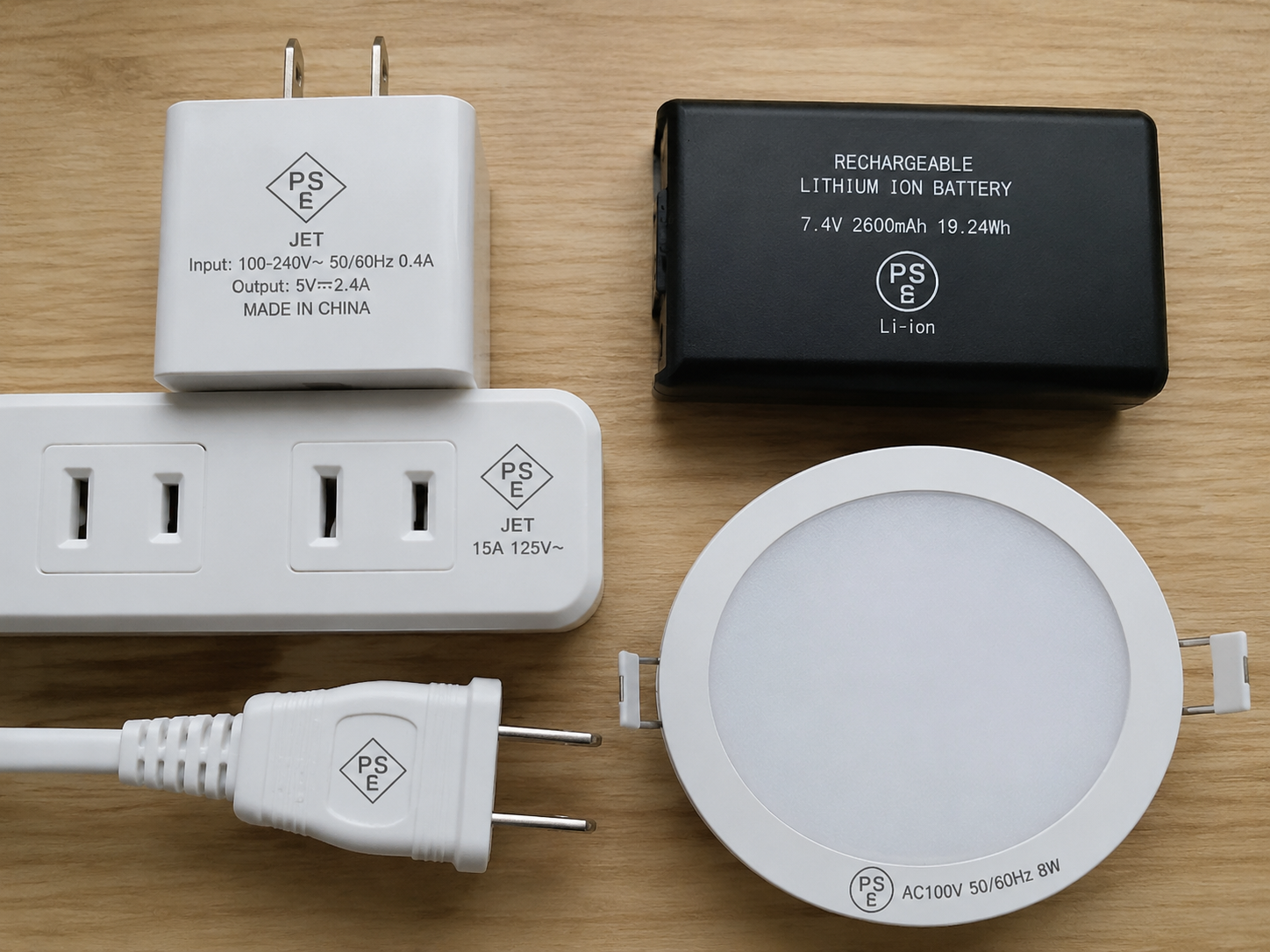
Among common items, AC adapters, plugs and sockets, some electric heating appliances, etc. may belong to specified electrical appliances, which require a diamond-shaped PSE mark and have stricter compliance requirements; lithium-ion batteries, some lighting-related products, etc. need to be specifically confirmed against the catalog, and cannot be directly judged as belonging to the diamond or circular PSE category solely by the product name. The remaining products in the catalog are non-specified electrical appliances, which are affixed with a circular PSE mark. It should be particularly clarified here: specified/non-specified is a statutory classification clearly defined in the Electrical Safety Law catalog, not a risk level determined by enterprises themselves. The risk priority of internal self-assessment by enterprises is only used for arranging compliance work and cannot replace formal item judgment.
There are also some products that may meet exemption conditions, but they cannot be directly determined solely by name. Four conditions must be checked at the same time: 1. Whether the purpose is to place on the market for sale, paid or free of charge; 2. Whether it is an electrical appliance item in the Electrical Safety Law catalog; 3. Whether the rated parameters and structure are within the regulatory coverage; 4. Whether the use meets exemption scenarios (such as purely self-use non-circulating products, special electrical equipment for specific industrial use that is not circulated in civilian/commercial use, non-electrical products, etc.).
A common misconception needs to be corrected here: many people think that low-voltage, USB-powered products do not need to comply with regulations, such as USB small fans and USB desk lamps, but this is not necessarily the case. Whether it is regulated depends on the purpose and parameters of the product. As long as it is in the Electrical Safety Law catalog, even USB-powered products must comply with regulations. For example, USB chargers belong to specified electrical appliances and must have a diamond-shaped PSE mark.
Two Core Reasons for Triggering Inspections
METI’s regulatory investigations are not random. The triggering factors are usually divided into two types:
• Routine verification: The regulatory authority may conduct spot checks based on category risk, circulation scale, complaint and accident records, abnormal filing information, etc. There is no unified, public, and fixed rule for the specific spot check ratio, frequency, and scope, which shall be subject to official formal notices.
• Targeted investigation: Special targeted inspections will be launched if there are consumer complaints about safety issues, product-caused safety accidents, real-name reports, problems found by platforms and transferred to METI, or customs finds that filing information does not match the actual goods.
3-Step Self-Test of Compliance Risk Priority
You don’t have to guess whether you will be inspected. Following these three steps, you can roughly sort out the priority of internal self-inspection—note that this is only a reference for arranging enterprise compliance work and cannot predict the actual probability of being spot-checked:
Step 1: Look at product attributes. If the product is an item in the Electrical Safety Law catalog, directly connected to Japanese mains electricity (100V), and belongs to the category of specified electrical appliances, the compliance requirements are higher, and self-inspection can be arranged first; if it is a product outside the catalog, low-voltage and non-mains-powered, the priority can be slightly lower.
Step 2: Look at compliance status. If the notification information is completely consistent with the actual product and entity, and there have been no compliance complaints or accident records, the risk is low; if there are discrepancies in filing information, or previous complaints or violation records, priority rectification is required.
Step 3: Look at circulation scale. The larger the sales volume and the wider the coverage channels of a product, the greater the impact scope once compliance problems occur, so priority can be given to investigation.
3. Core Verification Content: Know What Is Inspected, So You Can Prepare in Advance
Many people scramble for documents when they encounter an inspection. In fact, the core logic of METI’s verification is to confirm “the responsibility chain is complete, the product meets requirements, and the flow is traceable”. It mainly focuses on four major areas, and you can prepare accordingly in daily work.
Business Notification Qualification Verification: Check Whether the Filing Is Valid and Consistent
This is the most basic verification item, mainly looking at three aspects: First, whether the subject information of the notification and the corresponding product category range match the actual business situation. For example, if you filed for category A but actually sell category B which is not within the scope, that is not allowed; second, whether the notification number is authentic and valid, and whether it has been fraudulently used; third, if the business entity changes, new product categories are added, or the structure undergoes major changes, whether the notification change or supplementary procedures have been handled in a timely manner as required.
PSE Labeling and Nameplate Verification: Check Whether Statutory Labels Are Compliant
This is the most intuitive inspection item, and also a high-incidence area where many people make mistakes. It needs to be checked item by item:
1. Whether the shape of the PSE mark (diamond/circular) is consistent with the statutory item classification of the product. Specified electrical appliances cannot be incorrectly affixed with a circular PSE mark;
2. Whether the information at the statutory label position is complete: basic required items such as rated voltage, rated power, product model, and business operator name must be clear and legible. The business operator name shall be consistent with the notification subject or the subject that bears the labeling obligation according to law; different items may also require labeling of frequency, rated current, manufacturing batch, or other exclusive items, which need to be checked one by one according to the corresponding technical standards and labeling rules;
3. Whether the carrier, position, and size of the label meet the labeling rules of the corresponding item.
Special reminder: The display on e-commerce web pages or platform detail pages cannot replace statutory labeling requirements. Whether it needs to be printed on the product body, nameplate, or accompanying documents/packaging shall be confirmed according to the official regulations of the corresponding item, and cannot be generalized.
Technical Compliance Evidence Chain Verification: Whether It Can Prove Product Safety
Labels alone are not enough; evidence must be provided to prove that the product truly meets safety standards. Moreover, technical compliance evidence cannot be covered by a single report, and needs to be checked according to product classification:
• For specified electrical appliances: It is necessary to check whether there is a conformity inspection certificate issued by a METI-registered inspection body, corresponding technical documents, and self-inspection records of the manufacturer/importer; test reports issued by overseas laboratories cannot directly replace the statutory conformity certificates of Japanese registered inspection bodies, and can only be used as auxiliary reference.
• For non-specified electrical appliances: It is necessary to check the self-inspection records and technical standard conformity certification documents of the manufacturer or importer. The records must cover statutory safety items, and should correspond to specific models, production batches, key component versions, and shipment records. There cannot be only a general test document that cannot be traced to a specific batch.
All technical documents must be checked for consistency with the model, rated parameters, key components, and structural design of the actually sold products; if the product undergoes a model change, key component replacement, or circuit scheme adjustment, it is necessary to re-evaluate whether it meets the technical standards. There is no unified concept of “report validity period”, and the validity must be judged in combination with the product status and the applicable standard version.
Circulation Record Verification: Whether Product Flow Can Be Traced
Many sellers do not pay attention to this area in daily work, but it is actually a key focus of supervision. METI will check whether there are records of import batches, suppliers, and manufacturing factories, and whether sales volume, sales channels, and inventory status match the notification information; more importantly, once a product has a problem, whether the flow of all problematic products can be quickly traced to facilitate timely recall and loss stopping. Put simply, the entire chain of your products, from entering the factory to being sold to consumers, must have traceable records.
4. Possible Investigation Paths and Boundaries of Rights and Responsibilities: You Won’t Panic If You Understand the Rules
Regulatory investigations under the Electrical Safety Law do not have unified fixed procedures, and multiple methods may be used alone or in combination. The specific situation shall be subject to the official formal notice. You not only need to know what to do, but also know the boundaries of your basic rights and obligations.
Investigation Initiation Stage: How to Receive Notices and How to Verify Authenticity
Under normal circumstances, the regulatory authority will send formal written letters to responsible entities within Japan, and sometimes they will be conveyed through e-commerce platforms or local bureaus of economy, trade and industry; only in emergency situations, such as when a clear safety accident has occurred, may on-site inspections be conducted directly.
Formal notices generally clearly state the investigation scope, list of materials to be submitted, deadline, and designated liaison channels. Don’t panic when you receive a notice. The first step is to verify its authenticity: check whether the letter has the official seal of METI or the local bureau of economy, trade and industry, and you can also confirm through the publicly available contact information of METI to avoid fraud.
Investigation Implementation Stage: Verification Methods and Boundaries of Rights and Responsibilities
There are three main verification methods: the most common is written review, that is, you submit the materials, and the authorities conduct written verification; online inquiries or video verification may also be arranged, such as video inspection of warehouses and product labels; if the problem is relatively serious, on-site inspections will be arranged, going to offices, warehouses, and sales points for on-site verification.
As the investigated party, you have the obligation to cooperate: you must provide true and complete materials as required, answer reasonable questions truthfully, and must not obstruct investigations conducted in accordance with the law.
At the same time, you also have basic legal rights: you can require law enforcement personnel to show valid law enforcement certificates and explain the legal basis and scope of the investigation; for trade secrets that should be kept confidential according to law, you can request confidentiality; if it is an on-site inspection, for private areas not used for business (such as employee dormitories, private residences), you can decide whether to cooperate after confirming the legal basis. Note: The exercise of rights must comply with legal procedures. In case of uncertain situations, you should promptly consult a local Japanese compliance lawyer or professional, and must not directly obstruct official duties performed in accordance with the law.
Here is a reminder for overseas users: Under normal circumstances, the Japanese importer, as the primary responsible person, will uniformly liaise through the channels designated in the notice. Do not contact METI directly to submit materials without authorization; if the notice explicitly requires overseas entities to directly submit materials or explain the situation, they shall handle it in accordance with the notice requirements, and seek professional advice if necessary. There is no unified regulation that “direct contact is absolutely prohibited”.
Sampling and Technical Testing
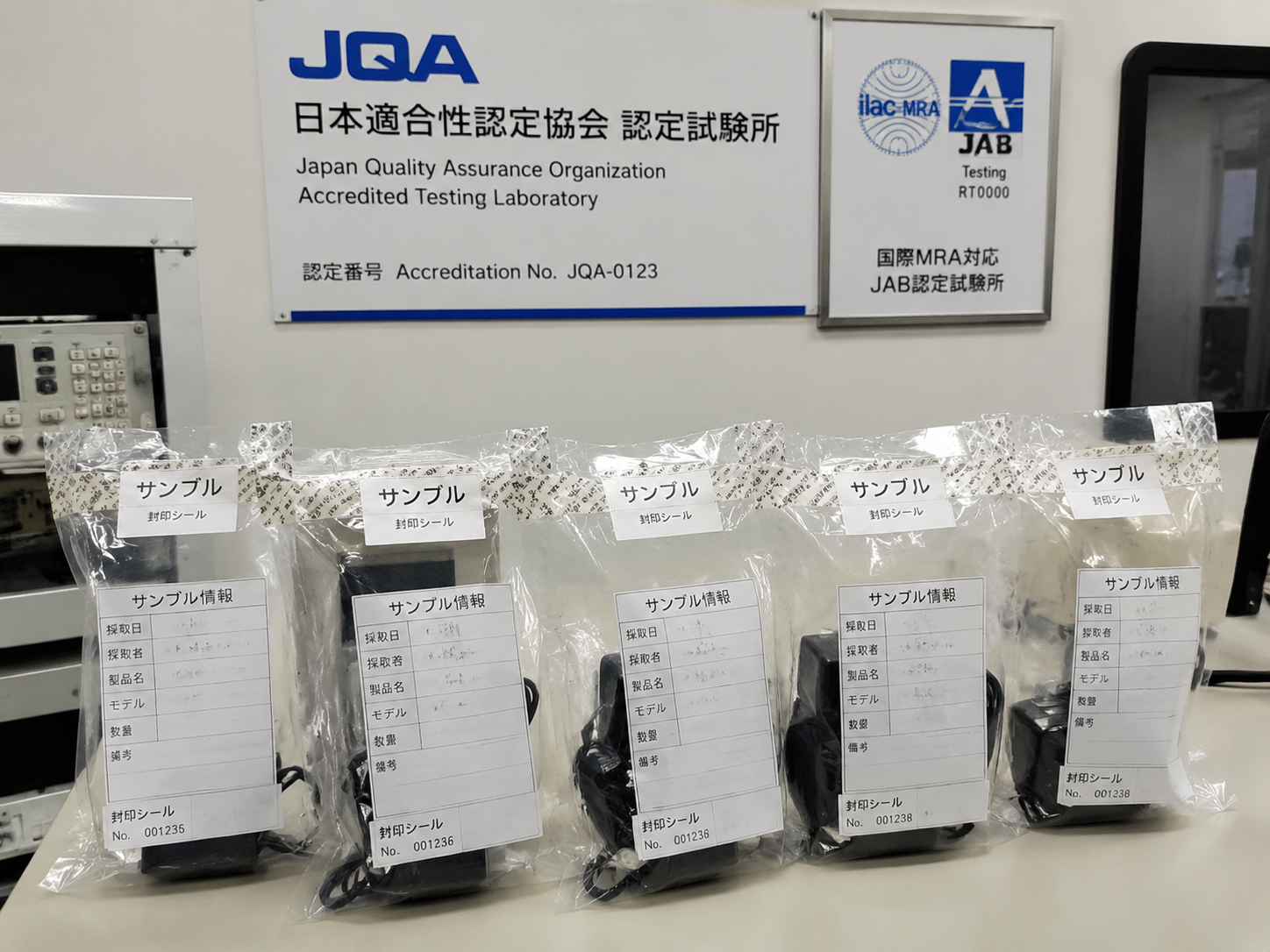
Sampling is not conducted in every investigation. Only when the regulatory authority deems that the product is suspected of non-compliance may sampling and technical testing procedures be initiated. Samples are usually taken from products on sale or in stock. The number of samples taken, sample sealing rules, testing items, and cost bearing methods are determined according to the category and formal notice; the testing institution shall be an institution that meets Japanese statutory qualification requirements. There is no unified fixed period for the testing cycle, which shall be subject to the official notice.
Investigation Results and Follow-up Links
After the investigation, there may be various results, including but not limited to: confirming compliance and closing the case, requiring supplementary submission of materials, issuing administrative guidance or improvement requirements, ordering to stop sales or recall problematic products, imposing administrative penalties, transferring to judicial procedures if suspected of crimes, etc.
If you have objections to the investigation results or administrative decisions, you must raise them in accordance with the relief channels, time limits, and applicant subjects specified in the formal documents. Different types of decisions (administrative guidance, administrative orders, administrative penalties) correspond to different relief methods. There is no unified “review/appeal period”, which shall be subject to official documents. Whether a re-inspection is required after rectification is completed and when restrictions are lifted shall also be handled in accordance with official requirements. One case closure does not mean that there will be no subsequent spot checks.
5. Violation Situations and Handling Logic: Only by Knowing the Consequences Can You Distinguish the Severity
Many people think that violations will lead to bankruptcy, but in fact, handling is graded, and the severity varies greatly in different situations. The specific situation shall be subject to the official final determination.
Three Common Types of Violations
Common violations can basically be divided into three categories:
• Notification-related: For example, engaging in related business without handling Business Notification as required, falsifying notification information, actual products or entities not matching the notification content and not making changes as required.
• Safety/labeling-related: For example, incorrect or missing PSE marks, products not meeting statutory technical standards, falsified nameplate or statutory label information, failure to keep technical documents or inspection records as required.
• Cooperation-related: For example, refusing, obstructing, or evading regulatory investigations, submitting false materials, deliberately concealing violation facts—even if the product itself has minor problems, a bad cooperation attitude may lead to heavier handling.
Handling Gradients and Influencing Factors
The specific handling measures and penalty intensity need to be comprehensively judged in combination with the illegal facts, responsible subjects, degree of harm, etc., and can be roughly divided into three levels: minor document or labeling defects are usually handled with administrative guidance, deadline for correction, and order for rectification; those involving non-conformity with safety standards, incorrect use of PSE marks, or false documents may be required to suspend sales, recall problematic products, and be fined; those with serious circumstances such as deliberate fraud, refusal or obstruction of inspection, or causing major safety accidents will be given heavier penalties, and may also involve criminal liability if they meet the provisions of the law. Whether a criminal offense is constituted shall be judged based on the specific provisions of the Electrical Safety Law and other applicable laws, combined with subjective state, accident consequences, and evidence. Not all safety accidents will directly trigger criminal liability.
There are four common factors affecting the severity of handling:
First is subjective intent: Deliberate fraud (such as forging filing numbers, forging PSE marks) will definitely be handled much more severely than accidentally missing a label.
Second is the degree of harm: Whether there has been a safety accident causing personal injury or property loss, and how many products are involved and the scope of circulation—the larger the quantity and scope, the heavier the handling.
Third is the degree of cooperation: Those who take the initiative to rectify and recall problematic products will be handled more leniently than those who conceal the facts and refuse to cooperate.
Fourth is violation history: First-time violators will be handled more leniently than those who refuse to mend their ways despite repeated admonitions. Those who commit violations again after having violation records will usually be given heavier penalties.
Practical Impact on Overseas Users
In addition to statutory penalties, violations may also bring chain effects: First, e-commerce platforms may take measures such as removing all store/all category products and sealing inventory; then your Japanese importer will most likely terminate cooperation, and even claim compensation for losses based on the contract, including fines, recall costs, goodwill losses, etc.; in the longer term, related brands or entities may face stricter reviews when handling notifications and customs clearance in Japan in the future.
6. Practical Guide for Overseas Users: Know How to Self-Inspect, Respond, and Make Basic Decisions
Now that you understand the rules, the key is to implement them. The following practical methods can be used both for daily compliance and when encountering investigations.
Daily Compliance Self-Inspection Suggestions
The best response is to do a good job of compliance in advance. The following are recommended internal control actions (not unified statutory requirements, enterprises can adjust according to their own scale):
• Qualification verification: Regularly check Business Notification information to ensure it is completely consistent with the product categories, models, parameters, and business entities of actually sold products. If there are changes, update the filing in time as required.
• Label inspection: Spot-check whether the PSE mark type, nameplate information, and label position meet the requirements of the corresponding item before each batch of goods is put into storage. Don’t wait until they are sold to find that the label is wrong.
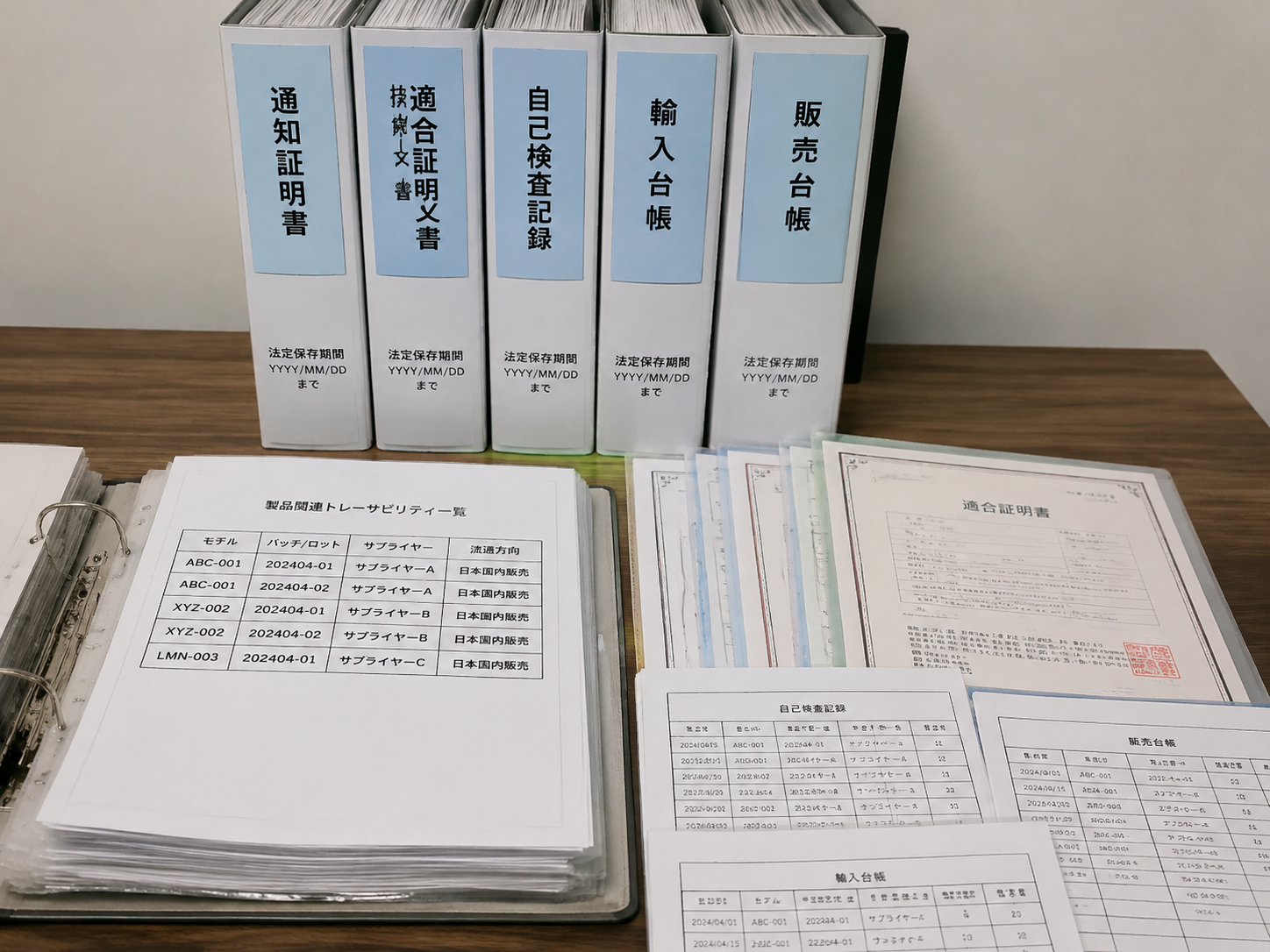
• Document retention: Retain materials according to the statutory retention period of various records, including notification certificates, conformity certificates/technical documents, self-inspection records, import and sales ledgers, etc. Establish files that can be traced to specific models, batches, suppliers, and flow directions. It is recommended to prepare Japanese versions of important documents for direct submission during investigations.
• Entity confirmation: Ensure that your Japanese importer has the ability to handle compliance liaison and knows how to deal with METI. The division of responsibilities between the two parties shall be clearly stated in the contract to avoid mutual shirking when problems arise—but note that contractual agreements cannot override statutory responsibilities.
4-Step Response Process After Receiving an Investigation Notice
If you really receive an investigation notice, don’t panic. Follow these four steps and there will be no major mistakes:
Step 1: First confirm the authenticity of the notice, clarify the specific scope of the investigation, deadline, designated contact person, and submission channel. Don’t start looking for documents in a daze.
Step 2: Immediately coordinate with the Japanese importer to sort out all compliance documents for the corresponding products. Overseas sellers should not directly submit any documents to METI without authorization, unless the notice explicitly requires overseas entities to submit directly.
Step 3: Conduct an internal pre-inspection in advance, and classify the risks of the found problems first: if it is a problem that does not involve product safety or item classification, such as missing documents or information filling errors, you can prepare supplementary explanations in advance; if it involves problems such as incorrect labels, doubtful item classification, or mismatched technical documents, you should first suspend the sales or shipment of the affected batches to avoid the expansion of risks.
Step 4: Submit the materials through the designated channel before the deadline. Keep records of the entire process, and save all emails and written records to avoid being unable to clarify things later.
Response Decisions for Different Problems
When encountering different problems, you need to first judge the risk level and then take corresponding measures. Do not generalize:
• Deviation in notification information or declaration materials: It is necessary to first confirm whether the deviation affects item classification, responsible subject identification, or product safety judgment. If it is only an error in non-core information such as address and contact person, the importer can submit a notification change application and supplementary explanation as required; if it involves deviation in product category or subject nature, it is necessary to re-evaluate the compliance status before handling.
• Inconsistent label or nameplate information: It is necessary to first confirm whether the inconsistent content affects safety identification (such as incorrect rated value, incorrect PSE shape). If it is a problem that does not affect core identification, such as printing position or font size, the label can be rectified as required; if it involves incorrect rated values or mark types, sales must be suspended, and the product compliance must be re-evaluated before deciding whether to relabel, re-test, or recall.
• Products suspected of not meeting technical standards: Immediately suspend the sales and shipment of related products, entrust a qualified institution to re-test and confirm. If there are indeed problems, measures such as rectification and recall must be taken as required. Do not conceal the problem and delay handling.
• Objections to administrative decisions: Carefully read the relief channels, time limits, and applicant subjects specified in the formal documents, raise them through legal channels within the specified time, and submit relevant evidence (test reports, batch records, communication records, etc.) together. Do not miss the statutory relief period.
Pitfalls to Avoid When Choosing Compliance Service Providers
Many overseas sellers will look for third-party compliance service providers to help with filing and respond to inspections. Here are three pitfalls to pay attention to:
First, prioritize choosing formal institutions with local Japanese compliance qualifications that can directly liaise with Japanese regulatory authorities. Don’t choose those that only have overseas offices and don’t even have a fixed contact person in Japan—you won’t be able to reach anyone when something really happens.
Second, never believe false propaganda such as “guaranteed pass” or “100% no inspection”. Regulatory spot checks are conducted based on multiple factors, and no one can guarantee that you will not be inspected. Those who say such things are basically scammers.
Third, be sure to clarify the service scope before signing the contract, such as whether it includes investigation response, filing updates, and dispute handling. Don’t wait until something happens to look for them, only for them to say it’s not within the service scope.
7. Common Misconceptions and Applicable Boundaries: Never Step into These Pitfalls
Many people have deviations in their understanding of METI supervision. The following most common pitfalls require special attention:
Misconception 1: If you have done METI filing, you will not be inspected.
Correct answer: METI filing (Business Notification) is only a pre-market statutory registration obligation, whose function is to inform the regulatory authority of the business entity and corresponding product categories. Enforcement inspection is a regular post-market regulatory action after the product is launched. Even if a legal notification has been completed, the authenticity and consistency of product labels, technical documents, and circulation records may still be spot-checked. Filing itself does not mean “inspection-free”.
Misconception 2: Having a PSE certificate/report/mark equals full compliance.
Correct answer: Many people understand PSE as “getting a universal certificate means compliance”, but under Japan’s PSE system, compliance is a collection of multiple links: specified electrical appliances require a conformity inspection certificate from a METI-registered inspection body, non-specified electrical appliances require self-inspection records, plus legal Business Notification, standardized labels, and traceable circulation records, to be considered fully compliant. Having only a mark, only a test report or certificate cannot be directly equated with full compliance. A problem in any link may be deemed a violation.
Misconception 3: Passing platform review means METI compliance.
Correct answer: The review of e-commerce platforms is the platform’s own access requirement, with standards generally looser than official law enforcement. Many platforms only check whether there is a notification number and PSE-related documents, and do not verify whether the documents match the actual products. Passing platform review does not mean recognition by the official regulatory authority.
Misconception 4: Small batches, trial sales, and samples do not need to comply with regulations.
Correct answer: Whether compliance is required depends on whether the product is in the Electrical Safety Law catalog and whether it is intended for market placement, and has no inevitable relationship with quantity. As long as it is a product in the catalog that is sold, provided free of charge, or used for commercial promotion in the Japanese market, even in small quantities, it may fall within the regulatory scope; inbound samples only used for internal testing and display and not entering the circulation link need to be judged for applicability based on the specific declaration method and purpose, and exemption cannot be determined solely based on “small quantity”.
Misconception 5: Products of the same series can share a set of compliance documents.
Correct answer: The coverage scope of compliance documents needs to be judged based on the product’s item, rated parameters, structure, key components, etc. Filing, test reports, or certificates cannot be shared solely based on similar appearance or same series name. If there are differences in electrical specifications and key components of different models, it is necessary to separately check whether they meet the corresponding requirements. When the product undergoes a model change or key component replacement, compliance also needs to be re-evaluated.
Applicable Boundaries and Updates of the Rules
The regulatory rules discussed here only apply to the post-market supervision under the Electrical Safety Law for civilian and commercial electrical products sold in the Japanese market. Special equipment for industrial use, purely self-use non-circulating products, etc. need to be judged for applicability according to specific situations. In addition, METI’s rules will change with policy adjustments and product catalog updates. For example, product classification and technical standards may be adjusted. Specific requirements shall be subject to METI’s latest official announcements and formal legal documents. Don’t apply old rules from several years ago to current situations.
Finally
After learning these contents, you should be able to independently complete the following basic judgments:
1. Judge whether your own products or business fall within the general scope of METI supervision under the Electrical Safety Law;
2. Sort out your own compliance risk priority according to product attributes, compliance status, and circulation scale;
3. List the core points of daily compliance self-inspection and establish a basic compliance file;
4. Know the correct first step after receiving an investigation notice (verify authenticity, coordinate with the importer);
5. Identify which acts are serious violations that need to be avoided with priority;
6. Distinguish the relationship and different roles of Business Notification, PSE mark, and enforcement investigation;
7. Understand the basic cooperation obligations and legal right boundaries when undergoing investigation;
8. Judge when it is necessary to contact a Japanese importer or professional compliance personnel to intervene.
METI compliance supervision is a regular part of Japan’s electrical appliance safety management, with the core purpose of ensuring consumer safety. Consolidate the compliance foundation in daily work, clarify responsibility boundaries, cooperate well with Japanese importers, and just respond according to the process when encountering investigations. The above is an introduction to the entry-level rule framework. For specific item classification, statutory requirements, investigation procedures, and penalty determination of individual products, all shall be subject to applicable legal provisions and official formal documents. In case of complex situations, it is recommended to promptly consult a local Japanese compliance lawyer or professional institution.