
Many overseas factories and cross-border sellers entering the Japanese electrical product market for the first time will be required by customers or platforms to provide “METI filing”. It sounds like a simple certificate, but when you actually look up information, a host of terms such as PSE mark, business notification, conformity inspection, Electrical Appliance and Material Safety Law, and Electricity Business Law can easily confuse people. This guide breaks down the process from product compliance determination, Japanese responsible party selection, document preparation, full-process handling to post-launch maintenance and pitfall avoidance, helping you go from a beginner to being able to make basic independent judgments and avoid unnecessary detours.
First, Understand: What Exactly Is the “METI Filing” Everyone Talks About?
Not a Single Certificate, but a Collective Term for a Set of Compliance Requirements
METI is the abbreviation of the Ministry of Economy, Trade and Industry of Japan, which is in charge of Japan’s trade, industry and various product compliance affairs. The commonly known “METI filing” in the industry is not an administrative approval certificate issued by METI for a single product, but a collective term for business notification + PSE compliance obligations under Japan’s . Its core attribute is statutory notification plus product compliance requirements, and its core function is to clarify the responsible party of the product, facilitating regulatory authorities to trace and handle safety accidents.
Don’t Confuse: Electrical Appliance and Material Safety Law vs Electricity Business Law
Both laws are administered by METI, but their jurisdictions are completely different:
• The direct basis for product compliance is the (abbreviated as DENAN), which regulates the market access of civil and commercial electrical products, that is, what kind of electrical products can be sold in Japan.
• The governs the operation of the power industry such as power generation, transmission and sales, and has nothing to do with the compliance of ordinary consumer and commercial electrical products.
Main Compliance Obligation Framework of the Electrical Appliance and Material Safety Law
The compliance requirements of the for regulated electrical products are carried out around four dimensions: entity notification, product safety, process control, and mark traceability. Specific obligations applicable to products of different categories and risk levels vary. The core framework includes four categories:
1. Business Notification: that is, “notification of business commencement” — entities engaged in the manufacture or import of regulated electrical appliances within Japan are required to submit a notification to METI to explain their engagement in relevant category businesses. This is a statutory notification at the entity level, not an approval for a single product.
2. Obligation of Conformity to Technical Standards: Regulated electrical products must comply with the electrical safety technical standards officially issued by Japan and have no safety hazards, which is the core requirement for all regulated products.
3. Self-inspection and Record Keeping: Notifying business operators are required to carry out safety inspections on products as required and keep relevant records, which regulatory authorities may retrieve and verify in accordance with legal procedures.
4. PSE Marking Obligation: Compliant regulated electrical products shall be marked with the PSE mark as required, for the convenience of consumer and regulatory identification.
Specific obligation requirements for different categories (such as inspection methods, record types, marking positions) shall be subject to the regulatory rules of the corresponding product items, and cannot be generalized.
Distinction of Three Core Concepts
Many people tend to confuse business notification, PSE mark, and conformity inspection. The three belong to different levels with clear logical boundaries:
• Business Notification: It is the business notification for the “Japanese responsible party”, proving that the entity has the qualification to engage in the import or manufacture of certain types of regulated electrical products. It is a statutory notification at the entity level, not a qualification approval for a single product.
• PSE Mark: It is a compliance mark for “individual products”. High-risk specified electrical appliances use a diamond-shaped mark, and low-risk non-specified electrical appliances use a circular mark.
• Conformity Inspection: It is a mandatory conformity assessment requirement for high-risk specified electrical appliances, which must be certified by a third-party organization registered with Japan’s METI.
The three are supporting: before selling regulated electrical products, it is necessary to complete the entity’s business notification, ensure the product meets the corresponding technical standards, and mark the PSE mark as required (specified products also need to obtain a conformity inspection certificate). Specific requirements depend on the product category.
Reasons Why Overseas Manufacturers Must Pay Attention
For overseas manufacturers, this is the core compliance threshold for entering the Japanese electrical product market: offline channels and e-commerce platforms usually require suppliers to provide compliance certificates, and products that have not completed compliance cannot be normally launched for sale.
It should be particularly noted that: If an overseas manufacturer has not established a legal entity engaged in import business within Japan, it cannot directly perform the notification obligation of import business as an overseas entity, and must plan the local Japanese responsible party in advance, otherwise the complete compliance process cannot be completed. The specific determination of the notifying entity shall be based on the identity of the entity actually engaged in manufacturing or import business within Japan, and the responsibilities of all parties can be clearly agreed through contracts.
Quick Judgment: Does Your Product Need This Compliance?
After understanding the basic concepts, you can gradually narrow the scope through a 3-step logic to quickly judge whether the product needs compliance, so as to avoid misjudgment based on experience.
3-Step Judgment Logic (from General to Specific)
Step 1: Determine whether the product enters the circulation chain within Japan. As long as the product is engaged in manufacturing, import, sales, commercial use, gift distribution and other activities within Japan, compliance requirements must be evaluated first; only transit goods that are not sold/used within Japan at all, and personal use imported goods that meet statutory conditions, need to be separately verified whether they are in the exemption scope, and cannot be directly assumed to be exempt from compliance.
Step 2: Check against official judgment basis to confirm whether the product is within the scope of regulated electrical appliances.
Step 3: If it is within the regulated scope, further classify it into high-risk “specified electrical appliances” or low-risk “non-specified electrical appliances” in combination with product item definition, rated parameters, use, structure, and sales method. The compliance processes and requirements of the two categories are quite different.
In short, only when the three premises of “entering circulation within Japan”, “falling within the regulated product item scope” and “meeting regulatory judgment conditions” are met at the same time, is it necessary to perform compliance obligations in accordance with the .
Judgment Shall Be Subject to Official Documents
Whether a product is within the regulated scope cannot be judged by subjective experience, and must be based on the official documents issued by METI as the core basis:
• : It lists the basic product item scope of all regulated electrical appliances, and is the core judgment list.
• : It clarifies the judgment rules for boundary products. For example, whether battery-powered products and supporting accessories are within the regulated scope can be found in it.
• : It stipulates the specific safety technical standard details that regulated products must meet.
• Product’s own attributes: rated voltage/current, use, structure, whether sold separately, etc., will affect the final judgment — for example, the same accessory may have completely different requirements when sold separately and when sold as a set with the main unit.
Common Regulated Categories and Non-Regulated Scenarios Requiring Verification (for Reference Only)
The following are examples of common regulated products and non-regulated scenarios, for reference only, and do not constitute a definite classification conclusion. The final judgment shall be subject to the specific provisions of METI’s and :
• Specified Electrical Appliances (high risk, requiring third-party conformity inspection): Common examples include AC power adapters, mobile phone chargers, power strips, storage-type electric water heaters, electric blankets, etc. — provided that the products are sold for the Japanese market, and their rated parameters and structures meet the regulatory requirements of the corresponding product items.
• Non-Specified Electrical Appliances (low risk, self-confirmed compliance): Common examples include household rice cookers, hair dryers, low-voltage LED light strips with AC drive, USB cables sold separately, etc. — these boundary products need to be judged one by one in combination with rated values, structure, use, sales methods and other conditions, and cannot be directly classified based on a single parameter (such as voltage).
• Non-regulated scenarios requiring separate verification: Items imported for personal use, products only for transit and not sold within Japan, large industrial-specific non-consumer electrical equipment, non-independent regulated accessories sold with the main unit and not sold separately, and parts that are only used as components of finished products and not sold separately to end users — these scenarios only do not need to comply with regulated product compliance when they meet specific statutory conditions, and cannot be directly assumed to be exempt.
Boundary Judgment Method for Easily Confused Products
The boundaries of several types of products are easy to blur. You can refer to the following judgment ideas, and the final confirmation still needs to be checked against METI official documents:
• Battery-powered products: Judge step by step in the following order: ① Can it be directly connected to Japan’s 100V AC mains? ② Is it accompanied by or sold separately with a matching external power supply/charger (the power supply part needs to be separately judged whether it is regulated)? ③ Does the product’s own rated value and use fall within the scope of regulated product items? ④ Does it belong to other independently regulated categories such as storage batteries? Conclusions cannot be drawn solely based on “whether it has a battery” or “whether it is plugged into the mains”.
• Supporting accessories: Regulated accessories sold separately need to perform compliance obligations separately; accessories sold with the main unit and not sold separately to end users do not need separate compliance, but the main unit itself must meet the compliance requirements of the corresponding category.
• Same-series models: The core of whether they can be declared under the same type is whether the safety-related attributes of the products are consistent — including rated parameters, insulation structure, key safety components, circuit design, enclosure protection level, etc. Only same-series products with no differences in these core safety elements may be treated as the same type. Whether they can be combined specifically shall be subject to the applicable technical standards, notification scope requirements and the judgment of the inspection agency for specified products. Business notification is the entity’s notification of the category scope, not per-model approval, but each model needs to be confirmed to fall within the notified category and type scope, and cannot be assumed to cover all models just because the category name is the same.
• Parts: Parts that are only used as components of finished products and not sold separately to end users do not need separate compliance.
Responsible Party: Who Handles the Business Notification? How Should Overseas Manufacturers Choose?
After confirming that the product needs compliance, the first step is to clarify the statutory notification obligation entity.
Core Rule: Who Is the Statutory Notifying Business Operator
The stipulates that a legal person or individual actually engaged in the manufacture or import of regulated electrical appliances within Japan is the statutory notifying business operator, who shall bear the notification and subsequent compliance obligations.
The core logic for judging the notifying entity is: whoever implements the manufacturing or import behavior within Japan shall perform the notification obligation. If an overseas manufacturer has not established a legal entity engaged in import business in Japan, it cannot directly handle the import business notification as an overseas entity, and the local Japanese import responsible party shall bear this obligation.
Notification is the entity’s notification of the business scope of a certain type of electrical appliances, not the approval of a single product — after notifying a certain category, subsequent products of the same category still need to be confirmed whether they fall within the notified business scope and type classification, and complete corresponding compliance verification; if they exceed the scope, re-evaluation or notification change is required.
Division of Statutory Obligations and Contractual Liabilities
Overseas manufacturers, notifying business operators, and sellers involved in the compliance process bear different statutory obligations and contractual liabilities respectively, and shall bear corresponding responsibilities according to the degree of fault when problems occur:
• Statutory level: The domestic Japanese notifying business operator (manufacturing/import entity) bears all statutory responsibilities under the , including handling business notification, ensuring products meet technical standards, carrying out self-inspection, keeping compliance records, marking PSE as required, cooperating with regulatory investigations and implementing recall measures, etc.
• Overseas manufacturers: As the producer of the product, they shall provide true and complete technical documents in accordance with the contract, and ensure the consistency between mass-produced products and compliance verification samples; if safety problems are caused by product design or production defects, they shall bear corresponding responsibilities in accordance with the law and the contract.
• Sellers: They shall verify the compliance documents of the regulated electrical products they sell, and shall not sell products that they know do not meet compliance requirements; if violations are caused by problems in the sales link, they shall bear corresponding responsibilities.
It is recommended that all parties clearly agree on the rights and responsibilities such as document provision, quality assurance, recall cooperation, and cost bearing through contracts before cooperation, so as to avoid subsequent disputes.
Comparison of 3 Common Japanese Responsible Party Solutions
There are three commonly used Japanese responsible parties for overseas manufacturers, which are suitable for enterprises of different sizes and business needs, and can be selected according to their own situation:
| Japanese Responsible Party Solution | Suitable For | Core Advantages | Main Disadvantages |
| Japanese cooperative importer/distributor | OEM factories with fixed Japanese customers | Low cost, no need to coordinate with an additional entity | Weak control, compliance documents are held by the customer |
| Japanese entity of third-party compliance agency | Small sellers, start-ups, no fixed Japanese partners | Flexible use on demand, no need to maintain a company on your own | Moderate control, need to select a reliable agency |
| Self-registered local Japanese company | Brand owners, large sellers, long-term sales of multiple products | Strong control, can independently carry out all-category business | High cost, need to maintain company operation, taxation, etc. |
OEM factories with fixed Japanese customers find it most worry-free to use the customer’s entity; small sellers and start-ups find it more flexible to choose the entity of a third-party agency; for brand owners that have long been deeply engaged in the Japanese market, self-registering a company has stronger controllability.
High-Frequency Risk Points in Entity Selection
When selecting a Japanese responsible party, pay attention to the following high-frequency risks and avoid them in advance:
1. It is necessary to confirm that the entity has true and valid registration information, a normally contactable actual office address, and the ability to perform statutory obligations such as document keeping, regulatory liaison, and recall cooperation. Entities that do not have real operation and regulatory response capabilities (such as shell entities that only use unreachable virtual addresses and have no actual responsible personnel) may have risks such as notification not being accepted and regulatory requirements not being implemented. Specific requirements shall be subject to METI’s review rules.
2. OEM factories should not arbitrarily use their own Japanese entities to handle notifications for customers, otherwise they will bear the compliance responsibilities under the as the statutory notifying entity. If customer products have safety problems, they need to perform corresponding obligations in accordance with the law. It is recommended that the customer actually responsible for import be the notifying entity.
3. When the notifying entity changes, it is necessary to go through the notification change procedures in accordance with regulations in time to avoid affecting customs clearance and sales.
Preparations: Classification Judgment and Document Requirements
After selecting the entity, don’t rush to proceed. There are several core matters to confirm first, and documents should also be sorted out in advance to avoid wasted effort.
Pre-Confirmation Matters (to Avoid Detours)
Before officially advancing compliance, first confirm the following core matters:
1. First complete the product classification judgment (specified/non-specified) and confirm the specific product item attribution. Wrong classification will lead to subsequent testing and document preparation all failing to meet requirements, wasting time and cost.
2. Confirm that the notifying entity is legal and valid, and can handle notification through the official channel designated by METI (currently the e-Gov online system is commonly used, and it can also be submitted by a legally entrusted agent). The specific method shall be subject to the latest process announced by METI.
3. Before the product is launched for sale, the compliance verification of the corresponding category must be completed: specified electrical appliances need to obtain a conformity inspection certificate from a Japanese registered agency, and non-specified electrical appliances need to complete the confirmation of conformity to technical standards and keep relevant documents. The submission time of notification can be adjusted according to business arrangements, but both notification and product compliance verification must be completed before launch.
Graded Core Document List
Documents to be prepared vary for different categories of products, which can be sorted out according to the following list. Specific requirements shall be subject to the rules of the notification and verification agency:
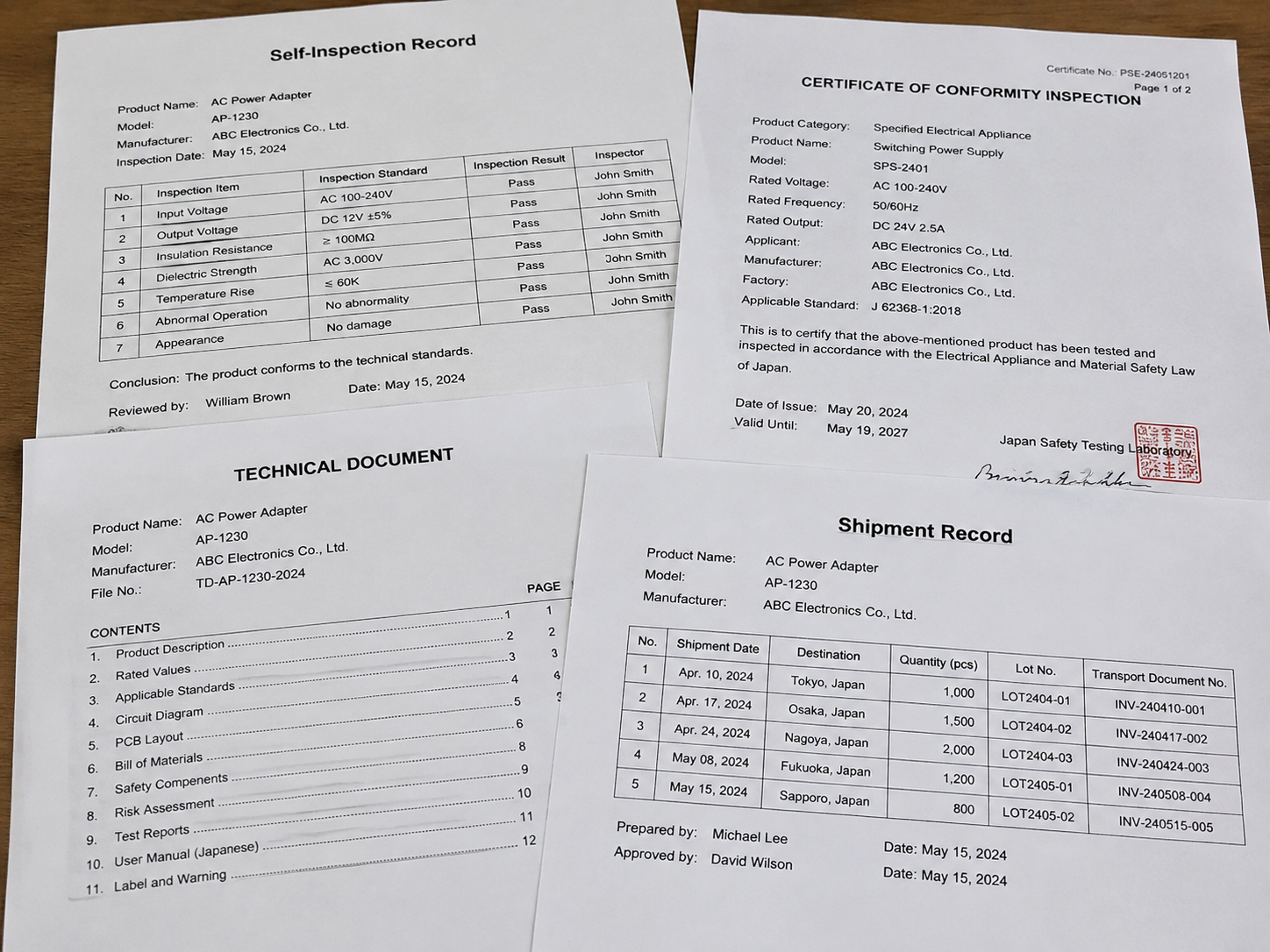
• General basic documents: Qualification documents and contact information of overseas manufacturers and notifying business operators, product model/specification/use description.
• Supplementary documents for non-specified electrical appliances: Test reports or compliance verification documents meeting the requirements of Japan’s , self-inspection records, Japanese instruction manuals, nameplate drafts.
• Supplementary documents for specified electrical appliances: Conformity inspection certificate issued by a METI-registered conformity inspection agency, list of key components.
The storage requirements for compliance documents shall be implemented in accordance with the and the specific provisions of the corresponding product items. The storage periods and starting points of different types of records (such as self-inspection records, conformity inspection certificates, technical documents, shipment records, etc.) vary, and it is necessary to ensure that they can be retrieved in time when regulatory authorities inspect in accordance with the law. The specific period can be confirmed with the notifying entity or professional agency for the statutory requirements of the corresponding category during the compliance preparation stage.
The Most Common Reason for Correction: Document Consistency
Many notification applications are required to be corrected, and the core reason is inconsistent documents. This point must be focused on self-inspection:
• The product model, specification, and manufacturer name must be completely consistent in the test report, instruction manual, and notification documents. Differences in expression may lead to correction.
• Declaration of multiple models of the same series must comply with the type classification rules, and the core safety differences of products cannot exceed the scope allowed by the standard, otherwise they cannot be declared jointly.
• All documents submitted to the official must be in Japanese, and professional terms must conform to the general expressions of Japanese laws and regulations, so as to avoid being required to be corrected due to irregular expressions.
3 Most Easily Overlooked Preparation Items
The following three details are easy to be ignored. Preparing them in advance can avoid subsequent rework:
1. The product nameplate should reserve space for the PSE mark and notifying business operator information in advance. For specified products, space for the inspection agency information should also be reserved. The size must meet the marking requirements of the corresponding product item, so as to avoid that the nameplate cannot accommodate compliance information after production.
2. The object of testing/inspection must be completely consistent with the actual mass-produced model. It is not allowed to test with prototypes and modify the structure after mass production, otherwise the compliance documents will be invalid.
3. If the product has multiple production factories, all of them need to be listed and the production-related information of the corresponding factories shall be provided, and no omission is allowed.
Full Practical Process: From Product Judgment to Launch for Sale
After the preparation work is completed, compliance can be advanced according to the following conventional steps (this is an empirical process without major corrections, and does not constitute a time or result commitment).
Full Conventional Compliance Steps
Step 1: Confirm the product item attribution and classification to ensure accurate judgment, which is the basis of the entire compliance.
Step 2: Determine the Japanese notifying business operator, and prepare basic qualifications and product technical documents.
Step 3: The notifying entity or its legal agent submits the business notification through official channels. Business notification is a statutory notification of business commencement, not an administrative approval or product qualification determination; METI will verify the submitted documents, and usually the acceptance can be completed within a few working days when the documents are complete (this duration is only an industry experience reference, and the specific shall be subject to the official processing progress). Acceptance only means that the documents meet the formal requirements, and does not mean that METI recognizes the product’s compliance.
Step 4: Complete product compliance verification: specified products complete third-party conformity inspection, non-specified products complete technical standard confirmation and self-inspection.
Step 5: Produce PSE marks, Japanese instruction manuals and packaging in accordance with regulatory requirements.
Step 6: Keep all compliance documents, and provide verification according to the requirements of the platform or downstream customers.
If there are problems with the notification documents, METI will notify corrections. After modifying according to the requirements, you can resubmit. The acceptance progress shall be subject to the official notification after the correction is passed.
Common Verification List for Platforms/Customers
Japan does not have a unified “official product filing number query system” open to the public, and some categories can query the list of notifying entities published by METI. Verification documents required by different e-commerce platforms and downstream customers vary. Common verification materials include:
• Notification-related certificates: such as notification submission records, acceptance notices, etc. The specific form shall be subject to the requirements of the platform or customer.
• Product compliance certificates: Conformity inspection certificates for specified products, test/verification documents for conformity to technical standards, self-inspection records.
• Mark and packaging documents: PSE mark draft, Japanese instruction manual, packaging draft.
• Consistency verification: Information such as notifying entity, manufacturer, product model, parameters, etc. must be consistent in all documents, and there shall be no contradictions.
Specific verification requirements shall be subject to the latest rules of the corresponding platform or customer, and a general list cannot replace targeted confirmation.
Common Correction Reasons and Handling Methods
The most common correction reasons include: wrong product classification, missing pages of documents, irregular Japanese expressions, and inconsistent product information.
Handling method: After modifying according to the requirements of the correction notice, you can resubmit. Generally, no additional fee is required, except for changes to core information.
Core Tips to Shorten the Processing Cycle
The following methods can effectively shorten the compliance cycle and reduce rework:
• Prepare Japanese documents in accordance with METI requirements in advance, and do a pre-self-inspection first to reduce the number of corrections — corrections usually increase processing time from several days to several weeks.
• For specified products, connect with Japanese-registered conformity inspection agencies in advance to arrange inspections, so as to avoid being stuck in the pre-verification link.
• Choose a notifying entity or service agency with compliance experience, who is familiar with the declaration rules and can avoid common problems in advance.
Time and Cost: Reasonable Expectations and Influencing Factors
There is no unified standard for compliance cycle and cost, which are affected by many factors such as products, documents, and agencies. The following are reasonable estimated ranges and core influencing factors for reference.
Overall Cycle Estimation (from Launch to Market Availability)
There is no unified standard for the compliance cycle. The following is the estimated range based on industry experience, excluding special situations such as product structure rectification, major document correction, factory inspection, and agency scheduling delays. The actual cycle needs to be determined according to product complexity, testing agency scheduling, document preparation quality, number of factories, etc., and does not constitute a time commitment:
• Non-specified electrical appliances: If there are already test materials that meet the requirements of Japanese technical standards, it usually takes 2-6 weeks to complete document preparation, notification submission and self-inspection empirically.
• Specified electrical appliances: Due to the need for third-party agencies to carry out conformity inspections, it usually takes 4-12 weeks empirically, and the specific duration is greatly affected by the scheduling of the inspection agency.
Main Cost Components
There is no official unified pricing for compliance fees, and the specific amount varies depending on product category, number of models, service providers, and inspection agencies. It is mainly composed of three parts:
• Product compliance verification fee: The third-party conformity inspection fee for specified electrical appliances is usually higher than the technical standard verification fee for non-specified electrical appliances.
• Notifying entity and service fee: Fees for the Japanese responsible party to provide declaration and compliance support services.
• Miscellaneous fees: Small fees such as translation fees and document production fees.
Key Factors Affecting Time and Cost
The following factors have the greatest impact on time and cost. Understanding them in advance can help you make reasonable expectations:
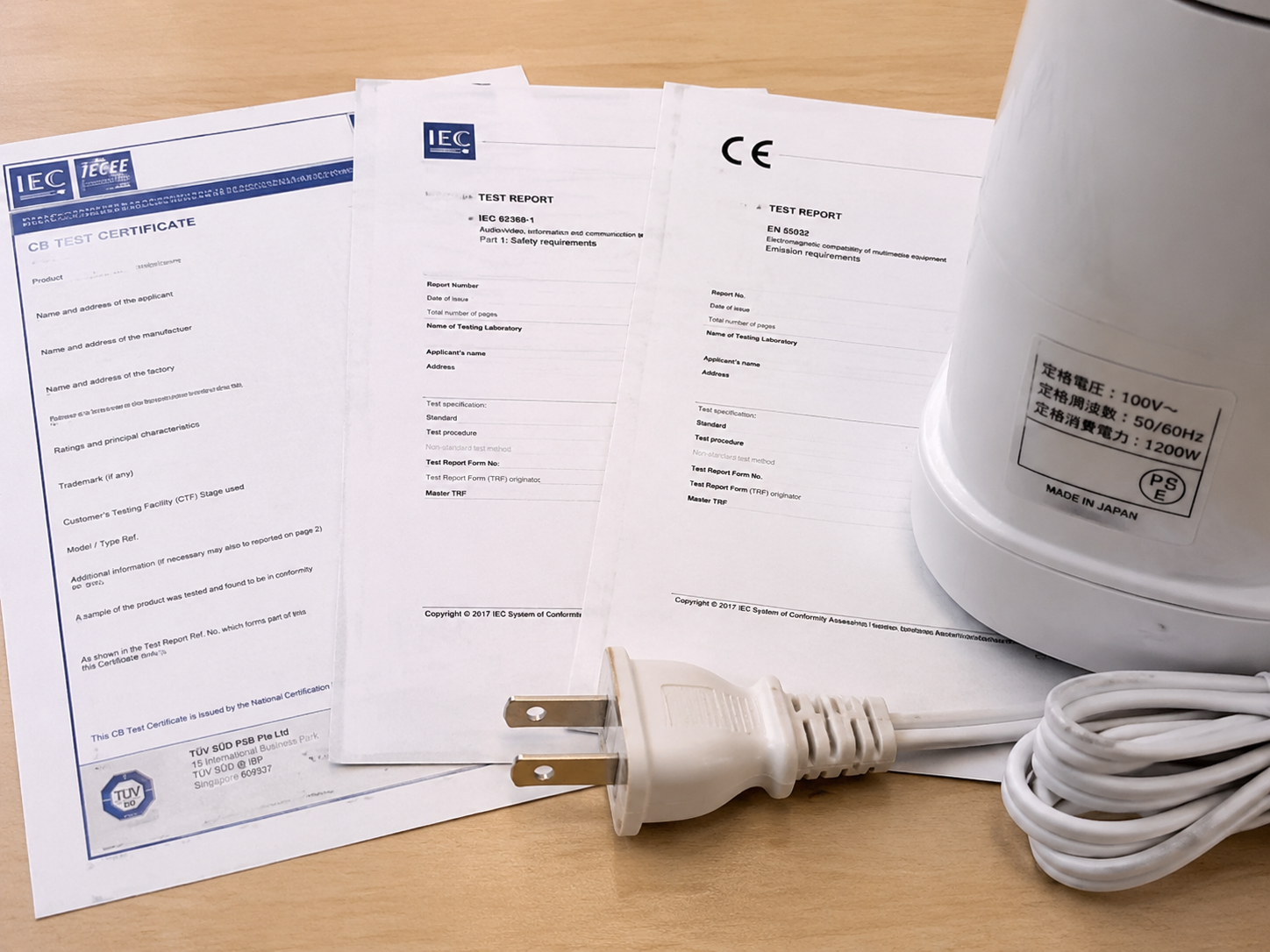
1. Whether there are already test documents that meet the requirements: If you hold a CB/IEC report that includes Japanese standard differences (JP differences), you can submit it to the inspection agency to evaluate whether it can be accepted. The acceptance requirements vary for different product categories and applicable standards, and cannot be generalized.
2. Whether the product needs rectification: If the product structure does not meet the safety standards, mold modification and component replacement are required, which will significantly increase time and cost.
3. Number of models: Same-series products that meet the same type classification rules can be verified jointly after confirmation, and the unit cost will be relatively reduced; if the core safety structures of each model are quite different, separate verification is required, and the cost is higher.
4. Document preparation quality: The more corrections, the longer the cycle, and may also increase service costs.
Practical Methods to Save Money and Time
If you want to control time and cost, you can refer to the following practical methods:
• Confirm product classification and type classification in advance to avoid repeated testing due to wrong classification.
• Choose agencies with corresponding qualifications to carry out compliance verification: specified electrical appliances need to choose METI-registered conformity inspection agencies, and verification of non-specified products must meet the requirements of Japan’s , so as to reduce the risk of reports not being accepted.
• Try to centrally declare same-series products that meet the same type, avoid repeated verification one by one model, and spread the cost. Whether they can be combined specifically shall be subject to applicable rules and the judgment of relevant agencies.
Post-Launch Compliance: Maintenance, Changes and Violation Risks
Compliance is a long-term requirement. After the product is launched, maintenance still needs to be done well to avoid violation risks.
Product PSE Mark Requirements (Must Be Checked Before Launch)
The PSE mark is an intuitive reflection of product compliance, and non-compliant marking will directly affect compliance. The specific marking items, size and position shall be determined according to the product item, applicable technical standards and marking regulations. The general basic requirements include:
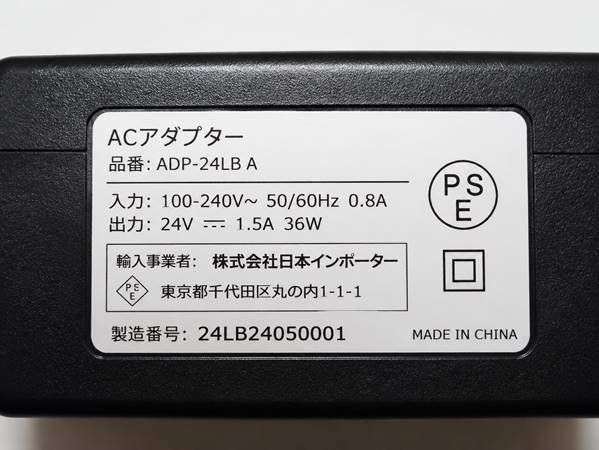
• Mark type: Specified electrical appliances use the diamond-shaped PSE mark, and non-specified electrical appliances use the circular PSE mark.
• Basic marking information: Usually, the name or registered abbreviation of the notifying business operator, and the product rated value (voltage/current/power, etc.) need to be marked; specified products also need to be marked with the name or mark of the registered inspection agency.
• Marking position: Most specified products must be marked on the product body in principle, and non-specified products can be marked on the body, packaging or instruction manual according to the requirements of the product item.
• Prohibition requirements: It is not allowed to fraudulently use, alter, or cover the PSE mark. Products that have not completed compliance shall not be marked with the PSE mark, otherwise it is a serious violation.
Certificate Validity Period and Notification Change/Abolition
Regarding validity period and changes, the rules for different documents are different:
• Business Notification: There is no fixed validity period. As long as the notifying entity exists and the business category and scope have not changed, it will remain valid and does not need to be renewed regularly.
• Conformity inspection certificate for specified products: The validity period depends on the product category, applicable standards and inspection agency rules, and there is no unified period. It is necessary to confirm in advance whether a re-application is required before expiration.
In the following situations, it is necessary to evaluate in time whether it is necessary to handle notification changes, re-perform compliance verification or update certificates:
1. The registration information and business scope of the notifying entity change;
2. The core safety structure, key safety components, and type scope of the product change;
3. The production factory of the product changes;
4. The applicable technical standards are revised.
The specific handling method shall be subject to METI regulations, certificate terms and the opinions of the inspection agency.
If the import/manufacturing business of a certain category of electrical appliances is terminated, it is necessary to go through the notification abolition procedures in accordance with regulations to avoid unnecessary subsequent responsibilities.
Daily Ongoing Compliance Obligations
After the product is launched, it is still necessary to perform ongoing compliance obligations to avoid violation risks:
• Keep all compliance documents in accordance with regulatory requirements, including test reports, notification-related documents, conformity inspection certificates, self-inspection records, shipment records, etc.
• When a product is found to have safety hazards, cooperate with the notifying business operator to report to METI, and take necessary measures such as recall and risk notification.
• Regularly pay attention to METI’s regulated list and regulatory updates, and adjust the compliance plan in time if the rules of the product category change.
Common Violations and Risks
Common violations include: false notification information, inconsistency between products and compliance documents, sales even after the conformity inspection certificate expires, unqualified PSE marks, launch and sale before completing compliance, etc. The corresponding risks can be divided into three categories, depending on the illegal act, document status and the rules of the competent authority/platform:
1. Statutory liability: Those who violate the provisions of the may face penalties such as fines and orders to stop sales, and in serious cases, may be prohibited from engaging in the manufacture/import of relevant electrical appliances.
2. Customs and import link risks: Japanese customs may require compliance certificates to be provided in accordance with the law during import customs clearance. Products with incomplete documents or unable to prove compliance may be temporarily detained, required to supplement documents or even returned.
3. Platform operation risks: Japan’s mainstream e-commerce platforms usually conduct random compliance inspections on regulated electrical appliances. If the compliance documents required by the platform cannot be provided, they may face penalties such as listing removal and sales restrictions.
Pitfall Avoidance Guide: Common Misconceptions and Solution Selection
The following are common compliance misconceptions, adaptation strategies for different entities and risk self-inspection methods, to help you avoid most pitfalls.
Clarification of High-Frequency Misconceptions
1. Misconception 1: With the PSE mark, there is no need to do business notification
Correct answer: The two are independent statutory obligations. Regulated products need to complete both the entity’s business notification and the product’s PSE compliance. Missing either one does not meet the requirements. Only marking without notification is a violation.
2. Misconception 2: One notification number can be used for all products
Correct answer: Notification is divided by category and type scope. Products beyond the notified scope need to be evaluated separately, and the same notification cannot be applied casually.
3. Misconception 3: METI compliance can be “guaranteed to pass”
Correct answer: Business notification is a statutory notification. It will be accepted if the documents are complete and meet the formal requirements, and there is no such thing as “pass or not”; conformity inspection has clear safety standards, and products that do not meet the standards cannot pass. Service providers can only help you standardize documents and reduce corrections, and it is impossible to promise “guaranteed pass”. Be cautious when encountering such publicity.
4. Misconception 4: Overseas manufacturers do not need to bear responsibility
Correct answer: As the product producer, overseas manufacturers are responsible for the product’s design and production quality. If safety problems are caused by product defects, they shall bear corresponding responsibilities in accordance with the law and the contract, and it is not possible to be completely exempt from responsibility just by finding a Japanese entity.
5. Misconception 5: The Electricity Business Law governs product compliance
Correct answer: Product compliance is under the jurisdiction of the . The governs the operation of the power industry such as power generation, transmission and sales. The two are completely different, so don’t confuse them.
Compliance Strategies for Different Types of Enterprises
Enterprises of different sizes and business models can choose adapted compliance strategies to effectively reduce costs and risks:
• Small sellers/start-ups (a small number of non-specified products): Choose a reliable third-party agency to provide Japanese entity + agency services, focus on verifying the agency’s actual office address and service capabilities, and avoid low-cost shell entities with no actual operation capabilities.
• Brand owners/large sellers (multiple specified products): You can register a local Japanese company or bind a long-term cooperative importer as the notifying entity, and declare same-series products jointly according to the type classification rules to reduce unit compliance costs.
• OEM factories (supplying to Japanese customers): The Japanese importer is the notifying entity, and the factory only needs to provide true and complete product technical documents as required. Do not bear the statutory responsibility of notification for customers to avoid additional risks.
Compliance Risk Level Self-Inspection
You can evaluate the compliance risk level according to your own situation, and high-risk items need to be reviewed emphatically:
• Low risk: Single product model, fixed production factory, stable Japanese responsible party, completely consistent documents and physical products.
• High risk: Multiple parties involved in OEM/ODM, mixed production in multiple factories, frequent model revisions, shipment first and then document supplementation.
The following types of products need to be reviewed emphatically: high-risk products such as charging/power/heating products, new products entering the Japanese market for the first time, projects with incomplete documents but requiring rapid launch. These are the most prone to compliance problems.
Criteria for Selecting Reliable Compliance Service Agencies
There are many agencies providing such compliance services now. You can refer to the following criteria when selecting to avoid unreliable service providers:
• Have a local Japanese physical office address, can provide entity qualification certificates, and have actual liaison and service capabilities.
• Can provide officially verifiable successful compliance cases of the same category, and have service experience in related projects.
• Do not promise “guaranteed pass”, will inform possible correction risks and handling solutions in advance, and seek truth from facts.
• Clear service scope, such as whether the Japanese notifying entity is included, whether document pre-audit is included, transparent charging, and no random additional fees midway.
For overseas manufacturers, the core logic of Japanese electrical product compliance is not complicated: first accurately determine whether the product is within the regulated scope and what type of compliance requirements it corresponds to, then select a suitable Japanese responsible party in combination with its own business scale, complete document preparation and compliance verification according to the process, and do a good job in continuous management of certificates, documents and changes after launch. As long as you clarify the responsibility boundaries and core requirements of each link and avoid common misconceptions, you can smoothly complete the electrical product compliance layout in the Japanese market.