
Foreign trade sellers targeting the Japanese market and people who like to buy Japanese digital products via cross-border e-commerce have most likely heard of a few terms: TELEC certification, MIC Giteki Mark, and Japanese radio certification. Many people get confused when they first encounter them: are these three different certifications, or are they the same thing? Why do some sources say you need to pass TELEC, while others say you need to affix the Giteki Mark?
In fact, these three terms belong to the same Japanese radio compliance system, just with different roles. Understanding their relationship can not only help you avoid being misled by agents, but also allow you to judge for yourself whether a product can legally enter the Japanese market.
First, Understand the Three Core Roles
Once you clarify the positioning of the three core roles, the relationship between them will become clear.
MIC: The Regulatory Body for Japanese Radio Compliance
The full name of MIC is the Ministry of Internal Affairs and Communications of Japan. You can think of it as the “chief steward” in charge of all communications and radio affairs in Japan. The legal basis for Japanese radio compliance is the , and MIC formulates relevant implementation rules and technical conditions based on this law, and is responsible for compliance supervision of the entire industry.
The Giteki Mark system is established based on the and relevant ministerial ordinances, public notices, and technical standards under the jurisdiction of MIC. MIC’s core work includes formulating Giteki-related rules, designating or registering third-party certification bodies, and supervising the professional conduct of these bodies. However, it does not directly certify specific products, but entrusts the specific certification execution work to qualified third-party bodies. If a certification body no longer meets the registration conditions or violates statutory obligations, MIC may take measures such as correction, business suspension, or even cancellation of registration in accordance with the law.
TELEC: A Well-Known Third-Party Certification Execution Body
The full name of TELEC is the Telecom Engineering Center. It is one of the third-party certification bodies designated by MIC. The official name for this type of body in Japan is “Registered Certification Body (RCB)”. Key point: TELEC is one of the RCBs, not the only one.
Its core work is to test and review the documentation of products applying for certification in accordance with the unified technical standards set by MIC, and issue Giteki certification-related certificates after passing. The reason many people call “Giteki certification” “TELEC certification” is that TELEC started earlier and has higher overseas recognition. Many agents and foreign trade practitioners casually simplify “Giteki certification issued by TELEC” to “TELEC certification”.
Giteki Mark: The Statutory Compliance Mark for Radio Products
The Giteki Mark (技適マーク) is Japan’s statutory unified compliance mark for radio products, equivalent to the “ID card” for radio products entering the Japanese market, not a “qualification mark” printed arbitrarily by manufacturers.
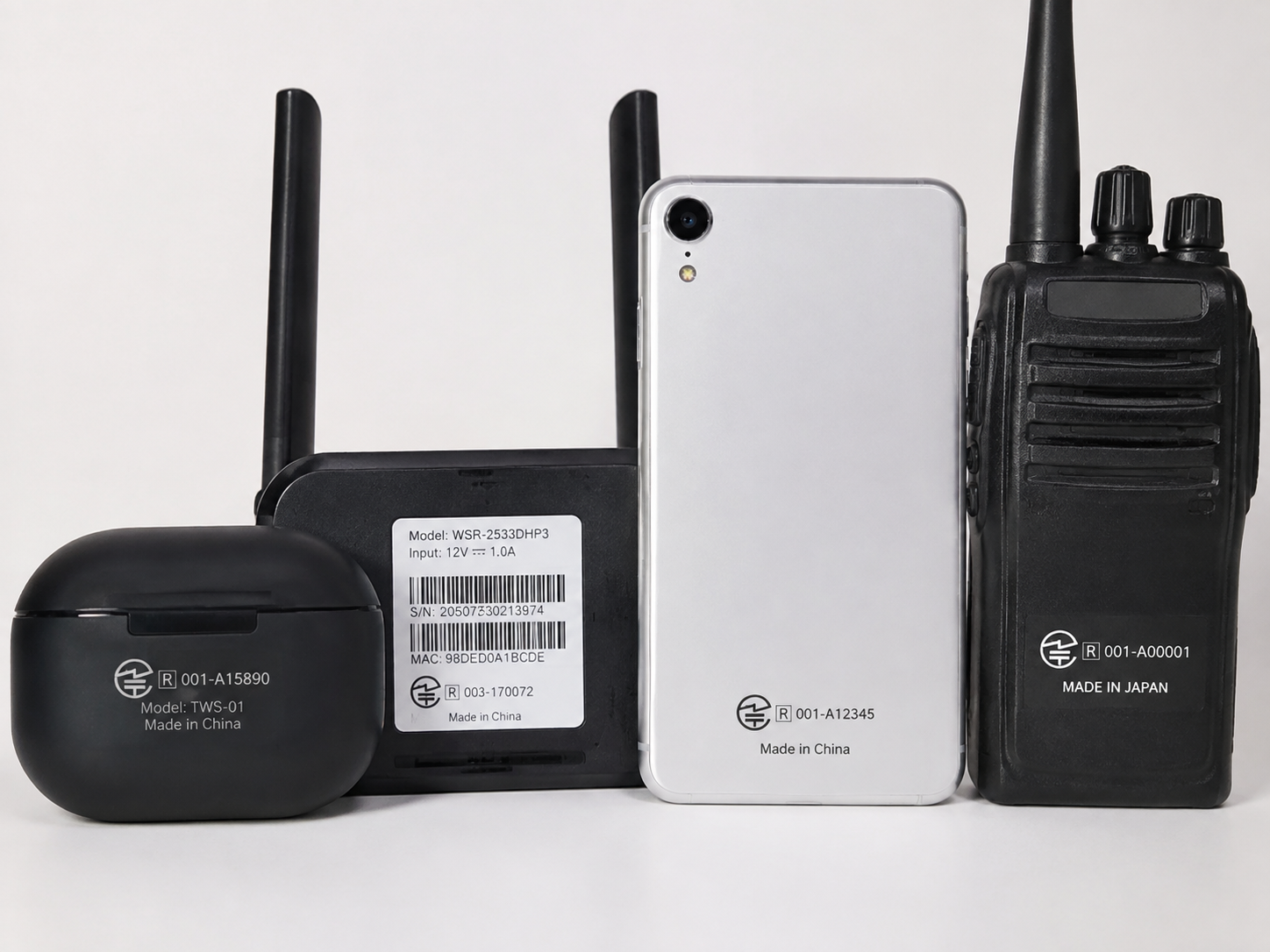
For radio transmitting equipment regulated by the , it is usually required to affix the Giteki Mark or number in accordance with regulations after passing certification; common devices with transmitting functions such as Bluetooth headsets, WiFi routers, mobile phones, and walkie-talkies mostly fall within the scope of regulation. The Giteki Mark shall be affixed to the device body in accordance with applicable rules; electronic display or other approved methods may be used if specified conditions are met, and relevant information on packaging or in manuals cannot of course replace the statutory marking obligation on the device body. For small devices with limited size (such as a single earbud of true wireless earphones, small sensors), if simplified marking or only marking the number is required, it must comply with the management rules of the corresponding device category and the specific provisions of MIC, and the complete mark cannot be omitted on one’s own just because the device is small.
Of course, there are statutory exceptions, but all need to meet corresponding regulatory conditions, and are not automatically exempted based on product name: devices that only receive and do not transmit, if they do not fall within the scope of radio transmitting equipment defined by the , are not subject to Giteki Mark requirements; low-power devices that meet exemption conditions such as Japan’s weak radio equipment do not need to obtain Giteki certification and affix the mark, but must strictly meet corresponding power, frequency band and other restrictions; prototypes only used for display and testing may be exempted from the marking requirements for ordinary marketed products only if they comply with MIC-related regulations such as temporary permits and testing systems, and are not sold externally or used as ordinary civilian equipment. The specific scope shall be subject to the latest provisions of MIC. In addition, note that legal import and sale, and legal operation of radio transmission are compliance requirements at different levels — even if products are allowed to enter the country in some cases, non-compliant equipment cannot activate the radio transmission function within Japan.
Why the Three Terms Are Often Used Interchangeably
At this point, you should understand the reason for the mixed use: on the one hand, it is colloquial simplification. For example, when a company gets Giteki certification done by TELEC, it is casually called “TELEC certification”, which actually refers to “Giteki certification issued by TELEC”; on the other hand, it is cognitive bias. Because TELEC is well-known, many people think it is the only body that can do this certification, and even think it is a government department, but neither is true.
Core Relationship: The Logical Chain from Rule-Making to Marking and Launching
Once you clarify the positioning of the three roles, their relationship becomes very clear. In essence, it is a complete logic from rule-making to compliant product launch, which can be understood in three layers.
Layer 1: The Entrustment Relationship Between Supervision and Execution
The establishes the basic institutional framework for Japanese radio compliance. As the regulatory body, MIC formulates specific implementation rules and technical conditions based on the law, and is responsible for registering and supervising third-party certification bodies.
RCBs such as TELEC are execution parties that have obtained MIC qualifications. They must carry out certification strictly in accordance with MIC’s unified technical requirements, have no right to adjust standards or relax requirements on their own, and all certification activities are subject to MIC’s supervision.
Layer 2: The Authorization Relationship Between Certification and the Mark
It should be noted that whether a technical standards conformity certificate is required, what certification path should be adopted, and how to mark should first be confirmed according to device category, frequency band, transmission conditions and applicable exemption rules, and should not be generalized solely based on “whether it has wireless function”. For products that need to be compliant through certification, the Giteki Mark is a unified statutory mark nationwide in Japan, not an exclusive mark of any particular body. Only products that have completed certification through an MIC-recognized RCB and meet the requirements are eligible to affix the Giteki Mark or number in accordance with regulations. No matter which qualified RCB issues the certificate, the appearance and legal effect of the Giteki Mark are consistent, and there is no such thing as a mark from a certain body being more authoritative.
Layer 3: The Binding Relationship Between the Mark and the Issuing Body
The unified Giteki Mark itself does not print the name of the issuing body, and is usually used with the corresponding certification number. However, the corresponding relationship between number format, certification category and issuing body will change with institutional adjustments and different device categories, so the issuing body cannot be directly judged solely by the appearance characteristics of the number; if you need to confirm the issuing entity, you should use the complete certification number to query in MIC’s public information or the official database of the corresponding registered certification body. Certification records from different issuing bodies can be verified through official channels, and no matter which RCB issues the certificate, the legal effect of the Giteki Mark is not affected.
Putting this logic into one sentence: MIC sets rules → enterprises select an RCB (such as TELEC) to apply for certification → pass the test and obtain the certificate → the product is launched with the Giteki Mark + number affixed in accordance with regulations.
Practical Identification: How to Judge Whether Giteki Certification Is Issued by TELEC
Often we need to confirm whether a product’s Giteki certification is issued by TELEC. For example, when asking an agent to handle certification, you may want to verify the executing body, or when shopping cross-border, you may want to check certification records. You can sort it out by following three steps.
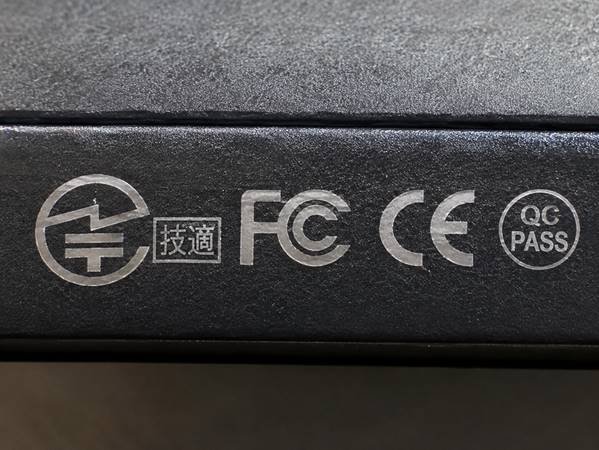
Step 1: Find the Giteki Mark. Look for the standard circular mark with the Chinese characters “技適” as specified by MIC. Do not judge solely based on the words “合格” (qualified) or “QC PASS” printed by the manufacturer, and do not mistake certification marks from other countries such as FCC and CE for the Giteki Mark.
Step 2: Find the certification number. Under normal circumstances, the number will be marked on the device together with the mark in accordance with regulations; for small devices with limited size, simplified marking that complies with the rules may be used, and in this case, just find the corresponding number. Note that do not mistake certification numbers from other countries for Giteki registration numbers; you should first confirm whether the mark conforms to the official style of the Giteki Mark.
Step 3: Verify through the official database. If you need to confirm whether the certification is issued by TELEC, you can use the complete certification number to search in the public database on TELEC’s official website. TELEC’s public database is completely free and does not require account registration. You can search by entering the registration number, product model, or certification holder name. The queryable content shall be subject to the records such as certification number, certification holder, device name or model actually displayed on the public page, and complete applicable boundary information such as software and hardware versions and antenna configurations may not be disclosed. The publication time of new certification records shall be subject to the update rhythm of the body’s system. If you cannot find the record, you should first check the complete number format, and then confirm with the certificate holder or the issuing body. Public records are only used to check certification filing information. The specific scope of application, version restrictions, antenna requirements and other validity boundaries of the product shall be subject to the official certificate and its accompanying conditions.
One more note here: if the mark or number is worn or obscured, do not guess blindly; just query through official channels.
Effectiveness Comparison: Similarities, Differences and Selection Logic Between TELEC and Other RCBs
Many people struggle when looking for certification: do I have to choose TELEC? Is a certificate issued by TELEC better than those from other bodies? In fact, the core conclusion is very clear: under the premise that the same applicable regulatory path, certification scope and product conditions are all met, all Giteki certifications issued by MIC-designated RCBs have exactly the same legal effect, and the differences are mainly at the service level.
We can see it more clearly with a table:
| Comparison Dimension | TELEC | Other MIC-Designated RCBs |
| Legal Effect | Valid throughout Japan, recognized by MIC (must meet certification coverage requirements) | Valid throughout Japan, recognized by MIC (must meet certification coverage requirements) |
| Technical Basis | Uniformly follows the technical requirements stipulated by MIC and relevant regulations | Uniformly follows the technical requirements stipulated by MIC and relevant regulations |
| Overseas Recognition | Relatively high; most foreign trade agents are more familiar with its processes | Relatively low; some bodies are only familiar to Japanese local practitioners |
| Current Registered Business Scope and Actual Acceptance Scope | Covers a wide range of device categories and frequency bands; specific acceptance eligibility must be checked against its current registration qualifications and supporting capabilities | Varies by body’s registration qualifications; covered devices and frequency bands differ, specific eligibility must be checked one by one |
| Cost and Cycle | Has its own acceptance schedule and fee rules; no unified industry standard | Each body independently formulates acceptance rules, fees and schedules; there are differences |
Since the effectiveness is the same, you don’t have to blindly choose TELEC when selecting a certification body. Just judge according to two priorities: first, look at the hard conditions — whether your product type, used frequency band, and applicable certification path are within the current registered business scope of the target body, and whether the supporting laboratory has corresponding testing capabilities; for common WiFi and Bluetooth products, most RCBs can accept applications. For niche or special types of devices, you should check their current registered business scope, acceptable device categories, and the testing capabilities of supporting laboratories one by one, and do not presuppose that only TELEC can handle it based on the body’s popularity. Second, look at actual needs, such as budget, certificate issuance cycle, and the agent’s familiarity with the body’s processes. A particular pitfall to avoid: do not pay extra premiums for so-called “TELEC exclusive certification” or “TELEC authoritative mark”. Such claims have no regulatory basis.
Scenario Judgment: Compliance Judgment for 3 Common Scenarios
After clarifying the basic relationship and effectiveness, let’s look at the three most common practical scenarios and how to quickly judge compliance.
Scenario 1: Exporting to Japan, Judging Whether a Product Can Be Launched Legally
First, categorize broadly: is your product a radio transmitting device regulated by the ? For example, ordinary wired earphones, power banks and other devices without transmitting functions do not fall within the scope of regulation and do not require Giteki certification; for devices with transmitting functions such as Bluetooth headsets and WiFi cameras, first confirm whether they fall within the statutory exemption scope (such as meeting the conditions of weak radio equipment, etc.). If they are not exempt, they need to complete the corresponding compliance procedures.
Next, verify: whether there is a Giteki certificate from an MIC-recognized body, and the actual product falls within the certification coverage — including model series, wireless modules, antennas, hardware versions, software versions and other listed conditions, and the Giteki Mark and registration number on the product are also consistent with the certificate. It should be noted that industrial, in-vehicle, and medical radio equipment may have additional industry compliance requirements, and you cannot only look at ordinary Giteki certification.
Scenario 2: Purchasing or Cross-Border Shopping for Japanese Products, Verifying Radio Compliance Records
First, it should be clarified here: the Giteki Mark and certification records can only verify the radio certification status of the product, and cannot alone prove that the product is genuine or that the channel is legal; judging authenticity also requires comprehensive confirmation combined with information such as sales channels, manufacturer model, and serial number.
The method for verifying radio compliance is very straightforward: first, according to the identification method mentioned earlier, find the Giteki Mark and registration number to initially judge whether there is a compliance mark; if you are not assured, you can check the records through the issuing body or MIC’s public database.
It should be specially noted here: products sold in batches must strictly meet the requirements that the Giteki Mark, registration number and compliance certificate correspond one-to-one, and the product falls within the coverage scope; if it is a small amount of personal cross-border shopping or brought into the country, it only means that it may meet the relevant entry regulations, and does not mean that the wireless transmission function can be legally activated within Japan — personal use also requires the device to meet the requirements of Japanese radio regulations, or meet the corresponding exemption conditions.
Scenario 3: After Product Modification/Accessory Replacement, Is the Original Certification Still Valid?
The core judgment criterion is: whether the modification changes the radio design or the applicable conditions of the original certification.
High-risk changes usually require re-evaluation of certification validity, and re-certification if necessary: for example, replacing antennas, replacing wireless modules, adjusting radio frequency parameters, upgrading transmission-related firmware, etc. These changes will directly affect core parameters such as transmission power and frequency.
Seemingly low-risk changes cannot be directly assumed to be compliant: for example, changing the shell, replacing the power supply, adjusting the structure around the antenna, changing the installation position, replacing some accessories, etc. Even if they seem unrelated to wireless functions, as long as they may affect radio frequency performance, it is necessary to re-evaluate whether they meet the original certification conditions.
Re-certification is usually not required only when it is confirmed that the modification does not affect the wireless design at all and does not violate the use conditions of the original certification (for example, only changing the outer packaging, adjusting appearance buttons for non-wireless functions, etc.). There is another common situation: using a wireless module that already has Giteki certification does not mean the whole device is compliant — module certification only covers the parameters of the module itself under standard test conditions. The whole device’s antenna selection, installation position, power limit, software configuration, etc. will affect transmission performance. Before the whole device is launched, the use conditions of the module must be checked, and whole-device certification must be supplemented if necessary.
Pitfall Avoidance Guide: The 5 Most Common Cognitive Misconceptions
Finally, let’s talk about the most common cognitive pitfalls. Many people may get confused even if they have been in the Japanese market for several years.
Misconception 1: Only the Giteki Mark Issued by TELEC Is Legal
Wrong judgment: Only Giteki certification issued by TELEC is legal and valid.
Key condition: All Giteki certifications issued by MIC-designated RCBs and within the applicable scope have exactly the same legal effect.
Action conclusion: No need to pay extra premiums for the title of “TELEC exclusive”.
Misconception 2: TELEC Is a Government Department, and It Formulated the Giteki Mark
Wrong judgment: TELEC is a government department and has the right to formulate Giteki Mark rules or “specially approve” certification.
Key condition: TELEC is a third-party registered certification body, and the rules and technical standards of the Giteki Mark are all formulated by MIC based on the .
Action conclusion: Do not believe unfounded claims such as “TELEC special approval” or “green channel”.
Misconception 3: Having a TELEC Certificate Means You Can Definitely Affix the Giteki Mark
Wrong judgment: As long as you get a certificate issued by TELEC, the product can legally affix the Giteki Mark.
Key condition: Legal marking requires simultaneous satisfaction of a valid certificate, the actual product’s model/software and hardware/antenna etc. falling within the certification coverage, and no modification to the wireless design.
Action conclusion: Be sure to check the consistency between the product and the certification coverage before purchasing or shipping.
Misconception 4: The Giteki Mark Is a Full Qualification/Globally Valid Proof
Wrong judgment: The Giteki Mark is a full qualification proof and is globally valid.
Key condition: The Giteki Mark only proves that radio transmission parameters meet the requirements of Japan’s , does not cover other dimensions such as safety and environmental protection, and is only valid in Japan.
Action conclusion: When exporting to other countries or needing other compliance proofs, you need to apply for the corresponding certification separately.
Misconception 5: If a Module Has a Giteki Certificate, the Whole Device Is Automatically Compliant
Wrong judgment: Using a wireless module with Giteki certification means the whole device automatically meets compliance requirements.
Key condition: Module certification only covers its own parameters under standard test conditions, and the whole device’s antenna, structure, software configuration, etc. will affect transmission performance.
Action conclusion: Before the whole device is launched, the use conditions of the module must be checked, and whole-device certification must be supplemented if necessary.
Final Summary
In general, MIC, TELEC, and the Giteki Mark are not three independent certification systems, but three roles with different positioning in Japan’s radio compliance chain: MIC is the rule-maker and supervisor, TELEC is one of the third-party registered certification bodies with MIC qualifications, and the Giteki Mark is Japan’s statutory unified compliance mark for radio products. When encountering related problems, first confirm the applicable regulatory path for the product, and then verify the matching between certification records and the product through official public channels. This way, you can avoid most cognitive misconceptions and accurately judge the compliance status.