
Many overseas sellers operating in the Japanese market ask the same question when they first encounter PSE certification: How many years is the validity period of this certification? This seemingly simple question cannot be answered with a single number. The valid status of PSE is not a license with a fixed term like a driver’s license; it must be comprehensively judged based on multiple factors such as the certificate, test report, and changes to the product itself, which directly affects whether your goods can clear customs smoothly and be sold normally on platforms.
PSE certification is a market access requirement for electrical products stipulated by Japan’s , with the Ministry of Economy, Trade and Industry (METI for short) as the regulatory authority. It should be noted that the PSE mark itself does not bear a unified validity period, and the validity cannot be judged solely by the information on the mark. For overseas sellers, the risk of certification invalidation is straightforward: at best, goods will be detained at Japanese customs and cannot clear customs; at worst, products will be directly removed from e-commerce platforms such as Amazon Japan, and in serious cases, they may face legal liabilities such as administrative sanctions and fines.
Before delving into the rules, let’s clarify three most easily confused concepts to avoid errors in subsequent judgments:
First, the difference from product shelf life — the shelf life is the service life of the product itself, a usage promise to consumers; while the PSE validity period is the compliance period for whether the product can be legally imported and sold in Japan, and the two are completely unrelated.
Second, the difference from the validity period of test reports — test reports are the supporting materials for applying for PSE certification, but the validity period of the report is not equal to the validity of the certification: for example, a diamond PSE certificate may have a 5-year validity period, even if the test report has passed the period marked by the institution, as long as the certificate status is normal and the supervision inspection is passed, the certification remains valid.
Third, the difference from the time limit required by platforms — the report time limits proposed by e-commerce platforms and importers are commercial rules, not the validity period stipulated by Japanese law. Even if it is not invalidated at the regulatory level, it cannot be listed if it does not meet the platform requirements.
In addition, there is a core premise that must be clarified first: PSE is divided into two categories, diamond and circular, with completely different rules, and they must never be judged by the same set of standards. Correctly classifying the type first will ensure that subsequent verifications do not go astray.
Validity Differences Between the Two Types of PSE
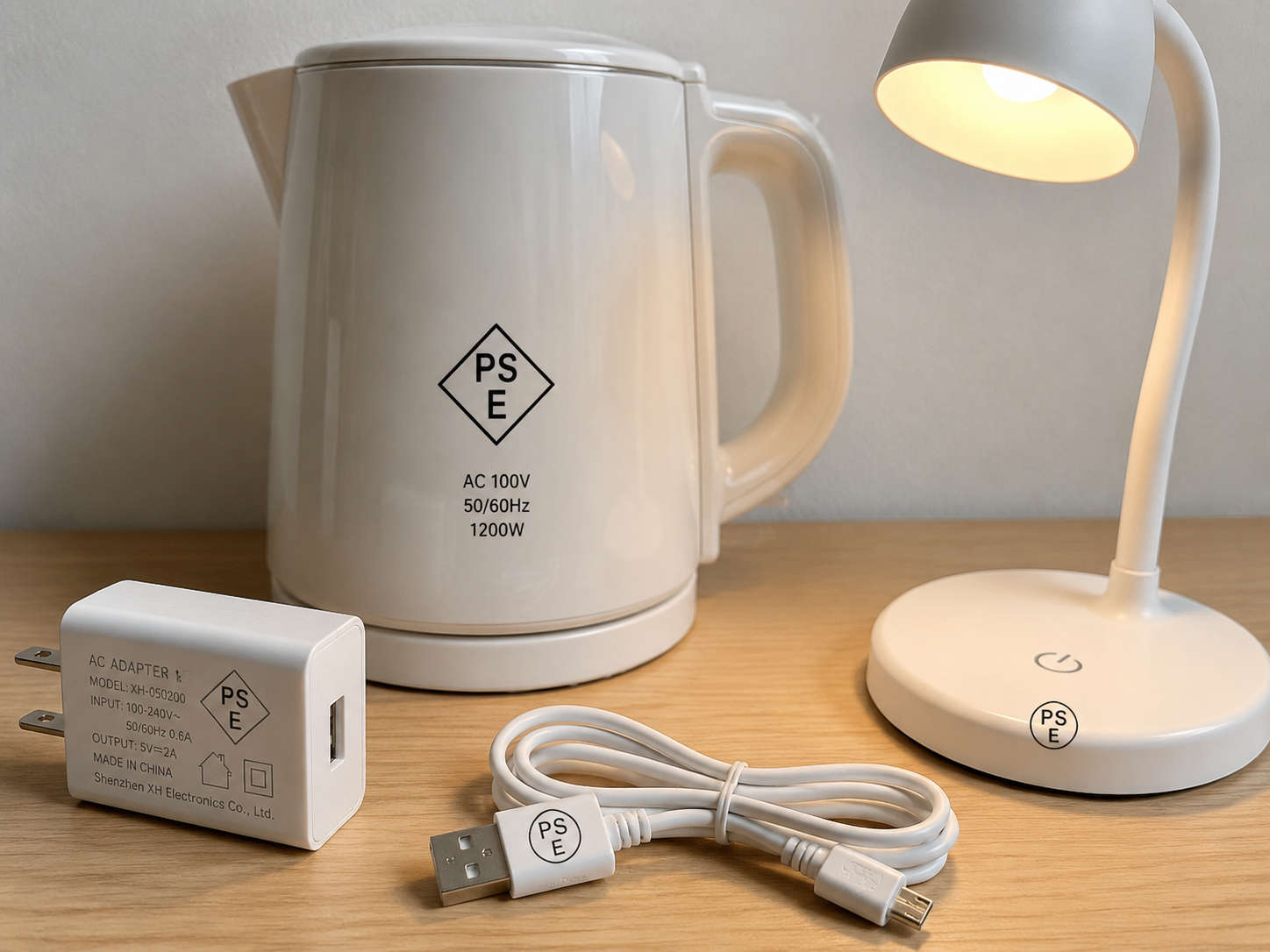
Distinguishing between the two types of PSE can actually be done in 10 seconds: Products with higher risks require certification issued by a third-party institution recognized by METI, with a diamond-shaped mark, commonly known in the industry as “diamond PSE”, and called “specified electrical appliances and materials” in regulations. Common examples such as mobile phone fast chargers, household electric kettles, and industrial wires of specific specifications fall into this category. Products with lower risks do not require third-party certification; enterprises can affix the circular mark after passing self-inspection and making a self-declaration, which is “circular PSE”, called “non-specified electrical appliances and materials” in regulations. For example, ordinary USB data cables and small desk lamps mostly fall into this category. Of course, the specific classification shall be subject to METI’s current list of electrical appliances and materials and product specifications. If you are unsure, it is recommended to check the official catalog instead of classifying based on experience.
Validity Rules for Diamond PSE
Japanese law does not set a unified validity period for diamond PSE. The specific term is determined by the issuing institution according to product categories and certification rules, and ultimately subject to the start and end dates marked on the certificate. Common reference durations in the industry are: 5 years for small home appliances such as mobile phone fast chargers and household electric kettles, and 7 years for products such as specific industrial wires, but these are only general cases, and everything shall be subject to the original certificate.
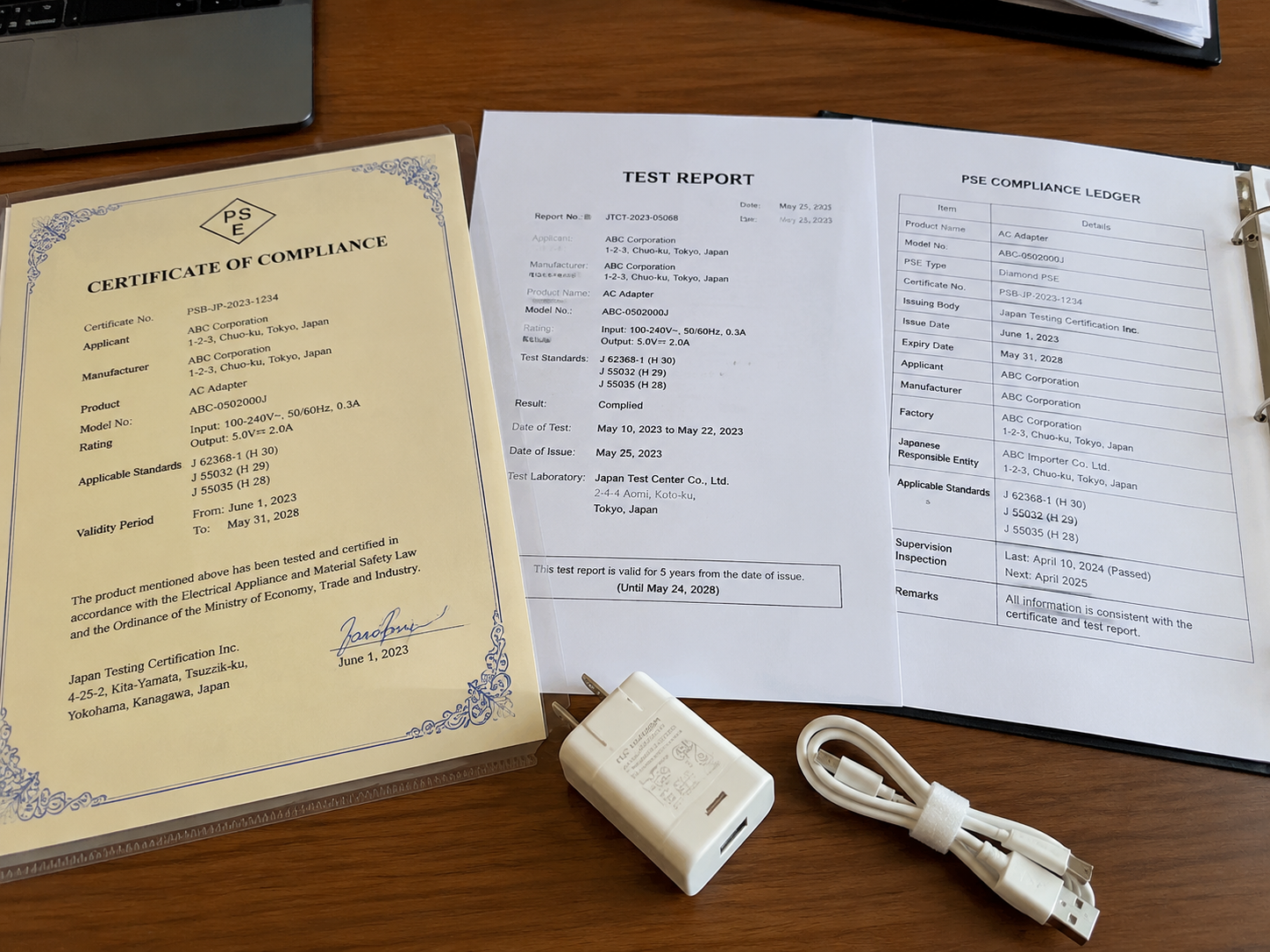
After receiving the diamond PSE certificate, be sure to first check several key pieces of information: issue date, validity start and end dates, covered product models, manufacturing factory, and Japanese responsible entity (i.e., Japanese importer or compliance officer). If any of these pieces of information do not match the actually imported and sold products, the certificate may be deemed invalid even if it is within the validity period.
In addition, diamond PSE is not a once-and-for-all matter after obtaining the certificate: the issuing institution will conduct regular supervision inspections on the manufacturing factory. If the inspection fails and rectification is not completed within the time limit, the certificate may be suspended or even revoked, which is equivalent to early invalidation.
Validity Rules for Circular PSE
The rules for circular PSE are very different from those for diamond PSE, and it is also the most easily misunderstood category: the Japanese government has not set a unified validity period for circular PSE at all, nor is there a “validity period certificate” issued by a government department. Its compliance logic is simple: as long as the product continues to meet Japan’s electrical safety technical standards, it can be sold legally.
The often-heard “5-year validity period for circular PSE” is actually an industry practice. Most test reports issued by third-party testing institutions mark a 5-year validity period, and many e-commerce platforms and importers also require reports issued within 5 years or even 3 years as compliance supporting evidence. However, this 5-year period is not a legal requirement, but only a reference at the institutional or commercial level.
To judge whether circular PSE is valid, there are three core elements: first, the validity period marked by the institution on the third-party test report (if any); second, whether the corresponding Japanese technical standards have been updated; third, whether the design, components, and structure of the product have changed.
Among them, the report period mainly affects the strength of supporting evidence and the acceptance of institutions and platforms, and is not directly equivalent to legal validity: reports that have not passed the period marked by the institution are more likely to be recognized by platforms and importers; even if the report is more than 5 years old, as long as the product has not undergone safety-related changes, the applicable standards are still the current valid version, and the enterprise can provide complete conformity assessment materials, it is not necessarily invalid at the regulatory level, but the platform or importer may require supplementary testing to meet commercial rules. Conversely, if product changes or standard updates result in non-compliance, the compliance will be invalid even if the report has just been issued for 1 year.
To facilitate a quick comparison of the differences between the two types, a core comparison table is compiled here:
| Comparison Dimension | Diamond PSE (Specified Electrical Appliances and Materials) | Circular PSE (Non-specified Electrical Appliances and Materials) |
| Official fixed validity period | No unified legal term, subject to the mark on the certificate | No official fixed validity period, no validity period certificate issued by the government |
| Core basis for validity | Certificate status + supervision inspection results + product consistency + validity of applicable standards | Compliance with current technical standards + product changes + requirements of reports/cooperating parties |
| Core causes of invalidation | Certificate expiration, failed supervision, unreported product/entity changes, end of standard update transition period | Product changes do not meet standards, no supplementary testing after standard updates, failure to meet commercial requirements |
| Responsible entity | Third-party issuing institution recognized by METI + Japanese importer | Self-responsible by the product selling/importing enterprise |
What Situations Will Cause PSE to Be Invalidated in Advance
Many people think that PSE will only be invalidated when the date on the certificate arrives, but this is not the case — there are many situations that can cause PSE to be invalidated in advance, even if the validity period has not yet expired.
The first is invalidation triggered by product-side changes. If core components directly related to safety are replaced, such as power cords, transformers, capacitors, batteries, fuses, etc., even if only the supplier is changed, it may affect safety performance. In addition, if the flame-retardant or insulating material of the shell is replaced, the circuit structure is adjusted, or parameters such as rated voltage/current are modified, the original compliance basis will also be invalidated. In this case, diamond PSE must be reported to the issuing institution for evaluation, and circular PSE must also undergo a new conformity assessment, and the original certification cannot be directly used.
The second is invalidation triggered by changes in production or responsible entities. For example, if the manufacturing factory relocates, the production line moves, or the OEM is replaced, especially for diamond PSE, the issuing institution must reconfirm the compliance of the production site, otherwise the certificate will be invalid for products produced by the new factory. In addition, after the Japanese responsible entity (importer) is changed, if the relevant information on the PSE mark is not updated simultaneously, it will also be deemed invalid.
The third is triggering at the regulatory and supervision level. Japan’s electrical safety technical standards are not static. When METI revises standards, a transition period is usually set: during the transition period, compliant products that meet the old standards can generally continue to be sold and imported, subject to official announcements; after the transition period ends, newly produced and newly imported products must meet the new standards, and old compliance documents will automatically become invalid. As for whether inventory already imported into Japan can continue to be sold, it shall be evaluated in combination with official requirements and product production time. In addition, if diamond PSE fails the regular factory supervision inspection and rectification is overdue, the certificate will be directly suspended or revoked.
There is another type of situation that is easily misjudged as legal invalidation: some platforms or importers require that the test report be issued within no more than 3 years, which is shorter than the 5-year legal or industry practice. Failure to meet such requirements will affect listing or cooperation, which is an additional constraint at the commercial level, not an inevitable invalidation at the regulatory level.
How to Query and Judge Whether PSE Is Valid
During verification, handle diamond and circular PSE separately:
Diamond PSE Verification Steps
The verification of diamond PSE can be carried out in this order to avoid missing key information:
First, check the validity start and end dates on the original certificate first — prioritize the original certificate, do not only look at screenshots or copies, to avoid information tampering.
Second, check whether the covered models, manufacturing factory, and Japanese responsible entity on the certificate are completely consistent with the products actually to be imported and sold. For example, if the model listed on the certificate is A and the product you sell is model B, even if the appearance is exactly the same, it is not within the coverage; if the manufacturing factory is changed, it is also not valid.
Third, verify the authenticity of the certificate. Prioritize verification through the official public query system of the issuing institution. If the institution does not have a public query channel, you can require the cooperating party to provide an official reply issued by the issuing institution to confirm that the certificate is authentic and valid.
Fourth, confirm whether the latest supervision inspection has been passed, whether there are records of suspension or revocation of the certificate, and at the same time confirm that the technical standards applicable to the certificate are currently valid and the transition period has not passed.
Circular PSE Judgment Method
Since circular PSE does not have an official certificate, its judgment is more flexible:
If there is a third-party test report, first check whether the report has passed the validity period marked by the institution, then confirm that the design, components, and structure of the product have not changed, and the corresponding Japanese technical standards have not been updated — meeting these three conditions can usually be used as an important basis for continued compliant sales. However, for complete compliance, it is also necessary to keep self-declarations, conformity assessment materials, compliance mark information, and relevant materials of the Japanese responsible entity to form a complete chain of compliance documents.
If it is a self-declaration made by the enterprise independently, regularly self-check whether there are changes in the product’s design, process, and components, and whether the corresponding technical standards are currently valid, to ensure that the product always meets the requirements.
When it involves platform listing or supplying to importers, it is also necessary to meet the other party’s commercial requirements such as report time limits.
Two Most Common Query Pitfalls
Many people make two low-level mistakes when checking the validity period, and here is a special reminder:
The first pitfall is thinking that what is printed on the PSE mark is the validity period. In fact, whether it is a diamond or circular PSE mark, the mark itself does not bear a unified validity period. The mark may contain information such as the issuing institution code, certification year, name of the Japanese responsible entity, and product rated information. The specific marked items need to be confirmed according to product categories and Japanese official marking rules. This information can only assist in verification and cannot replace the formal verification of certificates, reports, or self-declaration documents. In particular, do not take the certification year on the diamond mark as the start and end time of the validity period.
The second pitfall is thinking that as long as the certificate has not expired, all identical or similar products can use it. In fact, the PSE certificate only covers products of the models, specifications, and manufacturing factories clearly listed on it. Even if they are produced with the same mold, as long as the model is not listed on the certificate or they are not produced by the same factory, this certificate cannot be used.
What to Do When PSE Expires or Is Invalidated in Advance
If you really encounter the situation where PSE expires or is invalidated in advance, don’t panic, just handle it step by step.
First, confirm whether it is really invalid. In many cases, it is just a misreading of the date on the certificate, or the commercial requirements of the platform are regarded as legal invalidation — first check clearly: whether the certificate has really reached the validity period, or it is an early invalidation caused by product changes or standard updates, or it just does not meet the additional requirements of the platform. If it only fails to meet commercial requirements, for example, the platform requires a 3-year report but you have a 5-year one, just do supplementary testing, it is not a real legal invalidation.
After confirming invalidation, different types of PSE have different renewal methods:
For diamond PSE, it is recommended to apply for renewal to the original issuing institution 3-6 months in advance. If there are no major changes to the product, production site, or technical standards, generally only difference testing is required, no full retesting is needed, which saves time and money. If you apply to another issuing institution, there is a high probability that full testing will be required, and the cost and cycle will be much higher, so prioritize renewing with the original institution.
Renewal of circular PSE is simpler. If there are no major changes to the product, standards, or production site, just update the conformity assessment documents and self-declaration; if there are changes or the platform has requirements, just do the corresponding supplementary testing.
No matter which category it is, renewal without major changes will be faster and cheaper than a new application, so try to handle it in advance when the product has not been greatly adjusted, don’t wait until it is invalid to rush to make up for it.
The risks after invalidation should also be clear: if PSE is invalid for newly produced and newly imported batches, there are risks of being required by customs to supplement materials, suspending customs clearance, detaining goods, and being removed from platforms or restricted from sales. Compliance must be restored first before normal import and sales. As for inventory already imported into Japan, whether it can continue to be sold shall be evaluated in combination with the product shipment time and the regulatory requirements at that time. Generally, it is not recommended to continue selling to avoid complaints or penalties.
High-frequency Scenario Judgment and Daily Compliance Management
For daily judgment, you can prioritize 6 types of high-frequency scenarios:
1. The certificate has not expired, but parts such as power cords/batteries have been replaced. Will it be invalidated?
First, judge whether the replaced part is a safety-critical component — power cords, transformers, batteries, and fuses all fall into this category. If it is diamond PSE, you must first report to the issuing institution, and you can continue to use it only after the institution’s evaluation shows no problem; if it is circular PSE, you need to re-conduct a conformity assessment and update compliance materials, and cannot replace it directly.
2. The same product has a new color added, or the shell material has been changed. Is it a problem?
If only the appearance color is changed, and the material and performance of the shell remain unchanged, it will basically not affect the validity of PSE. But if the shell material is replaced, it is necessary to check whether the flame retardant and insulation properties of the new material meet Japanese standards; if not, it will be invalidated.
3. The adapter has PSE certification, but the whole machine does not. Is it okay to sell as a set?
The compliance of the whole machine or set cannot be proved solely by the PSE certification of the adapter. It is necessary to first confirm whether the whole machine and components such as adapters and power cords in the set respectively fall within the regulatory scope of the ; components falling within the regulatory scope need to meet the corresponding diamond or circular PSE requirements respectively, and sales are not recommended before compliance confirmation is completed. The compliance of the adapter does not mean that the entire product is compliant, and the certificate of a single component cannot be used as the compliance basis for the entire set of products.
4. The test report of circular PSE is more than 5 years old. Is it useless?
Not necessarily. First check whether there are changes in the product’s design and components, and whether the corresponding Japanese technical standards have been updated. If there are no changes, it is still compliant at the regulatory level. It’s just that if the platform or importer requires a report within 5 years, then supplementary testing is needed to meet commercial requirements.
5. The certificate has expired, but there is still inventory in Japan. Can it continue to be sold?
It depends on the batch: for inventory already imported into Japan, evaluate in combination with the product production time and the regulatory requirements at that time, and in some cases, it can continue to be sold; but for new batches that have not been imported, renewal must be completed first before customs clearance, otherwise there is a risk of goods being detained and customs clearance being suspended.
6. The same model has different batches, or a minor facelift has been done. Will it affect the validity?
The core is to see whether the materials and processes are consistent between batches or before and after the facelift. If it is just a minor appearance adjustment, without touching safety-critical components and structures, there is basically no problem; but if it involves changes to safety-critical components, circuit adjustments, or parameter changes, compliance needs to be re-evaluated.
In fact, as long as you do a few small things well in daily life, you don’t have to wait until it is invalid to rush to make up for it:
• As soon as you receive the PSE certificate, check clearly the information such as validity period, covered models, manufacturing factory, and Japanese responsible entity, and record them uniformly in the compliance ledger, don’t wait until you need to use it to rummage through.
• Before the product is facelifted or parts are replaced, first evaluate whether it will affect the validity of PSE. Don’t find that the certification is useless after the modification, which wastes money and delays things.
• Keep change records of safety-critical components and consistency verification documents for each batch, so that you can provide evidence in case of random inspections by customs or platforms.
• Start the renewal process 6 months in advance, don’t wait until only one or two months are left to handle it. If there is a problem in the middle, it is easy to cause a sales gap.
• Before settling on a new platform or cooperating with a new importer, first ask clearly about the other party’s additional requirements for PSE validity period, don’t find that it does not meet the requirements after the goods are prepared.
• Review at least once a year: check whether the corresponding Japanese technical standards have been updated, whether safety-critical components have been replaced, and whether the Japanese responsible entity has changed, to respond to changes in advance.
Finally, let’s mention two easily overlooked cognitive boundaries: First, the PSE validity period only applies to the Japanese market and has nothing to do with the certification rules of other countries. Certifications from other countries cannot replace PSE, and conversely, PSE cannot be used in other countries. Second, the fact that circular PSE has no fixed validity period does not mean it is once-and-for-all. As long as the product is modified or standards are updated, a compliance assessment must be re-conducted, otherwise problems will still occur.
Summary
So far, the core content about PSE validity period is almost covered. After reading this, you can at least independently judge these three things:
First, you can quickly distinguish the validity differences between diamond and circular PSE, and distinguish between legal terms, test report periods, and platform commercial requirements, and will no longer confuse them.
Second, you can independently verify the validity of PSE, judge whether it is a normal expiration or early invalidation, and also understand the compliance requirements of the standard update transition period.
Third, you can plan renewal in advance, deal with compliance issues in common scenarios such as facelifts, part replacements, and inventory handling, and avoid the core risks of customs detention and platform removal.