
Many cross-border sellers and finished product manufacturers targeting the U.S. market have fallen into this pit: when sourcing, suppliers say the parts “have UL certification”, but when applying for UL certification for the finished product, UL states that this is component recognition, which does not meet the requirements. You either have to conduct supplementary testing or replace the parts, which not only costs money but also delays the launch time.
Many people cannot tell the difference between UL component recognition and common UL finished product certification, nor do they know how to verify authenticity and judge whether a part is usable. This article will thoroughly explain the rules of UL component recognition from basics to practical operation, helping you avoid common pitfalls in sourcing, certification, and cross-border sales.
Basic Understanding: What is UL Component Recognition
UL component recognition is commonly known as “RU recognition”. In plain terms, it is a safety assessment for safety-related parts installed inside finished products that are not directly sold to end users. Its core function is very practical: it reduces repeated testing in UL certification for finished products, shortens the certification cycle, and lowers costs. UL is one of the Nationally Recognized Testing Laboratories (NRTL) recognized by OSHA (Occupational Safety and Health Administration of the United States). Its component recognition results are often accepted in UL certification for finished products and B2B sourcing safety audits; it is not an independent market access certificate for end consumers, and is only used for internal component safety assessment within the supply chain.
Whether you are a finished product R&D engineer, procurement specialist, supply chain manager, or a compliance novice who has just come into contact with U.S. safety certification, these rules are useful as long as you deal with parts bearing the UL mark.
People who are new to this are prone to two typical misunderstandings that need to be corrected first:
First, it is not a “miniaturized version of UL finished product certification”. Parts that have obtained component recognition can only be installed inside finished products for supporting use, and cannot be sold separately to ordinary consumers. For example, a built-in power supply with UL recognition is fine when installed in a speaker, but if it is sold separately as a mobile phone charger in individual packaging, it is non-compliant. Products directly intended for consumers require UL finished product listing.
Second, it is not a “quality certification”. UL component recognition only assesses safety-related items, such as whether there is a risk of electric leakage, fire, or hazards caused by overheating, and does not cover performance, service life, or user experience at all. For example, a switch with UL recognition only means that it will not cause safety problems when used within its rated parameters, but it does not mean that it will not fail after 100,000 operations, nor does it mean that it has a good feel.
UL component recognition is actively applied for by the component manufacturer or supplier. The basic process is very clear: the manufacturer first submits technical documentation and test samples, UL conducts testing according to the corresponding safety standards. After passing the test, an initial factory inspection is required to confirm that the mass production capacity is consistent with the samples. Finally, a unique File Number is assigned to the project. In terms of cost, since only the safety of the component itself needs to be tested, and there is no need to conduct an overall safety assessment of the finished product, the testing cost is usually 30%-50% lower than that of the same type of finished product certification, and the specific proportion depends on the type and complexity of the part.
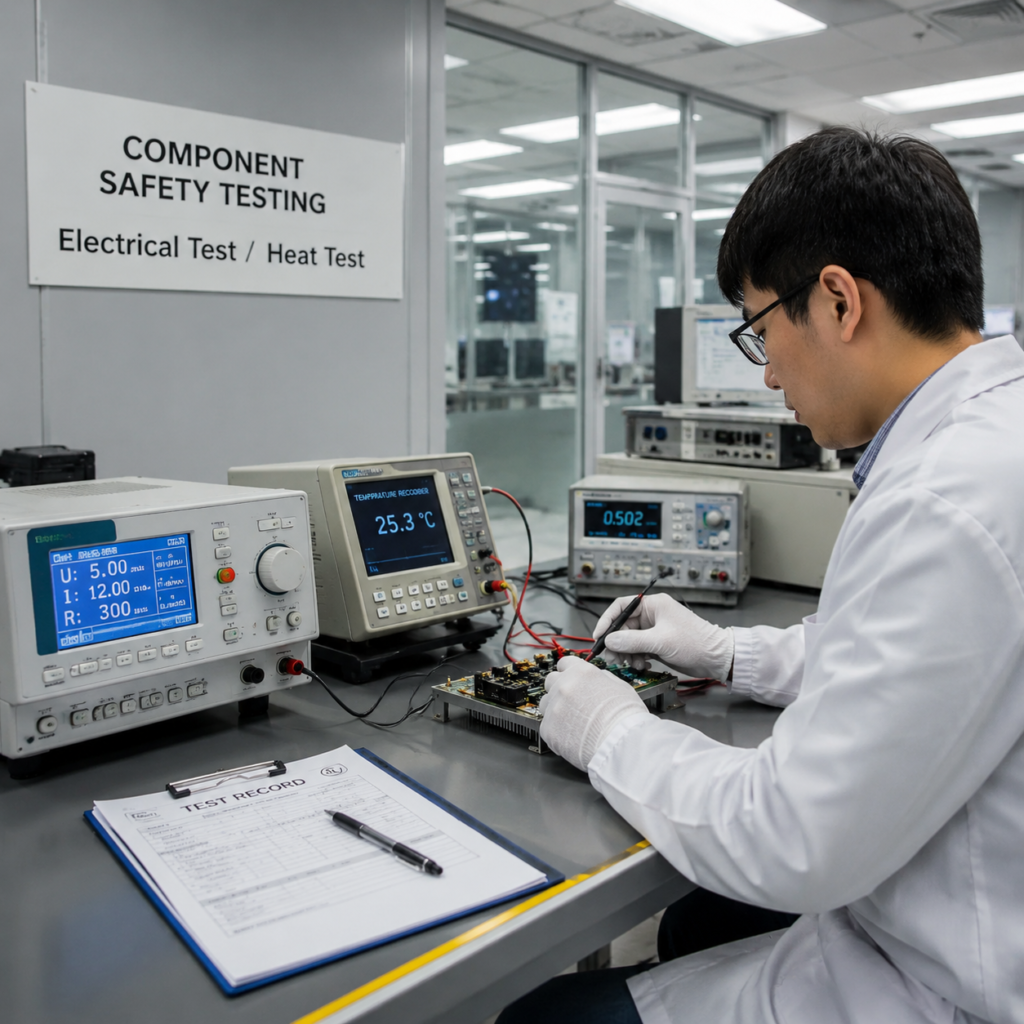
Essential Distinction for Beginners: UL Component Recognition vs UL Finished Product Listing
Many people cannot distinguish between UL component recognition and UL finished product listing — after all, both bear the UL logo and have a unique File Number, but their assessment levels and applicable scenarios are completely different. If you mix them up, at best the certification will fail, at worst the products will be detained.
We can quickly distinguish them from four core dimensions:
| Comparison Dimension | UL Component Recognition | UL Finished Product Listing |
|---|---|---|
| Certification Object | Components installed inside finished products that are not sold separately to end users | Complete finished products directly used by end users |
| Mark Style | Recognition mark with the words “RU” or “Recognized” | Circular listing mark with the word “LISTED” |
| Validity Rules | Has clear usage condition restrictions; only valid when the conditions are met | Meets the safety requirements of all end-user scenarios, and can be directly marketed to consumers |
| Market Application | For B2B supply chain supporting use, for procurement by finished product manufacturers | Universal for end consumers, retail channels, and e-commerce platforms |
Two common pitfalls need special reminder here:
First, do not assume that all UL marks are for the same type of certification. Both have the UL mark and a unique File Number, but their assessment strictness and applicable scenarios are vastly different. The simplest preliminary distinction method is to look at the core text on the mark: those with “RU” are component recognition, and those with “LISTED” are finished product listing.
Second, passing component recognition absolutely does not mean that a finished product installed with this part will automatically pass UL certification. Finished product certification assesses the safety of the entire product, including the coordination between parts, overall structure, heat dissipation, protection, etc. Qualified parts are only the basic prerequisite, and do not mean the finished product is qualified.
The two are not completely inconvertible. If a component has undergone complete testing according to the safety standards for finished products and is sold separately to end users, it can apply for upgrading to UL finished product listing. Conversely, if you treat products that should have finished product listing (such as direct-plug power strips and mobile phone chargers) as “components” to apply for recognition or sell them, once discovered, you will face product detention, platform removal, or even penalties.
Applicable Boundaries: Which Parts Need/Do Not Need Recognition
Not all parts installed in finished products need UL recognition. There are clear boundaries for whether they can be recognized and whether they need to be recognized.
First, let’s look at two core judgment criteria. Only parts that meet both criteria are suitable for UL component recognition:
First, it is a component of the finished product and will not be sold independently to end users;
Second, it performs safety-related functions — if it fails, it may cause safety risks such as fire, electric shock, and overheating.
For example, the power board in a speaker is part of the finished product, and its failure may cause electric leakage and fire, so it meets the requirements; while the decorative plastic sheet in the speaker is neither sold separately nor poses safety risks when damaged, so it does not need recognition.
Common UL-recognized components on the market are mainly divided into three categories:
The first category is electrical components and modules, such as switches, connectors, fuses, built-in power supplies, and LED drivers, all of which are directly related to circuit safety;
The second category is safety-related materials, such as insulating plastics, PCB substrates, flame-retardant housing materials, and potting adhesives — recognition of such materials is often called “UL Yellow Card”, because the earliest recognition documents were yellow cards, a term many veteran procurement staff have heard of;
The third category is structural and functional parts, such as wires and cables, thermostats, terminal blocks, and cooling fans. Failure of these parts may also bring safety risks.
There are three types of situations that are not suitable for UL component recognition:
The first type is independent finished products sold directly to consumers, such as power strips and mobile phone chargers, which should have finished product listing;
The second type is parts that only serve decorative or fixing functions and have no safety risks, such as ordinary decorative sheets and ordinary screws. Even if installed in finished products, they do not need separate recognition;
The third type is special components that exceed the coverage of UL’s existing safety standards. Without corresponding standards, conventional component recognition cannot be carried out.
There are also two situations where separate component recognition can be exempted, so you don’t have to spend the money:
One is low-risk, non-safety-critical auxiliary parts whose requirements have been fully covered by the corresponding finished product safety standards. They can be evaluated together with the finished product without separate application for recognition. It should be noted that wires and cables, insulating materials, terminal blocks, etc., even if installed inside the finished product, are usually safety-critical parts. Whether they can be exempted from separate recognition shall be judged according to the corresponding finished product standards and the requirements of UL engineers.
The other is customized exclusive non-universal parts that are only used for a specific finished product. These can be tested together with the finished product without separate application for component recognition.
Beginner Practical Operation: Identify the Mark + Verify Authenticity in 1 Minute
After understanding the basic concepts, next is the most practical operation: how to identify the UL component recognition mark, and how to check whether it is real and valid.
A formal UL component recognition mark must have three elements: the official UL logo, the words “RU” or “Recognized”, and a unique File Number. These marks are usually printed on the component body, the smallest packaging, or the accompanying technical documents. The RU recognition mark shall not be used to indicate that the finished product has passed UL certification; if a UL mark is printed on the outside of the finished product, you need to check its specific mark category and official database records, and cannot directly judge it as finished product listing solely based on the UL text. For beginners, there is a quick distinction tip: look at the core text on the mark. Those with “LISTED” are mostly finished product listing, and those with “RU” are component recognition.
When you get a part with the RU mark, don’t just stop at seeing the mark; all the information on it is useful:
First is the File Number, which is the unique number of this recognition project, equivalent to its “ID number”. You can find all details of the recognition using this number;
Then are the rated parameters, such as rated voltage, rated current, and temperature resistance grade, which are the upper limits for safe use of the part. Exceeding them may cause problems;
There are also some special restrictions, such as “for indoor dry environment only” and “must be installed in a ventilated position” — the official name of these restrictions is “Conditions of Acceptability”. Simply put, the recognition is only valid when these conditions are met.
Just looking at the mark is useless, as there are many cases of forged marks. You must check UL’s official database for confirmation. The query method is very simple and can be done in 1 minute:
First, open UL’s public database UL Product iQ, which can be used with a free registered account; if you are checking material recognition (that is, UL Yellow Card), you can use another UL database, UL Prospector, which is more convenient.
Then enter the part’s File Number or accurate model number, and you can find the corresponding recognition information.
After finding it, be sure to check four pieces of information: whether the manufacturer is consistent with the actual product, whether the model number matches, whether the rated parameters meet your usage requirements, and whether there are any usage restrictions you cannot meet. Finally, confirm that the recognition status is “Active”.
A reminder here: the consequences of forging UL recognition marks are very serious. Not only will products be detained by U.S. Customs and removed from e-commerce platforms, but they will also affect the UL certification of downstream finished product manufacturers, and even be held accountable by UL.
Several problems are often encountered during queries. Here are the unified handling methods:
If no record is found, don’t rush to say the supplier is committing fraud. It may be that the File Number is entered incorrectly, the model number is entered incorrectly, or the recognition has been revoked. You can first ask the supplier for the accurate File Number and then check again;
If the found information is inconsistent with the actual product, such as different manufacturers or different rated parameters, you must take the information in UL’s official database as the standard, and ask the supplier for a reasonable explanation. Otherwise, do not use the part;
If the status is found to be suspended or revoked, this part must absolutely not be used in new designs or new procurement. Otherwise, UL will not accept it during finished product certification.
Intermediate Basics: Core Rules of Recognition
After understanding the basic identification and query, next we will talk about something deeper: the core rules of UL component recognition. These rules are the key to judging whether a recognition is usable and whether it will be accepted by UL. People engaged in procurement, design, and compliance must understand them.
First core rule: All UL component recognitions are “conditionally valid”.
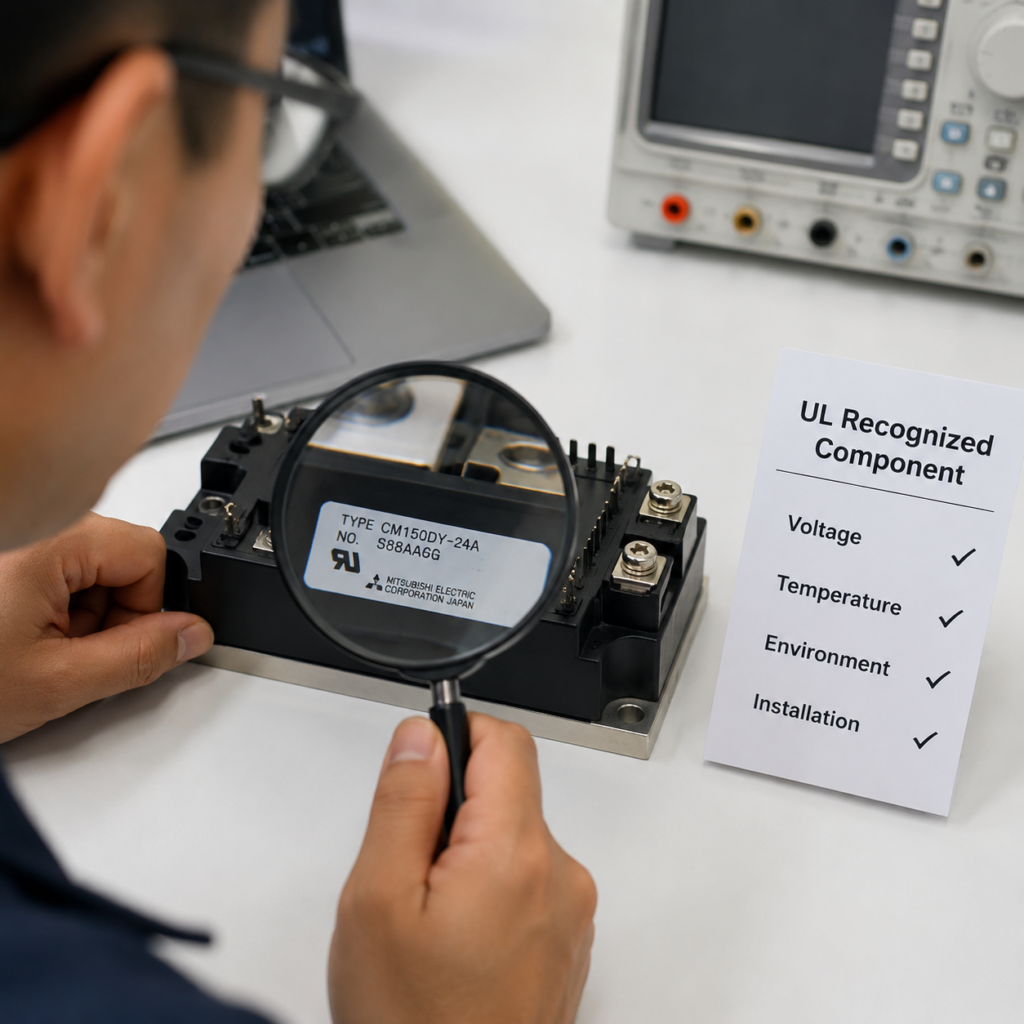
That is to say, the recognition is only valid under the specific conditions during testing. In actual use, all conditions must not exceed the marked limits, otherwise the recognition will automatically become invalid.
There are five common restriction dimensions: electrical parameters (voltage, current, power, etc.), temperature resistance grade, usage environment (indoor/outdoor, dry/humid, etc.), installation method (for example, whether it needs to be fixed on a heat sink), and pollution degree (for example, whether it can be used in a dusty environment).
The same part used in different finished products may have completely different recognition validity. For example, a capacitor with a temperature resistance of 85°C is valid when used in a router with good heat dissipation and a maximum internal temperature of only 70°C; but if it is used in an industrial power supply where the internal temperature often reaches 90°C, exceeding the temperature resistance limit, the recognition will become invalid. UL will not accept it during finished product certification, and additional supplementary testing will be required.
The consequence of out-of-range use is clear: the recognition automatically becomes invalid, and the safety test for this part has to be redone during finished product certification, which instead delays time and costs more money.
Second core rule: Acceptance rules in finished product certification.
We often say that component recognition can save money on finished product certification. Essentially, UL will accept the results of component recognition that meet the requirements, exempting part of the repeated safety tests.
But not all parts with the RU mark will be accepted. There are three common situations where UL will not accept them: first, parameter mismatch, where the actual parameters you use exceed the rated value of the part; second, invalid recognition status, such as having been revoked; third, failure to meet special restrictions, for example, it is required to be installed on a heat sink but you did not install it that way.
As for how much testing can be saved, generally speaking, it can reduce 10%-30% of the finished product testing volume, depending on the product type and test items. For example, power supply products have many internal key parts, so more testing can be saved; for some simple small home appliances, less testing can be saved.
Third core rule: Validity period and maintenance rules.
Many people think that UL recognition is valid for life once obtained, but that is not the case. UL component recognition does not have a fixed lifetime validity. UL conducts unannounced follow-up inspections at factories every year to ensure that mass-produced products are consistent with the originally submitted test samples.
There are three common reasons for recognition invalidation: first, failed factory inspection, for example, the mass-produced materials have been changed, the process has changed, and they are different from the test samples; second, UL’s safety standards have been updated, and the manufacturer has not updated the recognition in time; third, the safety-related structure, materials, or production address of the part have changed, and the manufacturer has not reported to UL in advance.
A special reminder here: any safety-related changes, such as changing insulating materials, modifying circuit structures, or changing production factories, must be reported to UL in advance and go through the change process, otherwise the recognition will be directly invalidated.
What if the recognition is revoked? According to UL’s rules, parts produced after revocation can no longer bear the UL recognition mark; but compliant inventory produced before revocation can usually continue to be circulated and used, subject to UL’s official notice.
Intermediate Practical Operation: Compliance Judgment Methods for Common Scenarios
After understanding the rules, let’s look at several most common scenarios in daily work and how to judge compliance.
First scenario: Sourcing and design component selection.
Many procurement staff only ask “does it have UL recognition?” when selecting parts, which is far from enough. Formal procurement inspection requires five steps: Step 1, confirm that it is a component recognition mark with the word “RU”, not other UL certification programs; Step 2, query in UL’s official database to confirm that the recognition status is active; Step 3, verify that the rated parameters of the part are greater than or equal to the actual usage parameters, and it is safer to leave a certain margin; Step 4, confirm that the usage environment, installation method, etc. all meet the special restrictions of the recognition. The parameter and condition verification here not only looks at electrical values such as voltage and current, but also covers all Conditions of Acceptability, such as temperature resistance grade, usage category, insulation/flame retardant grade, installation direction, heat dissipation conditions, pollution degree, indoor/outdoor or humid environment restrictions, etc. Failure to meet any one of them may lead to invalidation of the recognition. Step 5, archive the query results as compliance records, which can be directly submitted during subsequent finished product certification.
If it is design component selection, there are a few tips: prioritize selecting universal parts that already have UL recognition, so you don’t have to spend money on recognition yourself; when selecting, choose according to the extreme usage conditions of the finished product. For example, if the maximum operating temperature of the finished product is 80°C, select parts with a temperature resistance of at least 90°C to leave enough margin; if the part has special restrictions, be sure to confirm in advance that your design can meet them. Don’t wait until the finished product is tested to find that it does not meet the requirements, as it will be too late to modify the design by then.
Second scenario: Component replacement.
Manufacturers often encounter situations of changing suppliers or model numbers. Many people think “if the specifications are similar, you can replace them directly”, which is completely wrong. Even for parts of the same series, as long as the model suffix, material, manufacturer, or version changes, the recognition scope must be rechecked — it is very likely that the previous model has recognition but the new model does not, or the recognized parameters are different.
When replacing parts, in addition to verifying the validity of the recognition, you must also confirm that the safety performance of the finished product is not affected after the replacement and still meets UL’s requirements. Otherwise, even if the part itself is compliant, the finished product may fail the certification.
Third scenario: Compliance judgment for cross-border sales.
Many friends engaged in cross-border e-commerce ask: I sell repair parts, do they need UL certification?
If they are universal components for repair and replacement, such as switches and fuses for home appliances, having UL recognition makes it easier to pass the compliance audit of e-commerce platforms and less likely to be detained.
But note: if your parts can be used independently, such as adapters and power strips that can be used by plugging in directly, even if you say they are “repair parts”, they must have UL finished product listing, not just component recognition. This is the most common pitfall in cross-border sales — many people treat products that should have finished product listing as components to apply for recognition, resulting in customs detention and platform removal, causing great losses.
Common Misconception Pitfall Avoidance Guide
Finally, we have sorted out several most common misconceptions to help you quickly review and avoid pitfalls:
Misconceptions about Marks and Authenticity
- Misconception: All marks with the letters “UL” are component recognition marks → Correction: You need to check the “RU/Recognized” text and unique File Number, and take the official records of UL Product iQ as the standard.
- Misconception: A mark printed on the product is valid → Correction: You must query the official database to confirm the status is active and the information matches the actual product before it counts.
Misconceptions about Validity Cognition
- Misconception: Parts with UL recognition can enable the finished product to automatically pass UL certification → Correction: The finished product still needs separate overall safety assessment, and qualified parts are only a basic prerequisite.
- Misconception: The recognition certificate is valid for life → Correction: It needs to pass annual follow-up inspections. Standard updates or unreported safety-related changes may lead to invalidation.
Misconceptions about Selection and Usage
- Misconception: Models of the same series can be directly used interchangeably → Correction: Models of the same series with different suffixes, materials, or rated values may have different recognition scopes, and need to be checked one by one.
- Misconception: It’s enough if the supplier says it meets the requirements → Correction: The information in UL’s official database is the sole basis for compliance judgment.
- Misconception: Exceeding parameters a little doesn’t matter → Correction: Exceeding the restriction conditions will automatically invalidate the recognition, and additional supplementary testing is required for finished product certification.
Learning Summary
At this point, the core content of UL component recognition is almost covered. After reading this article, you should be able to do the following things:
First, you can quickly distinguish between UL component recognition (RU mark) and UL finished product listing, know their respective applicable scenarios, and will not mix them up;
Second, you can query the authenticity, status, and restriction conditions of component recognition through UL’s official database, and will not be deceived by fake marks;
Third, you can judge whether a recognized part meets the requirements in common scenarios such as sourcing, design, component replacement, and cross-border sales, and will not fall into pitfalls;
Fourth, you can identify common compliance misconceptions and reduce safety and compliance risks in sourcing, finished product certification, and cross-border sales.
In actual use, the core judgment points are to check the RU mark, the active status in the official database, and whether the rated parameters match the Conditions of Acceptability, to ensure that the recognized parts meet the safety requirements of the actual application scenario.