
If you live in the EU or run a cross-border business, you have definitely heard of the “common charger” initiative — in the future, mobile phones, earphones, and tablets will all use USB-C, so there is no need to stockpile a bunch of different chargers. But many people don’t know that this policy is not just empty talk: all relevant products to be sold in the EU market must meet statutory compliance requirements before they can be placed on the market. This content covers everything from entry-level to advanced knowledge, explaining testing requirements, judgment criteria, and pitfall avoidance methods clearly. You don’t need to understand professional jargon; whether you are an ordinary consumer or a cross-border practitioner, you can understand the compliance logic and troubleshoot common charging problems on your own.
Beginner Basics: What Testing Is and Which Products Require Testing
What Is Testing: Mandatory Access Threshold for EU Charging Products
Simply put, this is the compliance verification link under the EU common charger policy. The core logic of the EU’s access to electrical and electronic products is: the manufacturer first determines all applicable regulations for the product, selects a compliant verification method (usually testing), compiles complete technical documentation, signs the Declaration of Conformity (DoC, a legal document in which the manufacturer formally commits to product compliance), and then can affix the CE mark to enter the EU market.
The role of testing is to verify whether the product meets regulatory requirements. Not all products must be tested by third-party laboratories or officially authorized Notified Bodies (NB) — third-party involvement is only required when the product does not use officially recognized harmonized standards, or when regulations explicitly require NB intervention.
The core of common charger-related testing focuses on two points: first, whether it is universal across brands, and second, whether it is safe. Charging speed is not an assessment target — a product will not be given a higher rating just because it charges faster than others, but tests will check USB PD protocol support, whether the nominal power is true, and whether the power labeling is consistent, to avoid misunderstanding performance compliance as “fast charging speed ranking”. The ultimate goal of the policy is to reduce e-waste, so that users do not have to repeatedly buy new chargers when switching devices of different brands.
Two Types of Test Objects: Differences in Regulatory Basis for Devices and Chargers
Charging-related products are divided into two major categories, corresponding to different EU regulations, and cannot be confused:
One category is the device side, that is, portable electronic products that need charging such as mobile phones, tablets, and earphones, which are based on the revised Radio Equipment Directive (RED), the core content of the common charger directive; the other category is separately sold chargers (external power supplies), which are based on the EU Ecodesign Regulation for external power supplies, a supporting requirement of the common charger policy.
If a charger is included in the product packaging when purchasing a device, the requirements are more special: it must meet both the regulatory requirements for the charger itself and the common charger provisions for compatibility with the device it is bundled with.
Effective Dates and Covered Products: Which Categories Need Testing and When
Different product categories have different mandatory effective dates and applicable regulations. Remembering three key time points covers most daily products:
The first is December 28, 2024, for device-side (RED revision requirements): categories of portable radio equipment with wired charging function listed in the regulations, commonly covered categories include mobile phones, tablets, e-book readers, Bluetooth earphones/earbuds, over-ear headphones, portable speakers, handheld game consoles, portable navigation devices, digital cameras, wireless keyboards, wireless mice, etc.; among them, small-sized wearable devices such as smartwatches need to be comprehensively determined based on the list issued by the EU official, the radio function attributes of the product, and the wired charging configuration, and cannot be directly included in the scope solely by the category name.
The second is January 1, 2025, for external charger-side (Ecodesign regulation requirements): separately sold external chargers with a power of 100W or less, specifically designed to power portable electronic devices, must meet the interface, protocol, and energy efficiency requirements supporting the common charger; this does not apply to chargers for special products such as power tools and medical devices.
The third is December 28, 2026, also for device-side (RED revision requirements): laptops with wired charging function will be added to the mandatory scope.
The specific product coverage scope is subject to the latest updated list issued by the EU official.
Exemptions and Special Scope: Which Products Are Not Subject to This Common Charger Requirement
Not all products with charging function need to comply with this common charger requirement. Several categories need special explanation:
First, devices without wired charging function, such as earphones that only support wireless charging and ordinary wired mice, are not subject to this wired charging common requirement; second, non-radio small electronic devices, such as ordinary electric toothbrushes without Bluetooth, do not fall into the category of radio equipment and are not within the scope of the common charger under the RED revision; then, external chargers with power exceeding 100W are not included in the special requirements for external power supplies supporting this common charger, but still need to comply with other applicable EU regulatory obligations such as safety and electromagnetic compatibility (EMC).
In addition, special categories such as medical devices, industrial portable equipment, electric bicycles, and power tools are usually managed by special product regulations or category rules. Whether they are subject to the common charger requirement needs to be determined according to the specific product attributes, and they are not within the general coverage of this initiative.
Finally, it should be noted that this policy only binds new or refurbished products sold as commodities in the EU market, and second-hand products brought in for personal use are not restricted by this policy — for example, if you bring an old mobile phone from China for your own use, it is completely fine, but if a merchant sells refurbished phones in the EU, it must meet the corresponding requirements.
3 Basic Misconceptions Beginners Most Easily Get Wrong
People who are new to this policy are most likely to fall into three cognitive pitfalls, which are clarified here first to avoid getting more confused later:
The first misconception is “having a USB-C port means meeting the requirements”. In fact, this is not correct. In addition to the shape of the interface, many items such as charging protocol, safety, and labeling information need to be tested. Just having a USB-C shaped port is far from enough;
The second misconception is “wireless charging must also comply with the common charger requirement”. In fact, the mandatory interface and protocol requirements of the common charger described in this article only apply to the wired charging part. Wireless charging still needs to comply with other applicable EU regulatory requirements such as safety, EMC, and radio, and is not within the mandatory general scope of this common charger;
The third misconception is “products that meet the requirements must come with a charger”. On the contrary, the policy allows manufacturers not to include a charger, but it must be marked with a clear unified icon on the packaging, and cannot be hidden in the small print of the manual to mislead users.
Clarifying the Rules: Regulations and Standards for Testing
Only by understanding the difference between directives, standards, and certifications can you understand the underlying logic of compliance.
Directive vs Standard: The Difference Between Legal Requirements and Testing Methods
To use a simple analogy: a directive is like the traffic rules set by the EU, it is a law, which clearly stipulates “what basic requirements must be met to be sold”, such as “devices included in the scope must have a USB-C port for charging” and “devices included in the scope with wired charging power exceeding 15W must support the USB PD fast charging protocol”. Violations mean the product cannot be placed on the market;
Testing standards are like the operating rules of a driving test, they are specific testing operation guidelines, stipulating “how to test to be considered compliant”, such as how many millimeters the interface size must be accurate to, and how many insertions and removals count as qualified.
The relationship between the two is: if the test passes using “harmonized standards” listed in the Official Journal of the European Union (OJEU), it can be directly presumed to meet the corresponding basic legal requirements; if non-harmonized standards, old versions of standards, or enterprise-owned test schemes are used, the enterprise needs additional evidence to prove that the scheme fully covers the regulatory requirements, and cannot be directly equated with compliance.
The core responsibility for the entire compliance process lies with the manufacturer: first determine the product scope of application, identify all applicable regulations, select harmonized standards (or equivalent methods) that cover the corresponding basic requirements, complete testing and technical documentation compilation, sign the DoC and then affix the CE mark. Third parties or Notified Bodies are not a necessary link for all products.
Four Types of Core Testing Standards: What Each Covers
There seem to be many testing standards related to the common charger, but they are actually classified into four categories, covering all core requirements from the outside to the inside. Each category has corresponding commonly used harmonized standards, which can be used to verify the validity of test reports:
The first category is interface physical type, which manages the size and insertion/removal durability of the USB-C interface, ensuring that cables and devices of different brands can be plugged in and used stably, without loose connections or easy falling off; the commonly used harmonized standard is EN 62680-1-3 (USB Type-C Cable and Connector Specification).
The second category is charging protocol type, which manages the “communication rules” between devices and chargers — for example, PD fast charging is a common language. If the device and the charger do not speak the same language, they will not charge or can only charge slowly. This type of standard ensures that cross-brand charging and fast charging can work normally; the commonly used harmonized standard is EN 62680-1-2 (USB Power Delivery Specification).
The third category is safety type, which manages safety during charging, such as no electric leakage, no fire, no overheating, and both the device side and the charger side need to be tested; the commonly used harmonized standard for the device side is EN 62368-1 (Safety of audio/video, information and communication technology equipment), and the charger side may apply EN 62368-1 or EN 61558 series safety standards depending on the product category.
The fourth category is electromagnetic compatibility (EMC, in plain terms “no mutual interference during charging”): during charging, it will not interfere with nearby WiFi or Bluetooth earphones, and conversely, when there is external interference, it will not suddenly stop charging; the commonly used harmonized standards for radio equipment are EN 55032 (Electromagnetic emission requirements) and EN 55035 (Electromagnetic immunity requirements).
It should be noted that safety and EMC standards are general requirements for electrical and electronic products, not new content added by the common charger; the new content specifically added by the common charger is mainly requirements related to interfaces and protocols. The validity of all harmonized standards is subject to the latest status in the Official Journal of the European Union, and expired or revoked standards cannot be used for conformity presumption.
Analysis of Common Certifications: The Relationship Between CE, USB-IF, MFi and Testing
There are many certification names on the market, and their relationship with the EU common charger test is completely different. Don’t confuse them:
The CE mark is a mandatory access mark for most electrical and electronic products in the EU. The manufacturer can only affix the CE mark after completing the conformity assessment of all applicable EU regulations for the product, compiling technical documentation and signing the DoC; the relevant requirements of the common charger are only part of the CE compliance for radio equipment or external power supplies within the scope, not the entire CE requirement.
USB-IF certification is a voluntary certification carried out by the USB industry association, equivalent to an “excellence award” in the industry. Having it means the product is doing well in USB compatibility, but it cannot replace the EU’s statutory compliance requirements. Even with USB-IF certification, the product must complete compliance assessment in accordance with EU requirements before being placed on the market.
MFi certification is Apple’s exclusive certification for its own accessories, which has nothing to do with the EU’s common charger requirements, and MFi should not be used as a basis for compliance.
Misconceptions in Standard Use: Not All USB Standards Can Directly Prove Compliance
There is another easily overlooked detail: not just any USB standard test can directly prove compliance. Priority should be given to the harmonized standard versions listed in the Official Journal of the European Union that can still confer conformity presumption; if non-harmonized standards, old versions of standards, or enterprise-owned test schemes are used, additional evidence is required to prove that they fully cover the corresponding legal requirements, and they cannot be directly equated with compliance.
For manufacturers, it is not enough to just write “supports USB-C” on the packaging. They must be able to produce a complete chain of compliance evidence, otherwise it cannot be considered compliant.
Device-Side Testing: Core Test Items for Mobile Phones, Tablets, Earphones, etc.
Device-side testing is the one people are most exposed to, after all, the mobile phones and earphones we buy fall into this category. The core test items are divided into four categories.
Interface Physical Test: Check If the Interface Is Correct and Durable
This is the first key judgment point on the device side for “having a USB-C port does not mean compliance”: it must be an interface that supports charging, and the physical parameters must meet the standards.
The most basic requirement is: the device must have at least one USB-C port specifically for charging — if that USB-C port can only be used for data transmission and charging requires another interface, it does not meet the requirements.
The durability requirement is based on the applicable USB-C interface harmonized standard (such as EN 62680-1-3). Under standard test environment, the durability test index of standard USB-C male and female connectors is usually that they still meet electrical and mechanical performance requirements after 10,000 insertions and removals; this value is a test index under laboratory standard conditions, and is not directly equivalent to the actual service life in daily use. The actual service life is affected by many factors such as usage habits, cable quality, and insertion/removal force.
There is also mechanical strength testing: test items (such as bending resistance, tensile resistance) are determined according to applicable product safety and interface standards, to avoid interface loosening, falling off or damage during normal daily use, so that the interface will not be torn off or the cable will break inside when pulled.
Charging Function Test: Check If Universal Charging and Fast Charging Work
This part is the core of the common charger, mainly testing universality, and all judgments have clear preconditions.
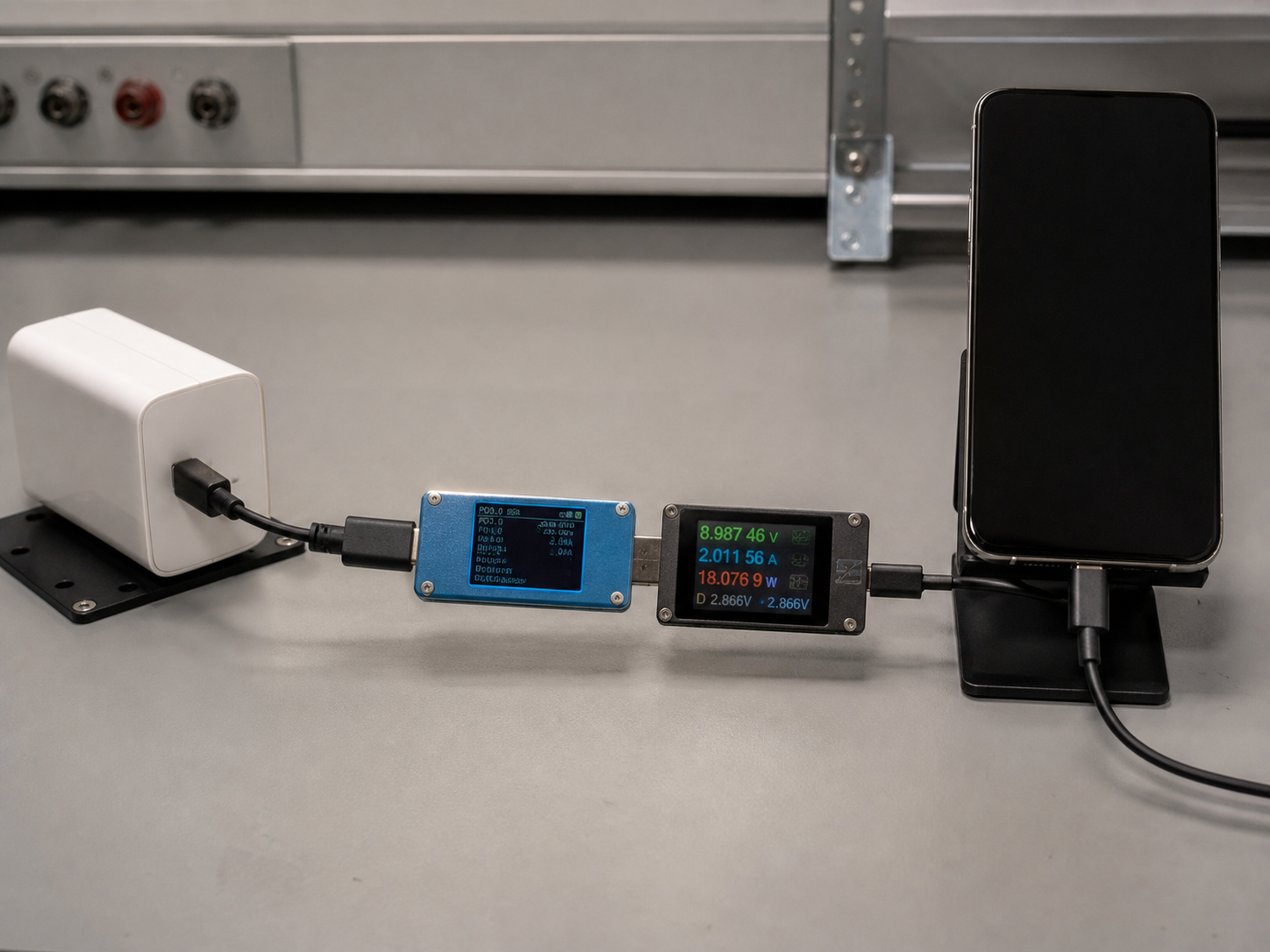
The core requirement for basic charging compatibility is that cross-brand charging works normally, and it cannot only recognize original chargers. Under the premise of using a standard-compliant USB-C cable and the charger’s output voltage and current levels covering the device’s minimum charging input range, compliant devices should be able to complete basic charging negotiation with standard-compliant USB-C chargers, and there should be no situation where “only the original charger can charge, and other compliant chargers have no response at all when plugged in”.
The mandatory requirement for PD fast charging is: for devices included in the common charger scope with wired charging power exceeding 15W, support for the USB PD fast charging protocol is mandatory. The judgment boundary is: if the device does not support the PD protocol at all and can only be charged with its own proprietary protocol, it is clearly non-compliant; if the device supports PD, but the charging speed varies due to differences in charger power levels, PPS (Programmable Power Supply) support, cable capability, and the device’s own charging strategy, as long as PD charging can be started normally and the nominal PD power level is true, it is not necessarily a violation.
The core requirement for power authenticity is that the nominal power must not be falsely labeled. The maximum charging power marked on the device must meet the measurement error and limit requirements specified in the applicable standards, and there must be no situation where it is labeled 65W but actually only reaches 40W at most.
The core requirement for cross-power adaptation is that adaptation to chargers of different power levels must not damage the device. Under the premise of normal PD protocol negotiation, using a low-power PD charger to charge a high-power device can normally charge slowly in low-power mode and will not burn out the device; using a high-power PD charger to charge a low-power device will automatically adapt to the maximum power supported by the device, and there will be no overvoltage or overcurrent.
Safety and Electromagnetic Compatibility Test: Check If There Are Problems During Use
Safety testing is the foundation of all electronic devices. Charging-related safety requirements are verified in accordance with applicable product safety standards (such as EN 62368-1), mainly including two aspects: first, under scenarios such as normal charging and abnormal operation, the temperature of accessible parts does not exceed the standard limit. The specific limit varies depending on the contact part, material, test environment and product category, and a unified value cannot be applied to all products; second, in case of short circuit, overvoltage, or overcurrent, the device’s protection function must meet the requirements to avoid the risk of electric leakage or fire; protection measures can take various forms such as power reduction, current limiting, power off, etc., and do not have to be complete power off.
Electromagnetic compatibility (EMC) testing ensures basic user experience, and is divided into two parts: emission and immunity: emission testing requires that the electromagnetic interference generated by the device during charging does not exceed the limits specified by the EU, and will not cause unreasonable interference to the normal use of other surrounding electronic devices; immunity testing requires that the device can still maintain normal charging under the specified external electromagnetic interference environment, and will not stop charging for no reason. In daily use, if the surrounding interference is too strong, there may still be temporary effects, which is a normal situation.
Labeling Information Test: Check If Users Can Understand the Parameters
Testing not only covers the product itself, but also whether users can understand the parameters to avoid being misled. Labeling information requirements depend on applicable regulations and product categories, and the core includes three aspects:
First, charging capability information: the charging interface type and rated input voltage current/power range must be clearly marked on the product label, manual or official specification page, so that users can choose a suitable charger;
Second, included charger labeling: for devices included in the common charger scope, the unified icon specified by the EU must be used on the packaging to clearly indicate whether a charger is included, and it must not be hidden in the small print of the manual;
Third, information consistency: the officially disclosed statutory charging parameters must be consistent, and users must not be misled by vague publicity that “you must buy the original charger to use it”.
Marketing publicity content on e-commerce pages must comply with EU consumer protection regulations, but it is not a core item of the common charger special test.
Two Unique Compliance Pitfalls on the Device Side
Regarding device-side compliance, there are two very common misconceptions that require special attention:
The first is “a USB-C charging port must support PD fast charging” — only devices within the scope with wired charging power exceeding 15W are mandatorily required to support PD. The USB-C port of some older or low-power devices may only support 5V slow charging, which is not a violation. However, if the device itself has a charging power exceeding 15W but does not support PD, it is non-compliant;
The second is “supporting PD will definitely achieve the maximum charging power” — the maximum power requires matching of three factors: the charger’s PD level, the carrying capacity of the charging cable, and the device’s own charging strategy (such as temperature and power limits). Differences in speed are normal and not necessarily a violation.
Charger-Side Testing: Core Test Items for Chargers
Separately sold chargers (external power supplies) have a similar testing logic to the device side, but with different focuses, and only apply to products included in the common charger ecodesign scope. There are three core test items.
Interface and Labeling Test: Check If the Output Port and Markings Are Compliant
This is the key judgment point on the charger side for “having a USB-C port does not mean compliance”: it must be a USB-C output port that supports PD, and meet safety and energy efficiency standards.
Interface requirements: for external chargers included in the common charger supporting ecodesign scope, with power ≤100W, and powering portable electronic devices, it is required that at least one USB-C output port supports the USB PD fast charging protocol; multi-port chargers only need to meet the requirement of at least one PD USB-C port, and the remaining interfaces can be configured according to the manufacturer’s design, but the output capability of each interface must be clearly marked.
Labeling requirements: the charger body must clearly mark rated input and output parameters, brand, model, certification marks and other information in accordance with applicable safety and ecodesign regulations, and the markings must be wear-resistant and not easy to fall off; the packaging or product specification page must clearly mark the type of each output interface, supported PD power levels, single-port/combined output modes, and whether it meets relevant ecodesign requirements.
Charging Performance Test: Check Fast Charging, Stability, and Energy Efficiency
Charging performance is the core of the charger, mainly testing four items:
The first is PD protocol compatibility: external chargers within the scope with power exceeding 15W must support the USB PD protocol, can normally negotiate charging with compliant PD devices of different brands, and cannot only support devices of their own brand;
The second is output power stability: during single-port output, the nominal power level must be stably output for a long time under the conditions specified in the applicable standards, and cannot drop power or stop charging after more than ten minutes;
The third is multi-port simultaneous charging test: multi-port chargers must clearly mark the single-port output power and the combined output power/dynamic distribution rules when multiple ports are used at the same time. The actual test results must be consistent with the labeled statement, and there must be no situation where “the single port is labeled 65W, but each port is only 10W when dual ports are charging at the same time without prior notice”;
The fourth is energy efficiency test: energy efficiency requirements such as standby power consumption are implemented in accordance with the specific limits and test conditions of the EU Ecodesign Regulation for external power supplies. The limits vary for external power supplies of different power levels and types, and are subject to the applicable regulation version and standards; energy efficiency requirements only apply to ≤100W external chargers within the scope. External chargers exceeding 100W are not subject to this special energy efficiency requirement, but still need to comply with other applicable regulations.
Safety Test: Check Protection Functions and Shell Temperature
The safety test of the charger is verified in accordance with applicable safety standards, focusing on two aspects: first, protection function: in case of overvoltage, overcurrent, short circuit, or overheating, it can automatically start protection, and there must be no electric leakage when plugged in; second, shell temperature: during full-load output, the temperature of parts that can be touched by human hands must not exceed the standard safety limit, so as not to burn the user.
Two Unique Compliance Pitfalls on the Charger Side
Regarding charger compliance, there are also two common misconceptions:
The first is “the higher the power, the harder it is to pass the test” — whether the test passes depends on whether it meets the requirements of the applicable standards, and has no direct relationship with the power level. A 100W charger can pass as long as all indicators meet the standards; it’s just that high-power products usually require more detailed tuning in thermal design, safety protection, and EMC control, and the design difficulty may be higher, but the test standards are not stricter.
The second is “chargers with a USB-C output port meet the common charger requirements” — in addition to having a USB-C port, chargers within the scope also need to support the PD protocol, meet safety, EMC, energy efficiency and other requirements. Many low-cost no-name chargers have a USB-C interface, but only have a 5V basic circuit inside, do not support PD, and have not passed relevant compliance tests, which are non-compliant.
Advanced Judgment: How to Read Test Conditions and Results
After understanding what is tested, you can further learn how to judge whether the test results are valid and how to check compliance. You don’t need to understand professional jargon for this part, just focus on the key points.
Test Preconditions: What Factors Affect Test Results
Testing is not just plugging in anywhere to test. The environmental conditions, supporting equipment, and sample status of all tests must strictly meet the requirements of applicable test standards, otherwise the results cannot be used as a basis for compliance judgment.
Specifically, it includes three aspects:
First, environmental conditions: temperature, humidity, air pressure, electromagnetic environment, etc. are set according to the standards corresponding to the test items. For example, the normal temperature test environment for most electronic devices is usually around 20℃-25℃, but the requirements of different standards and different test items may vary; too high or too low temperature will affect the test results of items such as power and temperature. If power reduction or protection activation occurs during daily use, it is necessary to comprehensively judge whether it is normal based on the rated use environment of the product manual and applicable safety standards, and cannot be uniformly attributed to product problems or environmental problems.
Second, supporting equipment: the instruments used for testing must be calibrated, and the test cables, reference equipment, loads, etc. must meet the parameter requirements specified in the standards. Ordinary consumer-grade products bought casually cannot be used as substitutes, otherwise the results have no reference value.
Third, product status: the test should use finished products in the final mass production state. The test results of engineering prototypes cannot directly represent the final model put on the market; the initial battery power, preprocessing procedures, etc. must also be implemented in accordance with standard requirements. For example, the maximum power test usually starts from a low power state to avoid the device automatically reducing power when fully charged, which affects the results.
Report Validity Judgment: How to Tell If a Test/Declaration Is Real
There are many compliance statements and test reports on the market. To judge whether they are valid, focus on four points:
First, look at the responsible subject and qualification chain: the core document for CE compliance is the Declaration of Conformity (DoC) issued by the manufacturer, which is the manufacturer’s statutory commitment, and must list all applicable regulations for the product, adopted standards, manufacturer information, etc.; test reports can be issued by the manufacturer’s internal laboratory or a third-party laboratory. Only when the product does not use harmonized standards, or when regulations explicitly require Notified Body (NB) intervention, is a certificate or report issued by the NB required, and not all products need an NB stamp.
Second, look at standard applicability: the standards used in the report must be harmonized standards that are currently valid and have conformity presumption effect in the Official Journal of the European Union (OJEU), and the standards cover the corresponding basic regulatory requirements; if old versions of standards, non-harmonized standards, or enterprise-owned test schemes are used, additional evidentiary materials are required to prove that they fully cover the regulatory requirements, otherwise they cannot be directly used as a basis for compliance.
Third, look at product consistency: the product brand, model, hardware version, firmware version, and core component solutions (such as interface chips, power chips) on the report must be completely consistent with the products on sale; if changes that may affect compliance occur (such as interface solution changes, charging protocol firmware updates, power architecture adjustments), retesting is required, and old reports cannot continue to be used.
Fourth, look at report completeness: a formal test report should include the report number, test date, sample information, test configuration, adopted standard version, results of each test, description of non-conformities, the seal of the testing institution or information of the authorized signatory, etc. Reports with only conclusions and no test details have questionable credibility.
How Ordinary Users Can Check Compliance
Ordinary consumers usually cannot obtain the complete test report of the product directly. For daily compliance checking, you can focus on three types of public information, without worrying about professional jargon:
First, product labeling and packaging: whether there is a CE mark, whether the charging interface type and rated power/voltage current parameters are clearly marked, and whether devices within the scope are marked with a unified icon indicating whether a charger is included;
Second, official specification information: on the brand official website or the product parameter page of regular e-commerce platforms, check whether the charging protocol and input/output parameters are clear — if it is a low-power small device (such as Bluetooth earphones, wireless mice), focus on checking the interface type, input parameters and safety marks, and there is no mandatory requirement for PD support; if it is a device/charger above 15W, it should clearly mark support for USB PD.
Third, compliance statement: some brands will publish the product’s Declaration of Conformity (DoC) on the official website, and you can check whether the applicable regulations and standards listed in it are correct.
Most Common Reasons for Failure: Which Problems Are Most Likely to Cause Failure
In actual testing, several types of problems are the most likely to cause non-conformity, which both manufacturers and consumers can pay attention to:
For example, unqualified interface physical size, which does not meet the USB-C standard, has poor adaptation with standard cables, is loose or easy to fall off;
For example, devices or chargers within the scope above 15W do not support PD fast charging and only use their own proprietary protocol;
For example, false labeling of charging power, which actually cannot reach the marked value and does not meet the error limit specified in the standard;
For example, failure in safety tests, such as excessive accessible temperature, failure of protection function, and unqualified insulation;
For example, failure in EMC tests, such as excessive electromagnetic interference or insufficient immunity;
There is also non-compliant labeling information, such as not marking whether a charger is included, vague parameters, and conflicting statutory information.
Practical Pitfall Avoidance: Real-Scenario Judgment and Problem Troubleshooting
After talking about so many rules, it ultimately comes down to daily use. The following practical methods can be used whether you are buying products or using them normally.
Compatibility Judgment for Different Devices: How to Tell If Universal Charging Works
Different types of devices have different compatibility requirements and judgment methods, which cannot be generalized. All judgments must be based on the nominal input parameters of the product:
Low-power devices (such as Bluetooth earphones, wireless mice, keyboards, etc.): as long as they have a USB-C port for charging, paired with a regular and qualified USB-C charger whose output voltage and current cover the device’s input range, they can usually charge normally. There is no need to deliberately pursue high power, buying it is a waste;
Medium-power devices such as mobile phones and tablets: models included in the common charger scope with charging power exceeding 15W are required to support USB PD according to regulations. Paired with a regular PD charger, they can usually charge normally. The charging speed varies due to device strategy, charger level, and cable capability, which is normal;
Laptops: starting from December 28, 2026, newly launched laptops with wired charging within the scope will be required to mandatorily comply with the common charger requirements. Products before this date need to be checked by yourself whether they support USB PD charging. Older low-power USB-C chargers may not be able to meet the charging needs of high-power laptops.
Three-Step Troubleshooting Method for Mixed Charging: How to Check When It Won’t Charge or Charges Slowly
When mixing chargers in daily use, you often encounter the problem of not charging or charging slowly. Don’t rush to buy a new one, just troubleshoot in three steps:
Step 1: Try replacing it with a compliant USB-C charging cable first: first check whether the rated current/power of the cable meets the charging demand. High-power fast charging scenarios usually require cables with E-Marker chips (a small chip built into the cable that can report its own current and voltage carrying capacity to the charger and device); if the cable’s carrying capacity is insufficient, it will limit the charging power, or even fail to start fast charging.
Step 2: Confirm the charger parameters: confirm that the charger supports the USB PD protocol (or other protocols required by the device), and the output power level covers the device’s input demand — for example, if the device supports 65W PD fast charging, using a 20W PD charger can only charge at a power within 20W, and slow speed is normal.
Step 3: Check the status of the device itself: the device may automatically reduce charging power due to low battery power, temperature reaching the protection threshold, system setting restrictions, etc., which is a normal protection mechanism and not a non-compliant product or charger.
Here we need to clarify the compatibility boundary: compliance only requires basic charging compatibility and PD protocol support, and does not guarantee that all combinations of devices, chargers, and cables can achieve the maximum charging speed. The actual power is determined by negotiation among the three.
5 Quick Checks Before Buying EU Version Products
When buying related products sold in the EU market, you don’t need to know too much professional knowledge. You can avoid most pitfalls by checking 5 items quickly:
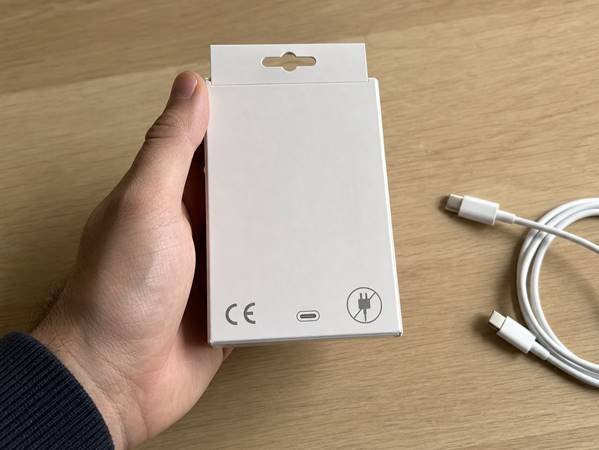
First, look at the CE mark on the packaging. This is the basic mark for EU market access. Products without CE cannot be sold regularly in the EU in principle;
Second, look at the USB-C charging interface mark to confirm that the product has a USB-C port for charging, not a USB-C port that only supports data transmission;
Third, look at the included charger mark: whether there is a unified icon specified by the EU on the packaging, clearly marking whether a charger is included, without having to look for it in the small print of the manual;
Fourth, look at fast charging and power parameters: products above 15W must clearly mark support for USB PD, as well as the rated input/output power range, and the values must not be vague;
Fifth, look at information consistency: the core charging parameters on the packaging, manual, and official specification page must correspond consistently, to avoid obvious contradictions or misleading publicity.
Common Pitfalls of Fake Compliance: Which “Seemingly Compliant” Products Are Actually Non-Compliant
There are many products on the market that look like they meet the requirements, but are actually fake compliance. There are four common pitfalls:
The first is “fake USB-C port”, which has the shape of USB-C on the outside, but the pins inside are incomplete, can only support 5V slow charging, or even only transmit data. Devices above 15W using this kind of interface are definitely non-compliant;
The second is “fake PD support”, the packaging says it supports PD, but actually only the manufacturer’s own proprietary protocol can fast charge, and using other brands’ PD chargers can only slow charge, or even cannot start fast charging;
The third is “fake CE mark”, which has not done actual testing and compliance assessment at all, just prints a CE mark and sells it, with no safety guarantee at all;
The fourth is “vague publicity”, the packaging only writes “fast charging”, does not say it supports PD, and deliberately misleads users to buy the original charger.
Boundaries of Compliance: What Situations Are Not Covered by Testing
Finally, we need to clarify the compliance boundaries of the common charger requirements to avoid excessive expectations:
First, scope boundary: the common charger requirements described in this article only apply to portable radio equipment within the scope and ≤100W external chargers. Other products (such as chargers with power >100W, medical devices, power tools, etc.) still need to comply with their applicable EU safety, EMC, radio, ecodesign and other regulatory requirements, and are not completely unregulated.
Second, transition period boundary: compliant existing products that have been officially placed on the EU market before the mandatory effective date can usually continue to be sold without re-compliance with the new requirements; but if they are first placed on the market after the mandatory date, re-imported into the EU, sold as commodities after refurbishment, or the product undergoes design/firmware/core component changes that may affect compliance, they still need to complete compliance assessment in accordance with the new requirements.
Third, regional version boundary: different regional versions of the same model product may have different configurations. Products from non-EU market versions may not meet the EU common charger requirements, so you need to pay attention to checking the parameters when purchasing cross-border.
Summary After Learning: The Judgment Abilities You Can Master
After reading this content, you don’t need to be a professional testing engineer to handle most judgments related to the EU common charger:
You can quickly distinguish whether a product is within the mandatory testing scope, know which categories need to meet the requirements and when, and which special categories need to be determined according to special rules;
You can understand the core charging parameters of devices and chargers, know the basic judgment standards for USB-C charging ports, PD fast charging, and power labeling, and avoid common pitfalls of fake interfaces and fake protocols;
You can initially identify the credibility of compliance statements, know how to check the basic compliance of products through public information, and will not be misled by fake CE and fake PD publicity;
You can troubleshoot the problems of not charging or charging slowly when mixing chargers by yourself, without blindly replacing new chargers or devices;
You also know where the boundaries of compliance are, and will not have unrealistic expectations for the effect of universal charging.
Mastering these judgment methods allows you to better enjoy the universal convenience brought by the common charger policy, while also avoiding the use risks of non-compliant products.