
If you have ever bought light bulbs or refrigerators at a home appliance store or on an e-commerce platform in the EU, you have most likely seen the small label printed with colored arrows—ranging from dark green A to bright red G, like a clear energy efficiency ranking. Many people who have just moved to Europe specifically pick products with A-grade labels when buying home appliances, but ignore capacity, functional zones, and rated annual power consumption. As a result, the A-grade large-capacity products they buy have a higher absolute power consumption than B-grade products of smaller specifications. There are also small sellers who have just entered the EU market, thinking that pasting an energy label means meeting all compliance requirements, only to have their goods detained by customs.
In fact, these pitfalls essentially stem from a failure to understand the rules of EU energy labels: they are neither quality certifications, nor the same as the CE mark or ErP ecodesign requirements. Even energy efficiency classes cannot be casually compared across product categories or specifications. This article will start with the most basic concepts, guide you to understand every piece of information on the label, master practical methods for selecting products using the label, and understand the underlying compliance logic. It can help ordinary consumers buy the right energy-saving products, and also serve as an entry-level compliance reference for small sellers who have just entered the EU market.
1. Clarification of Basic Concepts: ErP, Energy Labels, and CE Are Not the Same Thing
Many people’s first impression of energy labels is “energy efficiency class labels”. This statement is correct, but not accurate enough. In plain terms, it is a energy consumption classification information label that the EU requires eligible civil energy-using products to affix. Its core function is to allow ordinary users to quickly compare the energy efficiency level of products in the same category on shelves or e-commerce pages in a few seconds, without having to flip through dozens of pages of parameter manuals by themselves.
One understanding must be firmly established first: energy labels are essentially “mandatory information disclosure requirements”, not quality certifications or safety certifications. They are only linked to energy consumption and related performance, and cannot prove that a product is more durable or less likely to break, nor do they mean that the product complies with all EU regulations.
In terms of the regulatory framework, energy labels are part of the EU’s broad ecodesign management system for energy-related products, specifically responsible for conveying energy consumption information to consumers. The direct legal basis is the Energy Label Framework Regulation (EU 2017/1369) and supplementary regulations for each product category, not a single independent regulation. It is often discussed together with the ErP Ecodesign Directive because both mostly apply to the same type of energy-using products and jointly affect market access, but each has independent compliance requirements.
Then what is ErP, which is often mentioned together? Its full name is “Ecodesign Requirements for Energy-related Products” (ErP for short). The core regulation is 2009/125/EC, paired with specific implementation rules for each product. You can understand it as the market access passing line set by the EU for energy-using products—equivalent to an entry ticket.
The scope of this passing line is much wider than energy efficiency: in addition to minimum energy efficiency requirements, there are a series of ecodesign-related indicators such as standby/off power consumption, resource efficiency, repairability, disassembly and recyclability, and information disclosure. Restrictions on hazardous substances usually fall under other regulatory systems such as RoHS and REACH, and are not within the regular requirements of ErP. If a product fails to meet even one ErP requirement, in principle it cannot be sold in the EU market, and does not even have the qualification to enter.
As for the more familiar CE mark, it is another completely independent dimension. Many people think that CE is a “quality certificate” issued by a third-party institution, but it is not—it is a compliance mark affixed by the manufacturer or its authorized representative after completing the conformity assessment in accordance with the EU regulations applicable to the product, to declare that “my product meets the requirements of the corresponding regulations”. Which specific safety, health, and environmental protection regulations are covered depends entirely on the product type, and there is no unified “CE certification standard”.
The CE mark does not involve the evaluation of energy efficiency classes at all. No matter how much power a product consumes, as long as it meets the applicable safety and environmental protection regulations, it can be affixed with CE, so it can never replace the energy label.
Putting the three together, the logical order is actually very clear: a product must first meet the minimum passing line of ErP ecodesign (obtain entry qualification) before it can affix a compliant energy label (to inform users of the energy consumption level), and at the same time it must comply with the applicable regulations corresponding to the CE mark (meet basic safety, health and environmental protection requirements)—the three requirements are independent of each other, and none is dispensable.
Two initial misunderstandings that are most easy to fall into must be corrected first:
First, affixing an energy label does not mean that the product meets all EU compliance requirements. It is only the disclosure of energy consumption information, and does not mean that all ecodesign requirements of ErP have been met, nor can it replace the compliance obligations corresponding to CE.
Second, a high energy efficiency class does not mean that the product is of better quality or more durable. The class only measures energy consumption and related performance parameters, and has no direct relationship with the product’s service life, failure rate, or workmanship quality.
2. Scope of Application and Exemptions: Which Products Must Have Energy Labels
Now that we have clarified what energy labels are, the next question that everyone is most concerned about is naturally: which products need to be labeled? Are there any exceptions? First, a reminder: the following scope of application, exemptions, and category judgments are all entry-level preliminary screening methods. The final compliance judgment must be based on the current valid EU regulations and official guidelines for the corresponding category, and conclusions cannot be drawn solely based on the product name.
First Look at Two Core Judgment Premises
To judge whether a product needs an energy label, the core depends on two premises. If both are met, it is very likely that the label is required:
The first premise: the product is an energy-using product placed on the EU market and sold to end ordinary users. All sales channels, whether offline physical stores or online e-commerce, must comply. There is no exemption that “online stores do not need to label”. Even if brand-new products are sold on social platforms, as long as they are sold to ordinary users, they must meet the requirements.
The second premise: the product belongs to a category for which the EU has issued special energy label regulations. Not all energy-using products have corresponding label rules, and categories that are not covered do not need to be labeled for the time being.
Common Civil Product Categories with Mandatory Labeling
At present, the mandatory labeling civil product categories covered by the EU are mainly five categories, basically covering the main energy-using products for daily household use:
- Large home appliances: mainstream household large appliances such as refrigerators, freezers, washing machines, dishwashers, air conditioners, water heaters, dryers, ovens, and range hoods basically have corresponding energy label regulations;
- Lighting category: light sources that meet the legal definition (such as household light bulbs, LED lamp beads) and some civil lamps (such as ceiling lamps) need to be labeled. Sub-categories such as light strips and decorative lights need to be checked against current rules;
- Electronics category: televisions, electronic displays, etc. are typical covered categories; for computers, laptops, mobile phones, tablets, power banks, etc., it is necessary to distinguish between ecodesign requirements and energy label requirements, subject to the latest released product group regulations and applicable dates, and cannot be judged solely based on whether they are plugged in;
- Heating and ventilation category: heat pumps, household boilers, and some ventilation equipment have corresponding requirements. Whether products such as radiators are applicable needs to be checked against specific category rules.
In addition to civil products, some commercial and industrial equipment (such as motors, water pumps, fans) also have corresponding energy label requirements. The specific requirements shall be subject to the rules of the corresponding category, and cannot be directly classified solely by product name.
Common Exemption Situations
There are five types of common products that usually do not need energy labels, but each type has prerequisites and cannot be generalized:
Category 1: Purely mechanical products that are not driven by electricity or other energy sources at all. For example, manual bottle openers and ordinary bicycles are not energy-using products themselves, so they are naturally not within the scope of energy labels.
Category 2: Products for which there are no corresponding energy label regulations for the time being. Such products do not need to be labeled at present, but it should be noted that the EU’s energy efficiency coverage has been constantly updated. Categories that were not covered in the past may have new requirements in the future. Sellers who do long-term business can pay more attention to official updates.
Category 3: Small products with extremely low rated power. For entry-level preliminary screening, you can refer to the threshold of about 1W or less, but you must never treat <1W as a general exemption rule—it still depends on whether the category regulations set specific thresholds such as power, luminous flux, and use, subject to the regulations.
Category 4: Products for special industrial, military, and medical purposes. Such products are not exempt by default, and do not need to be labeled only if they are explicitly excluded by the corresponding category regulations. For example, for some medical-specific refrigerators, if the regulations explicitly exclude medical use, there is no need to affix civil energy labels; otherwise, they still need to meet the requirements.
Category 5: Second-hand products, customized non-sale items, and exhibition samples. Such products may not be applicable only when they are not sold as brand-new mass-produced goods normally placed on the market. For example, second-hand home appliances imported and sold through formal channels still need to meet energy label requirements in some cases, and it cannot be directly assumed that second-hand products do not need labels.
Judgment Methods for Boundary Ambiguity
Actual situations encountered are often more complicated. For example, do built-in refrigerators given away with cabinet purchases and light bulb accessories in sets need to be labeled separately? Here are three simple judgment ideas, suitable for entry-level preliminary screening:
First, whether combined, set, or built-in products need to be labeled separately depends on whether the component is an independent end product covered by regulations, whether it is detachable/replaceable, whether it is placed on the market separately, and whether its energy efficiency information needs to be separately disclosed to consumers during sales. You cannot default to exemption just because it is in a set, and it still needs to be subject to the corresponding category rules.
Second, for non-EU European markets, such as the United Kingdom and Switzerland, the energy label rules of these countries are not completely consistent with those of the EU. You cannot directly use EU labels, and you need to check the local specific regulations. For example, after Brexit, the UK has its own energy label system, which is different from EU rules and cannot be mixed.
Third, if you are really unsure, the safest way is to query the EU’s EPREL public energy consumption product database, or the special regulatory documents for the corresponding category, and do not judge based on experience.
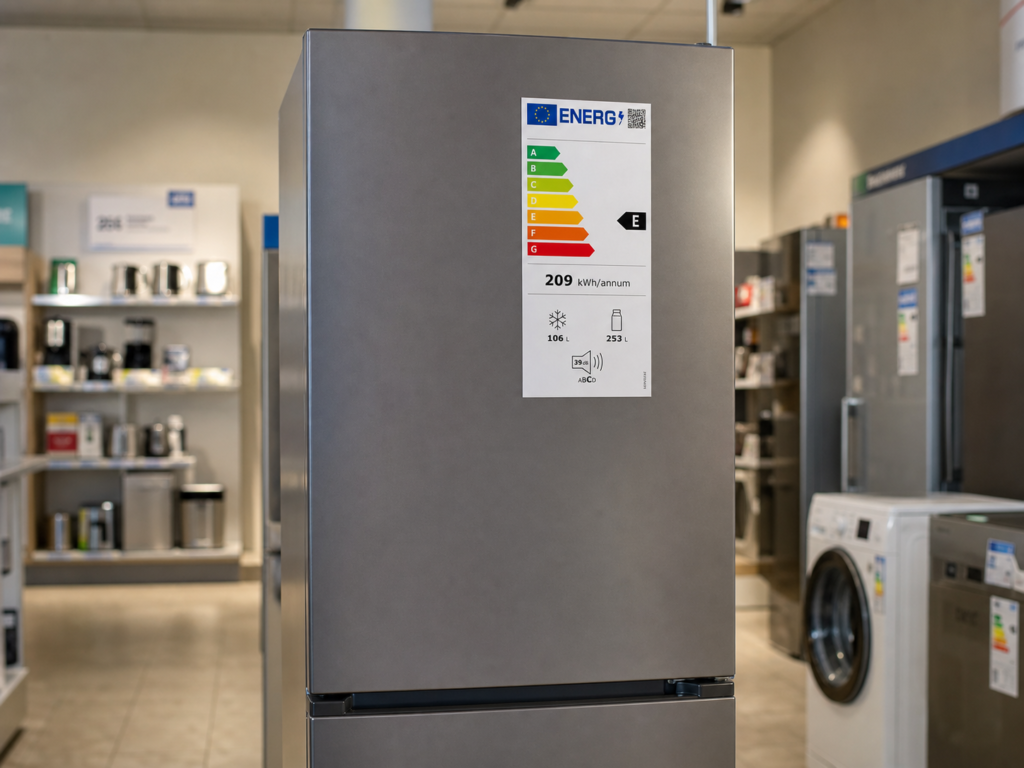
3. Interpretation of the New Version of Energy Label Content: Understand Core Information Piece by Piece
At present, most mainstream civil product categories in the EU use the new version of energy labels. The biggest difference from the old version is that plus suffixes such as A+, A++, and A+++ have been removed, and the seven levels A-G are uniformly used. However, whether old version labels can still be seen depends on whether the specific product group has completed re-labeling and the inventory/transition rules; consumers cannot directly judge illegality based solely on old version labels, and sellers cannot continue to use the old version on newly launched products that are required to use the new version.
Although the label parameters of different categories are different, the core structure is unified. We can start with two basic types:
The first type is fixed labels. Most civil products such as refrigerators, washing machines, and lighting use this type. The format is unified, the parameter fields are fixed, and the label structure of all products in the same category is completely consistent, which is convenient for comparison.
The second type is variable/multi-working condition labels, which are suitable for complex products such as air conditioners and heat pumps. Because the energy consumption performance varies greatly in different climate zones and under different load conditions, the label will display multiple sets of corresponding parameters such as seasonal efficiency and applicable climate zones according to working conditions, with richer information.
The core information structure of the two types of labels is completely consistent, and they all include four general modules: energy efficiency class area, product identity information area, key performance parameter area, and QR code and database entry. Which specific parameters are displayed and which icons are used are defined by the category regulations of the corresponding product.
First is the most conspicuous core area—the colored arrow area for energy efficiency classes. From left to right are gradient arrows from dark green to bright red, corresponding to seven levels from A to G: A (dark green) is the highest energy efficiency class, and G (bright red) is the lowest. The core feature of the new version of the label is no plus suffix at all. As long as you see ones with plus signs such as A+ and A++, they are usually old version labels.
A core rule must be firmly established here: energy efficiency classes are only meaningful for comparison within products of the same category and the same comparable benchmark, and have no reference value across categories at all.
The reason why the old version of the label was replaced is that after more than ten years of use, technological progress has been too fast, and a large number of products have reached the highest A+++ level, resulting in “class inflation”—since all are the highest level, it is impossible to distinguish who is more energy-efficient. Therefore, the EU has gradually replaced it with the new seven-level A-G system by category starting from 2021, with stricter classification standards and wider class gaps.
The second general module is the product identity information area. The label will list identity information such as the brand or supplier’s trademark, product model, and category. The specific position varies slightly with the category template. This information is not printed casually, and must be completely consistent with the nameplate on the product body and the filing information in the EPREL database. If they do not match, either the label is pasted incorrectly, or the product itself has compliance problems.
The third general module is the category-specific performance parameter area. This part is the core reference when purchasing. The parameters of different products are completely different, and it is also the part that many people are most likely to be confused about.
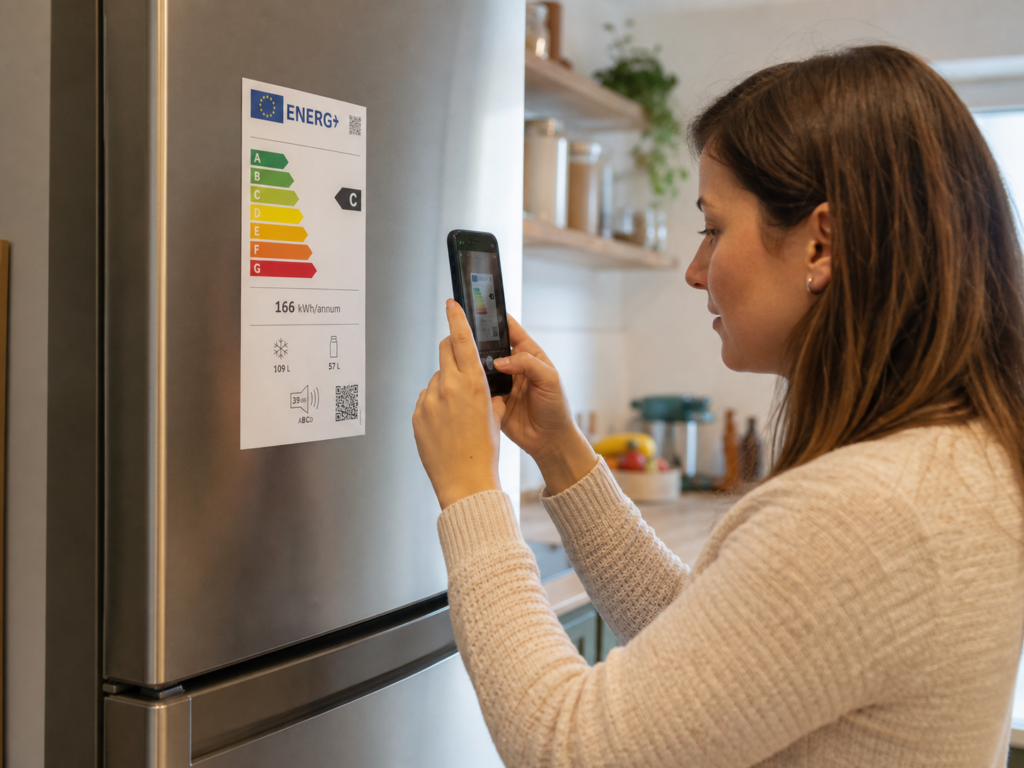
The fourth general module is the QR code and database entry. There is usually a QR code at the bottom of the label. For products that have been included in EPREL registration and new version label requirements, the QR code usually points to the EPREL public page; for old version, transition period, or categories not included in public registration, verification shall be carried out in accordance with corresponding regulations and official database rules. EPREL is one of the core channels for verifying the authenticity of energy labels. Consumers can check the public compliance information of products on it and download detailed product information sheets.
For your convenience, I have sorted out the core reference parameters of common categories and the plain language explanation of each parameter:
| Product Category | Core Reference Parameters (with plain language explanation) |
|---|---|
| Refrigeration equipment such as refrigerators/freezers | Annual power consumption (how many kWh are used in a year), net capacity (how much stuff can actually be stored), freezing capacity (the speed of freezing things) |
| Washing machines/dishwashers | Power consumption/water consumption of Eco program (how much electricity and water are used in the most power-saving mode), rated capacity (how many clothes/bowls can be washed at one time) |
| Household lighting products (light source category) | Luminous flux (that is, brightness, in lumens, the higher the value, the brighter), luminous efficacy (the efficiency of converting electrical energy into light energy, the higher, the more power-saving) |
| Televisions/displays | Screen size, standard mode power consumption (power consumption during daily viewing) |
| Air conditioners/heat pumps/heating equipment | Seasonal energy efficiency (such as SEER for cooling season, SCOP for heating season, that is, the average energy efficiency over the entire use season, which is closer to reality than single-point testing), applicable climate zone |
| General additional parameters for all categories | Noise value (unit: decibel dB, the smaller the value, the quieter; some products have noise classes from A to D) |
A common misunderstanding must be specially corrected here: many people think that “the quieter the product, the more energy-efficient it is”. In fact, there is no direct relationship between the two. Low noise does not equal low energy consumption, and needs to be judged separately. For example, some refrigerators add a lot of sound insulation cotton to reduce noise, which instead increases energy consumption. So do not link noise and energy efficiency together.
4. Practical Methods for Ordinary Users: Select Products, Calculate Costs, and Verify Authenticity with Energy Labels
After understanding all the information on the label, the next part is the most practical: how to use it to select the right energy-saving product for yourself, roughly calculate how much electricity bill you can save in a year, and how to check if the label is real.
Correct Logic for Purchase Comparison: Only Products of the Same Category and Specification Can Be Compared
When many people buy things, they think that A grade must be better than B grade when they see it, but this is not necessarily the case. There is an unbreakable major premise for comparing energy efficiency classes: only products of the same category and comparable specifications can be compared.
What does comparable specification mean? It is the comparison benchmark specified in the corresponding category regulations. For example, for refrigerators, it depends on net capacity; for washing machines, it depends on rated washing capacity; for televisions, it depends on screen size—only when core specifications are similar, class comparison is meaningful. For example, if you want to buy a refrigerator of about 500 liters, you can only compare classes among refrigerators around 500 liters. Comparing a 500-liter A-grade refrigerator with a 200-liter B-grade one has no reference value at all.
Moreover, prioritize comparing the measured/rated energy consumption parameters on the label (such as annual power consumption, cycle power consumption), and do not just look at the class letter. Because classes are divided by intervals. For example, both are A grade, but one may just meet the threshold for A grade, and the other is close to full marks. The actual energy consumption can differ by more than ten kWh. Looking at specific numbers is more accurate.
Method for Estimating Annual Energy/Energy Cost
Many people are willing to spend more money on high energy efficiency products just to save on electricity bills. So how to roughly calculate how much money can be saved in a year? Different products have different parameter types, and the estimation methods are also different, mainly divided into three categories:
1. Products with Annual Power Consumption (Year-round Powered Type)
For example, for year-round powered products such as refrigerators and freezers, the label usually marks the annual power consumption (unit: kWh/year, which is what we often call “degrees/year”). The estimation formula is very simple: annual power consumption × local residential electricity price = approximate annual electricity cost. For example, a 500-liter refrigerator has an annual power consumption of 120 kWh. Calculated at the local residential electricity price of 0.3 euros/kWh, the annual electricity bill is about 36 euros; if another model of the same capacity has an annual power consumption of 160 kWh, the annual electricity bill is 48 euros, and the price difference is clear at a glance.
2. Products with Cycle Power Consumption (Intermittent Use Type)
For example, for intermittently used products such as washing machines and dishwashers, the label may mark the power consumption per 100 working cycles. You can first estimate how many times you use it in a year: for example, a two-person family uses the washing machine 100 times a year, then the annual power consumption is the 100-cycle power consumption on the label, multiplied by the local electricity price to get the approximate annual electricity bill; if it is only used 50 times a year, divide by 2. The calculation method is very simple.
3. Products with Seasonal Efficiency (Heating and Cooling Type)
For heating and cooling products such as air conditioners and heat pumps, the label usually marks seasonal energy efficiency (such as SEER for cooling season, SCOP for heating season). This is an efficiency value, not direct power consumption. It is impossible to directly apply a formula to calculate the exact annual electricity bill, and it can only be used to compare the efficiency level with products of the same specification. The actual electricity bill of such products is greatly affected by local climate, house insulation, and usage time, even more than the impact of energy efficiency class, so the estimation can only be used as a reference.
It should be noted that all estimated values are reference values based on standardized parameters. The actual electricity bill during use will be affected by factors such as your usage habits, ambient temperature, and load, and will fluctuate up and down. Do not treat them as absolute values.
3-Step Operation Method for Label Authenticity Verification
There are also many cases of falsely marked energy efficiency classes now. How to check if the label is real? You can use the QR code on the label for preliminary verification, which has three steps, and ordinary people can operate it:
Step 1: Scan the QR code on the label to enter the product page of the corresponding database. If the scan results in a blank page or an unrelated website, there is most likely a problem.
Step 2: Check whether the product model, energy efficiency class, and core parameters on the page are completely consistent with those marked on the label. Even if the model is one letter different, it may be a different product, so pay attention.
Step 3: If there is no result from scanning the code, do not directly judge it as fake. First rule out several common situations: first, whether the model number is entered incorrectly (some product models are very long and easy to misread); second, whether it is a version for the EU market (for example, non-EU version products will not be filed in EPREL); third, whether the category has not been included in the EPREL registration scope. If it still cannot be found after ruling out these problems, you should be careful that the label is non-compliant.
Key Points for Purchase by Category
For products of different categories, the focus of attention when purchasing is different. Here are some practical purchase ideas for common categories, which can be used by ordinary people:
- Refrigeration equipment (refrigerators, freezers): First select the appropriate capacity according to the number of family members. Generally, 100-150 liters per person is enough. Do not buy too small a product just to pursue high energy efficiency, as it will be troublesome if it is not enough. Under the same capacity, compare the annual power consumption and noise value. For refrigerators placed in the living room, you can focus on noise; for those placed in the kitchen, you don’t need to worry too much.
- Washing machines/dishwashers: Prioritize looking at the power and water consumption of the Eco program. Many people think that the Eco program, which takes two hours to wash, must consume a lot of electricity. In fact, the opposite is true. Most Eco programs use low-temperature washing with less heating, which is more power-saving, just takes a little longer. If you usually wash clothes at night, you can completely use the Eco program and save a lot of electricity bills.
- Lighting products: First check whether the luminous flux (brightness) is sufficient, then compare energy efficiency. Generally speaking, the main lighting in the living room is estimated at 100-150 lumens per square meter, the bedroom at 50-80 lumens per square meter, and the reading area should be higher. After the brightness meets the demand, compare the energy efficiency classes. In addition, parameters related to light quality such as color temperature and color rendering are not reflected on the energy label, so you need to check the product parameters separately.
- Televisions/displays: The absolute power consumption of large-screen products is inherently higher than that of small-screen products. Do not compare a 65-inch B-grade product with a 55-inch A-grade product to see who consumes more electricity. You should combine your daily usage time and compare the standard mode power consumption under the same size. If you only watch TV for 1 hour a day, the electricity bill difference between high and low energy efficiency is actually not much, so you don’t need to worry too much about the class.
- Heating/hot water/air conditioning: Focus on seasonal energy efficiency, not a single point of energy efficiency. Moreover, the actual energy consumption of such products is particularly affected by installation quality and house insulation, even more than the impact of energy efficiency class. So don’t just stare at the label; installation and insulation are also very important.
5. Underlying Logic of Energy Efficiency Classes: From “Reading Letters” to “Understanding Judgment Standards”
If you want to go deeper and know how these classes are divided and why they must be compared within the same category, we can talk about the underlying logic behind it, helping you advance from “only knowing how to read letters” to “understanding judgment standards”, so that you can judge by yourself when encountering categories you have never seen before.
Core Rule of Class Division: Unified Ruler for the Same Category
The core principle of energy efficiency class division is “under the same product category and the same comparable benchmark, measure with a unified ruler”.
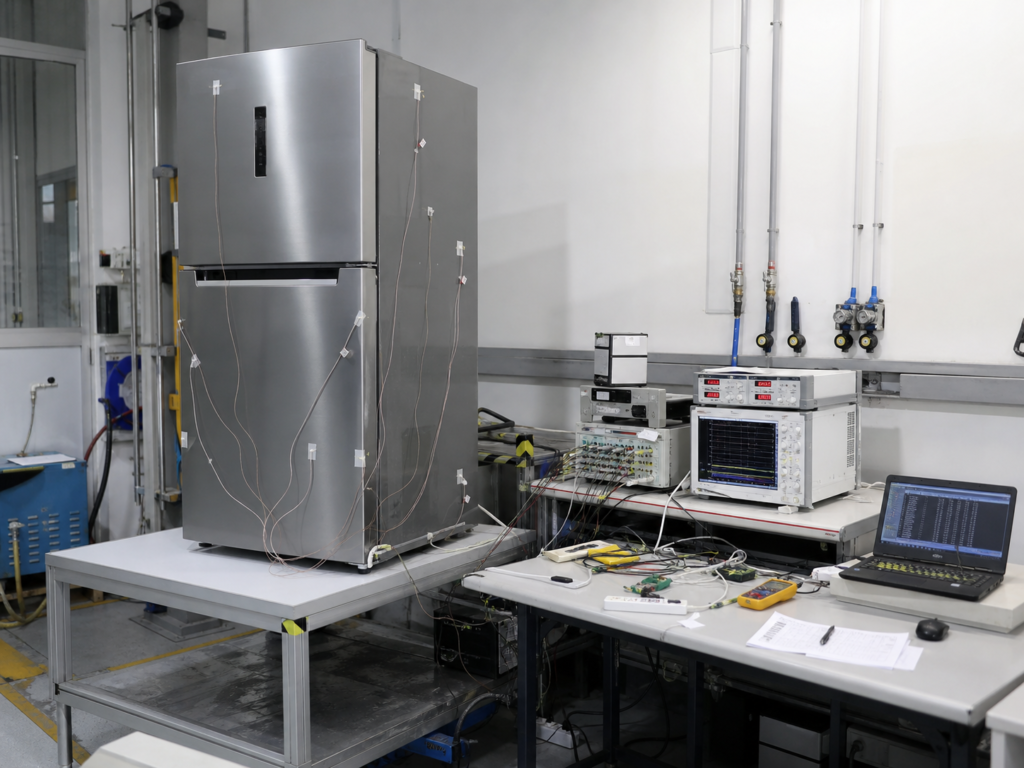
That is to say, products of the same category that meet the same comparison conditions all use the unified test procedures, boundary conditions, and calculation methods specified in regulations to measure energy consumption, so that the comparison is fair. Finally, they are divided into seven levels A-G according to energy consumption from low to high. When setting up the new version of classes, the EU deliberately left enough blank space for Class A—when the new version was just replaced, very few products could reach Class A, in order to leave room for future energy-saving technology upgrades and avoid the problem of class inflation soon again.
The classification thresholds of different categories are completely different, so cross-category comparison is absolutely not allowed. Some products use the “Energy Efficiency Index” (EEI for short) as a reference for classification. In plain terms, it is the value obtained by comparing the actual energy consumption of the product with the benchmark energy consumption specified in regulations. The smaller the value, the higher the energy efficiency. However, EEI only applies to some categories, and the calculation methods and classification intervals of different categories are completely different. Ordinary users do not need to master the specific calculation method, as long as they know it is a unified measurement standard.
Nature of Test Data: It Is a Comparison Benchmark, Not Actual Usage Value
The values on the label are not filled in casually by merchants, but are formed by suppliers based on test methods, harmonized standards, or calculation formulas specified in regulations, and are fully recorded in technical documents; market regulatory authorities can conduct sampling re-tests, and those with excessive deviations or false reports need to bear compliance responsibilities. These values are the core function of providing a benchmark for fair comparison within the same category, and is not equal to the actual energy consumption of each household.
There are many factors that affect actual energy consumption, such as ambient temperature, how much stuff is placed, which mode is used, and how well it is installed. These will cause differences between actual energy consumption and test values. You can just treat the values on the label as a “ruler for horizontal comparison”, and do not treat them as absolute usage costs.
Essence of the Difference Between Old and New Version Classes: Why A+++ Was Replaced
The old version of the label experienced “class inflation” due to technological progress. After a large number of products reached the highest level, it was impossible to distinguish their energy efficiency levels. Therefore, the EU reset it to the new seven-level A-G system, with stricter classification standards and more obvious class gaps.
It should be clarified here: there is no general conversion formula between old and new version classes. The re-labeling rules and threshold differences of different categories vary greatly, and there is no unified corresponding relationship. It is absolutely impossible to judge who is more energy-efficient just based on the letters “A+++” and “A”. When comparing across versions, you must look at the energy consumption or performance parameters under the same benchmark, and at the same time check the re-labeling rules of the category.
6. Compliance Responsibilities and Market Rules: Who Is Responsible and What Are the Consequences of Violations
If you are a Chinese small seller who has just entered the EU market, or want to understand the compliance logic behind the label, this part of the content will be useful to you. They are all entry-level compliance points, no need to remember complex regulation numbers, just understand the core rules.
Division of Compliance Responsibility Subjects
The core responsible subject in energy label regulations is called “supplier”, not an ordinary small distributor, but refers to the subject that bears primary responsibility for product compliance, usually the manufacturer, the importer within the EU, or the EU authorized representative designated by an overseas manufacturer. Specifically who is regarded as the “supplier” defined by regulations needs to be judged according to the Energy Label Framework Regulation and the way the product is placed on the EU market; the authorized representative can only perform responsibilities within the scope of authorization, and cannot automatically replace all obligations of the importer, manufacturer or distributor. If overseas sellers want to sell products to the EU market, they must ensure that there is a responsible subject within the EU to undertake corresponding obligations, and cannot directly sell non-compliant products from overseas.
According to different roles in the supply chain, the specific responsibilities are divided as follows:
- Manufacturer: It is the core responsible party for product compliance, responsible for the product meeting energy efficiency requirements, preparing complete technical documents, and ensuring that the label information is accurate and true;
- Importer: When introducing products to the EU market for sale, it is necessary to verify that the manufacturer has completed the compliance process, that the label and filing information are consistent, and that the technical documents are complete;
- Authorized representative: It is a subject within the EU designated by an overseas manufacturer, responsible for performing some regulatory obligations on its behalf. The specific authority depends on the scope of authorization and regulatory requirements;
- Distributor/seller: It is necessary to ensure that the products they sell have compliant energy labels, cannot sell obviously non-compliant products, and should promptly feedback problems to upstream suppliers.
If the parameters of the product change, for example, the energy consumption changes due to the replacement of the compressor, it is necessary to re-evaluate and update the label and filing information in accordance with regulatory requirements, and cannot continue to use the old label.
Sales End Display Obligations: Both Offline and Online Must Be Compliant
Whether it is offline physical stores or online e-commerce, they all have the obligation to display energy labels. The core principle is: consumers must be able to clearly see the complete energy efficiency information before purchasing, and it cannot be hidden.
The physical labels in offline stores must be affixed to the visible position of the product, or clearly displayed next to the product, and cannot be deliberately blocked by price tags or decorative stickers. For example, the label of a refrigerator should be pasted on the door so that customers can see it at a glance.
The requirements for online sales are more detailed, not just putting a picture on the detail page. All pages where consumers can see price, model, and energy efficiency-related information before purchasing, such as search list pages and product detail pages, usually need to display the energy efficiency class, complete label entry or complete label in accordance with applicable category rules, and also provide a product information sheet; you cannot just write “Class A”, and you cannot crop the QR code or change its color. The specific size, nested display method, and list page display requirements shall be implemented in accordance with category regulations and platform rules, and sellers shall upload them in accordance with the requirements of the corresponding platform.
If energy efficiency-related content is mentioned in advertisements or promotional campaigns, such as “Class 1 energy efficiency is more power-saving”, it is usually necessary to mark the product’s energy efficiency class and the available energy efficiency class range (A-G) of the category at the same time. The specific display format shall be subject to relevant regulatory requirements.
Clearly prohibited behaviors include: deliberately cropping or changing the color of labels, mixing labels for products of different models/capacities/sizes, falsely marking energy efficiency classes, etc. These are all serious violations.
Three Major Functions of the EPREL Database
We have mentioned the EPREL database many times before. It is the core hub of the entire energy label system, and mainly has three major functions:
For suppliers, it is a mandatory registration entry—products within the scope must be registered on it and technical documents must be submitted before being placed on the EU market, otherwise they are non-compliant and cannot be sold on the market.
For consumers, it is a public query channel—you can check the public parameters of products for free, verify label information, and download detailed product information sheets.
For regulatory authorities, it is a spot-check tool—market supervisors can spot-check whether products really meet the requirements through non-public technical documents in the database, without having to go to the manufacturer to check.
Market Supervision and Consequences of Violations
The supervision of energy labels in the EU is the responsibility of the market regulatory authorities of each member state. Random spot checks are carried out regularly, and customs can also detain non-compliant imported products.
Common consequences of violations include product removal, seizure, and fines. However, there is no unified EU standard for the amount of fines. The amount of fines varies in different member states and for different degrees of violations. Minor violations may be fined hundreds of euros, serious false labeling may be fined tens of thousands of euros, and may even be prohibited from entering the relevant market.
If ordinary users find non-compliant energy labels, they can also report to the local market regulatory authority, which will conduct verification.
7. Common Misunderstandings and Pitfall Avoidance Guide: Identify 6 Most Common Pitfalls
Regarding energy labels, there are 6 particularly common misunderstandings that many ordinary consumers and even new small sellers will fall into. We will explain them one by one to help you avoid these pitfalls.
Misunderstanding 1: The old version A+++ is more energy-efficient than the new version A
[Core Correction] The old and new versions are two completely different classification systems, with no fixed conversion relationship, and the strength cannot be judged directly by letters
The new version A is the highest class under the stricter system after re-labeling, but the old version A+++ cannot be directly converted to a certain class of the new version; cross-version comparison must return to the power consumption or energy efficiency index of the same category and the same benchmark, and cannot only look at the number of letters.
The judgment method is very simple: as long as the label has plus suffixes such as A+ and A++, it is usually an old version label. Whether the corresponding product can still be sold legally needs to be checked against the transition period regulations of the category. To compare the energy efficiency levels of two products, it is most accurate to directly look at the energy consumption parameters under the same benchmark.
Misunderstanding 2: All plug-in products need energy labels
[Core Correction] The scope of application of energy labels is subject to category regulations, and not all plug-in products need to be labeled
The scope of application of energy labels is completely subject to the special regulations of the corresponding category. Purely mechanical products without energy drive and categories not covered by any label regulations do not need to be labeled; products for special purposes such as industrial, military, and medical use do not need to be labeled only if they are explicitly excluded by corresponding regulations, and are not exempt by default; extremely low-power products also need to be judged according to category rules, and cannot be cut across the board directly with 1W as the line.
When judging, first confirm whether the product is a civil end product for ordinary users, then check whether there are current valid energy label regulations for the corresponding category. Only when both are met, the label is required.
Misunderstanding 3: Products with high energy efficiency class have lower total usage cost
[Core Correction] High energy efficiency products do not necessarily have lower total usage cost. You need to calculate the total cost in combination with usage scenarios
First of all, under the same class, the absolute power consumption of large-capacity products is definitely higher than that of small-capacity products. Secondly, high energy efficiency products usually have a higher selling price. If your usage frequency is not high, or you replace them within a few years, the electricity bill saved may not be worth the extra money you spent when buying.
When judging, you should combine the usage frequency, local electricity price, and expected service life to estimate the total cost of ownership (purchase cost plus electricity bill), and then decide whether to buy a higher class product. For example, a Class A refrigerator of the same capacity is 100 euros more expensive than a Class B one, and saves 20 euros in electricity bills a year. It will take 5 years to earn back the price difference. If you plan to use it for 10 years, it is cost-effective; if you only use it for 2 years, it is unnecessary.
Misunderstanding 4: Online sales do not need to display complete energy labels
[Core Correction] Both online and offline need to display complete energy labels, and only marking the class is a violation
The EU requires that remote sales must display the prescribed energy labels and related information to consumers before purchase. Deliberately cropping labels, only marking class letters, and concealing the class range are all non-compliant.
When judging, you can first check whether there are general elements such as complete A-G colored arrows, core performance parameters, and QR codes on the page. If they are missing, there is most likely a problem. Specifically, you can check against the official label style of the corresponding category.
Misunderstanding 5: Energy labels can be printed/modified/mixed by oneself
[Core Correction] Label information must be consistent with the filing. Self-modification and mixing are serious violations
All information on the energy label must be completely consistent with the product technical documents and EPREL filing information. Self-changing color, cropping QR codes, falsely marking classes, and mixing labels for different models are all prohibited.
The judgment method is also very simple: scan the code to enter the database to check the filing information, and then compare it with the EU official standard label style, and you can see the problem.
Misunderstanding 6: Affixing an energy label means the product is fully compliant
[Core Correction] Energy label is only energy consumption information disclosure, and does not mean full compliance
The energy label is only energy consumption-related information disclosure. It does not mean that the product meets all the requirements of ErP ecodesign, nor can it replace the compliance obligations corresponding to the CE mark.
To judge whether a product is fully compliant, it is necessary to combine the product type and check all corresponding regulatory requirements, not just look at the energy label.
8. Quick Self-Check List and Capability Summary
At this point, the core content of the EU ErP energy label is almost covered. Finally, we have sorted out two quick self-check lists, which can be used directly whether it is for ordinary consumers to select products or for small sellers to conduct compliance self-checks.
3-Step Inspection Method for Consumer Purchase
Step 1: Label matching check: For categories to which the new version has been applied, confirm that the new version A-G label without plus signs is used, and the label model is completely consistent with the purchased product; if it is an old version label, first check whether the category is still within the legal transition period.
Step 2: Same benchmark comparison: Under the premise of the same category and comparable specifications, first compare the measured/rated energy consumption parameters, then refer to the energy efficiency class, and do not compare across categories or specifications.
Step 3: Authenticity verification: Scan the QR code to enter the database, and check whether the core parameters are consistent with the label markings; if not found, first rule out situations such as wrong model, non-EU version, and not included in the registration scope before judging.
3-Step Self-Check for Entry-Level Compliance of Small Sellers
Step 1: Confirm the scope of application: Check against the current valid regulations of the corresponding category to confirm whether the sold product belongs to the scope of application of energy labels, to avoid missing or wrong labeling.
Step 2: Check information consistency: Ensure that the label version and core parameters are completely consistent with the product technical documents and filing information, and there is no false or wrong labeling.
Step 3: Full-channel compliant display: Check all online and offline sales channels to display complete and compliant energy labels in accordance with regulatory requirements, especially the list pages and detail pages of e-commerce platforms, which must meet the display requirements.
Core Judgment Abilities You Can Master After Learning
After learning this content, you should have mastered the core practical abilities regarding EU ErP energy labels:
- Able to distinguish the different functions of ErP ecodesign, CE mark, and energy label, and no longer confuse the three;
- Able to understand all core information of the new version of energy labels, and correctly compare the energy efficiency levels of products according to category rules;
- Able to identify common problems such as old and new labels, false labeling, and non-compliant display, and avoid most pitfalls;
- Able to verify the basic authenticity of energy labels through the official database, so you don’t have to be afraid of buying products with obvious false labeling;
- Able to estimate electricity costs in combination with your own usage scenarios, and judge whether high energy efficiency products are worth buying.
Whether you are an ordinary consumer living in the EU or a small seller who has just entered the EU market, mastering this knowledge will basically enable you to deal with the vast majority of energy label-related problems encountered in daily life.