
Practitioners engaged in exporting electronic products to the EU have more or less heard of the REACH regulation, but many people’s impression of it still stays at “testing a few chemical substances” and “paying a small fine”. In fact, REACH penalties are far more than just fines. The electronics industry, due to its long supply chain and numerous components, is a high-risk area for violations — ranging from fines of thousands of euros and listing takedowns, to detention of entire batches of goods, recall losses of millions of euros, and even affecting the customs clearance of all subsequent goods.
From the perspective of the electronics supply chain, to judge the risk of REACH penalties, one should first confirm the responsible entity, type of violation, country of occurrence, and rectification evidence. Whether you are an EU importer, cross-border seller, domestic OEM, or brand owner, you can understand the rules, clarify the boundaries, and master basic response methods through the following content.
Basic Understanding: Applicable Boundaries of REACH Penalties (Exclusive to the Electronics Industry)
First of all, we need to figure out: Who will be penalized by REACH? Which electronic products will trigger penalties? Why is the electronics industry particularly prone to falling into pitfalls?
Which Supply Chain Roles Bear Responsibility or Losses?
Many electronics manufacturers not located in the EU think: REACH is an EU regulation, it can’t fine me. This idea is extremely wrong — REACH’s responsibility covers the entire supply chain, and different roles have different forms of responsibility. Some receive penalty notices directly, while some do not get fined directly but may suffer greater indirect losses. Overall, they can be divided into three categories:
- Entities subject to direct regulatory penalties: Including EU importers (the primary legally responsible entity for electronic products entering the EU, directly held accountable if violations are found by customs or market supervision), EU Only Representatives (OR, the in-EU compliance entity entrusted by non-EU enterprises, directly penalized if they fail to fulfill their entrusted obligations), and EU-based manufacturers (directly held accountable for violations of locally produced electronic products).
- Entities that bear joint and several liability under certain conditions: EU distributors and cross-border e-commerce sellers who continue to sell products knowing or should know that they are non-compliant shall bear joint and several liability. For example, if a third-party seller on Amazon is found to have REACH violations, not only will the listing be taken down, but they may also receive regulatory penalties.
- Entities that mainly bear indirect losses: Non-EU electronics manufacturers and OEMs, although they will not directly receive penalty notices from EU regulators, consequences such as detained goods, failed customs clearance, recourse from importers, and being placed on the EU customs blacklist will also cause tangible economic losses.
Which Electronic Products Trigger REACH Penalties?
REACH covers a very wide range of electronic products, and the vast majority of consumer electronics, industrial electronics, and electronic components are within the scope of supervision — from small items such as earphones, charging cables, PCB boards, and connectors, to large items such as computers, servers, industrial control equipment, and even supporting batteries, all must meet REACH requirements.
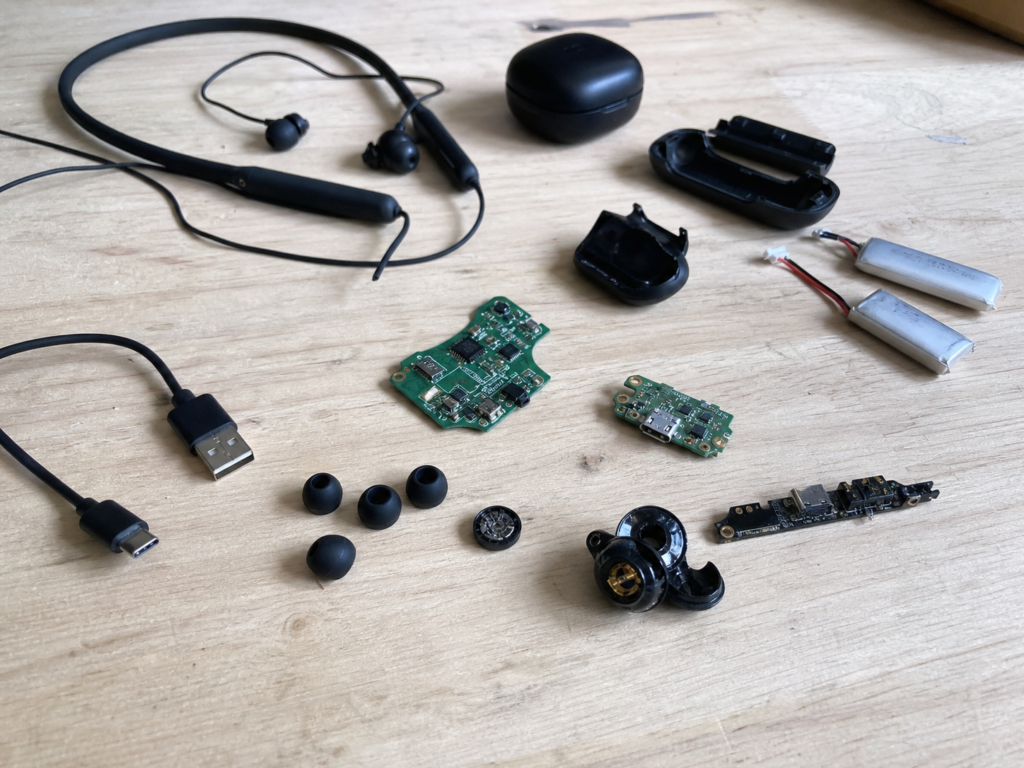
Of course, there are special circumstances: special electronic equipment in fields such as medical care and aerospace may be subject to special regulations at the same time, and some substances, uses, or market placement links may apply special exemptions or special rules; whether REACH is excluded or other regulations are prioritized shall be judged item by item according to product use, substance type, and placement scenario, and it cannot be assumed that REACH is completely inapplicable. Even if there are special rules for medical devices, aerospace, etc., it is still necessary to separately judge whether REACH restricted substances, SVHC information communication, SCIP and registration obligations are exempted, and cannot be deemed inapplicable solely based on industry category.
Here is a key rule that friends in the electronics industry should be particularly reminded of: A single component violation will drag down the entire batch or even the whole machine product, it is not that the whole machine passes the test and everything is fine. For example, for a batch of Bluetooth earphones, if the phthalates in the silicone ear caps exceed the standard, even if the earphone motherboard and battery are fine, the entire batch of goods may be detained by customs, which is a point that many enterprises easily ignore.
Why Is the Electronics Supply Chain More Prone to REACH Penalty Pitfalls?
Compared with industries such as clothing and toys, the electronics industry has a much higher probability of REACH violations, and there are three core reasons:
First, there are many supply chain tiers, and component information is easily broken. For example, the OEM you work with finds a material supplier, and the material supplier finds an upstream chemical plant; the material composition information may be incomplete after two or three transfers, and when a violation is found, it is discovered that the upstream used prohibited substances.
Second, there are many product parts and miscellaneous materials, making it easy to miss high-risk substances. An ordinary mobile phone has hundreds of parts, involving dozens of materials such as plastics, metals, inks, adhesives, and solders. Any substance in any small part that exceeds the standard may cause the entire batch of products to be non-compliant.
Third, the business impact of violation consequences is far greater than the fine. In the electronics industry, especially cross-border e-commerce, the loss of popular listings being taken down, entire batches of goods being detained, and recalls is often several times higher than the fine itself, and may even directly destroy a product.
Core Premise: There Is No EU-Wide Unified Fine Schedule for REACH
After talking about the applicable boundaries, the question that many people are most concerned about must be: How much is the fine for violating REACH? Here, we must first thoroughly explain a core premise that is most easily misunderstood — REACH simply does not have an EU-wide unified fine price list, don’t look around for the so-called “REACH fine standard table”, what you find is wrong.
Two-Tier Legal Logic of Penalties
REACH penalty rules are actually a “two-tier structure”:
The EU-level REACH regulation only stipulates which compliance obligations enterprises must fulfill, such as not using excessive restricted substances, notifying when SVHC exceeds the standard, making notifications, etc., but it does not stipulate how much the fine is for violating a specific article.
Specific penalty rules such as fines, sales bans, and criminal liability are formulated by each EU member state’s own domestic chemicals law, so the penalty scales vary greatly from country to country. The EU only gives a unified principle: all penalties must be “effective, proportionate and dissuasive” — that is, they cannot be too light, must match the severity of the violation, and can play a warning role.
Who Has the Authority to Issue REACH Penalty Notices?
Many people think that the European Chemicals Agency (ECHA) is the entity that issues fines, but it is not. The three types of institutions that truly have the power to enforce the law and issue fines are:
The first type is member state customs, which mainly conduct random inspections at the entry link. The most common immediate measure is to detain goods, your goods can’t even enter the EU customs territory, and in serious cases, they will be directly returned or destroyed.
The second type is member state market supervision authorities, responsible for random inspections in the market circulation link, including online e-commerce platforms. After finding violations, they can directly issue fines, and can also require products to be taken off the shelves and recalled.
The third type is the commonly heard European Chemicals Agency (ECHA), whose role is to coordinate joint enforcement actions among countries, such as organizing EU-wide special random inspections of electronic products, but it does not directly issue fines, nor does it directly handle violation cases of individual enterprises.
Basic Judgment Process of Penalties
The penalty judgment for REACH violations is actually divided into two steps:
The first step is to verify whether the enterprise has really violated REACH compliance obligations, such as whether the restricted substances really exceed the standard, whether the SCIP notification has really not been made.
The second step is to apply the domestic rules of the corresponding member state according to the place where the violation occurred, to determine the form of penalty and the specific amount.
Because of this, the same violation, such as failure to inform consumers of SVHC, may result in a fine of tens of thousands of euros in Germany, but only a warning and rectification in Poland, the results can be vastly different.
5 Most Common Types of REACH Violations in the Electronics Industry
After clarifying the basic rules, let’s look at the 5 types of REACH violations that the electronics industry is most prone to, and the corresponding penalty directions, you can check against your own products.
1. Restricted Substance (Annex XVII) Violations: Most Likely to Trigger Sales Bans and Recalls
First, in plain terms: restricted substances are highly hazardous chemical substances that the EU explicitly prohibits or strictly limits the amount of use. As long as the concentration exceeds the specified limit, it is a violation, corresponding to Annex XVII of the REACH regulation, so they are also often called “Annex XVII substances”.
The most common restricted substances in electronic products include lead, cadmium, nickel release, phthalates (also known as plasticizers, commonly used in soft plastics), some flame retardants, etc. The conditions for triggering a violation are very simple: the substance concentration exceeds the corresponding limit and does not meet the exemption requirements — for example, the lead exemption for certain industrial electronic components is not a violation.

High-risk components in the electronics industry mainly include cable sheaths, plug jackets, metal contacts, PCB boards, and coating inks. These materials often use restricted substances and are the focus of investigation. The consequences of such violations are usually relatively serious, and it is easy to trigger sales bans and product recalls.
2. Substances of Very High Concern (SVHC) Related Violations: The Most Common Type of Violation
Substances of Very High Concern (SVHC for short), simply put, are a class of chemical substances that are extremely harmful to human health or the environment, such as carcinogenic and reproductive function-affecting substances. The EU will put these substances into the “Candidate List”, which is updated every six months. Currently, it contains hundreds of substances, and the specific number is subject to the latest Candidate List released by ECHA.
Such violations are the most common in the electronics industry, and there are two main situations that trigger penalties:
The first is that the SVHC concentration in a single separable article exceeds 0.1%, but no relevant safety information is provided to downstream buyers or consumers;
The second is that the SVHC concentration exceeds 0.1%, and the total amount of the substance imported or produced by the enterprise per year exceeds 1 ton, but no notification has been submitted to ECHA.
Here, we must emphasize the most easily misunderstood calculation caliber: the 0.1% concentration is calculated based on “a single separable article”, not the total weight of the whole machine. For example, the silicone ear cap of an earphone and the plastic shell of a charging head are all separately separable parts, and the concentration must be calculated separately. As long as the SVHC concentration in a single separable article exceeds 0.1%, it will trigger the above-mentioned information communication or notification obligations; only failure to fulfill the corresponding obligations constitutes a violation.
It should also be noted that the SVHC list is updated every six months, and each newly added substance may cause originally compliant materials to suddenly become non-compliant. For example, a certain commonly used flame retardant was added to the list, if you don’t follow up in time, it is easy to fall into the trap. High-risk components in the electronics industry include flame-retardant plastics, connectors, solders, battery shells, etc.
3. Registration Obligation Violations: Electronic Auxiliary Materials Are Prone to Pitfalls
REACH registration obligation, simply put, is that if you import or produce a certain chemical substance of more than 1 ton per year, you must submit complete registration materials to ECHA to prove that the use of this substance is safe.
Many enterprises that make electronic finished products feel that registration has nothing to do with them. Indeed, ordinary electronic finished products generally do not involve registration obligations, unless the product will continuously release chemical substances, which is very rare. However, auxiliary materials in the electronics industry are particularly prone to this pitfall — for example, chemical mixtures such as inks, adhesives, cleaning agents, and thermal pastes that you export, if the annual import volume of a certain substance in them exceeds 1 ton, you need to fulfill the registration obligation. Many enterprises are penalized because they ignore the compliance of auxiliary materials.
4. Information Communication and Document Violations: The Most Easily Overlooked Hard-Hit Area
Many people think that as long as the substances meet the standards, REACH is fine. In fact, violations of documents and information communication account for a very high proportion, and they are particularly easy to be ignored. There are three common types:
The first type is failure to provide a Safety Data Sheet (SDS for short, also called Chemical Safety Data Sheet). This obligation applies to chemical substances or mixture auxiliary materials: if you supply chemical substances/mixtures such as adhesives, cleaning agents, and thermal pastes to the EU, or these auxiliary materials circulate in the EU supply chain, you usually need to provide a compliant SDS with the goods; ordinary electronic finished products generally do not involve SDS obligations, unless they contain chemical substances/mixtures that need to be supplied separately.
The second type is failure to upload to the SCIP database. The SCIP database is an information database established by the EU for waste management, requiring that articles sold in the EU market that contain SVHC with a concentration exceeding 0.1% must submit relevant substance information to facilitate subsequent recycling and treatment. Many enterprises do not know this requirement and are penalized for not making the notification.
The third type is false or invalid compliance declarations, such as forged test reports, declarations made with outdated versions of the SVHC list, or vague declarations that only say “compliant with REACH” without any specific information. These are all violations, and if found, they will be heavily penalized.
5. Authorization Substance (Annex XIV) Violations: Very Few Directly Involve Finished Products
Authorization substances correspond to Annex XIV of the REACH regulation. These substances are more hazardous than SVHC. The EU will set a “sunset date” for them. After the sunset date, you must obtain official EU authorization to continue using them, otherwise it is a violation.
For the electronics industry, it is very rare for finished products to directly involve authorization substances, and most of them are used in upstream chemical raw materials or production processes, such as some special solvents. Therefore, finished product enterprises do not need to worry too much, but they need to do basic risk management: at least confirm with upstream whether relevant processes or auxiliary materials involve Annex XIV substances and the authorization status after the sunset date, and include this requirement in procurement specifications or supplier declaration clauses.
The True Form of REACH Penalties: More Than Just Fines, Business Losses Are Often Greater
When many people mention REACH penalties, their first reaction is to pay a fine, but in fact, fines are only part of the penalty, and many times the business-level losses are much larger than the fines. Let’s talk about them from low to high severity:
Administrative Penalties: The Most Common Type of Penalty
Administrative penalties are the most common way of handling REACH violations, mainly in three types:
The first is a warning or rectification within a time limit, generally for minor violations and first-time violations. For example, if there are minor problems with documents and the violation is very minor, the regulator will first issue a warning, require rectification within the specified time, and if it is corrected, no fine will be imposed.
The second is fines, which is also what everyone is most concerned about. According to public cases in Western European countries, the common fine range is from several thousand euros to 500,000 euros; if it is a serious case of intentional violation, large-scale violation, or harm to human health or the environment, the fine can exceed one million euros, and some countries even have no upper limit. The calculation of fines usually refers to several factors: the nature of the violation, the value of the goods involved or the turnover of the enterprise, the degree of subjective fault, and the cooperation in rectification.
The third is administrative compulsory measures, which are often more troublesome for enterprises than fines, including entry detention of goods, market sales bans, e-commerce listing takedowns, product recalls, destruction or return of goods. For example, a batch of electronic goods worth hundreds of thousands of euros is detained by customs, and finally either returned or destroyed, the loss is much greater than the fine.
To facilitate everyone’s intuitive reference, I have sorted out the common penalty ranges of public electronics industry violation cases in Western European countries. Note that this is only for reference, the specific amount must be judged in combination with the violating country and actual circumstances, there is no unified standard:
| Violation Type | Common Penalty Range (Western European Public Cases) | Common Synchronous Measures |
|---|---|---|
| Excessive phthalates (restricted substances) in plastic parts | Tens of thousands to hundreds of thousands of euros | Product recall |
| Failure to inform consumers of SVHC (e-commerce channel) | Several thousand to 100,000 euros | Listing takedown |
| Failure to notify SCIP | 10,000 to 200,000 euros (the amount is usually adjusted in combination with the number of products involved and sales scope) | Require supplementary notification within a time limit, suspend sales of non-compliant products |
Commercial and Civil Consequences: Losses Are Usually Greater Than Fines
For many electronics enterprises, especially cross-border sellers, commercial losses are often several times higher than fines:
First is platform penalties. For example, e-commerce platforms such as Amazon and AliExpress will directly take down product listings when REACH violations are found, and even restrict the sales authority of the store. If you are running a popular listing with thousands of orders a day, the loss of being taken down for a month may be more than ten times higher than the fine.
Then there is supply chain recourse. For example, if an EU importer is fined or bears recall losses, they will definitely seek recourse from the upstream supplier. Fines, recall fees, storage fees, and freight will all be counted on the upstream.
There is also reputation loss. If the violation information is put into the EU safety warning system, many customers will put you on the high-risk supplier list and dare not cooperate with you again.
Finally, there is order loss. Existing orders are cancelled, and subsequent cooperation opportunities are gone, which has a great long-term impact on enterprises.
Criminal Liability: Only Triggered in Serious Cases
Many people worry about whether they will go to jail for REACH violations. In fact, the vast majority of ordinary violations do not involve criminal liability, and only very serious cases will trigger it: such as intentional fraud, large-scale violations, causing serious harm to human health or the environment, and repeated violations with no correction.
If criminal liability is triggered, it is generally the person in charge of the enterprise who is sentenced to imprisonment (the duration ranges from several months to several years, varying according to national regulations), and a fine is imposed at the same time. Everyone does not need to panic too much, but also should know that the consequences of intentional fraud and concealing violations are very serious.
Semi-Proficient Judgment: 5 Core Dimensions of Penalty Severity
After understanding the forms of penalties, many people will ask: How to judge whether a violation will be fined heavily or lightly? In fact, there are 5 core judgment dimensions, and mastering them can help you assess the approximate risk level by yourself.
1. Nature of Violation: The Greater the Harm, the Heavier the Penalty
The nature of the violation is the primary factor determining the severity of the penalty. Simply put, the greater the harm to the human body and the environment, the heavier the penalty.
Ranked by severity, it is roughly: excessive restricted substances > missing SVHC information > incomplete documents. If it involves carcinogenic, mutagenic, and reproductive toxic (CMR for short) substances, the penalty will be significantly increased, because such substances are more harmful.
2. Subjective Fault: Intentional Is Much Heavier Than Negligence
Regulators attach great importance to the subjective attitude of enterprises when determining penalties:
If it is intentional fraud, concealing information, or continuing to sell knowing that it is a violation, it will definitely be heavily penalized;
If the enterprise has complete compliance records, such as supplier material declarations, third-party test reports, and BOM screening records, which can prove that it has fulfilled reasonable compliance obligations, it may be given a lighter penalty or even exempted from penalty;
If it is a first-time violation caused by negligence, the penalty will be much lighter than that of repeated violations.
3. Scale of Violation: The Larger the Quantity, the Heavier the Penalty
The more products involved in the violation, the higher the value of the goods, and the greater the sales volume, the higher the fine, which is easy to understand.
In addition, if the product is sold in multiple EU countries at the same time, it may face law enforcement in multiple countries, that is, the same violation may be fined several times. Another point to note: the random inspection rate of e-commerce channels is much higher than that of offline channels, so the risk of violations being discovered is greater, not that the penalty is heavier, but that it is easier to be found.
4. Product Use: The Higher the Exposure Risk, the Heavier the Penalty
The use scenario and contact group of the product will also affect the penalty scale:
The penalty for consumer-grade electronic products is heavier than that for industrial-grade ones, because ordinary consumers have no professional protection and the exposure risk is higher;
If it is an electronic product for children that is in long-term contact with the skin, such as children’s watches and wearable devices, the penalty scale will be stricter, because such products have a greater impact on the human body.
5. Rectification Attitude: Active Remediation Can Lead to Lighter Penalties
The last dimension is the attitude towards rectification, which is something enterprises can control by themselves:
If you actively recall products, take them off the shelves voluntarily, cooperate with regulatory investigations, and actively submit rectification plans after the violation, you can apply for a reduced penalty;
If you refuse to rectify, conceal information, or resist investigation, you will not only be heavily penalized, but may even trigger criminal liability.
Differences in Penalty Scales Among Major Exporting Countries
Because REACH penalties are set by each member state, the strictness of law enforcement varies greatly from country to country. Friends who do export can adjust the priority of compliance according to their main destinations.
The following are common tendencies in public law enforcement cases and industry experience, which do not equal fixed fine standards; special actions, product categories, sales channels, and the current focus of local law enforcement agencies will all change the actual law enforcement intensity.
Germany: One of the Countries with the Strictest Law Enforcement for Electronic Products
Germany is one of the countries with the strictest REACH law enforcement for electronic products in the EU. The upper limit of fines is very high. Fines for serious violations can exceed one million euros, and criminal liability can also be pursued.
Germany’s law enforcement focuses mainly on SVHC notifications, SCIP uploads, and excessive restricted substances, and the frequency of random inspections on e-commerce channels is very high, with cross-border sellers being the key supervision targets. If your main market is Germany, you must do full compliance and cannot take chances.
France: Focusing on the Protection of Consumers’ Right to Know
The fine level for serious violations in France is similar to that in Germany, but for minor violations, rectification notices are usually issued first, and the proportion of direct fines is lower.
France’s law enforcement focuses more on the SVHC consumer notification obligation, that is, enterprises must clearly inform consumers which SVHC substances are contained in the product. In addition, France requires e-commerce platforms to actively investigate non-compliant products on the platform. If the platform fails to fulfill the investigation obligation, it will also be fined, so e-commerce platforms on the French site have particularly strict REACH requirements for sellers.
Netherlands: Mainly Port Entry Law Enforcement
The Netherlands’ law enforcement focuses on the port entry link, especially the Port of Rotterdam as the core entry hub in Europe. The risk of random inspection of electronic components at the port is relatively prominent, mainly checking whether restricted substances exceed the standard.
The penalty scale in the Netherlands is slightly lower than that in Germany and France. Generally, enterprises are first required to rectify, and fines are only imposed if they refuse to rectify. However, in recent years, the Netherlands’ verification of SCIP notifications has been increasing year by year, so attention should be paid to follow-up.
Central and Eastern European Member States (Poland, Czech Republic, etc.): Relatively Lenient Law Enforcement
For Central and Eastern European member states such as Poland, Czech Republic, and Hungary, the overall fine level in public cases is usually lower than that in Western Europe, and minor violations are mostly warnings and rectification within a time limit; law enforcement focuses on high-risk large electronic equipment, and the regular random inspection rate of small consumer electronics is relatively low, but high-risk products may still be strictly inspected. If your main market is Central and Eastern Europe, you can first prioritize controlling high-risk violations such as restricted substances, and then gradually improve other compliance items.
Rules of Other Key Regions
In addition to EU member states, there are two regions that require special attention:
One is the United Kingdom. After Brexit, the UK no longer implements EU REACH, but has its own UK REACH regulation. The rules are similar to EU REACH but independent. Some violations can be fined without upper limit. If you do the UK market, you need to do UK REACH compliance separately.
The other is Nordic countries (Sweden, Finland, Denmark, etc.). These countries have very high environmental protection requirements. Although the fine amount may not be higher than that in Germany and France, the information of violating enterprises will be made public, and the reputation loss is particularly large. Many large European customers value the compliance records in Nordic countries very much.
3 Methods to Quickly Judge the Strictness of Penalties in a Country
If your market is a country not mentioned above, you can use three methods to quickly judge the strictness of its law enforcement:
First, check whether the country has a special chemical law enforcement agency. If so, the law enforcement will be more standardized and stricter;
Second, check whether there have been REACH special law enforcement actions for electronic products in recent years. If so, it means that the regulatory focus is on the electronics industry, and the risk of violation is high;
Third, look at the country’s supervision of cross-border e-commerce. The stricter the supervision, the higher the probability of violations being discovered.
6 Most Common REACH Penalty Misconceptions in the Electronics Industry
After talking about the rules, let’s talk about the 6 penalty misconceptions that the electronics industry is most prone to. Many enterprises violate the rules because of these wrong cognitions.
Misconception 1: Having RoHS/CE Certification Will Not Trigger REACH Penalties
This is the most common misconception. Many people think that if the product has passed RoHS and has the CE mark, it meets all EU chemical requirements, but this is completely not the case.
EU RoHS mainly restricts 10 substances in electrical and electronic products, such as lead, mercury, cadmium, hexavalent chromium, PBB, PBDE and 4 phthalates. CE is the safety conformity mark of products, while REACH controls hundreds of chemical substances, and also includes multiple obligations such as SVHC notification, SCIP notification, and registration, which are not covered by RoHS and CE. For example: an earphone that has passed RoHS may be penalized by REACH because the SVHC in the silicone ear cap exceeds the standard, or the SCIP notification is not made, which is completely not conflicting.
Misconception 2: Calculating SVHC 0.1% Based on the Total Weight of the Whole Machine Is Sufficient
Many enterprises mistakenly believe that the SVHC 0.1% limit can be calculated based on the total weight of the whole machine, which is a typical cognitive deviation. In fact, the limit is calculated separately for a single separable article — for example, the small plastic part of a mobile phone charging interface, even if its weight proportion in the whole machine is only 0.01%, as long as its own SVHC concentration exceeds 0.1%, it will trigger obligations such as information communication, and failure to fulfill it may result in penalties.
Misconception 3: Non-EU Electronics Manufacturers Will Not Be Affected by REACH Penalties
Many domestic OEMs and electronics manufacturers believe that “since they are not in the EU, REACH cannot fine me”. In fact, non-EU enterprises are usually not the direct recipients of EU penalty notices, but they will bear indirect losses such as detained goods, obstructed customs clearance, recourse from importers, and customs blacklists as mentioned above. Some supply contracts may also stipulate that the upstream bear additional costs such as recall and testing.
Misconception 4: Small-Batch Samples/Test Sales Will Not Be Fined
Many enterprises think, I just send a few samples, or test sell dozens of units, the quantity is so small, I won’t be fined. This idea is wrong.
For restricted substance violations, as long as the product is imported, sold or supplied to the EU market and does not meet the restriction clauses or relevant exemption requirements, even if the batch is very small, it may be detained, banned from sale or penalized; samples only used for internal testing, not placed on the market, or for specific R&D purposes need to be judged separately according to the specific use and member state rules. Although the SVHC notification has a threshold of 1 ton/year, if the SVHC concentration exceeds 0.1%, even if the quantity is very small, if you do not inform consumers, you may still be penalized. So don’t think that you don’t need to do compliance just because the quantity is small.
Misconception 5: If Upstream Suppliers Say It’s Compliant, Downstream Doesn’t Need to Bear Responsibility
Many enterprises will say: My supplier said the product is compliant with REACH, why should I be fined? Because in EU rules, the EU importer is the primary legally responsible entity, and sellers who sell knowing that it is a violation shall bear joint and several liability.
Even if the upstream supplier provides you with a compliance declaration, or even a test report, if it is fake or expired, the regulator will still fine the importer or seller first, and you can only seek recourse from the upstream by yourself. So you can’t just listen to the upstream saying it’s compliant, you have to verify it yourself and keep the evidence.
Misconception 6: REACH Violations Only Require Paying a Fine
Many people think that REACH violations can be settled just by paying a fine, but in fact, the fine is only part of the violation cost. The actual loss should be calculated in combination with the administrative compulsory measures, platform disposal, product recall and supply chain recourse mentioned in Chapter 4, and the hidden impact is often much higher than the fine itself.
Practical Guide: Penalty Risk Self-Inspection and Basic Response
After talking about so many rules and misconceptions, finally, I will give you some practical and implementable methods, including how to self-inspect risks in daily life, and how to respond when violations are found.
4 Steps for Daily Risk Self-Inspection
Step 1: Locate your own role and clarify core obligations
Compare the responsibility boundaries of roles such as importer, seller, OEM, and OR to confirm the legal obligations you need to bear; when the rights and responsibilities are unclear, you can consult an EU compliance service provider or the entrusted Only Representative (OR).
Step 2: Investigate 3 types of most common violation risks
Verify the compliance of restricted substances in high-risk components (plastics, metals, PCB, ink, etc.); confirm whether the SVHC concentration of a single separable article exceeds 0.1%, and whether the corresponding notification and reporting obligations are fulfilled; check whether document obligations such as SCIP notification, SDS transmission, and chemical auxiliary material registration are implemented.
Step 3: Evaluate the risk level in combination with export destination and channel
Evaluate the risk level in combination with export destination and sales channel, and reasonably allocate compliance resources: Germany/France/Nordic + e-commerce channels are high-risk, and full compliance should be prioritized; Central and Eastern Europe + offline channels can first focus on restricted substances and high-risk component control, and simultaneously check obligations such as SVHC notification, SCIP notification, and SDS transmission.
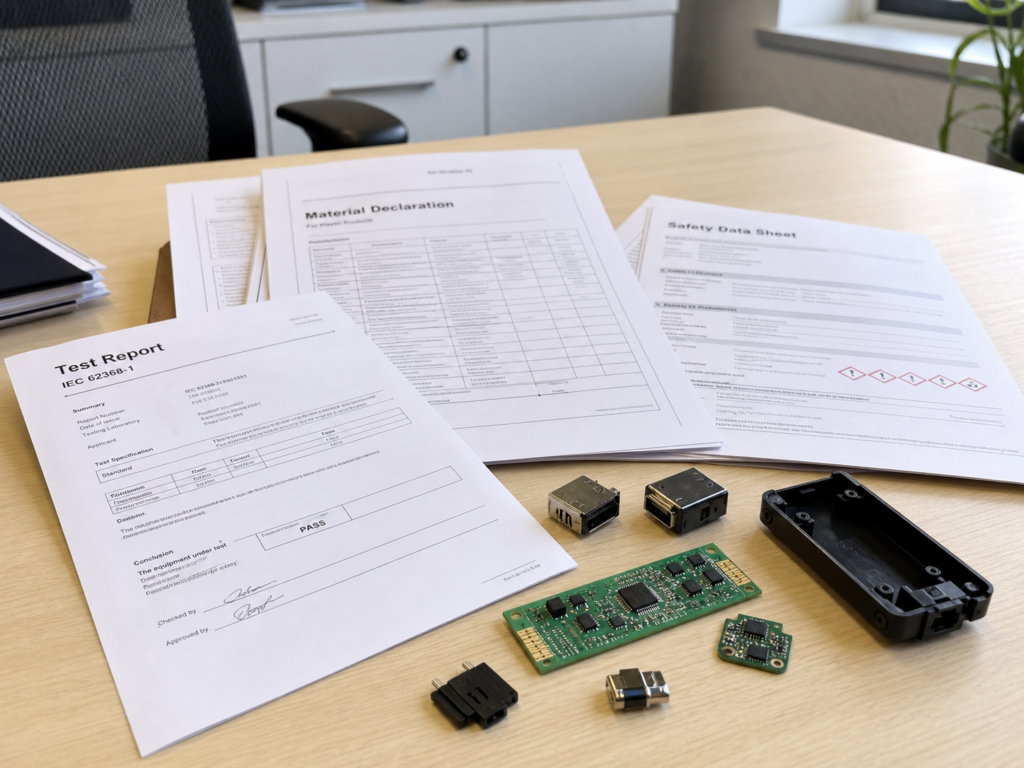
Step 4: Keep compliance vouchers to reduce penalty risks
Keep the full-chain compliance documents by product batch, including third-party test reports, supply chain material declarations corresponding to specific components and marked with the SVHC list version, SCIP notification records, SDS transmission vouchers, OR cooperation agreements, etc., which can prove that reasonable compliance obligations have been fulfilled during violation verification, and strive for lighter or exempted penalties.
Basic Response Steps After Being Randomly Inspected/Found Violations
In case your goods are detained by customs or you are found to have violations during regulatory random inspection, don’t panic, follow these four steps to handle it and minimize the loss:
Step 1: Control risks and avoid expansion
First, suspend the sales and shipment of suspicious batches, isolate the inventory, and don’t send them to the EU anymore, otherwise the larger the violation scale, the heavier the penalty.
Step 2: Verify the violation situation and do not blindly admit it
Don’t rush to admit your mistake first, first verify clearly: which substance is involved, what is the concentration, which article of REACH applies, whether it is really a violation, and whether there is a possibility of exemption. Also, investigate clearly which product batches are involved, how many quantities, and in which countries they are sold, don’t miss them, and don’t include batches that have no problems.
Step 3: Sort out compliance evidence and formulate a rectification plan
Find out all the compliance evidence you have, such as test reports, supplier declarations, and supply chain records. If it is indeed a violation, quickly formulate a rectification plan: for example, if you haven’t done the SCIP notification, make it up quickly; if the material exceeds the standard, change the material quickly; if a recall is needed, formulate a reasonable recall plan, and have a positive attitude.
Step 4: The EU responsible party shall connect with the regulator
Be sure to have the responsible entity within the EU connect with the regulator, that is, the EU importer or your entrusted OR, who are familiar with local regulations and law enforcement processes, and can communicate more smoothly. Actively submit the rectification plan to the regulator, cooperate with the investigation, and strive for lighter treatment. If the violation is the responsibility of the upstream supplier, such as providing a fake report, be sure to keep the evidence and seek recourse from them afterwards.
Basic Compliance Checklist
Finally, I will give you a simple basic compliance checklist, which you can directly check against:
- Product side: Whether high-risk components have corresponding third-party test reports
- Document side: Whether the SVHC declaration is marked with the list version, and whether it corresponds to specific components (rather than a vague whole-machine declaration)
- Supply chain side: Whether there is a notification mechanism for supplier material changes (suppliers should re-evaluate compliance in time after changing materials)
- Record side: Whether all compliance documents and batch tracking records are kept
Learning Summary
After mastering the above framework, enterprises can independently complete the following 5 judgments:
First, be able to judge whether you need to bear REACH penalty responsibility or indirect losses in the electronics supply chain;
Second, be able to correspond to 5 common REACH violations, and know the approximate penalty range and possible business impact;
Third, be able to avoid the 6 most common REACH penalty misconceptions in the electronics industry, and will not fall into traps due to wrong cognition;
Fourth, be able to judge the strictness of local law enforcement according to the export destination and sales channel, and reasonably adjust the priority of compliance;
Fifth, be able to complete basic REACH penalty risk self-inspection, and preliminary response when encountering violations.
Although REACH compliance involves multiple obligations, as long as you grasp the core risk points and implement them step by step, you can effectively reduce the risk of penalties. The specific penalty result shall be comprehensively determined in combination with member state rules, violation circumstances and compliance evidence.