
If you export electronic products to the EU, or are responsible for compliance or procurement in the electronics supply chain, you have most likely heard of abbreviations like REACH and SVHC. But many people either think this is “something only large companies need to worry about”, or confuse it with RoHS, until they panic when their goods are detained by customs or platforms require them to be removed from shelves for failing to fulfill compliance obligations. In fact, REACH SVHC is not as complicated as it sounds; its core logic is very simple: the EU requires enterprises to be responsible for hazardous chemicals in their products and inform of risks in advance, rather than paying the price after problems arise.
Chapter 1: First, Understand the Basics: What is the Relationship Between REACH SVHC and Electronic Products
1. Plain Language Explanation of Three Core Concepts
People who are new to this field can easily get confused by a pile of abbreviations. Let’s first explain the three most core concepts in plain language:
The first is REACH, whose full name is the Registration, Evaluation, Authorisation and Restriction of Chemicals Regulation. It is the core rule of the EU for controlling the chemical safety of products placed on the market. Its applicable objects are divided into three categories according to form: substances (such as pure chemical raw materials), mixtures (such as uncured glue, ink), and articles (Article, a special concept in the REACH regulation, referring to objects with a fixed shape whose function is determined by their shape rather than their chemical composition). Raw materials, components, and finished products in the electronics supply chain may fall into any of these categories, which need to be judged according to their actual form — for example, pure chemical solvents are substances, uncured conformal coatings and plastic pellets are mixtures, and screws, PCB boards, and finished electronic products with fixed shapes and independent functions are usually articles. Different forms are subject to different compliance obligations.
The second is Substances of Very High Concern (abbreviated as SVHC). Simply put, these are chemicals identified by the EU as posing serious hazards to human health or the environment — for example, those that may cause cancer, affect the reproductive system, or accumulate in the environment for a long time and are difficult to degrade. After these substances are included in the “Candidate List” (commonly referred to as the SVHC list), a series of compliance obligations will be triggered.
The third is “article”. This is the most easily misunderstood basic concept, and it is also the core unit for calculating thresholds later. It does not specifically refer to components at a certain level, but objects that meet the above definition. As small as a screw, as large as an entire laptop, they may be a combination of multiple independent articles. The specific judgment rules will be explained in detail in Chapter 3.
2. Core Differences Between Three Easily Confused Lists
Many people think SVHC are “prohibited substances”. In fact, the EU has three different sets of lists for chemical control, with completely different functions. Confusing them can easily lead to pitfalls. Let’s clarify them with a table:
| List Type | Core Function | Direct Impact on Electronic Products |
|---|---|---|
| Candidate List (commonly referred to as the SVHC list) | Lists substances of very high concern that pose serious hazards to human health/the environment | When the content of a single substance in a single applicable article is ≥0.1%, it triggers obligations of information communication, notification, and SCIP declaration; it is not prohibited |
| Authorisation List | Lists substances with extremely high risks that require strict control | To use the substance for specific purposes in the EU, you must first apply for approval from the European Chemicals Agency (abbreviated as ECHA), and it can only be used after approval |
| Restriction List | Lists substances with explicit bans for specific products/uses | As long as the product/use is within the restriction scope, use is directly prohibited; products exceeding the limit cannot be placed on the market |
It should be noted that the same substance may appear in multiple lists at the same time. For example, a certain type of phthalate is both on the Candidate List (requiring information communication) and on the Restriction List (prohibited for use in children’s products). Compliance requirements need to be judged separately, and you cannot only look at one of them.
3. Applicable Scope of Electronic Products and Easily Overlooked Boundaries
The scope of REACH coverage for electronic products is wider than many people think: most finished consumer electronics, components, and raw materials placed on the EU market (referring to the act of products first entering the EU market for sale or use, regardless of whether a fee is charged) are mostly within the scope of control. Even product packaging and auxiliary materials for assembly may also trigger corresponding obligations, and specific obligations applicable to products of different forms vary.
REACH has a small number of statutory exemptions. For example, military products and some medical devices regulated by specific medical regulations may be subject to special rules or exemptions. However, all exemptions must strictly correspond to specific REACH provisions, product uses, and applicable scenarios, and the scope cannot be expanded on one’s own; ordinary consumer electronics are usually not exempt.
Many people tend to overlook several boundary scenarios: samples for customer testing, promotional gifts, direct mail parcels from cross-border e-commerce, and after-sales replacement spare parts. As long as these fall within the scope of being placed on the EU market, they must meet corresponding requirements. You cannot assume exemption just because they are “free”, “small in quantity”, or “sent through personal channels”. EU customs and platforms both conduct random inspections on such products. For example, if you send a free sample charger to an EU customer, and the SVHC content in it reaches the 0.1% threshold and the corresponding compliance obligations are not fulfilled, it may still be detained by customs.
4. Why the Supply Chain Should Control SVHC Upfront
All SVHC risks come from upstream materials. The further upstream you control, the lower the cost. Rectification after finished product assembly often involves material replacement, rework, and delivery delays, with costs several times higher than at the material stage. Non-compliance may also trigger direct consequences such as customs detention, fines, product recalls, and removal from e-commerce platforms. In addition, downstream brand owners and major customers usually include SVHC compliance in supplier assessments, and reject materials without valid compliance declarations, test reports, or SCIP supporting materials. Upfront control can avoid subsequent cooperation risks.
Chapter 2: High-Risk Hiding Spots of SVHC in Electronic Products
The following are common SVHC risk material categories in electronic products, which do not mean that all substances under these categories have been included in the Candidate List; actual compliance judgment requires checking the specific substance name, CAS number/EC number, and the current version of the ECHA Candidate List.
SVHC are not evenly distributed in products. Most risks are concentrated in four types of materials. Prioritizing these areas during inspection can save a lot of time and cost.
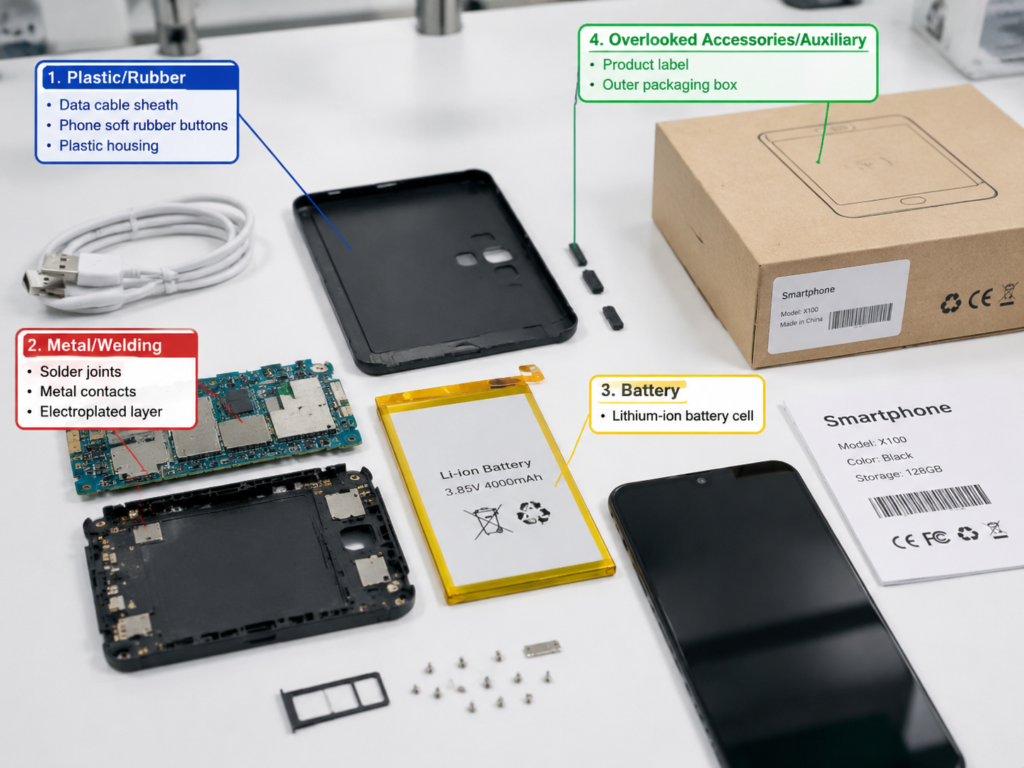
1. Plastic/Rubber Category
This type of material is the focus of SVHC inspection in the electronics industry, and may involve Candidate List substances such as phthalates (commonly used as plasticizers) and brominated flame retardants.
Common locations include data cable sheaths, soft rubber buttons, earbud tips, plastic housings, PCB substrates, etc. Among them, recycled plastics, products with old formulas, and soft PVC materials usually have higher risks — recycled plastics have complex sources and may be mixed with old materials containing SVHC; old formulas may still use plasticizers that have been under key control; soft PVC requires the addition of a large amount of plasticizers, and has always been a high-risk category for phthalate SVHCs.
2. Metal and Welding Category
This type of material may involve Candidate List substances such as lead compounds, cadmium compounds, hexavalent chromium compounds (specific entries such as chromium trioxide, strontium chromate, etc.), and nickel compounds.
Common locations include solder, metal contacts, electroplated layers, passivation layers, anti-corrosion coatings, etc. In practice, surface treatment layers are key inspection areas. You cannot assume non-compliance just because the coating thickness is thin. Specific threshold calculation needs to be combined with the article judgment rules in Chapter 3, and shall be based on the test data of the corresponding article level.
3. Battery and Energy Storage Category
Lithium batteries are core components of electronic products, and are also a high-risk SVHC inspection category. They may involve Candidate List substances such as cobalt salts, nickel compounds, and dimethyl carbonate, and electrolyte components may also involve related SVHCs.
Risk substances are mainly distributed in the cathode materials, electrolyte, cell casing and other parts of lithium batteries. A special reminder here: battery compliance documents only cover the battery itself, and cannot represent the SVHC status of other components of the whole machine. Do not ignore the inspection of other materials in the whole machine just because the battery has completed compliance assessment.
4. Easily Overlooked Accessories/Auxiliary Materials
Many enterprises only focus on main components when controlling SVHC, but ignore accessories and auxiliary materials, which are prone to compliance loopholes. They may involve Candidate List substances such as phthalates, heavy metals, and specific organic solvents.
Common locations include glue, ink, labels, product packaging, etc. It should also be noted that auxiliary materials used during assembly, such as solder wire and conformal coating, if they eventually become part of the product or are placed on the EU market together with the product, also fall within the scope of control and cannot be omitted.
Chapter 3: Core Judgment Rules: How to Calculate Thresholds and How Obligations Are Triggered
Many people think the SVHC rules are complicated, mainly because they do not understand the calculation logic of thresholds and the triggering conditions of different obligations. Let’s start with the most core thresholds and judgment units, then cover the handling rules for special scenarios.
1. Two Core Thresholds and Corresponding Obligations
SVHC compliance obligations are triggered by multiple thresholds and conditions. Among them, the two most core basic thresholds are 0.1% mass ratio and 1 ton/year placement volume. The triggering of different obligations also requires meeting additional conditions:
The first core threshold is 0.1% (mass ratio): when the content of a single SVHC in a single applicable article is ≥0.1%, it triggers the information communication obligation under Article 33 of REACH (communicating information to downstream customers, and replying within 45 days when consumers inquire), and also triggers the declaration obligation for the SCIP database. It must be noted here: the threshold is calculated per single article, not averaged over the whole machine — this is the most common cognitive misunderstanding. The specific article judgment rules will be explained in detail in the next section.
The second core threshold is 1 ton/year: this is one of the triggering conditions for SVHC notification under Article 7(2) of REACH, not the only condition. To trigger the notification obligation, the following four conditions must be met simultaneously:
- The substance has been included in the SVHC Candidate List;
- The content of the substance in a single article is ≥0.1%;
- The total weight of the substance placed on the EU market per year by producers or importers within the EU is ≥1 ton;
- Exposure of the substance to humans or the environment cannot be excluded, and the use of the substance has not obtained REACH registration.
For newly added substances in the Candidate List, there is usually a 6-month notification buffer period. The primary bearers of the statutory notification obligation are producers or importers within the EU; non-EU enterprises do not need to directly notify ECHA, but need to provide complete component, quantity and use data to the EU importer to cooperate with them in completing the notification assessment; if a non-EU enterprise legally appoints an Only Representative (OR) within the EU, the OR may perform part of the obligations on its behalf within the scope permitted by the regulation and the authorization agreement between the two parties, but cannot replace all the importer’s full statutory responsibilities.
2. Judgment Criteria for “Single Article”
Since the threshold is calculated per single article, how do you judge what a “single article” is? The core judgment basis is the definition of article in REACH: an object that obtains a fixed shape, surface or design during production, and whose function is to a greater extent determined by its shape, surface or design rather than its chemical composition.
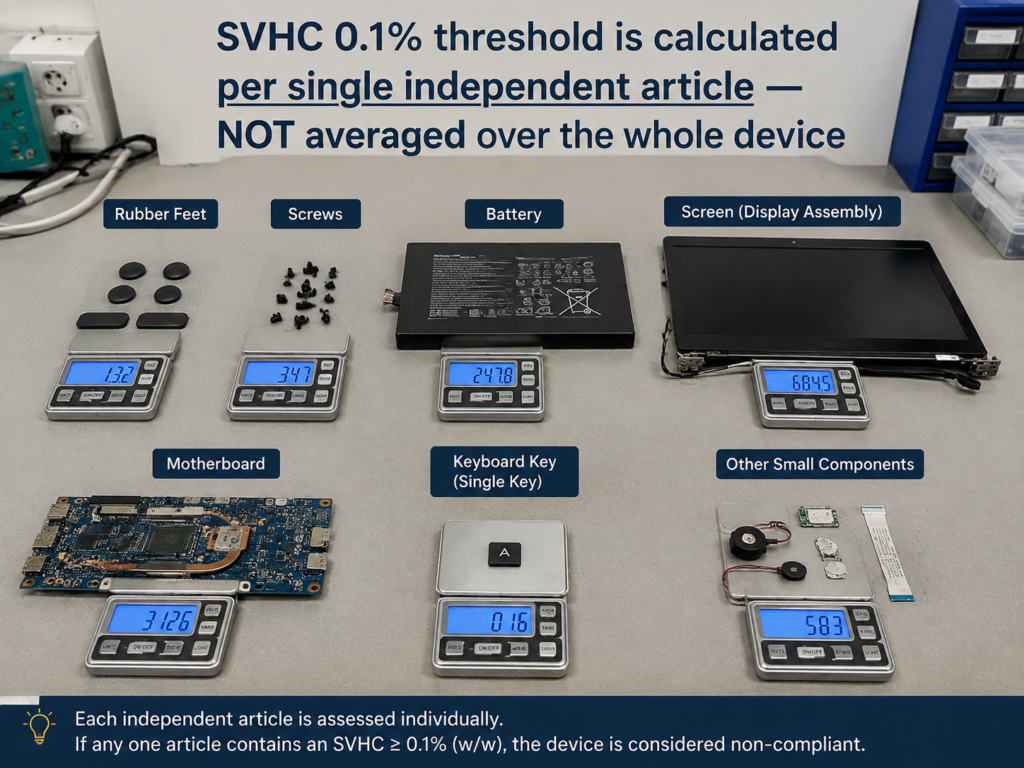
For complex electronic finished products such as mobile phones and laptops, when calculating the SVHC 0.1% threshold, you cannot simply average it over the total mass of the whole machine; components such as motherboards, batteries, screws, screens, buttons, and housings that still have independent article attributes should be used as threshold calculation units respectively. Information at the whole machine level can be used for product-level data aggregation, but cannot replace threshold judgment at the component article level.
Regarding the judgment of treatment layers such as surface coatings and plating layers, it is necessary to combine ECHA’s official guidelines and judge on a case-by-case basis from aspects such as function, supply form, combination method with the substrate, and whether they still have independent article attributes after disassembly. Under normal circumstances, if the coating/plating is a surface treatment completed when the substrate leaves the factory, and the component is supplied as a whole and cannot be separated without damaging the function, then the coating/plating is part of the coated article and is weighed together with the substrate; special scenarios need to be evaluated in combination with specific situations, and you cannot directly assume that all coatings need to be calculated separately.
3. Threshold Judgment for Special Scenarios
In actual operation, some scenarios with blurred boundaries will be encountered, which can be judged case-by-case in combination with ECHA’s official guidelines according to the following principles:
Micro components (such as SMD resistors, capacitors)
For tiny electronic components, there is no need to forcefully disassemble them to the smallest material level that cannot be reasonably identified, but the principle of “prioritize the finest reasonable level available” must be followed: if the supplier can provide SVHC data for a single component, or the component can be purchased and replaced as an independent article, priority should be given to judging by a single component; only when the component is inseparable, has no independent use function, cannot obtain finer level data, and evaluation by a higher-level component will not cover known high-risk small parts, can components such as the whole board or whole group be evaluated as a whole article. In actual operation, a reasonable evaluation level can be selected in combination with ECHA guidelines and supply chain traceability capabilities, provided that the existence of high-risk substances is not concealed.
Accompanying packaging
Packaging placed on the market together with the product needs to be judged on a case-by-case basis: if the packaging is only used to protect and contain the product (such as mobile phone packaging boxes, charger plastic bags), then it is evaluated as an independent article for SVHC content, and is not included in the mass denominator of the finished product itself; if the packaging itself has an independent use function (such as a reusable digital storage bag), it may be regarded as a separate product and needs to fulfill complete compliance obligations.
Mixtures such as glue and ink
The evaluation of mixtures such as glue and ink needs to be phased: if they are supplied separately in the form of a mixture, the compliance requirements for mixtures in REACH apply; if they become an inseparable part of the product after curing (such as ink printed on the housing, cured structural adhesive), they need to be included in the mass scope of the final article, and SVHC content is evaluated at the corresponding article level.
Three-step method for quick judgment
After reading the above rules, you can quickly sort out the judgment logic in 3 steps:
Step 1: Confirm the material form — whether it is a substance, mixture, or article; different forms are subject to different obligations;
Step 2: Determine the evaluation level — if it is an article in a complex product, determine the minimum unit for calculating the threshold according to the independent article judgment rules;
Step 3: Check the triggering conditions — first check whether the concentration of a single SVHC reaches 0.1%, then combine the placement volume, supply scenario, etc. to determine the specific obligations to be fulfilled.
4. Boundary Reminder for Below 0.1%
Many people think that if SVHC is below 0.1%, there is no compliance responsibility at all, but this is not the case. The “no need to fulfill the SVHC information communication obligation” here means that under the premises of correct article level, use of standard-compliant test methods, covering all substances in the current version of the Candidate List, and representative samples, only when it is confirmed that the content of a single SVHC is below 0.1%, the information communication obligation under Article 33 of REACH does not need to be triggered.
Even if the above conditions are met, it does not mean that there are no other EU chemical compliance risks — you also need to check the requirements of REACH’s Restriction List, Authorisation List, as well as other relevant regulations such as the POPs Regulation, Battery Regulation, and WEEE Directive. In addition, the internal control standards of many brand customers and e-commerce platforms are stricter than regulations, for example, requiring that SVHC cannot be detected at all. In this case, even if it is below 0.1%, it may not meet customer requirements, and confirmation is required in advance.
Chapter 4: Compliance Obligations of Each Link in the Supply Chain (Compared by Role)
SVHC compliance obligations are not a matter of a single link; each role in the entire supply chain has corresponding responsibilities. First, it is clarified that SCIP is a hazardous substance information database established by the EU under the Waste Framework Directive, mainly used for waste recycling management and protecting consumers’ right to know. The obligation is fulfilled by entities such as producers, importers, and assemblers who first place articles on the market within the EU. Non-EU enterprises usually provide product data through EU customers, importers, or authorized service providers, and cannot directly submit SCIP declarations.
Let’s first sort out the core rules of four types of core SVHC-related obligations with a table:
| Type of Compliance Obligation | Triggering Condition | Statutory Responsible Entity |
|---|---|---|
| Communicating information to the downstream supply chain (Article 33 of REACH) | The content of a certain SVHC in a single article is ≥0.1% | Producers and importers within the EU, and EU-based suppliers that supply articles to downstream parties |
| Consumer information response (Paragraph 2 of Article 33 of REACH) | The content of a certain SVHC in articles (including finished products) supplied to EU consumers is ≥0.1%, and the consumer makes an inquiry | Entities within the EU that directly supply products to consumers (such as importers, EU local sellers, or authorized distance sales responsible parties, specifically judged based on the actual transaction structure) |
| SVHC notification (Article 7(2) of REACH) | Simultaneously meet: ① The substance is in the Candidate List; ② Content in a single article is ≥0.1%; ③ The total weight of the substance placed on the market annually by EU producers/importers is ≥1 ton; ④ Exposure cannot be excluded and the use is not registered | Producers and importers within the EU |
| SCIP database declaration (EU Waste Framework Directive) | The content of a certain SVHC in articles (including complex products) placed on the EU market is ≥0.1% | Producers, importers, and assemblers within the EU who first place articles on the market |
Note: If distributors are only responsible for subsequent distribution, they usually do not need to bear the initial SCIP declaration obligation, but need to retain and communicate SVHC information; the Only Representative (OR) appointed by a non-EU enterprise may perform part of the obligations of the non-EU manufacturer on its behalf within the scope permitted by REACH regulations and the authorization agreement between the two parties, but cannot automatically replace the SCIP declaration subject or all the statutory responsibilities of the EU importer.
Different supply chain roles bear different obligations. The core is to fulfill the responsibilities of information communication, data cooperation, or statutory declaration according to their position in the chain of “placing on the EU market”. The following are the core obligations of common roles in the electronics supply chain:
Upstream Raw Material/Component Suppliers
There are two core obligations: First, if the SVHC content in the supplied articles is ≥0.1%, it is necessary to proactively inform downstream customers of the substance name and safe use information; second, cooperate with downstream customers to provide compliance materials, including Supplier Declaration of Conformity (abbreviated as SDoC), third-party test reports, etc., to support downstream in completing SCIP declaration, notification assessment and other work.
At present, more and more downstream major customers include SVHC compliance in supplier assessments. Suppliers who cannot provide valid compliance materials may be excluded from supply chain cooperation.
Midstream Assembly/Contract Manufacturers
The core work is to establish an SVHC information management system for all materials: First, establish a corresponding version of the Bill of Materials (abbreviated as BOM) and SVHC ledger, and verify the compliance materials of each batch of incoming components to ensure that the materials correspond to the material model and batch; second, not only control main components, but also auxiliary materials used in assembly such as solder, glue, and conformal coating, if they eventually become part of the product or are placed on the EU market together with the product, also need to be included in the control scope; third, summarize the SVHC information of all materials and completely pass it on to downstream brand owners, exporters, or EU importers.
If the contract manufacturer is an entity within the EU and places products on the EU market on its own, it needs to bear the corresponding statutory declaration obligation; if it only processes under entrustment, its core responsibility is material control and information communication.
Downstream Brand Owners/Exporters/Cross-border Sellers
As non-EU entities, they do not need to directly bear the statutory declaration obligations within the EU, but need to cooperate with the EU responsible entities to complete the following work: First, if the finished product contains ≥0.1% SVHC, it is necessary to prepare the corresponding substance information, and when consumers inquire through EU sales channels, cooperate with the EU-based sales responsible entity to reply free of charge within 45 days; second, provide accurate annual export volume and product component data to the EU importer or Only Representative, and cooperate with them to determine whether the SVHC notification threshold is reached; third, organize complete product material and SVHC information to support the EU responsible entity in completing the SCIP database declaration.
EU Importers/Domestic Producers
Producers and importers within the EU are the primary bearers of SVHC-related statutory obligations. They are responsible for fulfilling the SVHC notification obligation (if the triggering conditions are met), completing the SCIP database declaration, and bearing the statutory responsibility of replying to consumers on SVHC information. They need to ensure that products placed on the EU market meet REACH requirements and retain complete compliance materials.
In addition, distributors within the EU also need to retain and communicate SVHC information downstream to ensure supply chain information traceability.
Chapter 5: 5-Step SVHC Compliance Inspection That Beginners Can Directly Implement
Most SVHC risks come from upstream materials. The more upfront the control, the lower the rectification cost — problems discovered after finished product assembly often incur additional costs such as material replacement, rework, and delivery delays, which are much higher than the control cost at the upstream material stage. Even if you are new to SVHC, following these 5 steps, you can complete basic compliance inspections and control most common risks.
Step 1: Disassemble Materials and Mark High-Risk Items
First, disassemble your product into separable independent components, and classify them by material, such as plastic parts, metal parts, batteries, auxiliary materials, etc. Then, against the four types of high-risk materials mentioned in Chapter 2, mark the components with higher risks and prioritize inspecting these — for example, data cables made of soft PVC usually have higher risks than metal screws, and prioritizing inspection of high-risk components can greatly reduce testing and communication costs.
At the same time, organize the corresponding version of the Bill of Materials (BOM), and correspond the supplier, model, and batch of each material one by one to facilitate subsequent collection and verification of materials.
Step 2: Collect Compliance Materials from Upstream
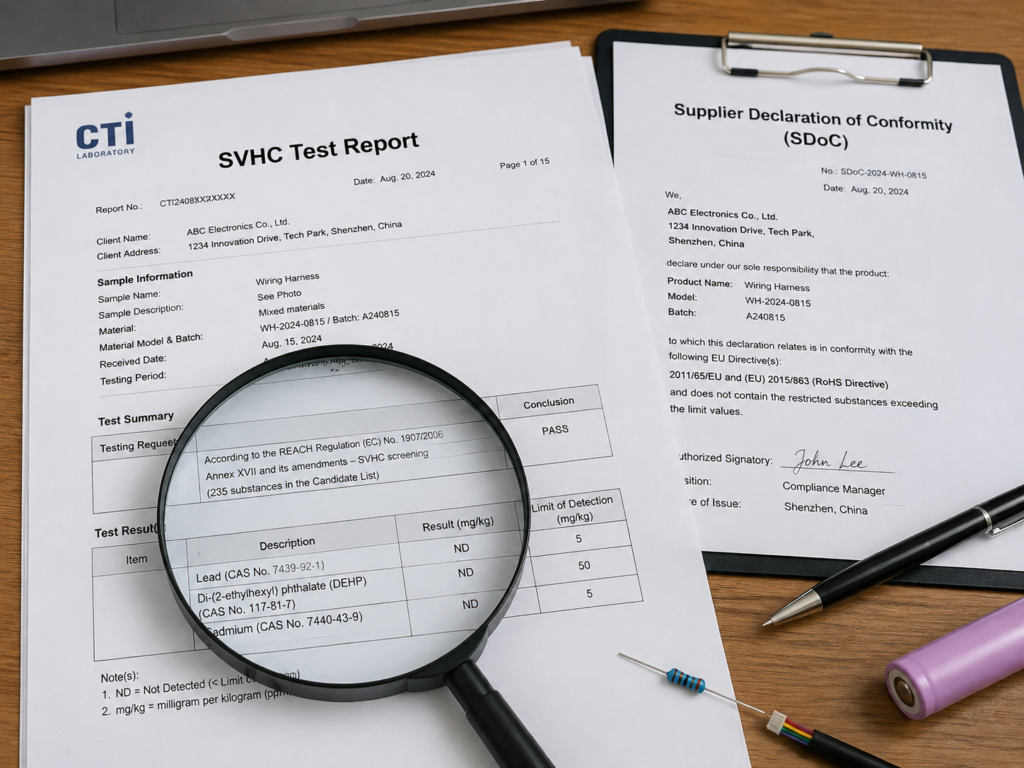
After organizing the material list, you can request compliance materials from upstream suppliers. Prioritize requesting the Supplier Declaration of Conformity (SDoC), which is a compliance commitment document issued by the supplier itself. It has low cost and fast acquisition speed, and is suitable for low-risk materials.
If it is a high-risk material and the supplier cannot provide a valid compliance declaration, you can require them to provide a third-party test report. A special note here: all materials must correspond to the specific material model and production batch. Reports from other models or other batches cannot be used as substitutes. Misattributed materials have no compliance validity.
Step 3: Verify Materials and Judge Risk Level
After receiving the materials, you cannot just look at whether there is an official seal or the testing agency logo. Focus on verifying 4 items:
① Candidate List version: Confirm whether the SVHC Candidate List version used in the declaration or test report is the corresponding version you need for compliance. Old versions cannot cover the compliance requirements of newly added substances.
② Material and batch matching: Confirm whether the material model and production batch marked on the materials are consistent with what you actually purchased, to avoid suppliers using materials from other materials to make up the numbers.
③ Test method and limit of detection: If it is a test report, it is necessary to confirm whether the test method meets EU general standards, and whether the limit of detection of the method meets the judgment needs of the 0.1% threshold — the limit of detection refers to the lowest concentration that can be detected by this method, and substances below the limit of detection cannot be accurately identified.
④ Article level and sample representativeness: Confirm whether the article level corresponding to the test or declaration is consistent with the single article you need to evaluate; at the same time, confirm whether the sample can represent the situation of the entire batch of materials.
After verification is completed, combined with the current Candidate List version, test method, limit of detection, measurement uncertainty, article level, and sample representativeness, the initial risk level of the material can be divided into three categories:
- Not detected: The target substance is below the limit of detection of the test method, which only means that the target substance was not found under the test conditions; if the test covers all Candidate List substances in the current version and the sample is representative, the compliance risk of such materials is relatively the lowest.
- Detected but below 0.1%: At the corresponding article level, within the acceptable range of test uncertainty, it is confirmed that the content of a single SVHC is below 0.1%, which usually does not trigger the information communication obligation under Article 33 of REACH, but it is still necessary to check other regulations and customer internal control requirements.
- Detected ≥0.1%: It is confirmed that the content of a single SVHC reaches or exceeds the 0.1% threshold, and the corresponding compliance obligations need to be fulfilled in accordance with regulations.
If the supplier only states “unable to confirm”, this cannot be equated with compliance. You must require them to supplement and provide complete materials, otherwise the risk will be borne by you yourself.
Step 4: Fulfill Obligations and Retain Evidence
If after inspection, the SVHC content of a material is ≥0.1%, you must fulfill the corresponding obligations in accordance with regulations: communicate complete substance information and safe use instructions to downstream customers, cooperate with EU responsible entities to prepare consumer response content, and assist in completing SVHC notification assessment and SCIP declaration.
All compliance materials need to be properly archived. According to the requirements of Article 36 of REACH, they usually need to be kept for at least 10 years, calculated from the date of the last manufacture, import or supply of the relevant products; enterprises also need to appropriately extend the retention period in combination with the product life cycle, contract agreements and the requirements of other applicable regulations. Materials to be retained include but are not limited to: supplier compliance declarations, original third-party test reports, corresponding version of BOM, material change records, SVHC information communication records, notification application vouchers (if applicable), SCIP declaration receipts (if applicable), etc.
Step 5: Long-Term Low-Cost Control Tips
SVHC is not a one-time inspection that lasts forever; it requires long-term control, but it does not require excessive investment. Remember three tips to achieve low-cost compliance:
First, confirm SVHC compliance before new materials are introduced. Do not wait until materials are purchased in batches and put into production to discover problems. Post-event rectification often incurs additional material replacement and rework costs, and may also affect the delivery cycle.
Second, regularly follow up on ECHA’s Candidate List updates. It is recommended to check the latest official version at least 1-2 times a year. After each update, check whether existing materials involve newly added SVHCs, and adjust control strategies in a timely manner.
Third, agree with suppliers that if they change the material formula, production process, or upstream supplier, they must notify you in advance, and you can simultaneously re-evaluate compliance to avoid compliance risks caused by suppliers changing materials without notice.
Chapter 6: Essential for Semi-Proficiency: 7 Common Misconceptions and Pitfall Avoidance
Many beginners are easily misled by some common wrong perceptions. Even if you have been doing compliance for a long time, you may still fall into pitfalls. We have sorted out 7 most common misconceptions. Avoiding these, your SVHC control level will surpass most beginners.
Misconception 1: SVHC are completely prohibited substances
This is the most common misunderstanding. The core of SVHC in the Candidate List is “very high concern” rather than “prohibited”. When the content reaches the 0.1% threshold, you only need to fulfill obligations such as information communication, notification, and SCIP declaration, and they can still be used legally. Only substances that are also included in the Restriction List (prohibited for specific uses) or the Authorisation List (can only be used after approval) are subject to use restrictions — for example, some phthalates are both in the Candidate List and restricted for use in children’s contact products. In this case, the requirements of both lists must be met simultaneously.
Misconception 2: RoHS compliance = REACH SVHC compliance
Many people confuse RoHS and REACH SVHC, which is completely wrong. The two are mutually independent regulatory requirements that may apply to the same electronic product at the same time:
- Different control scopes: RoHS targets restricted substances in electrical and electronic products. The currently commonly used version controls 10 categories of substances, and the limit is calculated by homogeneous material; while the SVHC Candidate List is updated irregularly by ECHA, the number of substances continues to increase, covering all articles entering the EU market, with a scope much larger than RoHS. Specific substances shall be subject to the currently applicable version.
- Different control logics: The core of RoHS is “restricting excessive use”, and products exceeding the limit cannot be placed on the market; while the core of SVHC is “information transparency”. Reaching the 0.1% threshold only requires fulfilling information communication and declaration obligations, and can still be used legally.
Even if you pass RoHS, you must also separately verify SVHC compliance; they cannot replace each other.
Misconception 3: Only testing the whole machine is enough, no need to care about internal components
Some enterprises, for convenience, directly send the entire product for testing, which恰恰容易掩盖风险 — because the SVHC threshold is calculated per single independent article, averaging over the whole machine will lower the concentration of high-risk small components. For example, for a 2-kilogram laptop, the soft rubber feet only weigh 3 grams. If the content of a certain SVHC in the feet is 0.5%, it is almost undetectable after averaging over the whole machine. However, the feet themselves, as separable independent articles, have already reached the 0.1% threshold and need to fulfill corresponding obligations. Complex electronic products need to be disassembled to the corresponding independent article level for evaluation, and risks cannot be excluded solely by whole-machine testing.
Misconception 4: One test report is valid for life
The validity of test reports has clear prerequisites and cannot be once and for all: First, the SVHC Candidate List is updated irregularly, and reports issued based on the old version of the Candidate List cannot cover subsequently added substances; second, after suppliers change material formulas, production processes, or raw material origins, the original report is no longer applicable; third, third-party test reports are only valid for the submitted batches and samples, and cannot directly cover all batches and all models of materials. Enterprises need to update compliance materials in a timely manner in combination with list updates and material changes.
Misconception 5: Only control the main unit, ignoring accessories/packaging/auxiliary materials
Many enterprises only focus on the main unit when conducting SVHC control, but ignore that all articles placed on the EU market together with the product are within the scope of control. For example, chargers and data cables given away when selling mobile phones, product outer packaging boxes, and even solder wire for assembly may separately trigger compliance obligations; even replacement batteries and spare buttons sent separately for after-sales service also need to meet the requirements, and control cannot be relaxed just because they are accessories, auxiliary materials, or spare parts.
Misconception 6: Only local EU enterprises need to manage it
Many non-EU sellers think that REACH is an EU regulation and they don’t need to worry about it since they are not in the EU. This is a typical fluke mentality. For non-EU enterprises exporting products to the EU, although the primary statutory responsibility is borne by importers or distance sales responsible entities within the EU, non-EU enterprises must provide complete product data to cooperate in fulfilling obligations, and cannot exempt themselves from product compliance management responsibilities through their non-EU status. At present, EU customs have carried out regular random inspections on direct mail parcels from cross-border e-commerce. If compliance obligations are not fulfilled, situations such as goods detention and platform removal may also occur.
Misconception 7: Having the CE mark means meeting REACH SVHC requirements
Many people think that products with the CE mark meet all EU regulatory requirements, but this is not the case. The CE mark is a compliance label for specific directives such as Electromagnetic Compatibility (EMC) and Low Voltage (LVD). The specific coverage varies depending on the directives applicable to the product, but none of them include the information communication and declaration obligations of REACH SVHC. SVHC compliance is an independent requirement that needs to be verified separately, and the CE mark cannot be used as proof of compliance.
Chapter 7: Learning Summary: Ability Checklist from Beginner to Semi-Proficient
After reading this article, you can compare the following 6 abilities to judge your mastery level:
- Can clearly distinguish the different functions of the REACH Candidate List, Authorisation List, and Restriction List, and do not confuse the boundary between “very high concern” and “prohibited”;
- Can quickly locate the common positions of 4 types of high-risk SVHC materials in electronic products, and prioritize focusing on high-risk links during inspection;
- Can calculate the 0.1% threshold according to the judgment rules of “single independent article”, and accurately judge whether the corresponding compliance obligations are triggered;
- Can combine their own role in the supply chain to clarify their own statutory responsibilities or cooperation obligations;
- Can verify the compliance declarations and test reports provided by suppliers, and initially judge the validity of materials and risk level;
- Can avoid 7 common cognitive misconceptions and complete basic SVHC compliance inspection according to the 5-step process.
For beginners in the electronics supply chain, there is no need to memorize all substances and provisions at the beginning. As long as you grasp the three core logics of “judging thresholds by article level, upfront control from upstream materials, and retaining compliance evidence throughout the entire chain”, you can handle most daily compliance scenarios; when encountering complex boundary situations, you can judge by combining ECHA official guidelines or the opinions of professional institutions.