
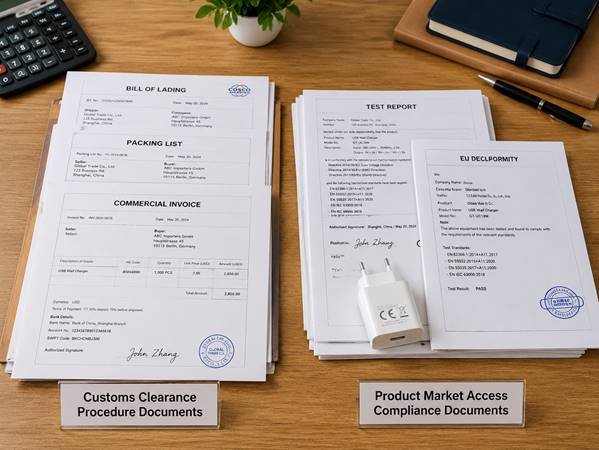
Many people shipping goods to the EU for the first time often fall into two extremes: either they think sticking a CE mark is enough to get by and don’t prepare supporting documents at all; or they cobble together a bunch of certificates, only to have their commercial declaration documents full of errors and omissions, and still get stuck. In fact, the document logic for EU customs clearance is very clear, with two core categories: one is customs clearance procedure documents, used for entry declaration, tax and duty calculation, and confirming the identity of goods; the other is product market access compliance documents (such as CE-related documents), used to prove that products meet EU sales requirements. They do not need to be actively submitted to customs for every shipment, but must be available at all times.
This article starts from the most basic concepts, covers how to determine product regulatory categories, prepare corresponding documents, and avoid common pitfalls. Even if you are doing business with the EU for the first time, you can prepare all the documents step by step and avoid wasting money.
1. First, Understand the Basics: What Are Clearance-Related Documents, Who Is Responsible, and What Happens If There Are Problems
Two Core Components of Clearance-Related Documents
Simply put, the full set of certification documents involved when non-EU goods enter the EU is divided into two core categories: the first is commercial clearance documents, which are used to answer the questions of “what the goods are, how much they are worth, where they come from, and how much tax should be charged”. All products require these for declaration; the second is market access compliance documents (such as CE-related documents), which are used to prove that products meet EU access requirements such as safety and environmental protection. Only products within the corresponding regulatory scope need to be prepared, and they are usually provided during random inspections by customs or market supervision authorities, not actively submitted for every shipment.
Here we first correct two of the most common misconceptions: it is not true that sticking a CE mark guarantees smooth customs clearance — the mark is just a compliance label on the product, and supporting documents must be available at all times; nor is it true that only compliance documents are needed for clearance. If there are errors or omissions in commercial declaration documents, even with complete compliance documents, release will be suspended.
Which Situations Require Import Clearance
All goods entering the EU Customs Union from non-EU countries/regions and requiring release into the EU market need to go through import declaration procedures — whether it is B2B full-container cargo, B2C small parcels, or equipment for enterprise use, there are no exceptions.
There are two types of situations that do not require import clearance for “release into the market”, but still have corresponding declaration obligations:
One is the flow of goods between EU member states. Since they are already within the Customs Union, there is no need to repeat import clearance, but it may involve VAT declaration, statistical declaration, or special supervision of specific categories (such as food traceability inspections);
The other is purely transit goods, that is, goods that only pass through the EU to be transferred to third countries and are not sold in the EU market. They only need to go through the customs transit procedure, and do not need to submit CE compliance documents according to market access requirements, but still need to complete the transit declaration. Customs may conduct inspections on safety, intellectual property rights, prohibited and restricted goods, etc.
Also note that not all products are regulated by CE: categories such as food, pharmaceuticals, cosmetics, and ordinary textile clothing are not included in the scope of CE harmonization legislation, and access documents must be prepared in accordance with the corresponding special regulations. Do not forcefully apply CE requirements.
How Are the Responsibilities of All Parties Divided
Many people think that hiring a freight forwarder means everything is fine. In fact, the responsibility boundaries of different roles are very clear and cannot be generalized:
• Overseas manufacturers or exporters: responsible for ensuring the authenticity of goods information, and that the full set of compliance documents is complete and consistent with the actual goods;
• EU-based importers: usually the first responsible party for placing products on the EU market, responsible for coordinating with manufacturers/EU authorized representatives to prepare compliance documents, and bearing important responsibility for product compliance and document authenticity; must hold a valid EU Economic Operators Registration and Identification number (EORI, equivalent to a universal ID for enterprises in EU customs, registered in one member state and valid across the EU);
• EU Authorized Representative (referred to as EU AR): a compliance responsible person specially designated by non-EU manufacturers, mainly responsible for liaising with EU regulatory authorities and handling product compliance-related issues;
• Freight forwarders or customs brokers: entrusted to handle declaration procedures, and the scope of responsibility depends on the entrustment agreement and agency mode: under the direct agency mode, the declaration responsibility is still borne by the principal; under the indirect agency mode, the customs broker may bear joint and several customs debt liability, subject to the rules of the member state and the content of the authorization.
Common question: Declaring with the freight forwarder’s EORI does not mean that the importer/cargo owner can be exempted from responsibility for product compliance and document authenticity.
What Are the Consequences of Non-Compliant Documents
Don’t think that if the documents are wrong, you can just make up for it. The consequences of problems of different degrees vary greatly: minor cases are where documents have defects but can be corrected, goods are suspended from release, and can be released after correction, but port detention fees, warehouse rental fees will be incurred, and time will be delayed; moderate cases are where documents are seriously inconsistent, classification is wrong, or compliance is questionable, goods may be detained, required to be returned, or fined, the enterprise’s customs credit rating may be downgraded, and the probability of random inspection of subsequent shipments will increase; severe cases involve document fraud, deliberate concealment, etc., which may be held accountable by market supervision authorities. In serious cases, they will be added to the EU’s entry dishonesty list, affecting the entry of subsequent goods.
2. Step 1: First Determine Which Regulatory Category Your Product Falls Into
Before preparing documents, you must first figure out whether your product requires CE and which regulation it falls under. Otherwise, preparing the wrong documents is a complete waste of effort.
Quickly Determine If Your Product Requires CE
CE is not a universal system covering all industrial products. Only products explicitly included in the scope by specific EU harmonization legislation (directives/regulations) need to bear the CE mark. You can make a preliminary judgment according to this logic:
1. First look at the product category: whether it belongs to common CE-covered categories such as electrical and electronic equipment, machinery, personal protective equipment, toys, wireless devices, etc.;
2. Then look at product attributes: for example, power supply method, whether it has wireless function, intended use, user group, etc., will affect whether it falls within the CE scope — for example, separate ordinary dry batteries are not within the CE scope, while lithium battery packs with protection circuits may be included in relevant directives. You cannot generalize that “all products with batteries are CE category”;
3. If you are unsure, you can check the EU’s public CE harmonization legislation product list, or find a qualified compliance agency for a free preliminary judgment. Don’t guess blindly.
There is a red line that must be remembered: products not within the CE scope must not be affixed with the CE mark on their own, otherwise they may be refused release, returned, or subject to administrative penalties.
Products Corresponding to Common Core CE Regulations
CE is not a unified standard, but consists of many harmonization regulations. Different products correspond to different requirements. The table below summarizes the most common categories for your reference. The specific scope of application is subject to the official text:
| Regulation Abbreviation | Regulation Name | Usually Applicable Product Scope (with exclusions, subject to official text) |
| LVD | Low Voltage Directive | Electrical equipment with a rated voltage of 50-1000V AC and 75-1500V DC, such as home appliances, lamps, chargers; excluding some specific medical, industrial equipment and other exclusions |
| EMC | Electromagnetic Compatibility Directive | Electronic and electrical equipment that generates or is affected by electromagnetic energy, such as mobile phones, routers, electronic scales; some special equipment has exclusions |
| RED | Radio Equipment Directive | Electronic equipment with wireless communication functions such as Bluetooth, WiFi, cellular, etc., such as Bluetooth headsets, smart door locks; usually covers related safety, electromagnetic compatibility and radio spectrum requirements |
| RoHS | Restriction of Hazardous Substances Directive | Electronic and electrical equipment within the scope, restricting the use of hazardous substances such as lead and mercury; there are product exclusions and specific application exemptions |
| MD | Machinery Directive (current) / Machinery Regulation (EU) 2023/1230 (transition period until 2027) | Machinery and equipment with moving parts, such as power tools, factory production lines, household juicers; specific application depends on product category and regulation transition arrangements |
| PPE | Personal Protective Equipment Regulation | Articles designed to protect the human body from health or safety risks, such as protective masks, safety helmets, goggles; divided into Category I/II/III according to risk level, with different requirements |
| Toys | Toy Safety Directive | Products designed or intended for use by children under 14 years of age in play, such as building blocks, dolls, children’s scooters; excluding non-play products such as children’s stationery and children’s furniture |
Most Common Category Judgment Pitfalls
Many people get stuck on category judgment. There are several common misconceptions that must be avoided:
First, a product may comply with multiple regulations at the same time, but it is not a simple superposition: for example, for a desk lamp with Bluetooth, if the wireless function falls within the scope of RED, RED usually covers its related safety, electromagnetic compatibility and radio requirements. The specific judgment needs to be combined with the product’s power supply method, wireless module integration method, whether it is placed on the market as an independent device, etc. It is not necessary to mechanically apply the combination of LVD+EMC+RED+RoHS, but shall be subject to the actually applicable regulatory requirements.
Second, for products of the same type, different intended uses may lead to different applicable regulations: for example, household electric drills and industrial-grade electric drills may have different mechanical conformity assessment procedures due to different usage scenarios and risk levels. You cannot make a general judgment solely based on “household/industrial”.
Third, the compliance requirements for accessories and complete machines are different: separately sold power adapters need to complete compliance as independent products; if they are placed on the market together with the complete machine as supporting accessories, they can be included in the compliance system of the complete machine, subject to regulatory requirements.
Fourth, not all products that come into contact with children are toys: only products designed or intended for children to play with are subject to the Toy Safety Directive. Children’s stationery, children’s furniture, etc. are regulated by other regulations. Don’t prepare the wrong documents.
3. Required for All Products: General Basic Clearance Documents
Whether your product is CE category or not, these basic commercial declaration and qualification documents are mandatory, and they are also the most error-prone areas.
Core Commercial Documents: Invoice, Packing List, HS Code
The commercial invoice is the core declaration document and must contain the following information: full names and addresses of the buyer and seller, specific product names and models, HS/CN code (customs code), quantity, unit price and total price, trade terms (such as FOB, CIF), currency, and invoice date.
Common mistakes many people make: product names are written very generally, such as only writing “accessories” or “daily necessities”, so customs has no idea what they are; deliberately underreporting the value of goods to pay less tax, only to be valued by customs and fined more; the information of the consignor and consignee does not match the EORI entity; free samples are directly written with zero value — customs will value them according to fair market value. Even free samples must be declared with a reasonable market price.
The packing list must correspond item by item with the information on the commercial invoice, including the number of pieces, gross and net weight, dimensions, shipping marks, and packaging material of each goods. There must be no discrepancies.
As for the HS/CN code, it is classified according to the function, material, and use of the product, which directly affects the tariff rate and regulatory conditions. However, the final rate may also be affected by origin, trade agreements, quotas, anti-dumping measures, etc. The TARIC database can be used for preliminary verification of classification and tax rates. For complex products, it is recommended to apply for legally binding Binding Tariff Information (BTI) to avoid classification disputes.
Transport and Origin Documents
Transport documents include ocean bills of lading, air waybills, express waybills, etc. The consignee information on them must correspond to the EORI information of the declaring entity to avoid inconsistency of the declaring entity.
A certificate of origin is not required to be submitted for every import: a general Certificate of Origin (CO) is only used to prove the country of production of the goods, and customs verifies it as needed; preferential origin certificates (such as origin declarations/certificates under free trade agreements between the EU and Vietnam, Singapore, South Korea, etc., or documents of specific preferential arrangements recognized by the EU) can enjoy preferential tariff rates, but must simultaneously meet the origin rules, certificate forms and declaration requirements of the corresponding trade agreement, otherwise the preference cannot be enjoyed. The specific requirements are subject to the customs of the importing country and relevant agreements.
Common misconception: the shipping country is not the same as the country of origin. For example, if you ship from China but the goods are actually produced in Vietnam, then the country of origin is Vietnam. Whether you can enjoy preferential tariffs depends on the rules of the trade agreement between Vietnam and the EU. Don’t get this wrong.
Also note: some high-risk, trade-controlled products may require additional import licenses, quota certificates, anti-dumping related documents, etc., depending on the product category and country of origin.
Import Entity Qualification Documents
First is the EORI number, which is the unified operator identity credential for EU customs. Whether the importer declares by itself or entrusts a customs broker to declare, a valid EORI number is required;
Then is import VAT related: the handling method of import VAT depends on the importer’s identity, member state procedures, and declaration method. Some member states support import VAT deferral (that is, no payment at the time of import, and subsequent declaration and deduction at the sales end). The specific situation needs to be confirmed with the tax or customs declaration agency of the importing country; B2B imports usually require the importer’s VAT number, but it is not uniformly required in all scenarios;
If you entrust a freight forwarder or customs broker to help with declaration, you must also provide a written customs declaration authorization letter, clarifying the agency mode (direct/indirect agency) and scope of responsibility to avoid unclear rights and responsibilities.
4. CE Category Products: Compliance Documents That Shall Be Available at All Times and for Inspection
If your product falls within the CE scope, in addition to the general declaration documents above, you also need to prepare compliance-related documents. In practice, the EU Declaration of Conformity (DoC), photos of product labels and CE marks, and EU responsible party information should usually be submitted to the importer or customs broker for pre-review before shipment; whether customs requires active upload with the import declaration depends on the member state’s system, product risk level, inspection instructions, and the customs broker’s operational requirements. Even if active upload is not required, it must be possible to submit quickly when requested by customs to avoid delays. These documents are usually divided into two categories according to submission scenarios: “may be required to be provided on the spot during inspection” and “need to be kept for subsequent random inspection”.
Core Documents Usually Required to Be Provided On-Site During Inspection
The first and most important is the EU Declaration of Conformity (DoC) — simply put, it is a guarantee issued by the manufacturer or its authorized entity that “the product meets all applicable CE regulatory requirements”. Note that this document is signed by the manufacturer itself, not issued by a third-party testing agency.
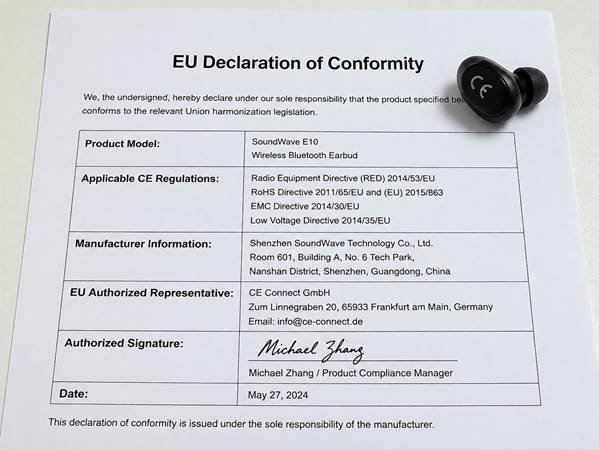
The DoC must contain the following content: product model, applicable CE regulations and harmonized standards, information of the manufacturer and EU authorized representative, signature of the authorized person, and date. Common mistakes such as wrong applicable regulations, no valid signature, and the model on it not matching the actual goods may lead to a request for correction or refusal of release.
The second is product labels and CE marks: the CE mark must be clear and indelible, usually with a height of not less than 5mm, with exceptions for special products with extremely small sizes; product labels must, in accordance with applicable regulatory requirements, mark the manufacturer/EU responsible party information, product model, and traceability identification (such as batch number, serial number) to facilitate regulatory traceability.
The third is proof of EU responsible party: overseas manufacturers cannot replace EU-based economic operators to fulfill the statutory liaison obligations for customs and market supervision: related products entering the EU market usually need to be able to provide the name and address of the EU-based importer, authorized representative, or other responsible party recognized by regulations. It should be clarified that overseas manufacturers still bear primary responsibility for product design, production compliance, and the authenticity of the DoC; EU-based responsible parties are mainly responsible for liaising with regulators, keeping documents as required, or assisting with recalls and other specific obligations. The specific scope of duties is determined by applicable regulations and authorization documents. If an EU authorized representative is used, a written authorization letter from the EU AR must also be provided to prove that the EU AR is indeed the responsible person you designated.
Documents for Inspection That Only Need to Be Provided During Random Inspections
Some documents do not need to be actively submitted to customs, but if you are randomly inspected, you must be able to take them out immediately, otherwise it will still be considered a violation:
First is the test report, which is the core technical evidence supporting the authenticity of the DoC. Whether it needs to be issued by a third-party laboratory and what qualifications the laboratory needs depend on the specific regulations and conformity assessment modules: for low-risk products with manufacturer’s self-declaration, there is no mandatory requirement that it must be issued by a laboratory with ISO/IEC 17025 qualification, but the test data must be authentic and traceable; for high-risk products or products requiring the participation of a notified body, test reports with corresponding qualifications must be provided in accordance with regulatory requirements. Many people ask how long the validity period of a test report is. In fact, there is no fixed validity period — as long as the product has not been redesigned and the applicable standards have not been updated, the report remains valid; conversely, if the standards are updated, even if you just did the report last month, you have to re-evaluate.
Then is the technical file, which is the full set of technical evidence for product compliance, including design drawings, risk assessment reports, list of key components, user manuals, etc. This set of documents is kept by the manufacturer or the EU authorized representative. Most CE harmonization regulations require them to be kept for 10 years after the last time the product is placed on the market (the specific period is subject to applicable regulations). When required by regulatory authorities, they must be provided within the specified time limit, and the language must meet regulatory requirements.
There is also the Notified Body (NB) certificate — NB is a third-party conformity assessment body officially recognized by the EU. Many people think that CE must have an NB certificate, but this is not the case. Only high-risk products explicitly required by regulations, or specific conformity assessment modules that require NB participation, need to provide an NB certificate. Ordinary low-risk products only need the manufacturer’s self-declaration, no need to find an NB. If you have an NB certificate, you can check its authenticity in the EU’s NANDO database to confirm that the institution’s authorization scope covers the corresponding product and regulation.
Three Most Easily Confused CE Concepts
Many people can’t distinguish several CE-related concepts. Let’s clarify them all at once:
First, CE mark ≠ CE certificate: the CE mark is a compliance label affixed to the product, and all products within the CE scope must be affixed as required; while the commonly referred to “CE certificate” mostly refers to the certificate issued by an NB, which is only required for some high-risk products. Don’t be fooled by bad agencies into wasting money;
Second, DoC ≠ test report: the DoC is the manufacturer’s own compliance commitment, and the test report is the technical evidence supporting this commitment. The two are not the same thing. Having a test report does not mean you have a DoC, and conversely, a DoC cannot be supported without a test report;
Third, customs release ≠ legal sale: customs mainly checks entry declaration documents and conducts necessary access compliance random inspections. After products enter the market, market supervision authorities will also conduct random inspections on product compliance in the sales link. If non-compliance is found, the penalty will be heavier than during clearance. Don’t think that everything is fine once clearance is passed.
5. Special Compliance Documents for Different Products
In addition to general CE compliance documents, different product categories have additional special document requirements according to different applicable regulations. The following are references for common categories, and the specific requirements shall be subject to the official requirements of the corresponding regulations.
Special Requirements for Common CE Categories
• Electrical and electronic category (LVD/EMC/RoHS/RED, etc.): test evidence covering all applicable regulatory requirements must be prepared; products with wireless functions need to supplement radio frequency-related test materials; the specific tests required depend on product functions and applicable regulations.
• Machinery category (MD/Machinery Regulation): risk assessment reports and user manuals (including safety warning content) that meet the language requirements of the member state where the product is placed must be supplemented; whether an NB certificate is required depends on the risk category of the machinery and the applicable conformity assessment procedure, and it is not a unified requirement for all “high-risk machinery”.
• Personal Protective Equipment (PPE) category: divided into three categories according to risk level: Category I is the lowest risk (only used to protect against minor, reversible risks, such as ordinary cleaning gloves), and only requires the manufacturer’s self-declaration; Category II is medium risk, Category III is high risk, requiring NB participation in conformity assessment, providing an NB certificate, and supporting use and maintenance manuals. The specific classification must be judged against the annexes of the PPE Regulation, and cannot be generally classified solely based on “low risk”.
• Toy category (Toys): safety test reports applicable to the corresponding product (such as physical and mechanical properties, chemical properties, electrical properties, etc., only applicable to toys with corresponding functions) must be supplemented, as well as compliance certificates for age labeling and warning statements (such as the warning “not suitable for children under 3 years old”, only applicable to toys with risks such as small parts).
Requirements for High-Risk and Non-CE Special Categories
Some products are either high-risk or not within the CE scope, and have special regulatory requirements:
• Medical devices/in vitro diagnostic medical devices: subject to MDR (Medical Device Regulation) or IVDR (In Vitro Diagnostic Medical Device Regulation). The documents to be provided depend on the product risk level: high-risk products usually require NB certificates, clinical evaluation summaries, Unique Device Identification (UDI), etc., while low-risk products have relatively simplified requirements, which cannot be generalized.
• Construction products: subject to CPR (Construction Products Regulation), requiring a Declaration of Performance (DoP); whether a European Technical Assessment (ETA) certificate is required depends on whether the product has harmonized standards, the applicable assessment system, etc. Not all construction products require ETA.
• Cosmetics, food contact materials: not within the scope of CE regulation, and are implemented in accordance with their respective special regulations: cosmetics need to provide EU-based responsible person information, product safety reports, product information files, etc.; food contact materials need to provide declarations of conformity, safety test reports and other documents.
• Batteries, chemicals: batteries are subject to the EU Battery Regulation, requiring preparation of technical files, labels, declarations of conformity, etc.; chemicals are subject to regulations such as REACH, and Safety Data Sheets (SDS) are only required under conditions specified by regulations (such as hazardous chemicals, reaching quantity thresholds). Not all batteries/chemicals require SDS.
How to Quickly Check Special Document Requirements
If you are unsure what other documents your product needs, you can query from the following channels as needed: first, the official annexes of the corresponding EU regulations, which clearly list the conformity assessment requirements and documents to be prepared, and are the most authoritative final basis; second, the EU’s official special query tools: the TARIC database is used to check the tax rates corresponding to HS codes, prohibition and restriction requirements, and possible required regulatory certificates; the NANDO database is used to verify the qualifications and authorization scope of Notified Bodies (NB) and confirm the validity of certificates; Safety Gate (formerly RAPEX) and public announcements of member state market supervision authorities can be referred to for recall trends and inspection priorities of high-risk products; third, find a qualified third-party compliance agency, which generally has a list of documents for corresponding categories for reference.
6. Document Submission Specifications: Format, Language and Process
Even if the documents are prepared, problems may still occur if you do not pay attention to the specifications when submitting.
Language and Format Requirements
In terms of language, different member states and different regulations have different requirements for document language: usually user-facing materials such as user manuals and safety warnings must be in the official language specified by the member state where the product is placed; the language requirements for internal compliance documents such as DoC and technical files depend on specific regulations and regulatory authority requirements. Most member states accept English, but some countries such as France, Spain, and Italy may require a local language version. The specific situation must be confirmed with the competent authority or customs broker of the target country in advance. Translation does not require mandatory notarization, but must be accurate. Customs or regulatory authorities may require official translation documents.
In terms of submission form, most EU customs accept electronic declaration documents. Some countries or specific scenarios require paper copies to be attached with the goods. It is recommended to confirm with the customs broker in advance.
There is a core principle that must be remembered: the product model, manufacturer name, and EU responsible party information on all documents must be completely consistent. Even a difference of one letter may cause problems.
Regular Clearance Submission Process
The normal EU import clearance process is mainly divided into four key nodes, which can be advanced in order. Note that safety declaration and formal import declaration should not be confused:
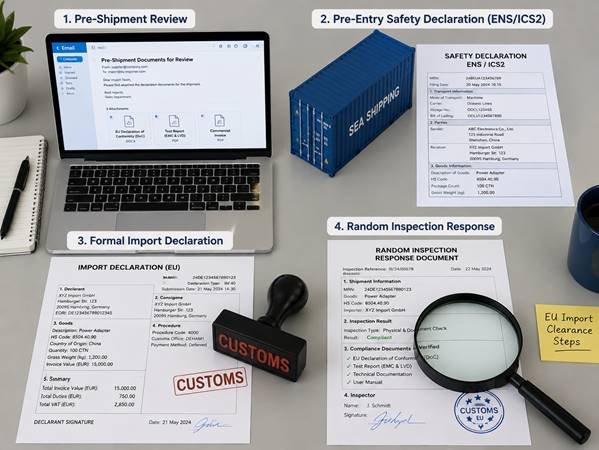
The first step is pre-shipment review: the exporter sends the full set of declaration documents and compliance documents to the EU importer or customs broker for early review. If there are problems, correct them in advance. Don’t wait until the goods arrive at the port to find mistakes, which wastes time and money.
The second step is pre-entry safety declaration: the carrier or relevant supply chain participants need to submit the Entry Summary Declaration (ENS). Currently, the EU is gradually unifying the submission requirements for entry safety data through the Import Control System 2 (ICS2) — ICS2 is mainly used for early screening of safety risks of incoming goods. Its scope of application, data fields and responsible entities vary depending on the mode of transport and implementation stage. The specific situation must be confirmed in accordance with the current EU official implementation rules. Special note: ENS/ICS2 is a safety risk screening declaration, not equal to a formal import clearance declaration, and cannot replace the subsequent import declaration process.
The third step is formal import declaration: after the goods arrive at the port, the importer or customs broker will submit the full set of import declaration documents through the member state’s electronic customs system. Enterprises can choose to pay tariffs and import VAT on the spot, or apply for VAT deferral if eligible.
The fourth step is responding to random inspections: if customs requires supplementary documents during review or inspection, they must be submitted as required within the specified time limit. Goods that do not receive a response after the timeout may be detained.
Most Common Submission Errors
Many people have no problem with the documents themselves, but they don’t pay attention when submitting, leading to delays: for example, documents are photographed blurry, information is missing, or handwritten characters are too sloppy for customs to recognize; the signature form does not meet requirements: the signing of documents such as DoC must comply with applicable regulations, customs system and importer filing rules. In some scenarios, electronic signatures may not be recognized, so it is best to confirm the requirements in advance; some people have scattered documents, a pile of unclassified files, so customs takes a long time to find something, which leaves a bad impression and is prone to misjudgment; the most common is that the product name is written too vaguely, such as only writing “daily necessities” or “accessories”, the ICS2 system will directly reject the order, or even detain the goods. Be sure to write clearly what the specific product is and what model it is.
7. Pitfall Avoidance Guide: Common Problems and Special Situations
Two Types of Core Problems That Most Easily Cause Clearance Delays
In summary, the reasons that most easily lead to clearance delays or cargo detention are mainly concentrated in two categories, which can be checked in advance:
One category is commercial declaration problems: inconsistent information among the three documents (invoice, packing list, transport document), wrong HS code classification, customs valuation disputes caused by under-declaration, invalid EORI or VAT number, lack of necessary regulatory certificates (such as import licenses), etc. These are all high-incidence areas;
The other category is compliance document problems: incomplete or untrue DoC information, non-compliant CE marks, no valid EU responsible party information, the coverage of test reports or NB certificates does not match the actual goods, the model on the documents does not match the actual goods. These are also very prone to problems.
What to Do If Goods Are Detained or Supplementary Documents Are Required
If you really encounter customs requiring supplementary documents or goods being detained, don’t panic, follow the steps:
First, through the importer or customs broker, ask clearly what documents need to be supplemented, how long the time limit is, and which department is in charge. Don’t guess blindly, and don’t submit documents randomly;
Second, find the manufacturer or compliance agency to prepare documents that meet the requirements. Absolutely do not modify or forge them yourself. Once discovered, the consequences will be more serious;
Third, submit through formal channels within the specified time limit, and follow up on the review progress at the same time. Communicate in time if there are problems;
Fourth, if customs finally determines a violation, you can apply for review in accordance with regulations. If it is indeed non-compliant, quickly arrange return or destruction. Don’t delay, the longer you delay, the higher the warehouse rent.
Special Situations Where Some Documents Can Be Simplified or Exempted
There are several special situations where documents can be simplified or even exempted, but they must meet strict conditions, and you cannot take advantage of loopholes:
The first is personal use items/non-commercial samples. As long as they are indeed for non-commercial use, in reasonable quantities, and the goods value meets relevant regulations, the declaration process can be simplified. But if you sell in bulk under the name of samples or personal use, you will be heavily fined once discovered. The specific limits and requirements need to be confirmed according to the mode of transport, member state rules and EU customs regulations.
The second is B2C low-value small parcels: low-value parcels with a value not exceeding 150 euros can be exempted from tariffs, but import VAT still needs to be paid (can be declared through mechanisms such as IOSS). The commercial declaration process can be appropriately simplified, but the product itself must still meet EU market access requirements. You cannot sell non-compliant products just because the value is low.
The third is transit goods: that is, goods that only pass through the EU for transshipment to other countries and are not sold in the EU market. They only need to go through the customs transit procedure, and do not need to submit market access CE compliance documents. However, they must be under customs supervision throughout the process, and necessary loading, unloading, storage and other operations can be carried out at approved locations. The key is that they cannot be released into the EU market.
The fourth is second-hand products and repair parts: for second-hand products that have been legally placed on the EU market, the judgment is usually based on the compliance requirements applicable at the time of their original placement and the current safety status, and the corresponding original compliance documents can be provided; but for second-hand equipment imported for the first time from outside the EU, products re-placed on the market after major modification/refurbishment, or products with significant changes in use or risk level, it is necessary to re-evaluate whether the current CE regulations, additional safety requirements of member states and user manual requirements apply. Parts used to repair products already circulating in the EU market do not need to be separately prepared with CE documents if they are provided with repair services and not sold separately; parts sold separately as new products still need to meet the applicable regulatory requirements of their own.
Practical Methods to Avoid Problems in Advance
In fact, most clearance problems can be avoided in advance. Here are some practical methods for you:
The first is to check item by item against the self-inspection list at the end of this article before shipment, covering three dimensions: commercial declaration, compliance documents, and submission specifications, to avoid low-level mistakes;
The second is to find importers, freight forwarders or compliance agencies with EU clearance and compliance experience to help review the full set of documents before shipment. They do this every day and can spot problems at a glance;
The third is that if product classification is in doubt, you can apply for Binding Tariff Information (BTI) as described in Chapter 3 to obtain a legally binding classification conclusion and avoid HS code disputes;
The fourth is that high-risk products can entrust a compliance agency to conduct pre-marketing compliance assessment in advance, and ship after confirming that they meet the requirements;
The fifth is that as long as the product is redesigned, the supplier is changed, or EU regulations are updated, be sure to re-evaluate the full set of documents. Don’t use old documents, which is very prone to problems.
8. Pre-Shipment Self-Inspection List and Capability Summary
Pre-Shipment Quick Self-Inspection List
For your convenience, I have organized the items to be checked into a table. Just go through it before shipment:
| Category | Self-Inspection Item | Requirement |
| Commercial Declaration Documents | Invoice, packing list, transport documents | Complete and core information (product name, model, quantity, consignor/consignee) is completely consistent |
| EORI, VAT number | Authentic and valid, the entity corresponds to the declarant/consignee | |
| HS/CN code | Preliminary verification has been carried out according to product function/material/use, and BTI or professional confirmation has been applied for complex products | |
| Certificate of origin | Prepared as needed, preferential certificate of origin complies with trade agreement rules | |
| Regulatory certificates | It has been confirmed whether the product requires special regulatory documents such as import licenses and quotas | |
| ENS/ICS2 declaration | Accurate safety declaration information has been submitted in advance as required | |
| Compliance Documents (only required for CE/special regulatory products) | Product regulatory category | It has been confirmed whether it is within the CE scope and which regulations/directives it corresponds to |
| EU Declaration of Conformity (DoC) | Complete information, correct applicable regulations, valid signature | |
| Product labels and CE marks | CE mark is clear and indelible, label contains responsible party information, model, traceability identification | |
| EU responsible party | Importer/EU AR information has been clarified, and the EU AR has valid written authorization | |
| Documents for inspection | Test reports, technical files, NB certificates (if required) are available at all times | |
| Submission Preparation | Document pre-review | Has been sent to the importer/customs broker for early review |
| Language requirements | Meets the language regulations of the target member state |
3 Things You Can Do Independently After Learning
After reading this article, you should be able to complete these three things independently:
First, you can preliminarily judge whether your product is within the CE scope, which main regulations it corresponds to, and know what types of clearance and compliance documents need to be prepared;
Second, you can sort out a list of general plus special documents according to the product category, and distinguish which ones need to be provided on the spot during inspection and which ones need to be kept for subsequent random inspection;
Third, you can check the most common clearance document problems in advance, and know the basic response steps when customs requires supplementary documents or random inspections, instead of handling blindly.
The document requirements for EU clearance seem trivial, but the core is all around “traceable goods identity and clear compliance responsibilities”. As long as you first clarify the regulatory category of the product, prepare the two sets of documents for declaration and compliance as required, and conduct self-inspection before shipment, most of the risks of delay and cargo detention can be avoided in advance. When encountering uncertain problems, prioritize confirming with an experienced customs broker or compliance agency. Don’t take chances to muddle through — the linkage between EU customs and market supervision is getting closer and closer, and one violation may bring long-term impacts.