
Merchants operating in the EU market often hear various claims about CE validity: some say 5 years, some say 10 years, and others claim it is “valid for life”. Many new merchants, due to unclear understanding of the rules, either get defrauded of fees by unscrupulous agencies, or suffer losses from customs detention of goods and delisting from e-commerce platforms.
In fact, the core of CE validity is continuous compliance status, rather than a fixed expiration date on a certain certificate. To understand this set of rules, we first need to clarify several most easily confused basic concepts.
I. Core Concepts: First Understand 3 Types of Easily Confused Marks and Documents
What many people call “CE certification” is actually a compliance system that includes marks, declaration documents, and third-party certificates. The legal natures of the three are completely different and cannot be confused:
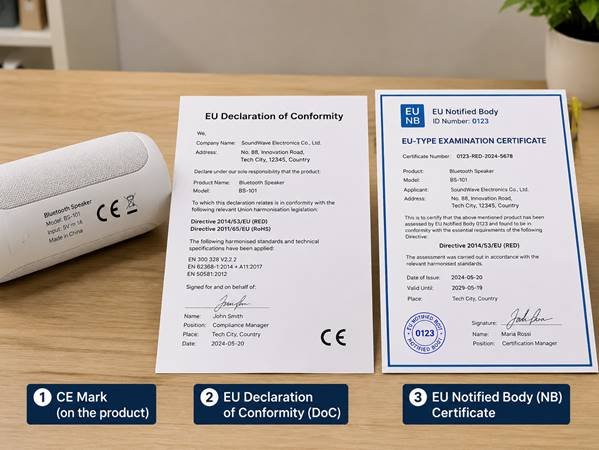
1. CE mark: A compliance commitment mark affixed by the manufacturer on the product itself, representing that the product meets relevant EU market access requirements. It is not an “official certification certificate” issued by authorities.
2. EU Declaration of Conformity (DoC): A written proof signed by the manufacturer itself, declaring that the product meets the requirements of applicable EU regulations. There is no unified expiration date for all product categories.
3. Notified Body (NB) Certificate: An assessment certificate issued by an EU-authorized third-party Notified Body only in the conformity assessment procedures for specific high-risk product categories, usually marked with a validity period.
Key conclusion: The validity period of an NB certificate ≠ the overall validity period of CE certification. CE does not have a unified statutory validity period for all product categories.
Essence of CE Validity and Consequences of Invalidity
CE validity period refers to the period of compliance status during which a product continuously meets EU market access requirements, covering the entire product lifecycle from design, production to market launch. Here, we need to distinguish two easily confused core concepts:
• Placing on the market: Refers to the first time a manufacturer or importer puts a product into the EU market for sale or use;
• Making available on the market: Refers to behaviors such as continued sale, subletting, and gifting in the distribution chain after the product is first placed on the market.
If the compliance status becomes invalid, new products that do not meet current requirements shall not continue to be placed on the market; as for whether inventory that has been legally placed on the market can continue to be made available, it shall be judged based on specific regulations, product categories, and transition provisions, and cannot be generalized. Risks that may be triggered by invalid compliance include customs detention of goods, regulatory penalties, delisting from e-commerce platforms, recalls, etc.
Clarification of 3 Most Common Entry-Level Misconceptions
• Misconception 1: CE certification has a unified statutory validity period of 5/10 years. Wrong. CE does not have a unified fixed period applicable to all products; the compliance status changes with changes in regulations, standards, and product conditions.
• Misconception 2: The validity period of a CE certificate issued by a third-party agency is the validity period of CE certification. Wrong. NB certificates are only involved in categories that mandate NB participation, and the certificate validity period only corresponds to the scope of the third-party assessment, and does not mean that the overall compliance status is permanently valid.
• Misconception 3: CE is valid for life as long as the product is not modified. Wrong. Even if the product itself remains unchanged, if applicable regulations or standards are updated or the transition period ends, the original compliance status may also become invalid.
II. 4 Core Variables for Judging Whether CE Becomes Invalid
CE compliance status is not static. Any change in the following variables may affect validity, and must be assessed one by one in combination with the applicable regulations and conformity assessment modules of the specific product:
1. Changes in Applicable EU Regulations/Directives
If new regulations come into force, old regulations are repealed, or the transition period of old regulations ends, the validity of the original compliance basis may change. The same product may be subject to multiple regulations. For example, small home appliances with Bluetooth must simultaneously meet the requirements of relevant regulations such as Low Voltage, Electromagnetic Compatibility, and Radio Equipment, and all of their validity must be verified.
Note: Regulatory transition rules usually distinguish conditions such as product category, certificate type, and original certificate issuance date, and not all products become invalid on the same day. For example, the transition arrangement for medical devices from the MDD Directive to the MDR Regulation must be specifically judged based on the product risk class, original certificate acquisition time, etc., and cannot be generalized.
2. Citation Status of the Harmonized Standards Used
Harmonized standards are the unified compliance testing bases officially recognized by the EU. Products that pass testing according to harmonized standards can be directly presumed to meet the essential requirements of the corresponding regulations (i.e., the effect of “presumption of conformity”, equivalent to obtaining an officially recognized “fast-track proof” of compliance).
If an old version of a harmonized standard has its citation withdrawn by the Official Journal of the European Union (OJEU), it does not mean that the product is immediately non-compliant. It is necessary to focus on verifying three time nodes and rules:
1. Date of withdrawal of citation: The date on which the OJEU officially announces that the standard is no longer officially cited;
2. Date of cessation of presumption of conformity: There is usually a certain interval from the withdrawal date, which is the transition period — during the transition period, testing completed according to the old standard can still enjoy the effect of presumption of conformity;
3. Transition arrangements: Some standard updates set special transition rules, such as allowing continued sale of specific products already produced, etc., which shall be subject to the specific announcements issued by the OJEU.
After the transition period ends, the effect of presumption of conformity based on the old standard will terminate, but enterprises can still prove that the product meets the essential requirements of regulations through other technical documents such as technical specifications and risk assessment reports; it is not directly “non-compliant”. There is no unified regulation on the length of the standard transition period, which commonly ranges from 6 months to 3 years, and the specific duration shall be subject to official announcements.
3. Changes in the Product Itself
When a product undergoes changes, whether it affects the compliance status is judged by the core criteria of whether the change involves the essential health and safety requirements of the product, whether it changes the scope of the original conformity assessment, and whether it affects product consistency. The judgment must be combined with the conclusions of risk assessment, and a conclusion cannot be drawn directly based solely on the type of change:
• Typical changes that may affect compliance: Changes in product design, core materials, key functions, key components, safety-related control software, intended use, etc., require re-assessment of compliance. For example, if an ordinary plastic water cup is changed from only holding cold water to holding boiling water (change in intended use), or if the safety performance changes after material replacement, the original compliance status may become invalid.
• Changes that usually do not affect compliance: Only adjustments to packaging, appearance printing, production batches, brand logo modifications that do not involve the product body, etc., generally do not directly affect the compliance status, but change records still need to be kept.
• Changes in production sites and core suppliers: It is necessary to assess whether the production process, quality control system, and sources of key components remain consistent after the change. If product consistency is not affected, re-assessment is usually not required; if the quality control level or product performance changes, re-assessment is required.
4. Certificate and Qualification Status of the Notified Body (NB)
This variable only applies to products for which regulations mandate NB participation in conformity assessment; self-declaration products do not need to consider this.
The validity period of certificates issued by an NB is determined by the corresponding regulations, product category, and certificate type, usually ranging from 1 to 5 years. The following situations may affect the validity of the certificate, but do not necessarily cause immediate invalidity:
1. The NB’s own designated qualification is revoked, or its authorization scope is reduced: Whether certificates issued within the corresponding scope remain valid depends on applicable regulations, decisions of the designated authority, certificate type, and regulatory transition arrangements; it cannot be assumed that all existing certificates become invalid simultaneously;
2. The enterprise fails to complete annual supervision audits and factory inspections as required by regulations or certificates: The certificate may be suspended or revoked, and the specific situation shall be subject to the official notice of the NB.
Note: A valid NB certificate is only one of the conditions for compliance of categories requiring NB participation. It is still necessary to simultaneously meet requirements such as regulations, standards, and product consistency to represent that the overall CE compliance status is valid.
III. CE Rules Under Different Conformity Assessment Modules
CE regulations set different conformity assessment modules for different products (simply put, the steps required by regulations to prove product compliance, such as self-inspection and archiving by the manufacturer, or participation of third-party Notified Bodies in testing, audit, and certification). The stricter the module, the higher the requirements for certificates and periodic reviews.
To facilitate entry-level understanding, we make a rough classification according to “self-declaration, partial links requiring NB participation, and mandatory NB certification” — note that this is not a unified risk classification of CE regulations. The assessment procedures for the same category of products may vary under different regulations, and the specific requirements must be subject to the corresponding regulations applicable to the product.
| Conformity Assessment Module | Typical Application Scenarios (must first confirm the product falls within the scope of the corresponding CE regulation) | Core Characteristics of Validity Period | Key Requirements |
| Self-declaration | Ordinary small home appliances, consumer electronics, etc. that fall within the scope of harmonized regulations that explicitly require CE marking, such as Low Voltage, Electromagnetic Compatibility, Radio Equipment, etc. (Note: Not all consumer products need to bear the CE mark. For example, food contact materials, ordinary non-protective clothing, most stationery, etc. are subject to special regulations or have no mandatory CE requirements. It is necessary to first confirm whether the product is within the scope of CE harmonized regulations) | No statutory fixed period; compliance status changes with regulations/standards/product changes | No NB certification required; the manufacturer bears compliance responsibility on its own. It is common in the industry to conduct internal reviews every 3-5 years (not mandatory, a practice for proactive risk management) |
| Partial links requiring NB participation | Category II Personal Protective Equipment (PPE, only applicable to products that meet the classification conditions of the PPE Regulation), some industrial machinery (NB participation is only required under specific conformity assessment procedures, depending on applicable regulations and product hazard levels), some construction products (whether NB participation is required is determined according to the applicable Construction Products Regulation, harmonized standards, or the assessment system corresponding to European Technical Assessments) | Rules are between self-declaration and full-process NB assessment; some categories have mandatory review requirements | Standard updates have a more direct impact on the presumption of conformity, and NB participation in assessment is required for specific links |
| Mandatory NB certification | Class III medical devices, Category III PPE (such as gas masks, only applicable to products that meet the classification conditions of the PPE Regulation), pressure equipment, certain categories of explosion-proof products, etc. (must meet the mandatory NB certification requirements of corresponding regulations) | Has a clear NB certificate validity period. For example, the statutory maximum validity period of conformity assessment certificates for some medical devices under the MDR Regulation is 5 years | The corresponding conformity assessment modules (refer to specific links in the assessment process, such as type examination, quality system audit, etc.) must be completed by an NB. Annual supervision audits/factory inspections must be cooperated with, and renewal assessment must be completed in advance before the certificate expires |
Note: The above classification is only for convenient quick judgment and does not mean that CE regulations have a unified “risk classification”. The conformity assessment module for specific products shall be subject to the explicit requirements of the corresponding regulations.
IV. Trigger Scenarios and Judgment Logic for CE Compliance Renewal
As mentioned in the first part, CE does not have a unified fixed validity period for all product categories. The core logic of renewal is not to follow the process by years, but to update compliance documents or certificates accordingly only when the compliance status undergoes substantive changes that affect the product’s ability to meet regulatory requirements. Manufacturers and EU Authorized Representatives must proactively assume continuous compliance responsibilities, rather than waiting for notifications from regulators or agencies.
6 Types of Scenarios That Require Re-assessment and Update Based on Results
When any of the following situations occurs, it is necessary to first re-assess the product’s compliance status, and then decide whether to update the DoC, technical documents, product labels, or NB certificate based on the assessment results — not all scenarios require re-testing or certificate re-issuance:
1. Applicable EU regulations/directives are revised, the transition period for old requirements officially ends, and the original compliance plan no longer meets the new requirements;
2. The harmonized standard used has its citation withdrawn by the OJEU, there is no transition room, and the original compliance plan cannot prove compliance with regulatory requirements through other paths;
3. The product undergoes core changes involving essential health and safety requirements (see the “Changes in the Product Itself” section above for judgment criteria);
4. For products requiring NB certification, the NB certificate expires, the NB’s qualification becomes invalid, or the certificate is suspended/revoked;
5. Judged as non-compliant by market supervision or platform spot checks, or safety risks are discovered after market launch triggering complaints and recalls, confirming non-compliance with regulatory requirements;
6. Changes in core information of economic operators:
• Change in manufacturer name/address: The manufacturer information on the DoC and product labels must be updated;
• Change in EU Authorized Representative information: The authorized representative information on the DoC and product labels must be updated;
• Change in importer information: The importer information on product packaging or accompanying documents must be updated. Usually, there is no need to modify the DoC, and the specific requirements shall be subject to regulatory requirements.
Such changes usually only require updating the corresponding documents or labels, and do not require re-testing or NB certificate re-issuance, unless the change affects the compliance coverage scope or assessment conclusion of the product.
Scenarios That Usually Do Not Require Re-testing or Certificate Update
1. The product has no core changes, and applicable regulations and harmonized standards are all in valid status or within the transition period;
2. Only non-core changes that do not affect the product’s safety performance occur;
3. The compliance basis of self-declaration products has not undergone substantive changes.
Does Renewal Require Re-testing?
• Typical scenarios requiring re-testing: Core product changes affect safety performance, new standards add core safety test items, the original test report does not cover the current product’s models or functions;
• Typical scenarios requiring only document updates: Changes in economic operator information, non-core content adjustments, regulatory/standard changes that do not involve core safety risks.
V. 3-Step Self-Inspection Method for CE Validity
Ordinary people do not need to rely on third-party agencies. They can complete basic validity self-inspection by following the three steps below to avoid most compliance risks:
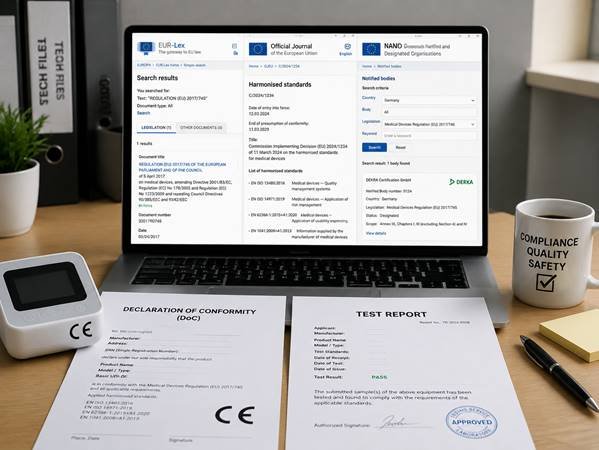
Step 1: Verify the Validity of the Compliance Basis
First, confirm whether the regulations and standards applicable to the product are still valid:
1. Check applicable regulations: Query the current version, revision records, and transition provisions of the corresponding regulations through the EU EUR-Lex website, and at the same time confirm that the product is indeed within the applicable scope of the regulations;
2. Check harmonized standards: Query the citation status, entry into force/withdrawal date, restriction conditions, and transition arrangements of the standards used through the harmonized standard list of the Official Journal of the European Union (OJEU). If the standard’s citation has been withdrawn, it is necessary to assess whether compliance can be proven through other technical paths.
Step 2: Verify the Consistency Between the Product and Compliance Documents
Compare the actually sold product with the held technical documents, DoC, and NB certificate (if any):
1. Confirm that the product’s model, core configuration, functions, and intended use are completely consistent with the records in the documents;
2. If there is an NB certificate, it is necessary to verify whether the product scope covered by the certificate and the conformity assessment modules match the currently sold product, and whether the certificate is within the validity period.
Step 3: Verify NB Qualification and Certificate Status (If Applicable)
For products requiring NB certification, it is necessary to confirm that the NB’s qualification and certificate status are valid:
1. Query the four-digit number of the NB through the EU NANDO database to confirm that the body still has the designated qualification for the corresponding product regulations and conformity assessment modules (NANDO can only query the authorization scope of NBs, and cannot directly prove the validity of a specific certificate);
2. Verify the current status of the specific certificate with the issuing NB or the corresponding competent authority, confirm that the required annual supervision audits and factory inspections have been completed, and there are no situations such as suspension or revocation; if the NB’s qualification changes, it is also necessary to verify whether existing certificates are still valid and whether transfer or re-assessment is required.
VI. Practical CE Renewal Processes Under Different Modules
Products with different conformity assessment modules have greatly different renewal processes, which can be operated according to the corresponding requirements:
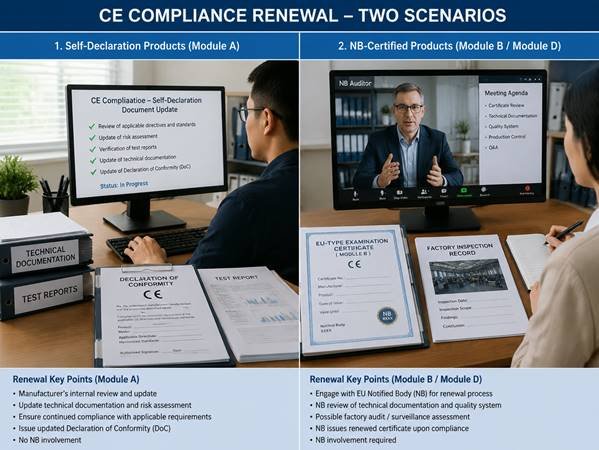
Renewal Process for Self-Declaration Products
Renewal of self-declaration products does not require applying for a “new CE certificate” from the authorities, and can be completed by the manufacturer on its own:
1. Assess the specific impact of regulation/standard updates and product changes on compliance;
2. If core safety performance changes are involved, entrust a qualified laboratory to conduct supplementary testing or carry out risk assessment; if there are no core changes, directly review the technical documents;
3. Update the DoC and technical documents, and mark the new version number and change description;
4. Keep the full set of updated documents for regulatory spot checks.
Renewal Assessment Process for Products Requiring NB Certification
For products requiring NB certification, renewal assessment must be planned in advance to avoid affecting normal sales:
1. Start preparation in advance: It is generally recommended to start the renewal assessment 3-6 months before the certificate expires. The specific time can be adjusted according to the corresponding regulatory requirements, certificate type, and the NB’s audit cycle; for strictly regulated categories (such as medical devices under MDR), due to tight NB resources and high documentation requirements, it is necessary to assess the schedule earlier to avoid sales interruption;
2. Prioritize contacting the original issuing NB: Replacing a Notified Body usually requires re-completing the corresponding conformity assessment procedure, making seamless connection difficult, and increasing both cost and time cost. It is recommended to prioritize the original issuing body;
3. Submit materials such as product change descriptions, latest technical documents, and post-market surveillance data (if required by regulations) to the NB;
4. Cooperate with the NB to complete procedures such as document review, sampling testing, and factory inspection (specific requirements depend on the category and certificate type);
5. After obtaining the new NB certificate, update the DoC and related documents.
Note: When a certificate expires, is suspended, or is transferred to another body, new products cannot of course continue to be placed on the market solely based on the old certificate; you should first verify the specific regulatory requirements, current certificate status, transfer arrangements, and applicable transition provisions before determining whether sales can continue. There is no unified standard for the cost and cycle of renewal assessment, and the NB will quote based on factors such as product complexity, assessment modules, change scope, and whether testing or factory audit is required.
Document Management Requirements After Renewal
Regardless of the module of the product, the updated compliance documents must be kept as required:
1. The document retention period is clearly stipulated by specific product regulations: Many general CE regulations adopt the rule of “retaining for at least 10 years after the last product is placed on the market”, but special categories such as medical devices and construction products may have different starting points or longer requirements, which shall be subject to the specific regulations applicable to the product;
2. Corresponding records of versions before and after update, and explanations of change reasons must be retained to facilitate regulatory traceability;
3. The EU Authorized Representative must keep copies of relevant compliance documents as required by regulations to ensure that they can be provided in a timely manner when required by regulatory authorities.
VII. Advanced Pitfall Avoidance and Practical Tips
After mastering the basic rules, you also need to pay attention to the following common compliance misconceptions and practical tips to avoid pitfalls:
1. True or False Judgment of Third-Party Agencies’ “Validity Period” Claims
Claims about the “validity period of CE certificates” on the market are uneven. You can quickly judge true or false using the three core concepts from the first part:
• The so-called “CE certificate valid for 5 years” for self-declaration products: Usually the validity period of service documents set by third-party agencies themselves, not an EU statutory requirement. As long as regulations and standards are still valid and the product has no core changes, even if the certificate issued by the agency “expires”, the product’s compliance status remains valid;
• Certificate validity period for products requiring NB certification: Must be subject to the official certificate issued by the NB, and it must be verified whether the NB’s qualification number is in the official list of the EU NANDO database; certificates issued by fake bodies have no effect at all;
• Any claim that “CE certification is valid for life” or “renewal is guaranteed to pass” is false publicity.
2. Response Logic for Standard Update Transition Periods
When encountering harmonized standard updates, there is no need to start the update immediately. You can judge the timing based on three dimensions: remaining transition period, product market sales volume, and update cost and complexity. If the transition period is short and product sales are large, it is recommended to update in advance to avoid being unable to place new products on the market after the transition period ends; if the transition period is sufficient and the product is about to be delisted, the arrangement can be postponed.
Note: Placing new non-compliant products on the market after the transition period ends will face penalties stipulated by corresponding regulations and member states, which may include rectification, restriction of supply, sales ban, recall, customs detention, fines, and delisting from e-commerce platforms, etc. The specific forms and amounts are determined by applicable product regulations, member state implementation rules, and the severity of the violation. In addition, standard updates do not necessarily require full re-testing. You can first assess whether the changed parts involve core safety risks. If only the details of the test method are adjusted and core safety is not involved, only partial supplementary testing may be required.
3. Update Optimization Methods for Multi-Model/Series Products
If a product has multiple models or belongs to the same series, duplicate costs can be reduced through reasonable arrangements during renewal:
• If only some models are changed, only the compliance documents of the affected models need to be updated, and unchanged models do not need adjustment;
• The premise for series products to share test reports or conformity assessment conclusions is that the core design, structure, materials, key components, control software, and intended use of each model are consistent, differences in rated parameters, appearance, etc. do not affect safety performance and compliance conclusions, and the scope of models covered by the report must be clearly confirmed by the testing body or Notified Body;
• When entrusting testing or assessment, explain all differences of the series products in advance, and let the body assess whether the report can be shared to avoid unnecessary duplicate testing.
4. Compliance Key Points for Cross-Border E-Commerce and Procurement Product Selection
• Cross-border e-commerce scenarios: Platforms may require uploading test reports or Notified Body certificates marked with clear dates. The platform’s material submission requirements do not replace statutory CE compliance judgments; when appealing, you need to submit the DoC, validity proof of applicable regulations and standards, test reports or NB certificates as required by the platform, to ensure that the documents fully correspond to the sold models and manufacturer information.
• Procurement product selection verification:
1. Don’t just look at the validity period on the certificate; prioritize verifying whether the harmonized standard used by the product is in the valid citation status of the OJEU;
2. Don’t just ask for a single CE certificate; you should require the supplier to provide the DoC + complete test report/technical document summary to judge the authenticity of compliance;
3. When purchasing high-risk products requiring NB certification, it is necessary to verify the NB’s authorization scope and the validity of the specific certificate.
5. Clarification of 5 Advanced Compliance Misconceptions
• Misconception 1: CE certification must be renewed annually with a fee. Wrong. The CE mark itself does not have a unified statutory annual fee, but manufacturers may incur related costs for compliance maintenance, such as laboratory re-testing, technical document update, quality system audit, Notified Body annual supervision, authorized representative service, etc.
• Misconception 2: A test report is permanently valid once obtained. Wrong. A test report only corresponds to specific samples, test conditions, and the version of the standard used. If the standard is updated or the product is changed, the probative force of the report will no longer apply.
• Misconception 3: Changing the model name can avoid re-assessment. Wrong. The core of judging whether re-assessment is required is whether the actual design, function, and performance of the product have changed. Only modifying the model name does not change the compliance judgment result.
• Misconception 4: A CE certificate for components can directly prove the compliance of the whole machine. Wrong. The whole machine must complete compliance assessment separately. The CE certificate of components can only prove that the components themselves meet the requirements, and does not mean that the assembled whole machine meets all regulatory requirements.
• Misconception 5: No need to care about standard updates if no one notifies you. Wrong. Manufacturers have the responsibility to proactively pay attention to changes in applicable regulations and standards, and “not receiving notification” cannot be used as a defense against non-compliance.
VIII. Quick Self-Inspection Checklist and Capability Summary
Quick Self-Inspection Checklist for CE Validity
You can check item by item against the following items. If all are met, the basic compliance status is valid:
□ All regulations/standards applicable to the product are within the validity period or legal transition period
□ The product’s core configuration, functions, and intended use are completely consistent with the technical documents/DoC
□ If there is an NB certificate, the certificate is within the validity period and covers the scope of currently sold products
□ The NB has the authorization qualification for the corresponding product, the certificate status is normal, and supervision audits/factory inspections have been completed as required (if applicable)
□ No unrectified regulatory non-compliance records or confirmed safety risks
5 Things You Should Be Able to Judge Independently After Reading
1. Can clearly distinguish the differences between the CE mark, EU Declaration of Conformity (DoC), and Notified Body (NB) certificate, and will not be fooled by various “validity period” claims;
2. Can judge whether their own product has a statutory NB certificate validity period based on the product’s conformity assessment module;
3. Can quickly identify trigger scenarios for CE renewal, without waiting for “certificate expiration” to discover compliance risks;
4. Can independently complete basic self-inspection of CE validity, and know free official query channels such as the Official Journal of the European Union (OJEU) and NANDO database;
5. Can distinguish the renewal processes between self-declaration products and NB-certified products, and avoid common agency scams and compliance pitfalls.
In the final analysis, CE compliance is a continuous responsibility throughout the entire product lifecycle, rather than a one-time certification that lasts forever. Whether renewal is required depends primarily on changes in regulations, standards, the product itself, and the conformity assessment status, rather than a fixed expiration date on a certain certificate.