
If you run a cross-border business selling charging products and plan to enter the Indian market, you will most likely come across the term “WPC certification”. Many people, when seeing WPC for the first time, first think of the Qi certification from the Wireless Power Consortium — after all, the abbreviation is exactly the same, but the two are completely different things. This article focuses specifically on products such as chargers, wireless charging docks, and charging accessories, and explains the entire WPC certification process clearly, from preliminary judgment to formal application, and then to pitfall avoidance tips. Even if you are new to the Indian market, you can follow the steps without making mistakes.
Must-Know Basics: Fundamental Knowledge of WPC Certification (Exclusive for Charging Products)
First, a plain-language explanation of WPC: its full name is the wireless equipment market access requirement issued by the Wireless Planning & Coordination Wing of India, and its core function is to enable products with wireless transmission functions to be sold and cleared customs legally in India. A key point must be emphasized here: it has nothing to do with the “Wireless Power Consortium (WPC)” we often refer to, they just happen to share the same abbreviation — one is a market access regulation of the Indian government, governing whether wireless signals (professionally called radio frequency) can be used legally; the other is an industry technology alliance, governing the compatibility of wireless charging. The two have no connection in terms of jurisdiction scope or content, so do not confuse them.
For charging products, the jurisdiction scope of WPC is very clear: it only governs the compliance of wireless signal transmission, and does not cover the safety or compatibility of the charging function itself. This is exactly complementary to India’s BIS certification — BIS governs electrical safety and compliance with India’s corresponding mandatory standards, while WPC governs wireless compliance. Charging products with wireless functions often require both certifications. If you sell products in India without obtaining WPC certification, you may face risks such as customs detention of goods, removal from e-commerce platforms, fines, and even product recalls, which is no trivial matter.
The types of WPC certification involved in charging products are actually very simple, mainly divided into two categories: the first is ETA (Equipment Type Approval), which is for consumer-grade charging products in license-exempt frequency bands, and this is the path you will take in the vast majority of cases; the second is License (frequency band license), which is for products in regulated frequency bands, and ordinary charging products basically do not involve this, so there is no need to study it too much. The core basis for determining which type to apply for is the actual operating wireless frequency band and transmission power of the product.
Quick Judgment: Does Your Charging Product Require WPC Certification?
Now that you understand what WPC is, the next thing you must be most concerned about is: does the charging product I sell require this certification? We can first do a quick screening based on common product types.
First, products that do not require certification at all: ordinary wired chargers, power adapters, pure charging cables, adapters, and plug accessories without wireless functions — these products do not actively transmit wireless signals at all, so naturally they have nothing to do with WPC.
Second, products that definitely require certification: smart chargers and charging sockets with Bluetooth, Wi-Fi, or NFC functions, and multi-port desktop charging stations with wireless functions — as long as they have a module that actively transmits wireless signals, certification is required.
Qi wireless charging pads/docks are a special case: you cannot judge just by the name “wireless charging”, you have to base it on the actually built-in wireless transmission module inside — if it has active transmission modules such as low-frequency communication, NFC, or Bluetooth, certification is required; if it is only pure magnetic induction charging with no additional wireless transmission function, you need to confirm by comparing specific parameters with WPC official requirements.
If you are still unsure after the above quick screening, you can use the three-step boundary judgment method to confirm step by step:
Step 1: First confirm whether the product has the function of actively transmitting wireless signals. If not, no certification is required at all; whether receive-only devices involve WPC needs to be checked against WPC’s current official requirements. Pure receive scenarios are extremely rare among charging products, so the logic for transmitting devices cannot be directly applied.
Step 2: Confirm whether the product’s wireless frequency band is in India’s civilian license-exempt list. If not, the ordinary ETA path is not available, and you may even need to apply for a frequency band license. Bluetooth, Wi-Fi, etc. used by ordinary charging products are basically in the license-exempt list, so this step can be passed in most cases.
Step 3: Confirm whether the transmission power meets the limits of the corresponding frequency band in India. If it meets the requirements, you can apply; if not, you must first rectify the product before proceeding.
Here we also need to correct several common judgment misunderstandings that many people fall into when applying for the first time:
First misunderstanding: Not all products called “wireless chargers” require certification. The core judgment basis is the actual wireless transmission characteristics, frequency band, and power of the product, not the product name. Pure magnetic induction wireless charging pads do not necessarily require certification.
Second misunderstanding: Low transmission power does not mean automatic exemption. Even if you think the product’s power is extremely low, you must confirm it against WPC’s official list, you cannot decide on your own.
Third misunderstanding: Certification conclusions for products with the same appearance are not necessarily consistent. For example, the same desktop charging station has a Wi-Fi version and a non-Wi-Fi version, and the certification requirements for the two are completely different. You cannot use the same certification just because the appearance is the same.
Pre-Application Preparation: Verification of Applicant Entity, Documents and Test Reports
If you have confirmed that your product requires WPC certification, don’t rush to submit the application first. Doing a few preparatory tasks well can help you avoid many detours, and prevent mid-process document supplementation or even rejection.
First is the requirement for the applicant entity, which is particularly important for overseas manufacturers: overseas manufacturers cannot directly submit applications to WPC, and must entrust a local Indian authorized representative, importer, or compliance service provider with local applicant entity qualifications as the applicant entity. The applicant entity assumes the responsibilities of holding the certificate, liaising with regulatory authorities, and cooperating with customs clearance. It is recommended to choose a partner familiar with the WPC process and experienced in handling certification for charging products. Another good news: WPC certification does not require factory audits or on-site inspections, which can save a lot of time and cost.
Next are the qualification and technical documents to be prepared, which are mainly divided into two categories:
One category is entity-related: the English business license and trademark certificate (if any) of the overseas manufacturer, the qualification documents of the local applicant entity, and the official authorization letter issued by the manufacturer.
The other category is product technology-related: core wireless parameter table, product appearance drawings, circuit block diagram with wireless module markings, English user manual, and nameplate drawing.
If you have multiple models that you want to apply for together, pay attention to the series application rules: only when different models only differ in color, shell, and plug specifications, and have exactly the same core wireless parameters, can they be applied for as the same series, sharing one test report to save costs. If the wireless parameters are different, they cannot be regarded as the same series.
Many sellers have already obtained international certifications such as CE and FCC before. Can these test reports be used for WPC application? The answer is that if they meet the requirements, you can apply for test exemption, and no need to redo the test. So how to judge whether a report is valid?
First, a valid report must meet the basic conditions: the laboratory issuing the report must have ISO/IEC 17025 qualification, and its NABL (National Accreditation Board for Testing and Calibration Laboratories of India) or ILAC (International Laboratory Accreditation Cooperation) accreditation scope must cover the corresponding wireless signal test items. It is not enough to just have 17025 qualification.
Common international reports such as CE RED (EU Radio Equipment Directive certification) and FCC ID (wireless equipment certification of the US Federal Communications Commission) can only be used as supporting materials for test exemption applications or technical reviews. You need to confirm that the test items, frequency bands, power, standard versions, and laboratory accreditation scope all cover WPC requirements. The final acceptance is subject to WPC’s official review.
If you are reading a report for the first time, you don’t need to understand too complex parameters. First check these points: Is the model on the report consistent with your product? Does the wireless technology (such as Bluetooth 5.3, Wi-Fi 6) match? Are the frequency band and transmission power the same as the actual product? Does the laboratory have a formal seal and signature? If these points are fine, then take it to your partner for confirmation.
If the report is too old, the model does not match, parameters are missing, or the laboratory qualification is not compliant, then it is invalid and cannot be used.
Here we also need to specially remind a common pitfall: a module having WPC certification does not mean the whole device does not need certification. For example, if you use a Bluetooth module that has passed WPC certification and install it in your own smart charger, the module’s certification can only be used as supporting material. Because the whole device’s antenna design, actual transmission power, and usage scenarios may be different from those of the module, you still need to apply for WPC certification for the whole device separately.
Full Formal Application Process: Follow the Steps to Avoid Rework
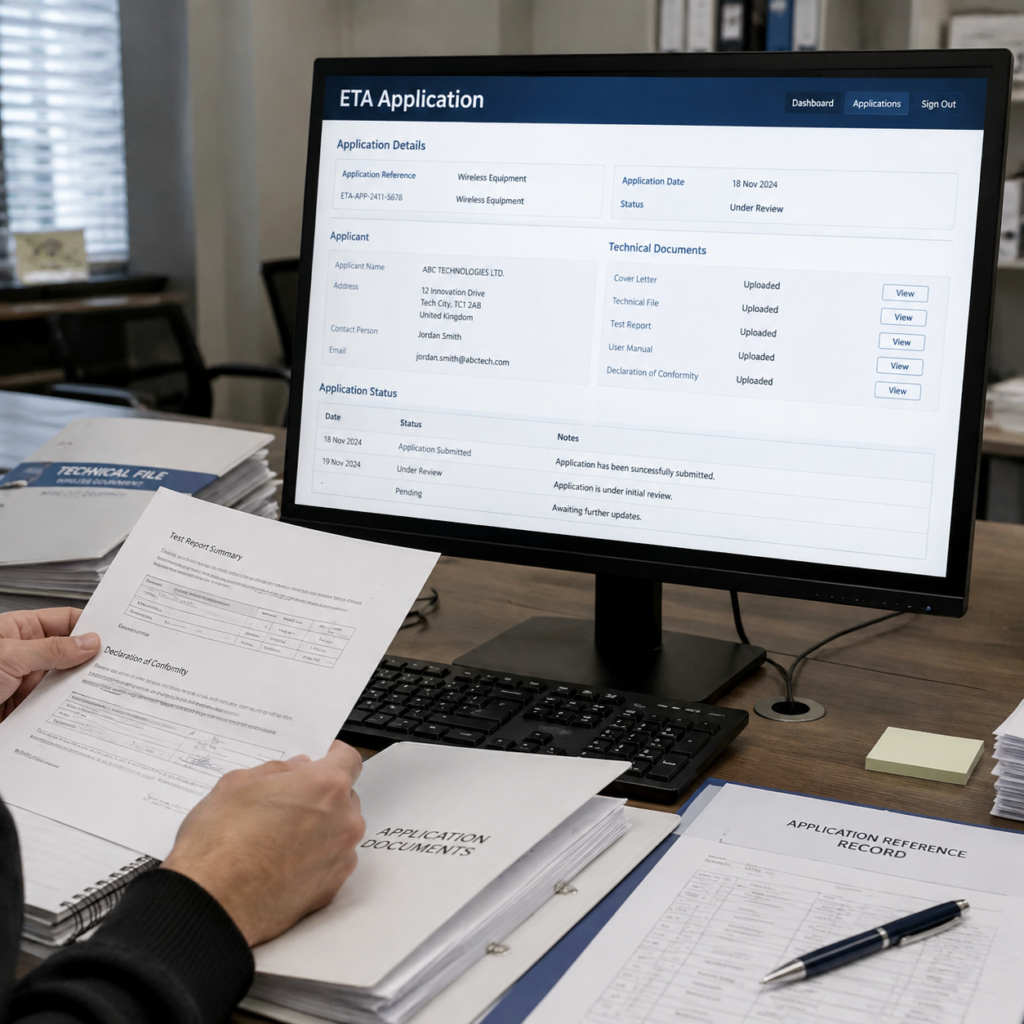
Once all documents are prepared, you can enter the formal application process. Before starting, you must first choose the correct ETA application path. Currently, there are two main paths:
The first is ordinary ETA, which requires complete official review. It is applicable to most charging products in license-exempt frequency bands, and is also the most commonly used path.
The second is ETA-SD (Self-Declaration path), which has a simpler process than ordinary ETA and issues certificates faster. However, it only applies to consumer-grade license-exempt products that meet the equipment categories, technical parameters, and application conditions currently open on the WPC official portal; if the product is not in the open categories, the parameters do not meet the requirements, or the portal does not support self-declaration submission, you should return to the ordinary ETA review path.
You cannot choose the path arbitrarily; it must be based on the product category requirements on the WPC official portal. Moreover, no matter which path you take, the application must be submitted by a local Indian entity.
After choosing the path, you can follow the steps. We have marked key checkpoints for each step, and following them will avoid rework:
Step 1: Register an official system account. This step is operated by the local Indian applicant entity, and is completed on the WPC online portal related to Saral Sanchar or the Department of Telecommunications (DoT) of India (the specific entry is subject to the current official announcement of WPC). You need to submit entity qualifications and the manufacturer’s authorization letter. Checkpoint: As long as the documents are correct, the account can be activated in 1-3 working days. If there is no news after that time, remember to ask your partner to check if there is a problem with the documents.
Step 2: Submit product application and technical documents. After the account is activated, select the category of short-range wireless transmission equipment in the system, and upload all prepared materials. The official will first conduct a preliminary review, mainly checking whether the documents are complete, whether the parameters are consistent before and after, and whether the product category is selected correctly. Checkpoint: The preliminary review cycle is generally 3-5 working days. If passed, it will enter the testing or final review stage; if unqualified, a document supplementation notice will be issued. Be sure to keep the application number properly, as it is needed for all subsequent status follow-ups.
Step 3: Sample testing (if required). Not all products require testing. If you hold a valid international test report that meets the requirements, and the parameters fully meet India’s limits, you can be exempted from testing after passing WPC review. If you do not have an accredited report, or there are doubts about the wireless parameters (such as a wireless charging pad whose power is close to the limit), you need to send samples for testing. The test content only covers radio frequency parameters such as wireless frequency band and transmission power, and does not involve other areas such as charging safety. Checkpoint: You must obtain a qualified test report issued by a laboratory with corresponding qualifications, otherwise you cannot proceed to the next step.
Step 4: Official review and certificate issuance. After passing the test (or passing the test exemption application), the official will conduct a final review, mainly checking the consistency of documents, the compliance of the test report, and whether the frequency band and power meet India’s requirements. Checkpoint: If the documents are complete and no supplementation is needed, the ETA review cycle for ordinary charging products is about 2-4 weeks. After passing, an electronic ETA certificate will be issued. Note that this certificate is only valid for the models listed in the application. After receiving it, be sure to check whether the model, frequency band, and power on the certificate are exactly the same as what you applied for. If there are errors, apply for modification in time, otherwise there will be problems in subsequent customs clearance.
Step 5: Compliance retention and labeling. Getting the certificate does not mean everything is done. Compliance documents such as the ETA certificate and test report must be properly kept for inspection at any time, and the documents used for customs clearance must be completely consistent with the information on the certificate. As for labeling, WPC has no mandatory unified labeling requirement. You can mark the ETA number on the packaging or nameplate as needed, it is not mandatory, and there is no need to spend extra money on special labels.
Intermediate Improvement: Certificate Management and Pitfall Avoidance Guide
For new sellers, following the process to get the certificate is already enough, but if you want to do long-term business in the Indian market, you also need to know some certificate management and pitfall avoidance tips, which can save you a lot of money and time.
First, let’s talk about the validity and applicable boundaries of the certificate. First is the validity period: the validity period and renewal requirements of ETA are subject to the terms on the certificate and the latest notice of WPC. As long as the key wireless parameters of the product remain unchanged, annual re-review is usually not required, and there is no need to pay for annual audits every year.
If there are subsequent changes, different situations are handled differently: for adjustments to appearance, packaging, and color with unchanged wireless parameters, you can apply for document update or change according to WPC’s current process; for changes in manufacturer name, model renaming, or applicant entity change, you need to confirm whether the change process is applicable based on WPC’s current rules, and re-application may be required in some cases; if you replace the wireless module, adjust the frequency band/power/wireless technology, you must re-evaluate or re-apply.
Also note that the applicable boundary of the WPC certificate is very clear: it only covers the models, frequency bands, power, wireless technologies, and applicant entities listed on the certificate. The original certificate cannot be used beyond the scope.
Next are the most common pitfalls in the entire process, and corresponding avoidance methods:
The first category is pitfalls in document submission: for example, if you do not have a qualified local applicant entity and apply directly by yourself, you will definitely be rejected; also, if the wireless parameters are written vaguely, you will be required to supplement documents, which delays time. The way to avoid this pit is to find a qualified partner in advance, and check the product’s wireless parameters accurately before submitting.
The second category is pitfalls in the testing stage: for example, using a report issued by a laboratory without corresponding 17025/NABL qualifications is directly invalid, wasting money; also, if the transmission power of the wireless charging pad exceeds the limit, the rectification cost is very high, and you may even need to replace the module. The way to avoid this pit is to confirm the qualification scope of the laboratory in advance, and roughly test the power yourself before sending samples for testing, don’t wait until the official requires testing to find problems.
The third category is pitfalls in review and series application: for example, applying for products with very different wireless parameters as the same series will definitely be rejected; also, if the product category is selected incorrectly, it will not pass. The way to avoid this pit is to ensure that the core wireless parameters of products in the same series are exactly the same, carefully check against the official list when selecting categories, and ask your partner for confirmation if you are unsure.
The fourth category is cognitive pitfalls: for example, thinking that having CE/FCC reports means you can automatically pass WPC, but in fact you can only apply for test exemption, and still need to go through official review; also, thinking that everything is fine once you get the WPC certificate, ignoring the requirements of other certifications such as BIS, you still won’t be able to clear customs and list products.
Many people are confused about the relationship between WPC and other Indian certifications such as BIS and TEC. Here we specifically explain their coordination methods:
First is the division of responsibilities. We can use a table for quick comparison:
| Certification Type | Jurisdiction Scope | Applicability for Charging Products |
|---|---|---|
| WPC Certification | Compliance of wireless signal transmission (radio frequency) | Required for products with active wireless transmission functions |
| BIS Certification | Electrical safety and compliance with India’s corresponding mandatory standards | Required for the vast majority of charging products |
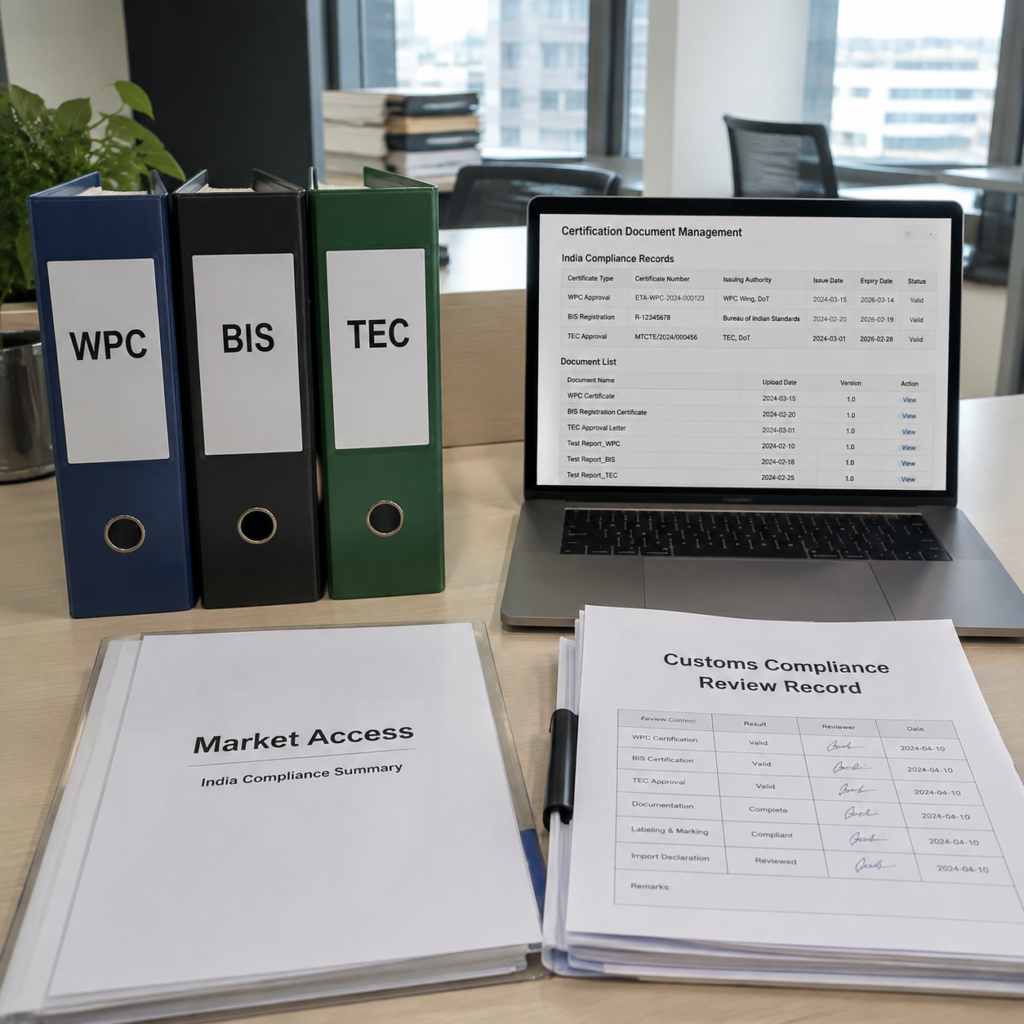
Supplementary note: Wireless charging compatibility is the responsibility of industry certifications such as Qi, and is not within the jurisdiction of WPC or BIS. Do not confuse the three.
If your charging product also has telecommunications functions (such as a portable charging router with cellular network), you also need to confirm whether TEC certification is required.
During customs clearance and e-commerce listing, customs and platforms may inspect all required certification certificates at the same time, so be sure to prepare them all in advance. In terms of labeling, the numbers of multiple certifications can be printed in the same label area, as long as the information is consistent, there is no need to make separate labels.
It is recommended that when doing compliance planning, you first list all the functions of the product clearly, then judge which certifications are required respectively, and prepare documents simultaneously to avoid the situation where different certifications use different model specifications, which will cause trouble when customs clearance does not match.
Practical Tools: Self-Check and Estimation Checklists
For your convenience in self-checking and estimation, we have compiled several practical checklists that you can directly refer to.
Quick WPC Application Self-Check Checklist
If these four conditions are met, you can start the application process:
□ The product has the function of actively transmitting wireless signals
□ The wireless frequency band is within India’s civilian license-exempt list
□ The transmission power meets the limits of the corresponding frequency band in India
□ A qualified local Indian applicant entity has been confirmed
Application Duration and Cost Estimation Method
In terms of duration, for ordinary charging product ETA, if the documents are complete and test exemption is applicable, it generally takes 3-6 weeks; if supplementary testing or document supplementation is required, it takes about 6-12 weeks. There are many factors affecting the cycle: the status of the official system, the number of supplementary submissions, whether the report is usable, Indian holidays, and the response speed of the partner will all affect the progress. Therefore, there is no absolutely fixed duration. Anyone who tells you “guaranteed certificate issuance in X days” should be treated with caution.
The cost mainly consists of three parts: official fees, local service fees, and testing fees. Generally speaking, the higher the transmission power of the product, the more complex the frequency band, and the more models applied for, the higher the cost. If you want to save money, try to use valid international reports with qualified qualifications to apply for test exemption, which can reduce or waive testing fees.
Customs Clearance and E-Commerce Listing Checklist
Check against this list before shipment to avoid most cargo detention problems:
□ The ETA certificate and test report are authentic and valid
□ The product’s HS code is consistent with the import declaration category
□ The models on the invoice and packaging are consistent with the models listed on the certificate
□ The Indian importer information is consistent with the applicant entity
□ If other certifications such as BIS and TEC are required, the certificates are also complete
Criteria for Judging Reliable Local Partners
Those that meet these points are basically relatively reliable:
First, they have the qualification of a legal local Indian applicant entity, can assume the responsibilities of authorized representative or importer, and have experience in handling WPC certification for charging products, not just other categories such as mobile phones and home appliances;
Second, they will help you do a compliance self-check of wireless parameters in advance, instead of charging money right away;
Third, they will clearly tell you the composition of the fee and the range of the duration, and do not promise an absolutely fixed number of days — after all, the official progress is not something a third party can control.
Summary
After reading this article, you can quickly judge whether your charging product requires Indian WPC certification, clearly distinguish the different roles of Indian WPC, Qi certification, and BIS certification, and also know which scenarios the ordinary ETA and self-declaration paths are suitable for. You can prepare documents according to the process, follow up the progress of each link, know the checkpoints of each step, avoid more than 80% of common application pitfalls, and reduce rework. You can also independently estimate the approximate application duration and cost range, judge what kind of local partner is reliable, and know how to check whether the compliance documents required for customs clearance and listing are consistent.
Before shipment, you can check the matching of certificate models, import entities, test reports, and other necessary certifications one by one against the customs clearance checklist to ensure smooth entry into the Indian market.