
When selling or using products with wireless transceiving functions in the EU market, the “RED Directive” and “CE marking” are the most commonly encountered compliance concepts. Many people mistakenly believe that RED only applies to professional wireless devices such as mobile phones and routers, and there are many confusions about its scope of application and its relationship with the CE marking.
I. Basic Definition and Core Functions of the RED Directive
1.1 Plain Language Explanation: What Exactly is the RED Directive
RED is a mandatory market access rule formulated by the EU for products with wireless transceiving functions. Its full name is Radio Equipment Directive (RED), and the currently valid version is 2014/53/EU, which has been applicable since June 13, 2016, replacing the previous old R&TTE Directive (1999/5/EC). The old R&TTE Directive had a transition period. For radio equipment currently placed on the EU/European Economic Area (EEA) market or put into use, compliance documents under the old R&TTE alone cannot prove compliance with RED requirements, and there is no retroactive negation of historically compliant products.
From the perspective of the regulatory system, RED is a special regulation under the EU CE access system, specifically governing radio equipment products, and is at the same level as the Toy Directive governing toy safety and the Low Voltage Directive governing general electrical safety.
1.2 Three Core Purposes of the Introduction of RED
The EU has separately formulated a special directive for radio equipment based on three core considerations:
The first is unifying regional market access standards. Before the implementation of RED, there were differences in the rules for wireless products among EU member states. The same product sold to different countries may need to complete repeated compliance assessments, resulting in high costs. After the implementation of RED, products that complete compliance once can circulate freely throughout the EU and EEA (including Iceland, Liechtenstein, and Norway) without applying for access country by country.
The second is protecting the personal safety of users. Wireless products involve both electrical power supply and radio wave emission. RED sets safety and radiation limits to avoid risks such as electric leakage and fire, and at the same time controls radio radiation within a safe range.
The third is regulating the use of radio spectrum. Radio spectrum is a public resource, similar to lanes on a highway. If devices occupy frequency bands arbitrarily, they will interfere with each other. RED reduces interference between devices through unified spectrum use rules and ensures the orderly use of public spectrum resources.
1.3 Two Basic Common Knowledge Points for Beginners
Learners who are new to RED often have two cognitive biases that need to be clarified first:
First, the coverage far exceeds that of professional wireless devices. It is not only dedicated wireless devices such as mobile phones and routers that need to comply with RED. As long as a product has wireless transmission or reception functions, even electric toothbrushes with Bluetooth and rice cookers connected to WiFi may be included in the scope of governance.
Second, the requirements are mandatory. As long as products are sold, imported, or put into use in the EU/EEA region (including equipment brought into the territory by enterprises for office use), they must comply with RED requirements, regardless of sales volume or usage scenarios.
II. Scope of Application of the RED Directive and Quick Self-Inspection Methods
To determine whether a product needs to comply with RED, you can confirm step by step according to the logic of “whether it is a radio equipment → whether it is excluded or exempt → whether it enters the EU/EEA market”, and then evaluate the requirements for the whole product in combination with the rules for combined products.
2.1 Core Judgment Logic
Step 1: Determine whether it is radio equipment as defined by RED.
Radio equipment governed by RED refers to equipment intentionally designed to transmit or receive radio waves for communication, positioning, sensing, or data transmission. The key here is “intentional” — if a device only produces accidental electromagnetic leakage during operation and is not specifically designed to transceive wireless signals, it does not fall into the category of radio equipment.
Step 2: Check the statutory exclusions.
If the product is radio equipment, it is also necessary to confirm whether it falls into the categories of statutory exemption or exclusion. For details of exclusions, see Section 2.3.
Step 3: Determine whether it involves the EU/EEA market.
Products only need to comply with RED requirements if they are sold, imported, or put into use in the EU/EEA region.
Step 4: Supplementary rules for combined products.
If wireless functions are integrated into non-dedicated wireless products such as home appliances, toys, tools, and medical devices, the whole product still needs to be evaluated for RED requirements related to wireless functions (such as radio frequency parameters, wireless-related safety and EMC requirements), rather than the entire product being fully governed by RED.
2.2 Examples of Commonly Applicable Products
Most consumer products with wireless functions in daily life fall within the scope of RED application. Common categories include:
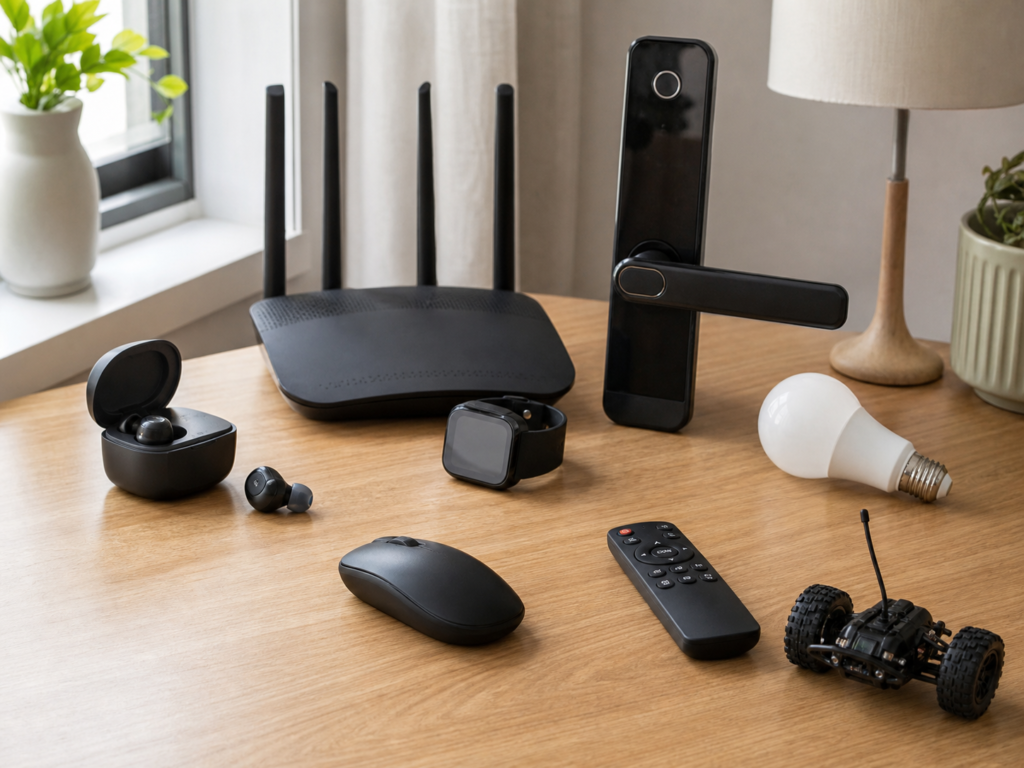
- Consumer electronics: Bluetooth earphones/speakers, smart watches, mobile phones, wireless mice, WiFi routers, wireless chargers with communication functions
- Smart home: wireless cameras, smart door locks, thermostats, door and window sensors, smart light bulbs
- Other categories: drone remote controls, walkie-talkies, IoT wireless devices, GPS navigators, remote control toys
2.3 Product Categories That Usually Need to Check Exclusion Conditions
Not all of the following categories are automatically excluded from RED application. They need to be checked one by one in combination with the purpose and design attributes of the equipment:
- Pure wired products with no wireless transceiving function at all: such as wired earphones, wired mice, wired keyboards, etc. Since they are not radio equipment, RED does not apply to them at all.
- Terminal equipment that only receives public radio and television signals: Receive-only equipment may also be included in the RED application judgment due to “receiving radio waves”. Whether it is excluded shall be subject to the exclusions listed in the RED annex and the specific purpose of the product; if the equipment also has transmission or other wireless functions such as Bluetooth and WiFi, it usually needs to be evaluated according to RED.
- Special radio equipment explicitly excluded in the RED annex such as aviation and maritime: Only equipment that is specially designed and used exclusively for aviation or maritime special communication or safety systems and is listed in the RED exclusion clauses shall be governed by special regulations; special wireless equipment for railways or other industries needs to check special regulations and RED exclusion clauses item by item, and cannot be directly excluded only by usage scenarios. Ordinary consumer-grade drones, in-vehicle Bluetooth, and general wireless equipment on civil ships cannot be excluded from RED on this basis, and the built-in general wireless modules still need to meet RED requirements.
- Amateur radio equipment: Only specific equipment or kits that are for personal use by amateur radio enthusiasts and are not publicly sold on the market as general consumer products shall be managed according to special rules for amateur radio; ordinary walkie-talkies sold on the market and consumer-grade wireless products with amateur frequency bands still need to comply with RED.
- Military/national security equipment, scientific research test prototypes: Special equipment for military or national security purposes, and prototypes only used for scientific research tests and not circulated in the civilian market, are not within the scope of RED application.
2.4 Quick Judgment Method for Boundary Products
For products that you are unsure about, you can make a preliminary judgment based on the following rules, and the final confirmation still needs to be combined with exclusions and product attributes:
- Consumer-grade products with common wireless transceiving functions such as Bluetooth, WiFi, 2G/3G/4G/5G, NFC, and GPS usually need to be included in the RED compliance assessment scope, and statutory exemptions such as broadcast reception categories need to be excluded first.
- For products that have their own special regulations such as medical equipment and auto parts, the built-in general wireless modules still need to meet RED requirements. For example, for a blood glucose meter with Bluetooth, the blood glucose meter itself needs to comply with medical device regulations, but the Bluetooth function part needs to be evaluated according to RED requirements.
- Wireless charging devices need to be distinguished by function: those that only charge by magnetic induction and do not have any data communication function need to check the latest EU exemption list, and RED may not apply; if they have communication functions (such as authentication handshake with the device during charging, data transmission), they must comply with RED.
- Low-power wireless devices (such as wireless doorbells, small remote control toys) need to comply with RED as long as they fall into the category of intentional transmission/reception of radio waves, regardless of the transmission power — the applicable test standards for low-power devices may be different from those for high-power devices, not that they do not need compliance.
III. Three Categories of Core Requirements of the RED Directive
The requirements of RED can be divided into three core categories, and there is an additional requirement that is gradually being implemented.
3.1 Health and Safety Requirements
In plain language, it means that the product is required not to harm users due to electrical, structural, or radiation problems.
It specifically covers three aspects: first, electrical safety, such as the charging port must not leak electricity, and the battery must meet safety requirements; second, mechanical safety, such as the shell must not have sharp structures that are easy to hurt people, and the structural strength must meet the requirements of the corresponding category; third, the limit of human exposure to radio radiation, that is, the radiation dose of the equipment must meet the standards stipulated by the EU.
Two common cognitions need to be clarified here:
- RED does not require products to have “zero radiation” — radio equipment inevitably generates radiation when working. Through the applicable human exposure assessment and meeting the limit requirements, the health risks within the compliance range can be controlled at an acceptable level, so there is no need to worry excessively.
- The safety requirements for wireless equipment have been included in the scope of RED, and usually there is no need to separately comply with the EU Low Voltage Directive (LVD) to avoid duplicate compliance.
3.2 Electromagnetic Compatibility (EMC) Requirements
Electromagnetic compatibility may seem professional, but it has only two core requirements: the equipment will not interfere with the normal operation of other electrical appliances, and can also resist interference from other electrical appliances.
It specifically includes two core contents: first, the interference emission of the equipment itself must not exceed the standard, and must not affect the normal operation of surrounding equipment; second, the equipment must have sufficient anti-interference ability and can still work stably in common electromagnetic environments.
Take a daily example: a compliant Bluetooth earphone will not slow down the WiFi speed, which is a reflection of the interference emission meeting the standard; when the microwave oven is turned on, the Bluetooth earphone can still produce sound normally and will not disconnect, which is a reflection of the anti-interference ability meeting the standard.
Consistent with safety requirements, the electromagnetic compatibility requirements for wireless equipment have been included in RED, and usually there is no need to separately comply with the EU EMC Directive, and the corresponding requirements of RED shall apply first.
3.3 Spectrum Use Requirements (Unique Core Requirements of RED)
In plain language: wireless equipment can only use radio frequency bands under the rules allowed by the EU, and cannot occupy public spectrum resources arbitrarily.
Specific requirements include: the operating frequency band, transmission power, bandwidth, and spurious emissions (i.e., other small signals leaked outside the main operating frequency band) of the equipment must comply with applicable EU spectrum coordination measures, harmonized standards, and frequency use conditions of the target member state.
There is an important note here: The RED declaration of conformity does not mean that the spectrum use license is automatically obtained in all EU member states, all locations, and all usage scenarios. Some frequency bands may have differences such as indoor and outdoor use restrictions, Dynamic Frequency Selection (DFS) requirements, and transmission power limits. For example, the 5GHz WiFi outdoor frequency band commonly used in some regions has strict DFS requirements and usage scenario restrictions in the EU. Directly copying product parameters from other markets may not comply with local usage rules. Such restrictions fall within the scope of verification of spectrum use conditions in the target market, and are not conclusions of the RED test itself.
Regarding labeling requirements: According to RED’s provisions on user information, manufacturers shall clearly mark the radio frequency bands used by the product, the maximum radio frequency transmission power corresponding to each frequency band, and necessary use restrictions in the product manual or accompanying materials; some specific categories of equipment may need to have relevant labels on the product body or packaging, subject to the applicable regulatory requirements of the corresponding product.
3.4 Additional Requirements: Privacy and Cybersecurity
Article 3(3) of 2014/53/EU stipulates the principle requirements for cybersecurity, privacy protection, and child-related protection, but these requirements do not automatically take effect with the issuance of the directive. The specific scope of application and effective time need to be clarified through delegated regulations issued by the European Commission.
EU Delegated Regulation 2022/30 has clarified the scope of application of cybersecurity and privacy requirements for connected wireless devices, wearable devices, wireless products for children, etc. The specific mandatory application date and transition arrangements shall be subject to the latest official EU text.
The core directions of such requirements include: protecting the security of users’ personal data, preventing illegal access to equipment, and reducing risks related to children’s use.
IV. Relationship Between RED, CE Marking, and Other EU Regulations
This is the most confusing part. The following clarifies the boundaries from three dimensions: subordinate relationship, regulatory division of labor, and verification methods.
4.1 Subordinate Relationship Between RED and CE Marking
Many people mistakenly believe that “CE certification” is a single third-party certificate, but this is not the case:
The CE marking is the general mark for EU product access, equivalent to the general access mark for the EU market, covering dozens of different special regulations — the Toy Directive governs toy safety, the Low Voltage Directive governs general electrical safety, and the RED Directive governs wireless products.
RED is one of the special regulations under the CE system specifically for radio equipment. The prerequisite for wireless products to legally affix the CE marking is that they meet the corresponding requirements of RED.
It should be particularly clarified that the CE marking is a compliance mark self-declared by the manufacturer, not a “quality certification” issued by a third-party institution. As long as the manufacturer can prove that the product complies with the corresponding EU regulations, it can affix the CE marking in accordance with the specifications, but it must be supported by real test data and complete technical documents as the basis for the self-declaration, and shall not be marked arbitrarily.
4.2 Division of Labor Differences Between RED and Common EU Regulations
Many products may involve multiple EU regulations at the same time. The following table sorts out the relationship between RED and common regulations:
| Regulation Name | Relationship with RED |
|---|---|
| Low Voltage Directive (LVD) | Governs the safety of general electrical appliances (with voltage threshold). RED has covered the safety requirements of wireless equipment, so wireless products usually do not need to apply LVD separately |
| EMC Directive | Governs the electromagnetic compatibility of general non-wireless equipment. RED has covered the EMC requirements of wireless equipment, so RED applies first to wireless products |
| RoHS/REACH/WEEE | Govern the restriction of hazardous substances in materials, chemical substance management, and e-waste recycling respectively. They have different scopes of governance from RED and can be applied in parallel with RED |
In short: requirements related to the safety and electromagnetic compatibility of wireless equipment shall be implemented in accordance with RED first, and there is no need to repeatedly apply the corresponding regulations for general electrical appliances; while regulations governing materials, environmental protection, and recycling do not overlap with the scope of RED governance, and products need to meet the corresponding requirements at the same time.
4.3 Method for Ordinary Users to Quickly Verify Whether CE Corresponds to RED
Without professional technical background, you can also initially check whether the CE marking of wireless products covers RED requirements through the following dimensions. Note: External labels and documents are only clues for risk investigation, and the final compliance shall be subject to complete technical documents and regulatory requirements:
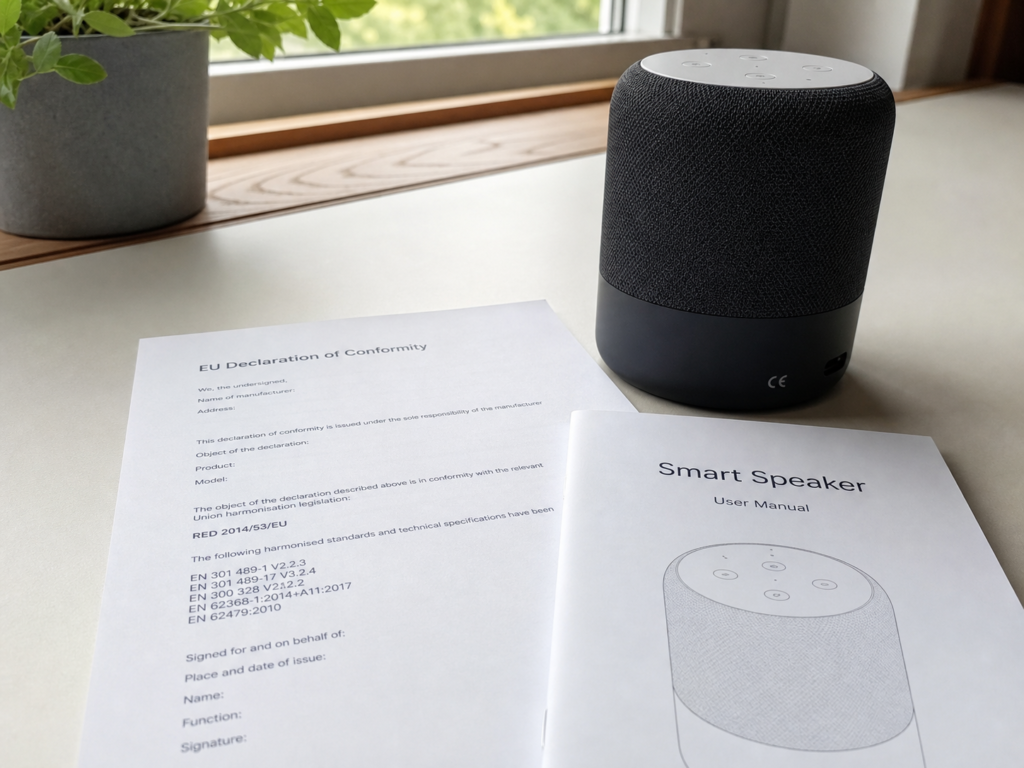
- Check accompanying materials: Check whether the product manual or accompanying documents mark the applicable radio frequency bands, the maximum transmission power of each frequency band, and use restrictions. Missing information is a high-risk signal that requires further verification.
- Check the EU Declaration of Conformity (DoC): The DoC is an official document signed by the manufacturer declaring that the product complies with the corresponding EU regulations. It needs to include core information such as product model, manufacturer’s name and address, applicable regulations (clearly marked RED 2014/53/EU), signatory’s name and position, and signing date; if the DoC only marks non-wireless special regulations such as the Low Voltage Directive and EMC Directive, it does not cover RED requirements.
- Be alert to high-risk signals: Products with multiple wireless functions but no radio frequency parameters marked, the model on the DoC is inconsistent with the actual product, no accompanying instructions in EU official languages, etc., all require further verification of complete technical documents.
It should be emphasized again: do not judge RED compliance only by the CE marking. The CE marking of ordinary home appliances is usually based on other regulations and has nothing to do with RED.
V. Basic Logic and Responsibility Division of RED Compliance
5.1 Four Core Steps of Compliance
The core logic of RED compliance can be divided into four steps. Among them, testing does not mandate the use of a unified standard, but there is clear room for path selection:
Step 1: Scope confirmation. Sort out all wireless functions of the product, judge whether it falls within the scope of RED application according to the previous logic, exclude statutory exemption categories, and confirm that the target market is the EU/EEA.
Step 2: Selection of conformity assessment path. Prioritize identifying applicable EU harmonized standards (i.e., general technical standards officially issued by the EU that can be used to prove that products meet the basic requirements of the directive). The practical significance of adopting EU harmonized standards is that products can obtain a “presumption of conformity” with the basic requirements of RED. Therefore, ordinary wireless products usually prioritize the harmonized standard testing path; if the harmonized standards can fully cover the product risks, testing and assessment can be completed in accordance with the standards; if there are no applicable harmonized standards, or only partial coverage, or the manufacturer does not adopt harmonized standards, other recognized technical specifications need to be selected, and conformity assessment shall be completed in accordance with the corresponding procedures.
Step 3: Technical document preparation. Sort out a full set of technical documents such as product design materials, test reports, risk assessment records, and manuals. The manufacturer shall keep the technical documents for the period required by regulations and be able to provide them when requested by the regulatory authority.
Step 4: Sign the declaration and affix the mark. The manufacturer signs the EU Declaration of Conformity (DoC) and affixes the CE marking on the product in accordance with the specifications.
5.2 Compliance Responsibilities of Different Market Roles
The compliance responsibility of RED is not only borne by the manufacturer. Different market roles have clear responsibilities:
- Manufacturer/brand owner: Bears the final responsibility for product compliance, is responsible for compliance assessment in the design stage, organizing testing, preparing technical documents, signing the DoC, and affixing the CE marking, to ensure that the product meets all applicable requirements.
- EU importer: Responsible for verifying the manufacturer’s qualifications, whether the product has a compliant CE marking, and whether it has a complete DoC and technical documents. At the same time, it shall mark its own name and contact information on the product to ensure that imported products meet RED requirements.
- Distributor/e-commerce seller: Responsible for checking whether the product’s CE marking and accompanying instruction documents are complete in the supply chain link, and shall not sell obviously non-compliant products; if compliance problems are found in the product, sales shall be stopped and cooperation with regulatory investigations shall be provided.
- EU authorized representative and domestic economic operator: The authorized representative under the RED framework is designated by the manufacturer through written authorization, and undertakes specific responsibilities such as cooperating with regulatory inspections and retaining technical documents within the scope of authorization; at the same time, according to relevant EU market supervision regulations, for products of non-EU manufacturers entering the EU market, an economic operator in the EU (which can be served by the importer or authorized representative) must be identified as the regulatory contact to ensure that regulatory authorities can obtain compliance technical documents at any time.
5.3 When a Notified Body Needs to Be Involved
A notified body is a third-party conformity assessment body recognized by the EU. Whether a notified body is required to participate in conformity assessment depends on factors such as the assessment path selected by the manufacturer and the coverage of harmonized standards. Not all special products must be intervened by a notified body.
Common situations that may involve a notified body include:
- There are no applicable EU harmonized standards, and product risks cannot be fully covered by self-assessment;
- The manufacturer chooses a conformity assessment path that requires the participation of a notified body (such as EU type examination, full quality assurance, etc.).
It should be noted that the use of special frequency bands does not necessarily trigger the notified body assessment procedure; only when the notified body actually participates in the conformity assessment procedure required by regulations will its four-digit number be marked next to the CE marking (e.g., CE 0123). Most ordinary consumer-grade wireless products are covered by mature harmonized standards, and the self-declaration path is sufficient. It is normal that there is no number next to the CE marking.
VI. Common Misconceptions and Pitfall Avoidance Guide
6.1 Common Misconceptions About the Relationship Between CE and RED
- Misconception 1: Having the CE marking means definitely complying with RED
Correction: The CE marking corresponds to multiple types of EU access regulations. The CE marking of ordinary home appliances is usually based on the Low Voltage and EMC Directives, which do not cover the special requirements of RED. The CE marking alone on wireless products does not mean compliance with RED. - Misconception 2: There is a separate “RED certification” and it is equivalent to CE compliance
Correction: There is no standard expression of “RED certification” in EU official terms. RED is one of the special directives under the CE system. CE compliance may also cover other regulatory requirements such as RoHS and WEEE, so the two cannot be directly equated. - Misconception 3: CE is a self-declaration, so no testing is needed
Correction: Self-declaration does not mean no basis is needed. It must be supported by real test reports and complete technical documents. For specific rules, please refer to the description of the CE marking in Section 4.1.
6.2 Common Misconceptions About Product Compliance
- Misconception 1: If a RED-compliant module is used, the whole machine will automatically be compliant
Correction: Antennas, enclosures, power supplies, software, etc. will affect radio frequency performance (for example, a metal enclosure may reflect signals causing excessive transmission power, and a high-gain antenna may exceed the limit). Even if a compliant module is used, the whole machine still needs to complete compliance assessment. - Misconception 2: Low-power wireless devices do not need to comply with RED
Correction: The core criterion for RED application is whether radio waves are intentionally transceived, regardless of power level. Low power only corresponds to different test standards, not that no compliance is needed. For the specific judgment logic, see Section 2.4 Boundary Product Judgment Method. - Misconception 3: Testing only the radio frequency function is enough
Correction: RED requirements cover three categories: health and safety, electromagnetic compatibility, and spectrum use. Charging port safety, enclosure structure safety, etc. all fall within the scope of safety requirements, and it is not enough to only test radio frequency parameters. - Misconception 4: Certifications from other regions such as US FCC and China SRRC can replace RED
Correction: There are differences in frequency band planning, power limits, and test requirements in different countries and regions. Certifications from other regions cannot replace RED compliance. Separate RED assessment is required to enter the EU market. - Misconception 5: Software updates do not affect compliance
Correction: If software updates modify radio frequency parameters (such as transmission power, operating frequency band, modulation method, etc.), compliance may be affected, and reassessment is required.
6.3 Common Consequences of Violation
The consequences of RED violations vary depending on the subject:
- Individuals or small businesses: Non-compliant products purchased overseas or carried may be confiscated by customs; when used by themselves, they may also interfere with surrounding wireless devices and affect the user experience.
- Enterprises: In mild cases, products will be removed from e-commerce platforms, fined by regulatory authorities, and product recalls will be initiated; in severe cases, they may be prohibited from entering the EU market, causing significant economic losses.
6.4 When to Consult a Professional Compliance Institution
In the following situations, it is recommended to seek support from a professional compliance institution to avoid judgment errors:
- Products using special frequency bands or high-power transmission;
- Involving other special regulations such as medical, automotive, aviation, etc., with complex compliance logic;
- Adopting new wireless technologies for which there are no ready applicable harmonized standards;
- Doubts about the RED application judgment of the product, requiring a formal assessment conclusion.
VII. Summary of Core Judgment Abilities
For beginner learners, there is no need to remember all technical details, just master the judgment ability of the corresponding level:
Beginner Level (Core Content)
- Know that RED is a mandatory access rule for wireless products in the EU, and is a special regulation under the CE system;
- Able to quickly judge whether common consumer electronic products need to comply with RED according to the logic of “whether it is a radio equipment → whether it is excluded or exempt → whether it enters the EU market”;
- Able to clearly state the three core requirements of RED (health and safety, electromagnetic compatibility, spectrum use) and understand its scope of governance;
- Able to clarify the subordinate relationship between the CE marking and RED, and know that having the CE marking does not mean complying with RED.
Intermediate Level (Advanced Content)
- Able to initially verify RED compliance through accompanying materials and DoC documents, and identify high-risk products;
- Able to avoid the most common RED cognitive misconceptions in consumption and cross-border sales;
- Able to judge whether boundary products fall within the scope of RED application or exclusion;
- Able to clarify when to seek support from a professional compliance institution.