
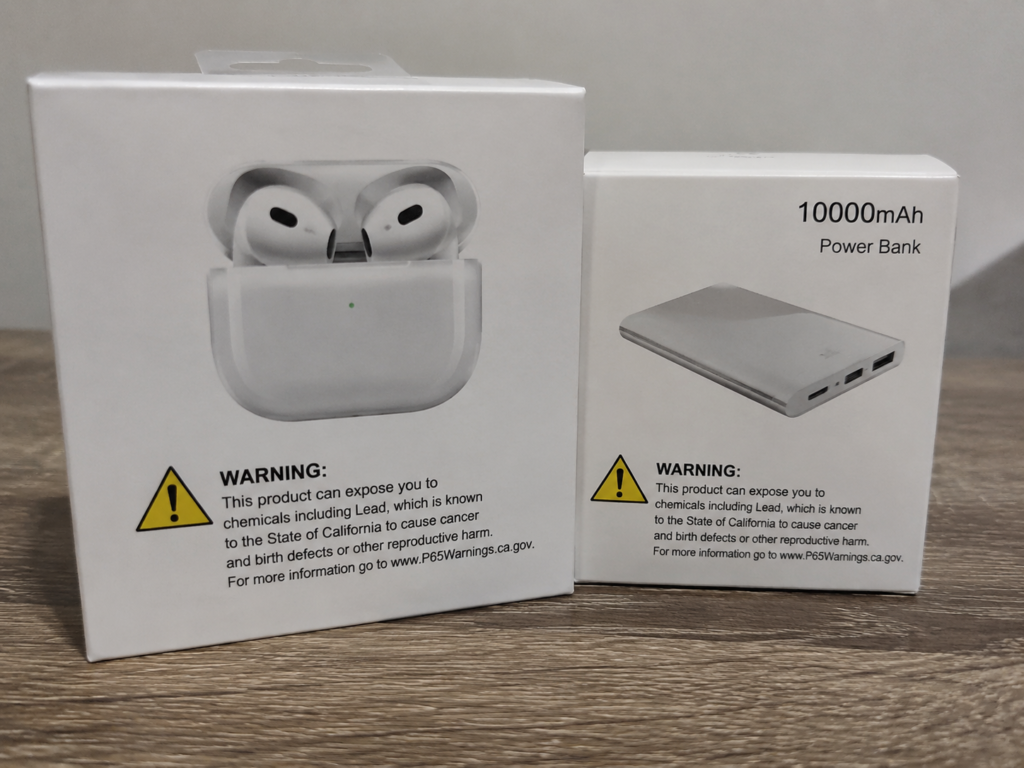
You may have bought US-version wireless earbuds or power banks, and the first thing you see when you unpack them is a yellow triangular warning with big “WARNING” printed on it, next to a string of English text about carcinogenic or reproductive toxicity, which scares you into thinking you bought an “unqualified toxic product”. In fact, behind this label is a consumer right-to-know regulation in California, USA—California Proposition 65, which has no direct correspondence with whether the product is toxic or whether its quality is qualified. This article will clarify the essence, applicable boundaries, judgment logic and common misconceptions of this regulation from the perspective of electronic products.
Basic Understanding: Quickly Grasp the Essence of the Regulation
Many people, when they first hear “California Proposition 65”, will subconsciously equate it with “banning the sale of toxic products”, but in fact its regulatory logic is completely different from such regulations—the core is not to restrict the use of substances, but to protect consumers’ right to know.
This regulation is a state law passed by California voters in 1986, with the official name Safe Drinking Water and Toxic Enforcement Act. What people usually call Prop 65 and California Proposition 65 all refer to it. It has only one core requirement: any product sold to California consumers must clearly inform consumers if there is an exposure risk of carcinogenic, reproductive toxic or developmental toxic substances.
Key point: It does not prohibit enterprises from using toxic substances, nor does it directly ban the sale of products; it only requires enterprises to fulfill their obligation of notification. This is the core of understanding the entire California Proposition 65, and all subsequent rules revolve around this logic.
Only Mandatory in California, Why Do Global Products Have Warnings
Many people will wonder: I am not in California, USA, why does the electronic product I bought also have this label?
First of all, it must be clear: California Proposition 65 is only a state law of the State of California, USA, not a federal law of the entire United States, let alone having global effect. In theory, only products sold to California need to comply.
But in reality, you can see this warning all over the world, mainly for three reasons:
First, in order to avoid litigation risks, brands often make unified packaging for the same product, and print warnings regardless of whether they are sold to California, other states, or other countries, so as to avoid the cost of separate production lines.
Second, mainstream cross-border e-commerce platforms such as Amazon and eBay clearly require products sold to California to disclose California Proposition 65 related information, and many sellers simply add warnings to all products in their stores to avoid penalties for missing disclosures.
Third, most electronic products exported to the United States are packaged in accordance with California’s compliance requirements by default, so even if you buy a used US-version product or purchase it through a third-party channel, it is easy to encounter this label.
Why Should Electronic Product Stakeholders Pay Attention
For the electronic product industry, California Proposition 65 is worthy of key attention, mainly for three reasons:
First, the cost of violation is high: the statutory maximum fine for a single violation is $2,500 per day, and the actual liability amount depends on the period of violation, the number of violations, settlement agreements or court discretion, and the losing party also has to bear the plaintiff’s attorney fees.
Second, the law enforcement subjects are diverse and private participation is high: unlike most regulations that are mainly enforced by government departments, California Proposition 65 allows eligible private lawyers, environmental organizations, etc. to participate in law enforcement, but they must perform the statutory 60-day pre-notification procedure—private enforcers must first serve a notice of violation to the involved enterprise, the California Attorney General and relevant local procuratorial organs. If the government does not file a lawsuit within the notice period, private enforcers can file a lawsuit in accordance with the law. Since private enforcers can obtain a portion of the fine share in accordance with the statutory proportion after winning the lawsuit, there are specialized teams in the market that pay attention to the compliance of various products, and electronic consumer goods are a high-frequency category of complaints.
Finally, it directly affects market access: once found to be in violation, in addition to fines, products may also be removed from e-commerce platforms and required to rectify the entire batch, which has a greater impact on small sellers.
Applicable Boundaries: Who Must Comply and Which Electronic Products Are Regulated
After understanding the essence, the next step is to draw clear boundaries: who needs to be held responsible? Which electronic products are within the jurisdiction?
Scope of Subjects Liable for Responsibility
Not all sellers of electronic products need to comply, there are two basic prerequisites: first, the number of employees of the enterprise is 10 or more, and the number of employees here is calculated based on the total number of employees of the enterprise as a whole, not only the number of local employees in California; second, the product will be sold to the California market.
And the responsibility is across the entire chain: from manufacturers, importers, distributors, to offline retailers and cross-border e-commerce sellers, as long as they are in this chain and meet the above two prerequisites, they may be held accountable. For example, if you are a small seller on Amazon, your company has 12 people, and the data cables you sell are shipped to California, then you have compliance obligations.
Scope of Regulated Electronic Products
This article mainly discusses the California Proposition 65 warning requirements for consumer electronic products sold to ordinary consumers—all consumer electronic products and accessories (including second-hand products) entering the California market are within the scope of regulation, not only the whole machine, but also components, packaging, and supporting data cables and chargers that users can access are all within the scope of regulation.
Electronic components for purely industrial use and not sold to ordinary consumers are not within the scope of the consumer product warning discussion in this article. If occupational exposure in industrial scenarios is involved, a separate assessment must be conducted in accordance with the compliance rules related to occupational exposure, and the consumer product warning requirements cannot be directly applied.
Statutory Exemption Situations
There are two types of statutory exemption situations, which need to be judged in combination with specific scenarios:
One is subject exemption: small enterprises with fewer than 10 employees can be exempted from their own direct liability under California Proposition 65. But note that this only exempts the enterprise’s own obligations. If the upstream supplier in the supply chain meets the subject requirements, it still needs to bear compliance responsibilities, and small enterprises cannot arbitrarily purchase non-compliant goods because of this.
The other is product exemption: if federal regulations have clearly stipulated similar chemical exposure warnings for specific products, and there is a conflict with the requirements of California Proposition 65 according to the principle of legal priority application, it is necessary to confirm whether exemption is available on a case-by-case basis in combination with specific product categories and applicable laws, and cannot be generalized by product category (for example, for medical electronic products regulated by the FDA, whether additional California Proposition 65 warnings are required needs to be judged in combination with specific federal rules, and is not automatically exempted).
Core Judgment Logic: How to Determine Whether a Warning Is Needed
Many people think that as long as the product contains toxic substances on the list, a label must be affixed, which is actually completely wrong. The judgment logic of California Proposition 65 is different from most substance control regulations, and the core depends on “exposure amount”, not “total content”.
Control Basis: Dynamically Updated List of Toxic Substances
The control object of California Proposition 65 is a list of toxic substances maintained by the California Office of Environmental Health Hazard Assessment (OEHHA for short, which is the official California agency responsible for toxicity assessment). OEHHA maintains this list in accordance with various listing mechanisms stipulated by California law, and the substances included are officially recognized as carcinogenic or causing reproductive and developmental toxicity.
Up to now, more than 900 substances have been included in the list, and new substances are added or adjusted dynamically every year. The specific number shall be subject to the latest list released by OEHHA on the same day. It sounds like a lot, but for electronic products, common substances of concern include lead, some phthalates, cadmium, mercury and some brominated flame retardants. The specific substances to be checked should be determined in combination with the material composition, use method and exposure path of the product, and there is no need to memorize the complete list.
Core Judgment Standard: Look at「Exposure Amount」, Not「Total Content」
This is the core logic of California Proposition 65, and it is also the place that is most easily confused with other regulations.
In plain language: to judge whether a warning is needed, it is not how much toxic substance is contained in the product in total, but the amount of substance that consumers actually come into contact with every day when using the product normally.
For example: the solder of a mobile phone motherboard contains lead, but if the motherboard is completely enclosed under normal and reasonably foreseeable use scenarios and will not cause user exposure, it usually does not trigger the warning obligation; but if it involves foreseeable exposure scenarios such as disassembly, severe wear, or maintenance, a separate assessment is still required.
This is completely different from the EU RoHS regulation that everyone is familiar with—RoHS restricts the total content of harmful substances in products, for example, lead cannot exceed 0.1%, regardless of whether you can come into contact with it; but California Proposition 65 does not care about the total content, it only depends on how much you can come into contact with.
Two Safety Thresholds: Reference Red Lines for Judgment
Then how much contact is considered to require a warning? OEHHA has set safe harbor thresholds for some substances on the list. If an enterprise can prove that the exposure is below the threshold, it does not need to post a warning:
If it is a carcinogenic substance, the corresponding safe harbor threshold is called「No Significant Risk Level」(NSRL for short)—meaning that when the daily exposure is below this level, the carcinogenic risk of lifelong exposure is negligible, and enterprises can use this as a legal defense basis for not posting a warning.
If it is a reproductive or developmental toxic substance, the corresponding safe harbor threshold is called「Maximum Allowable Dose Level」(MADL for short), which is based on one-thousandth of the「No Observed Effect Level」—that is, when it is below this level, enterprises can claim that there will be no observable hazard risk to the reproductive system or fetal development.
Two key details should be noted: first, not all substances on the list have corresponding NSRL or MADL values; second, the threshold is calculated based on「daily exposure」, that is, the amount of contact per day, not the percentage content of the substance in the product. Substances for which no safe harbor value has been published do not mean that a warning is automatically required; if an enterprise claims not to issue a warning, it still needs to provide a risk assessment basis that meets the requirements of the regulation to prove that the exposure level meets the requirements of no significant risk or no observed effect.
3 Common Exposure Routes for Electronic Products
Then what counts as “coming into contact”? For electronic products, there are three main exposure routes:
The most common is skin contact: for example, holding a mobile phone case, touching a data cable, holding a charger—if the substances in these accessible components can migrate to the skin, it counts as exposure.
Second is oral contact: mainly for children, for example, children gnaw on earphones, bite charging heads, chew watch straps—if the toxic substances in the components can be leached through saliva, it counts as exposure.
The third is dust inhalation: for example, old equipment wears out and sheds debris after long-term use, or when users disassemble the equipment by themselves, the tiny particles produced contain toxic substances and are inhaled into the lungs, which also counts as exposure.
Focus on Electronic Products: High-Frequency Restricted Substances and High-Risk Scenarios
As mentioned earlier, electronic products do not need to check the complete list, and can first start the assessment from several common types of substances of concern. We have sorted out the possible locations of these substances, as well as the product categories that need priority assessment and low-risk scenarios, to help you quickly locate the key points.
4 Types of High-Frequency Substances of Concern and Their Possible Sources
The first type is lead, which is also the most common substance of concern, and may appear in components such as solder, battery contacts, cable sheath stabilizers, and metal plating.
The second type is phthalates, which are commonly referred to as plasticizers, mainly used to soften plastics and rubber, and may appear in soft accessories such as soft rubber shells, data cable/earphone cable sheaths, mobile phone protective cases, and silicone watch straps.
The third type is cadmium and mercury. Cadmium may appear in rechargeable batteries, switch contacts, and plastic pigments; mercury is currently less used, and may only be found in components such as old display backlights and some old sensors.
The fourth type is brominated flame retardants. Note that not all brominated flame retardants are on the list, only some categories are included, and they may appear in components that require fire protection such as circuit boards and hard plastic shells.
High-Concern Electronic Product Categories That Require Priority Assessment
The following categories usually require priority exposure assessment due to their use scenarios or material characteristics, but it does not mean that such products must have warnings. In the end, it still needs to be based on actual exposure data:
The first is products with built-in batteries: such as wireless earbuds, power banks, smart watches, and portable speakers. Material fluctuations in battery contacts and related components may affect exposure levels.
The second is soft rubber accessories: such as data cables, mobile phone protective cases, earphone cases, and watch straps, which are mostly made of flexible materials and often come into long-term contact with the skin, so attention should be paid to the migration risk of substances such as plasticizers.
The third is children’s electronic products: such as toy electronic devices and children’s watches. Due to children’s gnawing behavior, the oral exposure risk is significantly higher than that of adult products.
The fourth is low-price unbranded products: such products often use recycled materials of unknown origin, lack of material compliance documents, and have higher fluctuations and uncertainties in substance content and migration/exposure, making them a high-incidence category of violation complaints.
Scenarios That Can Reduce Assessment Priority
The following scenarios usually have low exposure risks under normal use, and the assessment priority can be reduced, but it does not mean that there is no risk at all, and it still needs to be judged in combination with foreseeable use scenarios:
The first type is components that are completely enclosed inside the device and cannot be accessed by users during normal and reasonably foreseeable use, such as built-in circuit boards, chips, and battery cells; but if special scenarios such as disassembly and repair, severe wear and debris shedding of the device are involved, a re-assessment is still required.
The second type is hard metal or plastic shells with stable structure and no obvious wear and debris shedding. The substance migration of such materials is usually extremely low; but if it is used in long-term skin contact, or there is a possibility of children gnawing, it still needs to be evaluated in combination with actual migration data.
The third type is regular brand products that have completed material control and exposure assessment: such products usually have undergone compliance verification on the exposure of accessible components, and the risk is relatively controllable, but it should be noted that the brand identity itself cannot replace exposure assessment, and it still needs to be based on actual testing and assessment data.
Warning Labels: How to Read and Place Them to Be Compliant
Since it is a right-to-know regulation, the warning label is the core carrier. The warning rules of California Proposition 65 will be dynamically updated by OEHHA, and enterprises need to check compliance in accordance with the official rules effective at the time of sale. At present, the commonly used safe harbor warning benchmark in the industry is the 2018 revised version. At the same time, the short-form warning rules have been revised and transitional arrangements have been set. The content required for the short form and the labeling requirements for chemical substance names must be subject to the official rules effective at the time of sale, and a fixed format cannot be generally applied.
The following introduces the commonly used safe harbor warning format. Warnings that meet the safe harbor requirements can be directly presumed to be compliant; but as long as the content clarity and conspicuousness of the warning meet the regulatory requirements, even if the safe harbor format is not adopted, it may be deemed compliant, and enterprises can choose according to their own situation.
Core Components of Safe Harbor Warnings
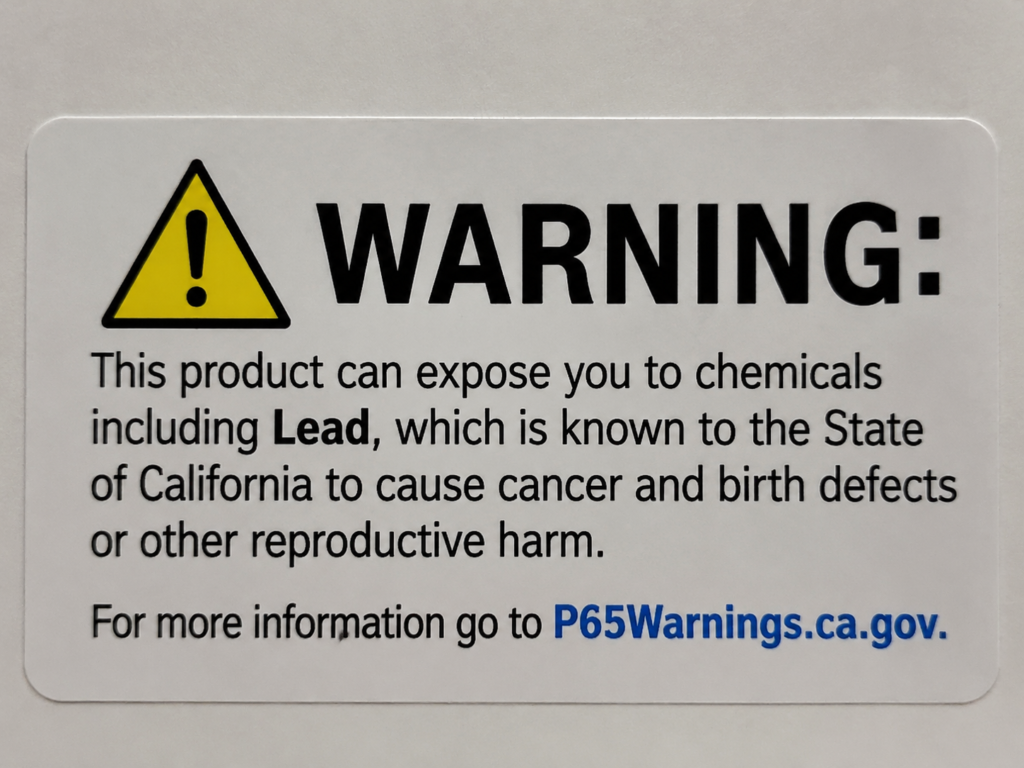
A California Proposition 65 warning that meets the 2018 version of safe harbor requirements usually includes the following core elements:
First, use a yellow equilateral triangle warning symbol with a black exclamation mark, paired with the conspicuous「WARNING」text.
Second, clearly state the type of hazard: whether it is carcinogenic, reproductive toxicity, or both.
Third, if it is a long-form warning, at least 1 main restricted substance must be listed, and it is not necessary to list all involved substances.
Fourth, the official inquiry website must be attached: P65Warnings.ca.gov, where consumers can check detailed information by themselves.
Format Selection and Placement Requirements for Different Scenarios
Safe harbor warnings are divided into long form and short form, corresponding to different use scenarios and placement requirements. The core principle is to ensure that consumers can clearly obtain warning information before purchasing or first contacting the product:
- Long form: It has the most complete information, needs to list specific restricted substances and risk types, and is suitable for carriers with sufficient space such as product outer packaging and accompanying manuals. For electronic products of regular size, the long-form warning can be directly printed on the product body, outer packaging or the conspicuous position of the accompanying label.
- Short form: The content is relatively concise, suitable for scenarios with limited space such as small/micro products (such as Bluetooth earphones, U disks, whose body space is insufficient to print complete long content) and online advertisements. If the body of a small product cannot print a complete warning, the short form or complete warning can be placed in the packaging, accompanying manuals and other materials, but it must meet the small product exemption conditions under the corresponding rules to ensure that consumers can see it when unpacking.
- Special requirements for online sales: Products sold through online channels such as e-commerce platforms and mail-order catalogs must display warnings before consumers complete their purchase. Common methods include placing them on the product detail page and the confirmation page before checkout; placing them only in the accompanying manual or electronic manual cannot meet the requirement of pre-purchase notification, which is a violation.
It should be noted that the specific content requirements of the short form (such as whether the name of the chemical substance needs to be marked) will be adjusted with the revision of official rules, and must be subject to the official rules effective at the time of sale, and a fixed format cannot be generally applied.
Key Reminder: Warning ≠ Product Dangerous or Unqualified
Many people panic when they see WARNING, thinking that the product is toxic and of poor quality, but that’s not the case at all.
The warning of California Proposition 65 only means that the product manufacturer or seller believes that the product has a chemical exposure risk that needs to be notified, or chooses to post a warning out of compliance conservatism; the warning itself cannot quantify the actual risk level of an individual, nor can it alone prove the degree of danger of the product, let alone a quality rating, nor does it mean that the product violates other regulations such as RoHS and UL. Conversely, the absence of a warning does not mean that the product is completely free of listed substances, or that there is no exposure risk at all.
Advanced Judgment and Pitfall Avoidance: From Understanding to Decision-Making
At this point, you can already understand the basic rules of California Proposition 65. Next, we will talk about something more practical: as a consumer, how to judge when you see a warning? As an entry-level practitioner or small seller, how to carry out basic compliance screening? What are the common pitfalls to avoid?
Consumer Version: Judgment Ideas After Seeing a Warning
You don’t have to throw away the product as soon as you see WARNING. You can judge according to the following ideas combined with your own needs:
Step 1: First look at the substances and hazard types listed in the warning, and figure out whether it is carcinogenic or reproductive toxicity, and what the main substances involved are.
Step 2: Evaluate the degree of concern in combination with the use scenario: Will this product be put into the mouth by children? Is it used in long-term skin contact? Will it wear frequently and produce dust? Is the user group a sensitive group such as pregnant women and children?
Step 3: Make a choice according to your own needs: if it is a product that children may put in their mouth, use in long-term skin contact, or frequent contact, or the user group is a sensitive group, you can take the initiative to ask the brand for detailed information such as restricted substances, accessible components, and use restrictions before making a decision; if it is a product that ordinary adults contact for a short time, you can choose according to your own risk acceptance.
If you want to learn more about the toxicity information of substances, you can check the public list and threshold data on the OEHHA official website, but the actual meaning of the threshold usually needs to be interpreted in combination with specific exposure scenarios, and should not be directly applied.
Entry-Level Practitioner/Small Seller Version: Basic Compliance Screening Steps
If you are a small seller who has just started cross-border e-commerce, or a product position who has just entered the industry, you can carry out basic compliance screening in the following four steps to gradually clarify the risk:
Step 1: Confirm the applicable boundary: first verify whether the product is sold to California, and whether the total number of employees of the enterprise reaches 10; if neither condition is met, there is no need to bear the direct compliance responsibility of California Proposition 65 for the time being, but you still need to pay attention to the compliance of upstream suppliers to avoid the transmission of supply chain risks.
Step 2: Screen potential listed substances: there is no need to check the complete list one by one. You can first target several common types of substances of concern in electronic products, ask suppliers for material declarations, BOM (Bill of Materials) or total content test reports, and identify whether accessible components (shells, wires, buttons, etc.) contain listed substances. Note: Material declarations and total content testing can only be used to identify potential risks, and usually cannot alone prove whether the daily exposure meets the standard.
Step 3: Evaluate exposure priority: focus on evaluating components in high-risk scenarios, including components that can be put into the mouth by children, flexible materials that are in long-term skin contact, surfaces that are easy to wear and release dust, etc.; for components that are completely enclosed inside and cannot be accessed by users during normal use, the assessment priority can be reduced.
Step 4: Determine the compliance plan: if through exposure assessment (combined with migration/release data, use frequency, target population, etc.), it is confirmed that the daily exposure of accessible components meets the applicable basis for no warning, you can keep a full set of compliance materials (BOM, material declaration, test report, exposure assessment record, etc.) without posting a warning; if the material cannot be adjusted temporarily, or the complete exposure assessment cannot be completed temporarily, you can post a compliant warning in accordance with the official rules effective at the time of sale; if you want to reduce the risk, you can try to replace materials with low-toxic or no listed substances, and after replacement, you still need to re-evaluate the exposure level to confirm whether it meets the requirements of no warning.
All compliance certification materials must be properly kept for verification.
Core Differences from Other Common Electronic Regulations
Many people confuse California Proposition 65 with other electronic regulations. Here is a table to help you quickly distinguish:
| Regulation/Certification | Core Control Direction | Scope of Application | Can It Replace California Proposition 65? |
|---|---|---|---|
| EU RoHS | Restrict the total content of specific harmful substances in electrical and electronic products | Electrical and electronic products sold in the EU market | No, the control logic is completely different. RoHS does not involve exposure assessment and consumer right-to-know requirements |
| EU REACH | Registration, evaluation, authorization and restriction of chemicals in the whole chain | All chemicals and downstream products in the EU market | No, there are differences in scope of application, control rules and legislative purposes |
| US FCC | Control the radio frequency/electromagnetic emission of applicable equipment, and require corresponding equipment to complete authorization | The scope of application depends on the type of equipment, covering most electronic equipment that emits radio frequency signals | No, it does not involve the obligation to notify chemical exposure risks at all |
| UL Certification | Electrical safety certification or NRTL listing carried out by a third-party institution | Whether it is required depends on product type, sales channel, local regulations or purchaser requirements, and is not a federal mandatory access requirement for all electronic products | No, the control direction is electrical safety, which has nothing to do with chemical exposure notification |
In short, these regulations each manage their own affairs and cannot replace each other. Even if you have RoHS and UL certifications, you still have to do the California Proposition 65 compliance that should be done.
Avoiding Common Cognitive Misconceptions
The following are the most common cognitive misconceptions about California Proposition 65, which should be avoided:
- Posting a warning = product is toxic/poor quality: The warning may be a conservative compliance choice of the enterprise, or it may be based on the results of exposure assessment. It cannot directly prove the degree of danger or quality level of the product.
- No warning = completely free of restricted substances: No warning may be because the exposure is below the safety threshold, or it may be that the enterprise is not compliant, and cannot be equated with zero exposure or absolute safety.
- With RoHS/UL/FCC certification, you don’t need to care about California Proposition 65: The control directions and logics of various regulations are completely different, and certification cannot replace the compliance obligations of California Proposition 65.
- Only California residents need to care: Brands often add warnings to the same product globally for unified supply chain. Consumers who purchase overseas, buy US-version products, and sellers who do the US market will all be involved.
- Posting a warning means no responsibility at all: If the content and placement of the warning do not meet the requirements of the rules (such as online sales not displaying before purchase), you may still be sued and held responsible.
Core Characteristics of Law Enforcement
The law enforcement subjects of California Proposition 65 are diverse. In addition to government departments such as the California Attorney General and local prosecutors, eligible private enforcers can also participate in litigation in accordance with the law, but they must perform the 60-day pre-notification procedure. If the government does not file a lawsuit within the notice period, they can file a lawsuit in accordance with the law.
In private enforcement cases, civil fines are usually distributed in accordance with the statutory proportion, of which 25% can be owned by private enforcers. The specific distribution result is also affected by the specific circumstances of the case, settlement arrangements and other factors.
Common violation handling results include: most cases end in settlement, and enterprises need to pay settlement funds and rectify as required; some cases will be fined and required to rectify within a time limit; those with serious violation circumstances and refusing to rectify may be required to stop selling in California, or be removed from e-commerce platforms.
Summary
In general, California Proposition 65 is essentially a consumer right-to-know regulation for the California market, with the core logic of「focusing on exposure and emphasizing notification」. It is neither a criterion for judging whether a product is toxic nor a basis for quality rating.
After reading this content, you can master two types of practical abilities: at the entry level, you can quickly identify California Proposition 65 warnings, understand their basic meaning, clarify their applicable boundaries, not confuse them with other regulations such as RoHS and UL, and also quickly judge whether an electronic product is a high-risk category; at the advanced level, as a consumer, you can judge the actual impact of the warning in combination with the use scenario without excessive panic, and as an entry-level seller, you can do basic compliance self-inspection according to the four-step process and avoid common cognitive pitfalls.
For ordinary consumers, there is no need to be overly anxious about warning labels, and you can make rational choices combined with your own use scenarios and needs; for electronic product practitioners, you need to carry out compliance work with exposure assessment as the core. Whether a specific product needs a warning should be determined based on the effective rules at the time of sale and actual exposure evidence.