
Most practitioners engaged in the electrical and electronics business in the European market have come across the two concepts of WEEE and EPR. A common misconception is that compliance only requires sticking a crossed-out trash bin label, or having the platform deduct a fee on your behalf, and that’s it. In reality, due to differences in rules across EU member states, coupled with many widespread cognitive misconceptions, newcomers can easily fall into pitfalls. This article starts from basic concepts, covering scope judgment, core obligations, implementation steps, and risk avoidance, to help readers move from beginner to mastering core judgment skills, and clarify the compliance requirements for European e-waste recycling.
I. First, Understand What WEEE EPR Actually Governs
1. Plain-Language Explanation of the Two Core Concepts
WEEE can be directly understood as “e-waste”. Its full name is Waste Electrical and Electronic Equipment. From large items like refrigerators and washing machines to small items like chargers and Bluetooth earphones, all fall within the scope of WEEE after being scrapped.
EPR is the abbreviation of Extended Producer Responsibility. Its core logic is simple: whoever puts products on the market shall bear the recycling and treatment costs after the products are scrapped. In the past, e-waste recycling was handled by local governments with taxpayers’ money, but now the entities that sell products and obtain profits shall bear the costs.
The relationship between the two is also very simple: EPR is a general environmental protection principle that applies not only to electrical and electronic equipment, but also to many categories such as packaging, batteries, textiles, etc.; while WEEE EPR is a special regulation of the EPR principle in the field of electrical and electronic equipment, specifically governing the recycling and treatment of e-waste.
2. Core Purposes of the EU’s Introduction of WEEE EPR
Some practitioners believe this is a trade barrier set up by the EU, but in fact, its starting points are mainly threefold:
First, reduce environmental and health risks. E-waste contains heavy metals such as lead, mercury, cadmium, and harmful materials such as brominated flame retardants. If it is randomly landfilled or incinerated, it will pollute soil, water sources and air, and ultimately affect human health.
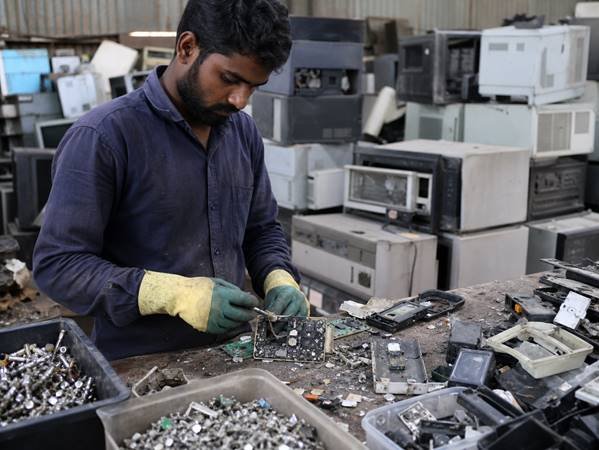
Second, improve resource utilization efficiency. E-waste contains precious metals such as gold, silver, copper, aluminum and recyclable plastics. Dismantling, recycling and reusing them is more environmentally friendly and saves more resources than continuously mining new ores.
Third, rationalize the cost-bearing logic. In the past, the recycling cost of e-waste was borne by public finance, which is equivalent to all taxpayers paying the bill, while enterprises that actually profit from product sales do not have to pay, which is obviously unreasonable. EPR transfers the recycling cost to the entities engaged in production and sales, and whoever benefits shall be responsible.
3. Quick Distinction of Easily Confused Regulations
Many practitioners easily confuse WEEE with other European environmental regulations. You can quickly distinguish them through the following table:
| Comparison Pair | Positioning of WEEE EPR | Positioning of the Other Regulation | Core Difference |
| WEEE vs RoHS | Governs recycling and treatment after product scrapping (back-end) | Governs restriction of hazardous substances in the production stage (front-end) | One governs how products are handled “after scrapping”, the other governs which hazardous materials cannot be added “during production” |
| WEEE vs Packaging EPR | Governs recycling of the electrical and electronic equipment itself | Governs packaging recycling of all products | The control objects are completely different, the two are independent of each other. Selling electrical and electronic equipment requires completing compliance for both at the same time |
| WEEE vs Battery EPR | Governs overall recycling of electrical and electronic equipment | Governs recycling of separately sold or built-in batteries | The scope of control is different. An electronic product with a battery will trigger both WEEE and Battery EPR obligations at the same time |
4. First Clarify the 4 Most Common Cognitive Misconceptions
Before going deep into the rules, first clarify a few cognitive pitfalls that are easiest to fall into, to avoid going astray from the start:
First, not only factories are responsible. Many people think “producers” are factories, but in fact, any entity that first puts products on the EU market, whether it is a brand owner, importer or cross-border seller, may be the obligation bearer.
Second, there is no EU-wide registration number. The EU only issues framework rules, and specific registration is managed separately by each country. You need to register for WEEE in as many countries as your sales cover.
Third, sticking a trash bin label does not mean compliance. Labeling is only one of the requirements for compliance. Registration, declaration, and fee payment are the core obligations. Only labeling without registration and fee payment is still a violation.
Fourth, platform deduction of fees does not equal full compliance. Many e-commerce platforms require sellers to upload WEEE qualifications, and even deduct part of the recycling fees on their behalf, but the platform only conducts basic qualification reviews, and the ultimate compliance responsibility still lies with the seller itself — if categories are underreported or declaration data is falsified, the seller will still be punished.
5. Relationship Between the EU Framework and Implementation by Member States
You may wonder, why are the rules different for each country for EU regulations?
In fact, at the EU level, the WEEE Directive 2012/19/EU is the core framework (including relevant amendments in 2022), which sets unified minimum requirements across Europe, such as basic principles requiring member states to establish recycling systems and producers to bear responsibilities. Each member state needs to transpose the directive into its national law, and can also issue stricter rules according to its own situation, such as stricter labeling requirements, higher rates, and stricter law enforcement standards. Enterprises should ultimately follow the current rules published by the competent authority of the target country.
After Brexit, the UK has left the EU framework, implements an independent WEEE system, and its registration numbers are not interoperable with those of the EU.
II. Quickly Confirm Whether Your Products/Entities Need Compliance
After understanding the basic concepts, the core issue that practitioners generally pay attention to is: does my business need WEEE compliance? The following clarifies the judgment criteria from three dimensions: region, product, and entity, with a 3-step self-check method attached that can be directly applied.
1. Geographical Scope: Which Markets Need to Comply
The core coverage area of WEEE EPR is the 27 EU member states, plus Norway, Iceland, and Liechtenstein in the European Economic Area. The UK implements an independent WEEE system, and its rules and registration numbers are not interoperable with the EU, so do not confuse them.
There is a key judgment criterion here: it is calculated based on the actual country of placement/sale, not the country of shipment. For example, if goods are placed in a German FBA warehouse but sold to French consumers, you need not only German WEEE but also French WEEE, because the products are actually placed on the French market.
2. Product Scope: Which Electrical and Electronic Equipment Are Regulated
Many people will use the old “10 categories of WEEE products” for comparison. In fact, most EU member states now adopt an “open scope” — as long as products meet the core definition, they are within the scope of control. The 10 categories are only a reference for classified declaration, not only the listed ones are regulated.
The core judgment standard is very simple: any independent equipment that relies on electric current or electromagnetic fields to work, or generates, transmits, measures electric current/electromagnetic fields counts.
Common covered categories include: large and small household appliances, mobile phones, computers and accessories, lighting equipment, power tools, electric toys, consumer electronics, smart monitoring equipment, etc., even separately sold chargers, data cables, and Bluetooth earphones are also included.
There are also some explicitly excluded products that do not require compliance:
• Electronic equipment dedicated to military and aerospace use
• Implantable medical electronic devices (such as pacemakers)
• Large fixed industrial production equipment
• Prototype equipment only used for research and development
• Items for personal use and non-commercial entry (such as mobile phones and computers brought by tourists)
There are also several common boundary situations, which can be directly compared for judgment:
• Separately sold electronic accessories such as chargers, data cables, and adapters: fall within the scope of WEEE compliance, because they are products placed on the market independently
• Components that are only used as parts and not sold separately to consumers (such as mobile phone motherboards, only sold to mobile phone manufacturers for assembly): do not fall within the scope of WEEE control, because the final product placed on the market is the finished mobile phone
• Non-traditional electrical appliances with electronic functions (such as smart luminous clothing, Bluetooth thermos cups): depends on the main function of the product. Classification may vary in different countries, and needs to be checked country by country
• Judgment of battery-related products: separately sold batteries (including separately replaceable spare batteries) mainly trigger battery EPR obligations, which need to be judged separately according to special battery regulations, and are not included in the category of WEEE accessories; if the battery is built into the finished electrical and electronic equipment, the finished product usually still needs to meet WEEE requirements, and the battery part may also trigger battery EPR obligations, which need to be fulfilled separately
3. Entity Scope: Who Are the Obligation Bearers
The “producer” in WEEE does not refer to factories, but refers to entities that first place WEEE products on the market within the territory of a member state. As long as they meet this definition, regardless of their identity, they are obligation bearers.
Common obligated entities include: manufacturers within the EU, own-brand owners, EU importers, brand owners selling under OEM, and cross-border sellers conducting remote sales to the EU.
Many cross-border sellers will have questions: I am a Chinese company, do I need to register? This depends on the sales model:
• If using EU overseas warehouses or FBA for delivery: it almost certainly triggers the registration obligation, because the goods are transported to the EU territory in advance, and the seller is the entity that first places the products on the market
• If it is China direct mail or self-shipment mode: whether it triggers registration and authorized representative obligations depends on the specific rules of the target country on remote sales — if you conduct commercial sales directly to end consumers in that country, you may still be recognized as a remote sales producer in that country, and you cannot default that no compliance is required just because you do not use a local EU warehouse. Generally, the higher the sales volume and the heavier the weight of a single shipment, the higher the risk of being traced by regulators. It is recommended to check the clear requirements of the competent authority of the target country in advance
• If you do B2B sales: compliance is also required, but the recycling collection channels and declaration caliber are different from B2C, not that no compliance is required
It is also necessary to distinguish the responsibility boundaries of several related roles to avoid confusing the attribution of responsibility:
• Importer: if overseas products are first introduced to the market of a member state by the importer, the importer is usually a WEEE obligated entity; only when the overseas seller has designated a qualified EU authorized representative and there is a clear responsible entity for first placement, the importer may not bear the main compliance responsibility
• E-commerce platform: only responsible for reviewing the seller’s WEEE qualifications, and does not bear the ultimate compliance responsibility
• Logistics provider: only responsible for cooperating with recycling and transportation related links, and does not bear the main compliance responsibility
4. 3-Step Quick Self-Check Method
You can quickly judge whether compliance is required through the following 3 steps, which can be directly applied:
Step 1: Confirm product attributes: first check whether the product meets the definition of electrical and electronic equipment, and is not in the exclusion list such as military use, implantable medical, etc.
Step 2: Confirm the nature of placement: as long as it is placed on the target EU market in a commercial form (including sales, gifts, free samples), it counts, regardless of B2C or B2B models.
Step 3: Confirm entity identity: judge whether you are the entity that “first places products within the territory of the member state” — for example, a Chinese seller using Spanish FBA for stockpiling and sales is an obligated entity and needs to register for Spanish WEEE.
III. 5 Core Compliance Obligations That Must Be Fulfilled
If it is judged that WEEE compliance is required, there are 5 core things to complete: registration, designation of an authorized representative, labeling, declaration and fee payment, and selecting the right PRO organization. The following explains them one by one.
1. Registration: Obtain Compliance Qualifications in the Country of Sale
Registration is the first step of compliance and also the most core prerequisite. You need to register separately in each country where you sell.
There are two channels for registration: one is to directly register with the regulatory authorities of each country, and the other is to register with an officially recognized Producer Responsibility Organization (PRO for short, which can be understood as an officially authorized organization that specifically helps enterprises handle recycling declaration and other affairs). For the vast majority of small and medium-sized enterprises and cross-border sellers, it is more convenient to find a PRO, because you don’t have to build a recycling network yourself.
Registration generally requires preparing materials such as company information, brand certificates, product classification lists, etc. After registration is approved, you will get the WEEE registration number of the corresponding country. Some countries require the registration number to be printed on the product or displayed in the backstage of the e-commerce platform.
2. Designate an EU Authorized Representative (Mandatory for Non-EU Enterprises)
If the company is not located within the EU (such as Chinese cross-border sellers and brand owners), most EU countries will mandatory require the designation of an EU authorized representative.
Note that this authorized representative is not a simple contact person, but shall bear joint and several liability for local compliance — if there is a compliance problem with the product, the regulatory authority will directly contact the authorized representative. Therefore, you cannot casually find a logistics provider, tax agent or ordinary importer to replace it. You must sign a formal authorization agreement, and the other party must also have the ability to bear relevant responsibilities.
3. Labeling: Correctly Print the Recycling Mark
It is the “crossed-out wheeled trash bin” pattern that everyone often sees. The function of this label is to tell consumers: this product is e-waste and cannot be thrown into domestic waste casually.

There are basic requirements for the placement of the label: it is preferred to print it on the product body. If the product size is too small (such as Bluetooth earphones), it can be printed on the packaging or manual. The minimum height of the label shall not be less than 7mm. Very small products can be exempted from the size requirement, but must be clearly marked in the manual.
In addition, different countries may have additional requirements: for example, France requires simultaneous affixing of the Triman label and recycling instructions, and some countries require the WEEE registration number to be printed. These shall be implemented in accordance with the rules of the corresponding country.
4. Declaration and Fee Payment: Bear Recycling Costs Based on Sales Volume
After registration and getting the number, it is not once and for all. You also need to regularly declare sales volume and pay recycling fees, which is the core cost of WEEE EPR.
First, let’s talk about declaration requirements:
• Declaration cycle: most countries declare annually or quarterly, subject to the requirements of the local PRO or regulatory authority
• Declaration caliber: declare based on product weight (kilograms) and category, not based on sales revenue, which many people get wrong
• Declaration scope: all products first placed on the market must be counted, including B2C, B2B, free samples, gifts, as long as they are commercially placed, none can be missed
• Data retention: declaration vouchers, sales data, etc., shall be retained for 2-10 years, requirements vary by country, and regulatory authorities may conduct random inspections
Then let’s talk about fee payment requirements:
• Fee composition: generally includes registration fee, annual fee, recycling treatment fee, management fee. Some countries also charge “historical waste sharing fee” — that is, for products already placed on the market before the implementation of the regulation, all producers share the recycling cost together, so a one-time fee may be incurred during the first registration
• Billing logic: basically “product weight × rate of the corresponding category”. Rates vary greatly across countries and categories. For example, large household appliances have high treatment costs, so the rate is high, and small electronic accessories have low rates
5. Select a Compliant PRO Organization
The vast majority of small and medium-sized enterprises and cross-border sellers will choose to join PRO’s collective recycling plan, without having to build a recycling network themselves (self-building is extremely costly and requires government approval, only a very small number of large enterprises will choose this).
There is only one core criterion for choosing a PRO: it must have the official recognition qualification of the corresponding country. If the PRO you find does not have official authorization, the registration number is also invalid and will not be recognized by the regulatory authority.
If you sell in multiple EU countries, you can find a PRO that supports multi-country services to uniformly manage registration and declaration in all countries, which can save time and may also reduce overall costs.
IV. Why One Set of Documents Cannot Work for the Whole of Europe: Differences in National Rules
Many people take it for granted when they first start that the EU is a unified market and one set of documents can handle all countries. In fact, the WEEE rules of each country are quite different, which is also content that must be mastered at the semi-proficient stage.
1. 6 Dimensions of Core Differences Among Countries
The rule differences among countries are mainly reflected in these 6 aspects:
• Registration process and review cycle: registration takes only a few weeks in some countries, and several months in others
• Product classification methods and rate standards: the same product may belong to different categories in different countries, and rates also vary greatly
• Labeling details and information disclosure requirements: some countries only require the trash bin label, some require adding registration number, Triman label
• Declaration cycle and material requirements: some declare annually, some quarterly, and the required materials are also different
• Mandatory degree of authorized representative: some countries have strict requirements, some have relatively loose requirements for overseas sellers
• Strictness of law enforcement and retrospective period: some countries have very strict inspections, with a retrospective period of up to 10 years, some countries have relatively mild law enforcement
2. Examples of Special Requirements in Mainstream Sales Countries
Let’s take a few markets where Chinese sellers most commonly operate as examples, and you can intuitively feel the differences:
• Germany: Germany’s WEEE regulatory authority is the EAR (Elektro-Altgeräte Register). Registration requires registration by “brand + equipment category”, and the registration number has a fixed format. Germany is one of the countries with the strictest law enforcement in the EU. Without a WEEE registration number, it is easy to be delisted by e-commerce platforms, and even fined due to complaints from competitors.
• France: France’s WEEE registration must be handled through an officially recognized éco-organisme. Labeling requirements are particularly strict, and the Triman label and detailed recycling instructions must be affixed at the same time. France’s WEEE, packaging, battery and other EPR categories implement independent management and independent declaration. WEEE registration cannot replace the compliance obligations of packaging or batteries; whether the same service provider can handle multiple categories at the same time depends on whether it has the official recognition qualification for the corresponding category, and it is not necessary to find different institutions separately.
• UK: After Brexit, it implements an independent WEEE system, and registration, declaration, and rates are all implemented in accordance with UK local rules.
3. Reliable Methods for Quickly Querying a Country’s Rules
If you operate in a relatively niche EU country and do not know the specific rules, do not readily believe second-hand information on the Internet. Using these two channels to query is the most reliable:
First, visit the official website of the Ministry of Environment or the WEEE regulatory authority of the corresponding country, which will have the most authoritative rule explanations.
Second, consult a local PRO organization with official recognition qualifications, who are most familiar with the rules of their own country.
Here is a reminder: do not readily believe the overpromises of some service providers of “one-stop agency for all-European WEEE”. Be sure to verify the other party’s official qualifications in each target country to avoid invalid registration costs.
V. Implementation Steps to Complete WEEE Compliance from Scratch
After finishing the rules, we have sorted out a set of implementation processes that can be directly applied. Following the steps will complete basic compliance.
Step 1: Clarify the Scope of Compliance
First sort out three core pieces of information: first, list all EU countries where you actually sell or plan to sell, and cannot only count the shipping countries; second, sort out a list of all products on sale, confirm their attributes against the definition of electrical and electronic equipment and the exclusion list, and complete classification according to the rules of the target country; third, verify your own entity identity, and non-EU enterprises should confirm in advance whether the target country mandatory requires an EU authorized representative.
Step 2: Choose the Way to Fulfill Obligations
The vast majority of small and medium-sized enterprises and cross-border sellers give priority to cooperating with PROs with official qualifications in the corresponding country and joining the collective recycling plan, without having to build a recycling network themselves (self-built recycling systems are extremely costly and require government approval, only suitable for evaluation by a very small number of large enterprises). If you sell in multiple countries at the same time, you can choose a compliance institution that supports multi-country services for unified management to reduce communication costs.
Step 3: Complete Registration and Platform Filing
Prepare materials required for registration such as company qualifications, brand certificates, product classification lists, authorized representative agreements (if needed), etc., and submit them to the PRO or the regulatory authority of the corresponding country; after obtaining the WEEE registration number, upload it to the e-commerce platform backstage in time to complete the qualification review, to avoid being restricted from sales due to lack of qualifications.
Step 4: Daily Implementation
In daily operations, three things must be implemented: first, affix compliant WEEE labels on products or packaging according to the requirements of the target country, and countries with additional labeling requirements (such as France requiring the Triman label) must implement them simultaneously; second, regularly count sales volume and corresponding product weight data, submit declarations according to the specified cycle, and do not miss reporting commercially placed products such as samples and gifts; third, pay recycling fees on time, and all registration certificates, declaration records, and payment vouchers must be retained for the number of years required by the target country for inspection.
Step 5: Long-Term Continuous Maintenance
WEEE compliance is not a one-time job: regularly check the validity period of the registration number, and renew on time to avoid invalidation; when adding new product categories or newly expanding to new sales countries, supplement registration in advance, do not wait until you are caught to supplement; usually also pay attention to regulatory updates in the target country, and adjust the compliance plan in a timely manner.
VI. Common Misconceptions and Risk Avoidance
This part is the core content of semi-proficiency, helping readers avoid the most common pitfalls in practice and reduce unnecessary losses.
1. The 8 Most Common Misconceptions in Practice
The following sorts out the 8 most common wrong cognitions, which can be checked with focus:
• Misconception 1: B2B sales do not need WEEE → Wrong! All commercially placed products need to be compliant. It’s just that B2B’s recycling collection channels and declaration caliber are different from B2C, not that it is not needed.
• Misconception 2: OEM factories that label other people’s brands are responsible → Wrong! The responsible entity is the brand owner or importer who first places the product on the market. OEM factories only do contract manufacturing and do not have to bear WEEE obligations.
• Misconception 3: It doesn’t matter if the product classification is wrong → Wrong! The rates of different categories are different. If the classification is wrong, you either pay less and are deemed a violation, or pay more and increase costs. In serious cases, you may also be fined.
• Misconception 4: Any recycling agency can register → Wrong! You must choose a PRO with official recognition qualifications, otherwise the registration is invalid, which is equivalent to wasting money.
• Misconception 5: Using another company’s registration number is compliant → Wrong! The entity of WEEE registration must be consistent with the actual sales entity and brand. For example, using a supplier’s registration number, your own store is still not compliant, and the platform will still delist you if found.
• Misconception 6: Registering one category allows selling all electronic products → Wrong! The registered categories must cover all products sold. For example, if you only registered small household appliances, selling mobile phone accessories is a violation.
• Misconception 7: Registration is valid for life after one registration → Wrong! WEEE registration has a validity period and needs to be renewed on time. After expiration, the registration number will automatically become invalid, which is equivalent to no registration.
• Misconception 8: Samples/gifts do not need to be declared → Wrong! As long as they are commercially placed products, even free samples and gifts will eventually become e-waste, and all need to be declared and paid for.
2. Common Violations and Consequences
Some practitioners believe that the consequence of violation is only a fine, but in fact the actual impact is more serious than expected:
Typical violations include: selling without registration, unqualified labeling, failure to declare and pay fees on time, falsification of declaration data, and cooperating PRO without official qualifications.
The corresponding consequences mainly include the following:
• Customs seizure of products, inability to clear customs, even being required to return or destroy
• High fines, standards vary by country, ranging from thousands of euros to hundreds of thousands of euros, and will be higher for serious cases
• E-commerce platform product delisting, store closure, fund withholding, until compliance qualifications are completed
• May form member state regulatory penalty records, public notifications or platform risk control records, affecting subsequent registration applications, market access reviews and e-commerce platform operation permissions in EU countries; some countries or platforms have special public announcement mechanisms for violating entities, and violation records may be retained for a long time
• Regulatory authorities can trace historical sales records, with a retrospective period ranging from 2 to 10 years, which means that illegal sales a few years ago will still be fined if found now
3. Compliance Effectiveness Self-Check List
Entities that have completed WEEE registration can check the effectiveness of compliance against the following list:
• Have completed WEEE registration in all EU countries where you actually sell, not just the shipping country
• The registered entity is completely consistent with the actual sales entity and brand, and all product categories sold are within the registration scope
• Non-EU enterprises have designated a qualified EU authorized representative and signed a formal authorization agreement
• The labels on the product or packaging meet the requirements of the corresponding country, not just a trash bin label
• Have completed sales volume declaration and fee payment on time, no underreporting
• All compliance vouchers (registration certificates, declaration records, payment vouchers) have been retained as required
• The cooperating PRO has the official recognition qualification of the corresponding country
4. 4 Judgment Points for Choosing a PRO/Service Provider
Choosing a compliant PRO or service provider can effectively reduce compliance communication and management costs, and also avoid invalid registration. Focus on these 4 points when judging:
First, whether it has official recognition qualifications in the target sales country. This is a hard indicator, and if not, directly exclude it.
Second, whether it covers the actually sold product categories and brands. Some PROs may only do certain types of products, so confirm clearly.
Third, whether the fee structure is transparent, and whether the rules for historical waste sharing fees are clearly stated, to avoid arbitrary fee increases later.
Fourth, whether it can provide complete registration certificates, declaration support and voucher retention services. Don’t pay money and get no paper or electronic vouchers, which cannot be provided during platform review or regulatory random inspection.
VII. Core Abilities You Can Master After Learning
At this point, the core content of WEEE EPR is finished. Let’s summarize the abilities you can obtain:
Beginner-level abilities can be used immediately after reading: you can quickly judge whether your own products need to comply with WEEE EPR regulations, can identify whether you are an obligated entity in the target sales country, can state the 5 core obligations of WEEE compliance, and also know the implementation steps from scratch, and can complete basic compliance by following them.
Semi-proficient abilities focus on judgment and pit avoidance: you can distinguish the differences between the EU framework and national rules, know where to check official rule information, can identify common compliance misconceptions against the self-check list, avoid core risks, and can also judge the qualifications of PROs or service providers according to standards, avoiding invalid registration costs.