
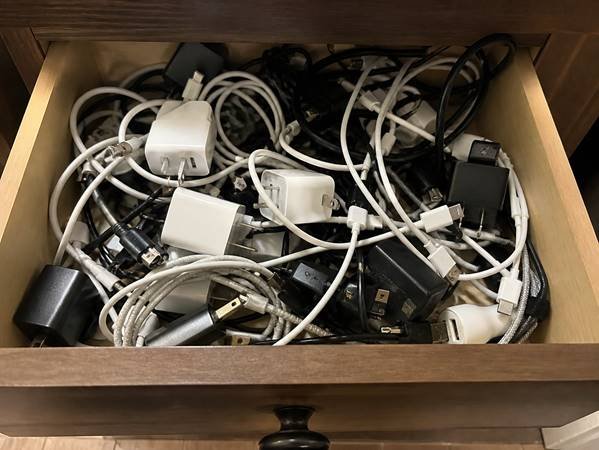
If you have lived in Europe, chances are you have a pile of chargers from different brands sitting in a drawer at home: you need a new charger when you switch phones, a new one when you switch tablets, even the charger for earbuds is different. It’s a pity to throw away the unused ones, but they take up space if you keep them. The common charger rule implemented by the EU is designed to solve this hassle, and the core of this rule is the USB PD fast charging standard.
Many people’s understanding of this rule only goes as far as “everyone will use USB-C ports in the future”, but in fact, the USB-C port is just the surface. What truly determines whether fast charging can be universal and whether products meet EU requirements is the USB PD protocol. This article starts from the most basic concepts, so that you can initially judge whether a product is compliant, choose the right charger and cable on your own, and put what you learn into use right after reading.
1. Get the Basics Straight: What USB PD Is, and Why the EU Is Unifying Charging Rules
Plain Language Explanation: USB PD is the “Universal Communication Rule” for Charging
The USB PD we often talk about is, put simply, a set of universal communication rules used to negotiate charging power between chargers and devices of different brands. Its official name is USB Power Delivery (USB power transfer standard).
In the past, ordinary USB charging usually operated at basic power supply capabilities such as a fixed 5V, and devices would draw power according to their own needs, but they could not negotiate higher voltages and power like PD. Fast charging rules of different brands were also incompatible with each other — if you use Brand A’s fast charger for Brand B’s phone, it may only run at basic slow charging, meaning the fast charger was a waste of money; if you use low-quality or mismatched accessories, it may also cause overheating, speed limits, or even safety risks.
USB PD solves this problem: after the cable is plugged in, the charger and the device will first “communicate”. The charger lists all the safe power options it can provide, and the device selects the most suitable one according to its maximum supported power capacity, which neither wastes power nor damages the device. Its core value is cross-brand universality — no matter which brand your device is from, as long as it supports PD, you can use the same fast charger for fast charging, without having to repeatedly buy dedicated accessories.
3 Core Reasons Why the EU Has Written USB PD into Regulations
The main reason why the EU has elevated USB PD to the regulatory level comes down to three points:
First, reducing e-waste. When promoting the common charger rule, the EU takes reducing idle and discarded dedicated charging accessories generated by device replacement as one of its core policy goals — dedicated chargers from different brands are not universal, and old accessories are often left unused or thrown away after users replace their devices. After unifying the PD standard, users no longer need to frequently change chargers, which can greatly reduce the generation of this type of e-waste.
Second, improving universality. In the past, charging accessories for devices of different brands and categories were not universal, so people had to bring multiple chargers when going out. After unifying PD, one charger can charge phones, tablets, earbuds, and even laptops, which is much more convenient.
Third, ensuring safety. Proprietary fast charging standards are set by each brand on their own, and their safety protection levels vary. USB PD provides a unified power supply capability negotiation mechanism, and compliant products also need to be equipped with hardware protections such as overvoltage, overcurrent, and temperature protection, as well as meet relevant safety standards. Therefore, the overall safety baseline is more consistent than that of closed proprietary fast charging systems, and risks are more controllable.
3 Most Easily Confused Concepts (90% of Beginners Get Them Wrong)
Many people can’t tell the difference between USB-C, USB PD, and charging wattage, and are often misled by merchant promotions. Here’s a table to clarify:
| Name | What it essentially is | Common Misconception |
| USB-C | An oval-shaped physical interface that can be plugged in either way up | Having a USB-C port equals having fast charging |
| USB PD | A universal rule for negotiating charging power between devices and chargers | It is an accessory function of the USB-C port |
| Charging Wattage | The upper limit of charging capability, not the actual constant output power | The higher the wattage, the faster the charging |
Put simply: the USB-C port is the “shape of the socket”, PD is the “power supply rule between the socket and the appliance”, and wattage is the “maximum power the socket can provide” — a matching shape does not mean the rules are compatible, nor does it mean the maximum power can be fully utilized.
Regulatory Background: No Need to Memorize Numbers, Just Look for Initial Screening Signals
The core of this set of rules is the EU Common Charger Directive, which is revised on the basis of the original Radio Equipment Directive (RED). Ordinary users do not need to memorize regulation numbers or complex clauses. To quickly initially screen whether a product meets EU fast charging requirements, you can first look at two intuitive signals: USB-C port + USB PD logo.
2. Regulatory Scope: Which Products Need to Comply, and When
Many people think that “by the end of 2024, all electronic devices must use USB-C PD”, but that’s not the case. The rules have clear applicable scopes and timelines, so there’s no need to worry excessively.
Product Categories That Must Comply and Effective Dates
First, it needs to be clarified that the core mandatory obligations of the Common Charger Directive mainly target specific categories of radio equipment placed on the EU market, not all charging-related products. The rules are implemented in two phases, covering daily-use portable consumer electronic devices:
The first phase starts on December 28, 2024, targeting small portable devices: mobile phones, tablets, digital cameras, earbuds (including charging cases), portable speakers, e-readers, handheld game consoles, keyboards, mice, and portable navigators. As long as these devices exceed the fast charging threshold, they must support USB PD.
The second phase starts on April 28, 2026, targeting high-power portable devices: laptop computers.
Constraints on applicable accessories are divided into two scenarios: one is chargers and charging cables sold together with the above regulated devices as bundled items, which must meet the compliance requirements of the devices to ensure standard PD charging can be achieved; the other is USB-C chargers sold separately for general charging scenarios, whose compliance needs to be comprehensively judged in combination with corresponding product regulations and standards such as external power supplies, low voltage, EMC, and ecodesign, and is not directly regulated only by the Common Charger Directive.
Correct Criteria for Judging Effective Dates
Regarding the effective dates, there are three key points that must be clarified, as many people misunderstand them:
First, the rules only regulate regulated radio equipment officially placed on the European Union (EU) market; European Economic Area (EEA) countries usually transpose and implement relevant rules through legislation, but you cannot directly equate all “European” regions with the EU scope. The core of judgment is whether the product enters the EU market for circulation, not just the sales version names such as “US version” or “domestic Chinese version”.
Second, the judgment criterion is the “time of placing on the market”, not the production time. For example, a mobile phone produced in December 2024 must meet the requirements if it first enters the EU market for sale in January 2025; but if it is an old model that was legally launched in the EU in November 2024, it is fine even if it is sold until 2025.
Third, the rules are not retroactive. Old products and stock that were legally launched before the effective date can continue to be sold, and there will be no mandatory recall or removal from shelves.
Common Devices Not Within the Core Regulatory Scope
Not all electronic devices with charging functions need to meet the common charging requirements. The following devices either do not belong to the category of radio equipment regulated by the rules, or are subject to special regulations, and do not need to comply with the common charging requirements in this topic:
1. Special-purpose professional equipment: medical equipment, explosion-proof equipment, military-use equipment. These types of equipment have special safety and performance regulations, and the common charging rules for general consumer electronics do not apply to them;
2. Large electric equipment: electric bicycles, electric tools, etc., which do not fall into the category of “portable consumer electronic devices” defined by these rules;
3. Devices that only support wireless charging: the rules only regulate wired charging interfaces. If a device has no wired charging function, the interface and PD protocol requirements do not apply;
4. Special categories such as implantable medical devices and antique collectible electronic devices are not judged according to the common charging requirements for ordinary consumer electronics.
3. Must-Know for Beginners: Core Mandatory Requirements for EU USB PD Fast Charging
Scope note: The following requirements apply to portable radio equipment regulated by the Common Charger Rule, as well as supporting bundled chargers, charging cables, and USB-C PD chargers sold separately for general scenarios; related products must also meet corresponding regulatory requirements such as low voltage, EMC, and ecodesign at the same time.
3 Thresholds That Trigger Mandatory PD Requirements (For the Device Side)
Many people think that as long as a device has a USB-C port, it must support PD, but that’s not the case. The EU has set three thresholds for mandatory PD requirements. The object of judgment is the device’s own rated wired charging capability, not the power of the charger matched by the user. As long as one of them is met, the device must support standard USB PD:
• Rated charging voltage > 5V (for example, the device supports fast charging voltages such as 9V, 12V, 15V, 20V, etc.)
• Rated charging current > 3A
• Rated charging power > 15W (for example, 9V/2A = 18W, which exceeds the threshold)
If the device only supports low-power charging of 5V/3A and below, such as some entry-level Bluetooth earbuds, even if it uses a USB-C port, it is not mandatory to support PD — because it originally has no fast charging demand.
3 Mandatory Requirements for the Device Side
For the regulated device itself, three conditions must be met to be compliant:
First, the wired charging interface must be USB-C (i.e., the USB-C socket on the device side), and exclusive interfaces such as Lightning and Micro USB cannot be used.
Second, devices that exceed the fast charging threshold must support the standard USB PD protocol; brands can retain their own proprietary fast charging at the same time (such as a brand’s 100W super fast charging), but it must not interfere with the normal use of the PD function — that is, the device can complete wired charging within its capability range through the standard PD protocol, instead of only being able to use a brand-exclusive charger.
Third, it must be clearly marked on the packaging or in the manual: minimum charging power, maximum wired charging power, and whether a charger is included, so that users can know whether they need to buy additional accessories before purchasing.
Mandatory Requirements for the Charger Side
The following requirements are compiled from the perspective of general judgment for ordinary users’ purchase and device matching, focusing on whether the product can be used as a compliant universal USB-C PD charger; specific legal obligations still need to be judged in combination with the product regulations applicable to the charger itself.
Whether it is a charger bundled with a device or a USB-C PD charger sold separately for general scenarios, it must meet the following basic requirements from the perspective of universal fast charging:
First, the output interface must be USB-C. Fast charging solutions that use a USB-A port with an adapter to pretend to be a USB-C port do not meet the compliance requirements for universal charging.
Second, it must support the standard USB PD protocol and support at least 15W PD output; for chargers bundled with devices, the power must also meet the minimum charging demand of the matched device.
Third, if it is a multi-port charger, it must be clearly marked: the maximum power when using a single port, and the power distribution rule when using multiple ports at the same time, such as “65W dual port, maximum 65W per single port, 45W + 18W when charging two ports simultaneously”, and vague promotion is not allowed.
Requirements for Charging Cables and Purchase Reference
There are two clear requirements for charging cables bundled with regulated devices:
First, if the device comes with a wired charging cable, it must be of USB-C to USB-C specification. USB-A to USB-C cables or C-port connections via adapters are not allowed;
Second, the rated power of the bundled cable must at least match the maximum wired charging capability of the device. You cannot send a cable with insufficient rated power, which would prevent the device from reaching its proper charging speed.
For ordinary users, when buying cables themselves, they can remember a simple reference standard: under 20V voltage for USB PD, the theoretical maximum carrying power of a 3A cable is 60W; if the device’s charging power exceeds 60W, you usually need to choose a 5A C to C cable with an E-Marker chip (built-in power identification chip), otherwise the speed will be limited. For PD charging below 60W, a regular 3A C to C cable is sufficient.
4. Plain Language Principle: How USB PD Fast Charging Actually Works
Many people worry about “whether using a high-power charger to charge a phone will damage it”. In fact, as long as you understand the working logic of PD, you won’t have this concern.
Core Logic: Negotiate First, Then Charge; Power is Determined by Three Parties Together
The core logic of USB PD is “negotiate first, then supply power”. With a normal and compliant combination of device, charger, and cable, there will be no situation where high power is forced, but the final power is not determined by a single party:
1. After the cable is plugged in, the charger will first send a “power menu” (professionally called PDO, Power Data Object) to the device, listing all PD power capabilities it supports, including fixed voltage levels, optional PPS programmable levels, etc.;
2. After receiving the menu, the device will combine its own maximum charging capability and the rated carrying capacity of the cable, select the most suitable one from the levels supported by both parties, and send a charging request to the charger;
3. After receiving the request, the charger will output according to the agreed level, and at the same time trigger its own overvoltage and overcurrent protection mechanisms, and will automatically cut off the output if an abnormality occurs.
Put simply, the actual charging power is the intersection of the combined capabilities of the device, charger, and cable, and will not exceed the upper limit of any party. Under normal use, there will never be a situation where “a high-power charger damages a low-power device”.
3 Common Scenarios to Help You Understand Quickly
We can understand this logic clearly through three scenarios that are most commonly encountered in daily life:
• A phone that supports 25W PD fast charging paired with a 65W PD charger: the levels provided by the charger include the fast charging level supported by the phone, the phone will select the level that matches its own needs, and the final charging power will not exceed 25W. It will not damage the phone, nor will it charge faster than the original 25W charger;
• An earbud charging case that supports 18W PD charging paired with a 45W PD charger: the earbuds will select a safe level not exceeding 18W from the available levels of the charger for charging, and the charging experience is basically the same as using the original 18W charger;
• Charging a 65W PD laptop with a 25W PD phone charger: the charger can only provide a maximum capacity of 25W, and the laptop will charge at the low level available to it, which may manifest as slow charging or only maintaining the battery level during use, and will not damage the device.
Common Question: Does PD Fast Charging Damage the Battery?
This is the most asked question: a formal and compliant PD fast charging system does not necessarily cause more battery wear than ordinary 5V charging.
Battery wear is the result of a combination of multiple factors, including charging temperature, battery chemical system, cycle count, long-term full charge storage state, device power management strategy, etc. Compliant PD devices and chargers usually work with temperature protection and power management mechanisms to automatically reduce charging speed at high battery levels (the threshold varies by device, commonly around 80%) and reduce heat generation, thereby controlling battery wear.
In other words, the PD protocol itself is just a set of charging negotiation rules, and will not directly cause faster battery aging. Unqualified charging accessories and bad usage habits are the main factors affecting battery life.
5. Intermediate Level: How to Quickly Initially Judge Whether a Product Meets EU PD Requirements
Note: The following methods are only for quick initial screening by ordinary users, and cannot replace official compliance document verification.
4 Intuitive Signals for Initial Screening
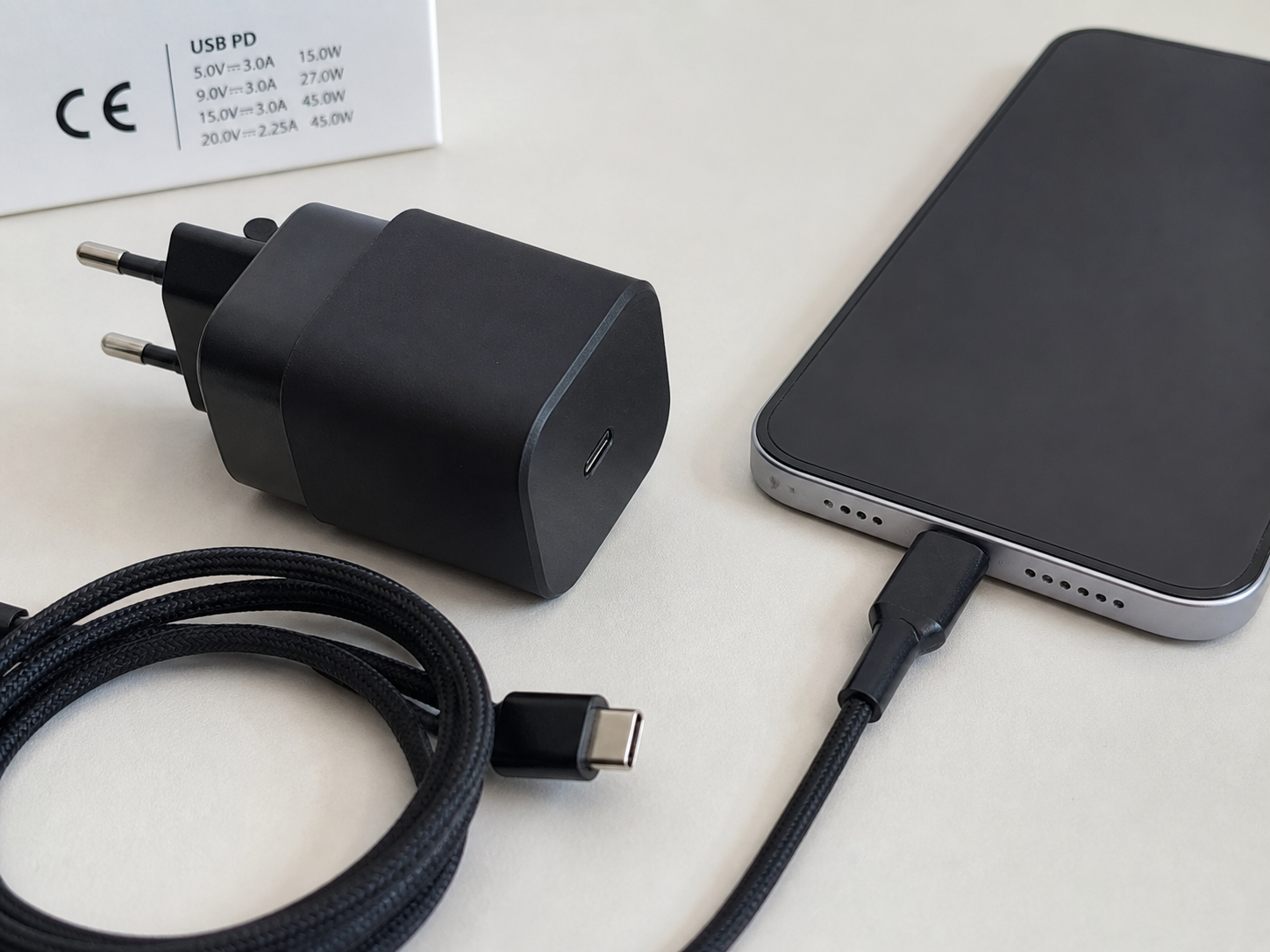
To judge whether a product is likely to meet the requirements, the core basis is on the product itself or its packaging. Look for these four pieces of information:
First, it has the basic compliance mark for EU market access: the CE mark (note: CE is a basic signal for market access, it cannot alone prove the compliance of the USB PD function, and needs to be judged together with subsequent marks and parameters);
Second, it is clearly marked with the words “USB PD” or “USB Power Delivery”, which is a direct indicator of support for the PD protocol;
Third, the parameter page has a complete USB PD capability statement, including fixed voltage levels or PPS expansion capabilities;
Fourth, it marks the minimum/maximum wired charging power and whether a charger is included, which is information that must be clearly indicated as required by regulations.
Key Points for Quick Initial Screening of Different Categories
For different types of products, the focus of judgment is different, and you can check targeted points:
• Portable devices: first check if the wired charging port is USB-C, then check if the nominal power exceeds 15W, whether it is marked as supporting USB PD;
• Chargers: first check if the output interface is USB-C (note that it is the output port connected to the device, not the input plug connected to the power supply), then check if there is a PD logo and a complete PD capability description;
• Charging cables: check if the packaging marks support for USB PD, and whether the maximum carrying current is 3A or 5A. Cables without clear power/current markings most likely do not support high-power PD fast charging.
Pitfall Avoidance: 3 Types of “Pseudo-Universal” Products
There are many products on the market under the banner of “meeting EU requirements”, but in fact they cannot achieve cross-brand universal fast charging. Be careful when you encounter these three types:
The first type is “has USB-C port but no PD”: it only has a USB-C interface, but only uses its own proprietary fast charging protocol. When used with PD chargers of other brands, it can only charge slowly, and cannot achieve universal fast charging;
The second type is “marked PD but no standard PD capability”: the packaging says it supports PD, but it actually only supports brand-exclusive non-standard power levels, and cannot normally negotiate fast charging with universal PD accessories. Here, pay attention to the judgment boundary: the common fixed voltage levels of standard PD are 5V, 9V, 12V, 15V, 20V; while PPS (Programmable Power Supply) is an official extended function of the PD protocol, which will be displayed as a voltage range (such as 3.3V-11V 3A), and you cannot judge it as non-standard just based on a single non-integer voltage value. The truly pseudo-compliant products are those that do not have a complete standard PD capability statement and only support brand-proprietary levels;
The third type is “USB-A port plus adapter”: the output port of the charger is USB-A, and it pretends to be a USB-C charger by giving away a USB-C adapter. This also does not meet the universal requirements of standard PD fast charging.
Difference Between Two Easily Confused Certifications/Marks
Many people confuse USB-IF certification with the CE mark, but in fact the two are completely different:
• USB-IF certification: it is an industry voluntary certification conducted by the USB Implementers Forum. Certified products usually have better compatibility and are less prone to matching problems, but it is not mandatory in the EU, and products without this certification may also be compliant; conversely, the absence of the USB-IF mark does not mean that the product does not support the PD protocol;
• CE mark: it is a mandatory compliance mark for EU market access, declared by the manufacturer itself that the product meets relevant EU regulations, and is not a third-party “certification”; all regulated electronic devices legally sold in the EU must have the CE mark. Whether a product is ultimately compliant needs to be judged in combination with legal documents such as the manufacturer’s Declaration of Conformity (DoC) and technical documentation.
4-Step Quick Initial Screening Checklist
If you want to quickly judge whether a product is likely to meet the EU common charging requirements, you can check against these 4 steps, and you will basically not go wrong:
• □ The wired charging interface of the device / the output interface of the charger is USB-C
• □ The product itself or its packaging has the “USB PD” or “USB Power Delivery” mark
• □ The parameter page has a complete USB PD capability description (including standard levels or PPS expansion)
• □ The product has the EU CE compliance mark (CE is a basic access signal, and PD compliance needs to be judged together with the above three items)
6. Intermediate Level: Power Judgment and Troubleshooting in Actual Use
Now that you understand compliance initial screening, let’s talk about how to choose suitable PD accessories in actual use, and how to troubleshoot when fast charging slows down.
Applicable Scenarios for PD Chargers of Different Powers
Many people always think that the higher the power, the better when choosing a charger. In fact, following the principle of “the intersection of the capabilities of the device, charger, and cable”, the actual charging power will not exceed the upper limit of any party. The core advantage of a high-power charger is that it is compatible with more devices of different powers, rather than speeding up a single device.
You can refer to the applicable scenarios for different power ranges:
• Around 15W PD: suitable for small low-power devices such as earbuds, smart watches, and small speakers. It is sufficient and cheap;
• 25W-45W PD: suitable for most mobile phones and tablets, can meet daily fast charging needs, and bringing one when going out can basically handle all portable devices;
• 65W and above PD: suitable for laptop computers and high-power tablets, and is backward compatible with small devices such as mobile phones and earbuds, suitable for multi-device users or travel.
Compatibility Rules for Old Devices/Old Accessories
After the rules take effect, can old devices and old chargers at home still be used? It depends on the situation:
• Old standard PD chargers/cables: as long as the power and interface match, they can still be used normally. The PD standard has backward compatibility, and they won’t become unusable just because they are old models;
• Old non-USB-C devices: for example, old phones with Lightning interface, you can use a C to Lightning adapter cable to connect to a PD charger for charging; if such devices were legally placed on the EU market before the effective date of the Common Charger Rule, they can continue to circulate according to transitional rules. If regulated devices newly placed on the market after the effective date still use non-USB-C ports, they do not meet the requirements;
• Old proprietary fast chargers: for example, a brand’s proprietary fast charger can only fast charge devices of the corresponding brand, and does not fall into the category of universal PD chargers, but it is fine for home use. It just cannot be sold as a universal compliant accessory matched with regulated devices.
4-Step Troubleshooting Sequence for Slow PD Fast Charging (Starting from the Most Common Causes)
Many people think the charger is broken when fast charging slows down. In fact, most of the time it’s a small problem. Troubleshoot in this order, starting from the most common causes, and it can basically be solved:
Step 1: Check the cable. This is the most common cause. For example, if the rated current of the cable used is insufficient (such as using a 2A cable to charge a 45W device), the cable is internally damaged, or the cable is too long or too thin causing voltage drop, all will lead to speed limits. Try replacing it with a reliable C to C cable with matching rated power, and it will most likely solve the problem.
Step 2: Check the charger. For example, if you are using a multi-port charger, when charging multiple devices at the same time, the power of a single port will decrease, which is normal; it is also possible that the charger and the device do not have a commonly supported PD fast charging level, and it may revert to 5V normal charging mode.
Step 3: Check the device status. If the device’s battery level is at a high level (commonly around 80%), most devices will activate battery protection and automatically reduce speed, which is a normal phenomenon, not a malfunction; in addition, some devices will also limit charging power when the temperature is too high, running under high load (such as playing games, watching HD videos) or when power saving mode is turned on, depending on the manufacturer’s power management strategy.
Step 4: Check protocol matching. If all the above are fine, you can confirm whether the device actually supports the standard USB PD protocol. Some old devices only support proprietary fast charging, and can only charge slowly at 5V with a PD charger.
Precautions for Sharing a PD Charger Among Multiple Devices
Now many people like to use multi-port PD chargers, just bring one when going out, but there are two points to pay attention to when using them:
• Single-port charger: it negotiates power with only one device at a time. No matter what device you charge, as long as it supports PD, it is safe and compatible, so there’s no need to worry.
• Multi-port charger: when charging multiple devices at the same time, the available power per port will decrease. The specific distribution depends on the rules marked on the product. For example, some 65W dual-port chargers output 45W + 18W when charging two devices at the same time, not each port can run at 65W.
If you travel frequently, prioritize choosing a multi-port PD charger, which can save you from bringing several chargers and is much more hassle-free.
7. Avoid Common Misconceptions: Don’t Confuse Interface, Power, and Compliance
Finally, we have compiled six of the most common misconceptions that many people have fallen for. Reading this will save you a lot of detours.
Misconception 1: Having a USB-C Port Means Meeting EU PD Requirements
Wrong. For regulated devices that exceed the fast charging threshold, products that only have a USB-C port but use proprietary fast charging and do not support the PD protocol do not meet the universal charging requirements.
Correct judgment: both conditions of “USB-C wired charging interface + support for standard USB PD protocol” must be met at the same time.
Misconception 2: The Higher the Charger Wattage, the Faster the Charging
Wrong. According to the negotiation logic of PD, the actual charging power will not exceed the upper limit of the device and cable, and a high-power charger will not break through the device’s own fast charging capability.
Correct logic: the advantage of a high-power charger is that it is compatible with more devices of different powers, rather than speeding up a single device.
Misconception 3: The EU Bans Brand Proprietary Fast Charging
Wrong. The EU only requires that devices exceeding the fast charging threshold must be compatible with standard USB PD, and does not ban brands’ own proprietary fast charging protocols.
Correct rule: proprietary protocols can coexist with PD. As long as the proprietary protocol does not interfere with the normal use of the PD function and ensures that universal PD accessories can also charge the device normally, it is compliant.
Misconception 4: A Device Not Including a Charger Is Non-Compliant
Wrong. The EU rule encourages reducing unnecessary chargers, and allows devices not to include a charger, as long as it clearly informs consumers on the packaging or sales page and indicates the charging power requirement.
The core requirement is to allow users to reuse existing PD chargers, without forcing them to buy new ones. Therefore, not including a charger does not equal non-compliance.
Misconception 5: All USB-C Cables Support PD Fast Charging
Wrong. Ordinary USB-C cables may only support 2A or 3A current, and will be speed-limited during high-power PD charging. Taking the 20V voltage level as an example, the theoretical maximum carrying power of a 3A cable is 60W. If the device’s charging power exceeds 60W, it needs to be paired with a 5A C to C cable with an E-Marker chip to achieve full speed.
Correct purchase: just choose a regular C to C cable with the corresponding rated current according to the device’s power, and that’s enough.
Misconception 6: The Higher the PD Version, the Better
Wrong. The EU rules only require support for the basic USB PD protocol, and extended functions such as PPS and PD3.1 are not mandatory.
Correct logic: as long as it supports standard PD levels, universal fast charging is possible, and there’s no need to pay extra for a higher version number — unless you have specific devices that need to use these extended functions.
Summary
The core of the EU’s common charger rule is not as simple as “mandating the use of USB-C ports”. Instead, by unifying the USB PD standard, devices and chargers of different brands can be truly universal, which not only reduces e-waste, but also saves users from wasting money.
After learning the content of this article, you can master 5 practical judgment abilities:
1. You can distinguish which categories of portable electronic devices need to meet the EU common charging requirements within what time frame, and understand the applicable scope and transitional arrangements of the rules;
2. You can accurately distinguish the three concepts of USB-C physical interface, USB PD fast charging protocol, and charging power, and will not be misled by the promotion of “having a USB-C port means fast charging”;
3. You can quickly initially screen whether a product is likely to meet the requirements through information such as the CE mark, PD logo, and parameter descriptions, and avoid the pitfalls of pseudo-universal accessories;
4. You can choose suitable PD chargers and cables according to the power requirements of your own devices, without spending extra money on high-power or high-version functions that you can’t use; when purchasing, prioritize regular products with clear parameters, which can meet the vast majority of usage needs;
5. When encountering slow PD fast charging, you can troubleshoot common causes in order from easy to difficult, and quickly locate the problem.