
If you operate in the Indonesian market for consumer electronics such as chargers and charging cables, you have most likely heard of SDPPI certification, but many people are confused when they first encounter it: what exactly does it regulate? Does my product need it? What procedures are required? Will I waste a lot of money? Today, we will start with the most basic judgment and explain the entire application process thoroughly. Whether you are a new entrant to the industry or a seller who wants to understand the details and avoid pitfalls, you will be able to follow along.
Basic Understanding and Eligibility Judgment
First, let’s clarify what SDPPI is. SDPPI generally refers to the regulatory function for communications and information resource equipment under the former Ministry of Communications and Information Technology of Indonesia. Currently, the relevant certification functions are under the responsibility of the Directorate General of Digital Infrastructure (Direktorat Jenderal Infrastruktur Digital, DJID) of the Ministry of Communications and Digital Affairs (Komdigi).
It mainly focuses on the technical compliance of communications and radio equipment, with core attention to the product’s wireless transmission, data transmission, spectrum use, and other applicable communications technical requirements. Simply put, it confirms whether your product will use radio frequency bands in violation of regulations, generate non-compliant interference, or communicate in non-compliant ways.
It is particularly important to note that SDPPI certification is not equivalent to electrical safety, energy efficiency, or charging performance compliance. Whether SNI or other safety and energy efficiency requirements are needed shall be judged separately based on product categories and current mandatory Indonesian regulations. It is also only one of the compliance requirements for products entering Indonesia; charging products with communications functions often require simultaneous verification of other regulations and certification requirements.
Quick Judgment on Whether Certification Is Required
To judge whether your product needs SDPPI certification, you cannot only look at whether it has active wireless transmission. Instead, you should make a comprehensive judgment based on whether the device is a regulated communications device in Indonesia, whether it has wireless or other regulated communications functions, product classification, and current technical requirements.
Products that only perform power conversion and are not regulated communications devices are generally not subject to this certification, but you cannot make an absolute judgment solely based on “no wireless transmission”. Some devices with wired communications, network, or control functions cannot be directly excluded from the regulatory scope just because they are not wireless products.
Take a specific example: smart chargers with Bluetooth, WiFi, cellular network, or NFC, and wireless charging docks that can connect to apps and have communications functions, usually require key assessment of their communications equipment certification requirements; while ordinary wired power adapters, charging cables that only charge and cannot transmit data, and purely physical conversion plugs are generally not subject to communications equipment certification.
What is more uncertain is pure wireless charging docks — those that only charge devices via magnetic induction, without Bluetooth, WiFi, or data transmission capabilities. Whether such products fall within the relevant regulatory scope shall be judged based on official classification, specific structure, and current technical requirements. It is best to conduct a pre-assessment with the official authority or an experienced agent in advance, rather than making a decision on your own to avoid pitfalls later.
Actual Consequences of Non-Certification
For devices that are legally within the scope of mandatory certification but have not obtained certification, they may be required to rectify, be removed from shelves, be returned, or bear administrative penalties during import, market supervision, or platform review. The specific consequences depend on the device category, the circumstances of the violation, and the actual handling by customs, regulatory authorities, and platforms at the time.
Therefore, “no certification” cannot be simply understood as every shipment will be directly detained by customs, nor can it be assumed that all e-commerce platforms will require an SDPPI number in the same way. Before actual shipment, you should still confirm whether the product is within the scope of mandatory certification and check the latest requirements of importers, platforms, and competent authorities.
Clarification of Easily Confused Concepts
Many people confuse SDPPI with other certifications. Here we specifically clarify several of the most common misconceptions:
First, SDPPI is not the same as SNI. SDPPI mainly regulates the technical compliance of communications and radio equipment; whether SNI is mandatory depends on whether the product is listed in the catalog of Indonesia’s current mandatory SNI regulations. Charging products may also involve other electrical safety, energy efficiency, or performance requirements. For example, a smart charger with Bluetooth needs to be judged not only whether it falls within the scope of communications equipment certification, but also separately verified whether SNI or other compliance documents are required. You cannot assume that one automatically applies or is automatically exempted just because you have obtained the other.
Second, SDPPI is not the same as CE or FCC. Whether overseas documents such as CE RED and FCC ID can be used for Indonesian certification shall be confirmed by DJID, accredited laboratories, or agents based on current rules. They are not guaranteed to directly replace Indonesian requirements, but they cannot be generally deemed completely invalid. Whether they are actually accepted depends on the report content, laboratory qualifications, test standards, and applicable certification methods.
Third, SDPPI is not the same as EMC. EMC (Electromagnetic Compatibility) may be part of communications equipment testing, but whether testing is required and which items are tested depend on the device category and current Indonesian technical requirements. Passing a certain EMC test does not mean that the entire SDPPI certification has been completed.
Fourth, the fact that the complete device requires certification does not mean all accessories need to be applied for separately. For example, a Bluetooth-enabled charger requires key assessment of communications equipment certification requirements, but the matching pure charging cable, if it is not a regulated communications device, generally does not require a separate application for the same type of certification. Don’t waste money unnecessarily.
Preparations Before Application
Once you confirm that certification is needed, sufficient preliminary preparation can save you a lot of detours.
First is the hard threshold for the applicant entity: SDPPI-related applications usually require a locally legally registered company in Indonesia, such as an importer, distributor, or authorized representative, to apply as the certificate holder. Overseas manufacturers or sellers cannot directly apply as local Indonesian certificate holders. Overseas manufacturers need to issue authorization documents to the local Indonesian certificate holder as required, and the certificate holder is responsible for receiving official notifications and bearing corresponding compliance responsibilities.
Choosing the Right Application Path
The relevant certification method is mainly determined based on the device category and current rules, and cannot be chosen solely based on the product name or whether it has wireless functions.
One is formal type certification, which is generally applicable to communications or radio frequency equipment that is included in the corresponding certification scope and requires submission of accredited test results. For example, smart charging products with functions such as Bluetooth, WiFi, and cellular communications often require a more complete technical assessment. Whether samples must be sent to local Indonesian laboratories shall be determined by DJID and accredited bodies based on the device category, applicable standards, and acceptable test documents.
The other is a low-risk method based on declaration of conformity, which only applies to specific low-risk devices explicitly included in this method under DJID’s current rules. Ordinary USB-C cables cannot be directly deemed eligible for self-declaration just because they have wired data transmission functions. You should first confirm whether it is a regulated communications device and whether it is in the official classification or list, then determine whether certification, testing, or other compliance documents are required.
Path judgment usually needs to be confirmed in combination with the product’s actual functions, device classification, HS code, and technical documents, and ultimately shall be subject to official classification and application system requirements. There is another very common pitfall: many people think that if the communications module used in the product already has SDPPI certification, the complete device does not need it. This is inaccurate. After the module is installed in the complete device, the antenna, housing, power supply method, and internal layout may affect radio frequency or EMC performance, so the complete device still needs to be assessed and cannot be directly deemed exempt.
Preparing Required Documents
The documents required for application are mainly divided into three categories. Organizing them in advance can save a lot of trouble.
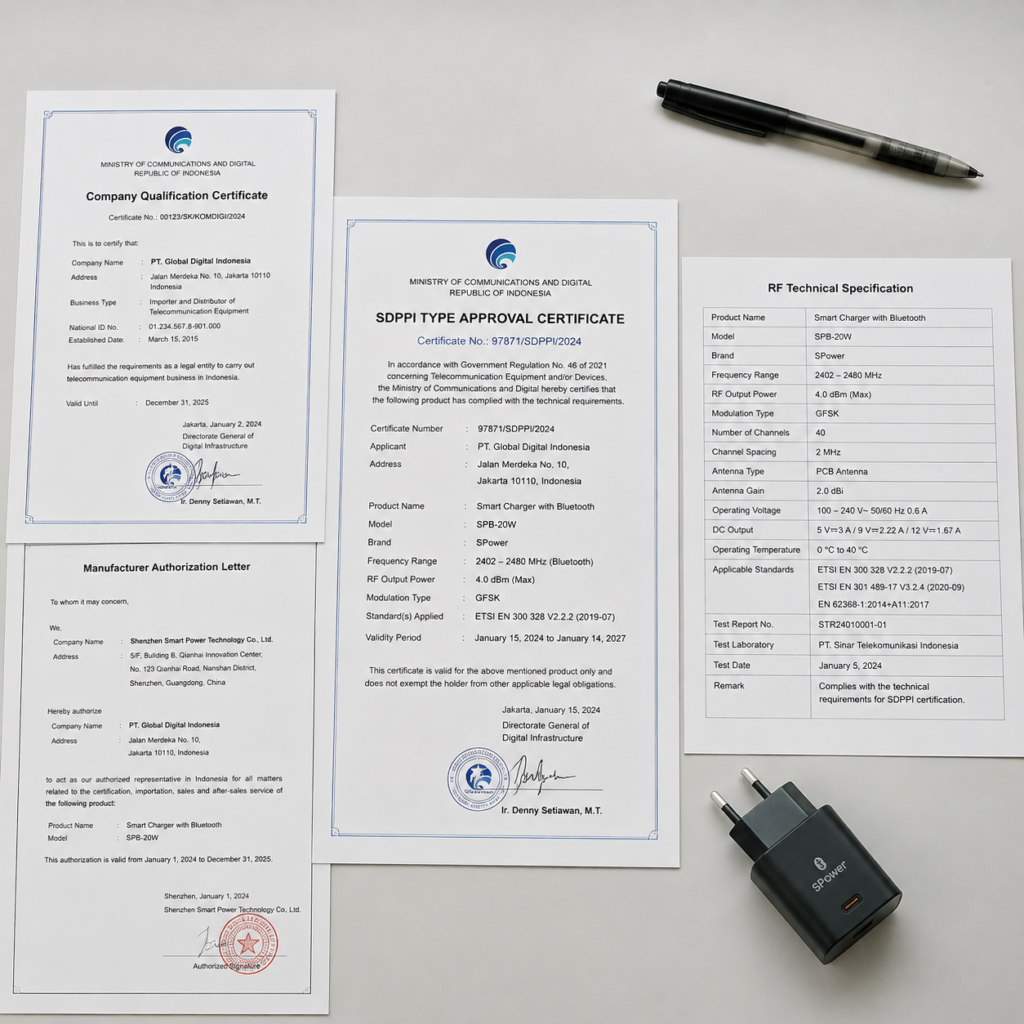
The first category is enterprise qualification documents, including the Indonesian certificate holder’s NIB (Business Identification Number), NPWP (Tax Identification Number), business license, and the authorization letter issued by the overseas manufacturer.
The second category is product technical documents, including product specifications (which must include both charging parameters and communications/radio frequency parameters), user manuals, and photos of nameplates and packaging.
The third category is reference documents, such as overseas radio frequency test reports like CE RED and FCC ID. Whether these documents can be used as formal certification documents shall be confirmed in accordance with the current requirements of DJID and accredited laboratories, and you cannot assume on your own that they can replace Indonesian requirements.
If the certification method requires submission of samples or test results, samples should also be prepared in advance. Samples should preferably be the final mass-produced version, with hardware, firmware, and antennas consistent with the bulk goods. Engineering prototypes cannot be used as substitutes. The number of samples is generally determined by the laboratory or certification body based on project requirements; common requirements may be several units, and the specific number shall be subject to actual notification. The model and version must be clearly marked on the samples. Products with wireless functions must also be able to normally activate all communications functions, such as Bluetooth pairing and WiFi connection, otherwise complete testing cannot be carried out.
Final Self-Check Before Submission
After all documents and samples are prepared, conduct a self-check first to avoid being rejected right after submission:
First, the model, brand, and manufacturer name on all documents must be completely consistent. You cannot have model A on one document and A1 on another; this situation is very likely to result in a request for supplementary materials.
Second, if there are overseas test reports, the sample parameters in the reports must completely match the applied product; you cannot mismatch them.
Third, the format and language of the documents (some documents require Indonesian) must meet the requirements of the official system; do not upload the wrong format.
Finally, if the product has had its wireless module replaced before, be sure to reconfirm whether supplementary assessment, change application, or re-testing is required. Do not replace it secretly without reporting.
Full Procedures by Application Path
Path 1: Formal Type Certification (Applicable to Products with Radio Frequency Functions)
The specific process of formal certification varies by device category and applicable certification method, and can generally be understood according to the following steps:
The first step is online application submission. The local Indonesian certificate holder registers an account in the current official system, fills in product parameters, and uploads the prepared documents. The original system entry and name may be adjusted, and shall be subject to the current official entry. The core checkpoints of this step are that product classification and communications parameters must be filled in accurately, and no functions can be omitted. For example, if the product has both Bluetooth and WiFi, you cannot only fill in Bluetooth.
The second step is preparing test results or sending samples for testing. Depending on the device category and current requirements, the application may require submission of test results from accredited laboratories, declarations of conformity, or other documents that comply with the rules. Whether samples must be submitted locally in Indonesia shall be determined by DJID and accredited bodies based on the device category, test standards, and acceptable overseas documents. When testing is required, it should be ensured that the testing covers all communications functions actually possessed by the product.
The third step is test result processing. After passing the test, the laboratory or relevant body will issue a test report; if it fails, the hardware, firmware, or documents shall be rectified according to the problems, and then resubmitted or re-tested as required. After getting the report, check it first. The model, version, and parameters on the report must be completely consistent with the application information, otherwise the official review may require correction.
The fourth step is official review. DJID will conduct review based on application documents, test results, declarations of conformity, and other applicable documents. If supplementary materials are required, the applicant shall submit them within the specified period in accordance with the system notification. Overdue may result in the application being closed, returned, or rejected, and the specific situation shall be subject to subsequent notifications and applicable rules. When supplementing materials, they must fully correspond to the review opinions; do not answer irrelevant questions.
The fifth step is obtaining the certificate. After passing the review, the official authority will issue the corresponding certification document, which usually lists information such as the certificate number, validity period, certificate holder, and applicable models. After getting the certificate, check the information immediately, such as whether the model is written correctly, whether the certificate holder’s name is correct, and whether the scope of communications functions is consistent with the product. If there are errors, apply for correction promptly; don’t wait until you start selling to find out.
Path 2: Low-Risk Self-Declaration (Subject to Official Classification)
Self-declaration only applies to low-risk devices explicitly included in this method under DJID’s current rules. You cannot directly classify all products without wireless transmission into this category.
First, confirm whether the product is a regulated communications device and whether it is in DJID’s current low-risk device list or applicable rules. Ordinary USB-C cables cannot be directly deemed eligible for self-declaration just because they have wired data transmission functions.
Second, prepare materials such as product specifications, compliance commitment letters, and qualification documents of the local certificate holder.
Third, submit the declaration of conformity application in the current official system. Whether testing is required and what format of technical documents to submit shall be subject to the requirements of the system and current rules.
Fourth, after passing the review, you may obtain the corresponding declaration number or electronic compliance document, and the specific form shall be subject to the document actually generated by the system. The product model and functions corresponding to the declaration number must be completely consistent with the actually sold product; you cannot use the number of Cable A for Cable B.
Regardless of which path you take, there are several key reminders for the entire process to remember: after submitting the application, check the system notifications regularly. Some notifications will not be sent via separate emails. If you miss the supplementary material deadline, the application may be closed or returned; make an appointment with the laboratory for testing in advance, and avoid Indonesian statutory holidays, such as Eid al-Fitr, which will cause a lot of delays; check the information immediately after getting the certificate, and apply for correction in time if there are errors. Don’t delay.
Core Understanding of the Testing Process
Many people have no idea about the test content of SDPPI. The test items are not exactly the same for all products, but are subject to the device category and current Indonesian technical requirements, which may include radio frequency, spectrum, EMC, SAR, or other applicable items.

Radio frequency items may include transmission frequency band, transmission power, occupied bandwidth, spurious emissions, etc. Spurious emissions are other radiations generated by the product outside the normal operating frequency band, which may cause interference to nearby devices. These items are usually the focus of wireless communications equipment assessment.
Whether EMC (Electromagnetic Compatibility) is tested and what content is tested shall also be confirmed based on the device category and applicable standards, which may involve requirements such as the device’s emission and immunity. SAR (Specific Absorption Rate) shall be judged based on the product’s usage method, human exposure situation, and specific technical requirements, and conclusions cannot be drawn solely based on the condition of “whether it is close to the human body”.
SDPPI certification cannot replace the compliance assessment of electrical safety, charging performance, energy efficiency, or interface compatibility applicable to the product. That is to say, passing the communications equipment certification does not mean that the charging safety, charging efficiency, or interface usage performance are all compliant. These matters still need to be separately verified in accordance with other Indonesian regulations for specific products.
Key Points for Quick Check of Test Reports
After getting the test report, you don’t need to stare at the dense parameters. First, grasp these core points for quick check:
First, look at the conclusion: Pass or Fail, this is the most straightforward.
Then check the test object: whether the model, hardware/firmware version, and communications module on the report are completely consistent with your applied product. If the test was conducted on a sample of another model, even a qualified report may not be usable for the current application.
Then check the version of the test standard: whether it meets the currently applicable Indonesian standards, and whether old standards are still accepted, which needs to be confirmed by DJID or accredited laboratories.
Finally, check the laboratory qualifications: whether the laboratory has KAN accreditation and covers the corresponding test items, or whether it is a laboratory accredited, designated, or allowed to be accepted by DJID under the rules. At the same time, confirm that the report meets the currently applicable standards and format. You cannot only look at whether there is a so-called unified “SDPPI accreditation mark”, because the absence of a unified mark does not mean the report is necessarily invalid, and having the mark does not mean all items will be automatically accepted.
Common Causes of Test Failure and Solutions
Most test failures are due to the following reasons: first, the wireless transmission power exceeds the applicable requirements; second, the spurious radiation does not meet the standard, that is, there are other excess radiations besides the main frequency band; third, the actual antenna configuration is different from the declared one, for example, the declared one is a ceramic antenna, but the actual bulk goods use a PCB antenna; fourth, the firmware version changes the communications parameters, for example, the test uses firmware version 1.0, but the bulk goods use version 1.1, with adjusted power or frequency band.
Don’t panic if the test fails. Handle it according to this approach: first distinguish the type of problem, whether it is a design problem, such as a problem with the hardware or firmware itself, or the wrong sample version was sent, or the documents were filled in incorrectly. After finding the problem, rectify it, and then resubmit samples of the same model or relevant documents after rectification. You cannot secretly change the model to avoid it, as it will be more troublesome if found out.
If you are not sure about the radio frequency performance of the product, you can find a qualified laboratory to do a pre-test in advance to get a preliminary understanding. Fixing problems in advance can reduce the risk of formal test failure and repeated testing.
Cost and Cycle Estimation
Core Cost Composition
There is no unified standard answer for the cost of SDPPI, which depends on the product type and application path. It mainly consists of several parts:
First is the official application fee, that is, the review or administrative fee charged by the competent authority, which is determined according to the product category and application matters.
Second is the testing fee, which is only incurred for certification items that require testing. The specific amount depends on the number of communications functions, test items, and product complexity. For example, a product with Bluetooth, WiFi, and NFC usually requires more assessment content than a product with only Bluetooth.
Third is the service fee of the local certificate holder or agent, because overseas sellers usually cannot directly apply as Indonesian certificate holders, and must find a local Indonesian company as the certificate holder. If you hire an agent, there will also be corresponding service fees.
Fourth are other possible fees, such as re-testing fees for failed tests, supplementary assessment fees, or subsequent renewal and change fees. These do not occur in every project, but you should have an expectation in advance.
General Cycle and Extension Factors
The cycle can only be an estimate based on specific products. The official authority does not have a unified guarantee of 1-2 weeks or 3-8 weeks for all products.
The actual processing time depends on product classification, document completeness, whether sample submission is required, laboratory scheduling, official review status, and test results. When testing goes smoothly and materials are complete, low-complexity projects may be completed quickly; projects requiring complete testing or multiple supplementary materials will take longer.
Many situations will slow down the cycle: for example, re-testing due to failed tests, repeated supplementary materials due to incomplete materials, queuing due to heavy official review workload, encountering Indonesian statutory holidays, and sample transportation time. These should all be calculated in advance, and don’t set the delivery date too tight.
Practical Tips to Save Money and Time
If you want to spend less and get the certificate quickly, here are some practical tips:
First, check all parameters in advance, prepare all documents, try to pass at one time, and reduce the number of supplementary materials.
Second, if it is a series of products with the same core communications module, you cannot of course assume that combined applications are allowed. Series or multi-model combined applications may only be applicable after DJID or an accredited laboratory confirms that the model differences do not affect the applicable technical requirements, radio frequency and EMC performance, and approves the representative samples. Changes in housing, antenna, radio frequency layout, power supply, and charging power may all affect the assessment results.
Third, do a pre-test before formal testing to confirm the compliance of radio frequency and other applicable items, and reduce the risk of repeated costs caused by formal test failure.
Fourth, when choosing a laboratory, prioritize those with testing experience in charging products and whose qualification scope covers the current project. This makes it easier to accurately understand the product’s functions and structure, reduces communication costs, and is less likely to miss applicable items.
Compliance Maintenance After Obtaining the Certificate
Getting the certificate is not the end of the story. Subsequent compliance maintenance is also very important, otherwise the certificate may need to be re-evaluated due to product changes, standard updates, or document expiration.
First are the product labeling requirements. Whether the certificate or declaration number needs to be marked on the product body or the minimum sales package, as well as the labeling format and placement, shall be subject to the latest official specifications and specific certificate requirements. For example, if the charger is large enough, the number can be printed on the bottom label; since the charging cable itself is too small, it may need to be printed on the outer packaging. The label must be clear and legible, and the model on it must be consistent with the model in the certification document; no mismatching is allowed.
Validity Period and Renewal Rules
The validity period of the certificate or declaration of conformity, the renewal application time, and whether re-testing is required cannot be uniformly summarized as “usually 3 years, apply 3 months in advance, no re-testing required”. These matters depend on the specific certificate type, system notifications, device changes, and current DJID rules, and shall be subject to the period marked on the certificate and subsequent official requirements.
Even if the communications functions have not changed, if the applicable standards have been updated, or the device’s hardware, firmware, antenna, power supply, and other key parameters have changed, supplementary assessment or testing may also be required. Don’t assume that the original certification can be used all the time just because the product name has not changed.
Whether Product Changes Require Re-Certification
If you modify the product during sales, do you need to re-apply for the certificate? This depends on the situation.
If you replace the communications module, modify the antenna, adjust the transmission power or communications frequency band, or modify other hardware and firmware that may affect radio frequency or EMC performance, you should confirm with DJID or an accredited laboratory before shipment whether change, expansion, or re-certification is required. You cannot simply assume that the original certificate will definitely expire immediately, nor can you assume that the original certificate will definitely remain valid after modification.
If you only modify the appearance color, packaging design, and other content that usually does not affect communications performance, you generally do not need to re-apply for the same type of certification, but you should still confirm whether documents or labels need to be updated. Changes in charging power, power supply circuit, internal layout, or housing structure may affect EMC or radio frequency performance, and cannot be directly deemed as not requiring declaration. An impact assessment should be conducted first.
Core Checkpoints of Market Spot Checks
Market supervision in Indonesia may involve customs, competent authorities, e-commerce platforms, and offline markets. Spot checks usually focus on: first, whether the product has applicable certification or conformity documents; second, whether the model, certificate holder, and functions corresponding to the documents are consistent with the actual product; third, whether the actual communications parameters of the product are consistent with those at the time of certification.
For example, if you use the number of a Bluetooth charger for a WiFi charger, or use one type of antenna during certification but replace it with another type in actual bulk goods, compliance problems may arise. Failure in spot checks may lead to measures such as rectification, removal from shelves, recall, administrative penalties, certificate suspension or revocation; whether it affects other models or subsequent imports shall be based on the scope of the violation, certificate status, and specific decisions of the competent authority.
Common Misconceptions and Pitfall Avoidance Guide
6 Most Common Pitfalls
During the SDPPI application process, many novices are prone to pitfalls. I have sorted out the 6 most common ones, and you can compare them to avoid them:
The first pitfall: applying for SDPPI even for pure charging products. If your product only has a charging function and no wireless or other regulated communications functions, it generally does not fall within the scope of this certification, and you will waste money. But ultimately, it shall still be subject to product classification and current requirements.
The second pitfall: thinking that SDPPI regulates charging safety. SDPPI mainly targets the technical compliance of communications and radio equipment, and cannot replace electrical safety, charging performance, energy efficiency, or interface compatibility assessment. Whether SNI is required shall be judged based on whether the specific product is included in Indonesia’s mandatory SNI catalog.
The third pitfall: applying directly with an overseas company. SDPPI-related applications usually require a locally legally registered company in Indonesia as the certificate holder. Overseas manufacturers or sellers should confirm the local applicant entity and authorization documents in advance.
The fourth pitfall: the certificate model is inconsistent with the bulk goods. For example, if you have 5 models of smart chargers, only 1 of which has been confirmed, and the other 4 directly use the same number, it may be deemed that the model does not match the certification scope during review or spot checks.
The fifth pitfall: randomly changing the communications module after getting the certificate. After replacing the communications module, antenna, or other components that may affect radio frequency and EMC performance, you should first confirm with DJID or an accredited laboratory whether change, expansion, or re-certification is required. Do not replace it secretly without reporting.
The sixth pitfall: thinking that with CE or FCC reports, no testing is needed. Whether overseas documents can be used for Indonesian certification shall be confirmed in accordance with current rules. They are neither guaranteed to directly replace testing, nor can it be simply assumed that all overseas reports are completely invalid.
Judgment on the Reliability of Agents
Many overseas sellers will hire agents to handle SDPPI, after all, they do not understand Indonesian rules and do not have a local certificate holder. When choosing an agent, don’t just look at the price. Judge whether it is reliable from the following points:
First, it must have a local entity in Indonesia and can provide formal certificate holder services. For those that only have domestic offices and do not even have a local contact person in Indonesia, there may be risks in communication and responsibility implementation.
Second, it must have real cases of SDPPI application for charging products. Charging products have their own characteristics. For example, chargers with wireless charging or Bluetooth are not exactly the same as conventional communications products such as mobile phones and routers. If the agent is familiar with such products, it is easier to identify functional and classification problems.
Third, it will first help you judge whether the product needs certification and which path to take, instead of persuading you to apply right away. A reliable agent will first help you do an assessment. If your product does not need certification at all, it should tell you directly, instead of letting you bear unnecessary costs.
Fourth, the quotation must be clear, listing each fee, such as official application fee, testing fee, certificate holder service fee, and possible re-testing fee, instead of just quoting a “one-price” and then secretly adding money later.
Handling Ideas for Detained Goods / Failed Spot Checks
If you really encounter customs detention of goods or failed market spot checks, don’t panic. First, handle it according to the following ideas:
First, verify the reason: whether it is because there is no certification, or the certification information does not match the product.
If the goods are within the scope of mandatory certification and have been detained by customs, you should immediately contact customs, the importer, and DJID to confirm the available rectification, return, destruction, or other disposal plans. It is not guaranteed that a supplementary application afterwards will definitely allow customs clearance, nor should you sell before approval.
If it is information mismatch, such as wrong model filling or labeling problems, quickly submit correct materials to apply for review in accordance with the requirements of the competent authority, and wait for further review after rectification.
Be sure not to alter the labels or certificates without permission. It may have been just a document or labeling problem, but unauthorized modification may be regarded as a more serious violation, and the penalty will be much heavier.
Pre-Application Quick Checklist and Capability Summary
Finally, I have sorted out a pre-application quick checklist for you, with a total of 6 items. Going through it before application can save you a lot of detours:
1. Confirm whether the product is a regulated communications device in Indonesia, and clearly judge whether SDPPI certification is required;
2. Confirm a qualified local Indonesian certificate holder, and find one in advance if you don’t have one;
3. Confirm that the product’s model and communications parameters are completely locked and will not be changed midway;
4. Check that the model, brand, and manufacturer information of all documents are completely consistent without discrepancies;
5. Confirm the application path according to official classification: whether to go through formal certification, declaration of conformity, or apply other compliance methods;
6. Simultaneously verify other Indonesian compliance requirements such as SNI to avoid missing other certifications.
After reading this article, you should be able to independently handle these 5 things: quickly judge whether your product needs SDPPI certification and which application path to take; prepare the required documents and samples according to the requirements, and be clear about the key checkpoints; follow up the entire application process, and know the core actions and risk points of each step; roughly estimate the cost and cycle of the application, and master practical tips to save money and time; avoid common pitfalls, be able to judge whether an agent is reliable, and have basic handling ideas when encountering detained goods or spot checks.
Overall, SDPPI certification may seem complicated, but its core is judgment around “technical compliance of communications equipment”. As long as you first confirm whether the product is within the regulatory scope, choose the correct path according to official classification, prepare documents in advance, and simultaneously verify other requirements such as electrical safety and energy efficiency, the application process will not be so chaotic. If you are not sure which category your product belongs to, it is best to do a pre-assessment in advance. Don’t wait until the goods are shipped to find that the certification or other compliance documents are not ready.