
Most sellers who sell products such as chargers, USB-C charging cables, and fast charging heads to India know that BIS certification is the entry threshold, but many overlook another mandatory requirement—EPR. Many sellers have their products delisted shortly after launching on Amazon India and Flipkart, or even have their goods detained upon arrival at the port, because they have not completed EPR registration. Many people’s first reaction to EPR is “another certification?” In fact, its nature is completely different from BIS and RoHS. From the perspective of charging products, this article sorts out the responsibility division, handling process, subsequent compliance, and pitfall avoidance points of India’s EPR.
Must-Know Basics: Fundamental Knowledge of EPR
First, clarify the most easily confused core point: EPR is not a quality and safety certification, but a set of environmental protection and recycling responsibility systems.
In plain terms, whoever puts charging products on the Indian market shall bear the relevant legal responsibilities for recycling and disposal after the products are scrapped. Its full name is “Extended Producer Responsibility”, and the core purpose is to make producers responsible for environmental protection throughout the product’s life cycle, covering the entire process from production to scrapping, to reduce e-waste pollution. It should be specially noted here: the legal obligations of organizing recycling, declaration, and verification and cancellation shall be borne by legal responsible entities such as producers, importers, or brand owners, and cannot be passed on to the government or consumers; relevant commercial costs can be reflected through normal operating costs.
Many sellers confuse EPR with BIS, but in fact the two are completely independent: BIS is a market entry safety threshold that verifies whether the electrical safety and quality of products meet Indian standards; EPR is an environmental protection requirement that governs the responsibility for recycling and disposal after products are scrapped, and the two cannot replace each other.
The core rules of India’s EPR come from the E-Waste Management Rules (2022 edition and subsequent amendments), and the competent authority is the Ministry of Environment, Forest and Climate Change (MoEFCC), which is responsible for formulating overall policies and annual recycling targets. After the revision of the rules in 2022, the biggest change is that EPR registration has changed from the previous decentralized management by each state to being uniformly responsible by the Central Pollution Control Board (CPCB). The registration standards and processes are consistent across India, and there is no need to apply separately by state.
Differences from Other Charging Product Compliance Requirements
Besides BIS, charging products entering India may also involve compliance requirements such as RoHS and BEE. The core differences are as follows:
| Compliance Type | Core Function | Nature Classification |
|---|---|---|
| BIS Certification | Verifies that the electrical safety and quality of products meet Indian standards; it is a mandatory market entry threshold | Safety and quality certification |
| RoHS Compliance | Restricts the content of 6 hazardous substances such as lead, mercury, and cadmium in products | Hazardous substance control system |
| BEE Energy Efficiency Label | Marks the energy consumption level of products, targeting electrical appliances with energy consumption requirements | Energy consumption labeling system |
| E-Waste EPR | Requires producers to bear the responsibility for recycling and disposal of products after scrapping | Environmental protection and recycling responsibility system |
It is also specially reminded: Plastic packaging EPR and battery EPR are two completely independent systems, and cannot replace e-waste EPR. For example, a power bank with a built-in battery itself belongs to the category covered by e-waste, and at the same time the internal battery is included in the scope of battery EPR control. Therefore, both types of EPR need to be handled, and only handling one is non-compliant.
If the required EPR is not handled, the most direct consequences include: mainstream e-commerce platforms such as Amazon India and Flipkart will directly delist the products; goods may be detained by customs and cannot be cleared after arriving at the port; if found by regulatory authorities later, they may also face fines and even be prohibited from entering the Indian market.
Quick Judgment: Does Your Product Need EPR Registration?
There is no need to rush to find an intermediary. You can make a judgment by yourself through the product scope, responsible entities, and the three-step method.
First, look at the product scope. Currently, charging products covered by e-waste EPR include: mobile phone/laptop chargers, fast charging heads/power adapters, USB/USB-C charging cables, and small consumer electronics with charging ports. Whether it is included is ultimately subject to the schedule of the E-Waste Management Rules and the optional categories on the CPCB EPR portal; having a charging port does not mean that the same category is automatically applicable. It should be checked item by item according to the attributes of the whole machine, whether the accessories are put on the Indian market, and whether they are sold separately or put on the market with the whole machine.
There are also some boundary categories that do not need to be handled, or need further confirmation: for example, special charging equipment for industrial scenarios (industrial chargers not sold to ordinary consumers), cable protective sleeves with pure mechanical structure (silicone/plastic protective shells without any electronic functions), are usually not within the scope of ordinary consumer e-waste EPR. For exclusive accessories that are not sold separately (such as custom charging cables given away with large equipment), exemption cannot be directly judged solely on the basis of “giveaway” or “not sold separately”. It needs to be checked in combination with four dimensions: whether it is put on the Indian market with terminal consumer whole machines, whether it has electronic functions, whether it is covered by CPCB EPR classification, and whether the EPR responsibility of the corresponding whole machine already includes the accessory. If it is a consumer-oriented charging electronic accessory, even if it is given away with the whole machine, it needs to be included in the launch volume statistics and cannot be excluded on its own.
Special attention should be paid to the declaration caliber: for charging cables and adapters sold with the whole machine, it should be checked whether they have been included in the EPR declaration scope of the whole machine to avoid omission or double calculation; separately sold charging accessories should usually be checked against the CPCB portal classification according to their corresponding categories.
Then look at the responsible entities. The three types of entities that need to register are: local Indian manufacturers, Indian importers, and brand owners—even overseas brands, as long as their products are sold in the Indian market, are responsible entities and cannot be exempted.
If you are still unsure, you can check one by one with the “three-step judgment method”:
Step 1: Is the product a charging electronic product sold to ordinary Indian consumers?
Step 2: Are you the brand owner, importer, or local Indian manufacturer?
Step 3: Can the corresponding category of the product be found on the official EPR portal of CPCB?
If the answers to all three questions are “yes”, registration is mandatory; if in doubt, be sure to follow the official rules issued by CPCB to avoid missing the registration.
Responsibility Division: What Responsibilities Do Different Roles Bear?
After confirming that registration is required, the core question of many overseas sellers is: who exactly should register? Who bears the responsibility? The boundaries of this part must be clarified to avoid pitfalls.
The core principle should be viewed at two levels: from the Indian regulatory level, the entities that directly bear the legal obligations of registration, declaration, and verification and cancellation to CPCB are locally registered Indian entities, importers, or officially authorized representatives; from the commercial and responsibility implementation level, overseas brands/exporters usually bear the EPR registration and recycling costs, and bear the final commercial compliance responsibility—don’t think that finding a local Indian importer or OEM can completely pass on all responsibilities. If there is a real compliance problem, the brand owner will still be implicated due to brand ownership and market launch dominance, and cannot be completely exempted from liability.
There is an easily confused boundary: e-commerce platforms are only responsible for verifying the EPR qualifications of sellers, and do not bear the producer’s recycling responsibility. That is to say, the platform will only check whether you have a certificate, and will not help you handle recycling and compliance matters. All responsibilities still rest with the seller and the brand owner.
Combined with the three most common scenarios for overseas sellers, the responsibility division is as follows:
- Chinese brands sold offline through local Indian importers: The Indian importer is the registration entity, responsible for submitting applications and liaising with regulators, but the final compliance responsibility and recycling costs are still borne by the brand owner. Both parties need to clarify rights and responsibilities in the agreement to avoid subsequent disputes.
- Overseas brands doing self-shipping on Indian e-commerce: Overseas companies cannot directly register EPR in India. They must appoint a local Indian authorized representative as the registration entity, and the local representative will liaise with CPCB. The brand owner bears all responsibilities and costs.
- OEM production of charging cables: If the OEM only produces according to the brand owner’s requirements and is not responsible for sales and brand operation, the EPR responsibility is fully borne by the brand owner, and the OEM does not need to register separately.
What to Prepare Before Registration?
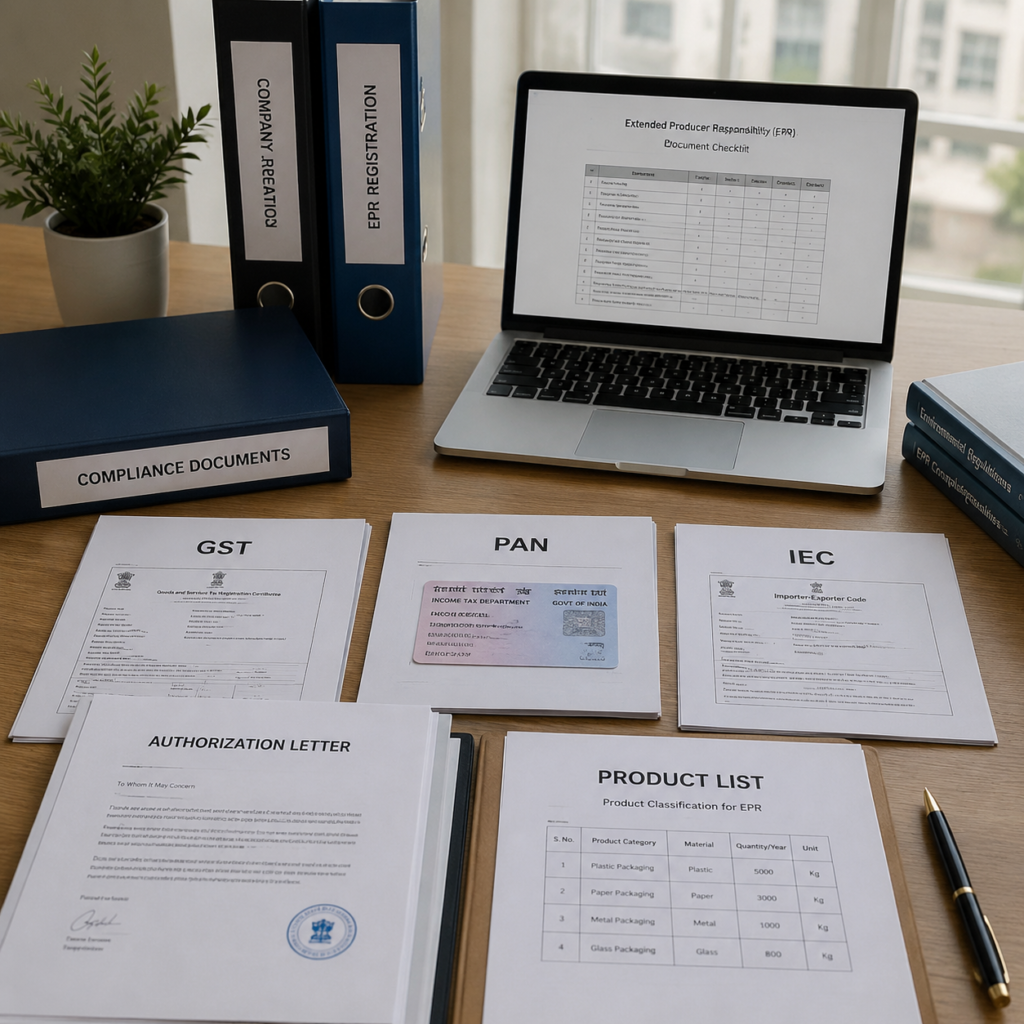
There are several hard thresholds for EPR registration. Preparing in advance can save a lot of detours.
Preparation of Entity Qualifications
The most core hard threshold: there must be a local legal entity in India to register, and overseas companies cannot apply directly. The local entity can be an Indian subsidiary, a joint venture, or an authorized importer or local representative, and must have the following qualifications: Indian business registration certificate, GST (Goods and Services Tax number), PAN (Permanent Account Number), and importers also need IEC (Import Export Code). Overseas brands need to issue a formal authorization letter to the local entity, clearly authorizing it to be responsible for EPR registration and compliance-related matters.
Preparation of Product Materials
Three types of materials need to be sorted out:
- A complete product list, including the models, brands, and specific categories of all charging products planned to be sold in India, without omission;
- Estimated annual launch volume in the Indian market. Note that this data is calculated based on local Indian sales, not global sales;
- Check the product classification on the CPCB EPR portal in advance to ensure that the product corresponds to the official classification, so as to avoid subsequent applications being rejected due to classification errors.
Selection of Compliance Partners
Many sellers will come into contact with PRO (Producer Responsibility Organization) or various compliance service agencies when preparing for EPR. Here, the core boundary of rights and responsibilities is first clarified: you can entrust a compliance service agency to assist in sorting out materials, operating the registration portal, and connecting with recycling resources, but the legal responsibilities of producers/importers for registration, declaration, and verification and cancellation cannot be replaced by any service agency. The final valid voucher used to offset the recycling responsibility is not a self-made certificate by the service agency, but an official EPR certificate that can be verified online in the CPCB system.
Core points for selecting a compliance service agency (including PRO):
- Can connect with formal recyclers registered on the CPCB portal, and can assist in obtaining valid EPR certificates that can be used for verification and cancellation;
- Have relevant service experience in charging e-waste, and be familiar with the recycling and verification process of small-category e-waste;
- Fees are generally calculated based on annual launch volume or weight. The service content and quotations of different agencies vary greatly, so you can compare multiple parties;
- Qualification verification: Require the other party to provide the CPCB registration certificate of the cooperative recycler, or directly check the qualification of the corresponding recycling entity in the public list on the CPCB official website. Don’t just listen to the verbal promises of intermediaries.
Checkpoints in the Preparation Stage
After all materials are prepared, check three items uniformly: the qualifications of local entities are all within the validity period, the product list covers all categories to be sold and the classification is consistent with the CPCB portal, and the qualifications of the recycling entities that the partner can connect with are real and valid. After confirmation, the application can be officially submitted.
Detailed Handling Process: From Application to Certificate Obtainment
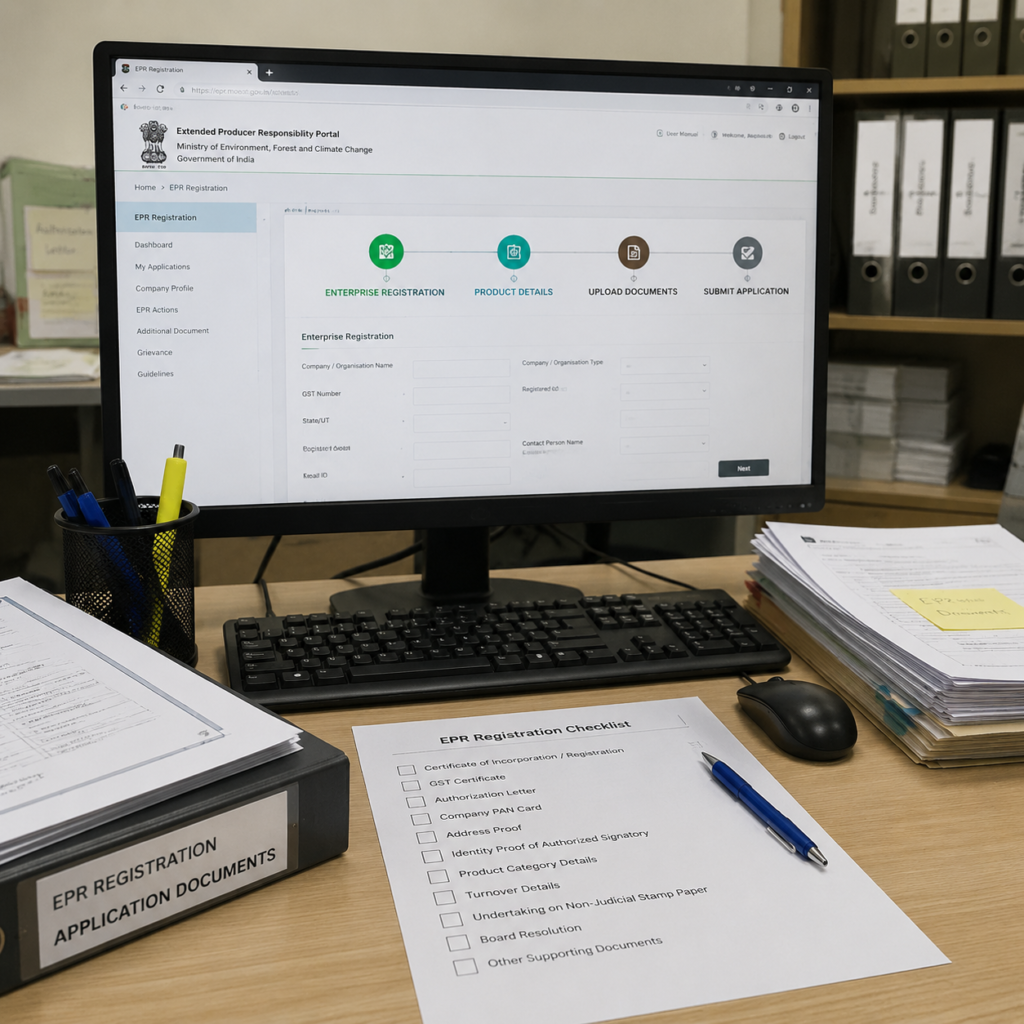
The entire EPR registration process is completed online. The process is not complicated, but there are many details. A mistake in one step may lead to rejection and re-examination.
Step 1: Determine Partners and Division of Responsibilities
First, sign two core agreements: one is an authorization agreement with the local entity, clarifying the registration entity, authorization scope, and responsibility division; the other is a service agreement with the compliance partner, clarifying the content of recycling services, charging standards, and the rights and responsibilities of both parties. Before signing the contract, it is necessary to confirm that the local entity has legal qualifications and that the recycling entity that the partner can connect with is a formal recycler registered on the CPCB portal.
Step 2: Sort Out Registration Application Materials
The materials to be prepared are divided into three categories:
- Basic entity materials: business license of the local entity, GST/PAN/IEC certificates, formal authorization letter issued by the brand owner;
- Product-related materials: list of charging products, estimated annual launch volume, recycling performance arrangement—this arrangement can be prepared with the assistance of the service agency, and must be consistent with the CPCB portal product categories, target volume calculation, and subsequent EPR certificate acquisition path;
- Supplementary materials: RoHS compliance declaration (if any), basic enterprise information form.
Checkpoint: The product list covers all sold categories, and the classification is consistent with the CPCB portal categories checked in advance.
Step 3: Submit Application and Pay Fees Online
The only official channel for application is the CPCB EPR online registration portal. Do not submit through unknown third-party links. The operation process is: register an enterprise account, fill in entity information and product information as required, upload all prepared materials, and finally pay the registration fee.
The registration fee is not a fixed value, and is charged according to product categories and launch volume tiers. The specific amount is subject to the latest standards on the CPCB official website. Don’t trust the “fixed price” of intermediaries. It is recommended to check on the official website by yourself.
Check uniformly before submission: the format and size of all materials meet the portal requirements, and key information such as entity, brand, and product model are completely consistent before and after, to avoid rejection due to inconsistent information.
Step 4: Official Review and Correction
CPCB’s review focuses on four items: legality of entity qualifications, accuracy of product classification, completeness of materials, and rationality of launch volume data. The review cycle is generally 15-30 working days, and the specific duration depends on the quality of materials and the complexity of categories—the more complete and accurate the materials, the faster the review.
If there is a problem with the materials, the official will issue a correction notice. Common reasons for correction include: incomplete materials, wrong product classification, and non-standard authorization documents. After receiving the correction notice, supplementary materials must be submitted within the specified time limit. If the time limit is exceeded, the application will be directly invalidated and the process needs to be restarted. Therefore, after submitting the application, pay attention to email and portal notifications to avoid missing the time limit.
Step 5: Obtain EPR Registration Number and Certificate
After the review is passed, you will receive an electronic EPR certificate issued by CPCB, which means the registration is completed.
Three points need to be noted after getting the certificate:
First, label display requirements: the content, position and size of the label shall be subject to the E-Waste Management Rules, CPCB certificate conditions, product categories and e-commerce platform review requirements; the content to be marked includes the EPR registration number and the crossed-out trash can logo, which can usually be displayed on the product body, packaging or user documents (such as manuals) and other compliant positions. For products with small volume such as charging cables and mini adapters, labeling can be prioritized through packaging, manuals or accompanying user documents, but the necessary labeling content required by the certificate cannot be omitted. If the official or e-commerce platform additionally requires public display on the brand’s official website, it can be supplemented, but it cannot replace the physical label on the product or packaging.
Second, the validity period of the certificate is usually 5 years, and the specific duration is subject to the content stated in the certificate and the latest CPCB rules.
Third, the certificate only covers the entity, brand and product categories at the time of declaration. For subsequent new brands or product models, the change process must be followed, and the original certificate cannot be used directly.
What Are the Ongoing Compliance Obligations After Registration?
Many sellers think that getting the EPR certificate means everything is fine, but in fact this is just the beginning. The subsequent ongoing compliance is the most prone to problems. Those who fail to perform subsequent obligations will be deemed non-compliant even if they have a certificate.
Fulfillment of Annual Recycling Targets
The annual recycling target is usually calculated based on parameters such as the corresponding product category in CPCB rules, the launch volume in the Indian market, product life or applicable base year, and the target ratio of the current year; the target volume for new market entrants, enterprises with insufficient historical launch data, or new categories needs to be confirmed according to CPCB’s current year rules and portal calculation results.
The actual recycling work is completed by the partner connecting with formal recyclers, but the brand owner/importer needs to provide the partner with real annual local Indian sales data, and must not falsely report or conceal the report, otherwise it will affect subsequent verification and cancellation.
EPR Certificate Verification and Cancellation Mechanism
The EPR certificate here is not the same as the registration certificate obtained at the time of registration: it is mainly generated by recyclers registered on the CPCB portal based on the actual recycling and disposal volume, which is equivalent to valid “points” for completing recycling tasks; for those involving refurbishment business, the refurbishment-related vouchers and their impact on EPR targets should be separately distinguished according to CPCB rules, and cannot be directly equated with recycling-type EPR certificates. You need to obtain valid certificates equivalent to the annual recycling target through the CPCB portal within the current year’s compliance cycle to offset the recycling responsibility. This process is called verification and cancellation.
There is a core pitfall avoidance point here: recycling certificates issued by ordinary waste recycling stations are completely invalid. Only certificates that can be verified in the CPCB system and can be used to offset the target volume are valid vouchers. Don’t waste money buying invalid recycling certificates, which will still be considered non-compliant if they cannot be verified and cancelled in the end.
Submission of Annual Compliance Report
The annual submission deadline is subject to CPCB’s official notification of the current year. Don’t memorize the fixed date, so as to avoid missing the time limit due to policy adjustments. The report needs to submit data such as product launch volume, actual recycling volume, and EPR certificate verification and cancellation status of the previous year.
It should be noted that the authenticity of the data is jointly responsible by the registration entity and the brand owner. All relevant records—including sales records, recycling records, and EPR certificate transaction records—must be kept for the number of years specified by the official for subsequent inspection, and shall not be discarded at will.
Information Change, Renewal and Cancellation
In the following scenarios, it is necessary to apply to CPCB for change in time: new product models or brands, annual launch volume significantly exceeding the estimate, and changes in entity information (such as company name change, address change). When making changes, in addition to submitting an application to CPCB, the service agreement with the partner should also be updated simultaneously to avoid inconsistent information between the two parties.
If the certificate is about to expire, a renewal application must be submitted at least 3 months before the expiration. Otherwise, selling products after the certificate expires is non-compliant.
If you plan to stop selling charging products in India in the future, you must first complete all unfulfilled recycling responsibilities before applying for cancellation of EPR registration. You cannot directly withdraw from the market leaving a gap in recycling responsibilities.
Response to Compliance Inspections
In addition to the CPCB at the central level, the State Pollution Control Boards (SPCB/PCC) of various states in India also carry out EPR compliance inspections on products in the local market. Common inspection items include: validity of EPR certificates, authenticity of launch volume data, fulfillment of recycling obligations, and compliance of product packaging labels.
There is no need to panic when responding to inspections. As long as you sort out all compliance records on weekdays, provide them truthfully to inspectors, and cooperate with official work, you will be fine. Do not conceal or provide false materials, otherwise the penalty will be aggravated.
Common Violations and Pitfall Avoidance Guide
Common Violation Scenarios
Many sellers accidentally fall into the pit of violations. The five most common types are: using EPR numbers of other categories (for example, using home appliance EPR as charging category EPR), continuing to sell after EPR expires without renewal, falsely reporting launch/recycling volume or purchasing invalid EPR certificates, failing to display EPR number or recycling logo on packaging as required, and omitting supporting accessories such as charging cables/adapters (even if they are given away with the whole machine, they must be included in the scope).
Consequences of Violations and Remedies
The severity of punishment depends on the nature of the violation, duration, sales scale, whether active rectification is carried out, and regulatory discretion. There is no absolute “light penalty” promise. The correct way to deal with problems after discovery:
- If it is a problem such as failure to label as required or failure to change information in time, immediately suspend the launch of the problematic batch of products, correct the labels or submit a change application, and keep complete rectification records;
- If it is a serious problem such as unregistered or false declaration, you need to complete the registration as soon as possible and actively cooperate with the official investigation to strive for lenient treatment.
On a daily basis, you can entrust the cooperative compliance service agency to carry out annual self-inspections, investigate risks in advance, and rectify in time.
Exclusive Pitfall Avoidance List for Overseas Sellers
- Do not find domestic agencies without local Indian compliance qualifications to handle it on your behalf, to avoid invalid certificates or interruption of subsequent services;
- Do not register just to get a registration number. EPR is an ongoing compliance obligation that requires completing the entire process of annual recycling, verification and cancellation, and declaration;
- Do not omit charging accessories sold/given away with the whole machine. All charging products delivered to Indian consumers must be included in the scope;
- Before signing the contract, confirm that the recycling entity that the partner can connect with has the qualification for handling charging e-waste, to avoid being unable to generate valid certificates;
- Do not borrow the EPR number of other entities. The certificate entity, brand, and product scope must be completely consistent with the actual sales, otherwise it will be deemed invalid.
Quick Judgment of EPR Registration Validity
If you are not sure whether the EPR certificate in your hand is valid, you can quickly judge it by three standards: first, the corresponding certificate information can be found in CPCB’s official database; second, the validity period of the certificate covers the current Indian fiscal year; third, the entity, brand, and product scope listed on the certificate completely match the actually sold products. Only when all three conditions are met is it a valid EPR registration.
In general, India’s e-waste EPR is a mandatory environmental protection responsibility system for charging products entering the Indian market, rather than a quality and safety certification. The core is that legal responsible entities such as producers, importers, or brand owners bear the recycling compliance obligations throughout the product’s life cycle. For overseas sellers, it is necessary to clarify the responsibility boundaries, complete the registration relying on the official CPCB process, and continuously fulfill the obligations of annual recycling, verification and cancellation, and declaration. Do not take chances or choose non-compliant services to avoid unnecessary losses.