
Many cross-border sellers and brand owners operating in the EU market feel confused when they first receive notifications from platforms requiring them to upload packaging EPR-related certificates: I just sell a product with a paper box, how is it related to waste recycling? Some even think printing a recyclable logo is enough to comply, which ends up affecting product sales. Packaging EPR is an extended producer responsibility framework established at the EU level, implemented by each member state through its own packaging regulations and recycling systems, and is one of the core compliance matters that need to be understood when entering the EU market.
1. Basic Understanding of Packaging EPR: Who Pays for Packaging Waste
What is Packaging EPR
In simple terms, the core rule of packaging EPR is: whoever first places packaged goods on the market of an EU member state shall be responsible for the recycling and treatment of that packaging. Its full name is Extended Producer Responsibility (EPR), which essentially transfers part of the waste treatment costs originally borne by public finances back to the market entities that generate packaging waste.
It should be clarified that EPR is not a one-time certification, but a long-term and ongoing legal obligation: as long as you continue to place packaged goods on the market of the target country, you need to regularly complete procedures such as declaration and fee payment in accordance with local rules.
Core Reasons for the EU to Promote Packaging EPR
Packaging is one of the main sources of municipal solid waste in the EU. According to the 2021 packaging waste statistics released by Eurostat in 2023, the per capita annual packaging waste generation in the 27 EU countries is about 189 kg. The statistical scope covers all types of sales, transport, and service packaging generated by households and economic activities. The specific values are adjusted with the year and statistical caliber, and shall be subject to the latest official release. The core goal of implementing the EPR system is to reduce the amount of packaging waste sent to landfill, improve the packaging recycling rate, and promote the development of the EU’s circular economy.
Differences Between Packaging EPR and Ordinary Environmental Labels
Many people confuse EPR with environmental labels on packaging, but in fact the two are completely different in nature:
• EPR is a regulatory obligation system: it includes full-process requirements such as registration, declaration, and fee payment, and is a legal obligation that requires actual performance of responsibilities and bearing of costs.
• Ordinary environmental labels are information display tools: they are only used to inform consumers of information such as packaging material and recycling attributes, and belong to informational labels.
A common misunderstanding needs to be clarified here: printing a recyclable logo on packaging does not mean that EPR compliance is completed. The statutory obligations of registration, declaration, and fee payment will not be exempted by affixing labels.
Entry-Level Core Cognitive Misconceptions
People who are new to EPR are most likely to fall into two cognitive pitfalls, and clarifying them in advance can avoid many subsequent problems:
First misconception: Only packaging manufacturers need to be responsible.
Correction: The core of responsibility determination is not “who produced the packaging”, but “who first placed the packaged goods on the market of the target country”. Brand owners, sellers, and importers may all become responsible entities, which has no direct relationship with whether they are packaging manufacturing enterprises.
Second misconception: If my supplier has registered EPR, I don’t need to do it.
Correction: If your supplier only produces goods and packaging overseas and does not place the goods on the EU market, then you, as the party selling the goods to the EU, are the statutory responsible entity. The supplier’s registration cannot cover your sales obligations, and the specific judgment needs to be combined with the transaction chain.
2. Quick Judgment of Applicable Scope: Whether You and Your Packaging Need to Comply
This chapter is a general introductory judgment framework, and the specific applicable boundary shall be subject to the officially effective regulations of each member state.
You can initially judge whether you need to fulfill the packaging EPR compliance obligations from the dimensions of responsible entity, control scope, and transaction mode.
Judgment of Responsible Entities: Who Must Do Packaging EPR
The core criterion for determining the responsible entity is who is the party that first places packaged goods on the market of the target country. Common responsible entities include EU-based brand owners/manufacturers, non-EU importers, and cross-border sellers selling to the EU (including direct mail, FBA/overseas warehouses). Non-EU enterprises usually need to designate a local authorized representative in the target country.
The responsibility determination for different warehousing and sales models needs to be confirmed in combination with conditions such as the customs clearance entity and the transfer node of goods ownership. The detailed judgment method for which countries need to be registered will be specifically explained in Chapter 4.
Judgment of Control Scope: Which Packaging Counts
The specific definition and control scope of packaging are usually divided into three categories by use:
• Sales packaging: packaging that comes with the product itself and finally reaches the user along with the product, such as cosmetic bottles, product color boxes, and food packaging bags.
• Transport packaging: packaging used to protect goods during transportation, such as express boxes, bubble wrap, tape, and pallet wrap.
• Service packaging: packaging used in the process of providing services, such as takeaway boxes, disposable tableware, and shopping bags in malls.
By material, it usually includes categories such as paper/paperboard, plastic, glass, metal, wood, and composite materials. The declaration rules for composite packaging vary greatly from country to country: some countries allow classification by main material, while others require separate declaration by the weight of different materials, so classification cannot be judged solely by appearance or name.
Whether you need to bear the declaration responsibility for a certain type of packaging also needs to be judged in combination with two conditions: first, whether you are the first placing entity of the packaging, and second, whether the packaging is provided by you. Packaging that is easily missed in e-commerce scenarios includes: secondary packaging (such as an additional express box when shipping if the product itself has a color box), packaging of gifts/samples, and packaging of secondary shipment after return and exchange; if these packaging are provided by the seller themselves and placed on the market for the first time along with the goods, most countries will require them to be included in the declaration statistics.
Items that may not be recognized as conventional packaging or are subject to special management rules need to be confirmed one by one in combination with the definition of the target country: if separate product manuals and hangtags only serve as information prompts and have no product protection function, some countries do not include them in the scope of packaging; specific industrial-specific packaging and dangerous goods-specific packaging are usually subject to separate management rules, which is not equivalent to exemption from EPR obligations; reusable packaging needs to be judged according to the recycling system, number of cycles, and agreement of responsible entities, and some countries require declaration at the first placement, and no repeated charging in the subsequent cycle use stage.
Responsibility Differences Between B2C and B2B
There are differences in the division of responsibilities under different transaction scenarios:
• B2C scenario: For packaged goods sold to end consumers, the party that first places the packaging to consumers or assumes the identity of importer/producer usually bears the main EPR responsibility, and there is no room for transferring responsibility to downstream consumers; some countries may have additional requirements for platforms, but this does not exempt the core obligations of the statutory responsible entity.
• B2B scenario: For industrial or commercial packaging circulated between enterprises, downstream enterprises may bear the recycling responsibility only under the premise that the law of the target country explicitly allows responsibility transfer. In addition to requiring downstream enterprises to have completed the corresponding EPR registration and the two parties to sign a written responsibility agreement that meets statutory requirements, the original placing party may still need to fulfill the obligations of information reporting, evidence provision, or partial declaration, and cannot be exempted from all responsibilities solely by verbal agreement or private contract.
Exemptions and Thresholds: When Can Simplification or Exemption Be Applied
Some countries have set up simplification or exemption rules for registration, declaration, or fee payment links for micro-enterprises or entities with low annual packaging placement volume, but the thresholds and applicable obligation scopes (such as only exempting fee payment while still requiring declaration) vary greatly from country to country, and cannot be directly applied.
In addition, special categories such as reusable packaging and dangerous goods-specific packaging may be subject to separate management rules, which does not mean that all EPR obligations are automatically exempted.
It is particularly reminded that the exemption rules of one country only apply to that country and cannot be directly applied to other EU countries; each country’s policies are formulated independently.
3. Core General Compliance Obligations: 4 Things That Must Be Completed
The following are the general core compliance links of packaging EPR, and the specific requirements and procedures of each country shall be subject to local official rules.
Register for the EPR Number of the Corresponding Country
The registration and responsibility fulfillment channels for packaging EPR are set by each member state independently, and usually involve two types of possible compliance actions: first, completing entity filing in the producer registration system of the national competent authority (such as Germany’s official LUCID producer registration system), and second, joining an officially authorized Producer Responsibility Organisation (PRO), which assists in fulfilling obligations such as recycling treatment and data declaration. Whether both need to be completed, who handles them, and whether there is an alternative responsibility fulfillment mechanism depend entirely on the statutory system of the target country.
The registration procedures and number formats vary from country to country. There is no EU-wide universal EPR registration number, and the registration certificate of one country cannot directly cover sales in other EU countries. Every time you enter a new target country market, you need to complete registration separately in accordance with local rules.
Materials usually required for registration include enterprise qualification documents, estimated annual packaging placement volume (broken down by material and category), etc. Major e-commerce platforms may require sellers to submit registration or recycling system participation certificates recognized by the corresponding site country, and failure to submit as required may affect product sales.
Declare Packaging Placement Data by Cycle
The core content of the declaration is the weight of packaging of each material and the corresponding categories that you actually placed on the market of the target country within the corresponding period.
The declaration frequency varies by country, sales scale, and PRO rules. Most countries declare once a year, and some countries declare semi-annually, quarterly, or monthly. It is necessary to confirm the statutory declaration cycle, deadline, measurement unit, and data correction rules of the target country in advance. Some countries or PROs adopt the model of “estimated declaration at the beginning of the year + prepaid fees, settlement based on actual data at the end of the year”, but this is not a universal EU rule.
All data supporting the declaration (such as packaging weighing records, packaging purchase vouchers, sales data, etc.) need to be retained for the statutory retention period of the target country, usually 3 to 6 years, for verification.
Pay Packaging Recycling Treatment Fees
The core calculation of recycling treatment fees is usually “packaging material × weight × corresponding recycling unit price”, but the specific rate is affected by multiple factors such as the recycling cost of the target country, ecological adjustment policies, service content of the selected PRO, and declaration cycle. The rates of different materials are significantly different: the treatment fee for plastic packaging is usually the highest, and that for paper is relatively lower, and the difference between the two can reach several times in some countries; for the same material, the rates of composite packaging and hard-to-recycle packaging are usually higher. Packaging with reduced design and single recyclable material may enjoy rate discounts under the rules of some countries or PROs, but the discounts are not universally applicable. They need to meet the recyclability standards, material requirements, certification conditions, etc. of the target country or PRO at the same time, and cannot be applied for solely based on the name of the packaging material.
Affix Packaging Labels as Required
It should be noted that packaging labeling requirements are independent compliance requirements from EPR registration and recycling treatment fee payment, and not all member states have unified mandatory labeling obligations: for example, the core of Germany’s packaging EPR is LUCID registration and joining the recycling system, and the Green Dot is a trademark of a specific recycling system, not mandatory for all packaging; France requires specific categories of packaging and products to be affixed with the Triman logo and material classification information, which needs to be displayed on the detail page simultaneously in some e-commerce scenarios. In countries with mandatory labeling or information disclosure requirements, labeling is only one of the independent compliance links and cannot replace registration, declaration, and fee payment.
4. Differences in Member State Rules and Judgment of Countries to Register
The EU only formulates framework requirements, and each member state has different implementation rules, which shall be subject to the official text of the target country.
Due to differences in rules among countries, accurately judging the countries that need to be registered can not only avoid the risk of non-compliance caused by missing registration, but also reduce unnecessary compliance expenses.
Core Reasons for Different Rules Among Countries
The EU only issues framework regulations (such as the current Packaging and Packaging Waste Directive and the new Packaging and Packaging Waste Regulation (PPWR)), and each member state needs to transpose the framework requirements into national law and establish its own recycling system, registration system, and rate mechanism. Therefore, there are differences among countries in the definition of responsible entities, control scope, declaration procedures, fee standards, and labeling requirements, and there is no EU-wide unified EPR system or registration number.
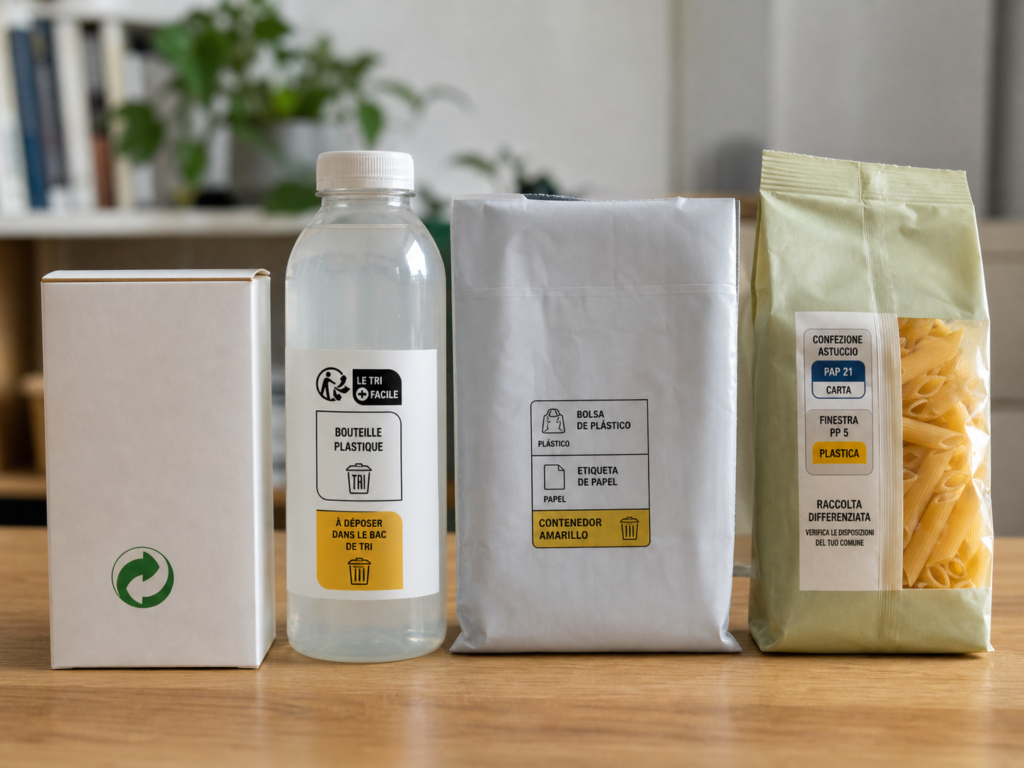
Comparison of Core Rules of the Four Core Target Countries
Germany, France, Spain, and Italy are EU markets where Chinese sellers have a large presence. The table below is only for preliminary screening and does not constitute a country-by-country compliance conclusion; registration, authorized representatives, declarations, labeling, and fees need to be verified one by one in combination with sales models, packaging categories, and official rules in effect at the time of release.
| Country | Core Registration Requirements | Main System Characteristics | Labeling Requirements | Simplification/Exemption Rules |
| Germany | It is necessary to first complete producer entity registration in the official LUCID system, and then join an officially authorized recycling system (PRO) | Full-category packaging control, mature regulatory system, producers need to complete both entity registration and participation in the recycling system | The Green Dot is a trademark of a specific recycling system. Whether it needs to be used depends on the selected recycling system and packaging type, and there is no universally mandatory unified labeling requirement | There are no universally applicable scale-based exemption rules, and all entities that meet the definition of producer must fulfill registration obligations |
| France | It is necessary to join an officially authorized PRO, which assists in completing producer registration and recycling responsibility fulfillment | Packaging is one of the categories of France’s multi-category EPR system, with a complete system covering all scenarios of packaging | Specific categories of packaging/products need to be affixed with the Triman logo and material classification code, which needs to be displayed on the product detail page simultaneously in e-commerce scenarios | Micro-enterprises that meet the officially recognized standards can enjoy simplified arrangements for some declaration or fee payment links, which is not equivalent to full exemption from EPR responsibilities. The specific conditions shall be subject to official rules |
| Spain | It is necessary to join an officially authorized PRO, and non-EU enterprises usually need to designate a local authorized representative | The registration and declaration rules are generally consistent with most EU countries, and managed by packaging material classification | It is necessary to mark packaging material classification information as required by regulations | For small producers whose annual packaging placement volume is below the statutory threshold, some obligations can be simplified; being below the threshold usually only affects the declaration frequency, report content, or some fee arrangements. Whether registration, authorized representatives, and voucher retention are still required needs to be confirmed item by item |
| Italy | It is necessary to join the nationally officially recognized producer responsibility system (such as CONAI-related systems) | The B2B packaging responsibility transfer rules are relatively clear and can only take effect if statutory conditions are met | It is necessary to mark packaging material classification information as required by regulations | Some small-scale entities or specific scenarios can apply simplified declaration, which shall be subject to officially released rules |
How to Judge Which Countries Need to Be Registered
When judging the countries that need to be registered, you cannot directly apply the logic of VAT distance selling thresholds, nor can you only take the sales destination as the sole criterion. You need to confirm step by step in combination with the sales model, identity of the responsible entity, and target country regulations. The core is to judge whether you are a “producer” or statutory responsible entity under the packaging regulations of the target country.
You can first sort out six core judgment dimensions: sales destination, location of goods inventory, import customs clearance entity, goods ownership/goods placement entity, packaging provider (you/platform/logistics provider/downstream buyer), and whether there is an EU-based importer that agrees to bear responsibility, then confirm one by one according to the following steps:
Step 1: Sort out all sales destinations and inventory locations, and list all involved EU countries;
Step 2: For each country, compare with the definition of “producer” in local packaging regulations, and judge whether you are a statutory responsible entity in combination with the customs clearance entity, goods ownership transfer node, and warehousing model (direct mail/FBA/overseas warehouse); only when the law of the target country recognizes overseas distance sellers as producers or responsible entities will the seller directly bear the corresponding registration obligation;
Step 3: Check the simplification/exemption rules of the target country to confirm whether you meet all applicable conditions (such as annual packaging volume threshold, micro-enterprise standards, etc.);
Step 4: If there is a situation of pure B2B wholesale, downstream enterprises have completed EPR registration in the country, or using an EU-based importer and the contract stipulates that the importer bears all statutory EPR obligations, you need to first confirm that the target country’s law allows such responsibility transfer, and then retain verifiable documents such as complete contracts and the other party’s registration certificate; some countries may still require overseas sellers to fulfill information reporting obligations.
Unless the systems of the two countries explicitly recognize each other, the EPR registration/participation certificate of one country cannot automatically cover sales in other EU countries.
5. Full Process of Compliance Operation from Scratch
The following is the general operation process, and the specific materials and cycle shall be subject to the official requirements of the target country.
After confirming the countries that need compliance, you can proceed step by step as follows. The core is to first figure out the basic data, and then complete registration and declaration as required.
Preliminary Information Inventory
Accurate packaging data is the basis of all compliance work, and data errors will directly affect the accuracy of subsequent registration and fee payment.
First, delimit the scope of packaging for which you need to bear responsibility: packaging that you purchase yourself and place on the market with goods usually needs to be fully included; for transport packaging provided free of charge by platforms or logistics providers and not owned by you, you need to confirm whether the provider bears the responsibility to avoid duplicate or wrong declarations.
Second, count all involved packaging levels: not only the sales packaging of the product, but also the transport packaging you provide (such as express boxes, cushioning materials, tape, pallet wrap, etc.).

Then, weigh by material category: take the average empty weight for each type of packaging (for example, a single product color box has an empty weight of 20 grams, classified as paper/paperboard; the tape used for a single parcel has an average weight of 5 grams, classified as plastic); composite packaging needs to be handled in accordance with the rules of the target country, and if you are unsure, you can consult the target country’s PRO or competent authority in advance.
Next, split the annual estimated sales volume by sales country, and calculate the total weight of packaging of each material in each country. Take a simple example: you sell a product to Germany, with a single sales packaging (paper) of 20 grams, transport packaging (plastic bubble wrap + tape) of 10 grams, and an estimated annual sales volume of 10,000 pieces. Then the annual paper packaging weight in Germany is 20g × 10,000 = 200 kg, and the plastic type is 10g × 10,000 = 100 kg.
Implementation Tip: The above simplified estimation is only applicable to scenarios where each order uses a fixed independent packaging configuration. Actual declarations need to be revised in combination with real situations: combined shipment, return and reissue, and reusable packaging need to adjust the statistical caliber in accordance with the rules of the target country to avoid duplicate charging; for transport packaging provided free of charge by platforms or logistics providers and not owned by you, you need to confirm whether the provider bears the responsibility to avoid duplicate declaration; if the packaging of gifts and samples is provided by you and placed with the goods, it usually needs to be included in the statistics. All data need to be checked one by one with the packaging use records of real orders, packaging purchase/requisition ledgers, and packaging data provided by platforms or logistics providers, and cannot be mechanically applied directly by the number of goods.
Apply for EPR Registration Number
First, choose the right formal channel: be sure to choose the PRO or official registration channel publicly announced by the target country, do not believe false propaganda such as “EU-wide universal EPR number”, to avoid invalid registration.
Then submit application materials: usually enterprise qualification documents and pre-counted packaging data are required. Non-EU enterprises also need to provide local authorized representative information as required (if needed).
The processing time is affected by the target country’s system, registration system efficiency, material completeness, and the processing rhythm of the selected PRO. The conventional processing cycle in most countries is 1 to 4 weeks, and the specific time shall be subject to the official notice of the official system or PRO. Before the statutory registration is completed, you cannot meet platform or regulatory requirements solely based on application screenshots.
After obtaining the registration certificate, upload it to the site backend of the corresponding e-commerce platform in time to avoid affecting product sales.
Packaging Label Rectification
In accordance with the statutory requirements of the target country, adjust the content, position, and size of the packaging label to ensure it is clear and legible; if the target country requires the label or material information to be displayed simultaneously on the e-commerce detail page, the corresponding content of the online store needs to be updated in time.
Declaration, Fee Payment and Voucher Management
Within each declaration cycle, count the packaging data actually placed in the current period as required by the target country, complete the declaration and pay the corresponding fees before the declaration deadline.
All compliance vouchers (including registration certificates, declaration records, fee payment vouchers, packaging weighing records, sales data, purchase vouchers, responsibility transfer agreements, etc.) need to be properly retained for the statutory retention period of the target country for verification.
6. Compliance Costs and Basic Decision-Making Methods
Compliance will inevitably generate costs. Clarifying the cost composition, finding the direction of legal cost reduction, and choosing a suitable handling method can help you control costs on the premise of compliance.
Three Components of Compliance Costs
The compliance cost of packaging EPR is usually divided into three categories. You can use a simplified formula to estimate the total annual cost: total annual compliance cost ≈ registration/service fee + Σ (annual placement weight of each material × corresponding material rate) + optional costs such as authorized representative/agent/version revision.
This formula is only a simplified estimation logic. The actual billing needs to pay attention to the following boundaries: first, the material rate is usually per kilogram, and some PROs will set a minimum recycling treatment fee threshold; second, fixed registration fees and PRO service fees may be calculated separately from the recycling treatment fee and are not included in the weight rate; third, fees in some countries include value-added tax or ecological adjustment surcharges, which shall be subject to official bills; fourth, authorized representative fees, agency fees, packaging revision fees, etc. are additional expenses and are not included in the basic compliance fees.
The three specific types of costs are:
• Fixed costs: including producer registration fees, PRO annual service fees, etc. The basic registration and annual service fees for small and medium-sized sellers in some countries range from tens of euros to hundreds of euros per year, depending on the service content, packaging category, and PRO. The specific amount shall be subject to the official real-time quotation of the selected institution.
• Variable costs: recycling treatment fees calculated based on packaging material and weight, which often change with packaging weight, material, and rate, are the most important variable item in the compliance budget, accounting for more than 70% of the total cost. The specific amount depends on the packaging material, total placement volume, target country, and the rate of the selected PRO.
• Other costs: including packaging revision fees (adjusting labels or materials), local authorized representative fees, agency service fees (such as entrusting a third party to handle), etc., which are optional or one-time expenses.
Legal Methods to Reasonably Reduce Compliance Costs
The core of legal cost reduction is to optimize the packaging itself, and all operations must be carried out on the premise of complying with the regulations of the target country:
First, optimize packaging design: reduce unnecessary redundant packaging, such as removing excess inner packaging, reasonably reducing the amount of cushioning materials, and reducing the total weight of a single package. Weight reduction usually directly reduces recycling treatment fees.
Second, adjust packaging materials: on the premise of meeting product protection requirements, prioritize the use of single recyclable materials with lower recycling treatment costs, and reduce the use of hard-to-recycle composite materials; some countries or PROs have rate discounts for packaging that meets recyclability standards, which shall be subject to official rules.
It is necessary to clarify the red line: you must never reduce costs illegally by falsely reporting packaging weight, omitting sales countries, or undercounting packaging types. Once verified, you may face penalties such as back payment of fees, late fees, and fines, which will outweigh the gains.
Judgment Criteria for Self-Registration or Finding an Agent
Choosing self-registration or entrusting an agent can be judged based on your own conditions:
• Situations suitable for self-registration: familiar with the official language of the target country, only laying out 1-2 countries, simple packaging categories (such as only involving single-material sales packaging), and having enough time to follow up on the whole process of registration, declaration, etc.
• Situations suitable for entrusting an agent: not familiar with the target country’s language, laying out multiple countries at the same time, complex packaging categories (involving multi-layer packaging, multiple materials), and not having enough time to handle compliance affairs.
The judgment logic is very simple: compare the time cost of handling compliance affairs by yourself with the agency service fee, and choose the solution that is more suitable for your business.
7. Practical Pitfall Avoidance and Violation Response
In practice, many practitioners fall into pitfalls due to inadequate understanding of the rules. The following summarizes the basic logic of high-frequency errors and violation response to help you reduce unnecessary losses.
Inventory of High-Frequency Practical Errors
There are five main types of high-frequency errors in practice, which require special attention:
1. Using a single registration certificate across countries: only registering EPR in one EU country but selling in multiple countries. Since each country’s system is independent, this situation is usually recognized as a violation.
2. Omitting transport packaging in declaration: only declaring the sales packaging of the product, and not including transport packaging such as express boxes, cushioning materials, and tape in the statistics. However, the control scope of most countries includes transport packaging provided by the seller themselves, and omission may lead to false declaration data.
3. Declaration data not updated for a long time: always using the initial estimated data for declaration, which is obviously inconsistent with the actual sales volume and packaging weight, and abnormalities are easily found during verification.
4. Choosing unqualified service institutions: not choosing an officially authorized PRO or formal service institution, or even believing false propaganda, resulting in invalid registration and failure to pass platform or regulatory verification.
5. Mistaking platform withholding for full compliance: some platforms may withhold recycling treatment fees, but statutory obligations such as registration, declaration, and label rectification are still borne by the seller. Failure to complete other requirements will still be a violation.
Core Consequences That May Arise from Violations
The consequences of violations are usually divided into several categories, and the specific ones shall be subject to the actual notice received and applicable laws:
• E-commerce platform measures: including product removal, suspension of sales authority, reduction of account compliance points, etc., which shall be implemented in accordance with the platform’s compliance rules.
• Regulatory and recycling system penalties: including ordering rectification, back payment of owed fees, late fees, fines, etc., which shall be handled by the member state’s regulatory authority or PRO in accordance with national regulations.
• Other possible impacts: under specific cases or the rules of some member states, serious violations may affect the import release of goods or market access, which shall be subject to official measures.
Basic Response Logic When Being Verified
If you receive a verification notice, you can handle it according to the following steps:
Step 1: Confirm the verification subject — first clarify whether the verification is initiated by customs, e-commerce platforms, member state regulatory authorities, or PRO. Different subjects have different verification focuses and requirements for submitted materials.
Step 2: Sort out compliance vouchers — organize registration certificates, declaration records, fee payment vouchers, responsibility transfer agreements (if any), and data supporting materials (weighing records, sales data, purchase vouchers, etc.) completely, and submit them as required.
Step 3: Cooperate with rectification and implementation — if violations are found during verification, promptly rectify, pay back fees or pay fines as required to avoid the expansion of violation consequences.
8. Regulatory Trends and Quick Self-Inspection Summary
Core Direction of Future Regulatory Changes
The EU’s new Packaging and Packaging Waste Regulation (abbreviated as PPWR in English) is a unified packaging rule directly applicable at the EU level. It has now entered the implementation transition phase. The core requirements include stricter packaging recyclability standards, recycled content requirements, industry-wide packaging reduction goals, and restrictions on some hard-to-recycle specific composite packaging and unreasonable excessive packaging. Different obligations of this regulation have transition periods of varying lengths, and most requirements will not be fully applicable immediately. The specific standards for some segmented categories still need to be further clarified through subsequent delegated acts and technical guidelines, and each member state also needs to formulate corresponding implementation rules. The specific effective time, transition arrangements, and national implementation rules shall be subject to the latest texts officially released by the EU and member states. Enterprises can pay attention to the dynamics in advance and gradually optimize packaging design to meet future requirements.
Quick Self-Inspection Checklist for Packaging EPR Compliance
You can quickly check your compliance progress against the following items:
□ Have confirmed that you are an EPR responsible entity in combination with the business model and target country rules
□ Have completed EPR-related registration in all sales target countries and uploaded to the corresponding platforms
□ Have counted the material and weight data of all packaging (including transport packaging) for which you need to bear responsibility
□ Have completed each cycle of declaration and paid recycling treatment fees as required
□ Packaging labels and online information meet the mandatory requirements of the target country
□ All compliance vouchers have been retained as required by the target country
Core Competency Summary
After mastering the basic logic of packaging EPR, you can quickly judge whether you are a responsible entity, complete the basic compliance operations of the target country according to the process, accurately sort out the list of countries that need to be registered, and choose the appropriate compliance method and legal cost reduction direction in combination with your own business scale and packaging complexity.
In general, packaging EPR is a compliance obligation that must be valued when entering the EU market. As long as you clarify your identity as a responsible entity and gradually implement various requirements in accordance with the statutory requirements of the target country, you can complete compliance smoothly. Doing a good job in packaging optimization and compliance planning in advance is an important foundation for enterprises to operate stably in the EU market for a long time.