
If you run a consumer electronics brand, work in OEM/ODM manufacturing, or sell electronics to Europe via cross-border e-commerce, you have definitely heard terms like the “EU common charger” and “USB-C directive”. Many people have lots of questions when they first encounter this: Do all products with a charging port have to switch to USB-C? Am I liable if I’m just a contract manufacturer? Will my goods be detained as soon as they arrive at European ports?
This article sorts out the basic responsibilities of manufacturers, judgment logic, and common misconceptions under this regulation, which can be used for preliminary compliance screening and data organization; for borderline product categories, complex products, or scenarios where multiple regulations overlap, confirmation must still be made in combination with the original text of the regulation and professional assessment.
1. First, Determine: Whether You and Your Products Are Subject to This Rule
Many people ask what needs to be changed right away, but the first step should be to judge: are you and your products actually bound by this regulation?
1.1 What exactly is this regulation?
Let’s put it in plain terms: the core goal of this regulation is to unify the wired charging interface of portable electronic devices to USB-C, and set a basic universal fast charging standard that all brands can use, to reduce e-waste and save consumers from having to repeatedly buy different chargers.
It is not an independent new regulation issued out of thin air by the EU, but a set of unified charging-related requirements introduced by amending the Radio Equipment Directive (RED, the basic regulation applicable to electronic devices with radio functions). It only applies to the listed products within the scope of RED, and does not cover all electronic products.
Scope of application: Directly applicable in EU member states; for non-EU member states in the European Economic Area (EEA) (such as Norway, Iceland, and Liechtenstein), it shall be subject to the relevant regulatory incorporation process and national implementation rules.
If a product is non-compliant, it may face consequences such as customs detention, platform delisting, fines, and sales suspension, affecting the product’s circulation in the EU market.
Common misconception: Many people think that a common charger means unified charging speed, and all devices will fast charge at the same speed in the future. That’s not the case — the regulation only unifies the form of the wired charging interface and the universal fast charging protocol; manufacturers can still retain proprietary high-power fast charging solutions, as long as they are compatible with the universal standard.
1.2 Who is the “manufacturer” that bears the main responsibility?
The “manufacturer” in EU regulations is different from the “production factory” as commonly understood. Under normal circumstances, the entity that places a product on the EU market under its own brand, trademark, or name is the manufacturer and bears core compliance responsibilities, regardless of whether it organizes production on its own.
For manufacturers headquartered outside the EU, according to the RED and EU market surveillance rules, they must ensure that there is a legally responsible entity (i.e., economic operator) within the EU that can undertake the functions of market surveillance liaison and compliance document provision in accordance with the law. Products must not be directly placed on the EU market without any EU-based counterpart entity. Common economic operator roles include importers, EU authorized representatives (commonly referred to as “EU AR”), etc. The applicable rules for different scenarios are as follows:
• If the product is introduced and placed on the market by an importer located within the EU, the importer itself has the legal obligation to conduct compliance verification and liaise with regulators. In this case, the overseas manufacturer does not need to additionally appoint a separate EU AR, but must clearly define the division of compliance responsibilities with the importer;
• If an overseas manufacturer directly sells to EU consumers through cross-border e-commerce, independent websites, etc., and there is no EU importer or other entity assuming the role of economic operator, it must appoint an EU authorized representative (EU AR), who shall bear joint and several liability for regulatory liaison and document preservation in accordance with regulatory requirements. However, the EU AR’s responsibility only covers the scope of statutory duties and does not replace the manufacturer’s core design and compliance obligations.
Responsibility judgment in OEM/ODM scenarios: If the product is placed on the market with the brand owner’s trademark, the brand owner is the first responsible party and cannot shift all compliance responsibilities to the contract manufacturer; if the contract manufacturer places the product on the EU market in its own name, it must bear all the responsibilities of a manufacturer.
Common misconception: Many people think that the contract manufacturer is the manufacturer, and you can just go to the factory if something goes wrong. In fact, EU regulators first trace the responsibility of the brand owner that placed the product on the market. The responsibility of the contract manufacturer must be determined in combination with its identity in the supply chain and contractual agreements, which is a separate matter from the responsibility division at the regulatory level.
1.3 Which products need to comply, and when?
The unified charging requirements only apply to consumer radio equipment listed in the directive that supports wired charging, and the effective dates are divided into two batches:
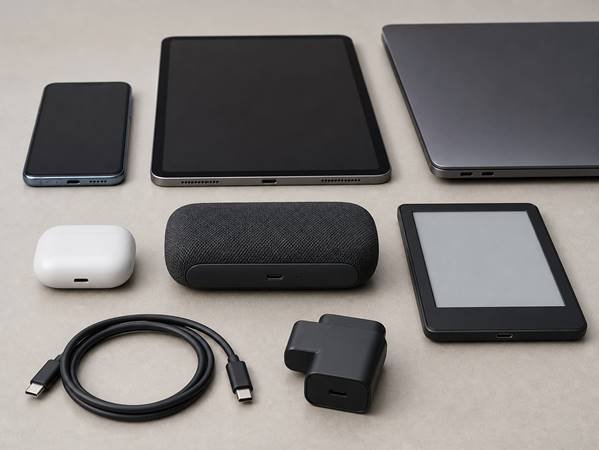
• Mandatory from December 28, 2024: mobile phones, tablets, headphones, portable cameras, portable game consoles, portable speakers, e-book readers, keyboards, mice, portable navigation devices, etc.;
• Mandatory from April 28, 2026: laptops.
Please note: Although USB-C chargers and cables sold separately or included with the main unit do not fall into the above radio equipment category and are subject to different specific regulations, they should also be included in the scope of compliance checks simultaneously. They must meet corresponding requirements such as charging parameter labeling, low voltage, electromagnetic compatibility, RoHS, and ecodesign, to avoid affecting overall sales due to non-compliant accessories.
Prerequisite for application: The device has a wired charging function — devices that only support wireless charging and do not have any wired charging interface are not subject to the USB-C interface and wired fast charging requirements; for devices that support both wired and wireless charging, the wired charging part still needs to meet the requirements.
The time standard for determining whether compliance is required is the time when the product is first placed on the EU market: that is, when the product is first made available on the EU market for the purpose of sale or use. This must be comprehensively judged in combination with the first provision act, sales conditions, and delivery arrangements, and is not solely based on the shipping time. For example:
• Cross-border e-commerce that openly sells to EU consumers and arranges delivery usually counts as placing on the market;
• Crowdfunding products are judged based on the actual time of first delivery to EU backers;
• Inventory that is simply stored in a warehouse within the EU and has not yet been subject to any sales or supply commitments is usually not considered placed on the market, but if first provision acts such as order placement or pre-sale agreements have been completed, it must be judged in combination with the actual situation.
Common misconception: Many people think that all devices with a USB port have to switch to USB-C. In fact, only consumer radio equipment explicitly listed in the directive needs to comply. Non-consumer or unlisted products such as industrial sensors and medical portable devices are not subject to this unified charging requirement even if they have a USB port.
1.4 In which cases does this requirement not apply?
Exemption judgment requires two steps: first, confirm that the product does not fall into the category of consumer radio equipment explicitly listed in the directive, then check whether it meets the specific exclusion scenarios. The following types of situations are not within the scope of application of the unified charging requirements, and there is no need to bear corresponding responsibilities:
1. Specialized non-consumer equipment: Portable equipment dedicated to industrial, medical, or military use does not itself fall into the category of consumer radio equipment listed in the directive, so it does not apply. The specific boundary must be judged in combination with the actual use, function of the equipment and the annex list of the regulation;
2. Built-in devices in transportation equipment: Charging devices built into transportation equipment such as cars and airplanes are not within the scope of the requirements;
3. Products subject to transitional rules: Products that have been legally placed on the EU market before the mandatory effective date do not need to be recalled for rectification and can continue to circulate and be sold; however, new batches of products produced after the effective date still need to comply if placed on the EU market;
4. Non-sale test and exhibition prototypes: Non-sale items used only for R&D testing and exhibition display are not considered placed on the market and do not need to comply; but if they are used for sale (including paid samples), they must meet the requirements.
Common misconception: Some people think that if you sell in small batches or only sell to small EU countries, no one will check. In fact, the applicable obligation is not affected by sales scale or the size of the member state. As long as it is an applicable product placed on the EU market, it must meet compliance requirements.
2. Core Responsibility 1: Mandatory Requirements for Product Design
If it is confirmed that the product falls within the scope of application, it must first meet the mandatory requirements at the hardware level, which are the basis of compliance.
2.1 USB-C Interface: Must Comply with Universal Standards, No Skirting the Rules Allowed
The most basic requirement is: the device must be equipped with a standard USB-C charging female port, and comply with the relevant requirements of the EU harmonized standard EN IEC 62680-1-3 (USB-C Interface Universal Specification), and be able to normally adapt and charge with USB-C cables that meet the universal standard.
“Fake USB-C” that only looks like USB-C but whose pin definition or electrical performance does not meet the universal standard is clearly non-compliant. It is also not allowed to replace the USB-C female port requirement of the device itself with an included adapter — for example, if the device itself is Micro USB and comes with a C-to-Micro adapter, it still does not meet the requirements.
If the device has multiple charging interfaces, it is allowed to retain other interfaces as long as one of them is a standard USB-C female port that can be used for wired charging.
2.2 Universal Fast Charging: Must Support USB PD When Trigger Conditions Are Met
USB PD (USB Power Delivery) is a universal fast charging negotiation protocol between devices and chargers of different brands, equivalent to a “universal language” for cross-brand fast charging. As long as both sides support PD, they can automatically negotiate to a suitable power level for charging.
The trigger condition of the regulation is: if the device can perform wired charging at a voltage higher than 5V, a current exceeding 3A, or a power exceeding 15W, it must support the USB PD protocol. If none of the above trigger conditions are met, the mandatory USB PD requirement of the revised RED is usually not triggered, but other applicable requirements such as interface and information disclosure still need to be met.
The judgment boundary needs to be clarified here: what the regulation requires is that the device has USB PD universal negotiation capability, not that any third-party PD charger can reach the device’s maximum charging power — after all, the charger itself has a power upper limit. As long as the device does not prevent chargers that comply with the USB PD specification from completing protocol negotiation and can charge normally according to the universal PD power levels declared by the device, it meets the requirements.
Manufacturers can retain proprietary high-power fast charging solutions (such as 100W, 200W proprietary protocols), but there is a red line: they must not hinder or restrict the complete operation of the USB PD charging function, and cannot restrict the normal negotiation and basic charging power of third-party compliant PD chargers through software or hardware. USB PD requirements are usually verified with reference to the EU harmonized standard EN IEC 62680-1-2 (USB Power Delivery Specification).

Common misconception: Having a USB-C port equals supporting fast charging. In fact, USB-C is just the interface form, which is a separate concept from the fast charging protocol. Low-power devices do not need to support PD fast charging if they do not meet the PD trigger conditions.
2.3 Supporting Accessories: Different Rules Apply to Main Units and Accessories
The core regulatory object of the unified charging requirements (revised RED) is the listed radio equipment (i.e., the main unit). Chargers and cables that are included or sold separately must respectively meet their corresponding EU regulatory requirements:
• Chargers (external power supplies): Must meet corresponding requirements such as the Low Voltage Directive, Electromagnetic Compatibility Directive, Ecodesign Regulation, and RoHS Directive;
• USB-C cables: Applicable regulations must be checked according to their specific structure, function (such as whether they support data transmission, whether they have an E-Marker chip) and sales method. Not all cables are subject to exactly the same safety and electromagnetic compatibility requirements.
If the product is sold as a set (main unit + charger/cable), the manufacturer is responsible for the compliance and information consistency of the entire set. The compliance status and information labeling of accessories will affect the compliance judgment of the entire set.
Common misconception: Many people think the EU requires that chargers cannot be included. In fact, the regulation does not mandate that chargers must be included; manufacturers can independently choose whether to include them, as long as they clearly inform consumers before sale. Not including a charger is not non-compliant; only non-compliant included accessories will cause problems.
2.4 Quick Technical Compliance Judgment Logic (Beginner Version)
You can initially judge hardware compliance through a four-step logic. For a more comprehensive check, please refer to the unified self-check list at the end of the article:
Step 1: Confirm whether the product is in the category list listed in the directive;
Step 2: Confirm whether it supports wired charging;
Step 3: Confirm whether it has a standard USB-C female port;
Step 4: Confirm whether the power exceeds 15W and whether it supports USB PD.
3. Core Responsibility 2: Information Disclosure and Compliance Document Requirements
Meeting hardware standards is only the first step; information disclosure and compliance documents are equally important. Many non-compliance cases arise from inconsistencies between documents and information.
3.1 Packaging and Sales Pages: Core Information Must Be Consistent, No Misleading Allowed
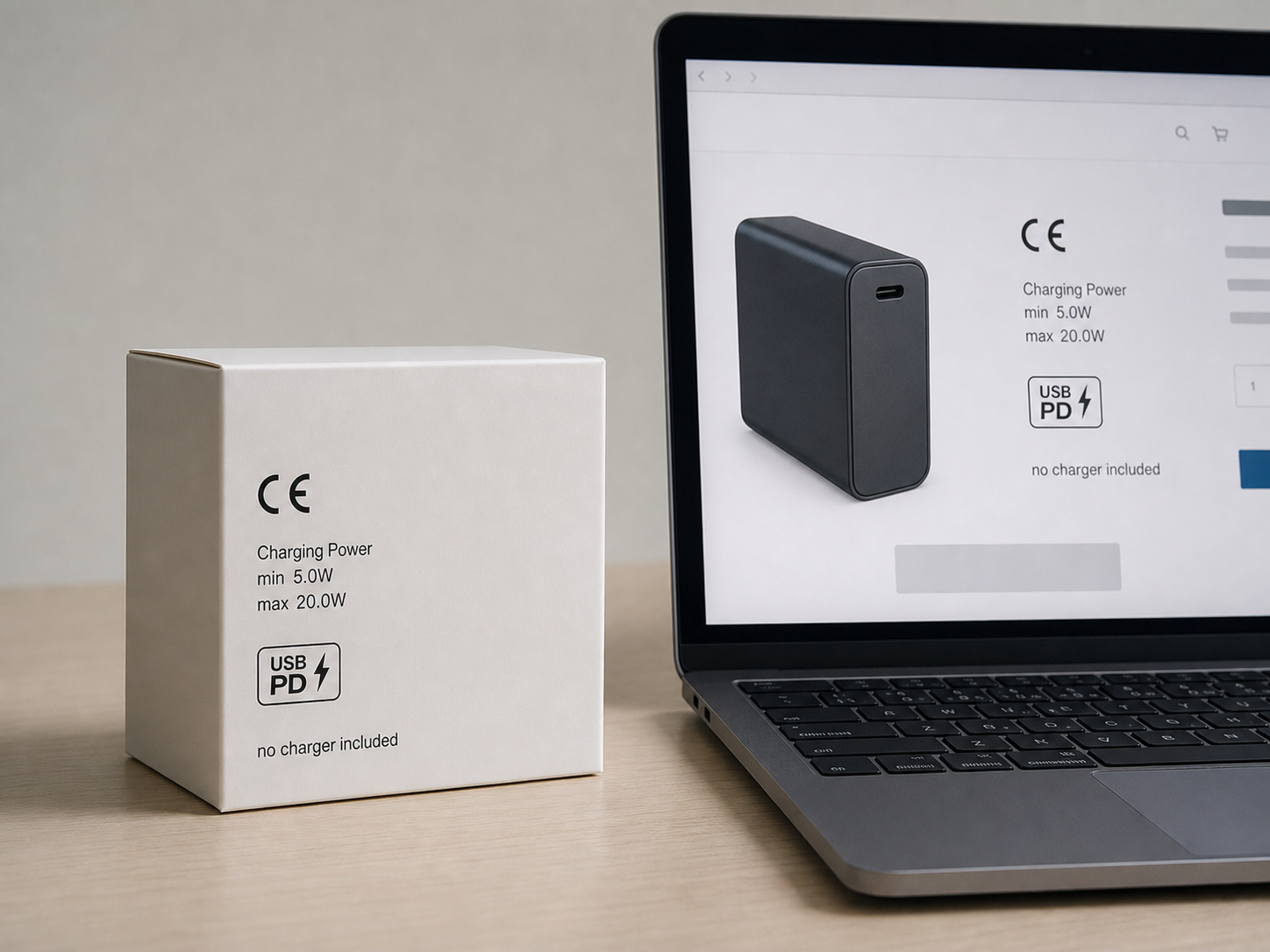
The regulation requires manufacturers to clearly disclose necessary charging-related information before consumers purchase. Packaging, manuals, and online sales pages must be completely consistent in statutory charging information, and consumers must be able to clearly see it before placing an order; different carriers can add additional explanations according to their own characteristics, but must not change or weaken the authenticity of the core information.
The core information to be disclosed includes:
1. Whether the product comes with a charger;
2. The minimum and maximum charging power of the device;
3. Whether it supports USB PD universal fast charging and the types of compatible charging devices;
4. When applicable, the specified charging-related marks or diagrams must be displayed.
Marketing and promotion must not use vague expressions to replace statutory charging parameters, and must not mislead about charging capacity or accessory inclusion — for example, only using promotional terms like “super fast charging” or “extreme flash charging” without labeling specific parameters, or the online page saying “charger included as standard” while the packaging labels “no charger included”, may constitute non-compliance.
3.2 Product Labeling: Must Meet Traceability Requirements
The labeling on products and packaging must meet the following basic requirements:
1. CE mark: The CE mark is a mark by which the manufacturer declares that the product complies with all applicable EU harmonized legislation and has completed the corresponding conformity assessment procedure; it is not a third-party quality certification. Please note: The CE mark alone cannot prove that the product meets the common charger-related requirements. It is necessary to combine the Declaration of Conformity (DoC) and technical documents to confirm whether the charging-related requirements of the revised RED are covered.
2. Manufacturer entity information (required): The manufacturer’s name, registered trade name or trademark, and contact postal address must be labeled. This is basic information that all applicable products must label.
3. Other economic operator information (if any): If the manufacturer has appointed an EU authorized representative or other economic operator that is required to be labeled by law, their name and address can be labeled at the same time, but the information of such entities cannot replace the manufacturer’s information. The labeling position must meet the relevant rule requirements for product size and readability.
4. Traceability information: Information such as model, batch, and serial number must be labeled to ensure that specific production batches can be traced when problems occur.
5. Manual: Must include charging compatibility-related information, and the language must meet the official language requirements of the selling member state, which is specifically determined according to the rules of the target market.
3.3 Compliance Documents: Complete Compliance Files Must Be Prepared
Manufacturers must prepare complete compliance certification documents, which must be provided in a timely manner during regulatory spot checks. The relevant requirements can be sorted out according to the following logic:
• Conformity assessment route: First, it is necessary to clarify the conformity assessment procedure applicable to the product under the RED (most consumer radio equipment applies to internal production control Module A). When internal production control applies, the manufacturer can complete internal assessment and testing on its own, or entrust a qualified third-party laboratory to conduct testing as a verification method; whether a third party must be used depends on the applicable conformity assessment procedure, product risk level, and the enterprise’s own technical capabilities. If testing is carried out using harmonized standards officially published by the EU, presumption of conformity can be enjoyed (i.e., compliance with harmonized standards defaults to meeting the corresponding regulatory requirements), but it is still necessary to ensure that technical documents cover all applicable requirements.
• Technical documentation: That is, the product’s compliance file, which usually includes product design descriptions, hardware and software version information, verification records of charging interfaces and PD protocols, test reports, risk analysis reports, conformity assessment procedure records, etc.
• EU Declaration of Conformity (DoC): A written compliance declaration signed by the manufacturer, which must list product identification information (brand, model, serial number, etc.), applicable EU regulations, adopted harmonized standards, information of the manufacturer and authorized representative, etc. The content must be completely consistent with the actual situation of the product.
• Storage requirements: Technical documentation and the Declaration of Conformity must be stored for at least 10 years from the date the relevant product is last placed on the EU market.
3.4 Post-Market Ongoing Responsibility: Compliance Is Not a One-Time Effort
After the product is launched on the market, the manufacturer still bears ongoing compliance responsibilities:
• If non-compliance or safety risks are found in the product, the supply of the relevant product should first be stopped, investigation and risk assessment should be carried out, appropriate measures such as correction, withdrawal, and recall should be taken according to the risk level, and the regulatory authorities of the relevant member states should be notified in accordance with applicable regulatory requirements;
• Must cooperate with the spot checks and investigations of regulatory authorities in various EU countries, and provide compliance materials as required;
• When the product is revised, a change impact assessment must be completed first and records must be kept. Only when the changes do not affect relevant parameters such as the electrical performance of the charging interface, charging power, PD negotiation logic, firmware charging limits, and safety test conclusions, is it unnecessary to re-conduct charging-related conformity assessment; if changes are made to charging interfaces, fast charging protocols, power parameters, etc. that affect charging compliance, all compliance documents must be re-evaluated and updated. Even changes that do not involve charging functions, such as only changing the color scheme, storage capacity, or shell material, also need to retain assessment records to confirm no impact.
Common misconception: Many people think that once the product is launched, it’s done. In fact, as long as the product is still within the document storage period, the manufacturer is responsible for its compliance, and revisions or discovered problems must be handled in a timely manner.
4. Advanced: Responsibility Boundaries and Special Scenario Judgment
If you have already sorted out the basic requirements, the following advanced content can help you clarify responsibility boundaries and avoid hidden pitfalls.
4.1 How Are the Responsibilities of Each Role in the Supply Chain Divided?
The responsibilities of different roles in the supply chain must be determined in combination with their legal status and actual behavior. The core distinction is between “statutory responsibility at the regulatory level” and “civil liability agreed by contract”. The responsibility boundaries of common roles can be referred to in the following table:
| Supply Chain Role | Main Statutory Duties | Responsibilities Not Borne/Not Replaced | Statutory Actions After Discovering Non-Compliance |
| Brand owner (places products on the market under its own brand) | Bears core full-process responsibilities such as product design, compliance verification, signing the DoC, post-market rectification, and risk notification | Is the first responsible party, cannot shift core compliance responsibilities to contract manufacturers or other supply chain roles | Proactively stop sales, conduct investigation and assessment, take correction/recall measures, notify regulatory authorities |
| Contract manufacturer (OEM/ODM, only does contract manufacturing, does not place products under its own brand) | Produces products in accordance with the contract manufacturing agreement, cooperates in providing technical materials required for compliance | Does not directly bear design compliance responsibility to EU regulators, unless it places products in its own name | Cooperates with the brand owner in rectification and provides technical materials as agreed in the contract |
| EU Authorized Representative (EU AR, economic operator appointed by the manufacturer) | Saves compliance documents, liaises with EU regulatory authorities, and transmits compliance information in accordance with the entrustment agreement and regulatory requirements | Does not replace the manufacturer’s core responsibilities such as design and conformity assessment, only bears joint and several liability within the scope of statutory/entrusted duties | Cooperates with regulatory investigations, timely transmits regulatory requirements to the manufacturer, and notifies regulatory authorities when necessary |
| Importer (economic operator that introduces products into the EU market) | Verifies the basic compliance labels of products (CE, manufacturer information, DoC, etc.), ensures that products meet EU requirements | Does not bear core compliance responsibility at the product design level | Immediately stops sales upon discovering obvious non-compliance, notifies the manufacturer and regulatory authorities |
| Distributor | Verifies basic compliance labels of products, ensures that sold products meet requirements | Does not bear product design and core verification responsibilities | Immediately stops sales upon discovering obvious non-compliance, cooperates with regulatory investigations |
Common misconception: Many people think that the ready-made test reports of contract manufacturers can be used directly. In fact, test reports must correspond to all information of the current product, such as brand, model, hardware version, software version, and production configuration. Simply modifying the brand name in the report header cannot make it valid compliance evidence. If the product design and configuration are completely consistent with the original report, the responsible entity must assess the applicability of the report and keep records, and supplement testing or re-assess if necessary.
4.2 Compliance Judgment for Special Sales Scenarios
Under different sales models, the core judgment standard is still “whether it constitutes placement on the EU market” as defined in Section 1.3. The reference judgments for common scenarios are as follows:
• Cross-border e-commerce (platform/independent site): If openly sold to EU consumers and delivery is arranged, it usually counts as placement on the market and must meet compliance requirements, regardless of whether there is a company or warehouse within the EU;
• Crowdfunding/pre-sale products: Whether the effective requirements apply is judged based on the time of actual first delivery to EU consumers/backers; if the delivery time is after the mandatory effective date, compliance is required;
• Small-batch samples: If used for sale (including paid samples), they count as placement on the market and require compliance; if only used for R&D testing and exhibition display and not for sale to the public, they are not considered placement on the market;
• Multi-region version products: The version sold in the EU must separately meet relevant EU requirements. Compliance documents from other countries or regions cannot directly replace EU compliance certificates. Even if the product’s hardware appearance is the same, it is necessary to confirm whether it meets specific EU requirements such as interface, protocol, and labeling.
Common misconception: A product that is compliant in its home country is equivalent to being EU compliant. In fact, the EU has separate requirements for interfaces, fast charging protocols, and labeling, which differ from the regulations of other countries, so separate EU compliance verification must be completed.
4.3 Boundary Judgment of Technical Requirements
Some easily confused technical boundary issues can be quickly judged according to the following rules (for specific requirements, please refer to the corresponding sections above):
• Proprietary fast charging: Proprietary high-power fast charging solutions can be retained, but the complete operation of the USB PD charging function must be guaranteed. For specific rules, see Section 2.2;
• Wireless charging devices: Devices that only support wireless charging are not subject to wired charging requirements; those that support both wired and wireless charging must meet wired requirements. For judgment criteria, see Section 1.3;
• Replacement accessories: Chargers and cables newly produced and placed on the EU market, whether original brand or not, must meet corresponding regulatory requirements. For details, see Section 2.3;
• Revision judgment: The standard for whether changes require re-assessment is in Section 3.4. All revisions must retain change impact assessment records, and those involving charging functions must be re-assessed;
• Effectiveness of the CE mark: Having a CE mark does not mean that it necessarily meets the common charger requirements. For specific explanations, see Section 3.2.
5. Pitfall Avoidance Reference: Consequences of Non-Compliance and High-Risk Behaviors
5.1 What Are the Possible Consequences of Non-Compliance?
The EU does not set a unified fine amount for all member states and all common charger non-compliance acts. The specific penalty measures and amounts are determined by each member state according to its own market surveillance regulations, the circumstances of the violation, and the type of product. Common consequences of non-compliance include:
• Entry stage: If non-compliance is found during customs inspection, the goods may be detained and need to be returned or destroyed;
• Sales stage: E-commerce platforms may delist non-compliant product links according to rules, and market surveillance authorities may require sales suspension;
• Regulatory penalties: May include rectification within a time limit, fines, etc. The maximum fine in some member states can reach 4% of the company’s global annual turnover or a fixed amount of hundreds of thousands of euros, but this standard is not uniform across the EU. In practice, it must be verified according to the specific regulations of the target member state, and the fine range also varies for different violation circumstances;
• After-sales stage: If sold products have compliance risks, regulatory authorities may require withdrawal or recall, and the relevant costs shall be borne by the responsible entity.
5.2 High-Risk Non-Compliance Behaviors That Occur Frequently
The following are the four most frequent types of non-compliance behaviors, which need to be focused on avoiding:
1. Hardware category: No standard USB-C charging female port, “fake USB-C” incompatible with universal standards, not supporting USB PD when PD trigger conditions are met, intentionally restricting the normal functions of third-party compliant PD chargers;
2. Labeling category: No CE mark, no clear labeling of whether a charger is included, charging parameters are false or inconsistent with reality;
3. Document category: Overseas manufacturers fail to legally ensure that there is a responsible entity within the EU that can liaise with regulators, no valid Declaration of Conformity/technical documentation, documents are inconsistent with the actual product information;
4. Information category: Contradictions between online sales pages and core product/packaging information, misleading promotion of accessory inclusion or charging capacity.
5.3 Reference for Internal Compliance Priority
You can set internal compliance priorities according to your own situation. The following is only a reference for internal resource allocation of enterprises, and does not represent official law enforcement standards:
• High priority: Categories with high spot check attention such as mobile phones, tablets, chargers, high-sales products, products without basic compliance labels;
• Medium priority: Niche categories, small-batch products, products whose hardware basically meets standards but have incomplete compliance documents;
• Low priority: Products close to the boundary of the scope of application, non-sale samples, old products that have been legally placed on the market before the effective date.
Please note: Priority is only used for internal resource allocation. As long as the product falls within the scope of application, it must 100% meet the regulatory requirements, and compliance standards cannot be lowered due to low priority; for products close to the exemption boundary, it is recommended to form a written scope judgment record for regulatory verification.
6. Practical Tools: Self-Check List and Compliance Implementation Steps
For your convenience in quick sorting, a unified self-check list and basic implementation steps are compiled here, which can be used for preliminary compliance screening.
6.1 Unified Self-Check List
| Check Category | Check Content |
| Scope and Time | Is the product a consumer radio device listed in the directive? Does it support wired charging? Is the time of placement on the EU market after the corresponding mandatory effective date? Does it fall into an inapplicable exemption/out-of-scope scenario? Are separately sold/included accessories included in the check simultaneously? |
| Hardware Requirements | Is it equipped with a standard USB-C charging female port that complies with universal standards? If PD trigger conditions are met (any of voltage >5V / current >3A / power >15W), does it support USB PD with complete functions? Are there settings that restrict third-party compliant PD chargers? |
| Accessories and Sets | Do included/separately sold chargers and cables meet corresponding regulatory requirements? Is the information of products sold as sets consistent and overall compliant? |
| Labeling and Information | Does the product/packaging have a CE mark? Is the manufacturer’s name and contact address labeled (if an EU economic operator is appointed, the corresponding information can be labeled at the same time)? Is there traceability information such as model, batch, and serial number? Is the charger inclusion status, minimum/maximum charging power, whether USB PD is supported, and compatible charging devices clearly disclosed? Is the core information on the online sales page consistent with the packaging? |
| Compliance Documents | Has the applicable conformity assessment procedure been completed? Is there technical documentation for the corresponding product version? Has an accurate EU Declaration of Conformity (DoC) been signed? Are the documents stored as required? |
| Post-Market Management | Has a post-market compliance monitoring mechanism been established? Is a change impact assessment conducted first when revising products? Is there a corresponding risk assessment and rectification process when problems are found? |
Note: This list is only for preliminary screening. If it involves borderline product categories, complex products, or scenarios where multiple regulations overlap, it is necessary to further verify regulatory requirements or consult a professional institution.
6.2 Four Steps for Basic Compliance Implementation
If you are new to EU common charger compliance, you can proceed according to the following steps:
1. Compliance determination: Sort out the product category, charging configuration, planned launch time, and target sales market, and confirm your own identity as the responsible entity; overseas manufacturers pre-select eligible EU-based responsible entities (such as importers, authorized representatives, etc.) in advance.
2. Product rectification: Replace with a standard USB-C female port as required, adapt to the USB PD protocol (for products that meet the trigger conditions), and remove restrictions on third-party compliant PD chargers; supporting chargers and cables simultaneously complete compliance rectification for corresponding regulations.
3. Compliance verification: Determine the applicable conformity assessment procedure, conduct internal testing or entrust a third-party laboratory to test, and compile complete technical documentation and EU Declaration of Conformity; overseas manufacturers sign a formal agreement with the selected EU responsible entity to clarify responsibilities.
4. Pre-launch verification: Check whether all core labels and information on the product, packaging, and online sales pages are consistent, confirm that compliance documents have been archived as required, and then officially place the product on the market after confirming there are no errors.
6.3 Most Easily Overlooked Issues in Self-Check
Many people tend to overlook the following points during self-check, so special attention is needed:
1. Dual verification of hardware + documents: Don’t only check the hardware interface and protocol; missing compliance documents or inconsistent information will also trigger penalties;
2. Dual verification of product + sales page: The core charging information on the online sales page must be consistent with the packaging, and there must be no contradictions;
3. Dual verification of main unit + accessories: Included or separately sold chargers and cables also need to be included in compliance checks, not just the main unit;
4. Dual verification of first + regular: Self-checks must be re-conducted when products are revised or regulatory standards are updated; compliance is not a one-time effort.
Final Summary
The core regulatory logic of the EU Common Charger Directive is to reduce e-waste by unifying interfaces and universal fast charging standards, and the ultimate bearer of all responsibilities is the manufacturer that places the product on the EU market under its own brand.
For enterprises, compliance implementation must cover at least five core links: first complete the judgment of applicable scope and responsible entity, then implement the hardware requirements of USB-C interface and USB PD universal fast charging, simultaneously verify the consistency of charging information on packaging and sales pages, archive complete Declaration of Conformity and technical documentation, and finally establish a post-market change management and risk response mechanism.
If your product belongs to a borderline category, you are unsure of the applicable scope, or it involves complex scenarios where multiple regulations overlap, it is recommended to consult a professional compliance institution to avoid unnecessary losses due to misjudgment.