
Whether you encounter customs detention when purchasing battery-powered electronic products via overseas shopping, or see battery-containing products in cross-border stores removed from platforms, many people first come into contact with the EU’s New Battery Regulation due to compliance issues. What exactly does this set of rules regulate? Which products fall within its scope? What should ordinary consumers and small and medium-sized merchants pay attention to respectively? This article sorts out the core regulatory points related to battery-containing electronic products from beginner to semi-proficient level, allowing you to grasp the key requirements without reading through hundreds of pages of official original text.
First, Get the Basics Right: What the Regulation Is and Whether It Applies to You
Simply put, this is a unified EU battery regulatory rule that officially entered into force in August 2023, replacing the old version of the Battery Directive that was previously adjusted by each member state on its own. Its core objectives are to improve battery safety, promote easy battery replacement, reduce electronic waste, and increase the recycling rate of waste batteries. The regulatory scope includes both batteries sold separately and all electronic products with built-in, removable, or complimentary batteries included with the product.
Direct consequences of non-compliance include customs detention of goods and removal from e-commerce platforms. The fine amount is formulated by each member state in accordance with its own enforcement law, and in some scenarios can be up to 4% of global annual turnover. The specific amount is subject to the regulations of the country of sale and the actual applicable scenario.
Many people are concerned about whether the products they come into contact with fall within the regulatory scope. In fact, the vast majority of daily-use battery-containing electronic products are subject to regulation: common consumer electronics such as mobile phones, wireless earphones, laptop computers, tablets, power banks, smart watches, and portable speakers; small daily-use electronics such as electric toothbrushes, wireless keyboards and mice, battery-powered remote controls, electronic scales, and toys; as well as light mobility tools such as electric scooters and electric bicycles (corresponding to light means of transport batteries, abbreviated as LMT batteries) — all are regulated. Only military, aerospace, specific medical, or special scientific research equipment are temporarily exempt, and ordinary users basically do not have access to such exempt products.
Here is a 30-second battery classification method for you — the battery category directly determines the strictness of regulation. When making a judgment, you don’t need to first obsess over whether it is a lithium battery or a dry battery; just look at the purpose first and then the weight. The most common type is portable batteries: weighing ≤5kg, used in ordinary handheld consumer scenarios, such as built-in batteries for mobile phones and earphones. This type has the fewest requirements and is the mainstream type of consumer electronics. The second category is LMT batteries: used for light mobility tools such as electric scooters and electric bicycles, with relatively more requirements. The third category is industrial/automotive batteries: such as large-capacity energy storage and electric vehicle batteries, which are basically not involved in ordinary consumer electronics, so there is no need to specifically study the corresponding rules.
Regarding the scope of application, three core boundaries need to be clarified: First, as long as a product contains batteries (whether built-in, removable, or spare batteries included as a free gift in the packaging), it is subject to regulation once it enters the EU market. There is no exception that “complimentary batteries do not count”. Second, the responsible entities cover the entire chain: complete machine brands, importers, and sellers all need to bear corresponding responsibilities, and it is not only the battery manufacturer that is responsible. Third, the requirements for different categories of batteries vary greatly, so there is no need to apply the strict rules for industrial batteries to increase unnecessary compliance costs.
Visible to the Naked Eye: Mandatory Labeling and Information Requirements (Must-Know for Beginners)
After confirming that a product falls within the regulatory scope, the easiest compliance check method is to verify the labeling — most of these requirements can be verified with the naked eye, and can be used by consumers when purchasing and inspecting goods, as well as by merchants for self-inspection when stocking goods.
The EU’s New Battery Regulation officially entered into force in August 2023, among which labeling obligations will be implemented in phases and by category starting from February 2024 according to specific provisions. The specific requirements are subject to the applicable provisions and the enforcement rules of the country of sale. For portable batteries and consumer electronics containing portable batteries newly placed on the EU market starting from February 2024, in principle, three types of core information must be marked in visible positions on the battery, product, or packaging: rated capacity, chemical composition, and the crossed-out wheeled bin recycling symbol (i.e., a reminder that it is prohibited to dispose of in ordinary household waste). The labeling must be clear, durable, and not easy to wear or fall off; if it is impossible to mark on the battery body due to extremely small size (such as button batteries) or technical reasons, the information can be transferred to the packaging or accompanying documents in accordance with regulations, but it cannot only be placed in internal documents that are difficult for ordinary consumers to obtain. Starting from 2027, applicable categories of portable batteries and LMT batteries must be affixed with an information QR code, which can be scanned to query information such as battery parameters and recycling methods required to be disclosed by the regulation; the QR code for LMT batteries must also link to a full-life-cycle file (i.e., battery passport). For categories involving additional disclosure requirements such as carbon footprint and recycled material ratio, relevant data must be linked in accordance with corresponding rules.
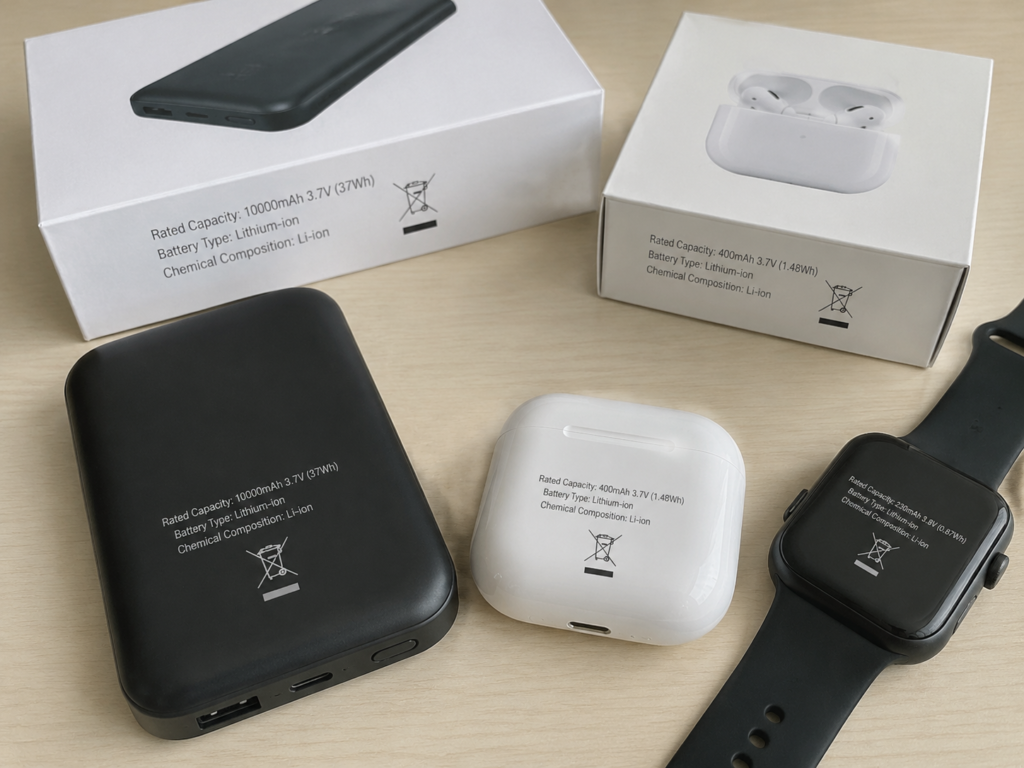
In addition to the labeling on the product body, the product packaging and instruction manual must include three types of mandatory information: First, the battery type and instructions for replacement; products with replaceable batteries must also be accompanied by specific operation instructions. Second, the query method for battery recycling channels within the EU, to facilitate consumers to find the nearest recycling point. Third, the contact information of the manufacturer or its responsible entity within the EU (including importers and authorized representatives).
Ordinary consumers can first conduct a preliminary screening based on two criteria (this is not equivalent to a complete compliance judgment): First, core information such as capacity, chemical composition, and recycling symbol should, in principle, be presented in positions that can be directly accessed at the time of purchase, such as the battery, product, or packaging, and cannot only be hidden in internal technical documents or require disassembly of the product to view; in cases of extremely small size or where regulations allow transfer of labeling, the information can be obtained through packaging, accompanying documents, or an officially published QR code. If the above core information or responsible entity information cannot be found at all, the compliance risk is relatively high. Second, information such as capacity and chemical composition marked on the label is consistent with the merchant’s promotion and the actual parameters of the product, with no false labeling or contradictions.
Button batteries have two additional requirements due to their special size: First, when information cannot be printed on the body, it can be placed in the packaging or accompanying documents, but regulatory requirements will not be reduced as a result. Second, for button batteries in products that children may come into contact with (such as toys, night lights, and location trackers), an anti-ingestion warning must be marked, and the battery compartment must be equipped with a child-resistant structure (e.g., requiring a screwdriver to open) to prevent children from taking out the battery and accidentally swallowing it.
Most Watched: Battery Removable and Replaceable Requirements (Exclusive to Consumer Electronics)
The problems of short product lifespan and large amounts of electronic waste caused by non-replaceable batteries in consumer electronics are one of the key issues addressed by this regulation, and are also the provisions that ordinary users are most concerned about.
The core of the so-called “removable and replaceable” means that ordinary users can complete battery disassembly and replacement by themselves without relying on professional maintenance personnel, with the ultimate goal of extending product service life and reducing electronic waste generation. Many people mistakenly believe that this requirement has already entered into force, but in fact there are clear time and scope restrictions.
This requirement will enter into force in February 2027, and only applies to portable battery electronic products (such as mobile phones, laptops, wireless earphones, etc.) newly placed on the EU market after the entry into force. Existing models and stock products that have been legally placed on the EU market before February 2027 do not need to be subject to this requirement retroactively; however, new production batches of the same design that enter the EU market after February 2027 still need to meet the replaceable requirement, and there is no such thing as “permanent exemption for old designs”. As for LMT batteries (for electric scooters and electric bicycles), they are only required to be replaceable by professional maintenance personnel, and do not require ordinary users to operate them by themselves.
To meet the removable and replaceable requirements, three core conditions must be satisfied: First, ordinary users can complete battery disassembly without professional maintenance skills, using common manual tools available on the market, or tools provided free of charge by the manufacturer with the product or replacement spare parts. There is no need to damage the product shell, nor to perform operations that may damage the product, such as heating to melt adhesive or prying the screen. Second, manufacturers must sell replacement batteries publicly and provide free replacement tutorials (such as text-and-graphic or video guides), so that users who want to replace the battery will not be unable to buy accessories or find operation methods. Third, after replacing the battery, the basic functions and use safety of the product are not affected, and there will be no risks such as liquid leakage, abnormal charging, or fire.
The regulation sets out limited exemption situations, but they do not take effect automatically. They must have a reasonable technical evaluation basis and be included in compliance documents: First, disassembling the battery will bring obvious safety risks (such as high voltage, chemical leakage). Second, products where a user-replaceable design would undermine statutory protection or functional requirements due to specific safety, hygiene, continuous power supply, or clearly defined special use environment requirements (such as some high-protection-grade professional equipment) require complete technical certification; simply claiming a high IP rating does not automatically grant exemption. Third, specific medical or professional equipment that meets the exemption conditions clearly listed by the EU official. Exemption cannot be applied for on the grounds of “special product”.
Beginner Compliance Process: What to Do for Battery-Containing Products Entering the EU
If you are a small or medium-sized merchant or cross-border seller planning to sell battery-containing products to the EU, the beginner-level compliance process is clear and implementable, and you don’t need to be troubled by professional terminology.
First, it is necessary to clarify the division of responsibilities: manufacturers and importers within the EU are the core responsible entities. The EU authorized representative, commonly known colloquially as “Ou Dai”, is only one type of responsible entity, and the roles and obligations of the three are not completely equivalent. If an overseas seller places products directly on the EU market, it must designate a responsible entity within the EU (such as an authorized representative or importer) that can bear the corresponding compliance obligations; if selling through an importer within the EU, the importer shall bear the corresponding compliance responsibility. The entire responsibility chain covers complete machine brands, importers, and sellers, and it is not only the battery manufacturer that is responsible. E-commerce platforms also bear review obligations, and will directly remove non-compliant products upon discovery, so there is no risk-free situation after listing.
The simplified beginner compliance process can be divided into four steps: Step 1, first complete battery classification. The vast majority of consumer electronics use portable batteries, and only after clarifying the category can the applicable requirements be matched. Step 2, complete battery safety and hazardous substance testing to ensure that common hazardous substances such as mercury, cadmium, and lead do not exceed the specified limits. Step 3, prepare core compliance documents. Step 4, after completing the conformity assessment and document retention for the corresponding category, affix the mandatory labeling for the current stage, and confirm that pre-requirements such as EPR registration in the country of sale and contact information of the responsible entity have been implemented, before officially launching the product for sale.

There are three types of core compliance documents to be prepared at the beginner stage: The first type is the Declaration of Conformity (DoC), which is an official compliance commitment letter issued by the manufacturer, which must be signed and stamped, and clearly list the New Battery Regulation as the compliance basis. The second type is battery safety and hazardous substance compliance certificates that can be accepted by importers, e-commerce platforms, or regulatory spot checks; high-risk category products usually require test reports issued by a qualified third-party laboratory. The third type is technical documentation, which includes product parameters, design descriptions, etc., and must be kept for 10 years for inspection by regulatory authorities during spot checks.
There is a common beginner misconception to note: you cannot directly use the battery supplier’s test report as the compliance certificate for the finished product. The battery supplier’s test report is only valid if it covers the finished product model you actually sell; if you change the battery supplier or modify the battery design, you need to re-complete the compliance verification. You cannot only rely on the supplier’s oral compliance commitment; you must retain written certification documents, otherwise the party placing the product on the market will bear the responsibility for non-compliance.
Advanced Must-Learn: Sustainability and Recycling Requirements (Semi-Proficient Level)
The above are the basic requirements that beginners must master. The following content belongs to the semi-proficient level. Ordinary consumers can learn about it, and sellers are advised to plan in advance to avoid being caught off guard when subsequent policies are implemented.
First is Extended Producer Responsibility (EPR). In layman’s terms, it means “whoever first places a product on the EU market bears the recycling and disposal costs after the product is scrapped”, and recycling costs cannot be passed on to local governments or consumers. The mandatory requirement is: if you sell products in an EU country, you must join the local battery recycling system and complete registration. The recycling target for portable batteries is calculated based on the collection rate, which needs to reach 63% in 2027 and 70% in 2030 — this target is an assessment requirement for the overall recycling system of member states and producer responsibility organizations, and does not require individual merchants to recover each battery of the same batch they sold one by one; the core obligations of merchants are to complete registration with the battery recycling system in the country of sale, declare sales volume as required, pay recycling fees, and cooperate with the relevant work of the recycling system.
Second is the carbon footprint requirement, which refers to calculating the total carbon emissions of a battery throughout its entire life cycle from production, use to scrapping. Carbon footprint obligations are implemented in phases according to battery categories. Currently, the categories that are clearly mandatorily covered include electric vehicle batteries, rechargeable industrial batteries with a capacity greater than 2kWh, and LMT batteries. The specific entry into force time is subject to the delegated acts and implementing acts subsequently issued by the EU. Portable batteries used in consumer electronics such as ordinary mobile phones and earphones have not yet entered the mandatory carbon footprint stage, and relevant requirements will be subject to subsequent official EU announcements. The carbon footprint values of all categories of batteries must be calculated in accordance with the unified EU method, and unvalidated values cannot be arbitrarily marked on one’s own. For beginners, current requirements can be quickly judged by category: ordinary portable batteries do not need to provide a certified carbon footprint label for the time being; LMT, electric vehicle, and large-capacity industrial batteries need to prioritize checking the corresponding carbon footprint implementation schedule.
Third is the recycled material ratio requirement, which means that key metals in batteries such as cobalt, lithium, and nickel need to gradually reach a minimum recycled material ratio to reduce dependence on newly mined minerals. The implementation pace also starts with large battery categories such as industrial, automotive, and LMT batteries, with portable batteries to follow later. For ordinary consumer electronics, the short-term direct impact is relatively small, but the supply chain needs to prepare material traceability certificates in advance (such as the ratio and source of recycled metals). Information related to these sustainability requirements can be queried through the product QR code or battery passport after 2027 (the scope of disclosure varies by category); consumers can use this to compare the environmental attributes of different products; small merchants are advised to request certificates of carbon footprint, recycled material ratio, and material source from suppliers in advance to avoid being unable to meet compliance requirements when subsequent policies are implemented.
Don’t Confuse: Boundaries with Other EU Electronic Regulations
Many beginners tend to confuse the application boundaries of various EU electronic-related regulations. The following table sorts out the relationship between common regulations and the New Battery Regulation for quick differentiation:
| Regulation Name | Relationship with the New Battery Regulation |
| RoHS (Restriction of Hazardous Substances) | Controls the hazardous substance limits of the entire electronic product; the New Battery Regulation puts forward additional full-life-cycle requirements for batteries, and both must be satisfied simultaneously |
| WEEE (Waste Electrical and Electronic Equipment) | Controls the scrapping and recycling responsibilities and registration of the entire electronic product; the New Battery Regulation controls the separate recycling EPR registration for batteries, and battery-containing products usually need to complete both types of registration |
| CE Marking | A general term for the conformity marks of multiple EU safety regulations, and the New Battery Regulation has been incorporated into the CE compliance system; having the CE mark does not mean that special battery requirements are covered, which need to be confirmed separately |
| RED (Radio Equipment Directive) | Controls products with wireless functions such as Bluetooth/WiFi; its requirements apply in addition to those of the New Battery Regulation, and wireless battery-containing products must comply with both |
| GPSR (General Product Safety Regulation) | Controls the overall safety of products (such as battery overheating, fire, accidental ingestion of button batteries, etc.), and complements the safety requirements of the New Battery Regulation |
| REACH (Registration, Evaluation, Authorisation and Restriction of Chemicals) | Controls the use of substances of very high concern, and components such as battery shells and cables must also meet its requirements |
Simply put, the New Battery Regulation is a special requirement for batteries, while other regulations control requirements for the complete machine or other dimensions. As long as they apply, they must be satisfied simultaneously. You cannot be exempted from special battery obligations on the grounds of “having passed CE certification” or “having completed RoHS compliance”.
Practical Tools: Quick Judgment Methods and Common Misconceptions
When judging compliance in daily situations, ordinary consumers and small and medium-sized merchants can refer to these practical methods and common misconceptions.
Ordinary consumers can conduct a preliminary screening of the basic compliance of battery-containing products in three steps: Step 1, look at the appearance and packaging to see if you can find the rated capacity, chemical composition, and crossed-out wheeled bin recycling symbol; Step 2, check the instruction manual or packaging for battery replacement instructions and recycling channel information; Step 3, ask the merchant whether they can explain the battery compliance basis, and whether they can provide the DoC, test report summary, or responsible entity information if necessary. If all three points above are satisfied, the basic compliance risk is low; if even the core labeling cannot be provided, there is a high probability of compliance issues.
For beginner compliance self-inspection of small and medium-sized merchants, you can confirm one by one against the following points: First, the battery classification is correct, and the requirements of the corresponding category are all covered; second, the responsible entity within the EU has been clarified; third, the product has been affixed with the mandatory labeling for the current stage; fourth, the Declaration of Conformity and battery safety compliance certification documents are fully prepared; fifth, the battery EPR registration in the country of sale has been completed. After all the above points are implemented, the basic compliance framework is established.
The most common compliance misconceptions can be divided into three categories. Identifying them in advance can effectively avoid risks:
Cognitive misconceptions: First, believing that having the CE mark means complying with battery regulations — CE is a general term for multiple safety regulations, and batteries have special requirements. If CE certification does not cover the special battery requirements, it is still non-compliant. Second, believing that small batteries or built-in non-removable batteries are not subject to regulation — as long as a product with batteries enters the EU market, regardless of size or whether it is removable, it is within the regulatory scope. Third, believing that a removable back cover counts as a removable battery — the battery must be able to be removed separately without damaging the product itself. If the battery is firmly glued and will be deformed or damaged after prying, it is not a compliant replaceable design.
Time-related misconceptions: First, believing that currently sold non-removable battery products are non-compliant — the removable requirement will not enter into force until 2027, and currently sold products only need to meet the current stage requirements. Second, believing that current consumer electronics must have a carbon footprint label — the carbon footprint requirement for ordinary portable batteries has not yet been introduced, so there is no need to mark unvalidated values in advance.
Implementation-related misconceptions: First, believing that products sold on e-commerce platforms must be compliant — platforms may have missed reviews, so you cannot fully rely on the platform’s review results. Second, believing that the requirements for battery-containing finished products and separately sold batteries are exactly the same — finished products have additional information disclosure requirements, for example, the complete machine instruction manual must also include battery-related information. Third, believing that directly using the battery supplier’s test report is sufficient for compliance — compliance verification must be completed in combination with the finished product, and only the supplier’s general report cannot be directly used as the compliance basis for the finished product.
There are several types of high-risk products that require key inspection whether for consumers to purchase or for merchants to sell: First, products with button batteries (toys, remote controls, location trackers, etc.), with focus on checking the anti-ingestion warning and the child-resistant structure of the battery compartment. Second, currently built-in non-removable consumer electronics (mobile phones, wireless earphones, etc.), which require advance planning of replaceable designs to avoid being unable to be launched after the new regulation takes effect in 2027. Third, LMT products such as electric scooters and electric bicycles, which have more requirements than ordinary consumer electronics, require separate verification of LMT-specific rules, and the standards for portable batteries cannot be directly applied. Fourth, products sold on cross-border e-commerce platforms — platforms will simultaneously check multiple requirements such as CE, EPR, and labeling, and the absence of any one may lead to removal, so they need to be fully prepared in advance.
Summary
In general, after mastering these key points, you can quickly complete six types of core judgments: First, identify whether a battery-containing electronic product falls within the regulatory scope and which category of battery it corresponds to. Second, conduct a preliminary screening of labeling compliance through appearance and packaging. Third, clarify the entry into force time, judgment criteria, and exemption conditions of the removable and replaceable requirements. Fourth, sort out the basic compliance process and core documents for battery-containing products entering the EU. Fifth, distinguish the boundaries between the New Battery Regulation and common regulations such as RoHS, WEEE, and CE. Sixth, avoid common compliance cognitive and implementation misconceptions. The core logic of this set of regulations is to improve battery safety and reduce electronic waste through full-life-cycle supervision. Whether for consumers to purchase or for cross-border operators to stock goods, clarifying the rules can effectively avoid unnecessary risks.