
For those working in home appliances, industrial equipment or medical devices, if you want to enter the US market, you have most likely heard of FCC certification. However, many people have a vague understanding of FCC Part 18: some think that any device using ISM bands such as 2.4G and 5.8G falls under Part 18 regulation; some believe all ISM devices are exempt from certification; others confuse Part 18 with Part 15. In the end, they either waste unnecessary money, or have their products detained by customs or removed from e-commerce platforms.
In fact, Part 18 is a special rule set by the Federal Communications Commission (FCC, the official US agency that regulates all radio frequency-related matters) for a special category of radio frequency devices — these devices do not use radio frequency to transmit signals, but use radio frequency energy to “do work”, such as heating, welding, or treating diseases. Today, we will explain Part 18 rules thoroughly from basics to practical operation, to help you quickly determine whether your product needs compliance, how to do it, and what pitfalls to avoid.
1. What is FCC Part 18: Rules Specifically Regulating “Devices That Use RF to Do Work”
To understand Part 18, you first need to grasp its regulatory logic: for ordinary wireless devices such as WiFi and Bluetooth, the core function is to transmit information via radio frequency, and the FCC strictly limits their transmit power to avoid interfering with other legitimate services. However, devices like microwave ovens and induction heating furnaces rely on high-power radio frequency to achieve their functions; if they were subject to the power limits of ordinary communication devices, they would not be usable at all.
Therefore, the FCC specifically formulated the Part 18 rules, with the core idea as follows: several dedicated ISM (Industrial, Scientific, Medical) bands are designated for these devices. You can transmit at relatively high power within the specified bands, but you must stabilize the operating frequency, and suppress out-of-band spurious signals and conducted interference transmitted through power lines within the limits. The ultimate goal is to protect protected legitimate radio frequency services such as aviation, navigation, satellite, broadcasting, and public safety.
What are the common applicable devices?
Devices regulated by Part 18 cover consumer, industrial, medical, and scientific research scenarios. Common ones include:
- Consumer category: Household microwave ovens, household RF beauty devices, small microwave disinfection boxes
- Industrial category: Induction heating furnaces, RF plastic welding machines, microwave drying equipment
- Medical category: High-frequency electrosurgical units, short-wave physiotherapy devices, microwave therapy devices (Note: These devices must also comply with FDA medical regulatory requirements, which are independent of FCC rules)
- Scientific research category: Laboratory RF plasma generators, NMR RF modules
A special reminder here: device classification cannot be based solely on the product name; it must be based on the core function and emission nature. For example, both use the 2.4G band, but a microwave oven uses RF for heating, so it falls under Part 18 regulation; a wireless router uses RF to transmit data, so it has nothing to do with Part 18.
What are the risks of non-compliance?
The non-compliance risks of Part 18 are divided into three levels according to severity. Fines are not imposed immediately, but they should not be taken lightly:
- The mildest is interference disposal risk: If the device causes harmful interference, the FCC will require you to rectify it or stop using it;
- The next is market access risk: Non-compliant products may be detained by customs, prohibited from entering the country, or removed from e-commerce platforms such as Amazon;
- Only in serious cases will there be civil fines and product recalls. The specific results shall be subject to the FCC’s investigation and rule provisions.
Liability is not only borne by manufacturers: manufacturers, importers, and sellers bear market entry compliance responsibilities; installers bear installation compliance responsibilities; the actual operators of the equipment (such as factories and hospitals) bear operation and interference disposal responsibilities. For example, if a factory buys industrial heating equipment and causes interference due to improper installation, the factory itself shall also bear corresponding responsibilities.
Finally, a reminder for all beginner readers: The ISM band is a designated frequency range, which does not equal “exempt from certification / can be used freely”. It must meet all the requirements of the corresponding regulatory rules. This is the first pitfall many people fall into.
2. Does Your Device Need to Comply with Part 18? Three-Step Judgment Method + Boundary Clarification
The question many people care about most is “Does the device I have need to comply with Part 18?” In fact, you can make a quick judgment using the three-step method, and combined with the rules for boundary scenarios, you will basically not make mistakes.
Core: Three-Step Judgment Method
Step 1, Check the core function: Is the main purpose of the device to use RF energy to do work (heating, processing, treatment, etc.), rather than transmit information? For example, an RF beauty device uses RF energy to stimulate the skin, which counts as doing work; a wireless headset uses RF to transmit sound, which counts as transmitting information, so it does not need to comply with Part 18.
Step 2, Check the emission nature: Is the RF emission of the device a “functional intentional emission” intentionally generated to achieve the function, excluding devices with only unintentional emissions? For example, ordinary computers also have circuit radiation, but that is unintentional emission incidental to digital operation, which complies with the unintentional emission requirements of Part 15 and has nothing to do with Part 18.
Step 3, Check the rule provisions: Confirm against the specific applicable provisions of Part 18 in combination with the operating frequency and category of the device. Note here: the operating frequency band only affects the limits and usage conditions, and is not a necessary condition for judging whether Part 18 applies — even if the device does not use a common ISM band, as long as its core is RF work, it may still be regulated by Part 18. However, atypical frequency bands will significantly change the limit requirements, test methods and interference risks. You cannot assume that as long as it is regulated by Part 18, it can be directly marketed. You must check the operation requirements of the corresponding provisions.
These Devices Definitely Do Not Need to Comply with Part 18
Several types of devices are easily misjudged. Here they are listed directly to help you quickly rule them out:
- Communication devices that use ISM bands to transmit data: WiFi, Bluetooth, LoRa, etc., comply with Part 15;
- Consumer low-power wireless products: wireless mice, remote controls, comply with Part 15;
- RF devices regulated by special rules: mobile phones, walkie-talkies, broadcast transmitters, comply with the corresponding Part chapters;
- Devices that do not use RF energy at all: ordinary resistance wire heaters, low-frequency motors, are not within the scope of FCC RF regulation.
How to Check Official Regulations?
The official regulation of Part 18 is Title 47, Part 18 of the Code of Federal Regulations of the United States (47 CFR Part 18). If you need to check the original text, be sure to check it on eCFR (Electronic Code of Federal Regulations, the official real-time updated database of US federal regulations), and do not trust old versions reposted by third parties.
When checking the rules, you can locate them in this order: first read §18.101 (Scope) and §18.107 (Definitions) to confirm whether the device is within the regulatory scope of Part 18; then read §18.203 (Equipment Authorization Requirements), combined with the general equipment authorization rules in Part 2 Subpart J, to clarify which compliance path to take; finally, if you need to check technical requirements, you can look up core provisions such as §18.301/§18.303 (Frequency Use and Emission Limits), §18.305 (Equipment Classification and Special Limits), §18.307 (Conducted Emission Requirements), §18.309 (Test Methods), §18.311/§18.313 (Report and Record Requirements), and §18.111 (Operating Conditions).
In addition, there are two related regulations to note: Part 2 Subpart J is the general rule for all FCC equipment authorizations; Part 15 Subpart B is the limit requirement for unintentional emissions. Part 18 devices also need to meet the provisions for unintentional emissions.
How to Judge Boundary Products?
For ambiguous products with complex functions, you can correspond according to the following rules:
- Multi-function composite devices: The core function shall prevail, and different functions shall comply with corresponding rules respectively. For example, for a smart microwave oven with WiFi, the heating function complies with Part 18, and the WiFi function complies with Part 15. The two certifications cannot cover each other, and neither is dispensable.
- Communication-type ISM band devices: As long as the core function is to transmit information, even if the ISM band is used, they comply with Part 15. For example, a LoRa gateway using the 915M ISM band, whose core is to transmit data, is regulated by Part 15.
- Ambiguous categories such as wireless charging and RFID: Judge based on operating frequency, transmit power, modulation method, and core purpose. Most consumer-grade low-power products (such as mobile phone wireless chargers) comply with Part 15, and industrial-grade high-power work devices comply with Part 18.
- Low-power ISM devices: Only when they fully meet the applicable categories, frequency bands, power and authorization procedures explicitly listed in Part 15 can they choose to comply with Part 15. You cannot choose between the two on your own just because the power is low and the ISM band is used.
Key Classification: Consumer Devices vs Non-Consumer Devices
Part 18 divides devices into two categories, which directly determine the authorization method, interference limits and labeling requirements. Do not classify them incorrectly:
- Consumer devices: Sold to ordinary households/the public, and can be operated without professional personnel, such as household microwave ovens and household RF beauty devices;
- Non-consumer devices: Only used in professional settings such as factories, hospitals, and laboratories by trained professional personnel, such as industrial induction heating furnaces and medical high-frequency electrosurgical units.
The core of classification is “intended use and user group”, not sales channel. For example, a heating furnace marked “for industrial professionals only” is a non-consumer device even if individuals can buy it online; while a small microwave disinfection box sold to ordinary households is a consumer device even if its power is not high.
3. Core Compliance Requirements of Part 18: 4 Types of Mandatory Hard Rules
No matter what type of ISM device it is, to meet Part 18 requirements, it must satisfy 4 types of core rules. We will explain the function and key points of each rule from a beginner’s perspective.
1. Frequency Band and Frequency Stability Requirements
The common ISM operating frequency bands under Part 18 rules mainly include: 6.78MHz, 13.56MHz, 27.12MHz, 40.68MHz, 902-928MHz (center 915MHz), 2400-2500MHz (center 2.45GHz), 5725-5875MHz (center 5.8GHz), 24-24.25GHz (center 24.125GHz). The above are commonly used frequency bands in the industry. The specific frequency band range, center frequency tolerance, available power and operating conditions shall ultimately be subject to the tables in current provisions such as §18.301/§18.303 in eCFR, and shall be checked one by one in combination with the device category. You cannot judge compliance on your own solely based on common knowledge of commonly used frequency bands.
The so-called frequency stability means that the operating frequency of your device cannot “drift randomly”, and must be maintained within the allowable deviation range, otherwise it will interfere with legitimate services in other frequency bands. Stability testing must cover the most unfavorable conditions: rated power supply, minimum/maximum operating voltage, entire ambient temperature range, start-up + steady-state process, maximum power, and the operating mode most prone to drift.
If you replace the crystal oscillator, clock source, or modify the frequency control algorithm later, you must re-evaluate the frequency stability. You cannot take it for granted that “replacing a small part has no impact”.
2. RF Emission Limit Requirements
Many people think that Part 18 only tests out-of-band spurious emissions. In fact, the limits cover a wide range: not only out-of-band spurious emissions, but also fundamental wave (signal at the main operating frequency of the device)/field strength/power within the operating band, conducted emissions (interference transmitted through power lines/signal lines), and radiated emissions (interference transmitted through air). All must meet the requirements.
There is no uniform general value for the limits. The specific limits depend on device power, operating frequency band, device classification (consumer/non-consumer), and measurement distance. For frequency bands that may involve protected services such as aviation, navigation, satellite, broadcasting, and public safety, the spurious emission limits are usually stricter. The specific protected frequency bands and limits shall be determined according to the actual operating frequency of the device, device classification, power, measurement distance and the corresponding provision tables. A unified value cannot be applied indiscriminately.
Testing must be carried out under the most stringent preconditions: maximum rated power, most unfavorable operating mode, rated power supply range, extreme temperature, all ports plugged with standard cables, and testing at the specified measurement distance. Only in this way can the results be valid.
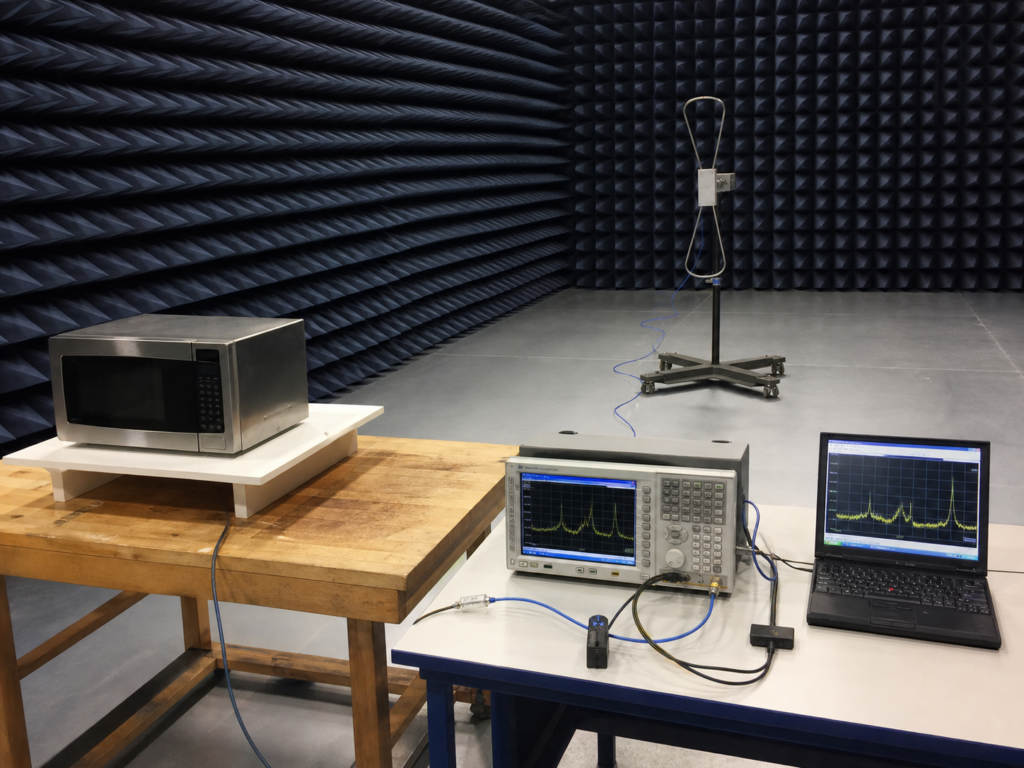
In addition, note that unintentional emissions generated by digital circuits, switching power supplies, etc. in the device need to meet the limit requirements of Part 15 Subpart B. However, this part is usually verified together in Part 18 testing, and there is no need to apply for Part 15 authorization separately.
3. Labeling and User Information Requirements
Labeling requirements are divided into two types according to authorization type:
- For devices that go through Certification (requiring an FCC ID), the unique FCC ID must be marked on a conspicuous position of the device, and cannot be pasted where it can only be seen after disassembling the device. Eligible devices can use electronic labels (for example, displayed in the screen menu), but must meet the relevant FCC rules.
- For devices that do not require Certification, there is no need to affix an FCC ID, but a declaration of conformity must be marked on the device or in the instruction manual, stating that the product meets the requirements of the corresponding rules.
All device instruction manuals must include an interference warning, informing users that the device may generate RF interference, which users need to troubleshoot and resolve on their own. Consumer devices must also additionally mark installation precautions, such as the recommended safe distance away from sensitive electronic devices.
According to the authorization method and import and sales arrangements, the US local responsible party and necessary contact information shall be identifiable on the device label, instruction manual or compliance documents. The relevant information of manufacturers and importers shall be traceable for inquiry by the FCC, customs, platforms or users.
4. Emission Types Must Not Be Missed
Finally, let’s emphasize the distinction between emission types again. Many people miss compliance here:
- Functional emission: RF energy intentionally generated by the device for the purpose of doing work. This part is subject to Part 18 rules;
- Unintentional emission: Spurious signals incidentally generated during the operation of digital circuits, power supplies, etc. This part needs to meet the limits of Part 15 Subpart B.
You cannot ignore the compliance requirements for unintentional emissions just because the device complies with Part 18. This is a common low-level mistake.
4. Full Compliance Process: 4 Steps from Design to Market Launch
Many people think that Part 18 compliance is just “finding a laboratory to do a test”. In fact, it is a full process that needs to be involved from the design stage. Following the four steps will basically not cause major problems.
First, Understand: Differences Between the Three Types of Authorization Methods
The equipment authorization rules of Part 18 are subject to the current text of 47 CFR §18.203 and Part 2 Subpart J. Different paths are matched according to device categories, which are mainly divided into three types:
- Certification: Reviewed and issued by a TCB (Telecommunication Certification Body, the official authorized issuing entity of the FCC, ordinary laboratories are not qualified to issue certificates) recognized by the FCC. A unique FCC ID is issued, which can be queried in the FCC official database. Consumer ISM devices are usually required to go through this process mandatorily.
- Verification: Only used for device categories explicitly applicable in the rules. After completing compliance testing as required, you only need to keep the test report and conformity documents. There is no need to apply for an FCC ID, and there is no official certificate issuance link. Most low-risk non-consumer ISM devices apply this method.
- SDoC (Supplier’s Declaration of Conformity): It is a general conformity declaration procedure under the FCC framework. It can replace Verification only for device categories explicitly permitted by the rules, and cannot be used unconditionally. The process also focuses on completing testing and retaining a full set of compliance documents, and no FCC ID is obtained.
It should be noted that some e-commerce platforms and importers, for risk control purposes, may additionally require Certification (FCC ID) for devices that could have gone through Verification/SDoC. This is a requirement of commercial channels, not a mandatory regulatory requirement. It is best to confirm with the channel clearly in advance to avoid that a lower-level authorization cannot meet the listing requirements in the end.
Four Steps to Compliance
Step 1, Pre-assessment: First confirm whether the device is under the jurisdiction of Part 18, clarify the device classification, operating frequency band, and power. At the same time, check whether it needs to comply with other rules at the same time — for example, devices with communication functions need to add Part 15, and medical devices need to add FDA. Don’t wait until the mold is opened to find that one item is missing, as the cost will be much higher.
Step 2, Design optimization: Do a good job in frequency stability at the design stage, reduce spurious leakage through electromagnetic shielding, power supply filtering and other methods. Don’t wait until the test fails to modify, as that will not only take time, but also have higher modification costs.
Step 3, Testing and authorization: First complete all compliance tests as required by the rules (Certification projects need to be tested by a laboratory recognized by the FCC), then follow the corresponding process according to the authorization type: For Certification devices, test reports and technical documents need to be submitted to the TCB, and the FCC ID is obtained after passing the review; For Verification/SDoC devices, there is no need to submit for official review. After completing the test, keep the report, declaration of conformity, responsible party information and user documents for verification by the FCC, customs or platforms.
Step 4, Post-market maintenance: All compliance documents (test reports, technical documents, authorization certificates, etc.) must be kept for at least 5 years, as the FCC may conduct random inspections at any time. Manufacturers must ensure that the mass-produced version is completely consistent with the test prototype, and cannot change materials or designs at will; Importers and sellers should also actively check the compliance qualifications of products, and cannot just listen to the supplier’s verbal statement that “there is certification” before purchasing, otherwise they will also be responsible if problems arise.
List of Required Compliance Documents
During the compliance process, the following documents must be fully prepared:
- Product technical documents: operating frequency range, rated power, all operating modes, software and hardware versions, circuit schematic diagrams;
- Test report: covering all operating modes, all ports, and the most unfavorable test conditions, and also including instrument calibration records and test configuration photos;
- Labeling and user documents: labels/declaration of conformity corresponding to the authorization type, interference warning, installation and operation manual;
- Responsible subject information: contact information and qualification certificates of the US local responsible party, manufacturer, and importer.
3 Common Pitfalls to Avoid
- Module certification cannot directly cover the whole machine: Module certification has strict applicable conditions, such as the antenna cannot be replaced at will, the installation method cannot be changed, the shielding structure cannot be modified, and it cannot work with other emission sources at the same time. The main functions of Part 18 such as heating and treatment are usually strongly related to the whole machine structure and shielding design, so basically the whole machine needs to be evaluated. You cannot take module certification as a free pass.
- The test prototype must be completely consistent with the mass-produced version: Changes in shell material, shielding structure, cable layout, and core component models may affect RF test results. Even if you replace a magnetron of the same model but different batch, it is best to confirm in advance whether it will affect the results.
- Do not classify devices and authorization methods on your own: If you are not sure which category the device belongs to or which authorization to take, be sure to consult a third-party organization recognized by the FCC. Don’t deliberately lean towards lower-requirement categories to save costs, as it will not be worth the loss if found out in the end.
5. Stop Confusing Them: Core Differences Between Part 18 and Part 15
Many people cannot distinguish between Part 18 and Part 15, and even think that “if you use the ISM band, you go through Part 18”. In fact, the core regulatory logic of the two is completely different. Let’s explain it clearly from the root.
The core of Part 18 is to regulate ISM devices that “use RF to do work”, with the idea of “designating special zones, allowing power, and managing boundaries” — you are given a designated frequency band, you can use high power inside, but don’t run out to interfere with others. The core of Part 15 is to regulate low-power devices that “use RF to transmit information” and the unintentional emissions of all electronic devices, with the idea of “limiting power and causing less trouble” — suppressing the transmit power from the source to avoid interfering with legitimate services.
For easy comparison, we have organized 6 core dimensions into a table:
| Comparison Dimension | FCC Part 18 | FCC Part 15 |
|---|---|---|
| Regulatory Object | ISM devices that use RF energy to do work (heating, treatment, processing, etc.) | Low-power devices that use RF to transmit information + unintentional emissions of all electronic devices |
| Emission Nature | Mainly functional intentional emissions (intentionally emit RF to achieve functions) | Includes communication-type intentional emissions + unintentional emissions incidental to circuits |
| Limit Logic | Higher power is allowed within designated frequency bands, with focus on limiting out-of-band/restricted band spurious and conducted emissions | Strictly limit overall transmit power to reduce interference possibilities from the source |
| Common Authorization Methods | Consumer devices mostly require Certification (FCC ID required), non-consumer devices mostly use Verification | Low-risk devices can use SDoC/Verification, some require Certification |
| Interference Obligations | Must not cause harmful interference, must accept legitimate external interference, and must rectify as required if interference is caused | Must not cause harmful interference, and must accept all legitimate external interference |
| Composite Device Handling | Comply with rules separately by function, different functions correspond to different rules, which cannot cover each other | Same as left |
After reading the basic comparison, you also need to clarify two boundary judgment rules to avoid confusing them in actual operation:
First, low-power RF work devices can choose to comply with Part 15 only when they fully meet the requirements of device categories, frequency bands, power and authorization procedures explicitly listed in Part 15. You cannot choose between the two on your own just because the power is low and the ISM band is used;
Second, composite devices with both work and communication functions need to comply with corresponding rules separately by function. A single FCC ID or a single test report cannot automatically cover all functions.
6. Pitfall Avoidance and Advanced Knowledge: Misconceptions, Report Interpretation and Change Management
If you already understand the basic rules and want to further improve your judgment ability and avoid common pitfalls, this part of the content will be very useful.
5 Common Compliance Misconceptions to Disbelieve
- Misconception: All ISM devices do not need certification
Correct answer: Consumer ISM devices are usually required to undergo Certification (with FCC ID) mandatorily. Even devices exempt from certification must meet all interference limit requirements. It is not that “you can do whatever you want without certification”. - Misconception: Medical ISM devices that have passed FDA do not need to pass FCC
Correct answer: The FDA regulates medical safety and effectiveness, and the FCC regulates RF interference. The two are completely independent. Medical ISM devices must comply with both at the same time. Many manufacturers have their products detained by customs because they missed FCC certification. - Misconception: Compliant devices will not cause any interference
Correct answer: Compliance only meets the minimum limit requirements. In complex electromagnetic environments (for example, there are particularly sensitive medical devices or precision instruments nearby), interference may still occur. Therefore, it is necessary to maintain a safe distance according to the instruction manual. - Misconception: Minor modifications/repairs do not affect compliance
Correct answer: Replacing magnetrons, power tubes, frequency sources, or modifying power/frequency control firmware may change RF parameters. The impact of changes must be evaluated according to the rules. You cannot think that “it’s just replacing a small part” and it will be fine. - Misconception: If the RF module has certification, the whole machine does not need testing
Correct answer: Module certification has strict applicable conditions (see practical reminders in Chapter 4 for details). The core work function of Part 18 usually requires a complete evaluation of the whole machine, and module certification cannot directly cover the whole machine.
3 Steps to Quickly Understand Part 18 Test Reports
Many people only look at “Pass/Fail” when they get a test report. In fact, there are many details inside. You can preliminarily judge the validity of the report using the three-step method:
Step 1, Check basic validity: Confirm that the cited FCC rules are the current version, the device classification is correct, the model/software and hardware versions of the tested device are consistent with the mass-produced version, and the test instruments are within the calibration validity period. These are the basics. If any one is wrong, the report is useless.
Step 2, Check test coverage: Confirm that the test covers all operating modes, all ports (power, signal, interface, etc.), the most unfavorable test conditions (maximum power, extreme voltage/temperature), and standard cable and antenna configurations. If only the easiest-to-pass mode is tested, even if the result is Pass, it is not valid.
Step 3, Evaluate result reliability: Focus on the limit margin of protected frequency bands such as aviation and navigation (the larger the margin, the safer), confirm that the peak/average detection method meets the rule requirements, the limit conversion is reasonable, and there are no unexplained abnormal data.
Compliance Evaluation Method for Device Changes
Product iteration and material replacement are common, but not all changes require re-certification. You can evaluate according to the following methods:
First, determine whether it is a type of change that needs evaluation:
- Hardware changes: replacing RF power tubes/magnetrons, resonant cavities, power modules, filters, shielding structures, frequency sources (crystal oscillators/PLLs, etc.);
- Software changes: modifying firmware that controls power, frequency, duty cycle, modulation method;
- Scenario changes: changing from use in professional settings to household use, or changing target users from professionals to ordinary consumers.
The FCC divides changes into three categories: Class I/II permissive change (permitted changes, which are minor modifications that do not affect RF parameters and do not require re-certification), changes that require supplementary testing, and changes that require re-application for authorization. The specific category shall be judged by the TCB or a testing organization recognized by the FCC, not by the manufacturer itself. Not all changes will invalidate the original certification.
The evaluation process is very simple: first list all change items, preliminarily judge whether they will affect RF parameters. If you are not sure, be sure to consult a third-party organization. You cannot assume on your own that “small changes are fine”.
Handling Logic for Interference Complaints
If you receive an interference complaint, don’t panic. First, troubleshoot according to the rules:
First, remember the basic operating rule of Part 18: devices must not cause harmful interference, and at the same time must accept legitimate RF interference received — for example, if your device is interfered by a legitimate radio station, you cannot ask the station to stop broadcasting, you can only find a way to solve it yourself.
When troubleshooting, first distinguish the cause: is it the device itself exceeding the emission limit, or interference caused by the installation environment, cable coupling, or improper use? For example, if the user removes the shielding door of the microwave oven, that is a problem of improper use, not a compliance problem of the device itself.
Common rectification measures include adjusting the installation position, adding electromagnetic shielding, replacing power filters, and optimizing grounding. Most interference problems can be solved through these methods.
The liability division is consistent with what was said before: manufacturers/importers/sellers bear market entry compliance responsibilities, installers bear installation compliance responsibilities, and operators bear operation and interference disposal responsibilities. Specific penalties and rectification requirements shall be subject to the FCC’s investigation results and rule provisions.
In general, the core logic of FCC Part 18 is not complicated: it designates dedicated “frequency zones” for devices that need high-power RF to achieve work functions such as heating, processing, and treatment. Within the zones, power limits are relaxed, but devices are required to strictly control signal boundaries and cannot spill over to other frequency bands to interfere with legitimate RF services such as aviation, navigation, and communications.
Before a product enters the US market, you can conduct a basic compliance check in this order: first determine whether it is under the jurisdiction of Part 18 through the core function and emission nature, then confirm the device classification, corresponding authorization method, test coverage, labeling and user document requirements, and at the same time prepare a compliance management plan for device changes in advance. For boundary products that you are not sure about, it is best to find a third-party professional organization recognized by the FCC for confirmation. Do not classify them on your own to avoid affecting product launch due to compliance issues.