
Cross-border sellers targeting the U.S. market, or anyone who needs to ship electronic products to the U.S., have most likely heard of “FCC certification” — many people have run into the same pitfall: as soon as their goods arrive at a U.S. port, they are detained by customs on the grounds of missing FCC-related materials, requiring either supplementary documents within a time limit or direct return, with port demurrage and storage fees rising day by day.
Many people think FCC is a separate “customs clearance certificate” that will give you a smooth pass once obtained, but that is not the case at all. FCC customs clearance is just a special compliance verification step in U.S. import customs clearance. The rules are complex if you don’t understand them, but simple if you do — as long as you grasp the logic and prepare in advance, most pitfalls can be avoided.
First, Understand the Basics: Core Rules of FCC Customs Clearance
Who Is in Charge of FCC Customs Clearance?
The FCC (Federal Communications Commission) is responsible for formulating compliance standards for electronic and wireless products, while CBP (U.S. Customs and Border Protection) is responsible for verifying whether products meet these requirements during customs clearance — simply put, “the FCC sets the rules, and customs inspects the goods”. Customs will only request FCC assistance when encountering technical judgment issues.
There is no so-called “FCC customs clearance certificate”; it is just a special verification item in the customs clearance process, following the same logic as FDA checks for food and CPSC checks for toys. The FCC Form 740 mentioned in many old materials has long been abolished and does not need to be submitted in advance, but this does not mean that compliance requirements are invalid: if customs requires proof, the importer must be able to provide valid materials.
Customs mainly checks three core dimensions for FCC verification: whether the product’s compliance qualification is authentic and valid, whether the submitted documents are consistent with the product label, and whether there is a reachable U.S. domestic responsible party.
What Are the Consequences of Non-Compliance?
The most common consequence is detention of goods, resulting in port demurrage and storage fees — the longer the delay, the higher the fees. In serious cases, return of goods or even forced destruction may be required.
There is no unified fixed amount for fines; they are directly linked to the value of the goods and whether the violation is intentional or negligent. For example, intentionally concealing the fact that a wireless product requires an FCC ID will result in a much heavier penalty than accidentally pasting the wrong label.
A more long-term impact is the lowering of the importer’s customs credit rating, which will greatly increase the random inspection rate for all subsequent imports, equivalent to being placed on the regulatory “key watch list”.
A special reminder: don’t think that passing customs clearance means everything is fine. The FCC will continue to conduct random inspections of products sold on the market (including e-commerce platforms and offline stores) afterwards. If non-compliance is found, accountability will still be pursued, and even a full recall may be required, resulting in far greater losses than customs detention.
5 Basic Terms Beginners Must Understand
First understand these high-frequency terms, so you won’t be confused when reading the process later. All terms are explained in plain language first, followed by professional explanations:
- FCC ID: The “compliance ID card” for wireless products in the U.S. market, issued by FCC-recognized certification bodies. Each wireless product corresponds to a unique number, which can be publicly queried on the FCC official website. (Professionally, products that actively emit wireless signals are called “intentional radiators”)
- SDoC (Supplier’s Declaration of Conformity): One of the common compliance methods for most ordinary non-wireless digital/electronic products. No official certification is required; only a declaration issued by the U.S. domestic responsible party and well-kept test reports for inspection are needed. (Products that do not emit signals themselves but generate electromagnetic interference when powered on are professionally called “unintentional radiators”)
- U.S. Domestic Responsible Party: A compliance liaison entity located in the U.S. with verifiable information, which can be a U.S. importer, a U.S.-registered enterprise, or a compliance service provider. It is responsible for responding to inquiries from the FCC and customs, so that regulators can reach a contact person if problems arise. The SDoC declaration must be issued by this entity; one directly issued by manufacturers outside the U.S. is invalid.
- Intentional/Unintentional Radiator: The former actively emits wireless signals (Bluetooth, WiFi, cellular networks, etc.), while the latter only generates electromagnetic interference during operation and does not actively emit radio frequency signals.
- Old Version DoC: DoC and Verification certification often mentioned in old materials were compliance paths of the FCC before 2017, and have now been replaced by SDoC. For new products, it is recommended to directly use SDoC, and do not use the old version of DoC as the basis for customs clearance of new goods, as it is easy to be blocked; however, existing products that were compliantly launched before 2017 can still apply according to the original rules.
To facilitate quick differentiation between the two core compliance methods, a comparison table is compiled:
| Comparison Item | FCC ID | SDoC |
|---|---|---|
| Applicable Products | Actively emit wireless signals (Bluetooth/WiFi/cellular, etc.) | Ordinary consumer electronic products with no wireless function but powered by electricity |
| Issuing/Preparing Party | FCC-recognized third-party certification body | Prepared independently by the U.S. domestic responsible party |
| Official Review Required | Yes, materials must be submitted and approved before certification is issued | No, test reports are kept independently for inspection |
| Labeling Requirements | Must be marked with the unique FCC ID number | No mandatory fixed wording, but responsible party information must be marked |
| Queryable on Official Website | Yes, validity can be publicly queried | No, no public query portal |
3 Most Common Entry-Level Misconceptions
Many people who are new to FCC have these three misunderstandings. Clarifying them in advance can save a lot of detours:
- Foreign certifications such as CE and UKCA can replace FCC: Absolutely not. U.S. Customs only recognizes FCC compliance requirements; certifications from other countries or regions cannot replace them. Declaring with a CE certificate will directly be judged as non-compliant.
- All electronic products need FCC ID: Incorrect. Only products that actively emit wireless signals require FCC ID. Most ordinary non-wireless electronic products follow SDoC, and purely mechanical, non-electrical products are directly exempt.
- Small-batch, sample, and gift items are automatically exempt from FCC: No. Simplified verification rules only apply to eligible non-sales scenarios; it is not that samples do not need compliance — even gifts, as long as they are part of the sales process (such as buy one get one free), must also comply with the requirements for normal sales products.
3-Step Quick Judgment: Which Type of FCC Compliance Does Your Product Need?
After understanding the basic concepts, what you care about most is definitely which type of compliance your product falls into. You don’t need to memorize the rules by rote; just follow this 3-step judgment method, which beginners can apply directly:
3-Step Judgment Method (Apply Directly)
Step 1: First check whether the product is powered by electricity and has electronic circuits. If it is a purely mechanical product that is completely non-electrical and has no electronic components, it is directly exempt from FCC compliance and can be imported as ordinary goods.
Step 2: If it is powered by electricity, then check whether it actively emits wireless signals — for example, products with Bluetooth, WiFi, cellular networks, wireless charging transmission function, walkie-talkies, remote controls, etc. As long as they actively emit radio frequency signals outward, they usually require FCC ID.
Step 3: If it has no wireless function, but generates electromagnetic interference when powered on (such as products with circuit boards or motors), it usually falls into the SDoC category and requires a Supplier’s Declaration of Conformity.
Note: This judgment applies to common consumer electronic products; industrial, medical, automotive, special exempt, or multi-function products need to be reconfirmed according to specific FCC rules.
Typical Examples of Three Types of Products
Common examples are as follows, which can be directly compared:
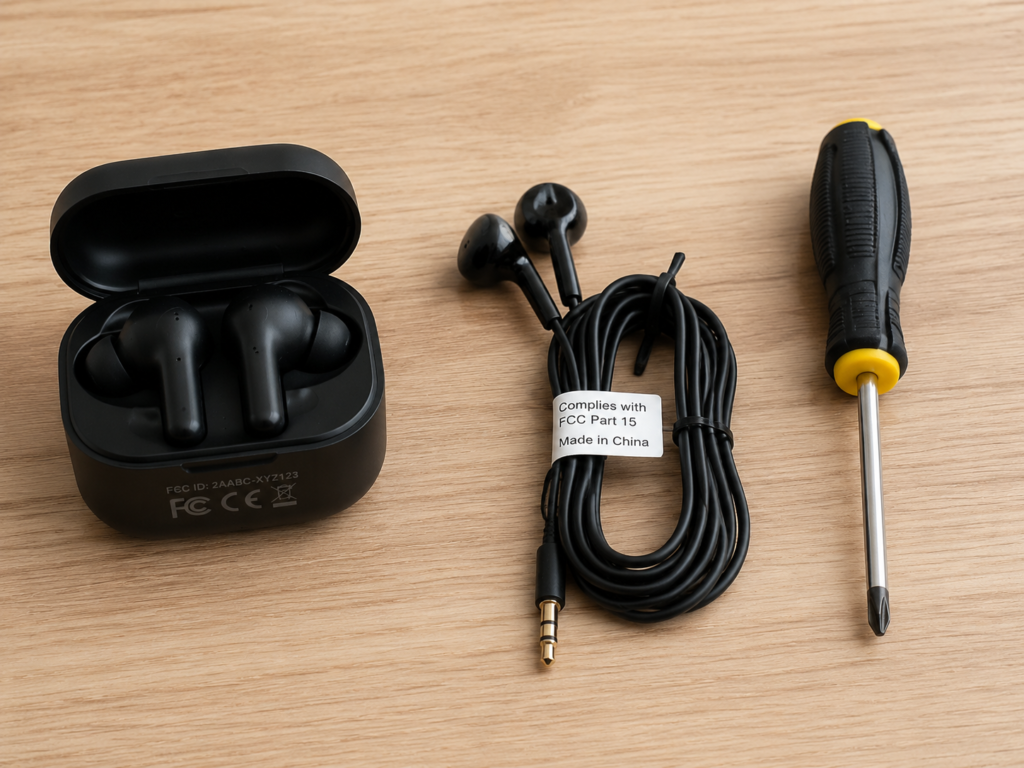
- Products requiring FCC ID: Bluetooth earphones/speakers, WiFi routers, smart watches, drones, wireless remote controls, wireless charging transmitter pads, tablets with cellular function.
- Products requiring SDoC: Ordinary desktop computers/laptops, wired earphones, power banks, keyboards and mice without wireless function, ordinary LED lights, wired USB hubs.
- Exempt products: Purely mechanical toys, hand tools such as manual screwdrivers/wrenches, household products without electronic circuits, simple devices that only use batteries and have no oscillation circuit.
Unsure About Edge Products? Judge by These Rules
Some products are special and not in the typical examples, such as complete machines with wireless modules, and lamps with remote controls. You can judge according to the following rules:
- Complete machines with wireless modules: If the built-in wireless module already has an FCC ID, it does not mean the complete machine can use it directly. Three conditions must be met simultaneously: the antenna is consistent with that during module certification, the transmission power does not exceed the module certification range, and the usage scenario matches the module certification range. If any one condition is missing, the module ID cannot be used, and a new FCC ID for the complete machine must be obtained.
- Lamps with remote control/dimming: As long as it has wireless remote control or wireless dimming function, the wireless control part is an intentional radiator and requires an FCC ID; SDoC for the complete machine alone is not sufficient.
- USB hubs with Ethernet ports/HDMI: Even if there is no wireless function, as long as it has a data transmission interface and generates electromagnetic interference when powered on, it falls into the SDoC category and must meet FCC electromagnetic interference requirements.
- Industrial, medical, automotive electronics: These products have special regulatory paths and do not apply to ordinary consumer FCC rules. It is recommended to consult a professional compliance agency for confirmation. This does not mean that FCC is completely unnecessary; as long as they contain wireless transmission or digital circuits, RF/EMC compliance still needs to be verified, but additional paths such as FDA, NHTSA, and industry standards are also required.
- Revised products: If the product has already obtained FCC certification, but subsequently the antenna is changed, the motherboard is replaced, the power is adjusted, or even the casing that affects the signal is replaced, the certification coverage must be rechecked. If it does not comply, re-certification is required.
Additional reminder: For devices operating in carrier-licensed frequency bands, and products with composite attributes such as medical/laser functions, see the subsequent composite regulation description for compliance requirements.
Pre-Clearance Preparation: Documents, Labels, and Consistency Verification
After determining the compliance type, you need to prepare customs clearance documents in advance — if this step is done well, 80% of cargo detentions can be avoided. Many people only remember to supplement documents after the goods are shipped, either too late or prone to errors.
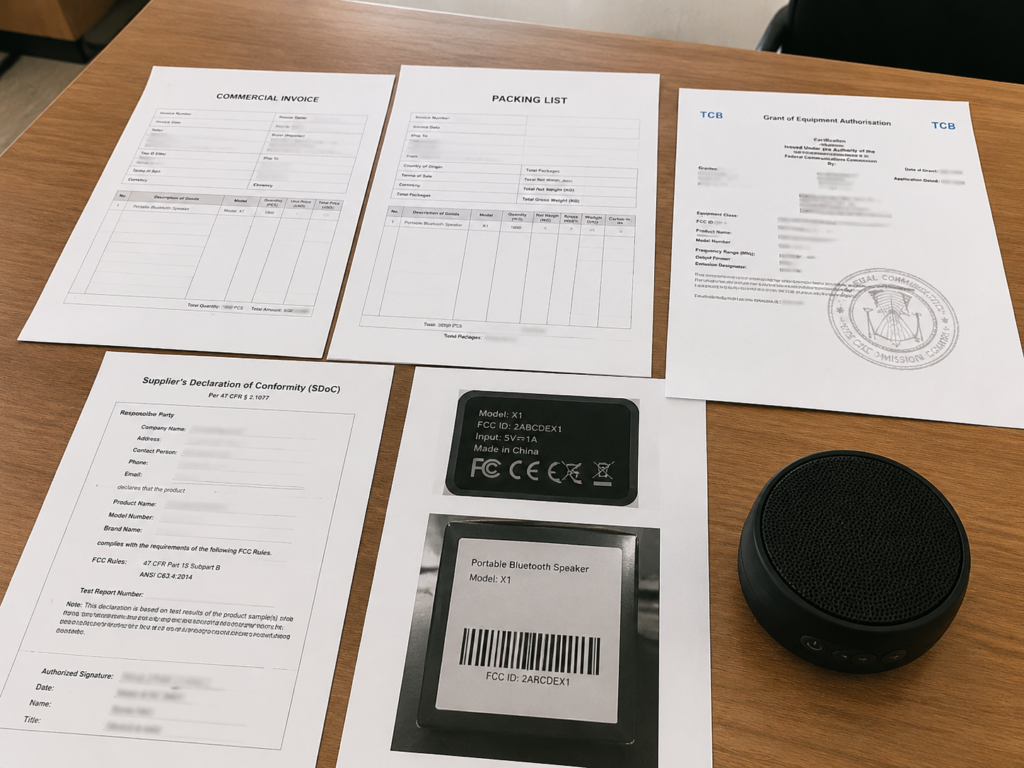
Document Package to Prepare for Customs Clearance (Two Categories)
Many people think FCC materials need to be submitted together with the customs declaration form, but that is not the case. Only basic documents need to be submitted during customs declaration; FCC compliance materials are for inspection: you don’t need to submit them if you are not selected for inspection, and you only need to provide them as required if selected.
Category 1: Basic Documents Mandatory for Customs Declaration
Common to all products: commercial invoice, packing list, bill of lading/waybill, U.S. importer tax ID (EIN or SSN), basic product information (model, brand, function, quantity, value).
Category 2: FCC Compliance Documents for Inspection (Only Required When Verified)
Prepare according to the product’s compliance type:
- FCC ID category: FCC ID Grant Certificate (Grant), photos of ID labels, test report summary, and a supplier authorization letter if imported by a distributor.
- SDoC category: SDoC declaration document, product test report, photos of compliance labels.
- Exempt category: No special FCC materials need to be prepared; just declare as ordinary goods. When customs inquires, you only need to explain that the product is purely mechanical/has no electronic circuits.
Label, Manual, and U.S. Responsible Party Requirements
Documents alone are not enough; non-compliant product labeling is also a common cause of cargo detention:
- FCC ID category labeling requirements: The FCC ID number must be marked on the product body at a position directly accessible to the user, and cannot be hidden inside. If the product is too small (such as the earbud body of Bluetooth earphones), it can be pasted on the accompanying manual or packaging, but must comply with the corresponding FCC rules and cannot be pasted arbitrarily.
- SDoC category labeling requirements: There is no mandatory requirement to mark fixed wording such as “Complies with FCC Part 15”, but there must be a compliance statement of applicable standards, warning statements in the manual, and U.S. domestic responsible party information. The official FCC logo is optional and not mandatory.
- Electronic label (e-label) requirements: Only applicable to categories allowed by the FCC (such as small electronic devices with displays), and must meet the following: users can view complete compliance information on the product interface without disassembling the device or using additional tools (such as the “About This Device” page on a mobile phone). If you need to remove the back cover to see it, it does not meet the requirements.
- U.S. domestic responsible party requirements: Must be a responsible party located in the U.S. with verifiable information, which can be a U.S. importer, U.S.-registered enterprise, or compliance service provider; the responsible party information on the SDoC declaration, manual/label, and import records should be consistent or have an explainable authorization relationship, and cannot be fabricated.
Document Consistency Verification: Don’t Underestimate “Matching”
Customs attaches great importance to consistency when checking FCC. The information on all documents and labels must be completely consistent; even a single letter difference may result in detention. There are four core check points:
- The product model and brand on the commercial invoice and packing list must be completely consistent with those on the FCC documents and product labels. You cannot write “Model A” on one and “Type A” on the other.
- The FCC ID Grantee information must be consistent with the manufacturer or authorized party information, and cannot be an unrelated third-party company.
- The importer information must be consistent with the customs declaration entity. You cannot use Company A’s qualifications to import in the name of Company B.
- For goods mixed with multiple SKUs, the packing list must mark the FCC compliance information corresponding to each SKU, and cannot only write the total quantity; otherwise, customs cannot verify compliance one by one.
Full FCC Customs Clearance Process: From Pre-Shipment to Post-Release
Can you ship the goods once the documents are ready? Don’t rush. First, understand the full customs clearance process, know which links are prone to problems, so you can avoid pitfalls in advance.
Pre-Shipment Pre-Verification: The Most Critical Pitfall Avoidance Step
Many people think customs clearance is something that happens after the goods arrive at the port. In fact, the stage where it is easiest to remedy and where you should most control the quality is before shipment. If this step is done well, there will basically be no major problems later.
Three things to do before shipment:
- Check item by item against the “Pre-Shipment Compliance Checklist” at the end of the article, and ship only after all requirements are met.
- Choose a U.S. local customs broker with experience in FCC product customs clearance, and send all inspection documents to them for pre-review in advance. Professional review is much more reliable than figuring it out on your own.
- For wireless products, check the validity of the ID in the FCC official system in advance to avoid obtaining fake certificates or revoked authorizations.
Port Arrival Declaration Stage
After the goods arrive at the port, the customs broker will submit a commercial declaration through the U.S. Customs electronic declaration system (ACE).
The CBP system will first conduct a preliminary review: verify basic information such as HS code, cargo value, and product description, then determine whether to conduct a special FCC verification based on the Participating Government Agencies (PGA) mechanism (simply put, customs is networked with regulatory agencies such as FCC and FDA, and the system automatically screens high-risk goods), product category, or random sampling rules.
After passing the preliminary review, the goods enter the queue for inspection or release.
Inspection and Release Stage
There are two subsequent scenarios:
- Not selected for special FCC verification: Released directly, and delivery can be arranged.
- Selected for special verification: Customs will notify you to submit the corresponding FCC compliance documents for inspection. When technical issues are involved, the FCC may participate in the judgment.
The review result is very clear: if the documents are complete and consistent, the goods will be released directly; if there are problems with the documents, a cargo detention notice will be issued, requiring supplementary documents or rectification within a time limit.
How Long to Keep Documents After Customs Clearance?
Don’t think you can throw away the documents after release. The FCC has clear retention requirements: compliance documents must be kept for at least 2 years from the date of stopping the manufacture, import, or sale of the product.
In practice, it is recommended to keep them for 5 years, because relevant documents may be used in scenarios such as customs retrospective checks, e-commerce platform verifications, and product recalls. It never hurts to keep them longer. Recommended documents to keep include: Grant/SDoC documents, full or summary test reports, photos of labels and packaging, manuals, invoices and packing lists for corresponding batches, supplier authorization letters, and product version change records; revision differences between different batches must be explainable.
Special Import Scenarios: FBA, Samples, and Composite Regulation
The above are all customs clearance rules for ordinary sales products. In actual import, there are many special scenarios, such as FBA first leg, samples, and temporary import, with different rules, which cannot be generalized.
Cross-Border E-Commerce FBA First Leg Customs Clearance
Amazon sellers care most about this, and there are three points to pay special attention to:
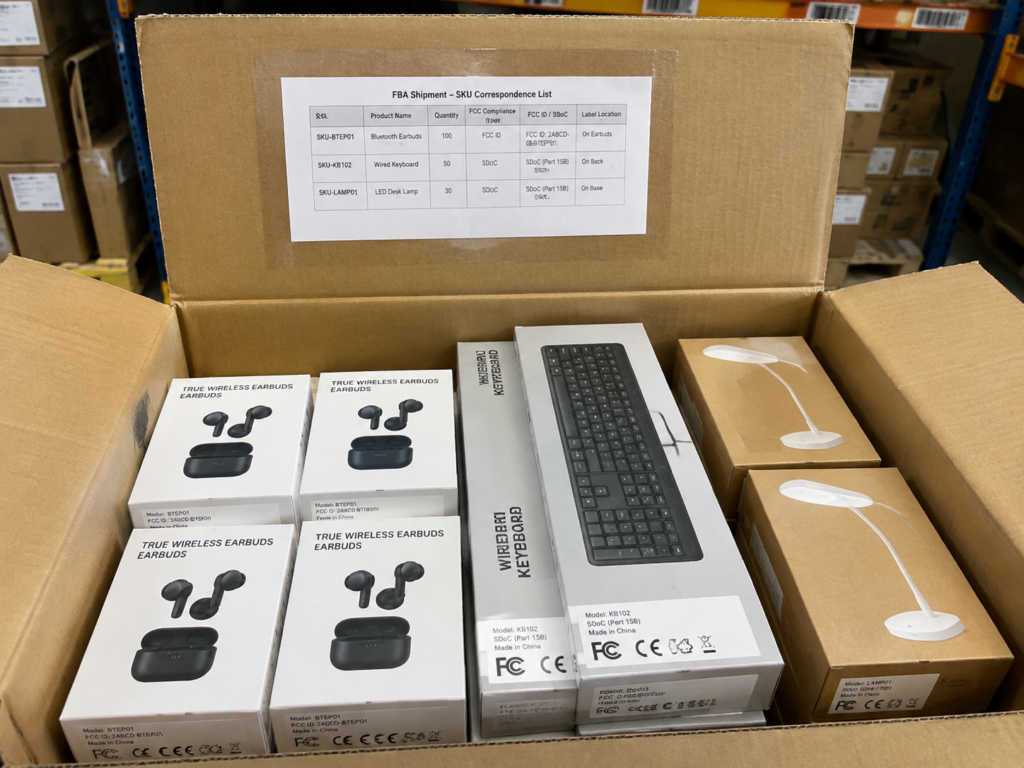
- Amazon does not assume importer responsibility. You must provide U.S. domestic importer/responsible party information on your own, and cannot import in the name of Amazon.
- In principle, FCC ID category products should be marked on the product body; for small-sized products or products where the FCC allows electronic labels or packaging/manual labeling, the corresponding rules must be followed. You cannot only label the FBA outer carton or shipping outer carton to replace the product’s own FCC label.
- For goods mixed with multiple SKUs, the outer carton must have a SKU correspondence table, and the packing list must also mark the FCC compliance information of each SKU to avoid inability to correspond during customs verification.
Limited Exception Import: Not Exemption from Compliance, But Simplified Verification
Many people ask whether sending samples or personal use items requires FCC. There are indeed simplified rules for such non-sales imports, but note that it is “simplified verification” not “exemption from compliance”, let alone that you can send anything casually.
There are three common limited exception scenarios:
- Personal use: Must simultaneously meet three conditions: non-commercial use, reasonable quantity, and for personal use only without resale. Simplified verification applies, and there is no need to submit complete FCC materials in advance, but the final requirement for supplementary documents is subject to CBP’s on-site judgment. For example, sending 1 Bluetooth earphone for personal use is most likely fine, but sending 10 and claiming they are all for personal use is hard to pass.
- Commercial samples: Must be marked “Sample Not for Sale”, with reasonable quantity, and only for display/testing. Simplified verification can be applied for, but basic compliance proof must still be available.
- Temporary import: For example, products for exhibition, repair, or testing must be handled with an ATA Carnet or temporary import bond, and must be re-exported in their original state within the specified period, and cannot be sold or delivered to consumers within the U.S.
Customs Clearance of Wireless Modules, Semi-Finished Products, and Components
If the imported goods are components or semi-finished products, the rules are different:
- Compliant wireless modules that have obtained FCC ID can be cleared as ordinary compliant products when imported separately.
- Ordinary components without wireless function (such as resistors, casings, circuit boards without wireless function) do not need separate FCC compliance, and are cleared as ordinary goods.
- For import of complete machines equipped with compliant modules, an integration description of the module and the complete machine must be prepared to prove that the three aforementioned conditions for using the module ID are still met; otherwise, customs may not recognize it.
Composite Regulation Products: FCC Is Just One of the Requirements
A special reminder: FCC only covers electromagnetic compatibility and radio frequency compliance. Many products, in addition to FCC, must also meet the requirements of other regulatory agencies, otherwise they will still be detained. Common composite regulation requirements include:
- Products containing lithium batteries and chargers: in addition to FCC, may involve battery transport dangerous goods rules, consumer product safety requirements, charger energy efficiency, and platform/retail safety standards; specific confirmation is based on battery type, whether sold with the device, power, and sales channel.
- Children’s products: must comply with CPSC children’s product safety rules (such as lead content and small part requirements).
- Products with laser or medical functions: must meet the requirements of the U.S. Food and Drug Administration (FDA).
- Energy products (such as refrigerators, air conditioners, chargers): must meet the energy efficiency requirements of the U.S. Department of Energy.
- Devices operating in carrier-licensed frequency bands: must meet industry requirements such as PTCRB.
When preparing customs clearance documents, don’t just focus on FCC. First confirm whether the product has other attributes, and implement the corresponding compliance requirements together.
What to Do If Customs Detains Your Goods? Common Causes and Remedies
Even with full preparation, you may encounter cargo detention. Don’t panic first, just follow the formal process.
6 Most Common Causes of Cargo Detention (Sorted by Frequency)
We have compiled the high-frequency causes of FCC-related cargo detention in actual customs clearance, which you can first check against by yourself:
- No FCC compliance at all, especially wireless products without FCC ID, which accounts for the highest proportion.
- Inconsistent document information: model, brand, and responsible party information do not match the declaration.
- Non-compliant FCC labels/markings, such as missing ID, wrong position, or incorrect information.
- Missing U.S. domestic responsible party information, or false information.
- Non-compliant SDoC documents, such as no corresponding test data or wrong applicable standards.
- Using certifications from other countries such as CE and UKCA to replace FCC compliance, which customs directly does not recognize.
Standard Processing Steps After Cargo Detention
If your goods are really detained, follow the formal steps:
Step 1: First obtain the formal cargo detention notice from CBP to clarify the type of problem — whether it is a document defect, label error, uncovered authorization, or the product itself is non-compliant. Different problems have completely different handling methods. Figure it out first before taking action.
Step 2: Within the supplementary document period specified by customs, supplement documents or make rectifications targeting the problem. For example, if the label is wrong, supplement photos of the correct label; if documents are missing, supplement the corresponding materials.
Step 3: Wait for the review result. If the documents meet the requirements, the goods will be released; if the review fails, you can choose return or destruction. If a fine is involved, you must pay the fine as required before handling the goods.
Specific Remedy Plans for Different Problems
The difficulty and methods of remedy vary greatly depending on the cause of detention:
- Document/label defects: This is the mildest case, such as a wrong letter in the model number or incorrect label position. You only need to supplement the correct documents and submit a rectification certificate. Some ports allow on-site label rectification under customs supervision, and the goods can be released after rectification.
- Authorization coverage issues: For example, if the product variant being sold is not covered by the original FCC certification, you can submit a difference description and certification coverage proof. If it meets the requirements, it will pass; if not, you need to complete the corresponding certification.
- The product itself is non-compliant: For example, if a wireless product has not obtained an FCC ID at all, handling it is more troublesome. You need to choose a plan based on the rules of the port where the goods are detained and the opinions of CBP and FCC. Common options include transferring to a bonded warehouse to complete certification then returning and re-importing, direct return, and on-site destruction. It is recommended that an experienced customs broker or lawyer communicate with the regulatory authority on how to choose specifically; do not operate on your own.
How to Reduce the Probability of Cargo Detention?
Instead of remedying after detention, it is better to do these things in advance, which can greatly reduce the risk of cargo detention:
- Be sure to complete the pre-verification checklist before shipment, and check item by item without finding it troublesome.
- For wireless products, check the validity of the ID on the FCC official website in advance to avoid obtaining invalid authorization.
- Choose a U.S. local customs broker with FCC customs clearance experience. Familiarity with the rules of each port can help you avoid pitfalls in advance.
- Keep both electronic and paper copies of all compliance documents, which can be retrieved at any time. Don’t look around for them only when customs asks for them.
Advanced Pitfall Avoidance: Common Misconceptions and Responsibility Boundaries
The previous content is all basic operations. The following advanced misconceptions have been encountered by many sellers who have been in the business for several years, so you must pay attention.
6 Common Advanced Misconceptions
- Having FCC certification guarantees customs clearance: Wrong. Certification is just one of the requirements. Customs clearance is only possible when labels, document consistency, and U.S. responsible party information all meet the requirements. If any one is incorrect, the goods may be detained.
- SDoC can replace FCC ID: Wrong. Wireless products must have FCC ID. Those who use SDoC to deceive customs will be directly treated as uncertified if caught, with heavier penalties.
- Borrowing someone else’s FCC ID works: Wrong. Products from different manufacturers with different internal designs cannot share an FCC ID even if they look exactly the same. If caught, not only will the goods be detained, but it may also involve fraud, with heavier fines.
- Passing e-commerce platform listing = no problem with customs clearance: Wrong. Platform listing rules and customs clearance requirements are two independent systems. Passing platform listing does not mean customs will release the goods. Many sellers have passed Amazon listing but only had their goods detained when shipped to the U.S., because they confused the two sets of rules.
- Passing customs clearance means complete safety: Wrong. Customs release only means passing the import stage. The FCC will still conduct random market inspections afterwards, and non-compliance will lead to accountability and recalls. For specific risks, see the previous description of violation consequences.
- If the module has an FCC ID, the complete machine must be compliant: Wrong. The module ID can only be used if the three aforementioned conditions for use are met. If any one is changed, the coverage does not apply, and re-certification is required.
Responsibility Boundaries of All Parties: Who Is Responsible When Something Goes Wrong?
Many people don’t know who to turn to when something goes wrong. Here we clarify the responsibilities of each party, so you don’t shift blame randomly or take responsibility unnecessarily:
- Importer: Bears the main compliance responsibility, responsible for truthful declaration, document retention, and liaison with customs and the FCC. The importer is the first responsible party when problems arise.
- Manufacturer/Supplier: Responsible for providing authentic and valid FCC compliance documents and correct product labels. If cargo detention is caused by fake certificates or wrong labels provided by the supplier, the importer can hold the supplier accountable, but customs will still first approach the importer.
- Freight Forwarder/Customs Broker: Only responsible for assisting in submitting documents and transmitting information, and does not bear the responsibility for compliance itself. They can remind you of precautions, but the ultimate compliance responsibility still lies with the importer.
- U.S. Domestic Responsible Party: Mainly responsible for responding to FCC compliance inquiries, which can be the importer itself (if it is a U.S.-registered company) or a third-party compliance service provider.
Beginner’s Toolkit: Query Methods, Checklists, and Templates
Finally, we have prepared several practical tools for you, all of which beginners can use directly, no need to look around.
FCC ID Self-Service Query Method and Result Judgment
If the supplier says the product has an FCC ID, don’t just believe it. Go to the official website to check it yourself, it only takes a few minutes:
- Query entry: FCC official OET Equipment Authorization Search system, which can be found through the FCC official website navigation.
- Query method: Prioritize entering the full FCC ID for query; if entering separately, the first 3-5 digits of the FCC ID are the Grantee Code, and the latter part is the Product Code; do not query only by brand name to avoid matching errors.
- Key points for result verification: Finding the ID is not the end; you need to check four core points:
- Whether the authorization is still valid, whether it has been revoked, terminated, or has restrictive conditions.
- Whether the grantee information is consistent with that provided by the supplier, to avoid it being another company’s certificate.
- Whether the product model, frequency, and power match the actual product you want to import.
- Whether the usage scenarios, antenna, and power limits specified in the Grant Notes meet the product’s intended use. For example, module certification cannot be directly used for non-compliant complete machines.
Pre-Shipment Compliance Checklist (Check Directly)
We have compiled all core precautions into a checklist. Check item by item before shipment, and ship only after all are checked. Basically, there will be no major problems:
- □ Product compliance type has been confirmed, and all corresponding compliance procedures are completed
- □ The position and content of FCC labels/markings meet the requirements
- □ The model, brand, and parameters of all documents are completely consistent
- □ U.S. domestic responsible party information is accurate and valid, and the SDoC declaration is issued by this entity
- □ The FCC ID of wireless products has been verified on the official website and is valid
- □ The customs broker has obtained all FCC inspection documents in advance and passed the pre-review
- □ For composite regulation products, it has been confirmed that all other regulatory requirements are met
Required Fields for SDoC Declaration (Reference Template)
Many people don’t know what to write in an SDoC declaration. You don’t need to look for complicated templates; just include these required fields:
- Product model, brand, description
- Name, address, and contact information of the U.S. domestic responsible party
- Applicable FCC standard number (e.g., 47 CFR Part 15)
- Declaration date, signature or seal of the responsible party
- Test report number and testing agency information (if any)
Note: SDoC is not an official certification document and cannot be written as an FCC certificate; the declaring entity must be a U.S. domestic responsible party, the listed model, brand, and standard number must be consistent with the test report and product label, and the information of the declaring entity, the responsible party in the manual, and the import declaration responsible party should be consistent or have an explainable authorization relationship.
When Do You Need Professional Help?
For most ordinary products, FCC customs clearance can be done by yourself following the steps in this article. But if you encounter the following situations, it is recommended to seek professional assistance, don’t tough it out:
- The product has complex functions and you are unsure about the compliance classification, such as products with wireless, medical, and laser functions at the same time.
- The goods have been detained by CBP, and still fail after supplementary documents, and you don’t know how to handle it.
- You need to expedite the FCC ID application, or change certification information.
- For cases involving large fines or requiring appeals, it is recommended to find an import/export lawyer with FCC experience.
Final Summary
After reading this article, you should be able to independently handle most common FCC customs clearance matters: you can quickly determine the compliance type of your product, prepare customs clearance documents as required and check consistency, adjust customs clearance plans according to different scenarios such as FBA, samples, and temporary import, independently query the validity of FCC ID and avoid common misconceptions. Even if you encounter cargo detention, you can first determine the type of problem, handle it step by step, or know when to seek professional help.
One final reminder: FCC is just one of the U.S. import compliance requirements. Many products also need to meet other regulatory requirements at the same time. Be sure to confirm all compliance requirements before shipment, and don’t attend to one thing and lose another.