
Friends engaged in EU electronic and electrical product foreign trade and cross-border e-commerce have most likely heard of RoHS, but many people get stuck on a very practical question: Is the product I sell classified as a “finished product” or a “component”?
For example, for the same charger, the compliance requirements are vastly different between one sold to factories to be shipped together with a laptop set, and one sold separately on Amazon to ordinary consumers. Many people either mistakenly treat components as independent products for compliance, incurring unnecessary extra costs; or conversely, declare independent EEE as components, burying compliance risks.
Before discussing the specific differences, let’s first clarify the basic rules of RoHS. After all, all differences are based on unified underlying rules. Only by understanding the basics can the following content not become more confusing as you read.
Prerequisite for Beginners: Basic RoHS Rules (Must Know)
1. What Exactly is the RoHS Directive?
In plain terms, RoHS is the “Restriction of Hazardous Substances Regulation” formulated by the EU for electronic and electrical products, and it is one of the entry thresholds for products to enter the EU market — products that do not meet the requirements cannot be legally sold in the EU market.
The basic directive of the current RoHS regulation is EU 2011/65/EU. Subsequently, 4 phthalates were added to the list of restricted substances through European Commission Delegated Directive 2015/863. Currently, Annex II lists a total of 10 restricted substances (the commonly known “RoHS 2.0” in the industry refers to this current set of rules and systems).
Its core jurisdiction covers “new electronic and electrical equipment (EEE) first placed on the EU market” — simply put, products that operate on electric current or electromagnetic fields. Of course, not all electronic-related products fall within its scope: military products, large stationary industrial equipment, etc. that meet the legal definition are within the statutory exclusion scope and do not need to comply with RoHS requirements, but such exclusions have strict applicable conditions, and not all military or industrial products can directly apply them; medical devices, monitoring and control instruments have been included in the scope of RoHS application, but they have special product categories, transition periods and exemption arrangements, which are slightly different from the rules for ordinary consumer electronics.
2. Unified Judgment Standard: Homogeneous Materials and Limit Values
Many people have the biggest misunderstanding about RoHS: they think that as long as the total weight of hazardous substances in the whole machine does not exceed the limit, it is fine, but this is completely not the case. The most core unit for RoHS judgment is called “homogeneous material”.
What is a homogeneous material? In plain terms, it is the smallest uniform material unit that cannot be further split by mechanical methods (such as breaking, scraping, disassembling). For example, a plastic shell is a homogeneous material, and the paint layer sprayed on the shell is also a separate homogeneous material. Even if the paint is only a thin layer, it must meet the standard separately.
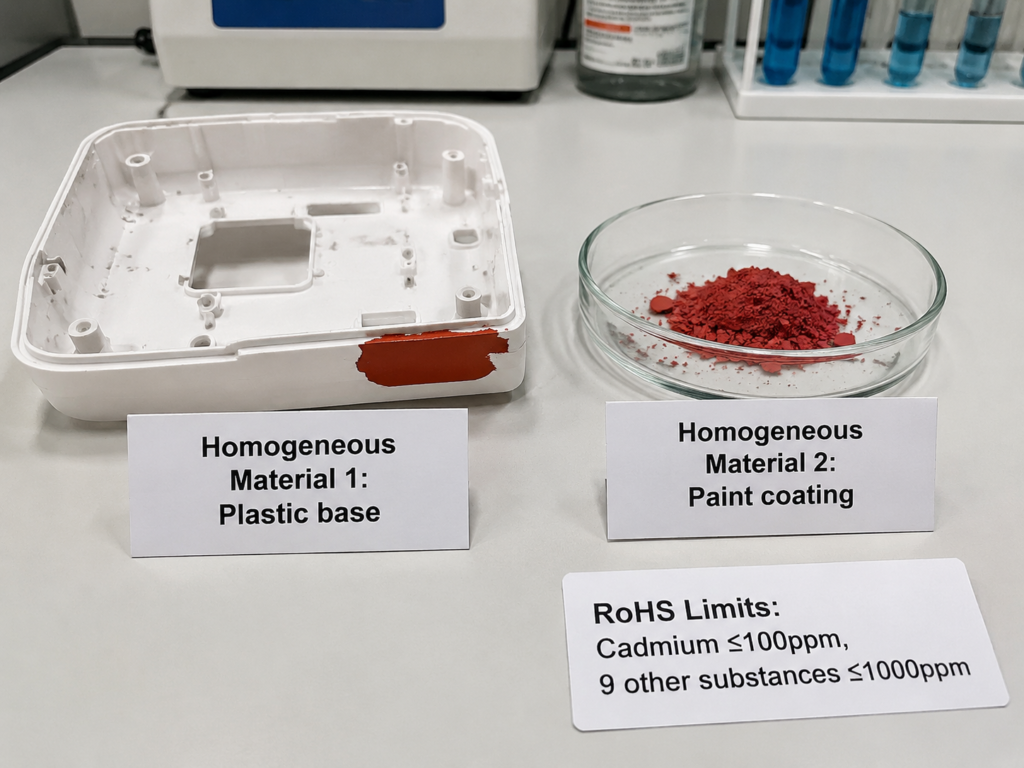
The corresponding limit rules are also clear: the whole machine weight cannot be used to dilute excess levels, and every layer and every piece of homogeneous material must meet the limit requirements.
The specific limits are: among the 10 restricted substances, the requirement for metallic cadmium is the strictest, not exceeding 100 ppm (that is, 0.01% by weight); the remaining 9 (including lead, mercury, hexavalent chromium, 2 brominated flame retardants, and 4 phthalates) each have a limit of 1000 ppm (that is, 0.1%).
3. Why It is Necessary to Distinguish Between Components and Finished Products
Many people may think that since materials must meet the limits anyway, what difference does it make to distinguish them? In fact, the difference is huge: the same product may have very different legal identities, compliance obligations, responsible parties and cost inputs under different sales scenarios and forms.
If the classification is wrong, at best you will spend unnecessary money on unnecessary certifications and documents, at worst your goods will be detained by customs, required to be rectified or recalled, and you may even bear unnecessary legal responsibilities. Therefore, before starting RoHS compliance work, it is definitely twice the result with half the effort to first clarify the compliance identity corresponding to your product.
Core Concepts: “Finished Products” and “Components” in RoHS
After understanding the basic rules, let’s clarify what the commonly referred to “finished products” and “components” actually are. First, it must be clear that there is no statutory binary classification of “finished products” and “components” in RoHS regulations; what it directly governs is eligible electronic and electrical equipment (EEE). The “finished products” and “components” we talk about daily are common terms in the supply chain to facilitate the distinction of compliance obligations — the core of all judgments ultimately returns to the two statutory baselines: “whether it is an independent EEE” and “whether it is first placed on the EU market”.
Commonly Referred to “Finished Products”: EEE Placed on the Market Independently
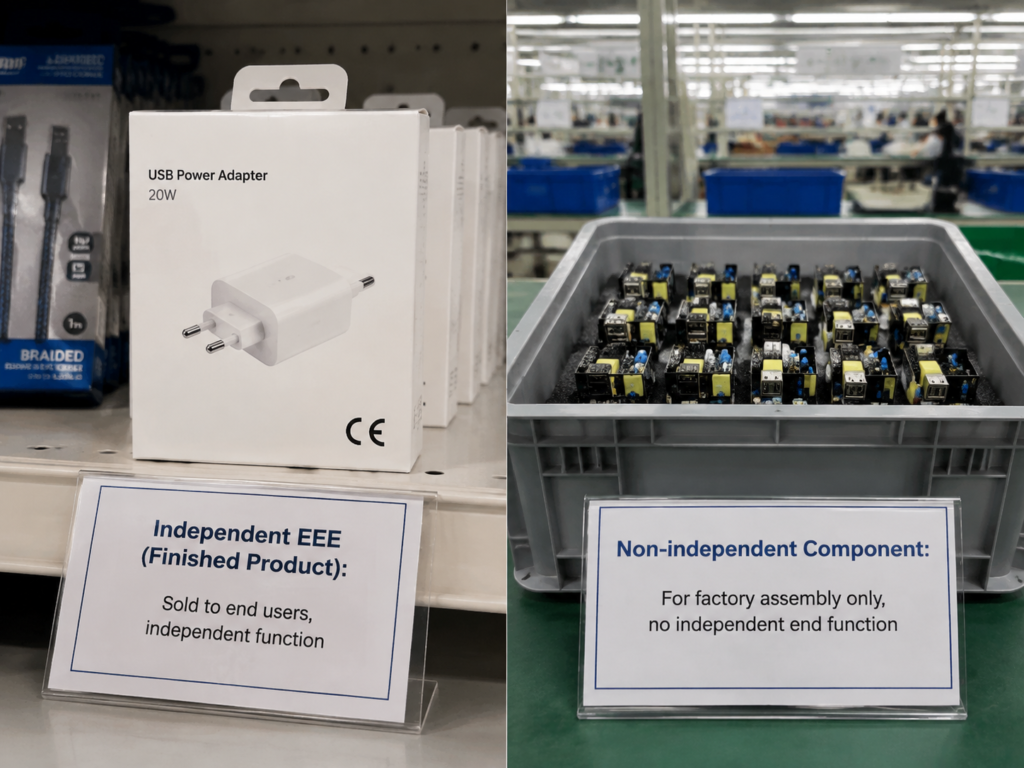
The “RoHS finished products” we refer to daily usually refer to independent EEE that can be directly sold to end users and can achieve complete electronic and electrical functions without additional assembly.
Its core feature is that it has an independent use function and is placed on the market in the form of an independent product; being oriented to ordinary consumers and usable independently are common auxiliary judgment factors, but not the only standard — even independent electronic equipment sold to enterprises, as long as it falls within the scope of EEE and is first placed on the EU market, also falls within the compliance scope of such “finished products”.
Typical examples include: mobile phones, household desk lamps, separately sold power banks, Bluetooth headsets, etc. — you can use them right after plugging in or charging them at home, without installing other parts.
Commonly Referred to “Components”: Non-Independent Assembly Components
The “RoHS components” we refer to usually refer to non-independent components used for assembling, repairing or replacing other products, which cannot independently achieve the final electronic and electrical use function.
A common feature of such components is that they are mainly sold to manufacturers for the production or repair of other products, but similarly, you cannot only look at the sales target — if a component itself has independent electronic and electrical functions, even if it is sold to factories, it may still be an independent EEE and needs to comply with RoHS requirements separately.
Typical examples include: resistors on circuit boards, bare PCB boards, factory-customized built-in batteries, ordinary cables, plastic shells, electroplated terminals, etc. — they cannot achieve the final use function when taken out alone, and must be installed in other products to function.
Preliminary Distinction Logic for Boundary-Ambiguous Products
In reality, there are definitely many products that fall between the two and are difficult to judge. Here is a basic distinction idea for you: the core is to look at two statutory baselines, and then make a comprehensive judgment combined with three auxiliary factors:
The two statutory baselines are: ① Is it itself an electronic and electrical equipment (EEE)? ② Is it first placed on the EU market in the form of an independent product?
The three auxiliary factors are: ① Can it independently achieve complete electronic and electrical functions? ② Is the main sales target end consumers or manufacturers? ③ Is the sales channel retail or industrial wholesale?
Let’s take two common examples to help you understand:
For example, for the same power module, if it is retailed and can directly charge a mobile phone when plugged in, it has independent functions and is placed on the market separately, so it usually belongs to independent EEE (commonly referred to as “finished product”); if it is a control module that can only be embedded in a router and cannot be used alone, it belongs to a non-independent component (commonly referred to as “component”).
Another example is chargers: the universal models sold in supermarkets that consumers can use right after buying are independent EEE; if it is a factory-customized built-in charger that is only used to be installed in a certain home appliance set and not sold separately to the outside, it belongs to a non-independent component.
Note: These examples are only common cases. The specific judgment must be combined with the actual function of the product, sales form and regulatory details, and cannot be applied in a one-size-fits-all manner.
Why We Must Distinguish: Responsibilities, Costs and Risks Are All Different
Maybe you still don’t feel the importance of classification. Next, let’s talk about how big the difference between the two is from three dimensions: responsible subject, compliance cost, and regulatory risk.
Different Subjects of Compliance Responsibility
If it is an independent EEE (commonly referred to as “finished product”), the manufacturer, importer or brand owner that places the product on the EU market shall bear the primary compliance responsibility. If something goes wrong, the regulatory authority will first contact these responsible subjects.
If it is a non-independent component (commonly referred to as “component”), the responsibility shall be borne according to different situations: if the component supplier directly imports it separately into the EU and it itself is an independent EEE, the supplier or the importer of the component shall bear the responsibility; if the component is imported into the EU together with the finished product and is a non-independent component, usually the responsible party of the finished product first bears the overall compliance responsibility, and then the finished product party can recourse to the component supplier according to the contract agreement and actual situation.
Obvious Difference in Compliance Costs
The compliance work of independent EEE needs to cover all homogeneous materials of the whole machine, and also requires sorting out a full set of technical documents and issuing a declaration of conformity. Some products may need sampling test verification, so the overall cost is higher.
Non-independent components only need to ensure that their own materials meet the limit requirements and provide corresponding compliance certification materials, so the cost is relatively lower. If you mistake a non-independent component for an independent EEE to do full compliance, you will spend a lot of unnecessary expenses for no reason; conversely, if you declare an independent EEE as a component, you will face risks such as goods detention and rectification if found by the regulatory authority, resulting in greater losses.
Different Risks of Regulatory Spot Checks
Because independent EEE is directly oriented to end users, it is the key spot check target of EU customs and market supervision departments. If it violates the regulations, measures such as sales restriction and recall may be directly taken.
The probability of non-independent components being directly spot-checked is relatively low. Generally, only when there is a problem with the finished product and the regulatory authority traces back up the supply chain will it find the component supplier.
Item-by-Item Comparison of Core Differences (Unified Caliber: Current RoHS Regulations · 10 Restricted Substances)
To let you see the difference between the two more clearly, we have sorted out the 6 core comparison dimensions into the table below for your quick reference, and then we will explain the rules and precautions behind them one by one:
| Comparison Dimension | Non-Independent Component (Commonly Referred to as “Component”) | Independent EEE (Commonly Referred to as “Finished Product”) | Special Change Conditions |
|---|---|---|---|
| Scope of Application Trigger | Usually does not directly bear EEE compliance obligations under RoHS, but its materials must meet limit requirements to support downstream finished product compliance | If it belongs to the EEE category under RoHS jurisdiction and is first placed on the EU market, it must comply regardless of the sales target | 1. If the component itself has independent electronic and electrical functions, falls within the scope of EEE and is placed on the EU market separately, compliance obligations shall be assessed as independent EEE; 2. For second-hand products/components that have been legally placed on the EU market for the first time and have not undergone substantial transformation, change of use or remanufacturing, re-transaction usually does not constitute a new first placement and does not need to be re-complied; second-hand products imported from outside the EU need to be judged separately |
| Hazardous Substance Coverage | Only covers all its own homogeneous materials | Covers all homogeneous materials of the whole machine, including materials that finally remain and become part of the product (such as solder, adhesives, inks, coatings, etc.) | If the specific application of the component meets the applicable scenarios, product categories and validity period requirements of RoHS exemption clauses, the exemption can be continued in the finished product, but the applicability must be verified by the finished product manufacturer and cannot be directly applied solely based on the supplier’s declaration |
| Compliance Verification Method | Suppliers can prove material compliance through materials such as material declarations, test reports, material data, change records, etc. The specific form is determined by the supply chain based on risk | Manufacturers need to establish technical documents by integrating bill of materials (BOM), supplier information, necessary test reports, change records, etc. based on risk assessment to prove product compliance; high-risk materials can be sampled and rechecked, and whole machine disassembly testing is one of the optional verification methods | When material formula, production process or supplier changes, both need to re-evaluate compliance |
| Labeling and Document Requirements | Usually no need to affix CE mark separately. Suppliers generally need to provide their own material compliance certificates and batch traceability information, which shall be subject to contract agreement | For EEE within the scope of CE mark application, the manufacturer shall affix the CE mark, prepare the Declaration of Conformity (DoC) and Technical Construction File (TCF), and keep them for 10 years from the date of first placement on the market; importers and authorized representatives shall bear corresponding obligations in accordance with regulations | If the component itself is an independent EEE or covered by other CE regulations, labeling and document obligations need to be assessed separately |
| Violation Accountability Logic | For non-independent components imported together with finished products, usually the finished product responsible party first bears primary responsibility, and then recourses to the supplier according to contracts and evidence; for independently imported independent EEE components, the responsibility of their importers/manufacturers shall be directly investigated | The manufacturer/importer placing the product on the market bears primary responsibility. Member states shall take measures such as rectification, sales restriction, recall or fine in accordance with their own implementation regulations, which vary by country and case | If the supplier can prove that it has provided true and compliant materials, and the finished product party privately replaces materials leading to violations, it may affect the responsibility distribution. The specific judgment needs to be combined with contracts, evidence and member state laws; the finished product responsible party still bears primary responsibility for the compliance of the final product |
| Exemption Application Responsibility | Suppliers need to prove that their products meet the exemption conditions, and clearly inform customers of the exemption clauses, applicable scenarios and validity period | The finished product party shall uniformly verify the applicability of all component exemptions and confirm that they meet the category, use and time requirements of its own products | After the exemption clause expires, the corresponding application needs to re-meet the limit requirements |
1. Different Trigger Rules for Scope of Application
Non-independent components themselves are not electronic and electrical equipment (EEE), so they usually do not directly bear EEE compliance obligations under RoHS, but this does not mean that their materials can fail to meet the standards — because downstream finished product manufacturers need to include all component materials in compliance assessment, component materials must meet RoHS limit requirements before they can be used to produce finished products placed on the EU market. If the components are used for products that are statutorily excluded, such as military products and large stationary industrial equipment, then the material requirements for the components are determined by the rules of the corresponding products and do not need to meet RoHS limits.
As long as independent EEE belongs to the category under RoHS jurisdiction and is first placed on the EU market, no matter who it is sold to (consumers or enterprises), it must comply with RoHS requirements.
There are two special situations to note here:
First, don’t think that “what is sold to factories must be components” — if the product itself has independent electronic and electrical functions and falls within the scope of EEE, even if it is sold to factories for use, as long as it is first placed on the EU market, it needs to comply with RoHS requirements separately. The sales target is only an auxiliary judgment factor, not a decisive standard.
Second, the exemption for second-hand products has strict prerequisites: only second-hand products or components that have been legally placed on the EU market for the first time and have not undergone substantial transformation, change of use or remanufacturing do not need to re-comply with RoHS when re-traded within the EU; if they are second-hand products imported into the EU from outside the EU, they may still constitute a first placement and need to meet RoHS requirements.
2. Different Coverage Scopes of Hazardous Substances
The compliance of non-independent components only needs to cover all their own homogeneous materials. For example, for a plastic shell, you only need to test the shell itself and the paint on it, without worrying about other materials.
The coverage of independent EEE is much larger: it not only covers all components in the whole machine, but also includes materials that finally remain and become part of the product, such as solder, glue, coatings on labels, etc. — although these materials are not separate components, they are also part of the product and must meet the limit requirements.
Note: Process auxiliary materials that are only used in the production process and do not remain in the product in the end (such as cleaning agents, release agents) are not within the scope of RoHS assessment, and do not need to meet the standards just because they are used in production.
Regarding the application of exemptions, special explanation is needed here: RoHS exemptions are limited exceptions for specific application scenarios, product categories and specific substances, not overall exemptions for a certain type of component. If the specific application of a component meets the requirements of the exemption clause, even if it is installed in a non-exempt finished product, the exemption can still be used, but the finished product manufacturer must verify that this exemption is indeed applicable to its own product category, use and validity period, and cannot directly apply it solely based on the supplier’s declaration.
3. Different Compliance Verification Methods
Many people think that RoHS has fixed compliance document requirements, such as requiring a “material composition declaration” or mandatory third-party testing, but this is not the case. RoHS regulations do not force enterprises to provide documents of a specific format, nor do they stipulate that third-party testing must be done — the core obligation of enterprises is to establish sufficient technical documents to prove that products meet the limit requirements. The specific form of evidence adopted is decided by the enterprise itself based on risk assessment.
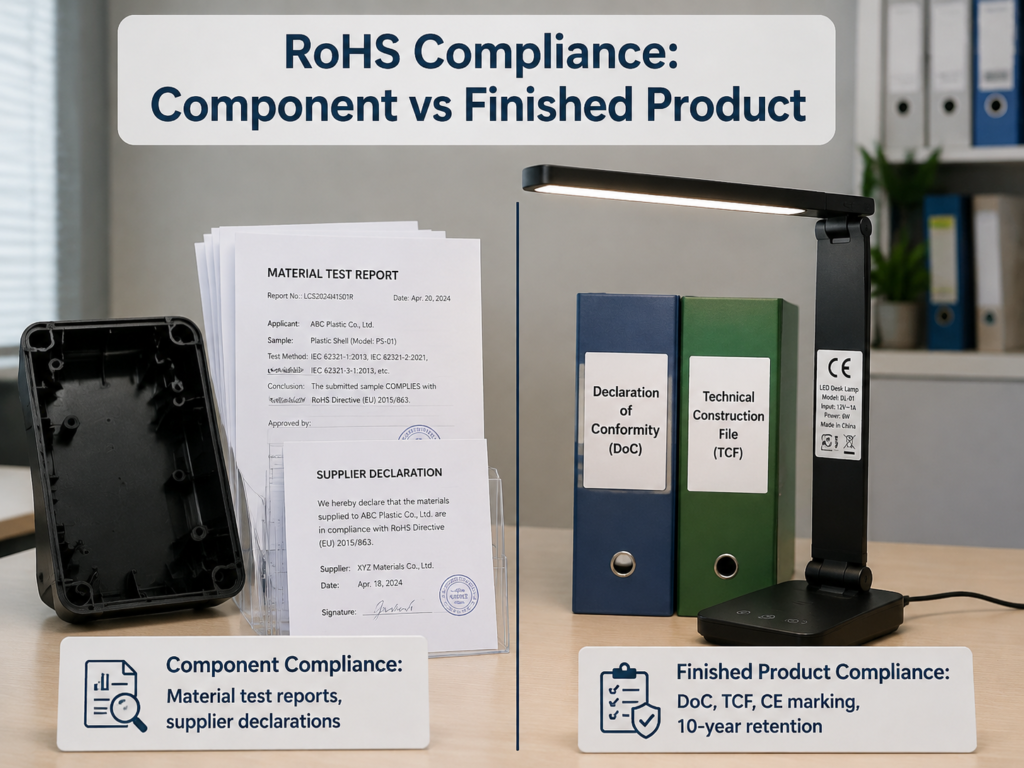
For suppliers of non-independent components, common certification methods include material compliance declarations, third-party test reports, material composition data, production change records, etc. The specific materials to be provided can be negotiated and determined by both parties in the supply chain according to the risk level of the materials.
For manufacturers of independent EEE, common compliance verification methods include: sorting out the bill of materials (BOM, i.e. the detailed list of all components and materials of the finished product), collecting supplier compliance materials, conducting sampling verification on high-risk materials, and conducting whole machine disassembly testing when necessary. These are all optional evidence means, not a statutory “either-or” path, and the ultimate goal is to establish complete technical documents to prove that the product meets the requirements.
Whether it is a component or a finished product, as long as the material formula, production process or supplier changes, compliance needs to be re-evaluated, and old reports or declarations cannot be used all the time.
4. Different Labeling and Document Requirements
The most intuitive difference is the CE mark. First, it must be clear that the CE mark is a conformity mark shared by multiple EU New Approach Directives, representing that the product meets the requirements of relevant EU health, safety and environmental protection regulations. It is not only RoHS that requires the CE mark, nor do all electronic-related products need to be affixed with CE.
For independent EEE, if it falls within the scope of regulations requiring the affixation of the CE mark, its manufacturer shall affix the CE mark in accordance with regulations, and at the same time prepare a Declaration of Conformity (DoC, i.e. a written declaration issued by the enterprise to prove that the product meets the requirements of relevant regulations) and Technical Construction File (TCF, i.e. the full set of technical materials required to prove product compliance, including bill of materials, test reports, risk assessment records, etc.), and keep them for 10 years from the date of first placement of the product on the EU market. Importers and authorized representatives also need to bear corresponding document verification and preservation obligations in accordance with regulatory requirements.
For non-independent components, there is usually no need to affix the CE mark separately. Suppliers generally only need to provide compliance certificates and batch traceability information for their own materials, and the specific requirements can be agreed by both parties in the contract.
Note: If a component itself is an independent EEE, or is covered by other regulations requiring the CE mark, then the labeling and document obligations need to be assessed separately, and it cannot be generalized that “all components do not need to be affixed with CE”.
5. Different Violation Accountability Logics
If independent EEE violates the regulations, the regulatory authorities of member states will take corresponding measures in accordance with their own RoHS implementation regulations, which may include requiring rectification, restricting sales, recalling products, imposing fines, etc. The specific form, amount and procedure of punishment vary greatly due to different national laws, the severity of the violation and the risk level of the product, and there is no unified EU fine standard. These responsibilities are first borne by the manufacturer or importer that places the product on the EU market.
If the problem of non-independent components leads to the violation of the finished product, usually the responsible party of the finished product first bears the primary responsibility, and then the finished product party can recourse to the component supplier for responsibility according to the contract agreement, actual supply situation and relevant evidence. If it is an independent EEE component imported separately into the EU, the responsibility of the importer or manufacturer of the component shall be directly investigated.
It should be noted here that if the component supplier can prove that it has provided true and compliant materials, and the finished product party privately replaced the materials leading to the violation, it may affect the responsibility distribution between the two parties, but the specific responsibility division needs to be judged in combination with the contract agreement, relevant evidence and the laws of the member state, and it cannot be generalized that “the supplier is fully exempt from responsibility” — the finished product responsible party always bears primary responsibility for the compliance of the final product placed on the market.
6. Different Exemption Application Responsibilities
RoHS exemption clauses have strict applicable conditions and cannot be used casually, and the responsibilities of the component and finished product sides are also different.
For component suppliers, if you claim that your product is eligible for a certain exemption, you need to bear the burden of proof, and clearly inform your customers of the clause number corresponding to this exemption, the applicable scenarios, and the validity period, so as to facilitate downstream customers to verify.
For finished product manufacturers, you cannot just listen to the supplier saying there is an exemption and use it directly. You must verify by yourself whether this exemption is really applicable to your product category, use and current validity period, because the final compliance responsibility is borne by the finished product party.
Whether it is a component or a finished product, as long as the corresponding exemption clause expires, it must re-meet the limit requirements and cannot continue to use the exemption. The EU will regularly evaluate the necessity of exemption clauses. Some exemptions may be renewed after expiration, and some may be invalidated. It is necessary to pay attention to regulatory updates in time.
Quick Initial Screening: How to Judge the Compliance Identity of a Product
After talking about the differences, you may say: I understand the truth, but what if I still can’t distinguish when encountering specific products? Don’t worry, here is a set of “four questions for initial screening” method, which can help you make a quick preliminary judgment. The final conclusion still needs to be verified in combination with regulatory details.
Four Questions for Initial Screening (Judge in Order)
Step 1: Is this product itself an electronic and electrical equipment (EEE)? That is, does it operate on electric current or electromagnetic fields and belong to the product category applicable to RoHS? If it does not belong to EEE at all, then the EEE compliance rules of RoHS do not apply (but if it is a component of EEE, the materials still need to meet the limit requirements).
Step 2: If it belongs to EEE, then check whether there are statutory exclusions or special category rules? For example, does it meet the strict definition of statutory exclusions such as military products and large stationary industrial equipment? Does it belong to categories with special rules such as medical and monitoring?
Step 3: Next, check whether it is first placed on the EU market in the form of an independent product? If yes, then it shall bear compliance obligations in accordance with the requirements of independent EEE.
Step 4: If it is not an independent EEE, but only a component or part, then check whether it is only used to assemble other products and not sold separately as an end product? If yes, it usually belongs to a non-independent component and can be handled in accordance with the supply chain material compliance requirements.
Auxiliary reference factors: whether the product can be used independently, whether the main sales target is consumers or factories, and whether the sales channel is retail or industrial wholesale — these can help you make auxiliary judgments, but cannot be used as the only decisive standard.
If you are still unsure after going through these four questions, it is recommended that you check them one by one against the official definition of RoHS regulations, product category list and exemption clauses, or confirm with a professional compliance agency. Do not draw conclusions based on feeling.
Judgment Reference for Common Boundary Scenarios
In reality, there are several types of products that are particularly easy to confuse. We have sorted out common judgment references. Each conclusion has applicable prerequisites, so do not apply them in a one-size-fits-all manner:
- Charger/power products: Universal retail models that consumers can use independently after purchase usually belong to independent EEE; factory-customized built-in power modules that are exclusively embedded in a certain device and not sold separately usually belong to non-independent components. Core of judgment: whether it has independent use function and whether it is placed on the market in the form of an independent product.
- Battery products: Separately retailed power banks, consumer spare lithium batteries, etc., if they fall within the scope of EEE, are usually evaluated as independent products; factory-customized battery packs that are only supplied as built-in components of a certain device usually belong to non-independent components. Note: Not all batteries belong to EEE, which needs to be judged in combination with their functions, power supply methods and legal definitions.
- DIY electronic kits: Those sold in sets to ordinary consumers that can achieve complete electronic and electrical functions after assembly are usually evaluated as EEE as a whole; scattered components sold to factories as production raw materials do not belong to independently placed finished products. Core of judgment: sales target and the final use form of the whole set of products.
- Repair spare parts: Those used to replace the original parts of products that have been legally placed on the EU market and do not change the original function and compliance status of the product usually do not need to go through the compliance process of first placement again; brand-new spare parts sold separately to consumers, if they themselves are independent EEE, need to be evaluated as independent products. Core of judgment: whether it constitutes a new first placement and whether it changes the compliance status of the original product.
- Modules with electronic functions: Those that can independently achieve complete electronic and electrical functions and are sold separately may belong to independent EEE; those that can only be embedded in other products and cannot achieve the final use function alone usually belong to non-independent components. Core of judgment: whether it has the function of independent use and the form of independent sales.
Clarification of Common Judgment Misconceptions
There are several other common mistakes that many people make, which must be avoided:
- Misconception: Small-sized ones must be components — Wrong. Bluetooth headsets and USB flash drives are very small, but they are all products that can be used independently and belong to independent EEE.
- Misconception: Components do not need to comply with RoHS — Wrong. Non-independent components do not need to bear EEE compliance obligations separately, but their materials must meet RoHS limit requirements, otherwise they will lead to violations of downstream finished products. Only the subject and form of compliance responsibility are different.
- Misconception: Those with CE mark must be finished products — Wrong. The CE mark is a conformity mark shared by multiple EU regulations. Some separately sold components may also be affixed with the CE mark if they fall within the scope of other CE regulations; conversely, some independent EEE may not need to be affixed with CE if they do not fall within the scope of CE mark application. You cannot judge just by whether there is a CE mark.
- Misconception: Those with simple functions must be components — Wrong. The function of a night light is very simple, just plug in and light up, but it is directly sold to consumers for independent use and belongs to independent EEE.
- Misconception: Products sold to factories do not need to comply with RoHS separately — Wrong. If the product itself is an independent EEE, even if it is sold to factories for use, as long as it is first placed on the EU market, it needs to comply with RoHS requirements separately. The sales target is only an auxiliary judgment factor.
Compliance Pitfall Avoidance Points for Different Roles (Semi-Proficient Level)
If you can already preliminarily judge the compliance identity of the product, next we will talk about specific compliance pitfall avoidance points for different supply chain roles, to help you avoid detours and unnecessary expenses.
Non-Independent Component Suppliers (Selling to EU Factories/Brands)
As a supplier of non-independent components, your core obligation is to ensure that the materials you supply meet RoHS limit requirements, while avoiding bearing additional compliance costs that do not belong to you:
- You only need to provide compliance certification materials for your own materials (such as material declarations, test reports, etc.), and do not need to take the initiative to bear the EEE compliance obligations of the whole machine (for example, no need to do the whole machine DoC, do not casually affix the CE mark to the product), otherwise you will spend more money for no reason, and may be misjudged as independent EEE and bear higher obligations. If your product itself is an independent EEE, then compliance obligations shall be assessed in accordance with the requirements of independent products.
- If your product applies RoHS exemptions, be sure to clearly inform customers of the exemption clause number, applicable scenarios and validity period, so as to facilitate downstream customers to verify the applicability and avoid subsequent disputes.
- The retention period of test reports, production records and other materials shall be determined according to customer contract requirements, supply chain management systems and applicable legal deadlines. Do not easily believe the statement of “unified retention for 5 years”, as requirements may vary for different customers and regions.
- For high-risk materials (such as electroplated parts, plastic parts, cables), taking the initiative to provide test reports can improve supply chain trust, reduce downstream verification costs, and enhance your product competitiveness.
- Do not make “absolute exemption” promises to downstream parties. Responsibility distribution needs to be judged in combination with contracts and actual situations; but as long as the materials you provide are true and the supply meets the agreement, you usually will not bear the responsibility caused by the finished product party’s private material replacement.
Finished Product Brand Owners/Importers (Including Cross-Border E-Commerce Sellers)
As the responsible party placing independent EEE on the EU market, you need to bear the primary compliance risk, so you must strictly check:
- First confirm whether your product falls within the scope of EEE under RoHS jurisdiction and whether there are statutory exclusion situations. Don’t spend money on certification right away. For example, purely mechanical products do not belong to EEE at all, and products that meet statutory exclusion conditions do not need to do RoHS compliance.
- You need to bear primary responsibility for the RoHS compliance of the final product. Don’t just rely on the supplier’s verbal promises. Collect written compliance materials, as only black and white documents count.
- Data collection should have priority: first collect RoHS compliance declarations for all materials to confirm basic compliance; then request test reports or conduct sampling verification for high-risk materials (such as plastic shells, cables, PCB boards, solder, batteries, etc.) to reduce the risk of data fraud.
- Sort out the bill of materials (BOM), establish a complete Technical Construction File (TCF) and Declaration of Conformity (DoC), and affix the CE mark to the product as required; these materials shall be kept for 10 years from the date of first placement of the product on the EU market, and regulatory authorities may request them at any time.
- If you are engaged in cross-border e-commerce, pay attention: if your product is an independent EEE sold directly to EU consumers, you may need to bear the compliance obligations of a manufacturer or importer, and you cannot take a chance to declare it as a “component”; but if it is indeed a non-independent component for industrial assembly and the sales target is enterprise customers, it can be handled according to the requirements of components — the core still depends on the attributes and placement form of the product itself, not just the sales channel.
- Be sure to keep the traceability records of all components, such as supplier information, batch numbers, test reports, etc. In case of problems, you can quickly locate the source and facilitate subsequent accountability.
General Supply Chain Compliance Logic
Whether you are a component supplier or a finished product party, you can use this set of logic to improve compliance efficiency, without doing everything and testing everything:
- Deduce risks from finished products: First confirm whether the finished product is going to enter the EU and whether it belongs to EEE under RoHS jurisdiction, then split out the core high-risk components, and finally only need to collect compliance evidence for high-risk materials. For low-risk materials, a compliance declaration is enough, which can save a lot of time and money.
- Data update depends on trigger conditions: It is not necessary to retest every year. Only when the material formula, production process or supplier changes, it is necessary to re-evaluate compliance and update relevant materials; if there is no change, there is no need for regular retesting.
- Grasp the key points when looking at compliance declarations: Don’t take a piece of paper as true. Look at four core points: whether it covers the 10 restricted substances in RoHS Annex II, whether it corresponds to current regulatory requirements, whether it states exemption clauses/applicable models/validity period, and whether there is a valid signature from the supplier. Missing any one cannot be used as valid compliance evidence.
Boundaries and Cognitive Misconceptions That Are Easy to Fall Into
Finally, let’s talk about a few of the easiest pitfalls to fall into. Many people who have been doing compliance for several years may get them wrong, so be sure to pay attention.
Confusion Between Regulations and Product Boundaries
The first big pit is confusing different EU regulations, or getting the product’s jurisdiction boundary wrong:
- Do not confuse RoHS, REACH and WEEE:
- The jurisdiction scope of RoHS is the content limits of 10 hazardous substances listed in Annex II in homogeneous materials of applicable electronic and electrical equipment (EEE). It does not regulate all electronic-related chemical substances, nor all environmental protection requirements of all electronic products.
- REACH (Registration, Evaluation, Authorization and Restriction of Chemicals Regulation of the EU) targets the registration, evaluation, authorization and restriction of chemical substances in chemical substances, mixtures and articles. Its coverage is wider than RoHS. Specific obligations depend on the type of substance, use and product category. The same product may need to meet different requirements of RoHS and REACH at the same time.
- WEEE (Waste Electrical and Electronic Equipment Directive) regulates the recycling and treatment of electronic and electrical products, requiring producers to bear recycling costs, which is a different dimension of requirements from RoHS’s restriction of hazardous substances.
- Common misunderstandings about product boundaries:
- Packaging and paper manuals usually do not fall within the scope of RoHS jurisdiction; they are more subject to regulations such as packaging waste and REACH; only a very small number of electronic packaging integrated with products may be included in the scope of EEE.
- The random accessories of the product (such as power cords, adapters, remote controls) shall be judged separately whether they belong to EEE. If they do, they must also meet RoHS requirements, and cannot be ignored just because they are gifts or accessories.
- Purely mechanical parts (such as ordinary screws, plastic shells without electronic functions) themselves are not independent EEE and do not need to bear RoHS EEE compliance obligations separately, but if they are components of electronic and electrical equipment, their materials still need to be included in the RoHS homogeneous material assessment of the finished product manufacturer. It cannot be said that “purely mechanical parts are completely unaffected by RoHS”.
- Medical devices, monitoring and control instruments have been included in the scope of RoHS application, but they have special product categories, transition periods and exemption arrangements, and do not belong to fully exempt categories. Those who make such products should separately check the requirements of the corresponding categories.
- Statutory exclusion clauses such as military products and large stationary industrial equipment have strict definitions. Not all military-related or industrial products can be excluded, and they must be checked one by one against the provisions of the regulations.
Common Misconceptions About Compliance Cognition
There are several other common cognitive errors, don’t fall into them:
- Misconception: If all components are compliant, the finished product will automatically be compliant — Wrong. The compliance assessment of finished products covers all finally remaining homogeneous materials, including materials used in the production process but finally remaining in the product, such as solder, adhesives, coatings, etc. If these are missed, even if all separate components meet the standards, the finished product may still be non-compliant.
- Misconception: Test reports are permanently valid — Wrong. Test reports only represent the state of the submitted sample at the time of testing. As long as the material formula, production process or supplier changes, compliance needs to be re-evaluated, and a report cannot be used for many years.
- Misconception: Exemptions can be used all the time — Wrong. All RoHS exemptions have strict applicable scenarios, product categories and validity periods. The EU will regularly evaluate the necessity of exemption clauses. They will become invalid after expiration, and must meet the limit requirements and cannot continue to be used.
- Misconception: All electronic products need to do RoHS — Wrong. Only electronic and electrical equipment that falls within the scope of RoHS application and is first placed on the EU market needs to comply. Products that meet statutory exclusion clauses do not need to comply.
- Misconception: It’s fine if the average of the whole machine weight does not exceed the limit — Wrong. RoHS limits are for each piece of homogeneous material. Even if only a thin layer of paint exceeds the limit, even if the total weight of hazardous substances in the entire product is very low, it is still a violation. The whole machine weight must never be used for dilution.
Summary
In general, there is no absolute statutory classification of “finished products/components” under RoHS regulations. The core of all judgments must return to the two baselines: “whether it is an applicable electronic and electrical equipment (EEE)” and “whether it is first placed on the EU market”. Sales channels, sales targets, size, and whether the function is simple are only auxiliary references and cannot be used as the only judgment standard. The core of compliance work is to ensure that the 10 restricted substances in the homogeneous materials of the product meet the limit requirements, and at the same time bear corresponding obligations according to the compliance identity of the product. If you encounter a particularly complex boundary product and are unsure about the classification or compliance requirements, it is recommended to confirm with a professional compliance agency or legal counsel to avoid unnecessary costs or compliance risks caused by classification errors.