
Most enterprises or practitioners planning to enter the EU market have heard of concepts such as “CE compliance”, “notified body” and “NB number”, but they are easily misled by the publicity of various institutions when implementing: some claim to be official NBs and promise guaranteed pass without testing, some have quotations several times different, and some claim to undertake all CE business with only one NB number. What exactly is a CE notified body? Does your product need to connect with an NB? How to select to avoid risks? Starting from basic concepts, this article gradually dismantles practical methods that can be implemented independently, to help you sort out the logic of the whole process.
Basic Understanding: What Exactly Does a CE Notified Body Do
Let’s first give a straightforward definition: A CE Notified Body (full English name: Notified Body, abbreviated as NB) is an independent third-party CE conformity assessment body authorized by the regulatory authorities of EU member states, and is not an official department directly under the EU. Its identity mark is a four-digit NB number, and its core function is to carry out conformity assessment on products requiring third-party assessment in accordance with EU regulatory requirements, and issue assessment documents with statutory endorsement.
Note: The conformity documents issued by NBs may be EU type-examination certificates, quality system certificates or other statutory certificates of conformity, depending on the regulations and assessment modules. Their names, validity and supervision requirements vary. They are uniformly referred to as “NB certificates” below.
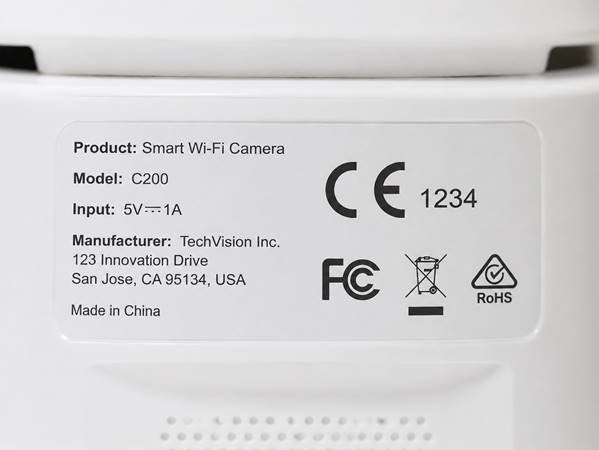
Many people confuse the relationship between NBs and the CE mark. Here we first clarify the core conclusion: The CE mark is a self-declaration of conformity made by the manufacturer, not a “certification mark” issued by an NB. Only when EU regulations clearly require third-party participation in conformity assessment is an NB required to intervene in the CE compliance process; for low-risk products, the manufacturer shall complete all conformity assessments required by applicable regulations (including risk analysis, necessary testing or technical verification, compiling complete technical documentation, and signing the declaration of conformity), then affix the CE mark as required, without the need to engage an NB. Only products that require NB participation need to mark the corresponding four-digit NB number next to the CE mark, and the specific marking requirements shall be subject to the provisions of the corresponding regulations.
Practitioners who are new to this field can easily confuse NBs with other types of institutions. Finding the wrong object not only wastes costs, but may also result in invalid certificates. The following table can help you quickly distinguish the core boundaries of various institutions:
| Type of Institution | Core Functions | Eligible to Conduct CE Statutory Conformity Assessment / Issue NB Certificates? |
| CE Notified Body (NB) | Carry out conformity assessment in accordance with regulations and issue statutory assessment documents | Yes (only within its authorized scope) |
| General Testing Laboratory | Issue product test reports | No |
| General Certification Body | Carry out voluntary certifications such as ISO | No |
| Consulting / Coaching Institution | Assist in preparing technical documentation and guide conformity rectification | No |
| EU Authorized Representative (AR) | Act as a legal contact within the EU and liaise with regulators | No |
Beginners are most likely to fall into these 4 cognitive pitfalls. Avoiding them in advance can reduce compliance risks:
• Misconception: All CE compliance requires an NB → Correction: Low-risk products can follow the self-declaration route without third-party involvement. The specific requirement shall be judged according to the conformity assessment modules required by the regulations;
• Misconception: NBs are official departments directly under the EU → Correction: NBs are independent third-party institutions authorized by EU member states, and have no subordinate relationship with EU or member state regulatory authorities;
• Misconception: Having an NB number means you can handle all CE business → Correction: Each NB only has authorization qualifications for a specific scope, and certificates issued beyond the authorized scope have no legal effect;
• Misconception: The larger the NB number, the better the qualification → Correction: The NB number is a four-digit code used to identify a notified body. The number itself does not represent the qualification level, business scope or assessment capability. Specific qualifications shall be subject to the officially publicized authorization information.
Core Functions, Rights and Liability Boundaries of NBs
After understanding the basic concepts, we will sort out the core work, statutory rights and responsibilities, and boundaries of NBs in the whole CE compliance process, to avoid disputes caused by information asymmetry.
4 Core Tasks of NBs
From project launch to post-certification maintenance, the core work of NBs mainly revolves around 4 links. The specific service content shall be subject to the institution’s public scope and contractual agreement:
The first is Confirmation of assessment scope and procedures: NBs can explain to applicants their designated authorization scope, materials required for assessment, specific processes and assessment basis, but do not assume the responsibilities of manufacturers for formulating regulatory strategies, improving product design or compiling technical documentation.
The second is Conformity assessment: This is the core function of NBs. Specific work includes technical documentation review, product type examination/testing, quality system audit, factory on-site inspection, etc. The specific items to be carried out depend on the conformity assessment modules required by the regulations.
The third is Issuance of NB certificates: Only when the assessment is passed and the product is within its authorized scope will the NB issue the corresponding type of conformity certificate; certificates issued beyond the authorized scope have no legal effect.
The fourth is Post-certification supervision: After the certificate is issued, the NB will carry out regular supervision audits in accordance with regulatory requirements; if there are changes in product design, key components, production address, etc., the manufacturer shall submit a change application, and the NB will assess whether re-assessment is required to ensure continuous compliance with regulatory requirements.
Statutory Rights and Responsibilities of NBs
As institutions authorized by EU member states, the rights and responsibilities of NBs are clearly defined by applicable regulations and member state regulatory rules:
• Statutory rights: NBs may suspend or withdraw certificates issued by themselves in accordance with regulatory requirements; under the requirements of applicable regulations and member state regulatory procedures, NBs shall report major non-conformities, certificate restrictions, suspension or withdrawal decisions to the designated competent authority.
• Statutory responsibilities: NBs shall be responsible for their own assessment processes and results. If there are violations (such as issuing certificates beyond scope, non-compliant assessment procedures, etc.), their authorization qualifications may be suspended or revoked by the regulatory authorities of member states; specific administrative, contractual or civil liabilities depend on the facts of the violation, applicable laws and contractual agreements.
5 Things NBs Absolutely Cannot Do
Many compliance risks stem from NBs operating beyond their boundaries. Formal NBs will never touch the following 5 red lines. If you encounter an institution that dares to promise such content, you need to immediately re-verify its qualifications:
1. Cannot undertake business beyond the regulations, product scope and assessment modules of their own authorization;
2. Cannot design products, compile and maintain technical documentation or make declarations of conformity on behalf of manufacturers; NBs may point out non-conformities, require supplementary evidence and explain the assessment basis, but do not replace the manufacturer as the main responsible party for compliance;
3. Cannot promise “guaranteed pass” or “100% certification”, because the main responsibility for compliance lies with the manufacturer, and NBs only carry out independent assessments in accordance with regulatory requirements;
4. Do not bear the product quality, after-sales or legal liabilities of the manufacturer. The first responsible person for product compliance is always the manufacturer;
5. Do not provide services beyond the scope of conformity assessment, such as legal, tax, and commercial agency services.
Certificate Validity and Liability Boundaries
Here we specifically clarify the validity boundary of NB certificates to avoid cognitive deviation:
• NBs are only responsible for the content within their own assessment scope to ensure that the assessment process complies with regulatory requirements, but do not cover all compliance obligations of the product; the manufacturer shall bear full statutory responsibility for product design, safety, completeness of technical documentation, and CE declaration of conformity.
• NB certificates are not passes for “EU-approved products”, but only prove that the corresponding assessment link complies with regulatory requirements. The main responsible party for compliance throughout the product life cycle is always the manufacturer.
• Test reports and NB certificates are completely different in nature: test reports only prove the test results of submitted samples, while NB certificates are conclusions of conformity assessment based on regulatory requirements. Some types of certificates include continuous supervision conditions, which shall be subject to the certificate type and regulatory requirements.
Pre-judgment: Does Your Product Really Need an NB?
This is the core issue that practitioners are most concerned about. You don’t need to consult everywhere. You can complete the preliminary judgment independently according to the 3-step logic. For complex products, the final confirmation still needs to be based on the specific regulatory classification and assessment modules.
3-Step Core Judgment Method
Step 1, Determine all EU regulations/directives applicable to the product: When judging, do not only look at the product name, but make a comprehensive judgment based on function, purpose and risk. For example, for face mask products, ordinary decorative face masks without any medical or protective function claims are usually managed as general consumer goods; those claimed to have protective uses such as dust prevention, particle protection, respiratory protection, chemical protection, etc., shall be judged in accordance with the Personal Protective Equipment (PPE) Regulation; those claimed to have medical uses such as medical use, disease prevention, sterility, etc., shall be judged in accordance with the Medical Device Regulation (MDR), and the applicable rules are completely different. It should be noted that product claims are only one of the judgment factors, and a comprehensive judgment shall be made in combination with the objective functions, design features and intended use scenarios of the product. The applicability of PPE, medical devices or other safety regulations cannot be excluded solely based on marketing copy or merchant claims. If the product meets the applicable conditions of multiple regulations at the same time, the requirements of each regulation shall be identified separately.
Step 2, Check the risk level and conformity assessment module of the product in the corresponding regulations: The so-called “conformity assessment module”, in plain terms, is the conformity assessment method stipulated by EU regulations. Some allow enterprises to self-declare, some require third-party type examination, and some require third-party factory audit plus continuous supervision.
Step 3, As long as the corresponding module requires third-party assessment, an NB must be engaged, otherwise the self-declaration route can be followed.
It should be noted that if the function, purpose or design of the same product changes, different regulations and modules may apply, and re-judgment is required.
Reference for Common Product Categories
To facilitate practitioners to form a preliminary understanding, here are some references for common categories, but it should be emphasized that specific requirements must be based on current regulations and product classification, and cannot be judged solely by the category list.
• High-risk categories that usually require NB involvement: medium and high-risk medical devices, Category III personal protective equipment (such as gas masks, high-altitude safety belts), pressure equipment, explosion-proof products, gas appliances, elevators, high-risk machinery (shall be judged according to the high-risk categories listed in the annex of the EU Machinery Regulation corresponding to the applicable time of the product, such as woodworking machinery, injection molding machines and other categories listed in Annex IV of the current Machinery Directive 2006/42/EC); ordinary machinery (non-high-risk annex categories) can usually be self-declared, but the final judgment shall still be based on product functions, risk levels and classification rules of applicable regulations, and it cannot be directly determined that NB involvement is not required solely based on the general description of “ordinary machinery”.
• Low-risk categories that can usually be self-declared: ordinary low-risk electronic and electrical products, non-high-risk ordinary machinery, ordinary clothing, and general daily necessities that fall within the scope of the Electromagnetic Compatibility (EMC) Directive and Low Voltage (LVD) Directive and whose corresponding conformity assessment procedures allow self-declaration.
Even for low-risk categories, if the product adds special safety functions, the risk level needs to be re-judged. In addition, it should be clarified that self-declaration does not mean exemption from compliance obligations. Manufacturers still need to complete all assessment work required by applicable regulations, compile complete technical documentation, and accept market supervision spot checks. Those who fail to meet the requirements will also face penalties.
Self-check List When in Doubt
If you still cannot determine according to the above methods, you can check one by one according to these 5 steps:
1. Clarify the core functions, intended use and use scenarios of the product;
2. Match all applicable EU regulations/directives to avoid omissions;
3. Confirm the risk level of the product in each regulation and the corresponding conformity assessment module;
4. Check whether the regulations mandate third-party conformity assessment;
5. If there are still doubts, you may consult the regulatory authorities of EU member states or confirm through the official channels of formal NBs.
Qualification Verification: Operation Guide for Official NANDO Query
After confirming that you need to find an NB, the first step is not to ask for a quotation, but to learn to verify the real qualifications of the NB – after all, there are many intermediaries pretending to be NBs and institutions issuing certificates beyond their scope. The core official channel for verifying NB qualifications is the EU’s NANDO database.
First, Understand What NANDO Is
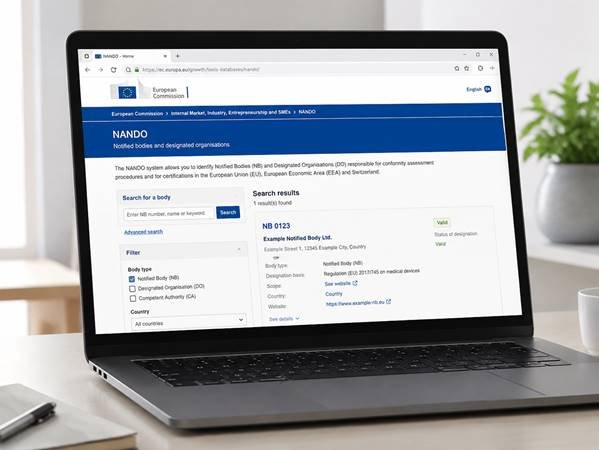
NANDO is the notified body information database published by the European Commission. It is the core EU official channel for verifying the designation status and authorization scope of NBs. It is open to the public free of charge and does not require registration. When verifying NB qualifications, in addition to the information published on NANDO, if necessary, cross-confirmation can be made in combination with the public decisions of the competent authorities of the member state to which the institution belongs and the qualifications of the certificate issuing entity, to avoid misjudgment due to issues such as delayed database updates.
Step-by-Step Query Operation
Before querying, first confirm that you are entering a formal channel: the official database is the NANDO (New Approach Notified and Designated Organisations) system under the European Commission, with the domain name suffix europa.eu. You can directly locate it by entering “NANDO notified bodies” in the search bar of the European Commission’s official website. It requires no registration and is completely free. If you encounter a page that requires payment or login, it is a counterfeit.
The specific query can be operated according to the following steps:
1. Accurately locate the institution: You can directly enter the 4-digit NB number or the full name of the institution for precise search, or filter the list of eligible institutions by applicable regulations and product categories.
2. Check the basic status of the institution: After entering the institution details page, first check whether the current “designation status” is “valid” and whether there are public records of suspension or revocation; if the status is abnormal, directly exclude it.
3. Check the statutory authorization scope: Find the entry of the corresponding applicable regulation, click to enter the details page, and check in turn:
• Whether the product category/product code covers your product;
• Whether the authorized conformity assessment procedures/modules cover the type of assessment you need (such as type examination, quality system audit, etc.).
This step is the core of verification. It must be completely matched, and you cannot only look at the general category of regulatory qualifications.
4. Auxiliary check of harmonized standards: If the NANDO page lists the harmonized standards or technical specifications that the NB can cover, you can further check whether they cover the relevant standards used by the product. Special attention should be paid: harmonized standards are only a reference for technical capability, and do not mean that the NB has obtained authorization for all relevant products or all assessment modules, and cannot replace the verification of the statutory authorization scope.
3 Easily Overlooked Verification Details
Many people only check “whether there is an NB number” when using NANDO, which is far from enough. There are 3 details that need to be focused on:
1. Must check the specific authorization details: Do not only look at the “has NB number” or general category regulatory qualifications displayed on the institution’s homepage. You need to click on the “authorization scope” details under the corresponding regulation entry, and check the specific product category/product code and conformity assessment module to ensure that they fully cover the product requirements. For example, enterprises engaged in medical devices cannot choose an NB just because it has MDR qualification; they must check whether it covers the corresponding product code and the required conformity assessment procedures; ordinary Class I medical devices are generally self-declared by the manufacturer, and only Class I devices with specific situations such as sterility, measurement function, reusable surgical instruments, etc. require NB involvement. If the scope is found to be mismatched, directly exclude the institution.
2. Verify subcontracting arrangements and the main responsible party: NBs may use external laboratories or technical personnel on the premise of complying with regulatory requirements, but shall bear full responsibility for the assessment process and final results. Before signing the contract, you may require the NB to state in writing: whether there is subcontracting, the specific links of subcontracting (such as testing, on-site audit), the name of the subcontracting institution, the NB’s review responsibility and the certificate issuing entity. If the NB is unwilling to bear the final responsibility, you should choose carefully.
3. Check the history of qualification changes: You can view the NB’s qualification change records on the NANDO page. If there are frequent suspensions/resumptions, significant reductions in authorization scope, multiple publicized violations by regulatory authorities, etc., it indicates that its own compliance stability is poor. It is recommended to prioritize institutions with more stable qualification records.
Impact of NB Qualification Changes on Certificates
If the NB’s qualification changes subsequently, the validity of the issued certificate shall be judged in combination with the decision of the competent authority, applicable regulations and the actual status of the certificate. The impacts and handling methods of different types of changes vary:
• Qualification suspension: It usually affects the acceptance of new application businesses, as well as supervision audits, change assessments and other activities during the suspension period; the validity of issued certificates shall be judged in combination with the reason for suspension, the decision of the competent authority and applicable regulations. You shall promptly contact the NB or the competent authority of the member state to confirm, and shall not assume that it continues to be valid by default.
• Qualification revocation: All authorizations of the NB are terminated, and new application businesses are directly stopped; issued certificates shall be transferred (transferred to other qualified NBs) or re-assessed in accordance with the transition rules of applicable regulations and the requirements of the competent authority. For details, please consult the original NB, the receiving NB or the competent authority.
• Reduction of authorization scope: It only affects businesses within the reduced scope. It is necessary to check item by item whether the regulations, product categories and assessment modules involved in the original certificate are still within the valid authorization scope of the NB; if they are no longer within the scope, certificate transfer or re-assessment shall be handled in accordance with regulatory requirements.
No matter what kind of qualification change occurs, you shall not determine on your own that the certificate continues to be valid or is directly invalidated. It shall be subject to official formal notices and regulatory requirements.
Beginner’s Version of the Full NB Selection Process
After learning to verify qualifications, you can select according to the following 5-step process. Beginners can follow it to select a compliant and appropriate institution.
Step 1: Prepare Basic Product Information in Advance
Prepare all materials before connecting with the NB, which can reduce the time cost of back-and-forth communication and obtain a more accurate quotation. The materials to be prepared are divided into three categories:
• Product information: name, model, purpose, core functions, list of key components, risk analysis report (if any);
• Compliance information: identified applicable regulations, harmonized standards, conformity assessment modules;
• Project requirements: planned launch time, budget range, production location, communication language requirements.
Step 2: Screen Candidate NBs with Matching Qualifications
Screen from the NANDO database according to the aforementioned verification standards. First select institutions with fully matching qualifications, then select 3-5 with experience in assessing similar products as candidates, and directly exclude institutions with suspended/revoked qualification records or mismatched scopes. Prioritize NBs with experience in assessing products of the same category, which have higher communication efficiency and more accurate grasp of regulatory requirements.
Step 3: Unified Inquiry and Scheme Comparison
When making inquiries, you shall send exactly the same product information to all candidate NBs to ensure consistent quotation standards, otherwise there is no comparative significance. Require the other party to issue a written scheme, which at least includes: applicable regulations, assessment modules, specific service content, estimated cycle, and quotation details.

When comparing, do not only look at the price, but conduct a comprehensive assessment from the following dimensions: qualification matching degree (this is the core prerequisite, no matter how cheap it is, it is useless if it does not match), whether the cycle meets the launch plan, total cost, communication language and response speed, service scope (whether testing, factory audit, certification, annual supervision are included).
Special attention should be paid to hidden costs: such as travel expenses for factory audits, retesting fees for unqualified tests, re-assessment fees after rectification, annual supervision fees, etc. Some institutions have very low initial quotations, but these fees need to be charged separately, and the final total cost may be much higher. Be sure to verify clearly in advance.
Step 4: 3 Verifications Before Signing the Contract
After determining the intended institution, don’t rush to sign the contract. Do 3 verifications to avoid falling into the trap of intermediaries or illegal institutions:
First, verify the identity of the contact person: confirm that the other party is a formal employee of the NB. For example, require the other party to send formal documents using the official email, or verify the identity of the contact person through the public contact information on the NB’s official website, to avoid intermediaries impersonating NB employees to take orders.
Second, verify the assessment scheme: confirm that the regulations and modules in the scheme are consistent with the actual requirements of the product, and there are no redundant mandatory items; at the same time, confirm that the manufacturer name, production address, and product model range covered by the certificate are completely consistent with the actual situation, to avoid the problem of scope mismatch after the certificate is issued.
Third, verify the certificate template: confirm that the NB number, authorization scope, and product information marking on the template comply with regulatory requirements, to avoid obtaining non-compliant certificates.
Step 5: Key Checkpoints in the Assessment Process
After the project starts, it is not enough to just hand over the materials to the NB. The following key points need to be focused on to avoid affecting the assessment progress or results:
• Technical documentation shall be completely consistent with the actually produced product, and there shall be no inconsistency between the document description and the actual product;
• Submitted samples shall be able to represent the declared model and mass production status; if there are reasonable differences between the samples used for type examination and the mass-produced products (such as trial production samples), the differences shall be truthfully recorded, their impact on the compliance conclusion shall be assessed, and the safety performance of the mass-produced products shall be consistent with the assessed model. Samples that deliberately evade test requirements or are seriously inconsistent with the mass production status shall not be submitted for testing;
• For non-conformities raised by the NB, rectify them item by item and keep complete rectification records to ensure that the rectification complies with regulatory requirements;
• Quality system documentation shall be able to support production consistency, otherwise even if the type examination is passed, the factory audit may fail.
Certificate Obtainment and Subsequent Precautions
Only after all assessment activities required by the applicable conformity assessment module, such as technical documentation review, product inspection/testing, system audit, on-site inspection, etc., are completed, all identified non-conformities are closed, and the NB makes a qualified conclusion after assessment, can the NB issue the certificate in accordance with the corresponding certificate type and contractual agreement. Common reasons for rejection include: mismatched NB qualifications, too many missing items in technical documentation, unqualified testing, and overdue rectification.
After obtaining the certificate, properly keep the NB certificate, technical documentation, declaration of conformity, test records and supervision audit records in accordance with applicable regulatory requirements; manufacturers shall respectively check the storage period, starting point and storage subject requirements of the above documents under each applicable regulation, and keep them properly in accordance with the regulations. At the same time, cooperate with the NB’s regular supervision audits, and submit an assessment application in time when the product changes.
Advanced Selection: Judgment Skills and Scenario-based Decision-making
If your product has high risks and special needs, you can further refer to the following advanced judgment methods to select a more suitable notified body.
Core Dimensions for Judging the Reliability of NBs
Instead of looking at the institution’s advertising, you can check verifiable hard indicators from 4 core dimensions, and then make a comprehensive judgment combined with 2 auxiliary references:
Core Dimension 1: Qualification Stability
Through the NANDO database and public information of the competent authorities of the member state, check the NB’s qualification history, whether there are frequent suspensions/resumptions, significant scope reductions or public penalty records. The more stable the qualification, the stronger the guarantee of certificate validity.
Core Dimension 2: Industry Recognition
It can be judged through public cooperation information of well-known enterprises in the same category, verifiable similar project cases, professional reputation in the industry, etc. Note that do not easily believe data without public sources such as “national first” and “100% pass rate” unilaterally promoted by the institution – the EU does not uniformly publicize the supervision spot check pass rate of each NB, and individual cases or self-declared data of institutions are not referential.
Core Dimension 3: Regulatory Compliance Record
It shall be subject to the violation penalty and qualification adjustment records published by the competent authority of the member state to which the NB belongs. If there are records of multiple notifications by regulatory authorities, penalties for issuing certificates beyond scope, etc., you should choose carefully.
Core Dimension 4: Independence and Impartiality
Check whether the NB has an interest association with the applicant that may affect the impartiality of the assessment, and whether it provides consulting services to the same applicant that replace its design, manufacturing or compliance decision-making; for other related services, you may require the NB to state in writing the independence arrangements and conflict of interest control measures.
Auxiliary Reference 1: Technical Adaptability
Verify whether the NB has experience in assessing similar products, professional assessment personnel in the corresponding field, necessary testing capabilities or cooperative resources. You may require verifiable similar project cases to be provided. The higher the technical adaptability, the lower the communication cost and the higher the assessment efficiency.
Auxiliary Reference 2: Service Transparency
Whether the written scheme clearly lists the assessment scope, process, cycle, cost details, supervision requirements, and whether the certificate sample complies with regulatory specifications. The higher the transparency of the institution, the lower the probability of subsequent hidden charges and process disputes.
Selection Logic for 3 Common Scenarios
The selection priorities for different needs are completely different, and there is no need to blindly choose the most expensive or largest institution:
• Fast-to-market scenario: For example, to catch up with the peak sales season, prioritize formal NBs with local docking teams, short scheduling and high efficiency, on the premise that the qualifications must be fully matched. Some large international NBs have cumbersome processes and long scheduling, which are less efficient than small but sophisticated formal NBs;
• High-risk product scenario (such as Class III medical devices, explosion-proof products, Category III PPE, etc.): Prioritize checking the NB’s authorization scope of corresponding regulations, technical assessment experience of similar products, supervision and audit mechanism and certificate traceability, to reduce the risk of certificates being questioned by regulatory authorities due to non-compliant assessment procedures. The final validity of the certificate shall still be subject to applicable regulations, requirements of regulatory authorities and the actual status of the certificate;
• Limited budget scenario: Prioritize NBs with just matching qualifications and service content that just meets the requirements. There is no need to choose institutions with a lot of unnecessary value-added services, but you must be alert to quotations that are significantly lower than the market price – such quotations may have risks such as mismatched authorization scope, missing service content (such as excluding supervision audit and retesting fees), hidden charges, etc. You need to verify item by item in the following ways: compare whether the NANDO authorization scope is consistent with the products/regulations covered by the quotation, require the other party to provide complete quotation details (including all costs such as testing, travel, re-assessment, annual supervision, etc.), confirm that the certificate is finally issued directly by the NB rather than other institutions, to avoid losing big due to small gains.
Selection Focus for Key Product Categories
Regulatory requirements for different categories vary greatly, and the core points need to be focused on during selection:
• Medical devices (MDR/IVDR, i.e. EU Medical Device Regulation / In Vitro Diagnostic Medical Device Regulation): It is necessary to first confirm that the NB covers the corresponding product code or device scope and has relevant clinical review capabilities; affected by regulatory requirements and institutional resources, NB scheduling may be long. The actual cycle shall be subject to product classification, technical documentation maturity and the NB’s written scheduling. It is recommended to plan the project time in advance.
• Personal Protective Equipment (PPE): It is necessary to confirm that the NB covers the specific PPE category (for example, if you make respiratory protection products, you cannot choose an NB that only has the qualification for chemical protective gloves). Prioritize institutions that have both testing and factory audit capabilities to reduce the communication cost of docking with third-party laboratories.
• Industrial products (machinery/pressure equipment/elevators): Confirm that the NB covers the high-risk categories in the corresponding regulations, is familiar with relevant harmonized standards and safety component requirements, to avoid the problem of insufficient professional ability during the assessment process.
• Low-risk products: If the buyer requires an NB to issue a certificate, first confirm whether it is a mandatory requirement of the regulations. If it is only the buyer’s personal requirement, you can weigh the cost again to avoid unnecessary expenses.
Selection Precautions for Multi-regulation Applicability
Many products are subject to multiple regulations at the same time. For example, an industrial machine may meet the applicable conditions of the Machinery Regulation, EMC Directive and ATEX Directive at the same time. In this case, prioritize NBs that can cover all applicable regulations. You only need to dock with one institution, which has low communication cost and higher efficiency. If a single NB cannot cover all regulations, you must separately confirm the NB qualifications corresponding to each regulation to avoid missing the assessment requirements of any item.
Common Misconceptions and Risk Remedies
Finally, we sort out the most common pitfalls in the process of selection and certificate holding, as well as the remedies if you fall into the pitfalls.
Common Cognitive Misconceptions
• Misconception: NB certificates are absolutely recognized throughout the EU → Correction: As long as the certificate is issued by a legally designated NB with matching authorization scope in accordance with applicable regulations and correct assessment procedures, it can in principle be used within the EU in accordance with the rules; however, if there are situations such as the NB issuing certificates beyond scope, non-compliant assessment procedures, invalid certificates, or products inconsistent with the certified model, the customs and market supervision authorities of member states have the right to refuse recognition, and there is no such thing as “absolute recognition”.
• Misconception: Having an NB certificate = full CE compliance → Correction: NBs are only responsible for the content within their own assessment scope, and manufacturers still need to bear full compliance responsibility for the entire product life cycle. For specific boundaries, please refer to the previous section on rights and liability division.
Common Selection Misconceptions
• Misconception: Choosing the cheapest NB is the most cost-effective → Correction: Behind low prices, there may be hidden problems such as issuing certificates beyond scope, hidden charges, and insufficient service quality, which may eventually lead to greater losses such as customs detention and product recalls. Risks need to be checked in advance through NANDO qualification verification and complete quotation comparison;
• Misconception: The higher the institution’s popularity, the better → Correction: Popularity cannot replace the matching of qualification scope. Large institutions may have insufficient experience in niche categories, charge higher fees and have longer cycles. The one that suits your own needs is the most appropriate;
• Misconception: “Guaranteed pass, fast certification, no testing” is a benefit → Correction: Formal NBs will not make such promises. Such promotions are highly suspicious. Be sure to first verify the compliance of their qualifications, contract terms and assessment schemes.
Common Certificate Misconceptions
• Misconception: NB certificates are valid for life → Correction: Whether the certificate has a fixed validity period, the length of the validity period, and whether annual supervision or regular re-assessment is required depends on the applicable regulations, conformity assessment modules and the conditions stated in the certificate, and cannot be generalized; in any case, product changes shall be notified to the NB in time, and re-assessed if necessary;
• Misconception: Getting the certificate means everything is done once and for all → Correction: When there are changes in product design, key components, production address, etc., you must promptly notify the NB and carry out re-assessment if necessary, otherwise the certificate may become invalid;
• Misconception: ISO system certificates can replace NB assessment → Correction: ISO system certification is a voluntary certification, and CE conformity assessment is a statutory mandatory requirement. The two cannot replace each other.
Remedies for Selecting Non-compliant NBs
If you really fall into the trap, you can handle it according to different situations:
• Signed but not yet issued certificate: You may terminate the contract after verifying the qualification problem. If the other party is suspected of violating regulations, you may complain to the regulatory authority of the member state to which the NB belongs;
• Already obtained the certificate but the certificate is invalid: Immediately stop using the invalid certificate, and find a formal NB to re-assess and issue the certificate as soon as possible. Do not take chances, otherwise it may lead to customs detention, product recalls, regulatory fines and even market access bans, and the loss is much higher than the compliance cost;
• Losses caused by NB violations: For example, if goods are detained due to the NB issuing certificates beyond scope, you may hold it liable in accordance with the contract, or report to the regulatory authority of the member state to which it belongs, to safeguard your legitimate rights and interests.
Generally speaking, to complete the selection and compliance management of CE notified bodies, you only need to implement five core actions: First, identify all applicable regulations in combination with product functions, purposes and risks, and judge whether NB involvement is required; second, verify the designation status, authorization scope and qualification stability of NBs through the EU NANDO database; third, provide unified and complete product information to candidate institutions, and compare written schemes and cost details; fourth, confirm the assessment scheme, certificate scope and liability boundaries before signing the contract; fifth, continuously manage product changes and cooperate with supervision audits after obtaining the certificate to maintain the effectiveness of compliance. The core of CE compliance is to match the formal assessment path required by the corresponding regulations, and implement the substantive compliance of products and documents, so that most risks can be avoided.