
Practitioners engaged in the trade of electronic and electrical products in the EU often come across the two concepts of RoHS 2 and RoHS 3. Some claims state that the two are completely independent sets of regulations requiring new certification; others argue that only a small number of substances are added with no substantial impact. Unclear judgment of the version relationship and applicable requirements may lead to unnecessary testing costs, and even affect the legal entry of products into the EU market.
1. Essential Basics: RoHS Fundamentals and Legal Status of the Two Versions
You can understand RoHS as a mandatory environmental access rule set by the EU for electrical and electronic equipment (EEE for short) — it specifically restricts toxic and harmful substances in products to prevent these substances from polluting the environment and endangering human health after the products are scrapped.
Its control objects are not all electrical products. In principle, it applies to equipment that meets the definition of EEE (operating on electric current or electromagnetic fields), is intended to be placed on the EU market and is not within the statutory exclusion scope, as well as related cables and independently placed components clearly specified in the regulations; specific applicability shall be comprehensively judged in combination with product functions, rated voltage and product categories, and all electrical products or all internal components of equipment cannot be directly classified under RoHS control.
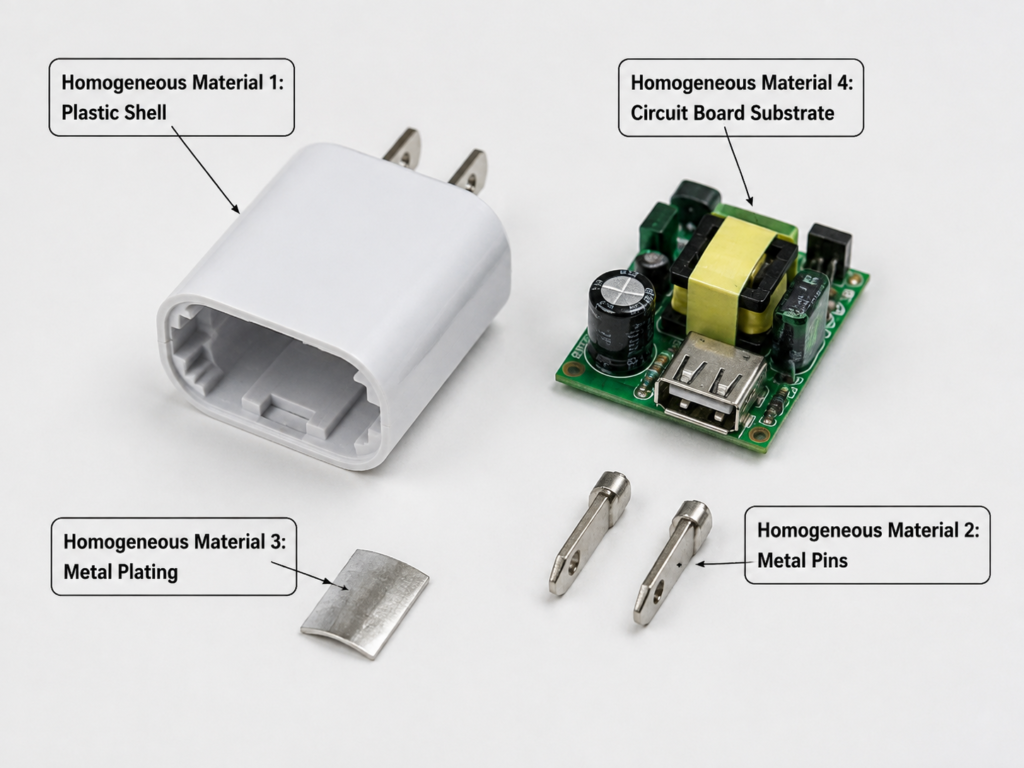
Here is the most core calculation rule: The limit is calculated based on the weight proportion of “homogeneous materials”, not the average of the whole machine. The so-called homogeneous material refers to the smallest single material that cannot be further disassembled, for example, the plastic shell is one type, and the metal plating on the surface of the shell is another; each type must meet the standard independently. For example: a charger has a lead content of 0.2% in its plastic shell and 0.01% in its metal pins. The average of the whole machine may be exactly 0.1%, but the plastic shell alone exceeds the limit, which is still non-compliant.
If the product does not comply with RoHS and other applicable EU regulations, the manufacturer cannot complete the legal conformity assessment and affix the CE marking, nor can it place the product on the market legally; it may be subject to measures such as detention, recall and fines by customs or market supervision authorities, depending on the law enforcement of member states and the circumstances of the violation.
Official Identity and Subordination Relationship of the Two Versions
The official number of RoHS 2 is 2011/65/EU, which is the basic framework directive of the current entire RoHS system, governing core rules such as product scope, responsible parties, and compliance processes.
The industry’s commonly known “RoHS 3”, officially named Commission Delegated Directive (EU) 2015/863, is a special revision of Annex II of RoHS 2, not an independent new directive — its core adjustment is only the list of restricted substances (adding 4 phthalates), with supporting updates to the implementation timeline and related appendices; all core frameworks such as product scope and conformity assessment follow the provisions of RoHS 2.

The currently effective RoHS rules in the EU are “RoHS 2 basic directive + (EU) 2015/863 amendment”. The earliest 2002 version of RoHS 1 has long been abolished and does not need to be considered at all.
Core Reasons for Version Update
RoHS 2 itself has a clear mechanism (Article 6 of the directive): the list of restricted substances shall be regularly evaluated, and the control scope shall be dynamically adjusted in combination with multi-dimensional factors such as hazard evidence, substitution feasibility, and socio-economic impact.
The core background of this revision is that after assessment, the EU believes that the four phthalates (softeners commonly used in plastics) DEHP, DBP, BBP and DIBP have clear health risks, which cannot be covered by the original 6 substances. Therefore, they were included in the restricted list of Annex II through the delegated revision procedure.
By the way, let’s clarify a confusing point: RoHS and REACH are two completely independent EU environmental regulations, with different scopes of application and judgment logic, and legal obligations cannot be directly mutually recognized.
Clarification of Core Basic Cognition
- Misconception 1: RoHS 3 is an independent new directive that completely replaces RoHS 2 (Correct answer: It is a special revision of RoHS 2, and all core frameworks follow the original regulations)
- Misconception 2: There is an officially issued “RoHS 3 certification certificate” (Correct answer: RoHS is a manufacturer’s self-declaration system, there is no unified official certification, and third-party test reports are only voluntary compliance evidence)
2. Prerequisites for Comparison: Unify 3 Benchmarks to Avoid Invalid Judgments
To accurately compare the differences between the two versions, it is necessary to unify three comparison benchmarks first to avoid deviations due to inconsistent premises.
Criterion 1: Only compare non-excluded electrical and electronic products
All the differences we discuss later are only for products and components that are under RoHS control and not within the statutory exclusion scope.
Many people think that as long as they are military products or industrial equipment, RoHS does not apply, but that is not the case. Statutory exclusion categories have strict official definitions, such as military equipment, equipment sent into space, specific large fixed industrial tools, means of transport, non-road mobile machinery, professional R&D equipment, etc. They must fully meet the definitions to be excluded, and cannot be directly applied only by industry name. For example, for the same industrial electronic equipment, small handheld detectors are not within the exclusion scope, while large fixed industrial production line control devices may meet the exclusion conditions.
RoHS divides controlled products into 11 official categories, namely: Category 1 Large Household Appliances, Category 2 Small Household Appliances, Category 3 Information Technology and Telecommunications Equipment, Category 4 Consumer Equipment, Category 5 Lighting Equipment, Category 6 Electrical and Electronic Tools, Category 7 Toys, Leisure and Sports Equipment, Category 8 Medical Devices (including in vitro diagnostic medical devices), Category 9 Monitoring and Control Instruments, Category 10 Vending Machines, Category 11 Other EEE. All timeline rules in the following text are divided according to these categories.
In addition, it should be clear that the 2015/863 amendment did not adjust the product scope of RoHS, and all scope rules were originally set by RoHS 2.
Criterion 2: Based on the “time of first placing on the EU market”
The core time standard for judging compliance is the time when the product is first placed on the EU market, not the production date.
Here we need to distinguish two easily confused concepts and clarify the applicable premises:
- Placing on the market: The manufacturer or importer first provides the product on the EU market, including paid sales and free supply for commercial purposes; customs clearance itself is not the only judgment criterion, the core is whether the product enters the EU supply chain for circulation for the first time.
- Making available on the market: After the product is first legally placed on the EU market, subsequent acts such as distribution, second-hand resale, and free transfer do not need to be re-compliant with the new regulations, but three conditions must be met at the same time: ① The product has been legally placed on the market for the first time before; ② The subsequent transfer is only in the circulation link, and no substantial transformation has occurred; ③ It is not re-placed on the market as a new product. If the product is substantially transformed or upgraded and placed on the market as a new product, or the time of first placing cannot be proved, compliance shall be checked in accordance with the latest applicable requirements.
RoHS has always been implemented in phases according to product categories, not all products take effect on the same day. For specific timelines and corresponding requirements, please refer to the quick decision table later.
Criterion 3: Only compare content with differences
2015/863 is a special revision, and most of the rules have not been changed. Core contents such as the general framework of product scope, basic requirements for CE marking, and division of responsibilities of parties all follow the provisions of RoHS 2. The only real differences between the two versions are in four aspects: list of restricted substances, special exemptions for phthalates, implementation timeline, and requirements for updating compliance documents. The following text only focuses on these parts.
3. Core Difference 1: List of Restricted Substances Changes from 6 to 10 Items
The most critical adjustment in this revision is that the number of restricted substances has changed from 6 to 10, which is the origin of the commonly known “RoHS 10 items”. All limits are calculated based on the weight proportion of homogeneous materials.
Original 6 Restricted Substances in RoHS 2
- Cadmium (Cd): The limit is 0.01% (100ppm), which is the strictest among all substances. It is commonly found in pigments, metal platings, and some electronic contacts. Some batteries or battery-related components may also use cadmium-containing materials, but for battery products placed on the market independently, the main substance restrictions and labeling requirements shall be judged in accordance with EU battery regulations; only when batteries are part of electrical and electronic equipment, they need to be evaluated simultaneously in combination with the applicable scope of RoHS, and RoHS is only one of the many requirements they need to meet.
- Lead, mercury, hexavalent chromium, polybrominated biphenyls (PBB), polybrominated diphenyl ethers (PBDE): The limit for these 5 substances is 0.1% (1000ppm), and they are commonly found in solder, ceramic glazes, fluorescent tubes, and flame-retardant plastics.
4 New Phthalates: Substances, Limits and Risk Assessment
The 4 new phthalates added in 2015/863 are DEHP, DBP, BBP and DIBP, all of which are commonly used softeners in plastics; they were included in the restriction list of Annex II due to relevant hazard assessments, especially reproductive toxicity risks. The unified limit for these 4 substances is also 0.1%, also calculated based on homogeneous materials.
High-risk materials for phthalates have clear targets: soft polymers containing plasticizers, PVC cable sheaths, soft rubber coatings and some sealing materials usually require key verification; whether coatings have risks depends on their formula and homogeneous material composition, and not all coatings are high-risk.
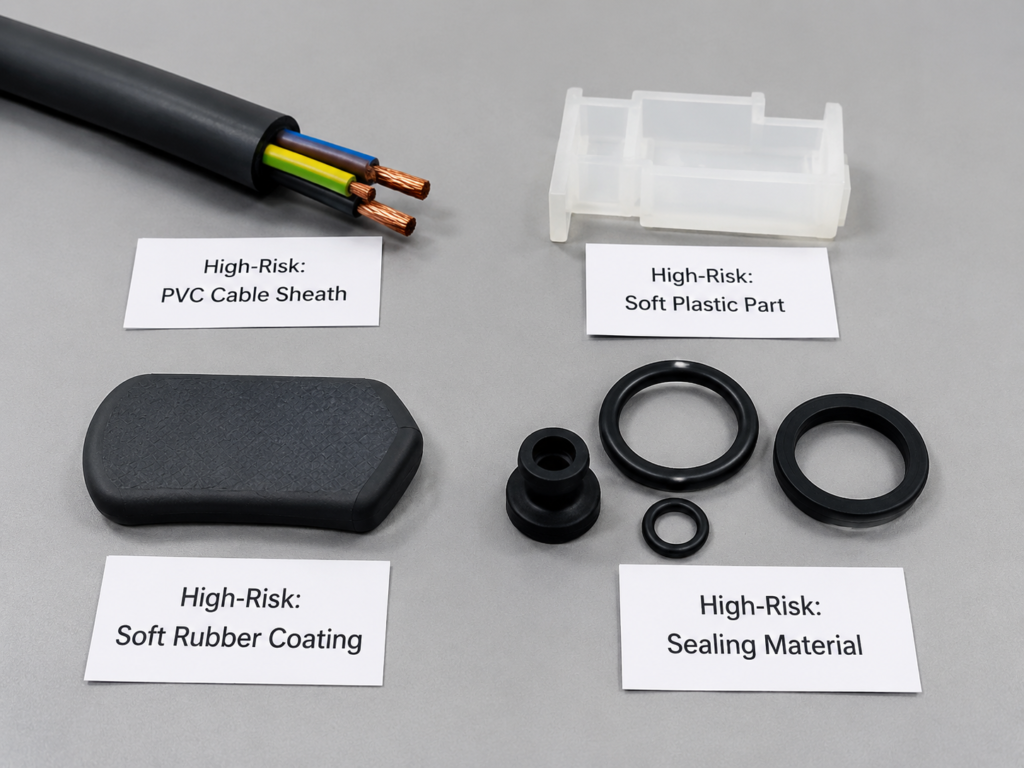
Compliance evidence does not have to rely entirely on testing. It should be based on homogeneous material disassembly, BOM (Bill of Materials) sorting, supplier component declarations, and change control, and be flexibly selected in combination with material risk levels:
- High-risk organic materials (soft plastics, adhesives, cable sheaths, etc.): Prioritize providing third-party test reports or complete supply chain component certificates.
- For inorganic materials such as pure metal and glass that are not coated, do not contain composite structures or adhesives, the risk of phthalates is usually low: regulations do not require testing of each low-risk homogeneous material one by one. Enterprises can verify compliance through material attribute analysis, supplier declarations of conformity, etc. based on risk assessment; however, if the material has coatings, adhesives, composite structures, or uses recycled materials, or the supplier changes, the risk shall be re-evaluated, and supplementary testing shall be carried out if necessary. Enterprises still need to bear the overall compliance responsibility to ensure that all homogeneous materials meet the limit requirements.
Scenarios Where New Phthalates Do Not Change Compliance Conclusions
Not all products will be substantially affected by this revision, but the premise for judgment is to complete the homogeneous material identification and risk assessment of the entire product, and conclusions cannot be drawn directly only by material names:
- After complete material identification and risk assessment, it is confirmed that all homogeneous materials do not contain high-risk phthalate components and are supported by sufficient evidence, the new limits will not trigger the problem of exceeding the limit.
- The materials meet the special exemption clauses for phthalates. It should be particularly clear here: exemption is never an exemption for the entire product, but only for specified substances, specified uses, and specified product categories, and each exemption has an official number and validity period. The specific content in the official annex must be checked, and it cannot be generalized casually.
Do Not Misunderstand the Scope of “RoHS 10 Items”
Finally, let’s clarify a common conceptual confusion:
- RoHS 10 items = original 6 items of RoHS 2 + 4 new phthalates added in 2015/863, nothing more.
- Not all phthalates are within the scope of RoHS control. For example, phthalates such as DINP and DNOP are not on the list.
- The so-called “RoHS 14 items” and “RoHS 20 items” on the market are not official EU requirements, but items independently expanded by testing institutions.
4. Core Difference 2: Adjustments to Implementation Timeline, Exemptions and Compliance Requirements
In addition to the substance list, the two versions also have differences in implementation timeline, exemption rules and compliance requirements, and it is easy to make mistakes if you get them wrong.
Difference in Implementation Timeline: Implemented by Product Category
The difference in the effective time of different product categories is mainly related to the time when products are included in RoHS and the risk level: consumer products, toys and other categories first implement the original 6 items, and then implement the phthalate requirements; the transition period for phthalate requirements for medical and industrial monitoring categories is longer; while Category 11 (Other EEE) was only included in the RoHS scope on July 22, 2019, and must meet all 10 requirements from the date of inclusion, with no separate 6-item transition period.
Let’s emphasize again the point that is easy to get wrong: the 2021 deadline for Category 8 (medical devices including in vitro diagnostics) and Category 9 (monitoring and control instruments) only applies to the 4 new phthalates. The 6 requirements for these two types of products were already implemented as early as 2014. Do not mistakenly think that RoHS control over medical and monitoring control equipment only started in 2021.
For the specific time nodes of each category, you can directly refer to the quick decision table in the practical operation section later.
Difference in Exemption Rules: Only New Special Exemptions for Phthalates Added
There are very few adjustments to the exemption rules:
- The 2015/863 amendment itself did not adjust the exemption list for the original 6 substances, and all follow the provisions when RoHS 2 was issued.
- The 4 new phthalates have special exemptions, but the number is very small, only covering a small number of specific industrial/medical materials (such as specific high-temperature rubber).
Exemptions are not static. The European Commission will regularly update the exemption list through other delegated directives based on new scientific research evidence. Each time an exemption is applied, the corresponding substance, use, product category, official exemption number and current validity period must be checked, and the list of a certain version cannot be directly applied.
Difference in Compliance Requirements: The Entire System Needs to Be Updated, Not Just Adding a Report
This revision is not just about adding a phthalate test report; the entire compliance system must be updated simultaneously:
First, clarify the responsibilities of each party, which is completely consistent with the provisions of RoHS 2: the manufacturer is the first responsible party, responsible for conformity assessment, preparing technical documentation, issuing the EU Declaration of Conformity, and affixing the CE marking; the importer shall verify the manufacturer’s compliance documents to ensure that the products meet the requirements and keep records; the authorized representative may be entrusted to undertake part of the obligations; the distributor shall ensure that the products sold have compliant markings and cooperate with supervision.
The rules for conformity assessment have also not changed: it is still the manufacturer’s self-declaration, there is no official unified “RoHS certification certificate”, and third-party test reports are only voluntary compliance evidence.
There are 3 main contents that need to be updated after the revision:
- Full update of technical documentation: Including BOM list, homogeneous material list, supplier declarations, test reports, etc. It is not allowed to only add a phthalate test report.
- Update of Declaration of Conformity (DoC): At least it should clearly reference the RoHS 2 basic directive (2011/65/EU) and its Annex II amendment, namely Commission Delegated Directive (EU) 2015/863; if the product is also subject to other EU regulations such as EMC, Low Voltage, Radio Equipment, etc., they should also be listed together.
- CE marking requirements: CE is a marking shared by multiple regulations. It can only be affixed after meeting the conformity assessment of all applicable EU regulations (Low Voltage, EMC, RoHS, etc.). It is not an exclusive marking for RoHS, nor can it replace technical documentation and compliance evidence — when supervising inspections, what they look at is the complete technical documents, not just whether there is a label.
5. Practical Judgment: 4 Steps to Determine the Applicable RoHS Requirements for Products
After talking about so many differences, you may still not know what requirements your product needs to meet. You can judge it clearly by following 4 steps.
4-Step Judgment Process
- Step 1: Confirm whether the product is an electrical and electronic equipment/component under RoHS control and is not within the statutory exclusion scope. If it meets the exclusion conditions (such as military and aerospace equipment), there is no need to consider RoHS at all.
- Step 2: Confirm the RoHS 11 product category to which the product belongs. The core is to distinguish between consumer, medical, monitoring and control categories, and whether it belongs to Category 11 (Other EEE). These categories have different effective times.
- Step 3: Confirm the time when the product is first placed on the EU market, whether it is before or after the effective date of phthalates for the corresponding category.
- Step 4: Compare with the implementation time of the corresponding category, and combine material risks and exemption clauses to judge whether it is necessary to meet the new phthalate requirements.
Examples of Applicability of Common Products
Here are a few common examples for reference:
- Mobile phones, laptops, small household appliances: usually classified into Category 3 and Category 2. Those placed on the EU market after July 22, 2019 need to meet the RoHS 10-item requirements.
- Electric toys, leisure and sports electronic equipment: usually classified into Category 7. Those placed on the EU market after July 22, 2019 need to meet the RoHS 10-item requirements.
- Vending machines: usually classified into Category 10. Those placed on the EU market after July 22, 2019 need to meet the RoHS 10-item requirements.
- Medical B-ultrasound machines: usually classified into Category 8. Those placed on the EU market after July 22, 2021 need to meet the RoHS 10-item requirements.
- Industrial automation control cabinets: only when their main function is to monitor or control industrial processes and meet the definition of Category 9, they are classified into Category 9. Those placed on the EU market after July 22, 2021 need to meet the RoHS 10-item requirements; they cannot be directly classified only by product name or industry use.
- Small electronic accessories not classified into the first 10 categories (Category 11): only those placed on the EU market after July 22, 2019 need to meet the 10-item requirements, and before that they were not within the scope of RoHS control.
- Military communication equipment, aerospace electronic components: those that meet the statutory exclusion definition do not need to comply with RoHS.
Note: The category determination of complex products needs to be confirmed in combination with the main function and official classification guidelines, and cannot be directly judged only based on the product name.
3 Most Easily Misapplied Boundaries
There are several boundaries that are particularly easy to confuse, so let’s talk about them separately:
- Boundary between components and maintenance spare parts:
- Products placed on the market independently as independent electrical and electronic products, cables or components (such as separately sold power cords, connectors): the corresponding RoHS requirements apply according to their own product category and first placement time.
- Spare parts for maintenance or upgrade of equipment that has been legally circulated in the EU: need to be judged in combination with the first placement time of the equipment and the purpose of the spare parts, and usually the requirements at the time of the first placement of the equipment can be applied; however, there are special spare parts transition rules for medical devices, in vitro diagnostic medical devices, and monitoring and control instruments, which need to be confirmed by checking official clauses, and general conditions cannot be applied in a general way.
- Components only used for the manufacturer’s internal production and not directly sold to the outside world: do not directly trigger RoHS obligations for placing on the market, but the final finished product still needs to meet the corresponding requirements.
- Boundary of second-hand products: Second-hand products that have been legally circulated in the EU are resold without needing to re-comply with the new regulations; second-hand electrical and electronic products imported from abroad for the first time must comply with the latest requirements.
- Toys with electronic functions: For example, electric toy cars need to comply with both RoHS and the Toy Safety Directive. The phthalate requirements and scopes of application of the two are different, cannot be mutually recognized, and must be met separately.
Quick Decision Table for Phthalate Requirements
To facilitate quick judgment, we have compiled a decision table, which you can check against:
| Product Category | Time of First Placing on the EU Market | RoHS Substance Requirements to Comply With |
|---|---|---|
| Categories 1-7, 10 | January 2, 2013 ~ July 21, 2019 | Only original 6 items |
| Categories 1-7, 10 | July 22, 2019 and after | 10 items (6 items + 4 phthalates) |
| Categories 8, 9 | January 2, 2014 ~ July 21, 2021 | Only original 6 items |
| Categories 8, 9 | July 22, 2021 and after | 10 items (6 items + 4 phthalates) |
| Category 11 | Before July 22, 2019 | Not within RoHS control scope |
| Category 11 | July 22, 2019 and after | 10 items (6 items + 4 phthalates) |
| Statutorily excluded products | Any time | No need to comply with RoHS |
6. Pitfall Avoidance Guide: Compliance Operation Minefields and Boundaries of Easily Confused Regulations
Knowing how to judge, you also need to avoid some common pitfalls, which many veteran sellers who have been doing business for several years are also prone to step into.
Compliance Operation Minefields
- Only test the whole machine without testing homogeneous materials. Correct answer: The limit is calculated based on homogeneous materials. The average qualification of the whole machine does not mean that a single material is qualified, and supervision is judged based on homogeneous materials.
- Old RoHS reports are always valid. Correct answer: There is no unified statutory validity period for reports. To determine whether they can be used, 4 points need to be checked: ① Whether they cover all 10 substances (if the product needs to meet the 10-item requirements); ② Whether the product model, materials, and suppliers are consistent with the current ones; ③ Whether the testing methods and evidence chain meet the requirements; ④ Technical documentation and supply chain declarations are traceable.
- Use CE marking as RoHS compliance proof. Correct answer: CE is a marking shared by multiple regulations and cannot replace RoHS technical documentation and conformity evidence. Supervision and inspection depend on substantive documents.
- High-risk materials only rely on supplier declarations without verification. Correct answer: High-risk materials such as soft plastics and cable sheaths need to be supported by testing or complete component certificates, and cannot only rely on oral or simple declarations.
Boundaries of Easily Confused Regulations: Substance Requirements Cannot Be Directly Mutually Recognized
Many people confuse the substance requirements of RoHS with those of other regulations. The core principle is: different EU environmental regulations have different control objects, substance lists, limits, and application logic, and legal obligations cannot replace each other; but the same supplier declaration or test data can be used as auxiliary evidence for the technical documentation of multiple sets of regulations when they meet the scope and method requirements.
- REACH Regulation: REACH mainly regulates substances, mixtures, articles under specific conditions and supply chain obligations, while RoHS targets specific restricted substances in electrical and electronic equipment. The two have different lists, limits and liability triggering conditions. REACH compliance documents cannot automatically replace RoHS conformity, but qualified material data can assist RoHS risk assessment.
- Toy Safety Directive: Only applicable to toy products, with stricter phthalate limits and different coverage. Toys with electronics need to meet the requirements of both sets of regulations at the same time.
- Battery Regulation: Battery products placed on the market independently need to separately meet the requirements of the current EU battery regulation such as substance limits, labeling, and extended producer responsibility; for electrical and electronic equipment with built-in batteries, the RoHS obligations of the equipment itself and the battery regulation obligations of the battery need to be evaluated separately, and the two cannot replace each other.
- POPs Regulation: Targeting persistent organic pollutants, it may set limits on some substances (such as polybrominated diphenyl ethers, etc.) at the same time as RoHS, but the scope of application, limits, and exemption rules are different. Compliance requirements need to be checked separately and cannot replace each other.
Reminders for Time Judgment Pitfalls
- Do not misjudge the product category: For example, treating industrial monitoring and control equipment as consumer electronics, or misclassifying vending machines into other categories, will lead to incorrect application of the effective time. If you are not sure, check the official product category guide.
- Do not misuse the time benchmark: Production date ≠ time of first placing on the market. The core is the time when the product first enters the EU supply chain for circulation.
- Do not confuse “placing on the market” and “making available on the market”: For products that have been legally placed on the EU market before the effective date of the phthalate requirements, subsequent “making available on the market” acts such as distribution and resale usually do not need to be re-compliant due to the entry into force of the new regulations; but if the product is placed on the market for the first time after the effective date, it must meet the 10-item requirements applicable at that time.
7. Compliance Materials and Authoritative Information References
Requirements for Preparation of Compliance Materials
Corresponding compliance materials need to be prepared according to the first placement time of the product, its category and the applicability of exemptions:
- Scenarios applicable to the 6-substance requirement: Only for products that historically met the first placement time and product category requirements and have been legally circulated, or scenarios that meet valid exemption clauses, you can prepare 6 hazardous substance conformity certificates, complete technical documentation, EU Declaration of Conformity, and CE marking on the premise of meeting all applicable regulations.
- Scenarios applicable to the 10-substance requirement: For Category 1-7, 10, 11 products first placed on the market after July 22, 2019, and Category 8, 9 products first placed on the market after July 22, 2021, you need to prepare 10 hazardous substance conformity certificates, updated full set of technical documentation, EU Declaration of Conformity clearly referencing RoHS 2 and the (EU) 2015/863 amendment, and CE marking on the premise of meeting all applicable regulations.
Authoritative Information Query Channels (by Priority)
If you need to check the latest official information, prioritize these channels:
- EU EUR-Lex: The official EU legal database, where all official documents of directive texts, amendments, and exemption updates are located, the most authoritative.
- European Commission RoHS Official Page: There are official guides, policy interpretations, and frequently asked questions, which are much easier to understand than the legal text.
- Guides from market supervision authorities of each member state: There may be slight differences in implementation details among different member states. Check the guide of the country where you mainly sell products.
- EU ECHA official website: There are some compliance tools for auxiliary reference, but they cannot replace the official RoHS exemption list, and the final decision shall be based on the documents of the European Commission.
RoHS 2 and the commonly known RoHS 3 are not two independent sets of regulations, but a relationship between a basic framework and a special revision. The core change is only the addition of 4 phthalate restricted substances, and most of the other rules follow the existing framework of RoHS 2. When judging product compliance requirements, you only need to grasp the three core dimensions of “product category and exclusion scope”, “time of first placing on the EU market”, and “homogeneous material limit” to quickly sort out the applicable rules. In case of uncertain special situations, it is recommended to prioritize checking the latest official documents or consulting professional compliance institutions to ensure that products meet the access requirements of the EU market.