
Sellers who export charging products to the EU have most likely heard suppliers say “our products comply with RoHS”, but if you ask further whether it is RoHS 2 or RoHS 3, many people will be vague — either they themselves don’t understand it clearly, or they want to muddle through the 10-substance requirement with a 6-substance test report. Don’t underestimate the difference between these two versions; choosing the wrong one will at best waste money on useless testing, and at worst lead to goods being detained during customs clearance, causing even greater losses.
First, Understand the Basics: What Exactly is RoHS
Let’s first cover the basics for those who are new to this: RoHS is an EU regulation on the control of hazardous substances in electrical and electronic equipment, whose core is to restrict the content of toxic and harmful substances in products, so as to reduce harm to the environment and human health after the products are discarded.
Many people think RoHS 2 and RoHS 3 are two separate new regulations, but that is not the case at all. RoHS 2 is the core main directive of the EU, with the official number 2011/65/EU, officially implemented in 2013, and it is the foundation of the entire RoHS framework. The commonly mentioned “RoHS 3” is just a common name in the industry; its official identity is the amendment (EU) 2015/863 — it is not a separate new regulation, but just a “patch” to RoHS 2 that adds 4 controlled substances. When we say “comply with EU RoHS requirements” nowadays, it by default refers to complying with the requirements of the RoHS 2 main directive plus this 2015 amendment, which is commonly known as the RoHS 3 standard.
Since RoHS 3 is a patch to RoHS 2, why do we need to make a special distinction? Because there are still a large number of products and test reports on the market that only comply with RoHS 2 (i.e., the 6-substance requirement). If your product needs to meet the latest EU requirements, you will definitely not pass customs clearance with a 6-substance report, which is equivalent to wasting money on testing and delaying the delivery schedule.
There are also many vague names on the market, such as “old version RoHS” and “new version RoHS”, which have no official legal effect. The default correspondence in the supply chain is: “6-substance RoHS” refers to the original requirements of RoHS 2, and “10-substance RoHS” refers to RoHS 3 with the amendment added. For a reliable judgment, don’t listen to common names; look at three core pieces of information: the number of restricted substances, the referenced regulation number, and the applicable market.
Unify the Premise Before Comparison: Avoid Misapplying Rules
Before formally comparing the differences between the two versions, let’s first unify the basic rules for comparison; otherwise, talking about differences without considering the applicable scenarios will be inaccurate.
For all comparisons in this article, the default applicable regions are EU member states plus Norway, Iceland, and Liechtenstein in the European Economic Area (EEA); the default products compared are ordinary consumer-grade charging products, such as common products like mobile phone chargers, USB-C charging cables, and power bank accessories. Special categories such as military equipment, medical equipment, and industrial monitoring equipment are not included in this default comparison scope because they have exclusive exemptions.
In addition, it should be noted in advance: if your product belongs to the medical/monitoring category, was launched within the transition period, is a supporting spare part/cable for old equipment, or is sold in the UK (which has an independent UK RoHS system after Brexit), the rules will be adjusted, and you should not directly apply the general conclusions below.
Comparison of Core Control Requirements: The Essential Difference Between 6 and 10 Substances
The core difference between the two versions lies in the types of controlled hazardous substances and the corresponding requirements. We first organize the core differences into a table for quick comparison:
| Comparison Item | RoHS 2 (6 substances) | RoHS 3 (10 substances) |
| Number of controlled substances | 6 types (4 heavy metals + 2 flame retardants) | 10 types (original 6 + 4 plasticizers) |
| Calculation basis | Per homogeneous material unit | Consistent with RoHS 2 |
| Limits for the original 6 substances | Cadmium: 100 ppm; the other 5 types: 1000 ppm each | Consistent with RoHS 2 |
| Limits for newly added plasticizers | None | 1000 ppm each for the 4 types |
| Exemptions for ordinary consumer products | According to RoHS 2 general exemptions | No new exemptions |
Specific Differences in Controlled Substances
The original control list of RoHS 2 includes 6 substances, namely lead, mercury, cadmium, hexavalent chromium, polybrominated biphenyls (PBBs), and polybrominated diphenyl ethers (PBDEs) — the first four are heavy metals, and the last two are flame retardants commonly used in the electronics industry, all of which are known toxic and harmful substances. The 4 new substances added in RoHS 3 are phthalates, commonly known as plasticizers. These substances are often added to plastics and rubber to make the materials softer and more flexible, and long-term exposure may pose health risks. After adding them, the total number of controlled substances is 10.
Unified Logic of Limit Rules
Whether it is RoHS 2 or RoHS 3, the calculation basis for limits is the same: calculated per homogeneous material unit. Here is an explanation of what a homogeneous material is: it is the smallest unit that a product can be disassembled into, with completely uniform material. For example, the PVC sheath of a charging cable is one homogeneous unit, the copper wire inside is another, and the plastic core of the connector is yet another. You cannot mix the entire cable together to test the average content.

In terms of specific values, among the original 6 substances, cadmium has the strictest limit of 0.01% (that is, 100 ppm, ppm means parts per million), and the remaining 5 types (lead, mercury, hexavalent chromium, PBBs, PBDEs) all have a limit of 0.1% (1000 ppm). Each substance is calculated separately and not accumulated. The 4 newly added plasticizers also have a limit of 0.1% (1000 ppm) each, which is also calculated separately.
Differences in Exemption Clauses
Many people ask whether RoHS 3 has new exemptions. The answer is: ordinary consumer-grade charging products basically cannot use them. RoHS 3 fully inherits all existing exemption clauses of RoHS 2, and the newly added exemptions are only for medical equipment and industrial monitoring equipment. Ordinary charging heads and charging cables are not within the scope of exemptions, and all applicable requirements must be met.
Comparison of Testing Requirements: The Most Prone-to-Mistake Link
With 4 more controlled substances, the corresponding testing requirements are naturally different. This is also a link where many suppliers tend to cut corners, so you must pay special attention to it.
Sample Disassembly Requirements
The basic principles of disassembly for the two versions are the same: both require the product to be disassembled into homogeneous material units before testing, and the entire product must never be tested directly — otherwise, even if a small component exceeds the limit, it will be diluted by other qualified materials and cannot be detected.
The difference between the two is that RoHS 3 requires additional disassembly of all organic materials, that is, carbon-containing materials such as plastics, rubber, inks, and adhesives, specifically for testing plasticizers. The workload of disassembly is much larger than that of RoHS 2.
Differences in Testing Methods
For the original 6 substances, the testing methods of the two versions are exactly the same. For example, heavy metals can be quickly screened by X-ray fluorescence (XRF) or accurately detected by chemical analysis, and flame retardants are detected by gas chromatography-mass spectrometry (GC-MS).
But the 4 newly added plasticizers must be tested accurately with specialized laboratory chemical testing methods. Here we need to specifically mention a common pitfall:
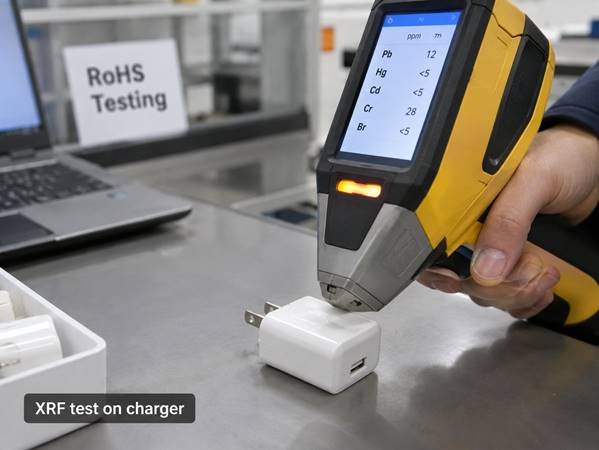
many suppliers will show the scan results of a handheld XRF detector and say “we comply with RoHS 3”, which is completely unreliable — XRF can only detect elements, and plasticizers are organic compounds, which XRF cannot detect at all. So if someone claims RoHS 3 compliance but only gives you an XRF report, just reject it directly.
Result Judgment Rules
The logic of result judgment is the same for both versions: as long as one controlled substance in one homogeneous material exceeds the limit, the entire product is unqualified, and the average content of the whole product is not considered. The only difference is that RoHS 3 requires checking the limits of 10 substances at the same time, with 4 more assessment items.
Key Points for Test Report Verification
RoHS 2 test reports can absolutely not replace RoHS 3 reports, because they lack the test data of 4 plasticizers.
When you get a RoHS report, to quickly judge which version it is, focus on three points:
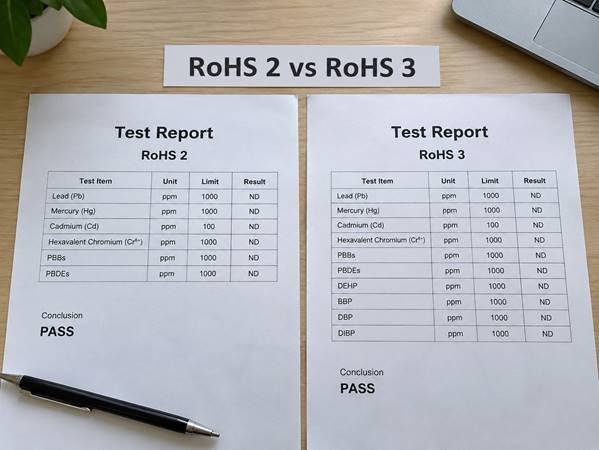
first, the number of test items — 6 items means RoHS 2, and 10 items means RoHS 3; second, whether the unit and value of the limits are correct, for example, whether cadmium is 100 ppm; third, whether the sample model and material on the report are completely consistent with the product you want to purchase, and don’t accept reports from other models as a substitute.
Comparison of Compliance Rules: Common Misconceptions About CE and Labeling
In addition to testing requirements, there are also some differences in the compliance process between the two versions, especially regarding the connection with CE certification, which many people tend to confuse.
Applicable Product Scope
Many people think RoHS 3 has expanded the product scope, but that is not the case — the applicable product scope of the two versions is exactly the same. All products belonging to the electrical and electronic equipment category, including separately sold charging accessories (such as separately sold charging cables and chargers), are within the control scope.
Implementation Time and Transition Period
The official implementation date of RoHS 2 is July 13, 2013. From that date, all electrical and electronic products exported to the EU must comply with the requirements of RoHS 2.
For the 4 new plasticizer requirements added in RoHS 3, the implementation date for ordinary consumer electronics is July 22, 2019 — that is to say, all ordinary charging products sold in the EU market after July 22, 2019 must meet the 10-substance requirement; the implementation date for medical and industrial monitoring products is two years later, on July 22, 2021.
There is also a special rule here: if it is a supporting spare part for old equipment or a historical stock product, the applicable version is determined according to the time when it was first placed on the EU market. For example, stock charging cables produced in 2018 and already entering the EU market before 2019 do not need to re-comply with RoHS 3 requirements, but if they are newly placed on the market after July 2019, they must comply.
Connection with CE Certification
This is also one of the biggest differences between RoHS 2 and the earlier RoHS 1. RoHS 2 incorporated RoHS into the CE certification system for the first time, which means that products must bear the CE mark, complete the conformity assessment, issue the EU Declaration of Conformity (DoC), and keep complete technical documentation.
RoHS 3 continues this CE requirement, and there is no need to redo the entire set of CE certification, but the DoC document needs to be updated to reference the (EU) 2015/863 amendment, and at the same time, compliance evidence for the 10 substances, such as the newly added plasticizer test report, must be added to the technical documentation.
Product Labeling Perception
Many people think RoHS 3 has a special official mark, such as printing a “RoHS 3” logo on the product, but there is actually no such thing at all. The official EU RoHS compliance mark is the CE mark plus the WEEE crossed-out wheeled bin mark. Apart from this, there are no official dedicated marks for “RoHS 2” or “RoHS 3”. If you see a self-defined RoHS 3 mark printed on a supplier’s product, don’t believe it directly; you must check the underlying test report and technical documentation to avoid it being self-proclaimed.
Exclusive Compliance Guide for Charging Products
After talking about the general differences, let’s talk about some practical operation methods for charging products, after all, different categories have different high-risk points and judgment logic.
Corresponding High-Risk Components
Knowing which parts are prone to exceeding the limit allows you to focus on them during inspection:
• High-risk components in the RoHS 2 stage: solder (prone to containing lead), metal plating (prone to containing hexavalent chromium), flame retardants in PCB boards and electronic components (PBBs, PBDEs).
• New high-risk components in RoHS 3: PVC or TPE sheath of charging cables, soft rubber parts of plugs, plastic cores of USB connectors, printing ink on the shell of charging heads, and adhesives for fixing components — these are all high-incidence areas where plasticizers are prone to exceeding the limit.
Quick Judgment Method for Applicable Version
Many people don’t know which version to use for compliance when they get a charging product. In fact, it’s very simple, just judge according to these four steps:
1. Check the shipment time: All ordinary charging products exported to the EU after July 22, 2019 must comply with RoHS 3, no need to hesitate;
2. Check the product category: If it is an ordinary consumer-grade charging product, such as a mobile phone charger, laptop charging cable, or car charger, there are no special exemptions, and all must comply with RoHS 3;
3. Check the sales region: If it is sold to the EU or EEA countries, follow the EU rules; if it is sold to the UK, you need to separately confirm the UK RoHS requirements. Although the content is similar to EU RoHS, it is an independent system, and EU reports cannot be used directly;
4. Check customer requirements: Some brand customers may have required suppliers to comply with RoHS 3 in advance before 2019, and in this case, just follow the customer’s requirements.
Key Points for Verifying Supplier Compliance Documents
When asking suppliers for compliance documents, don’t just say “give me the RoHS report”, as it is easy to get a 6-substance report to muddle through. You should check according to these key points:
First, ask clearly whether it is 6 substances or 10 substances. Don’t believe vague statements like “comply with RoHS”; it must be clearly 10 substances to be RoHS 3;
Second, check the regulations referenced in the report. It must include both the 2011/65/EU main directive and the (EU) 2015/863 amendment. Only with both can it be considered complete RoHS 3 compliance;
Third, verify the product model, material version, and production batch on the report. They must be completely consistent with the product you want to purchase. Reports with changed materials, changed suppliers, or changed batches cannot be used;
Fourth, check the issuing entity, date, and liability statement of the report. It must be issued by a qualified laboratory and be traceable to the corresponding batch. Reports that are randomly edited or have no issuing entity are directly invalid.
Reference for Testing Cost and Cycle
The testing cost of RoHS 3 is 30%-50% higher than that of RoHS 2, and the testing cycle is also longer — because many of the original 6 substances can be quickly screened by XRF, while the newly added plasticizers must be sent to the laboratory for chemical testing, which takes several days. So if you need to do RoHS 3 testing, reserve time and budget in advance.
Common Misconceptions to Avoid
Finally, we have sorted out several of the most common RoHS version misconceptions, which many people who have been in foreign trade for several years have fallen into. You can compare them to avoid pitfalls:
1. Don’t think RoHS 3 is a brand-new regulation that replaces RoHS 2: It is only an amendment to RoHS 2. The core rules are still those of RoHS 2, with only 4 new controlled substances added. There is no question of one replacing the other.
2. Don’t think compliance is achieved as long as the average content of the whole product meets the standard: The product must be disassembled into the smallest homogeneous material units, and every substance in every unit must not exceed the limit. Even if only the plasticizer in a small plastic core exceeds the limit, the entire product is unqualified.
3. Don’t think passing an XRF scan means complying with RoHS 3: XRF cannot detect organic compounds, that is, it cannot detect plasticizers. RoHS 3 requires a special chemical test report for plasticizers, and XRF results alone are completely invalid.
4. Don’t think a product with the CE mark must comply with RoHS 3: CE is a self-declaration system. Manufacturers can affix the CE mark as long as they declare compliance themselves. However, whether tests have been conducted and whether the technical documentation is complete need to be verified. You cannot default to compliance just by looking at the CE mark.
5. Don’t think charging products with all-metal shells don’t need RoHS 3: Even if the shell is all-metal, the PCB board, adhesives, printing ink, connector plastic cores, etc. inside are still organic materials and may still contain plasticizers. Unless the product has no organic materials at all (which is almost impossible for charging products), it must comply with RoHS 3.
6. Don’t think RoHS reports are valid for a long time: RoHS reports are only valid for the samples tested at that time and the corresponding production batches. As long as the raw material supplier is changed, the product formula is modified, or the production batch is changed, the compliance needs to be re-evaluated. You cannot use one report for several years.
Overall, the relationship between RoHS 2 and RoHS 3 is more like that between a basic version and an upgrade patch — the core rules remain unchanged, with only 4 more plasticizer control requirements added. For sellers who export ordinary consumer-grade charging products to the EU, compliance basically needs to be done in accordance with RoHS 3 (i.e., 10 substances) requirements now. As long as you remember that the core difference is 4 plasticizers, testing cannot rely only on XRF, and reports need to be checked for 10 items and regulation numbers, you can avoid most pitfalls. Next time you encounter a supplier saying “comply with RoHS”, you can also accurately ask key questions and won’t be fooled by vague statements.