
Comparison of Processing Cycles for PSE and KC Certification
Sellers who export products such as charging cables and chargers to Japan and South Korea often ask one of the most common questions: “Which is faster, obtaining PSE or KC certification?” Many people immediately request a cycle comparison table, but they often overlook the most core premise: not all charging products fall under the mandatory regulatory scope of PSE or KC. Even if products are both called “chargers” or “charging cables”, different certification paths can lead to cycles that differ by several times.
This article will start with basic judgment and thoroughly explain the cycle comparison between PSE and KC — not only providing reference cycles under a unified caliber, but also telling you which factors cause cycle fluctuations, how to avoid pitfalls and speed up the process, and how to schedule the start time backward from the launch date. After reading it, you will be able to judge the cycle independently and avoid common traps.
First Things First: Determine Product Regulation First, Then Compare Cycles
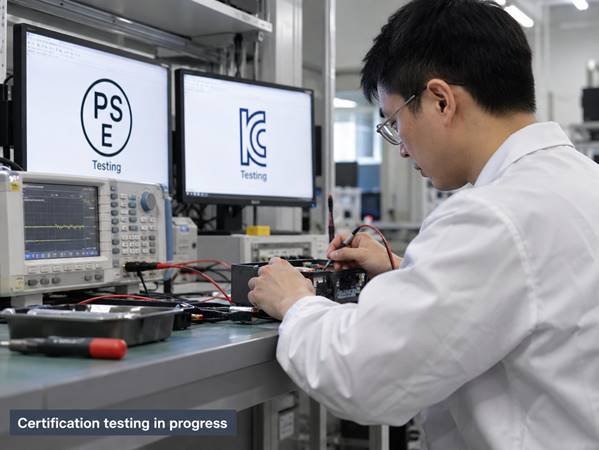
Many people ask service providers about the cycle and receive vastly different answers: some say it can be completed in 4 weeks, while others say it takes 3 months. Essentially, this is because the product’s regulatory path has not been confirmed first — that is, whether your product needs this certification at all, and which type of certification it requires.
Why Can’t We Directly Compare Cycles?
There are three core reasons:
First, not all charging cables and chargers are within the mandatory regulatory scope of PSE or KC. For example, ordinary passive USB-A to Lightning charging cables may not be mandatory regulated categories in both Japan and South Korea, so naturally there is no “processing cycle” to speak of.
Second, products with the same name may have cycles that differ by several times due to different certification paths. For example, for USB-C chargers, some fall under a low-risk path without factory inspection, while others fall under a high-risk path requiring testing plus factory inspection. The former may be completed in 4 weeks, while the latter takes 3 months, making direct comparison impossible.
Third, the major premise of all cycle comparisons is that the product’s regulatory path has been confirmed in writing through official channels. Cycles calculated based on randomly guessed paths are completely useless.
Quick Initial Screening: Self-Check with Four Questions First
You can first use four questions to conduct an initial screening of your product to determine the general regulatory direction — note that this is only an initial screening. The final classification must be subject to the official catalog and written confirmation from the designated certification body, and you cannot make a decision on your own.
First question: Does the product have mains AC input or an AC plug? For example, a wall charger with prongs has AC input, while an ordinary charging cable with USB ports on both ends does not. AC input or AC plug is one of the initial screening indicators for identifying some power supply products, but it cannot be used alone to judge whether a product is regulated by the PSE or KC safety system; confirmation must still be made based on each country’s official product categories, product structure, rated parameters and applicable definitions.
Second question: Is the product sold independently, or sold bundled with a main unit or adapter? For example, a charging cable sold separately in an e-commerce listing may have different regulatory requirements from the same charging cable included as a free gift with a laptop purchase.
Third question: Is your cable purely passive, or does it have an E-Marker chip, power control module, conversion module or communication module? It should be specially noted here: an E-Marker chip is not a sufficient condition for triggering certification. It is not the case that certification is required simply because the chip is present; the determination must also be combined with the product’s rated voltage and current, as well as its sales form.
Fourth question: Does the product have additional functions such as wireless charging, Bluetooth, or Wi-Fi? Radio transmission functions such as Bluetooth and Wi-Fi usually require simultaneous verification of radio wave regulations; whether wireless charging functions are subject to radio wave regulations or EMC requirements must be separately confirmed based on its working method, frequency band, output and local exemption rules. Energy efficiency requirements also only apply to products included in the corresponding energy efficiency regulations.
After completing these four questions, you can separately verify the corresponding PSE certification path, KC safety certification path, and KC EMC/radio wave requirements.
First Understand What PSE Certification Is
PSE is a mandatory safety compliance system implemented under Japan’s for electrical appliances within the statutory catalog. Whether a product must fulfill PSE obligations must first be confirmed based on the official catalog, rated parameters and product form. Electrical appliances listed in the catalog of the must fulfill corresponding PSE safety compliance obligations to be legally sold in Japan. The core assessment covers electrical safety requirements such as electric shock prevention, fire prevention, and heat resistance, and some categories also involve electromagnetic interference clauses.
The Japanese government officially divides regulated products into two categories according to risk level. The commonly used terms “round PSE” and “diamond PSE” are colloquial names based on the shape of the mark. You must never classify products randomly on your own; classification must be determined based on the official catalog, rated parameters and sales form:
• Non-specified electrical appliances (round PSE): Products with relatively low risk, with slightly looser regulatory requirements.
• Specified electrical appliances (diamond PSE): High-risk categories, with stricter regulation.
If you require official verification of product classification, you can check the electrical appliance catalog of Japan’s Ministry of Economy, Trade and Industry (METI), or request a written classification confirmation from an officially authorized certification body.
Then Understand What KC Certification Is
For products included in the management scope of South Korea’s , KC safety compliance is an important mandatory requirement before market entry; whether it specifically applies to safety certification, safety confirmation declaration, supplier conformity confirmation, or is not applicable, must be confirmed based on official product categories and product attributes. It is one of the safety compliance requirements that products included in South Korea’s safety management scope must fulfill before entering the market. Unlike PSE, South Korea’s electrical safety and EMC/radio wave compliance fall under separate regulations. Whether to handle them simultaneously depends on the product’s functions, import and sales models.
The South Korean government officially divides products into three categories according to risk level. The final classification shall be subject to the mandatory product categories published on the Safety Korea Product Safety Information Portal and the current rules of the Korean Agency for Technology and Standards (KATS); specific certification or testing shall be handled by the corresponding designated institutions, and cannot be determined independently:
• Safety certification: High-risk categories, requiring testing by an authorized body + first factory inspection + certificate issuance, with regular follow-up supervision.
• Safety confirmation declaration: Medium and low-risk categories, only requiring submission of a declaration for record after passing testing, with no mandatory factory inspection.
• Supplier conformity confirmation: Low-risk categories, where enterprises can conduct self-testing or entrust testing, then retain the report and make a self-declaration.
In addition, some KC certification paths require a local South Korean agent or importer as the domestic responsible entity, depending on the product category and application mode. To confirm classification and responsible entities, you can first search the Safety Korea official product category database for preliminary matching, then apply for written classification confirmation from a South Korean designated certification body, and at the same time clarify the responsibilities of the manufacturer, importer, and South Korean domestic agent (such as label marking, complaint handling, post-market compliance); for products with USB-C PD, wireless charging, Bluetooth, or Wi-Fi, additional requirements such as EMC, radio waves, and energy efficiency must also be verified simultaneously.
Unified Premise for Cycle Comparison (Avoid Invalid Comparisons)
To make the comparison meaningful, we first unify the caliber of all comparisons, and all subsequent cycle data are references under this premise:
First, Grouping rules: First confirm the regulatory path according to the official catalog, then divide into two groups for comparison based on “whether third-party mandatory testing + first factory inspection is required”. It is emphasized again here: ordinary passive USB charging cables may not be within the mandatory regulatory scope, and paths or cycles cannot be preset.
Second, Cycle definition: What we refer to is the estimated project planning cycle, not the official statutory time limit. The calculation starts from the day when “materials are complete, samples are submitted as qualified, and the laboratory officially accepts the application”.
Third, Ideal premise: Materials are complete and error-free, samples pass the first test, no rectification is required, it is not the peak export season (September to December each year is the peak season), and the factory cooperates normally.
Fourth, Unified exclusions: High-power custom models above 100W, products with wireless/Bluetooth functions, abnormal factory inspections, policy changes, and cross-border logistics time are temporarily excluded from the basic cycle, and we will separately explain how to superimpose these factors later.
4 Boundary Misconceptions That Beginners Must Avoid
Before formally discussing the cycle, let’s clarify a few of the most common pitfalls to avoid subsequent understanding deviations:
1. PSE ≠ Full compliance in Japan: PSE only corresponds to electrical safety requirements, and does not cover other compliance requirements such as wireless and energy efficiency. Radio transmission functions such as Bluetooth and Wi-Fi usually require simultaneous verification of Japan’s radio wave regulations; whether wireless charging functions are subject to radio wave regulations or EMC requirements must be separately confirmed based on its working method, frequency band, output and local exemption rules. Energy efficiency requirements also only apply to products included in the corresponding energy efficiency regulations.
2. KC safety compliance ≠ Full compliance in South Korea: For products with special functions, in addition to safety certification, additional verification of EMC, radio wave, energy efficiency and other requirements is needed. You cannot assume that everything is fine just because you have the KC safety mark.
3. Existing CB/CE report ≠ Direct certificate conversion: CB or CE reports cannot be directly exchanged for PSE or KC certificates, but they can be used for technical evaluation and difference analysis. Some test items that meet requirements can be cited, which can save a little time, but it is not direct conversion.
4. Same name “charger/cable” ≠ Same certification path: Any change in power, function, sales form, or rated parameter may change the classification and cycle. You cannot directly apply the cycle of other people’s products to your own.
How the Cycle Is Composed: Statutory Process + Commercial Services
Many people think the certification cycle is just the time for laboratory testing, but that is not the case. The complete certification cycle includes statutorily required processes, as well as many commercial service links, the latter of which is often the key factor affecting the cycle.
Statutory Core Process of PSE
Divided according to two types of paths:
• Non-specified electrical appliances (round PSE): After confirming that the product is a non-specified electrical appliance, the manufacturer or importer assuming the obligation shall complete business notification (if applicable), technical standard conformity confirmation and self-inspection record keeping, and affix the round PSE mark as required; this path usually does not generate a third-party product certificate, nor does it require mandatory factory inspection.
• Specified electrical appliances (diamond PSE): Third-party testing is required first, then the authorized body conducts factory production consistency verification. After passing, the Japanese authorized body issues the certificate, with regular post-market supervision thereafter.
Statutory Core Process of KC
Divided according to three types of paths:
• Safety certification path: Testing → first factory inspection → certificate issuance by the body → regular follow-up supervision, which is the category with the strictest requirements and the most processes.
• Safety confirmation declaration path: Testing or obtaining a safety confirmation report → submit the safety confirmation declaration according to law and mark as required, with no mandatory factory inspection.
• Supplier conformity confirmation path: Enterprise self-testing or entrusted testing → complete supplier conformity confirmation, retain test results and mark according to law; if current product category rules require system declaration or registration, it shall be confirmed separately, and the process is the simplest.
In addition, the statutory process of EMC/radio wave compliance can be carried out in parallel with safety testing, without waiting for safety testing to be completed, which can save a lot of time.
Commercial Services That Affect the Cycle (Non-statutory but Very Common)
In addition to statutory processes, many commercial services, although not mandatory, are used by almost all applicants, and will directly affect the cycle:
• Materials category: For example, Japanese/Korean translation, label review, data sorting and correction. If materials are disorganized, the acceptance process alone can be delayed for a long time.
• Testing category: For example, pre-testing before formal testing, expedited scheduling, and parallel execution of multiple test items. These can affect both time and cost.
• Factory inspection category: For example, pre-inspection guidance, auditor coordination. If the factory has no experience, factory inspection is prone to problems that delay progress.
• Docking category: For example, South Korean local agent services, communication and coordination with certification bodies. Especially for cross-border applications, local docking can save a lot of communication costs.
Which Documents Will Delay Progress? Prepare in Advance at Corresponding Nodes
Different documents affect different links, and preparing in advance can save a lot of detours:
• Documents affecting the acceptance link: Product specifications, circuit diagrams, BOM (Bill of Materials), power of attorney, applicant qualification documents. Formal acceptance cannot proceed if any of these are missing.
• Documents affecting the testing link: Certificates of key components (such as plugs, transformers, fuses, etc.), PCB Layout (printed circuit board wiring diagram, when applicable). If key components are not certified, rectification or additional testing is very likely to be required.
• Documents affecting the factory inspection link: Factory quality system documents, key component procurement records, production process documents, past test reports. These are mandatory items checked during factory inspection.
• Check label information at nodes required by the applicable system: Rated nameplate, Japanese/Korean warning texts, PSE/KC mark design drafts, marking of responsible entity information. Whether label drafts need to be submitted, label language and marking items shall be confirmed according to specific product categories, certification paths and applicable regulations; do not generally refer to this item as “label filing” or “label release”.
Under the Same Caliber, What Is the Approximate Cycle of the Two Types of Certification?
All cycle data below are based on domestic officially authorized laboratories, samples passing the first test, complete materials, non-peak season, and normal factory cooperation. They are industry reference values, not official statutory time limits. The final cycle must be subject to the actual scheduling of the accepting body.
Case A: Low-Risk Products Without Mandatory First Factory Inspection
This group only applies to specific products that have been confirmed in writing according to the METI catalog as non-specified electrical appliances and do not involve other parallel mandatory compliance; whether USB cables are regulated by PSE cannot be judged solely by name.
Premise: The regulatory path has been confirmed in writing through official channels, no first factory inspection is required, and there are no additional EMC/radio wave requirements.
Tasks that can be done in parallel: During the testing period, you can simultaneously complete label design and preparation of business notification/declaration materials, without waiting for testing to be completed.
Cycle range:
• PSE (non-specified/round): 4-6 weeks, including compliance evidence sorting and business notification when applicable.
• KC (safety confirmation declaration): 5-7 weeks, including legal declaration and local agent docking when applicable.
• KC (supplier conformity confirmation): The cycle shall be separately confirmed based on test result preparation, conformity confirmation and operation nodes required by current product category rules, and cannot share a fixed filing or certificate issuance cycle with safety confirmation declaration.
Situations likely to trigger delays: Materials require correction, sample testing fails, and body scheduling is tight.
Non-applicable scope: Cables with active circuits, power supply products with AC input, products requiring additional EMC/radio waves.
Case B: AC Power Products Requiring Third-Party Testing + First Factory Inspection
For example, AC/DC adapters (commonly known as wall chargers) that are classified as specified electrical appliances fall into this group.
Premise: The regulatory path has been confirmed in writing through official channels, first factory inspection is required, and there are no additional EMC/radio wave requirements.
Tasks that can be done in parallel: During the testing period, you can simultaneously prepare factory inspection materials, dock with local agents, and complete the first draft of the label to save subsequent time.
Cycle range:
• PSE (specified/diamond): 8-12 weeks, including factory production consistency verification and certificate issuance by the body.
• KC (safety certification): 9-13 weeks, including first factory inspection and certificate issuance by the body.
Situations likely to trigger delays: Testing fails and requires rectification, factory inspection has non-conformities that need to be closed, and body review is backlogged.
Non-applicable scope: High-power custom models, products with wireless/Bluetooth functions, products requiring additional energy efficiency/radio waves.
Additional Item: How Long Does It Take to Handle EMC/Radio Waves Simultaneously?
EMC and radio compliance shall be scheduled separately according to the applicable system, and the total cycle shall be determined by the critical path with safety items; when fully parallel, the total cycle may not increase, but when there is testing, rectification or body scheduling backlog, it may increase significantly. Written scheduling shall be obtained from the corresponding designated testing or registration body.
Reference of Sub-item Cycles for Each Statutory Link
To make it clearer where time is spent, we break down the cycle of each link for your reference:
| Link | PSE (Low Risk Without Factory Inspection) | PSE (AC Power With Factory Inspection) | KC (Safety Confirmation Declaration) | KC (Supplier Conformity Confirmation) | KC (AC Power With Factory Inspection) |
| Material acceptance | Within 1 week (no domestic entity required) | Within 1 week (no domestic entity required) | 1-2 weeks (domestic entity required including agent docking) | Confirmed according to product category rules and material preparation status | 1-2 weeks (domestic entity required including agent docking) |
| Sample testing (safety only) | 2-3 weeks | 4-5 weeks | 3-4 weeks | Confirmed according to product and testing arrangement | 5-6 weeks |
| Factory verification/inspection | No mandatory requirement | 2-3 weeks (including scheduling + on-site) | No mandatory requirement | No mandatory requirement | 2-4 weeks (including scheduling + on-site) |
| Final completion node | No third-party certificate issuance; time for business notification and internal compliance document preparation shall be listed separately from the product certificate process | Within 1 week (requires review by Japanese body) | Complete safety confirmation declaration and marking according to law | Complete supplier conformity confirmation, retain test results and mark according to law; whether system declaration or registration is required shall be confirmed according to product category | 1-2 weeks (requires review by South Korean body) |
Note: If EMC testing is required, an additional 1-2 weeks will be added to the sample testing link, depending on the degree of parallelism.
Don’t Ignore Follow-up: Continuous Compliance and Change Management
Many people think that once certification is obtained, it is a permanent solution. In fact, subsequent continuous compliance and changes will also affect the cycle and cost:
• PSE side: The certificate validity period for specified electrical appliances (diamond PSE) is divided into three tiers: 3 years, 5 years, and 7 years, and re-evaluation is required before expiration; non-specified electrical appliances (round PSE) do not have a unified validity period, but technical documents must be continuously retained to ensure that mass-produced products meet standards and are subject to post-market spot checks at any time.
• KC side: The validity period, change requirements, regular post-market management, and factory inspection frequency of different certification paths must be confirmed according to specific product categories and current rules, and there is no unified renewal rule.
If the product’s specifications or models change (such as changing the appearance, modifying the circuit, or replacing key components), both types of certification require evaluation of the magnitude of the change, which may require supplementary testing or even re-declaration. You cannot sell the product after making random changes on your own.
Under What Circumstances Will “Which Is Faster” Be Reversed?
The above comparison is under ideal conditions, but several core variables will directly change the conclusion of the cycle comparison. It is not always the case that PSE is faster or slower than KC:
1. Change in product regulatory path: For example, if a product was originally assumed to follow a low-risk path without factory inspection, but the official determines it follows a high-risk path with factory inspection, or the number of test items increases, the cycle difference between the two may narrow or even reverse.
2. Difference in reuse of existing reports: The acceptance scope of reports such as CB and CE differs between PSE and KC. If your CB report has more items recognized by PSE, the PSE cycle will be shortened more, and vice versa.
3. Difference in body scheduling: If scheduling for bodies in a certain country is particularly tight, such as around Japan’s Obon Festival or South Korea’s Mid-Autumn Festival, the corresponding certification cycle may be significantly lengthened, and even a situation where “certification with factory inspection is faster than that without factory inspection” may occur.
4. Additional compliance requirements: If a product needs to handle EMC and radio wave certification simultaneously in South Korea but not in Japan, the total KC cycle will be longer than that of PSE.
Why Is the Actual Cycle Different from the Quotation? These Variables Cause Fluctuations
The above are all ideal cycles. In actual processing, many variables will make the cycle longer or shorter. We have sorted them into four categories for you to estimate based on your own situation.
Product-side Variables
• Power/function complexity: Products with high power, multi-port fast charging, and new specifications such as PD3.1 have more test items, so the cycle is naturally longer.
• Function superposition: Products with wireless charging, Bluetooth, or Wi-Fi require additional corresponding compliance handling, which increases the cycle.
• Compliance of key components: If key components such as plugs, transformers, and fuses already have certification from the corresponding country, the probability of rectification during testing is low, and the cycle is more controllable.
• Sales form: Independent sales, bundled with main unit as a gift, sold as accessories — different sales forms may correspond to different regulatory paths, and cycles also differ.
Applicant-side Variables
• Material completeness: If the core documents mentioned above are missing, the acceptance link alone can be delayed for a long time.
• Sample consistency: If the submitted sample is different from the mass-produced version, re-sampling and testing will be required, wasting time.
• Factory cooperation degree: Incomplete factory inspection materials and no dedicated audit contact will extend the factory inspection link.
• Implementation of domestic entity: For product categories requiring a local agent, if the agent is not secured in time, progress will be delayed.
Body-side Variables
• Scheduling situation: September to December each year is the peak export season, scheduling for laboratories and factory inspections will be longer, and the cycle may be 2-4 weeks longer than usual.
• Body qualification: Laboratories that directly hold official authorization are much more efficient than those introduced through intermediaries, avoiding wasted time from back-and-forth message relay.
• Testing parallelism: Conducting multiple test items simultaneously saves time compared to separate applications.
• Commercial service selection: Services such as expedited processing and pre-testing will directly change the length of the cycle.
External Environment Variables
• Policy/standard update: If the target country’s supervision is tightened and standards are revised, the review cycle will become longer, and re-testing may even be required.
• Holiday impact: Chinese Spring Festival, Japan’s Golden Week and Obon Festival, South Korea’s New Year and Mid-Autumn Festival — these holidays will cause bodies to suspend operations, and time shall be postponed accordingly.
• Cross-border logistics: Delays in mailing samples and documents need to be additionally factored in by yourself, which has been excluded from our previous basic cycle estimation.
Don’t Just Look at the Quoted Cycle: Cost and Cycle Are Linked
Many people compare prices with service providers and only look at “how much it costs and how long it takes to get the certificate”, but there are many pitfalls in quotations. Some quotations look cheap with short cycles, but actually hide many traps. Cost and cycle are directly linked and cannot be viewed separately.
Core Composition of Certification Costs (All Linked to Cycle)
Certification costs are mainly composed of four parts, each of which directly affects the cycle:
• Testing fee: Accounts for the highest proportion. The more test items, the longer the cycle, and the higher the cost.
• Factory verification/inspection fee: Paths with factory inspection requirements increase both time and cost.
• Compliance entity service fee: For example, KC’s local agent service fee and translation fee increase both preparation time and cost.
• Rectification and retest fee: This is a hidden cost that delays the cycle and adds expenses. The proportion depends entirely on the product’s pass rate.
Core Relationship Between Cycle and Cost
• Expedited service: You can pay extra fees to shorten the cycle of some processes, but physical testing has a lower limit and cannot be expedited infinitely. For example, a test that originally takes 3 weeks can take at least just over 1 week, and cannot produce results in a day or two.
• First-pass rate: Conducting pre-testing before formal testing can reduce the probability of rectification and reduce additional time and cost. How much can be saved depends on the basic quality of the product.
• Unified application for series products: For multiple models of the same series, select a representative model for full testing, and subsequent models only undergo difference evaluation, which can both shorten the cycle and reduce costs.
Pitfall Avoidance: How to Verify the Cycle and Cost of a Quotation
To avoid low-price routines, after receiving a quotation, be sure to check these five points:
1. Confirm the product regulatory path corresponding to the quotation, and whether it has been verified in writing through official channels. Do not let the service provider quote a low price based on the lowest risk path, only to inform you after payment that your product belongs to a higher risk path requiring additional fees and time.
2. Confirm whether the quotation includes all costs of the statutory process, such as testing fees, certificate issuance/declaration fees, first factory inspection fees, etc., to avoid missing items.
3. Confirm whether commercial service fees are included, such as translation fees, local agent service fees, pre-testing fees, etc., to avoid separate charges later.
4. Confirm how retesting and re-inspection are charged after the first test fails, and how the cycle is calculated.
5. Confirm the cycle boundary of the quotation, whether it includes scheduling, logistics, holidays, and additional compliance items. Do not take exclusions as commitments.
Price Comparison Table Template: A Reliable Quotation Should Include These Items
To facilitate your horizontal comparison of PSE and KC quotations, you can require service providers to list all items according to the following list. Quotations with missing items cannot be directly compared:
| Category | Specific Items |
| Basic information | Currency and taxes, number of applicable models, test standard version |
| Statutory fees | Testing fee, certificate/declaration fee, first factory inspection fee (including travel expenses) |
| Service fees | Local responsible entity (agent/importer) service fee, translation/label design fee |
| Additional fees | EMC/radio compliance fee, retest/re-inspection unit price |
| Validity period and exclusions | Certificate validity period, clearly excluded costs and time (such as logistics fees, rectification fees, expedited fees, holiday postponement) |
It should be specially noted that quotations for the same product vary greatly across different authorized bodies and different factory locations. There is no universal fixed price, and it must be subject to the written quotation of the body.
Practical Operation: Pitfall Avoidance, Speed-up and Scheduling Planning
After explaining the composition and reference of the cycle, finally, we provide some directly applicable practical methods to help you avoid pitfalls and save time.
4 Most Common Cycle Cognitive Misconceptions
First, correct a few of the most common mistakes:
1. Misconception 1: The cycle quoted by the service provider is the final cycle: What the service provider quotes is the estimated cycle under ideal conditions, which does not include fluctuation factors such as rectification, scheduling, and logistics. Be sure to reserve buffer time and do not arrange schedules too tightly.
2. Misconception 2: Certification with factory inspection must be slower than that without factory inspection: Not necessarily. If scheduling for bodies in a certain country is particularly tight, certification without factory inspection may be slower than that with factory inspection due to queue unavailability, so it cannot be absolute.
3. Misconception 3: Normal sample function will not affect the cycle: Normal function is only the most basic requirement. Non-conformity in structure, key components, or labels will trigger rectification and retesting, greatly delaying progress.
4. Misconception 4: Round PSE (non-specified) does not require testing at all: Incorrect. Although round PSE does not require mandatory factory inspection, it needs to be verified according to Japanese standards and compliance evidence must be retained. It is not a matter of simply sticking a label. If non-conformity is found during spot checks, penalties are very serious.
6 Actions That Can Actually Shorten the Cycle
If you want to speed up progress as much as possible, you can start from these aspects:
1. Verify the path in advance: First check the official product category database, and apply for written classification confirmation from an officially authorized body to avoid midway changes and additional items. This is the most core point; if the path is wrong, all subsequent efforts are in vain.
2. Prepare materials in advance: According to the core document list mentioned above, sort out all materials in advance, and translate those requiring translation into Japanese/Korean ahead of time. Do not start looking for them only when acceptance is needed.
3. Pre-test for baseline assessment: Before formally submitting samples, conduct internal pre-testing first to identify safety and EMC problems in advance, reducing the probability of rectification during formal testing.
4. Choose authorized bodies: Directly select laboratories with official PSE/KC authorization to avoid intermediary referrals, which wastes time going back and forth and is prone to errors.
5. Lock the product version: Do not randomly change the circuit, key components, or appearance during the testing process, otherwise re-testing may be required, and previous time will be wasted.
6. Push preparations in parallel: During the testing period, simultaneously prepare factory inspection materials, secure domestic entities, and verify applicable label requirements. Do not start these tasks only after obtaining the certificate, which can save several weeks of time.
The Cycle Is Delayed? Check in This Order
If you find progress is slow during processing, do not wait blindly. Check according to priority from high to low:
Step 1: First confirm whether there are any non-conforming items in the sample test, and whether the rectification plan has been submitted and confirmed by the body — this is the most common cause of delay.
Step 2: Check whether there are any correction requirements for the application materials, and whether you have replied in time — many times the delay occurs because the body requests supplementary materials and the applicant has not noticed.
Step 3: Verify whether the scheduling of factory verification/inspection has been postponed, and whether the factory has prepared the corresponding materials.
Step 4: Confirm whether the certificate-issuing body has a review backlog, and whether additional materials need to be supplemented.
How to Calculate Certification Start Time Backward from the Launch Date
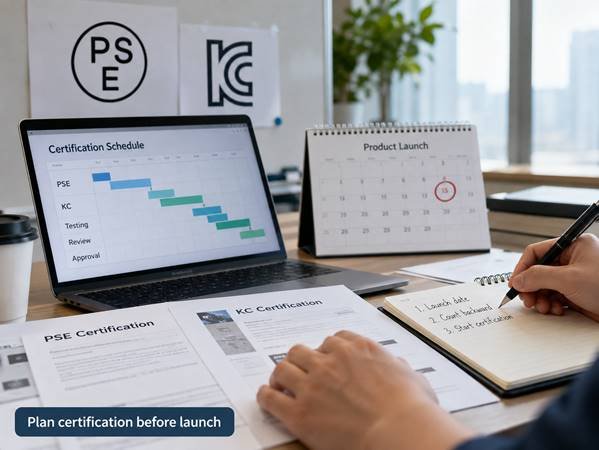
If you have a clear launch date, you can use this method to calculate the certification start time backward to avoid missing the deadline:
1. Calculate the basic cycle: According to the product path that has been confirmed in writing, take the middle value of the corresponding estimated range. For example, for AC power products requiring factory inspection, take 10 weeks for PSE and 11 weeks for KC.
2. Add variable superposition time: According to the variables mentioned above, superimpose known additional time, such as adding 2 weeks for peak season scheduling, and adding 2 weeks for EMC handling.
3. Reserve buffer time: If it is the first time doing certification, or the product complexity is relatively high, it is recommended to reserve about 30% buffer time to cope with sudden rectification and scheduling fluctuations.
4. Calculate the start time: Start time = Target launch date – (Basic cycle + Variable superposition time + Buffer time).
For example: You want to sell a wall charger with wireless charging, which has been confirmed as PSE diamond, KC safety certification + EMC. The basic cycle of KC is longer, so take 11 weeks, add 2 weeks for peak season scheduling, add 2 weeks for EMC, and reserve 30% buffer for the first time. Then the total cycle is (11+2+2) × 1.3 ≈ 19.5 weeks, which is about 5 months. If you want to launch in early December, you have to start certification in early July.
If you are doing certification for multiple markets simultaneously, prioritize starting the one with more test items, and promote the other in parallel to maximize parallel efficiency.
Final Summary
After reading this article, you should have a clear judgment on the cycle comparison between PSE and KC:
You can use the “four-question method” to initially screen whether your charging product is regulated by PSE/KC, and you know to obtain the final classification through the official catalog and written confirmation from authorized bodies, instead of making random judgments on your own; you can distinguish the two core paths of PSE and the three core paths of KC, and understand the difference between statutory processes and commercial services, without thinking that certification is as simple as “a quick test in the laboratory”; under the premise that the path has been confirmed in writing, you can estimate the approximate cycle range of the two types of certification according to the grouping rules, without being confused by messy quotations; you can identify the core variables that affect the cycle, and understand that “which is faster” is not absolute, but depends on specific applicable conditions; you can verify the quotation and cycle of service providers according to a unified caliber, avoiding common low-price traps; you can also calculate the certification start time backward according to the target launch date, reserve a reasonable buffer, and avoid missing the launch plan.
In short, the core premise of all cycle comparisons is “confirm the product regulatory path first”. Discussing cycles without a clear path is useless.