
For those exporting USB-C charging cables, chargers and similar products to the EU, when you first encounter CE compliance, you will most likely come across two completely contradictory statements: some say CE only requires self-testing and signing a declaration; others say you must find a notified body to issue a certificate, which is costly and has a long cycle. Which one is correct? What is the difference in cost and cycle between the two paths? Does your product really need a notified body?
This article focuses on charging products to thoroughly explain the two CE compliance paths: self-declaration and notified body participation. From concepts, regulatory judgment, cost and cycle comparison to decision-making logic and pitfall avoidance points, you will be able to judge which path to choose by yourself after reading.
Core Conclusions First
Let’s put the most critical conclusions first, so that those in a hurry can quickly grasp the key points:
First, there is not only one way for CE compliance; it is divided into two categories: one is called Internal Production Control (commonly known as self-declaration), where the manufacturer completes testing and assessment on its own, signs the EU Declaration of Conformity (EU DoC), and does not need a notified body to issue a certificate; the other is an assessment procedure with the participation of a Notified Body (NB for short), which requires the NB to issue third-party assessment documents.
Second, the path with NB participation usually increases costs and time for NB assessment, possible quality system audits, subsequent supervision or change confirmation, etc. Moreover, even if you engage an NB, the manufacturer still needs to sign the EU DoC in the end and bear primary responsibility.
Third, the vast majority of ordinary charging cables, wired chargers, and wireless chargers without communication functions do not require NB participation, and self-declaration is legal and compliant.
Fourth, whether a product requires NB intervention mainly depends on the conformity assessment modules specified in the applicable regulations. For example, if a product falls within the scope of RED (Radio Equipment Directive) and does not fully adopt the applicable harmonized standards, a procedure with NB participation must be selected; in addition, platforms, major customers, insurance institutions, etc. may also put forward commercial third-party document requirements.
Pre-Judgment of Applicable Regulations for Charging Products
To figure out whether your product needs an NB, you first need to know which EU regulations apply to the product. This is the premise of cost comparison, and it is also the area where unscrupulous service providers are most likely to take advantage.
Four General Judgment Rules
For the regulatory judgment of all charging products, you can first quickly screen according to these four rules:
1. RED Priority Rule: If a product falls within the scope of RED (Radio Equipment Directive) (i.e., it intentionally emits radio waves for functions such as communication and ranging, such as charging devices with Bluetooth or Wi‑Fi), the product’s safety and electromagnetic compatibility (EMC) requirements are uniformly covered by RED, and there is no need to separately apply the LVD (Low Voltage Directive) and EMC Directive, nor to conduct repeated tests.
2. LVD Voltage Threshold: LVD is a directive governing the safety of electrical equipment, but it only covers electrical equipment with AC 50V~1000V and DC 75V~1500V. Products below this voltage range (for example, ordinary USB-C cables generally have an operating voltage of 5V~20V) are not under the jurisdiction of LVD.
3. EMC Benign Exclusion: EMC governs the electromagnetic emission and anti-interference capabilities of equipment. The EMC Directive may not apply only when the equipment does not generate excessive electromagnetic disturbance and does not experience unacceptable performance degradation in the normally expected electromagnetic environment. For products with active chips, you cannot only look at whether there is electromagnetic emission; you must also assess whether their performance may be affected by electromagnetic disturbance.
4. Independent Sales Judgment: Products that are sold separately and can be used independently by end users need to have their compliance status reflected separately in the corresponding technical documentation and EU DoC; products sold together with the main product as accessories can be covered together in the technical documentation and EU DoC of the main product. However, being sold with the main product does not exempt the accessories themselves from applicable material and product compliance obligations.
Compliance Mapping of 5 Common Charging Products
We map the 5 most common types of charging products to the above rules, and you can directly compare them:
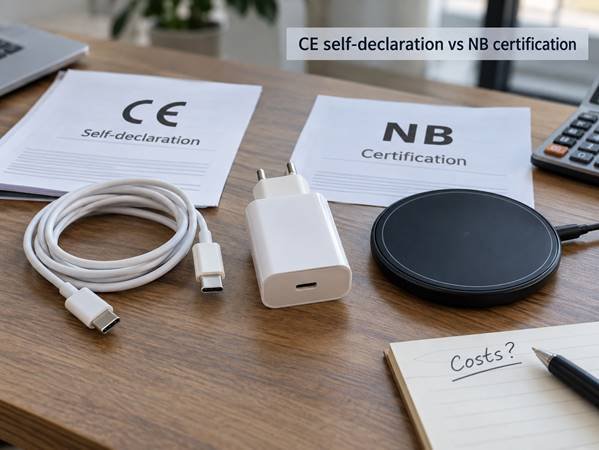
Note: Obligations such as GPSR, WEEE and ecodesign shall be judged separately according to the product and risks. Especially for products subject to EU harmonized legislation, GPSR only applies supplementally to risks or risk categories not covered by that specific legislation. These obligations need to be verified according to applicable conditions regardless of which CE path is taken, but they are not within the scope of the CE conformity assessment comparison, so they will not be elaborated here.
1. Passive USB-C Charging Cable
Purely passive and low-voltage in nature, usually not subject to LVD and EMC; as a cable used to transmit current, it must usually comply with RoHS. Whether sold independently or placed on the market with the main product, there must be RoHS compliance evidence; when sold with the main product, it can be covered together in the technical documentation and EU DoC of the main product, and the CE mark shall be affixed according to applicable rules. There is no statutory NB requirement, and it is optional only when there are commercial requirements.
2. USB-C Cable with E-Marker/Active Chip
With active chips, most still have an operating voltage lower than 75V DC, and are subject to RoHS. The applicability of EMC must be assessed according to its function as a finished device: if it generates electromagnetic disturbance, or its performance may be affected by electromagnetic disturbance, EMC usually applies. It can be claimed that EMC does not apply only when it simultaneously meets the conditions that it does not generate excessive disturbance and does not experience unacceptable performance degradation in the normally expected electromagnetic environment. There is no statutory NB requirement, and it is optional only when there are commercial requirements. If the operating voltage is higher than 75V DC, it is necessary to further judge whether LVD applies.
3. External Wired Charger (No Wireless/Communication Function)
High-voltage input, AC-DC conversion, falls within the LVD voltage range, and is subject to LVD, EMC, and RoHS. If the charger meets the definition of “external power supply (EPS)” in the applicable ecodesign regulations and is not an exclusion item, it must meet the corresponding requirements for efficiency, no-load power consumption, etc.; it cannot be uniformly determined solely as an “external wired charger”. There is no statutory mandatory NB requirement. Failure to adopt harmonized standards only results in the loss of presumption of conformity (i.e., additional proof of compliance is required during regulatory spot checks, which is not illegal).
4. Wireless Charger Without Communication Function
It only transmits electrical energy through induction and has no communication emission, so it does not fall within the scope of RED. It is subject to LVD (judged by input voltage, generally applicable to high-voltage input), EMC, and RoHS. The relevant ecodesign requirements for wireless chargers and wireless charging pads shall be judged in accordance with Commission Regulation (EU) 2025/2052; this regulation shall apply from 14 December 2028. When placing products on the EEA market, the status of its incorporation into the EEA Agreement shall also be verified separately. There is no statutory mandatory NB requirement.
5. Charging Devices with Bluetooth/Wi‑Fi
Intentionally emitting radio waves for communication, falling within the scope of RED, subject to RED, RoHS, and ecodesign (if applicable). Safety and EMC are uniformly covered by RED, and LVD/EMC do not apply separately. When the RED harmonized standards are not fully adopted, Annex III or Annex IV must be selected with NB participation.
4 Dimensions for Quick Self-Check
If your product is not in the above categories, you can quickly judge by yourself according to four dimensions:
• Rated voltage range: judge whether it falls within the jurisdiction of LVD
• Whether there is intentional radio transmission/reception: judge whether it falls within the jurisdiction of RED
• Whether it is placed on the market independently: judge how technical documentation and EU DoC cover the product
• Whether EU harmonized standards are fully adopted: judge whether Internal Production Control is optional under RED
Core Comparison: Dual Matrix of Cost and Cycle
We have sorted out the differences in cost and cycle between the two paths into the table below, which is clear at a glance:
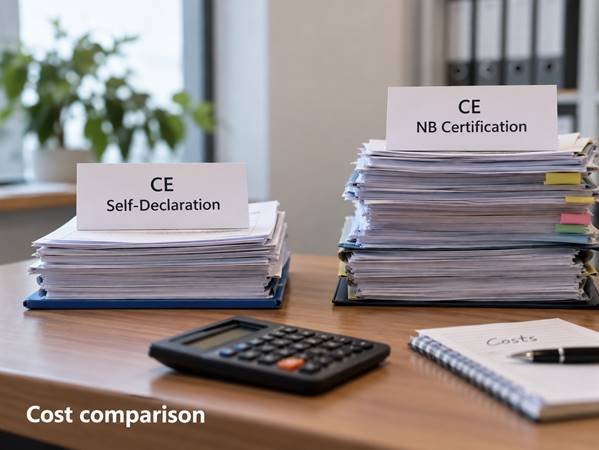
| Comparison Item | Internal Production Control (Self-Declaration) | Notified Body (NB) Participation Path | Core Difference Explanation |
| 【Cost Items】 | |||
| Regulatory Judgment and Ecodesign Screening | Mandatory, fixed fee | Mandatory, fixed fee | No difference |
| Sample Testing Fee | Mandatory, priced according to product complexity | Mandatory, may include NB witnessing or additional review | Relevant fees may increase when NB participates |
| Rectification and Retesting Fee | Triggered when samples are unqualified | Triggered when samples are unqualified | The NB path may also require payment of relevant re-review fees |
| Technical Documentation Compilation Fee | Mandatory, priced according to product complexity | Mandatory, must meet the documentation requirements of the corresponding procedure | The NB path may increase document review and supplementation costs |
| NB Assessment Fee | None | Mandatory (when required by law or commerce) | Annex III is EU type-examination; Annex IV is quality system assessment and supervision |
| NB Quality System Audit Fee | None | Conditionally triggered | Required for modules involving quality system assessment such as Annex IV |
| NB Supervision Audit Fee | None | Conditionally triggered | Under Annex IV, regular supervision audits are conducted by the NB, and the frequency and fees are subject to the procedure and contract |
| Change Assessment Fee | Triggered when product/standard changes | Triggered when product/standard changes | The NB path needs to confirm the compliance of changes according to applicable procedures, and the cost may be higher |
| 【Cycle Items】 | |||
| Laboratory Testing Scheduling + Testing | Mandatory, cycle determined by product complexity | Mandatory, cycle determined by product complexity | No essential difference |
| Rectification and Retesting Cycle | Triggered when samples are unqualified | Triggered when samples are unqualified | The NB path usually requires simultaneous relevant review |
| Technical Documentation Compilation Cycle | Mandatory | Mandatory | No essential difference |
| NB Scheduling and Assessment Cycle | None | Mandatory | Core difference in cycle, affected by NB scheduling and product complexity |
| NB Quality System Audit Cycle | None | Conditionally triggered | Required for modules involving quality system assessment such as Annex IV |
| DoC Signing and Archiving | Can be signed after passing the test | Signed after obtaining the assessment documents required by the NB | The signing time of the NB path is delayed |
Reference for Three Typical Scenarios
The following scenarios are used to illustrate path differences. Actual costs and cycles shall be subject to applicable regulations, service scope and written quotations:
1. Low complexity (passive USB-C cable): Usually there is no statutory NB requirement. If the platform or customer requires third-party documents, you should first confirm whether they require test reports, certification documents, or statutory NB assessment, and cannot directly estimate based on the NB path.
2. Medium complexity (20W wired charger): Usually Internal Production Control can be adopted in accordance with LVD, EMC, RoHS and other requirements. If the customer additionally requires third-party documents, the issuing authority, scope of application, and whether subsequent change services are required for the document should be clarified.
3. Wireless charger with Bluetooth: Whether an NB is required depends on the adoption of harmonized standards for the basic requirements related to RED. Annex II is optional when the applicable harmonized standards are fully adopted; Annex III or Annex IV must be selected when they are not fully adopted, so NB participation is required. It shall not be preset as “requiring Annex III” solely based on product complexity or Bluetooth function.
Reminder again: EU regulations do not stipulate a unified price and cycle for CE testing, NB services or commercial third-party services. Actual costs and cycles are subject to written quotations and contract scope.
Decision Logic for Compliance Path Selection
After talking so much, you may still not know how to choose. Follow the logic below step by step, and you will basically not go wrong.
First Distinguish the Essence of the Two Types of Requirements
• Statutory mandatory requirements: Explicitly required by EU regulations, they are the bottom line for market access and must never be omitted.
• Commercial requirements: Additional requirements put forward by platforms, major customers, etc., which are not legally mandatory, can be selected according to your own sales needs.
Many people waste money because they treat commercial requirements as statutory requirements.
3-Step Quick Decision-Making Method
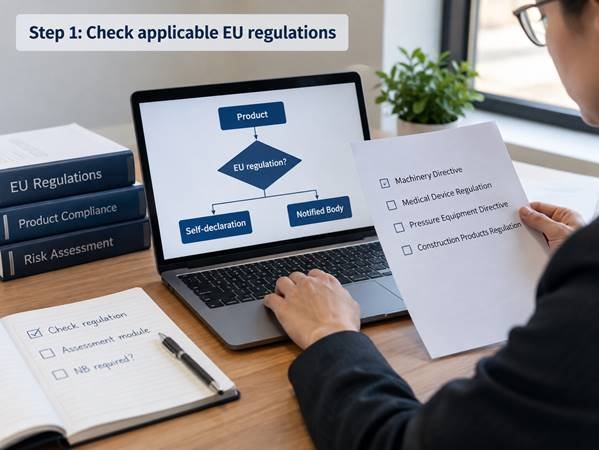
1. Step 1: Judge regulations: First determine the EU regulations applicable to the product, then check whether the corresponding assessment module mandatorily requires NB participation. If the law requires an NB, there is no choice but to do it.
2. Step 2: Judge requirements: If the law does not require an NB, then check whether your own sales channels have commercial requirements, and clarify your core needs.
3. Step 3: Compare cost and cycle: On the premise of ensuring compliance, choose the path with the lowest cost and the most suitable cycle.
Quick Matching of Applicable Scenarios
• Prioritize Internal Production Control: When regulations allow self-declaration, sales channels have no NB requirements, and the budget is limited and rapid listing is required. The vast majority of ordinary charging cables, wired chargers, and wireless chargers without communication fall into this category.
• Must/Recommended to adopt third-party path: If regulations specify NB modules, NB must be used; if it is for commercial access or trust enhancement needs, the specific documents required by the customer, the qualification of the issuing authority, and the scope of application should be confirmed first. Higher product risk itself does not automatically trigger statutory NB obligations.
Hard Boundaries of Phased Strategy
Many people will ask: Can we first do self-declaration for quick listing, and then add NB later if needed? It depends on the situation. Two boundaries must never be crossed:
1. Only products for which Internal Production Control is legally allowed can first be placed on the market with self-declaration, and third-party assessments or documents can be supplemented later according to commercial needs. For example, for ordinary wired chargers, first do self-declaration for listing, and then supplement when major customers require specific third-party documents. Most of the previous test reports and technical documents can be reused, which can save a lot of costs.
2. For products that legally require NB intervention, it is absolutely forbidden to first list them with self-declaration and then supplement the NB. This is a violation. Once found, you will be punished and the products will be detained.
Pitfall Avoidance Guide and Capability Summary
7 Common Compliance Misconceptions
1. Do charging products with Bluetooth/Wi‑Fi definitely need an NB? Wrong. When RED harmonized standards are fully adopted, Annex II Internal Production Control is optional, and no NB is required.
2. Do RED, LVD, and EMC need to be done at the same time? Wrong. For products within the scope of RED, safety and EMC are covered by RED, LVD/EMC do not apply repeatedly, and no repeated testing is required.
3. Do wireless chargers definitely apply to RED? Wrong. For inductive charging products without communication functions, the emission solely for electric energy transmission is not within the jurisdiction of RED.
4. Do USB-C cables with E-Marker definitely apply to LVD? Wrong. Those with an operating voltage lower than 75V DC are not subject to LVD, and the vast majority of cables with E-Marker are below this threshold.
5. Do all NB projects have annual fees? Wrong. The EU type-examination of Annex III does not involve regular quality system supervision audits like Annex IV; Annex IV requires regular supervision audits by the NB, but the supervision frequency and fees are subject to applicable procedures and contracts, not fixed annual fees stipulated by law.
6. Can charging products with the same appearance share all reports? Wrong. They need to be checked item by item according to reuse conditions. Those with different key parameters and internal materials cannot be directly reused, and at least difference testing is required.
7. Do non-EU manufacturers have to find an authorized representative separately? Wrong. Non-EU manufacturers do not necessarily have to hire an authorized representative separately, but for products subject to Article 4 of Regulation (EU) 2019/1020, there must be a responsible economic operator within the EU: EU manufacturer, importer, or authorized representative with written authorization; if none of these entities exist, a qualified EU-based fulfillment service provider can assume the role. Ordinary distributors cannot of course replace this role.
Quick Answers to Common Questions
• Is it necessary to find an NB for CE certification? Most ordinary charging cables and chargers do not need it; it is only required when required by law or commerce.
• How much does CE certification for chargers cost? EU regulations do not stipulate a unified price. Ordinary 20W wired chargers usually adopt Internal Production Control. The specific cost depends on product configuration, applicable standards, test items, whether rectification is required, and service scope; if there are commercial third-party document requirements, their nature and quotation scope should also be confirmed separately.
• Do USB-C cables need CE? Passive USB-C cables are usually not subject to LVD and EMC, but as cables used to transmit current, they must usually comply with RoHS. Whether sold independently or placed on the market with the main product, they should have RoHS compliance evidence; when sold with the main product, they can be covered together in the technical documentation and EU DoC of the main product, and the CE mark shall be affixed according to applicable rules.
• What is the difference between an NB certificate and a DoC? The DoC is a responsibility document signed by the manufacturer, which is required for all CE paths; the NB issues third-party assessment documents, which are only available for paths with NB participation, and are one of the supporting documents for the DoC, not a mandatory requirement.
Core Capability Summary
After reading this article, you should have mastered three core capabilities:
First, you can distinguish the essential differences between CE self-declaration and NB participation paths, understand the cost and cycle composition, and correspond to the actual situation of different charging products.
Second, you can independently select the appropriate compliance path according to the logic of “first judge regulations, then judge requirements, and finally compare costs”, without being led by service providers.
Third, you can identify common compliance pitfalls such as NB qualification verification, report reuse, and hidden fees, to avoid wasting money.
Finally, it should be noted that the content of this article is only for CE compliance in the EU/EEA region. Compliance requirements for UK UKCA and other countries and regions need to be evaluated separately. This article is a popular science guide and does not constitute a compliance judgment opinion for specific products. Actual operations need to be verified in combination with product parameters and the latest regulatory requirements.
CE compliance seems complicated, but in fact, as long as you understand the rules and choose the right path, you can meet the requirements at an appropriate cost and avoid unnecessary waste of money.